


 Скачать презентацию Part One Human Evolution Series Copyright 2005
10177303.ppt
- Количество слайдов: 46
 Part One Human Evolution Series: Copyright © 2005 Version: 2. 0 Set 2
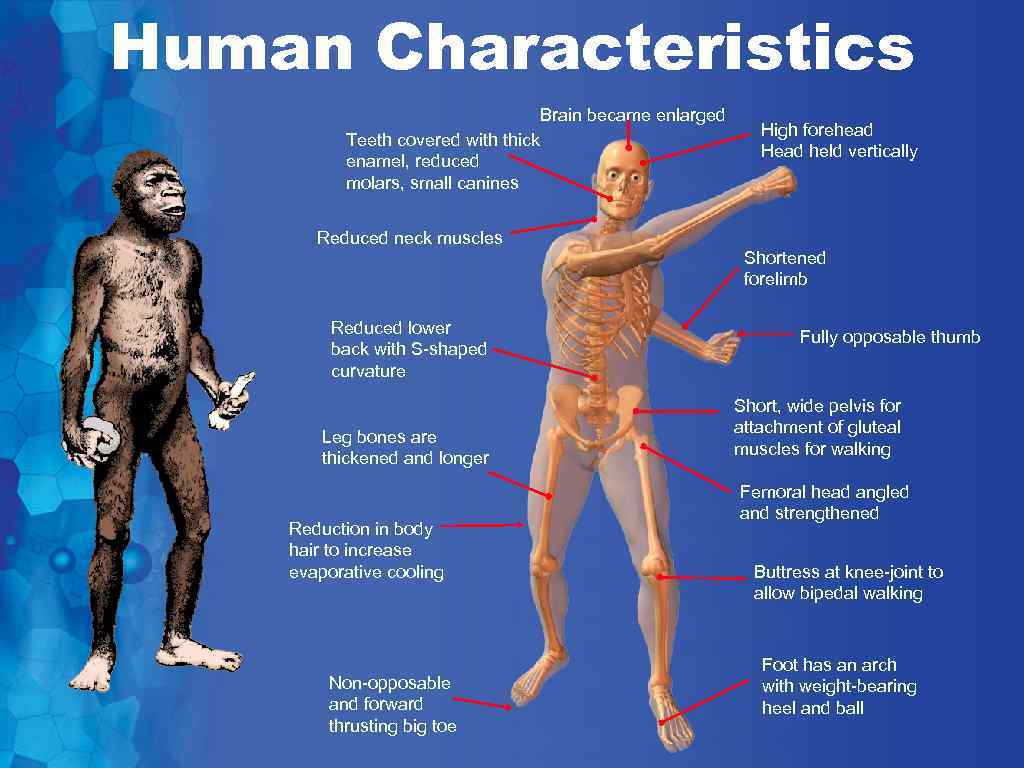 Human Characteristics Brain became enlarged Teeth covered with thick enamel, reduced molars, small canines Reduced neck muscles Reduced lower back with S-shaped curvature Leg bones are thickened and longer Reduction in body hair to increase evaporative cooling Non-opposable and forward thrusting big toe High forehead Head held vertically Shortened forelimb Fully opposable thumb Short, wide pelvis for attachment of gluteal muscles for walking Femoral head angled and strengthened Buttress at knee-joint to allow bipedal walking Foot has an arch with weight-bearing heel and ball
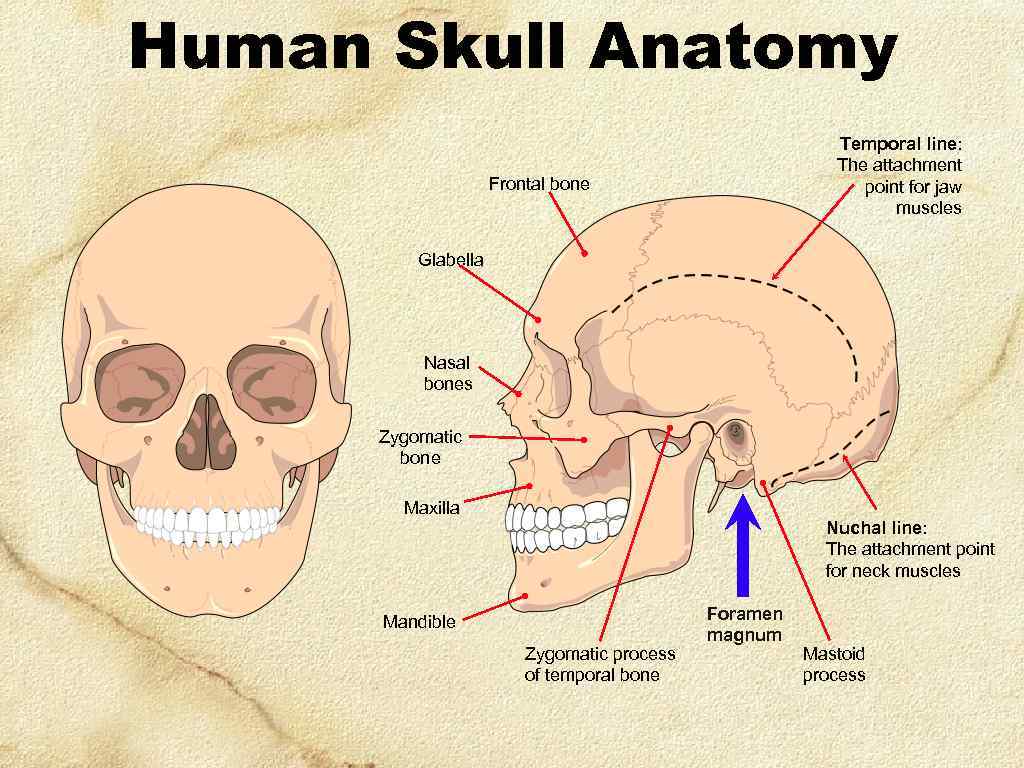 Human Skull Anatomy Temporal line: The attachment point for jaw muscles Frontal bone Glabella Nasal bones Zygomatic bone Maxilla Nuchal line: The attachment point for neck muscles Mandible Zygomatic process of temporal bone Foramen magnum Mastoid process
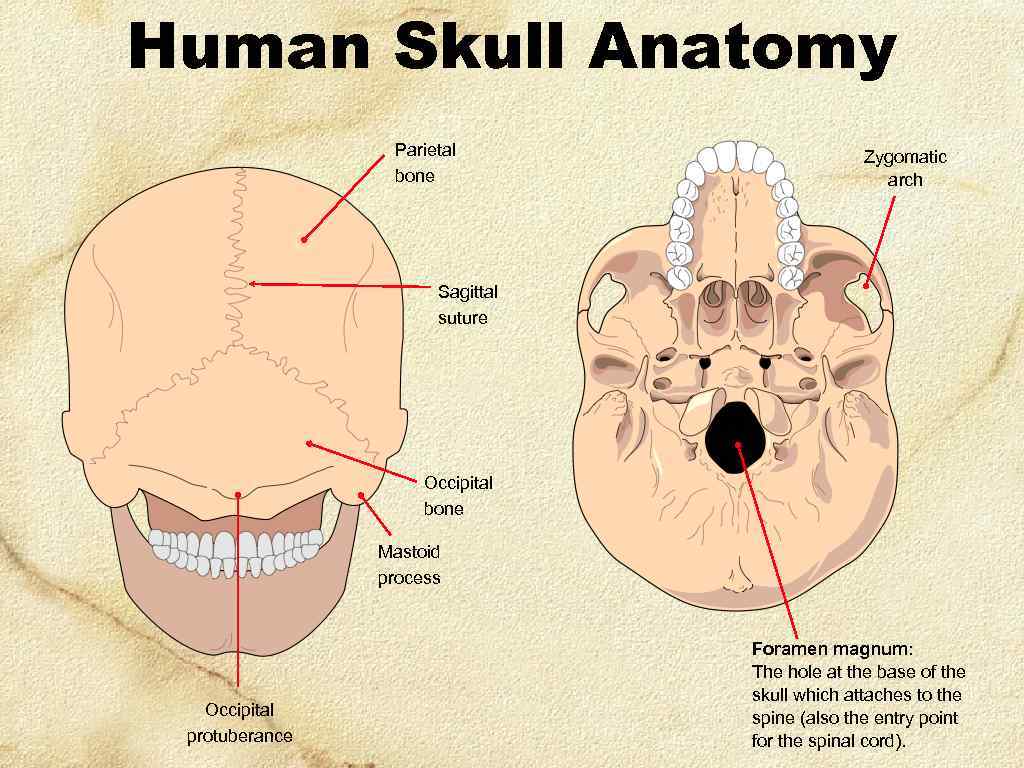 Human Skull Anatomy Parietal bone Zygomatic arch Sagittal suture Occipital bone Mastoid process Occipital protuberance Foramen magnum: The hole at the base of the skull which attaches to the spine (also the entry point for the spinal cord).
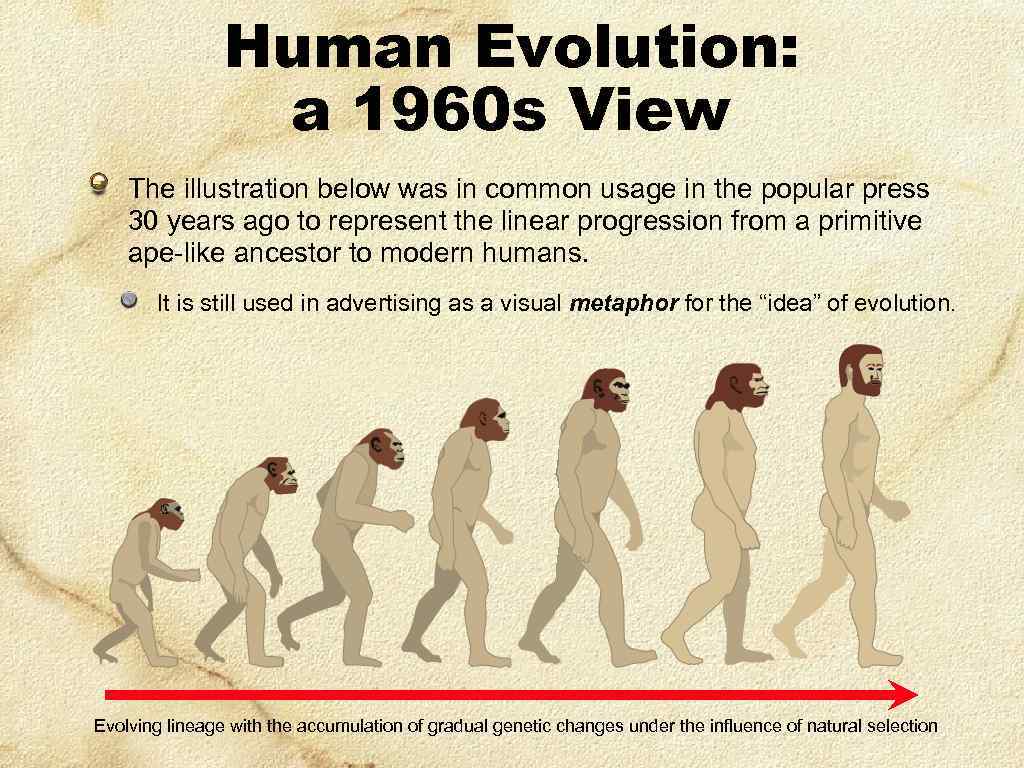 Human Evolution: a 1960 s View The illustration below was in common usage in the popular press 30 years ago to represent the linear progression from a primitive ape-like ancestor to modern humans. It is still used in advertising as a visual metaphor for the “idea” of evolution. Evolving lineage with the accumulation of gradual genetic changes under the influence of natural selection
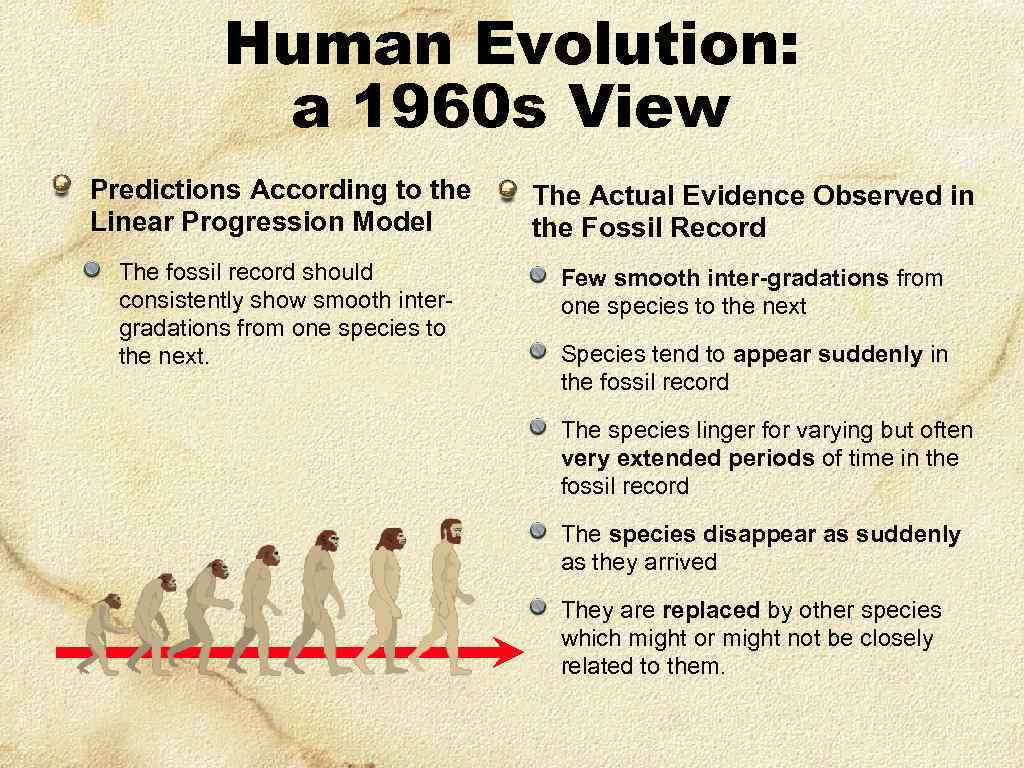 Human Evolution: a 1960 s View Predictions According to the Linear Progression Model The Actual Evidence Observed in the Fossil Record The fossil record should consistently show smooth intergradations from one species to the next. Few smooth inter-gradations from one species to the next Species tend to appear suddenly in the fossil record The species linger for varying but often very extended periods of time in the fossil record The species disappear as suddenly as they arrived They are replaced by other species which might or might not be closely related to them.
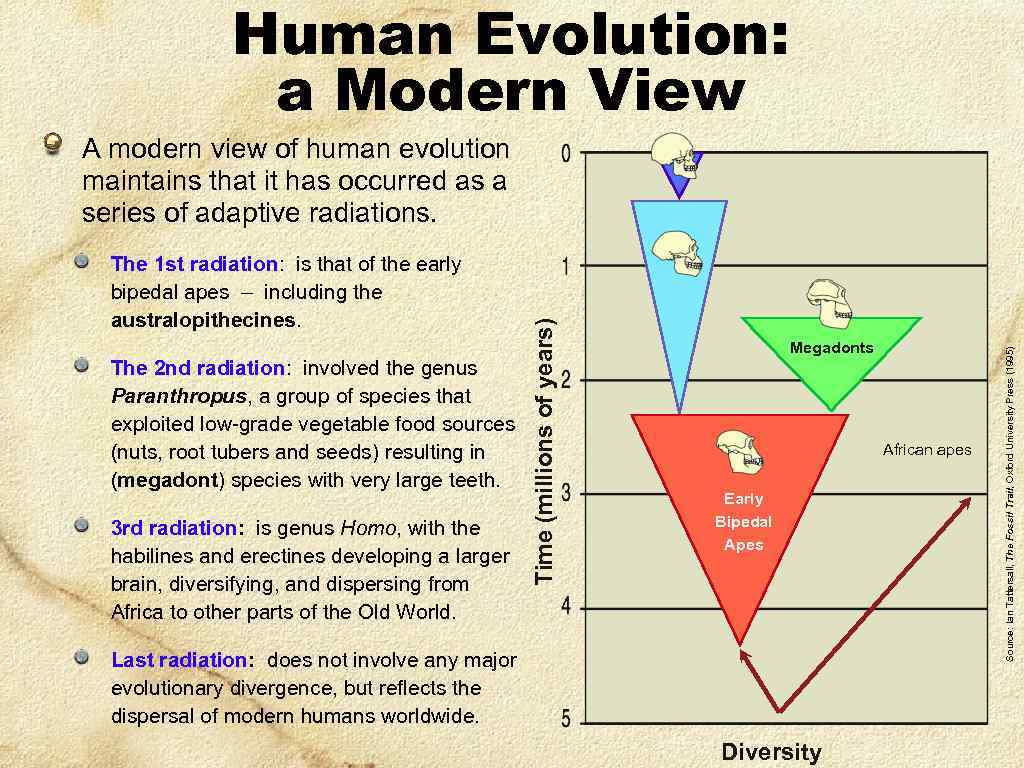 Human Evolution: a Modern View The 2 nd radiation: involved the genus Paranthropus, a group of species that exploited low-grade vegetable food sources (nuts, root tubers and seeds) resulting in (megadont) species with very large teeth. 3 rd radiation: is genus Homo, with the habilines and erectines developing a larger brain, diversifying, and dispersing from Africa to other parts of the Old World. Megadonts African apes Early Bipedal Apes Last radiation: does not involve any major evolutionary divergence, but reflects the dispersal of modern humans worldwide. Diversity Source: Ian Tattersall, The Fossil Trail, Oxford University Press (1995) The 1 st radiation: is that of the early bipedal apes – including the australopithecines. Time (millions of years) A modern view of human evolution maintains that it has occurred as a series of adaptive radiations.
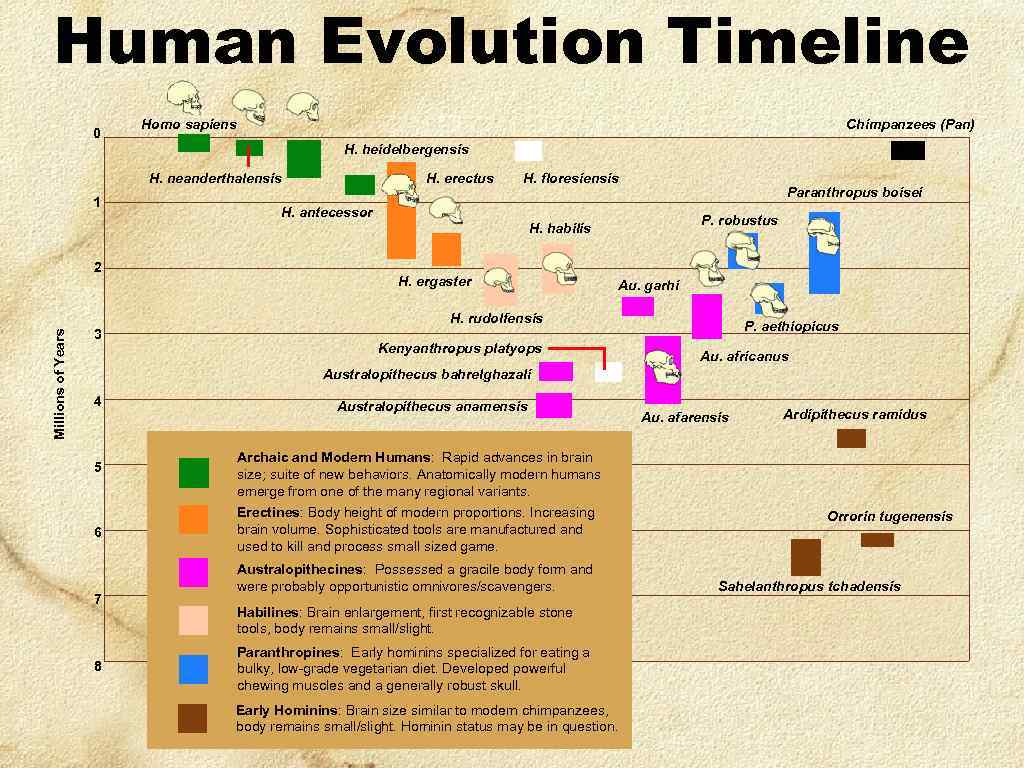 Human Evolution Timeline 0 Homo sapiens Chimpanzees (Pan) H. heidelbergensis H. neanderthalensis 1 H. erectus H. floresiensis Paranthropus boisei H. antecessor P. robustus H. habilis 2 H. ergaster Au. garhi Millions of Years H. rudolfensis 3 Kenyanthropus platyops P. aethiopicus Au. africanus Australopithecus bahrelghazali 4 5 6 7 8 Australopithecus anamensis Archaic and Modern Humans: Rapid advances in brain size; suite of new behaviors. Anatomically modern humans emerge from one of the many regional variants. Erectines: Body height of modern proportions. Increasing brain volume. Sophisticated tools are manufactured and used to kill and process small sized game. Australopithecines: Possessed a gracile body form and were probably opportunistic omnivores/scavengers. Habilines: Brain enlargement, first recognizable stone tools, body remains small/slight. Paranthropines: Early hominins specialized for eating a bulky, low-grade vegetarian diet. Developed powerful chewing muscles and a generally robust skull. Early Hominins: Brain size similar to modern chimpanzees, body remains small/slight. Hominin status may be in question. Au. afarensis Ardipithecus ramidus Orrorin tugenensis Sahelanthropus tchadensis
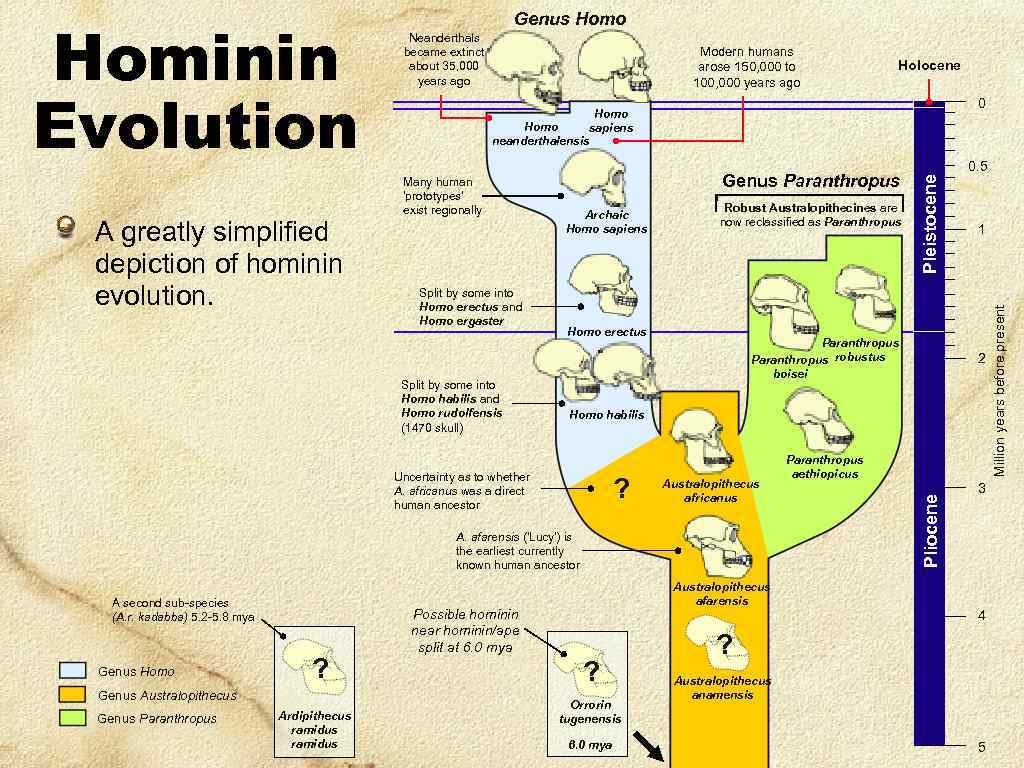 Modern humans arose 150, 000 to 100, 000 years ago 0 Homo sapiens neanderthalensis Split by some into Homo erectus and Homo ergaster Genus Paranthropus Archaic Homo sapiens Robust Australopithecines are now reclassified as Paranthropus Homo erectus Paranthropus robustus boisei ? Australopithecus africanus A. afarensis ('Lucy') is the earliest currently known human ancestor ? Genus Australopithecus Genus Paranthropus Ardipithecus ramidus 1 2 Homo habilis Uncertainty as to whether A. africanus was a direct human ancestor Genus Homo 0. 5 Australopithecus afarensis Possible hominin near hominin/ape split at 6. 0 mya ? Orrorin tugenensis 6. 0 mya Paranthropus aethiopicus 3 4 ? Australopithecus anamensis 5 Million years before present Many human 'prototypes' exist regionally Split by some into Homo habilis and Homo rudolfensis (1470 skull) A second sub-species (A. r. kadabba) 5. 2 -5. 8 mya Holocene Pleistocene A greatly simplified depiction of hominin evolution. Neanderthals became extinct about 35, 000 years ago Pliocene Hominin Evolution Genus Homo
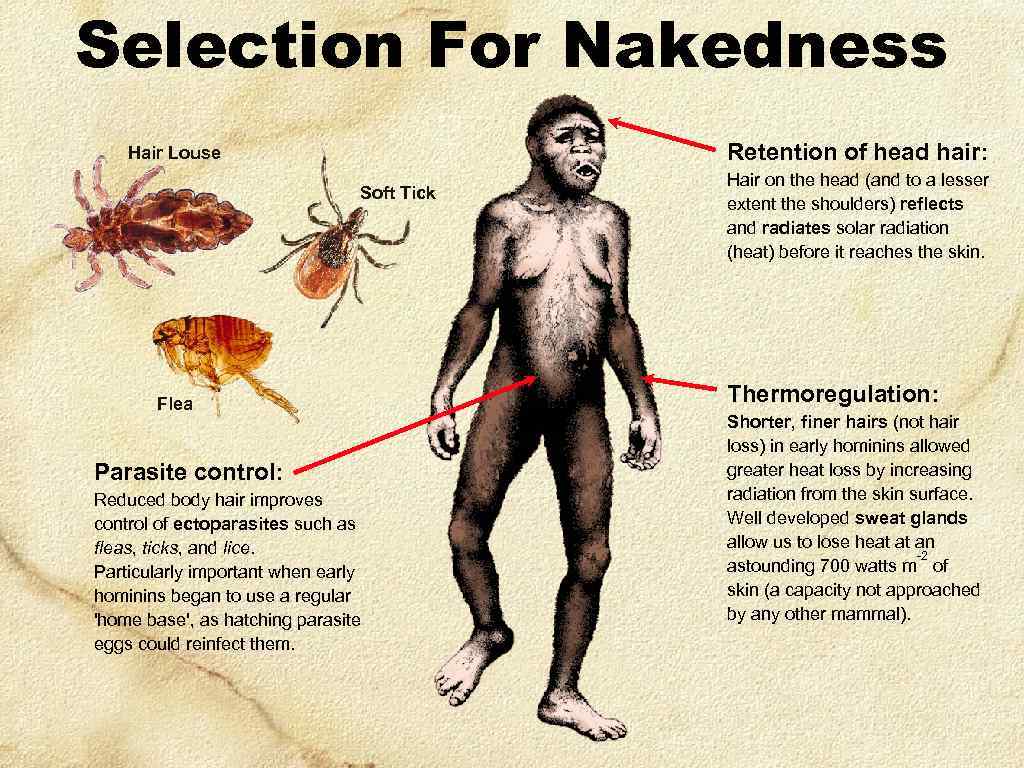 Selection For Nakedness Retention of head hair: Hair Louse Soft Tick Flea Parasite control: Reduced body hair improves control of ectoparasites such as fleas, ticks, and lice. Particularly important when early hominins began to use a regular 'home base', as hatching parasite eggs could reinfect them. Hair on the head (and to a lesser extent the shoulders) reflects and radiates solar radiation (heat) before it reaches the skin. Thermoregulation: Shorter, finer hairs (not hair loss) in early hominins allowed greater heat loss by increasing radiation from the skin surface. Well developed sweat glands allow us to lose heat at an -2 astounding 700 watts m of skin (a capacity not approached by any other mammal).
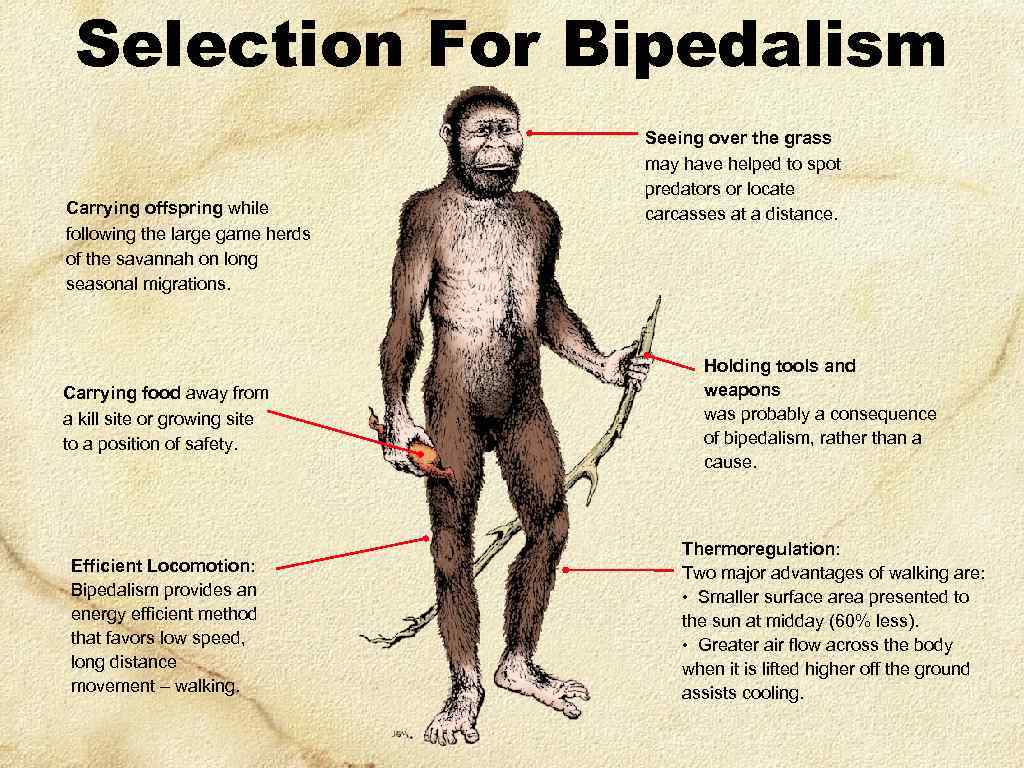 Selection For Bipedalism Carrying offspring while following the large game herds of the savannah on long seasonal migrations. Carrying food away from a kill site or growing site to a position of safety. Efficient Locomotion: Bipedalism provides an energy efficient method that favors low speed, long distance movement – walking. Seeing over the grass may have helped to spot predators or locate carcasses at a distance. Holding tools and weapons was probably a consequence of bipedalism, rather than a cause. Thermoregulation: Two major advantages of walking are: • Smaller surface area presented to the sun at midday (60% less). • Greater air flow across the body when it is lifted higher off the ground assists cooling.
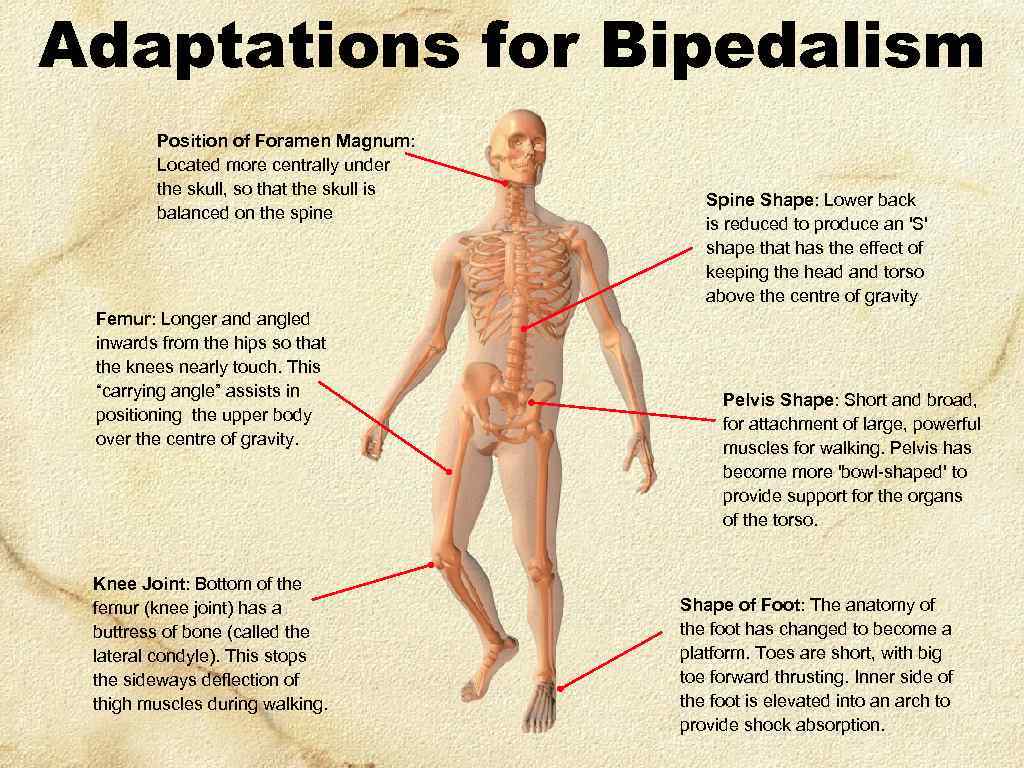 Adaptations for Bipedalism Position of Foramen Magnum: Located more centrally under the skull, so that the skull is balanced on the spine Femur: Longer and angled inwards from the hips so that the knees nearly touch. This “carrying angle” assists in positioning the upper body over the centre of gravity. Knee Joint: Bottom of the femur (knee joint) has a buttress of bone (called the lateral condyle). This stops the sideways deflection of thigh muscles during walking. Spine Shape: Lower back is reduced to produce an 'S' shape that has the effect of keeping the head and torso above the centre of gravity Pelvis Shape: Short and broad, for attachment of large, powerful muscles for walking. Pelvis has become more 'bowl-shaped' to provide support for the organs of the torso. Shape of Foot: The anatomy of the foot has changed to become a platform. Toes are short, with big toe forward thrusting. Inner side of the foot is elevated into an arch to provide shock absorption.
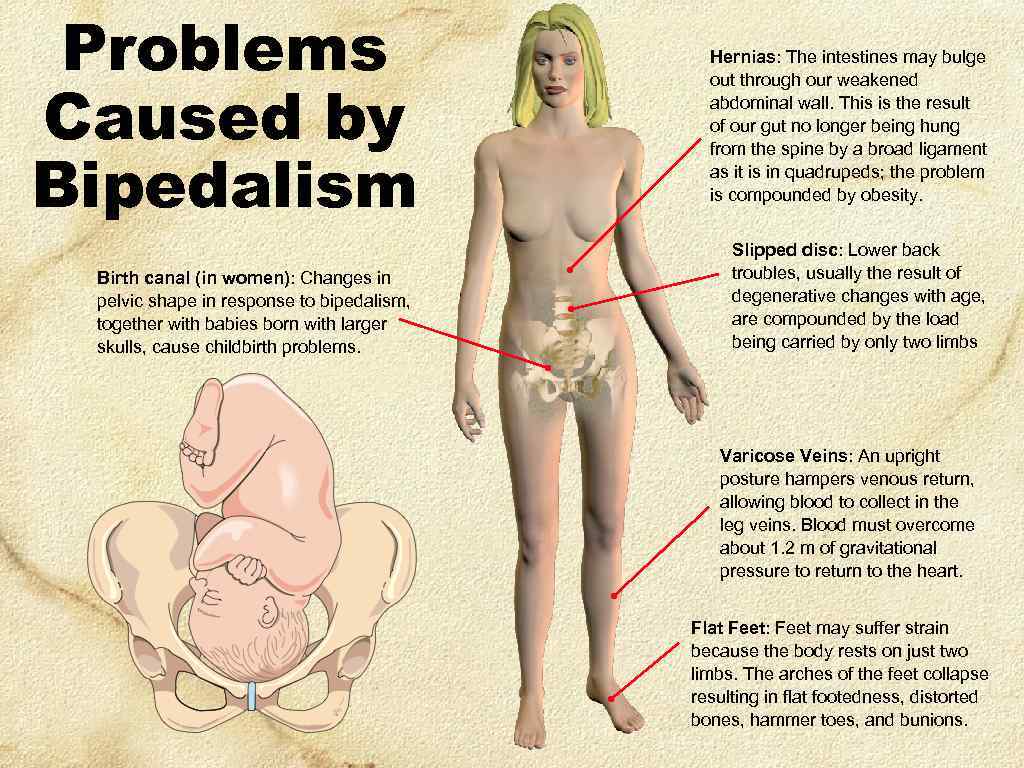 Problems Caused by Bipedalism Birth canal (in women): Changes in pelvic shape in response to bipedalism, together with babies born with larger skulls, cause childbirth problems. Hernias: The intestines may bulge out through our weakened abdominal wall. This is the result of our gut no longer being hung from the spine by a broad ligament as it is in quadrupeds; the problem is compounded by obesity. Slipped disc: Lower back troubles, usually the result of degenerative changes with age, are compounded by the load being carried by only two limbs Varicose Veins: An upright posture hampers venous return, allowing blood to collect in the leg veins. Blood must overcome about 1. 2 m of gravitational pressure to return to the heart. Flat Feet: Feet may suffer strain because the body rests on just two limbs. The arches of the feet collapse resulting in flat footedness, distorted bones, hammer toes, and bunions.
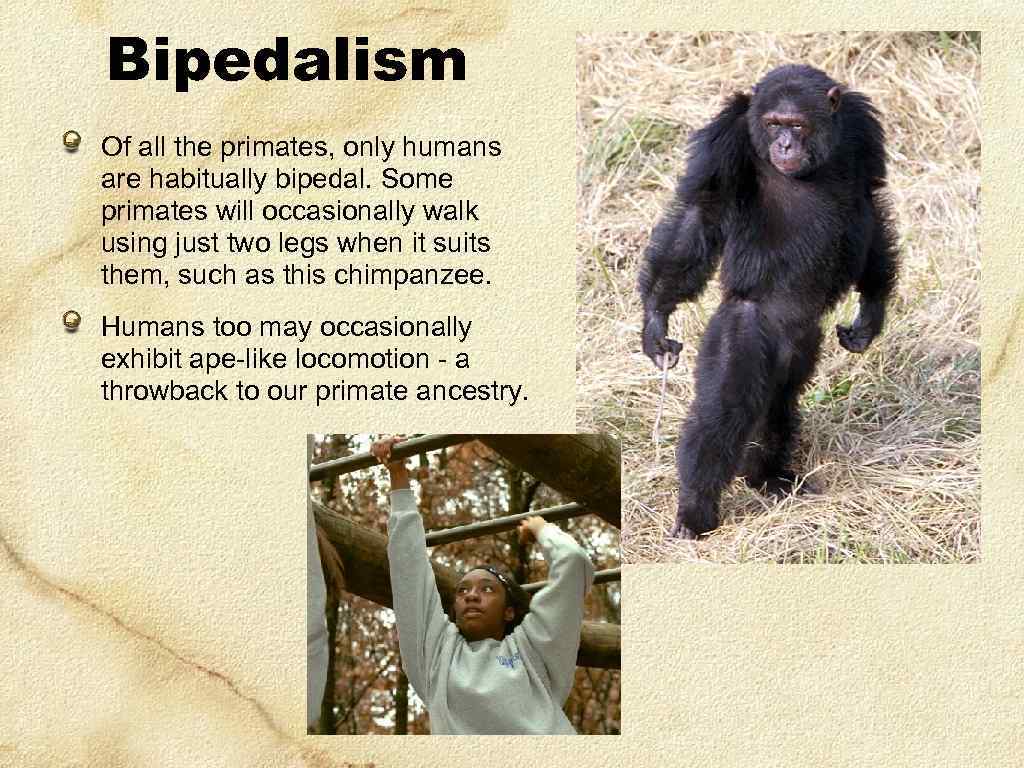 Bipedalism Of all the primates, only humans are habitually bipedal. Some primates will occasionally walk using just two legs when it suits them, such as this chimpanzee. Humans too may occasionally exhibit ape-like locomotion - a throwback to our primate ancestry.
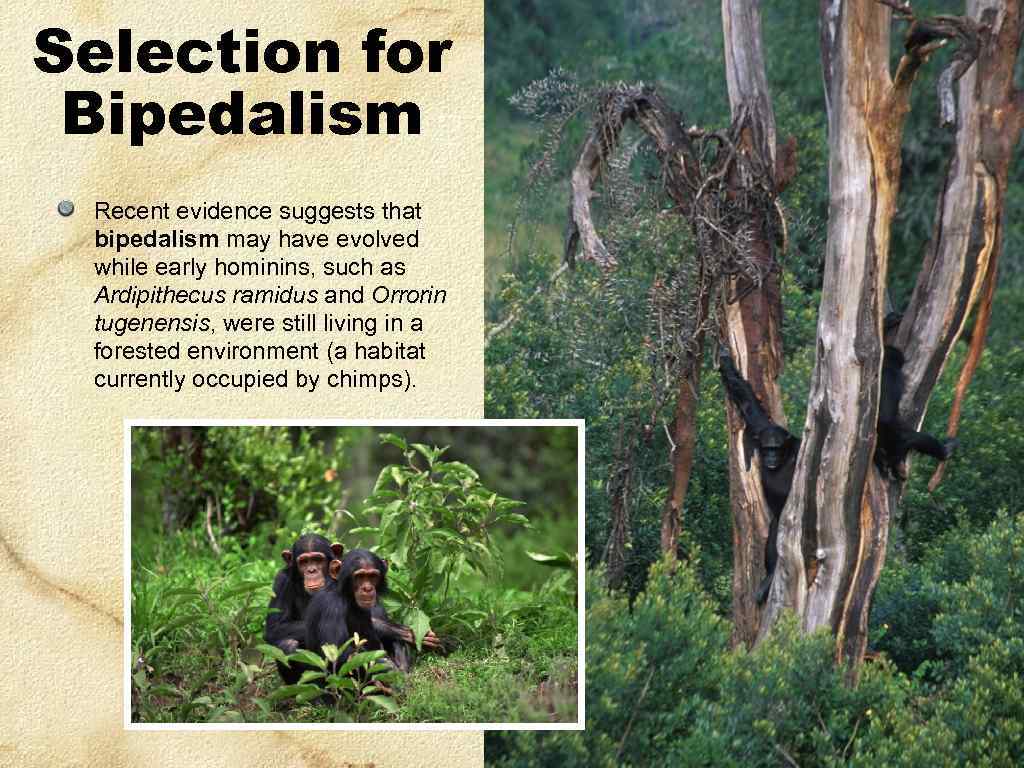 Selection for Bipedalism Recent evidence suggests that bipedalism may have evolved while early hominins, such as Ardipithecus ramidus and Orrorin tugenensis, were still living in a forested environment (a habitat currently occupied by chimps).
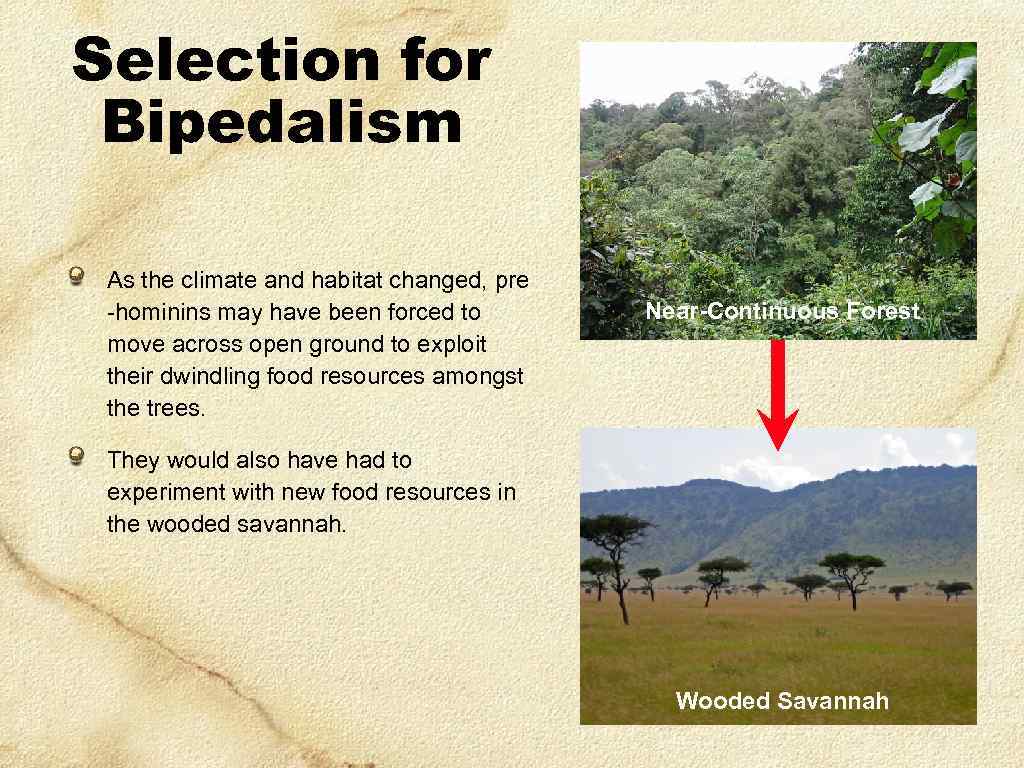 Selection for Bipedalism As the climate and habitat changed, pre -hominins may have been forced to move across open ground to exploit their dwindling food resources amongst the trees. Near-Continuous Forest They would also have had to experiment with new food resources in the wooded savannah. Wooded Savannah
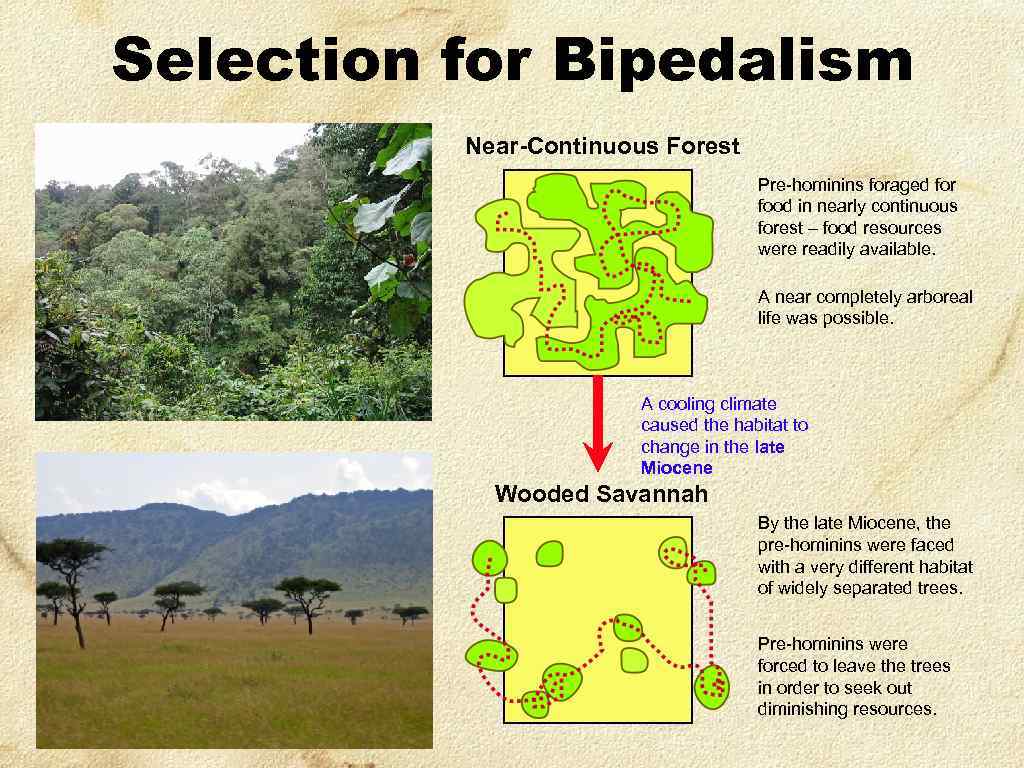 Selection for Bipedalism Near-Continuous Forest Pre-hominins foraged for food in nearly continuous forest – food resources were readily available. A near completely arboreal life was possible. A cooling climate caused the habitat to change in the late Miocene Wooded Savannah By the late Miocene, the pre-hominins were faced with a very different habitat of widely separated trees. Pre-hominins were forced to leave the trees in order to seek out diminishing resources.
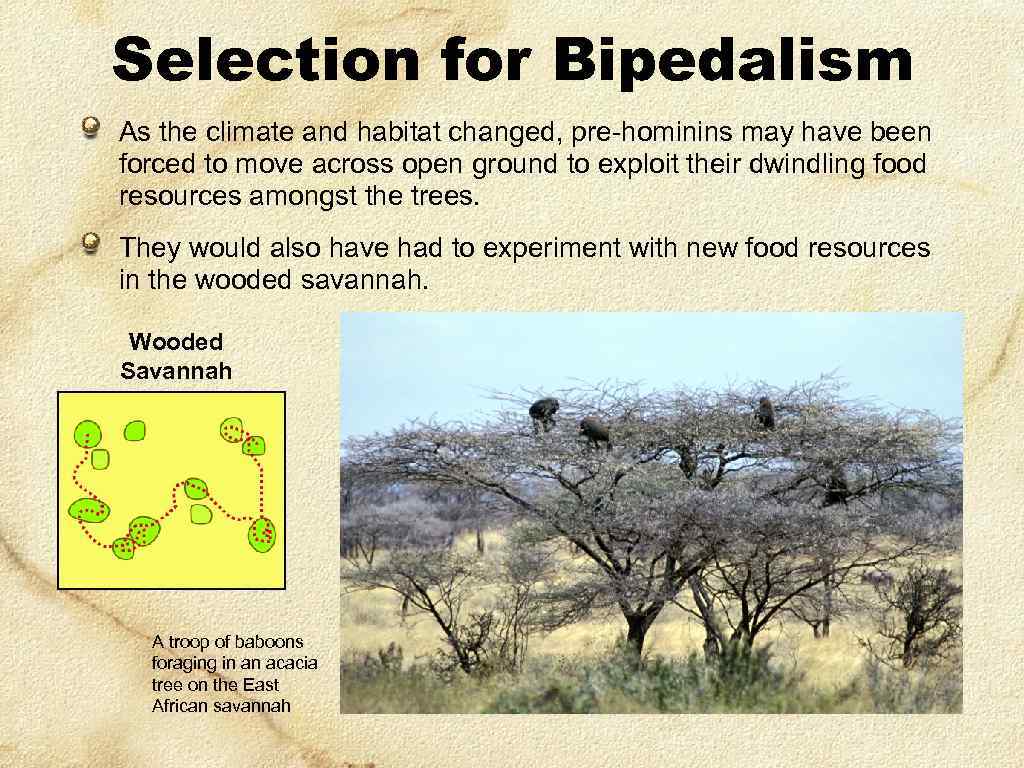 Selection for Bipedalism As the climate and habitat changed, pre-hominins may have been forced to move across open ground to exploit their dwindling food resources amongst the trees. They would also have had to experiment with new food resources in the wooded savannah. Wooded Savannah A troop of baboons foraging in an acacia tree on the East African savannah
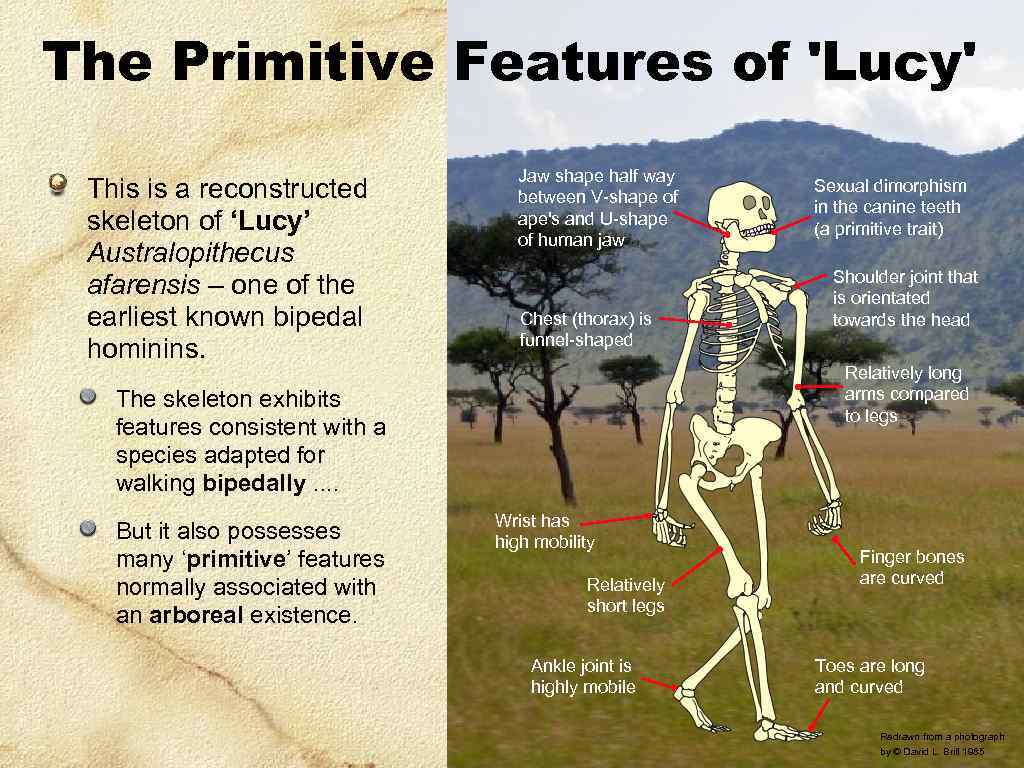 The Primitive Features of 'Lucy' This is a reconstructed skeleton of ‘Lucy’ Australopithecus afarensis – one of the earliest known bipedal hominins. Jaw shape half way between V-shape of ape's and U-shape of human jaw Chest (thorax) is funnel-shaped Shoulder joint that is orientated towards the head Relatively long arms compared to legs The skeleton exhibits features consistent with a species adapted for walking bipedally. . But it also possesses many ‘primitive’ features normally associated with an arboreal existence. Sexual dimorphism in the canine teeth (a primitive trait) Wrist has high mobility Relatively short legs Ankle joint is highly mobile Finger bones are curved Toes are long and curved Redrawn from a photograph by © David L. Brill 1985
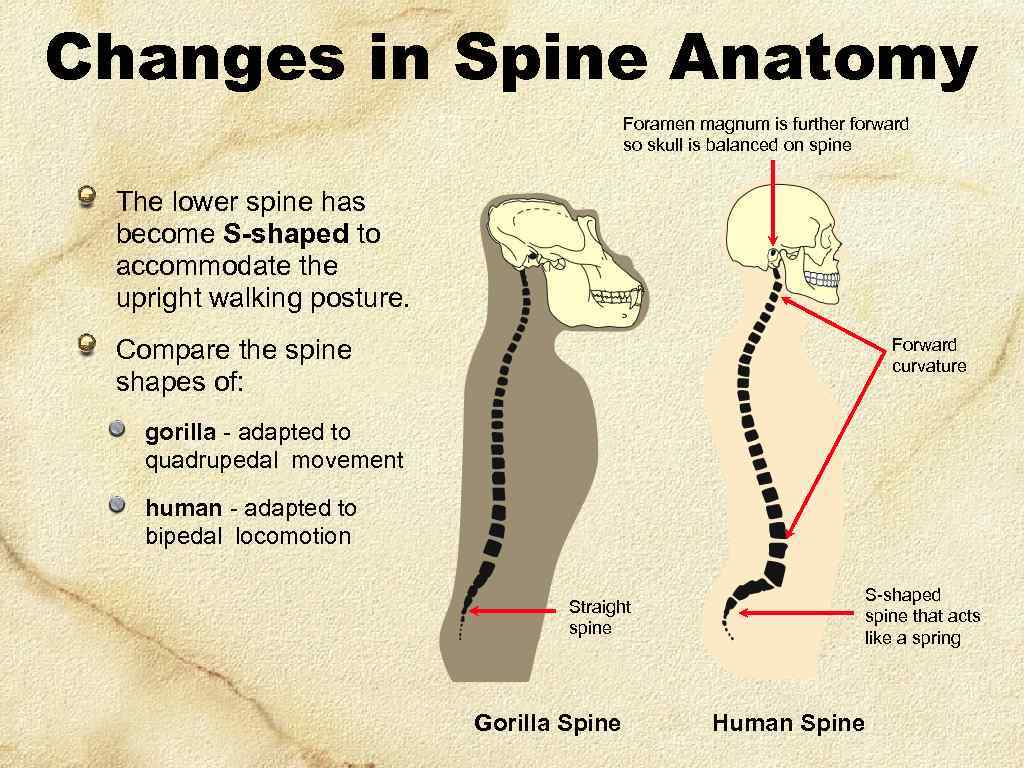 Changes in Spine Anatomy Foramen magnum is further forward so skull is balanced on spine The lower spine has become S-shaped to accommodate the upright walking posture. Compare the spine shapes of: Forward curvature gorilla - adapted to quadrupedal movement human - adapted to bipedal locomotion Straight spine Gorilla Spine S-shaped spine that acts like a spring Human Spine
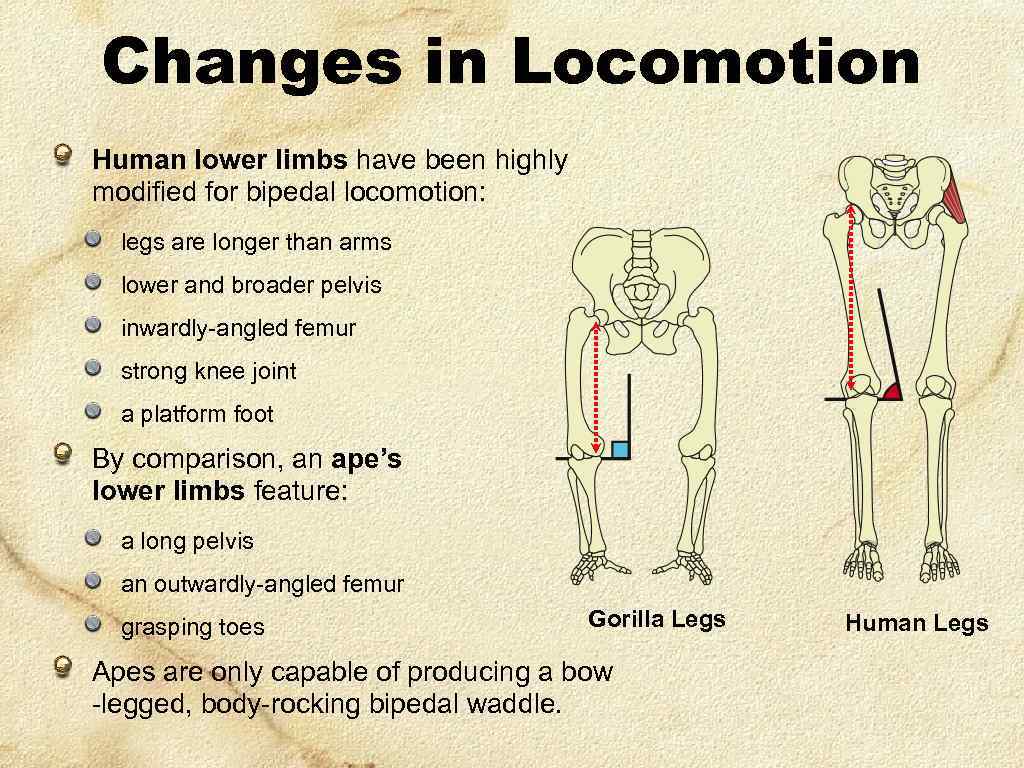 Changes in Locomotion Human lower limbs have been highly modified for bipedal locomotion: legs are longer than arms lower and broader pelvis inwardly-angled femur strong knee joint a platform foot By comparison, an ape’s lower limbs feature: a long pelvis an outwardly-angled femur grasping toes Gorilla Legs Apes are only capable of producing a bow -legged, body-rocking bipedal waddle. Human Legs
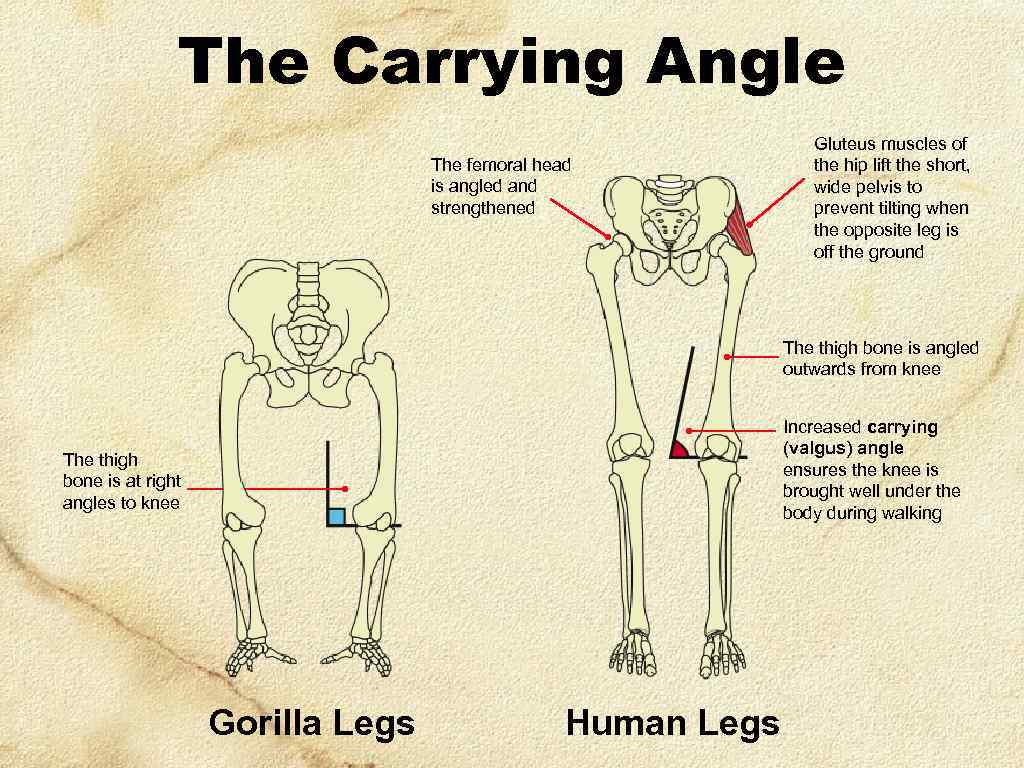 The Carrying Angle The femoral head is angled and strengthened Gluteus muscles of the hip lift the short, wide pelvis to prevent tilting when the opposite leg is off the ground The thigh bone is angled outwards from knee Increased carrying (valgus) angle ensures the knee is brought well under the body during walking The thigh bone is at right angles to knee Gorilla Legs Human Legs
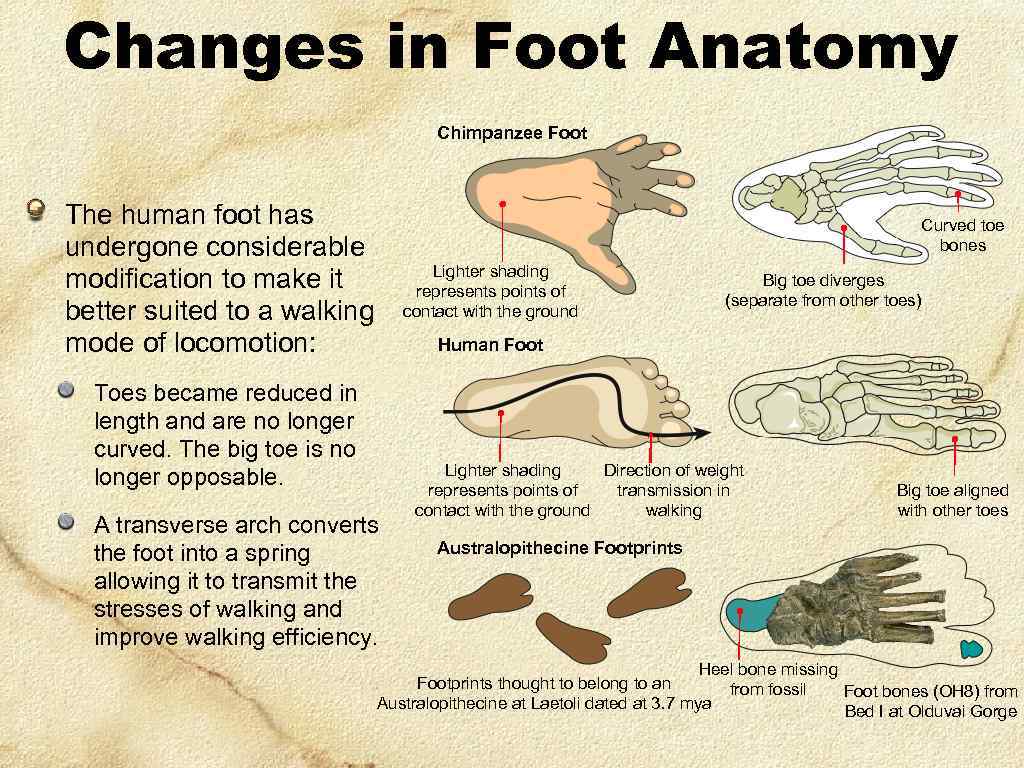 Changes in Foot Anatomy Chimpanzee Foot The human foot has undergone considerable modification to make it better suited to a walking mode of locomotion: Curved toe bones Lighter shading represents points of contact with the ground Big toe diverges (separate from other toes) Human Foot Toes became reduced in length and are no longer curved. The big toe is no longer opposable. A transverse arch converts the foot into a spring allowing it to transmit the stresses of walking and improve walking efficiency. Lighter shading Direction of weight represents points of transmission in contact with the ground walking Big toe aligned with other toes Australopithecine Footprints Heel bone missing Footprints thought to belong to an from fossil Foot bones (OH 8) from Australopithecine at Laetoli dated at 3. 7 mya Bed I at Olduvai Gorge
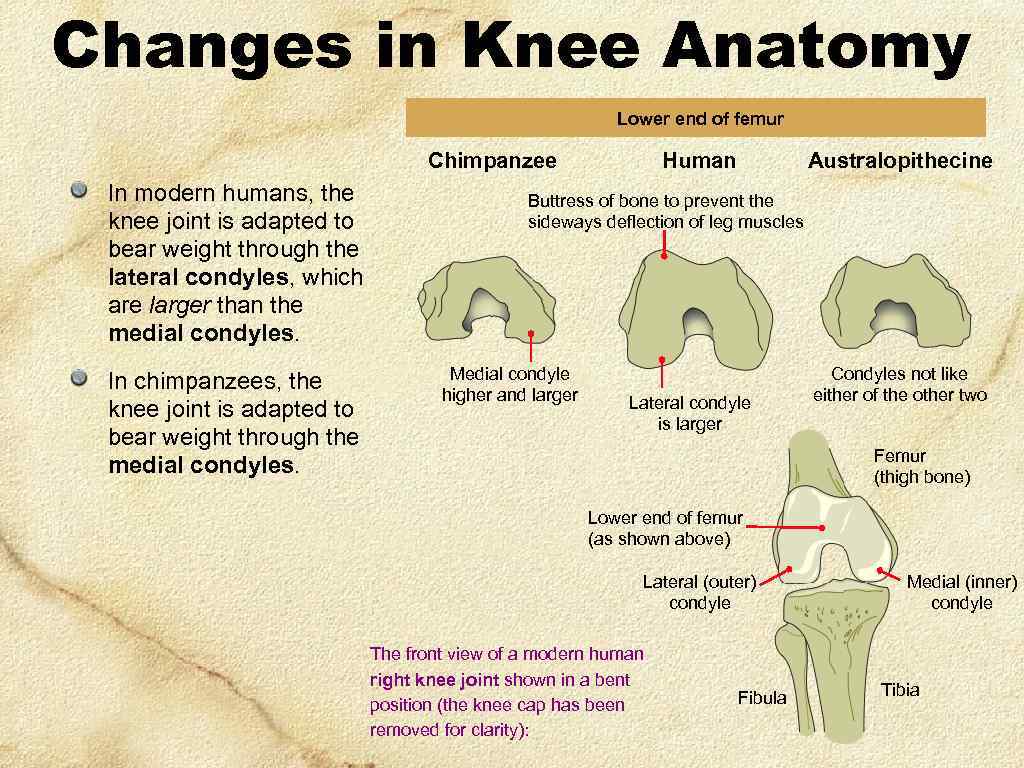 Changes in Knee Anatomy Lower end of femur Chimpanzee In modern humans, the knee joint is adapted to bear weight through the lateral condyles, which are larger than the medial condyles. In chimpanzees, the knee joint is adapted to bear weight through the medial condyles. Human Australopithecine Buttress of bone to prevent the sideways deflection of leg muscles Medial condyle higher and larger Lateral condyle is larger Condyles not like either of the other two Femur (thigh bone) Lower end of femur (as shown above) Lateral (outer) condyle The front view of a modern human right knee joint shown in a bent position (the knee cap has been removed for clarity): Fibula Medial (inner) condyle Tibia
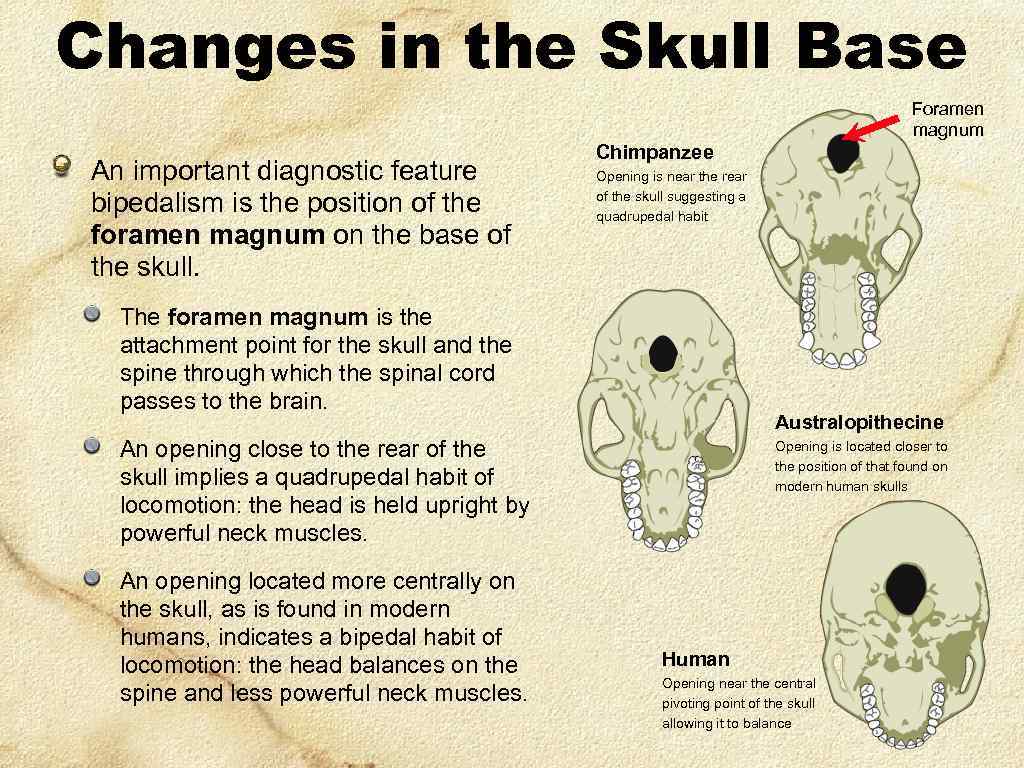 Changes in the Skull Base Foramen magnum An important diagnostic feature bipedalism is the position of the foramen magnum on the base of the skull. Chimpanzee Opening is near the rear of the skull suggesting a quadrupedal habit The foramen magnum is the attachment point for the skull and the spine through which the spinal cord passes to the brain. Australopithecine An opening close to the rear of the skull implies a quadrupedal habit of locomotion: the head is held upright by powerful neck muscles. An opening located more centrally on the skull, as is found in modern humans, indicates a bipedal habit of locomotion: the head balances on the spine and less powerful neck muscles. Opening is located closer to the position of that found on modern human skulls Human Opening near the central pivoting point of the skull allowing it to balance
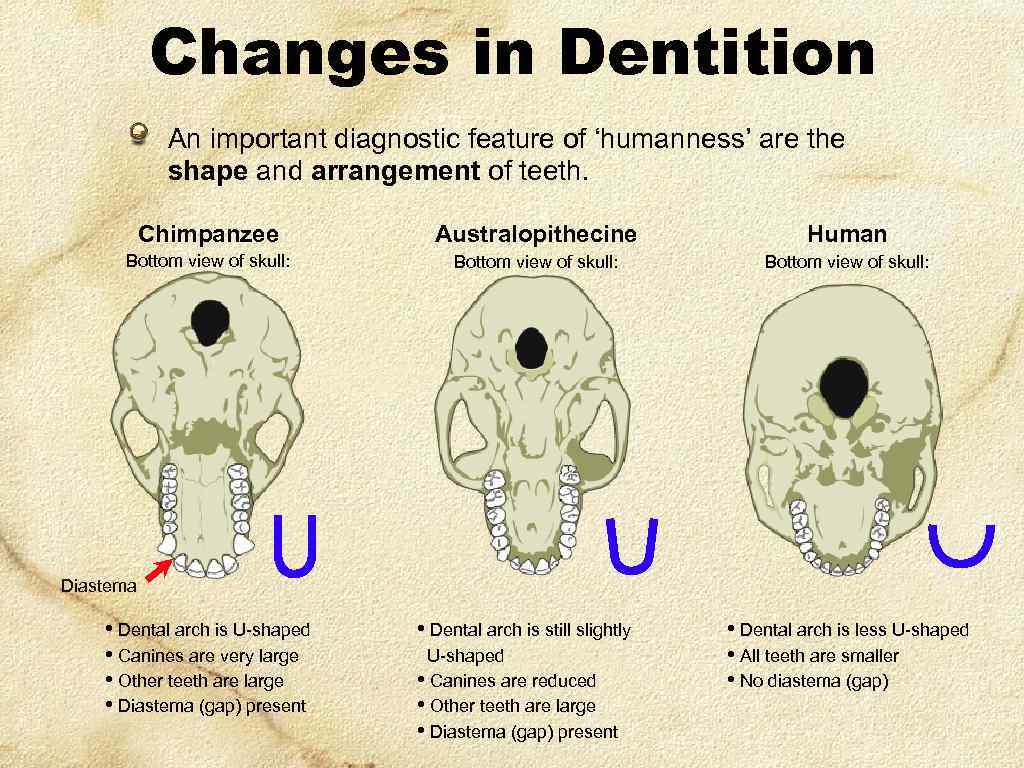 Changes in Dentition An important diagnostic feature of ‘humanness’ are the shape and arrangement of teeth. Chimpanzee Australopithecine Human Bottom view of skull: Diastema • Dental arch is U-shaped • Canines are very large • Other teeth are large • Diastema (gap) present • Dental arch is still slightly U-shaped • Canines are reduced • Other teeth are large • Diastema (gap) present • Dental arch is less U-shaped • All teeth are smaller • No diastema (gap)
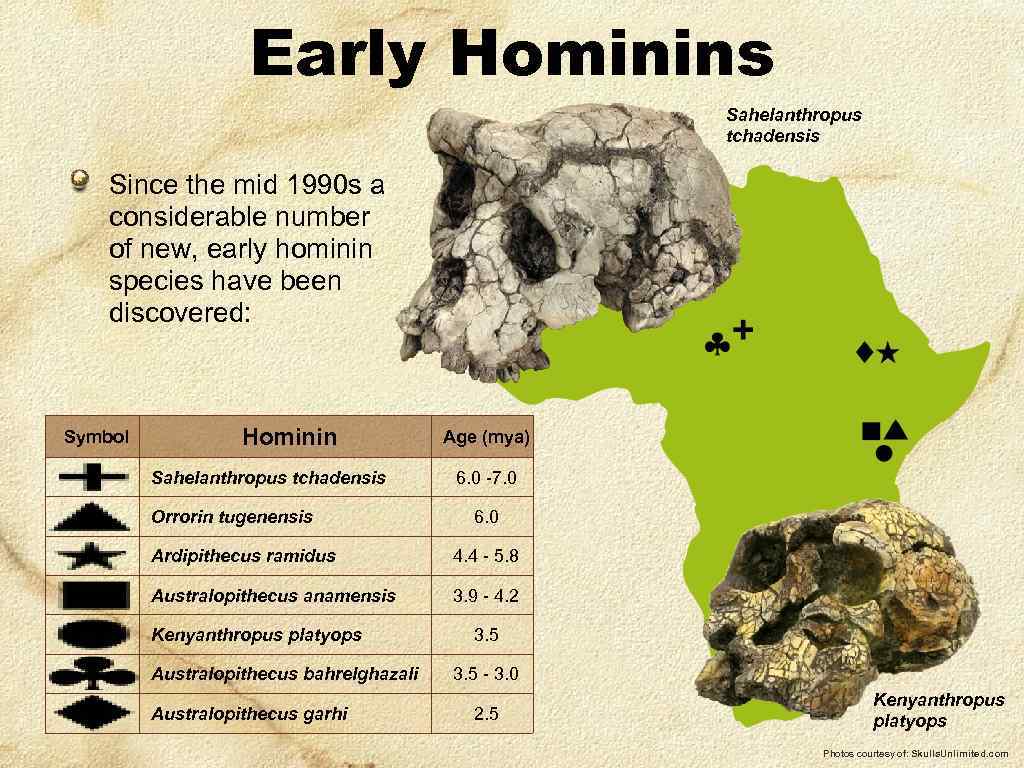 Early Hominins Sahelanthropus tchadensis Since the mid 1990 s a considerable number of new, early hominin species have been discovered: Symbol Hominin Sahelanthropus tchadensis Orrorin tugenensis Age (mya) 6. 0 -7. 0 6. 0 Ardipithecus ramidus 4. 4 - 5. 8 Australopithecus anamensis 3. 9 - 4. 2 Kenyanthropus platyops Australopithecus bahrelghazali Australopithecus garhi 3. 5 - 3. 0 2. 5 Kenyanthropus platyops Photos courtesy of: Skulls. Unlimited. com
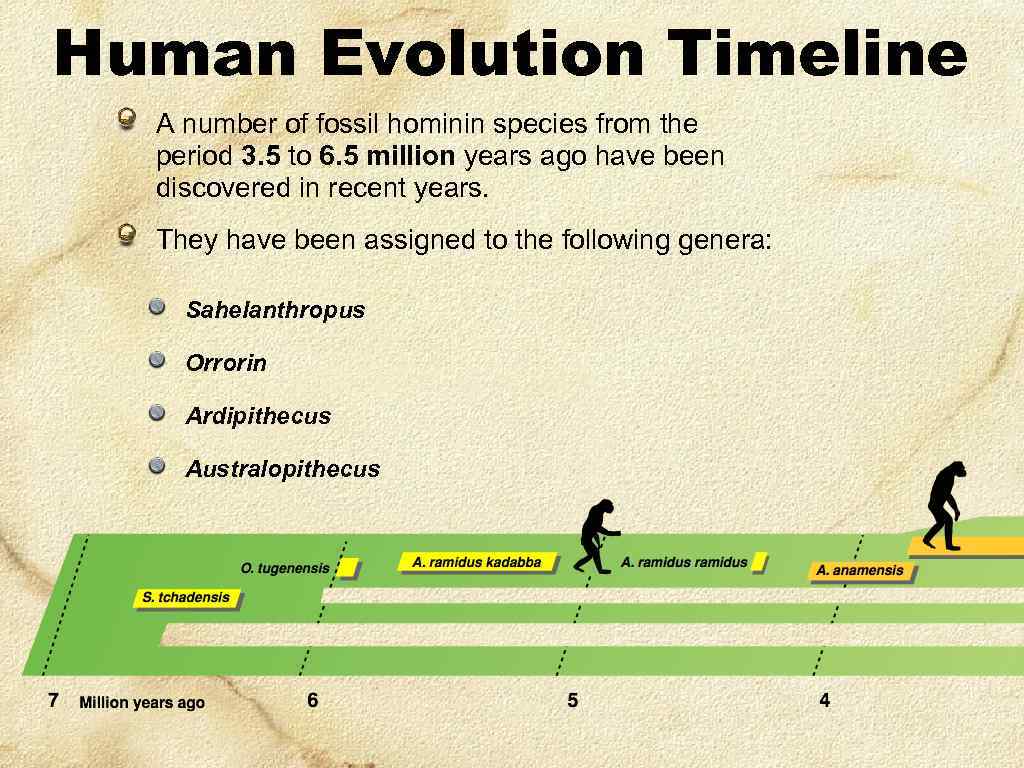 Human Evolution Timeline A number of fossil hominin species from the period 3. 5 to 6. 5 million years ago have been discovered in recent years. They have been assigned to the following genera: Sahelanthropus Orrorin Ardipithecus Australopithecus
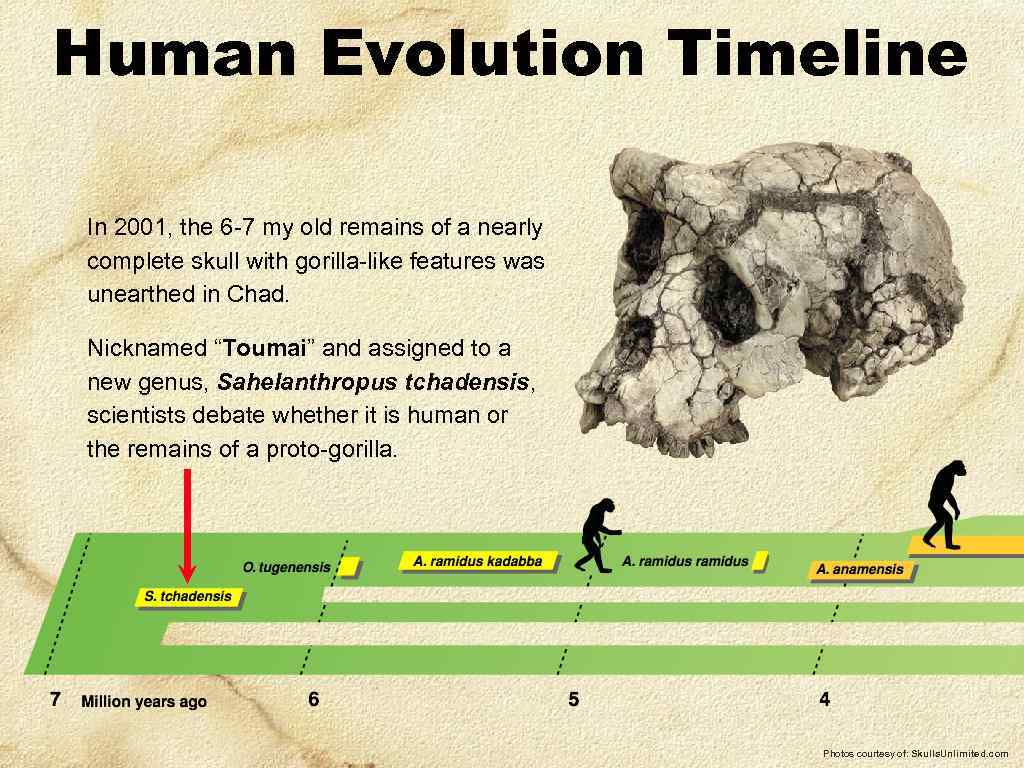 Human Evolution Timeline In 2001, the 6 -7 my old remains of a nearly complete skull with gorilla-like features was unearthed in Chad. Nicknamed “Toumai” and assigned to a new genus, Sahelanthropus tchadensis, scientists debate whether it is human or the remains of a proto-gorilla. Photos courtesy of: Skulls. Unlimited. com
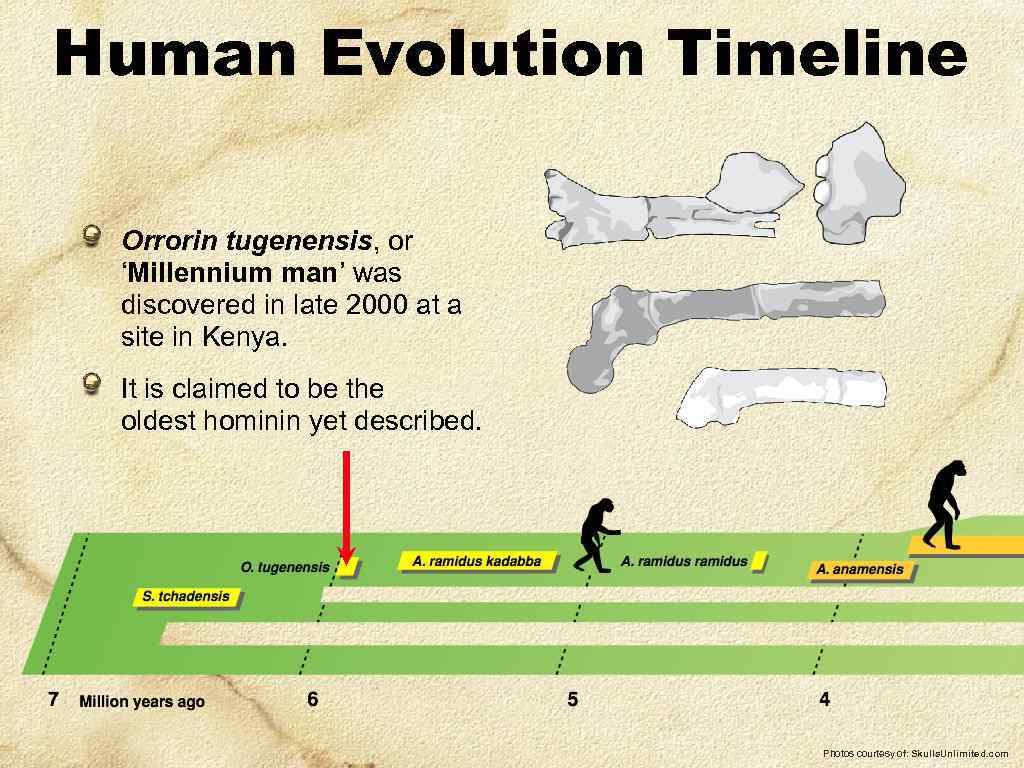 Human Evolution Timeline Orrorin tugenensis, or ‘Millennium man’ was discovered in late 2000 at a site in Kenya. It is claimed to be the oldest hominin yet described. Photos courtesy of: Skulls. Unlimited. com
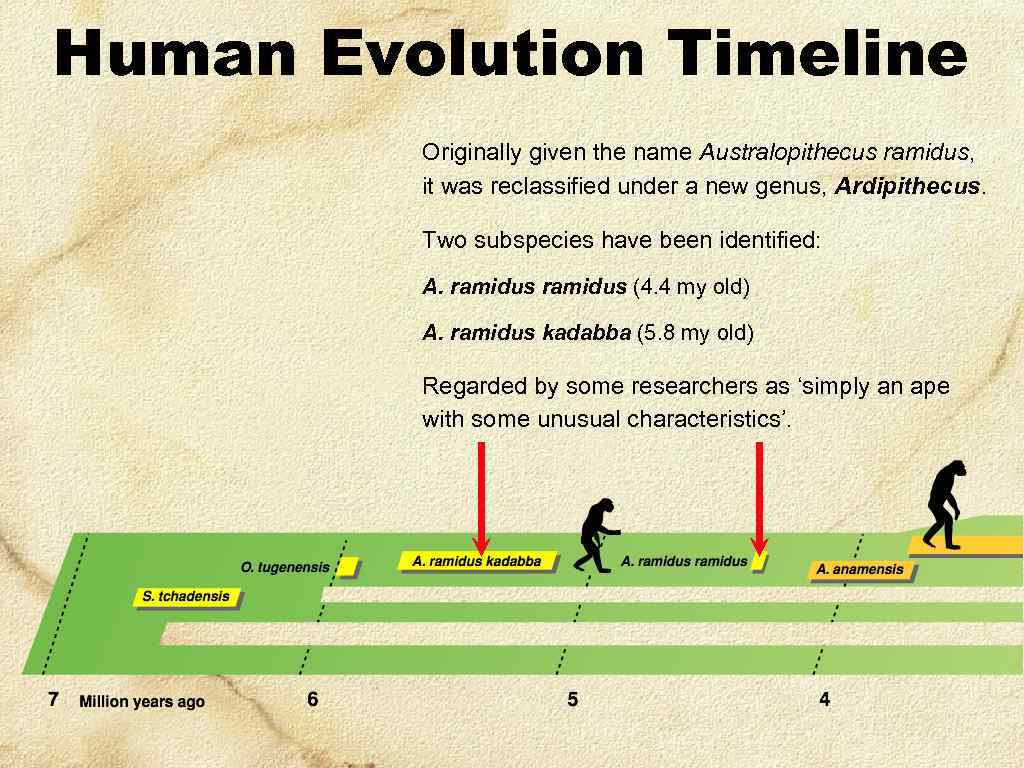 Human Evolution Timeline Originally given the name Australopithecus ramidus, it was reclassified under a new genus, Ardipithecus. Two subspecies have been identified: A. ramidus (4. 4 my old) A. ramidus kadabba (5. 8 my old) Regarded by some researchers as ‘simply an ape with some unusual characteristics’.
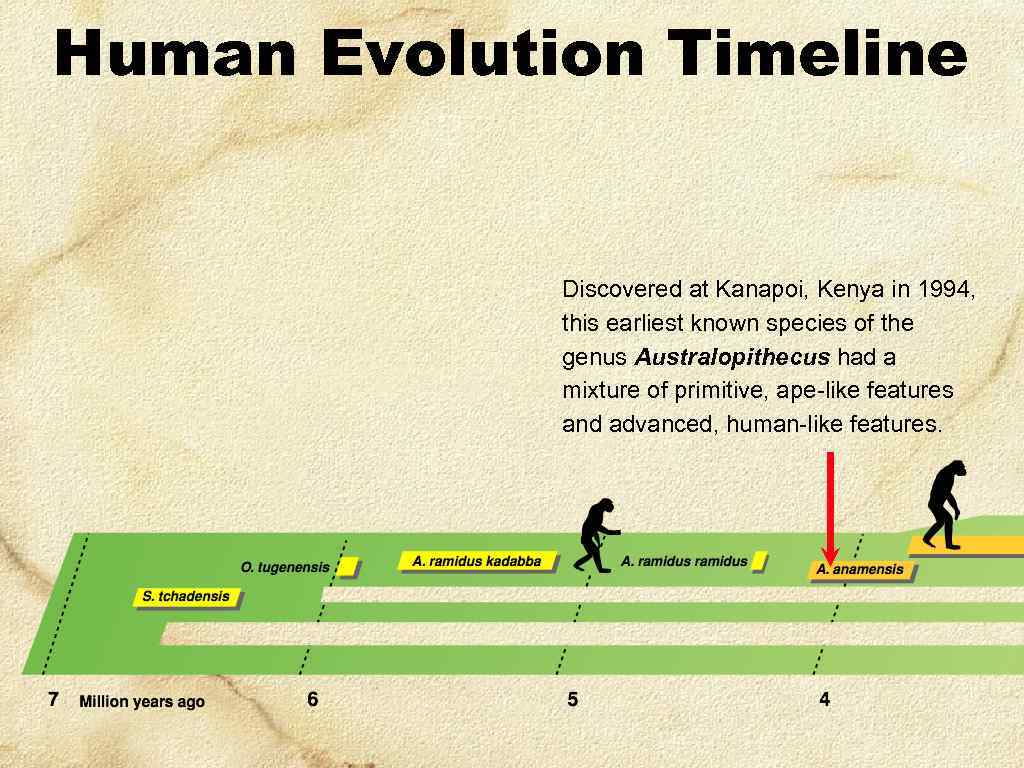 Human Evolution Timeline Discovered at Kanapoi, Kenya in 1994, this earliest known species of the genus Australopithecus had a mixture of primitive, ape-like features and advanced, human-like features.
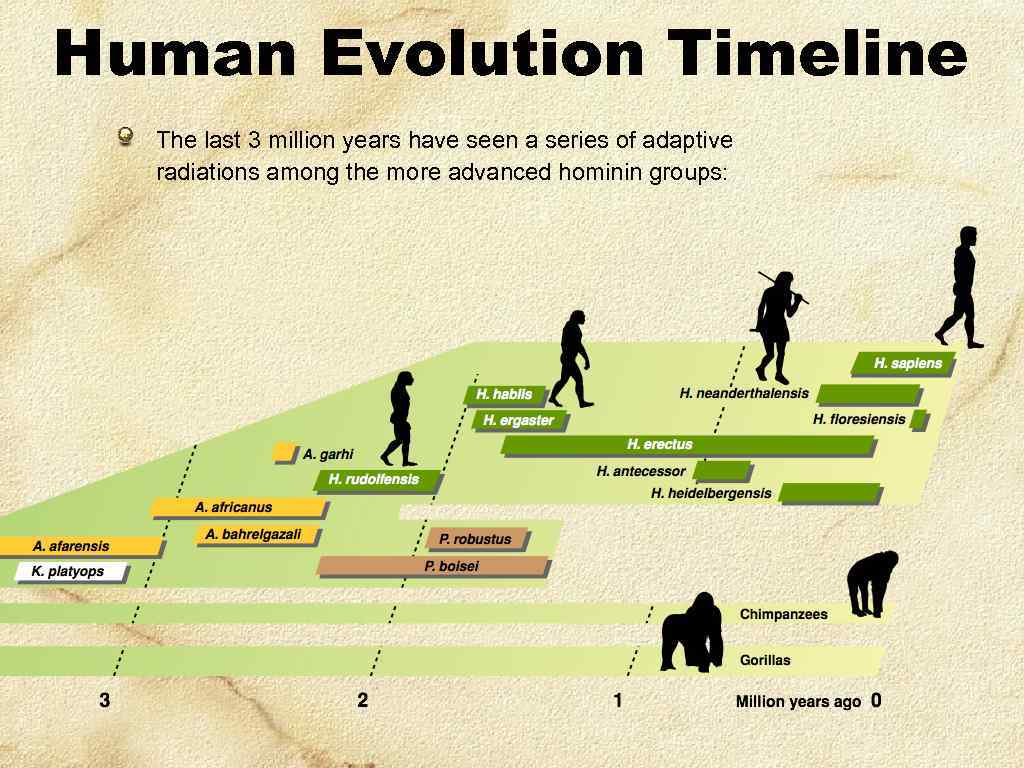 Human Evolution Timeline The last 3 million years have seen a series of adaptive radiations among the more advanced hominin groups:
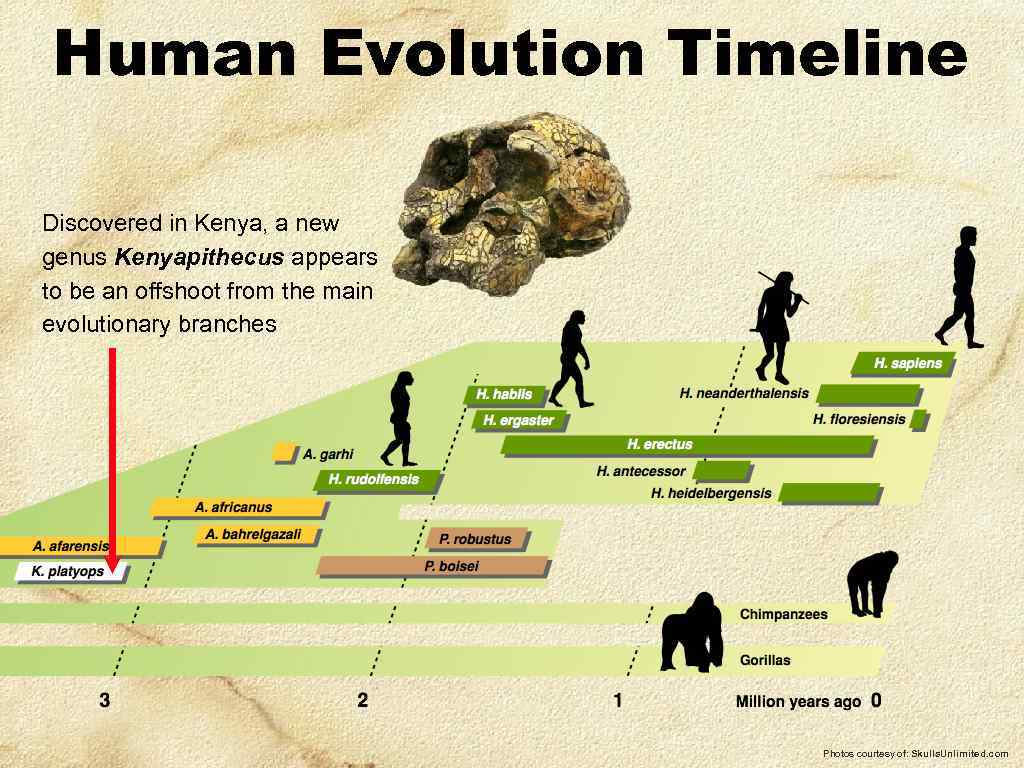 Human Evolution Timeline Discovered in Kenya, a new genus Kenyapithecus appears to be an offshoot from the main evolutionary branches Photos courtesy of: Skulls. Unlimited. com
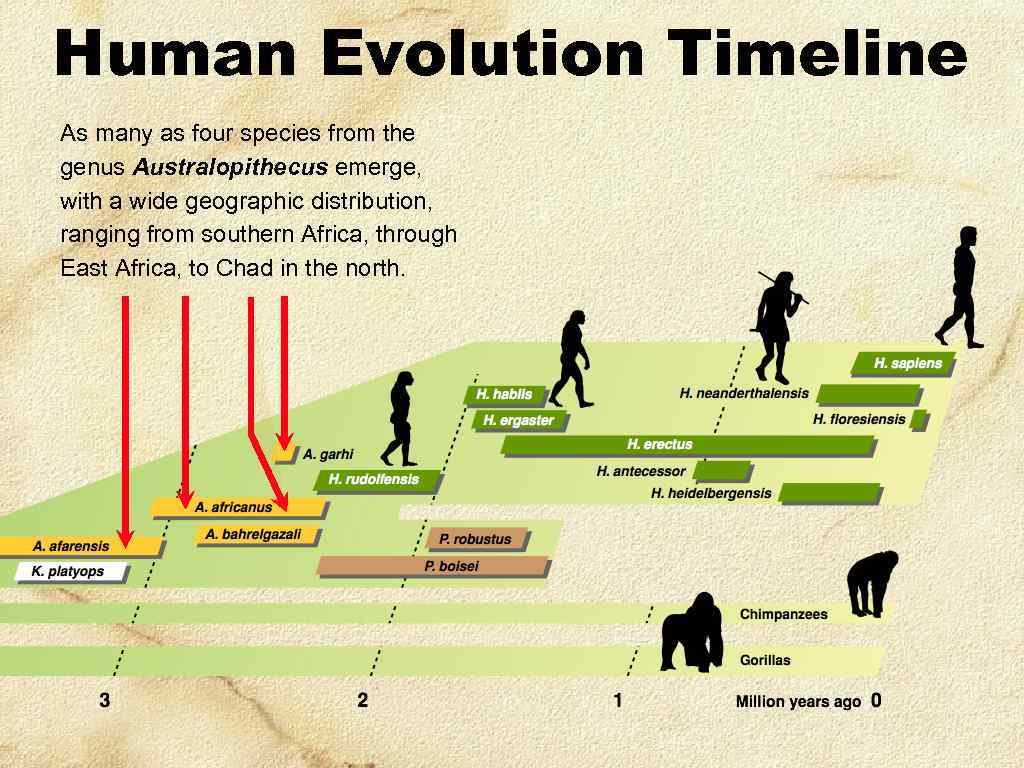 Human Evolution Timeline As many as four species from the genus Australopithecus emerge, with a wide geographic distribution, ranging from southern Africa, through East Africa, to Chad in the north.
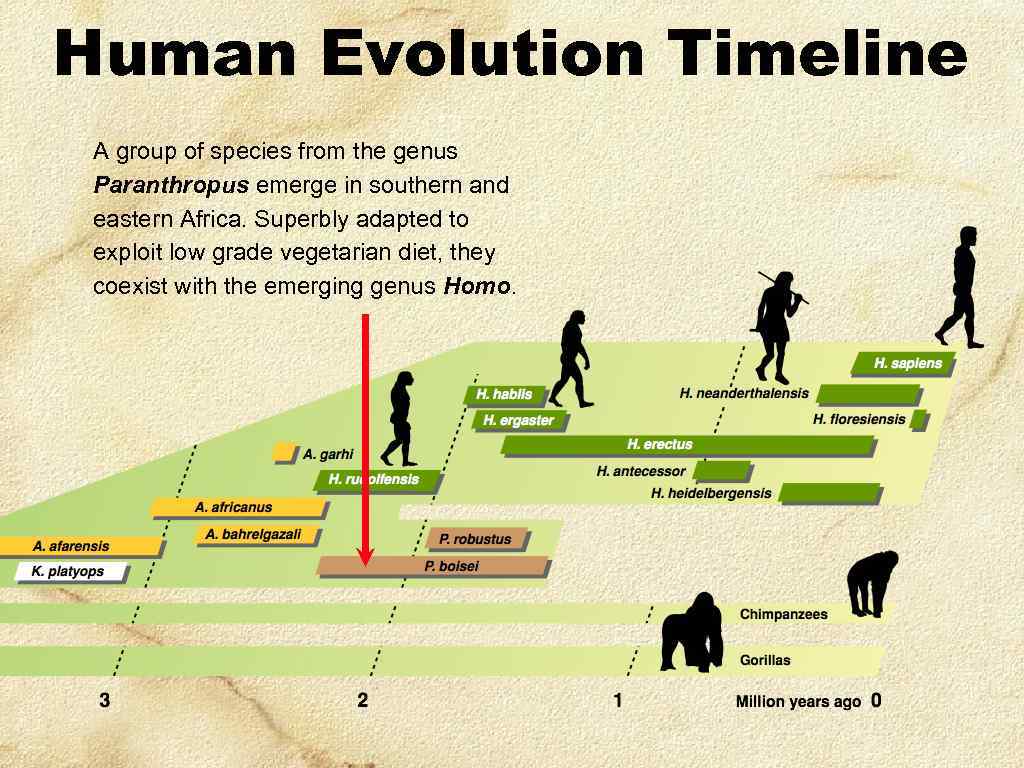 Human Evolution Timeline A group of species from the genus Paranthropus emerge in southern and eastern Africa. Superbly adapted to exploit low grade vegetarian diet, they coexist with the emerging genus Homo.
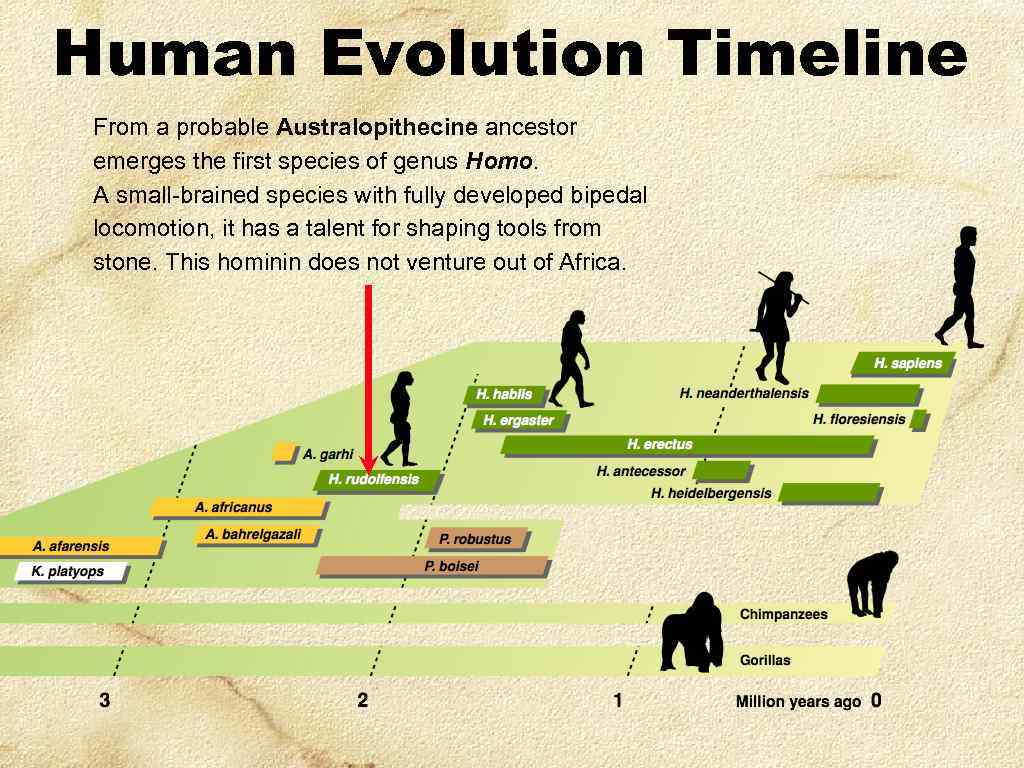 Human Evolution Timeline From a probable Australopithecine ancestor emerges the first species of genus Homo. A small-brained species with fully developed bipedal locomotion, it has a talent for shaping tools from stone. This hominin does not venture out of Africa.
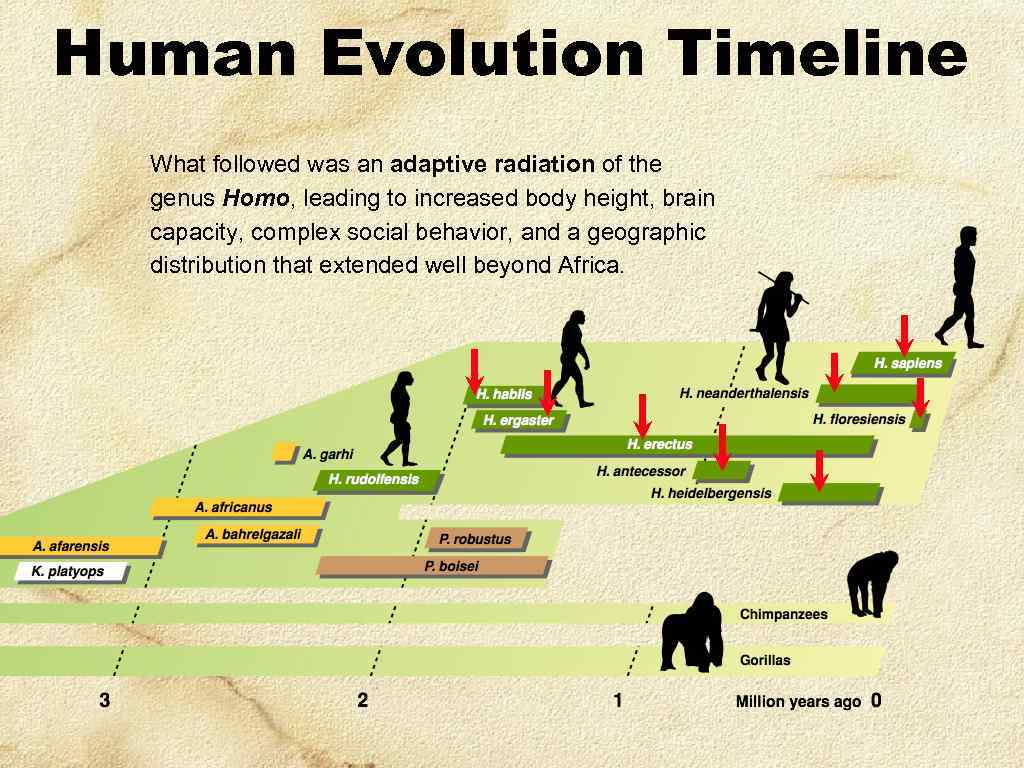 Human Evolution Timeline What followed was an adaptive radiation of the genus Homo, leading to increased body height, brain capacity, complex social behavior, and a geographic distribution that extended well beyond Africa.
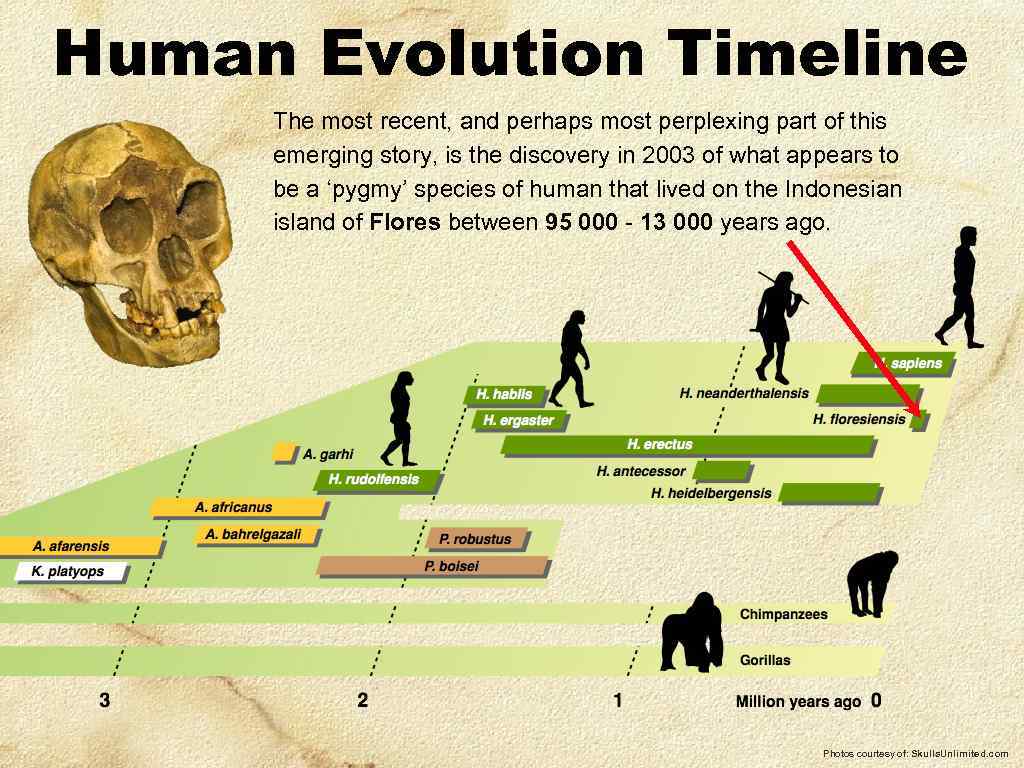 Human Evolution Timeline The most recent, and perhaps most perplexing part of this emerging story, is the discovery in 2003 of what appears to be a ‘pygmy’ species of human that lived on the Indonesian island of Flores between 95 000 - 13 000 years ago. Photos courtesy of: Skulls. Unlimited. com
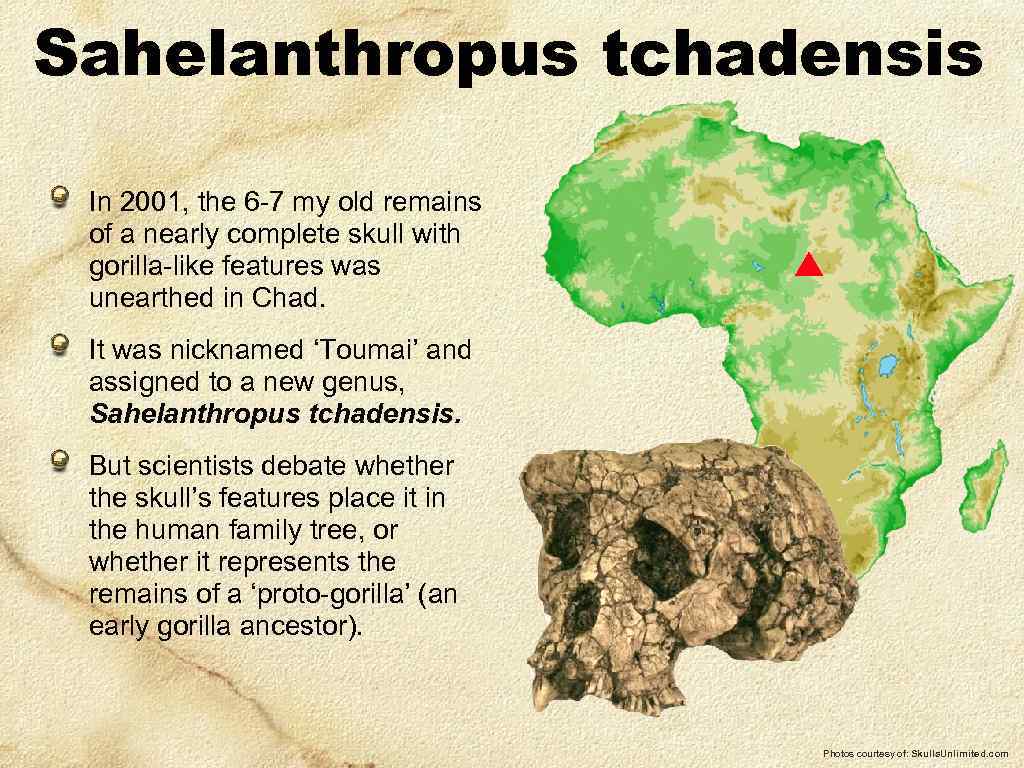 Sahelanthropus tchadensis In 2001, the 6 -7 my old remains of a nearly complete skull with gorilla-like features was unearthed in Chad. It was nicknamed ‘Toumai’ and assigned to a new genus, Sahelanthropus tchadensis. But scientists debate whether the skull’s features place it in the human family tree, or whether it represents the remains of a ‘proto-gorilla’ (an early gorilla ancestor). Photos courtesy of: Skulls. Unlimited. com
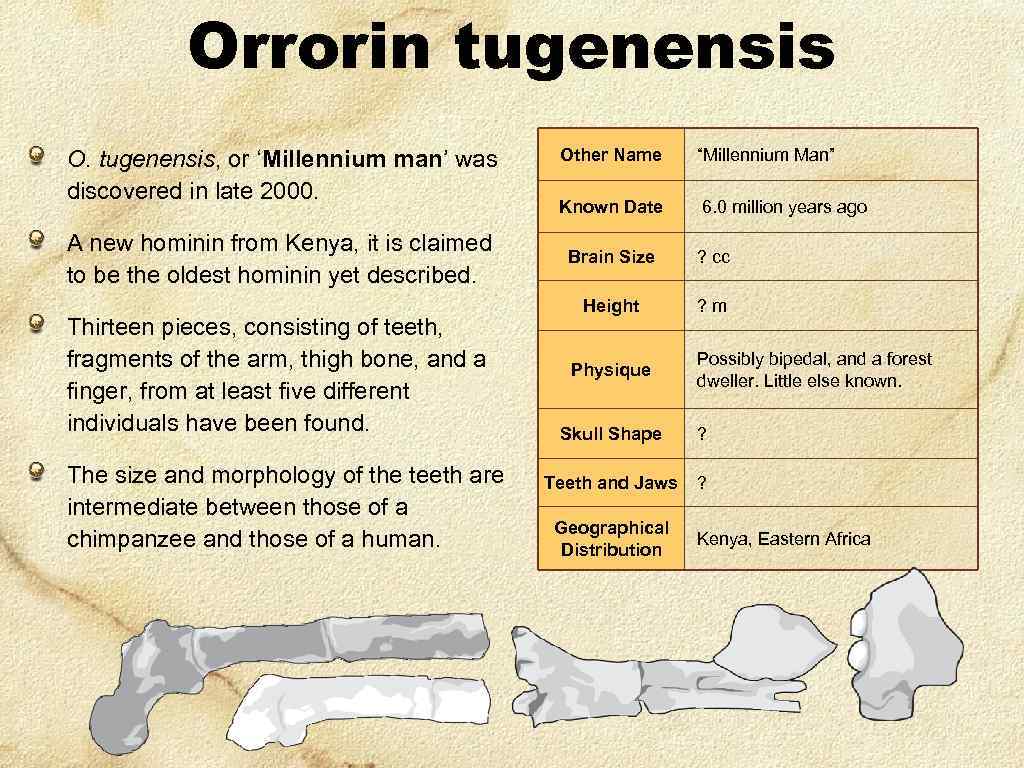 Orrorin tugenensis O. tugenensis, or ‘Millennium man’ was discovered in late 2000. A new hominin from Kenya, it is claimed to be the oldest hominin yet described. Thirteen pieces, consisting of teeth, fragments of the arm, thigh bone, and a finger, from at least five different individuals have been found. The size and morphology of the teeth are intermediate between those of a chimpanzee and those of a human. Other Name “Millennium Man” Known Date 6. 0 million years ago Brain Size ? cc Height ? m Physique Possibly bipedal, and a forest dweller. Little else known. Skull Shape ? Teeth and Jaws ? Geographical Distribution Kenya, Eastern Africa
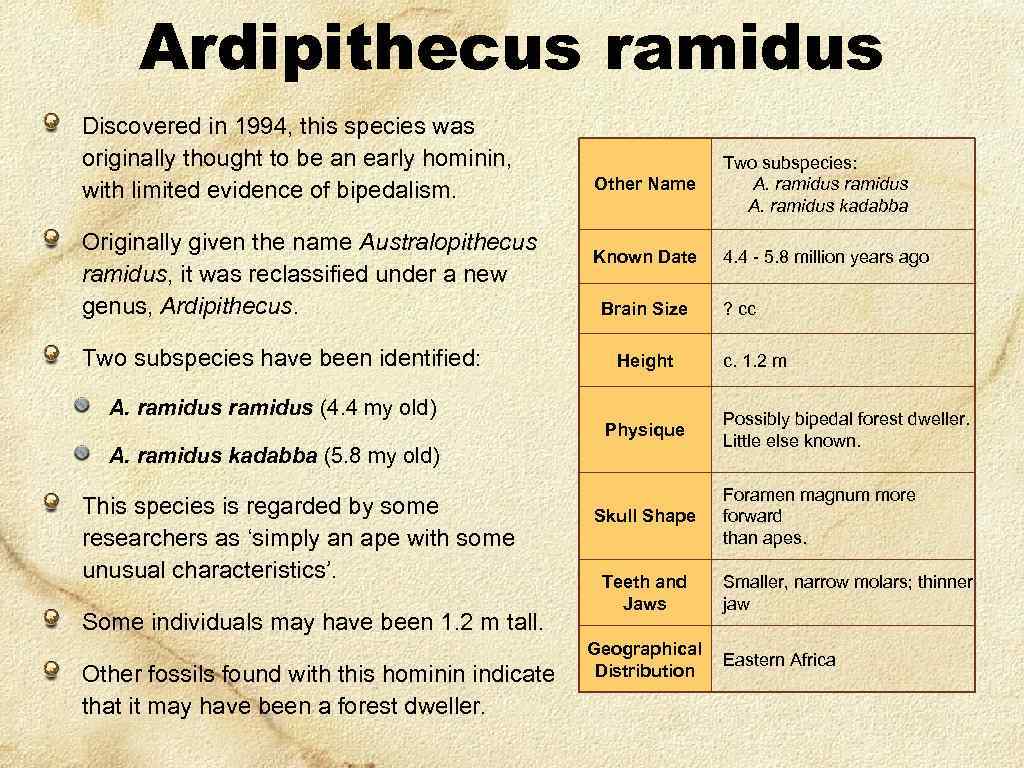 Ardipithecus ramidus Discovered in 1994, this species was originally thought to be an early hominin, with limited evidence of bipedalism. Originally given the name Australopithecus ramidus, it was reclassified under a new genus, Ardipithecus. Two subspecies have been identified: A. ramidus (4. 4 my old) Other Name Two subspecies: A. ramidus kadabba Known Date 4. 4 - 5. 8 million years ago Brain Size Height Physique A. ramidus kadabba (5. 8 my old) This species is regarded by some researchers as ‘simply an ape with some unusual characteristics’. Some individuals may have been 1. 2 m tall. Other fossils found with this hominin indicate that it may have been a forest dweller. Skull Shape Teeth and Jaws Geographical Distribution ? cc c. 1. 2 m Possibly bipedal forest dweller. Little else known. Foramen magnum more forward than apes. Smaller, narrow molars; thinner jaw Eastern Africa
 Terms of Use 1. Biozone International retains copyright to the intellectual property included in this presentation file, with acknowledgement that certain photos are used under license and are credited appropriately on the next screen. 2. You MAY: a. Use these slides for presentations in your classrooms using a data projector, interactive whiteboard, and overhead projector. b. Place these files on the school’s intranet (school computer network), but not in contradiction of clause 3 (a) below. c. Edit and customize this file by adding, deleting, and modifying information to better suit your needs. d. Place these presentation files on any computer within the school, including staff laptops. e. Print out this file in Power. Point “Handouts” format as per the print dialogue box, for the express purpose of allowing students to make their own notes about the presentation. 3. You MAY NOT: a. Put these presentation files onto the internet or on a service that may be accessed offsite from the campus, unless access to the service is protected by a user login and password protocol. b. Print these files onto paper to make your own worksheets for distribution to students. c. Create a NEW document using any of the graphics/images in this presentation file. d. Incorporate any part of this presentation file for the production of another commercial product. e. REMOVE any of the references to Biozone, the copyright notices, photo credits, or terms of use from this file.
 Photo Credits Photographic images are used under licence from the following photo libraries: Corel Corporation Professional Photos Art. Today. com, Clipart. com i. Stock. Photos. com Photo. Disc Inc. Hemera Technologies Inc. Photo. Objects. com Photos. com Skulls. Unlimited. com Additional artwork and photographs are the property of Biozone International Ltd. BIOZONE International Ltd | P. O. Box 13 -034, 109 Cambridge Road, Hamilton, NEW ZEALAND Phone: + 64 7 856 -8104 | Fax: + 64 7 856 -9243 | E-mail: sales@biozone. co. nz | Internet: www. biozone. co. nz Copyright © 2005 Biozone International Ltd All rights reserved
 Presentation MEDIA See our other titles: See full details on our web site: biozone. co. nz