


 Скачать презентацию Part IV Pricing strategies and market segmentation Chapter
da5ecd4f44367e4f64fe052554946bb1.ppt
- Количество слайдов: 73
 Part IV. Pricing strategies and market segmentation Chapter 8. Group pricing and personalized pricing Slides Industrial Organization: Markets and Strategies Paul Belleflamme and Martin Peitz © Cambridge University Press 2009
 Introduction to Part IV Case. How to sell this book? • Suppose it’s the only IO book on the market • Profits we can make depend on • Information we have on consumers • Instruments we can use to design tariffs • If limited information and instruments • Only available strategy: uniform price • If more information price discrimination • Ideally, know exactly what each consumer is willing to pay • If not, identify characteristics related to willingness to pay and segment market into several groups (e. g. , US market vs. European market) Personalized and group pricing (Chapter 8) © Cambridge University Press 2009 2
 Introduction to Part IV Case. How to sell this book? (cont’d) • If more information price discrimination (cont’d) • If no identifiable characteristics, design different versions and induce consumers to self-select (e. g. , hard-back vs. paperback) Menu pricing (Chapter 9) • If more instruments several possibilities • Sell different versions (menu pricing) • Sell at different prices over time (e. g. , discount future prices, condition prices on purchase history) Intertemporal pricing (Chapter 10) • Set a special price for a bundle of product (e. g. , book + instructor manual + CD-rom with slides and exercises) Bundling and tying (Chapter 11) • More information & more instruments higher profits © Cambridge University Press 2009 3
 Introduction to Part IV Case. How to sell this book? (cont’d) • What if other IO books on the market? • More information or more instruments don’t necessarily translate into more profits. • Why? • Competitors can use the same strategies. • Competition can be exacerbated for some groups of consumers. • We study • Effects of imperfect competition • Impacts on welfare © Cambridge University Press 2009 4
 Chapter 8 - Objectives Chapter 8. Learning objectives • Be able to distinguish between the 3 types of price discrimination. • See how personalized and group pricing allow a monopolist to extract more consumer surplus and, thereby, to increase profits. • Understand how to set different prices for different groups. • Understand that in oligopoly settings, the positive surplus extraction effect of price discrimination may be outweighed by a negative competition enhancing effect. © Cambridge University Press 2009 5
 Chapter 8 - Price discrimination Definition • 2 varieties of a good are sold (by the same seller) to 2 buyers at different net prices • Net price (paid by the buyer) cost associated with product differentiation • Feasibility? • Market power • No arbitrage • Consumers find it impossible or too costly • ‘Physical arbitrage’ transfer of the good itself between consumers • ‘Personal arbitrage’ transfer of demand between different packages aimed at different consumers (see Chapter 9) © Cambridge University Press 2009 6
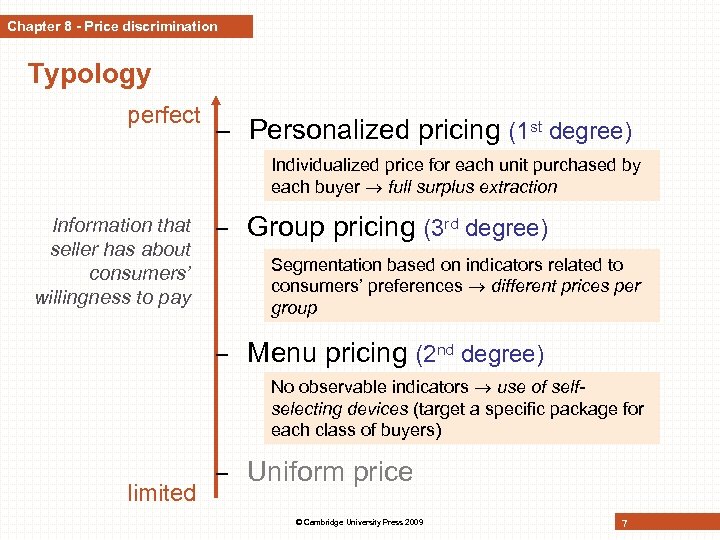 Chapter 8 - Price discrimination Typology perfect Personalized pricing (1 st degree) Individualized price for each unit purchased by each buyer full surplus extraction Information that seller has about consumers’ willingness to pay Group pricing (3 rd degree) Segmentation based on indicators related to consumers’ preferences different prices per group Menu pricing (2 nd degree) No observable indicators use of selfselecting devices (target a specific package for each class of buyers) limited Uniform price © Cambridge University Press 2009 7
 Chapter 8 - Price discrimination Case. Airline fares • Favorable context • Great heterogeneity across consumers • Limited arbitrage opportunities • Negligible marginal cost (up to capacity) • Discount fares based on restrictions • Restrictions fostering self-selection • Purchase in advance, Saturday-night stayover, surcharge for one-way tickets, . . . • Restrictions based on observable characteristics • Family, age, students • Strategy of low cost carriers • Eliminate above restrictions (except intertemporal pricing) • New form of geographical group pricing (see Chapter 9) © Cambridge University Press 2009 8
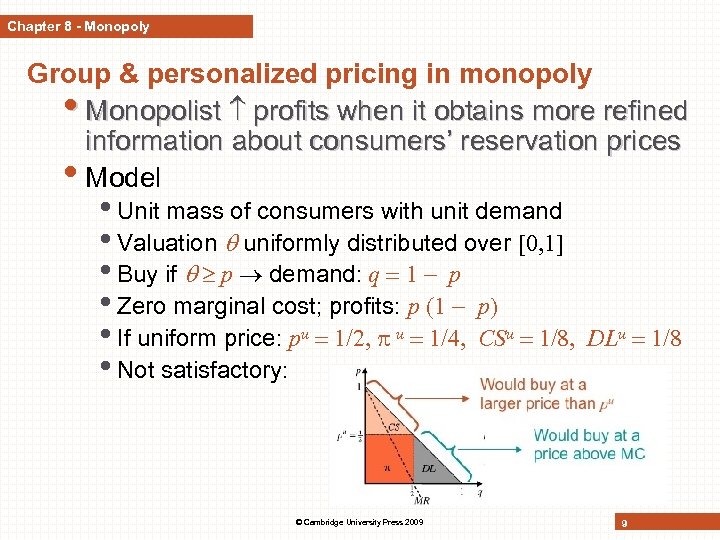 Chapter 8 - Monopoly Group & personalized pricing in monopoly • Monopolist profits when it obtains more refined information about consumers’ reservation prices • Model • Unit mass of consumers with unit demand • Valuation uniformly distributed over • Buy if p demand: q p • Zero marginal cost; profits: p ( p) • If uniform price: pu CSu DLu • Not satisfactory: © Cambridge University Press 2009 9
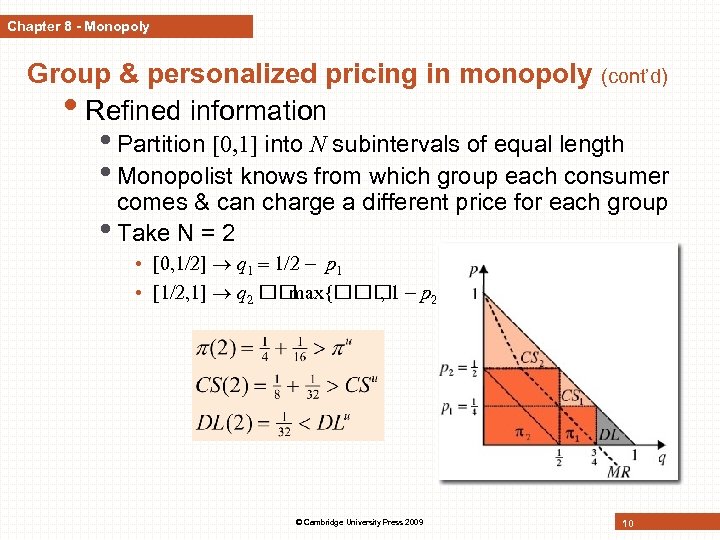 Chapter 8 - Monopoly Group & personalized pricing in monopoly • Refined information (cont’d) • Partition into N subintervals of equal length • Monopolist knows from which group each consumer comes & can charge a different price for each group • Take N = 2 • q 1 p 1 • q 2 max{ p 2} , © Cambridge University Press 2009 10
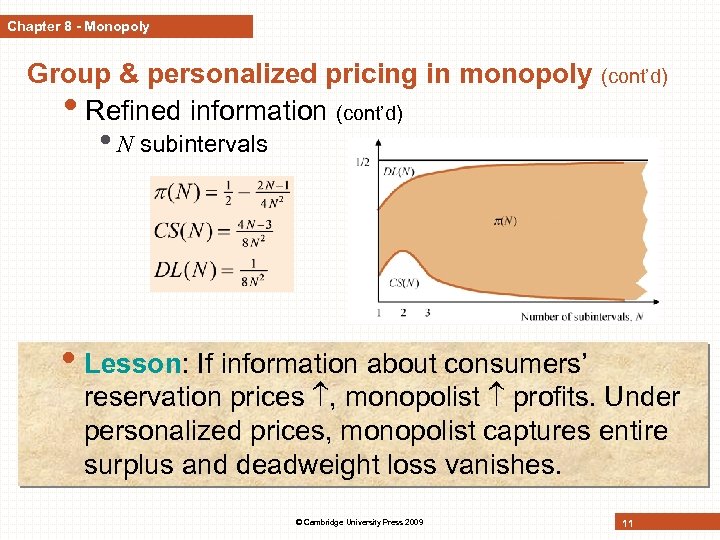 Chapter 8 - Monopoly Group & personalized pricing in monopoly • Refined information (cont’d) • N subintervals • Lesson: If information about consumers’ reservation prices , monopolist profits. Under personalized prices, monopolist captures entire surplus and deadweight loss vanishes. © Cambridge University Press 2009 11
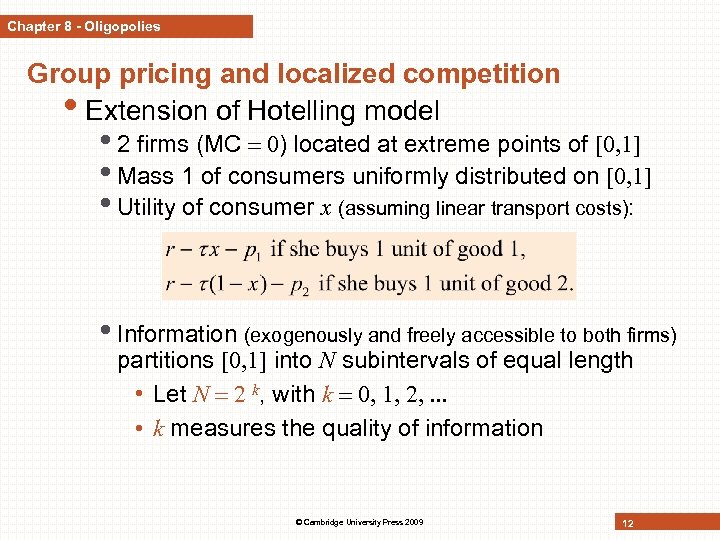 Chapter 8 - Oligopolies Group pricing and localized competition • Extension of Hotelling model • 2 firms (MC ) located at extreme points of • Mass 1 of consumers uniformly distributed on • Utility of consumer x (assuming linear transport costs): • Information (exogenously and freely accessible to both firms) partitions into N subintervals of equal length • Let N k, with k • k measures the quality of information © Cambridge University Press 2009 12
 Chapter 8 - Oligopolies Group pricing and localized competition • 3 -stage game (cont’d) 1. Firms decide to acquire information of quality k or not 2 a. Firms choose their regular price 2 b. Firm(s) with information target(s) specific discount to consumer segments • Pricing decisions (stages 2 a and 2 b) 4 subgames • Neither firms acquires information • Same as linear Hotelling model (see Chapter 5) • NI, NI • Both firms acquire information • Firm i acquires information; firm j doesn’t © Cambridge University Press 2009 13
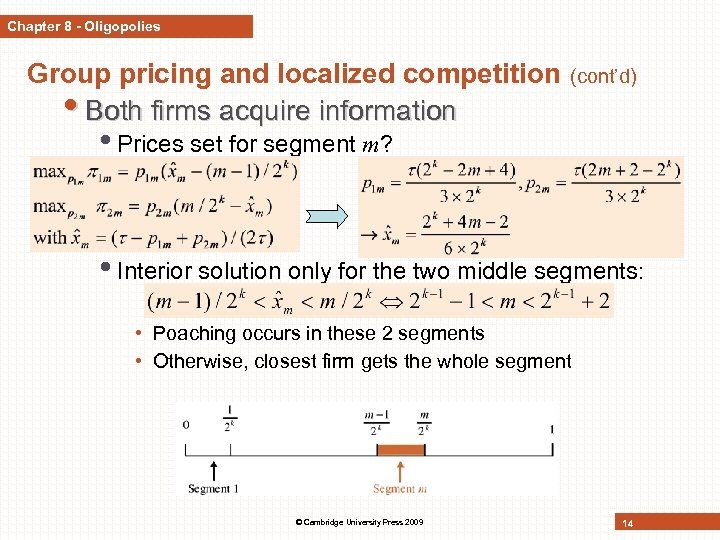 Chapter 8 - Oligopolies Group pricing and localized competition • Both firms acquire information (cont’d) • Prices set for segment m? • Interior solution only for the two middle segments: • Poaching occurs in these 2 segments • Otherwise, closest firm gets the whole segment © Cambridge University Press 2009 14
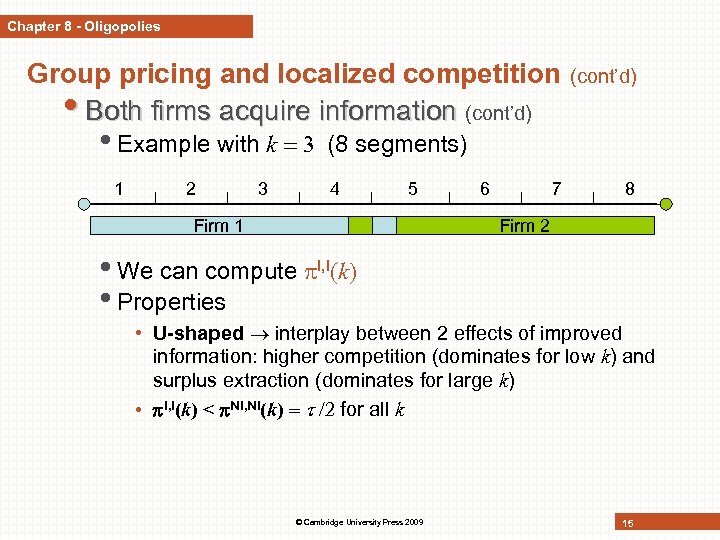 Chapter 8 - Oligopolies Group pricing and localized competition • Both firms acquire information (cont’d) • Example with k (8 segments) 1 2 3 4 5 Firm 1 6 7 8 Firm 2 • We can compute I, I(k) • Properties • U-shaped interplay between 2 effects of improved information: higher competition (dominates for low k) and surplus extraction (dominates for large k) • I, I(k) < NI, NI(k) for all k © Cambridge University Press 2009 15
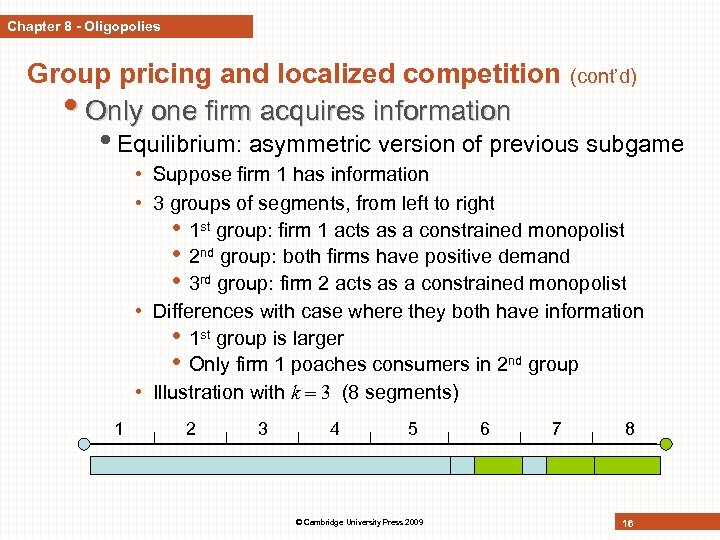 Chapter 8 - Oligopolies Group pricing and localized competition • Only one firm acquires information (cont’d) • Equilibrium: asymmetric version of previous subgame • Suppose firm 1 has information • 3 groups of segments, from left to right • 1 st group: firm 1 acts as a constrained monopolist • 2 nd group: both firms have positive demand • 3 rd group: firm 2 acts as a constrained monopolist • Differences with case where they both have information • 1 st group is larger • Only firm 1 poaches consumers in 2 nd group • Illustration with k (8 segments) 1 2 3 4 5 © Cambridge University Press 2009 6 7 8 16
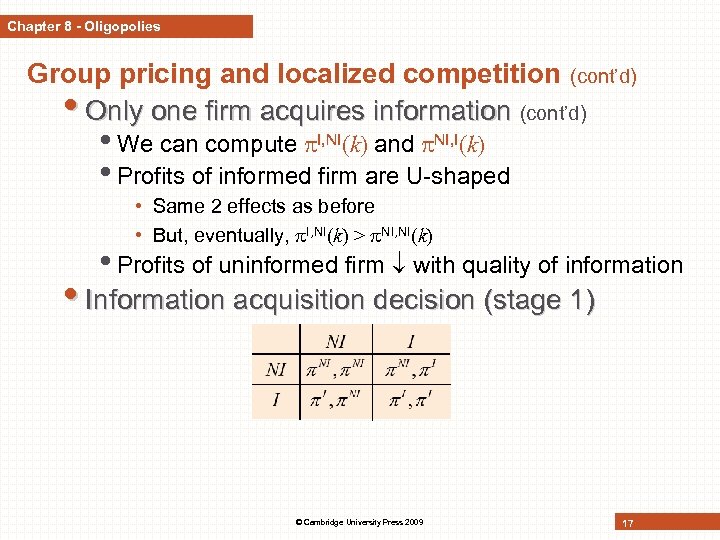 Chapter 8 - Oligopolies Group pricing and localized competition (cont’d) • Only one firm acquires information (cont’d) • We can compute I, NI(k) and NI, I(k) • Profits of informed firm are U-shaped • Same 2 effects as before • But, eventually, I, NI(k) > NI, NI(k) • Profits of uninformed firm with quality of information • Information acquisition decision (stage 1) © Cambridge University Press 2009 17
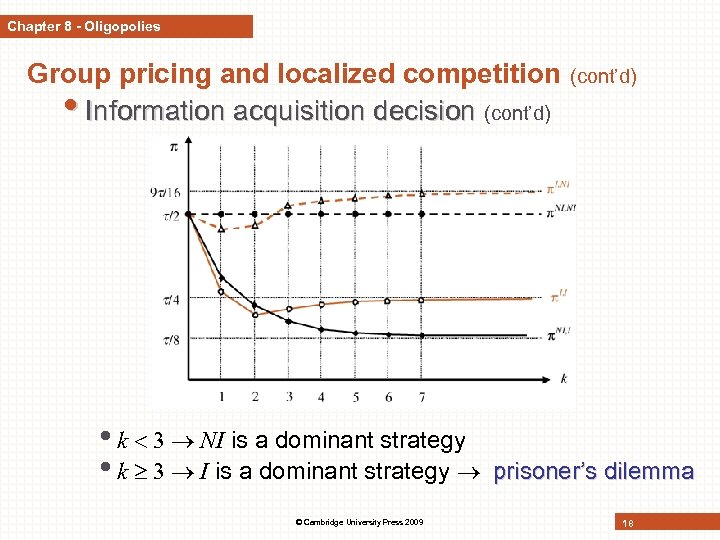 Chapter 8 - Oligopolies Group pricing and localized competition • Information acquisition decision (cont’d) • k NI is a dominant strategy • k I is a dominant strategy prisoner’s dilemma © Cambridge University Press 2009 18
 Chapter 8 - Oligopolies Group pricing and localized competition (cont’d) • Lesson: In a competitive setting, customer-specific information impacts firms in 2 conflicting ways: • firms can extract more surplus from each consumer; • price competition is exacerbated. When the quality of information is sufficiently large, the former effect dominates the latter. Then, firms use the information and price discriminate at equilibrium. However, they may well be better off if they could jointly agree not to use information. © Cambridge University Press 2009 19
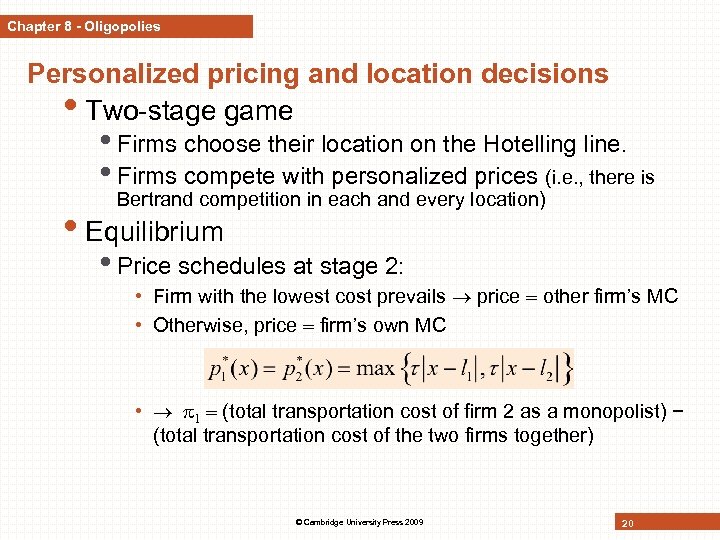 Chapter 8 - Oligopolies Personalized pricing and location decisions • Two-stage game • Firms choose their location on the Hotelling line. • Firms compete with personalized prices (i. e. , there is Bertrand competition in each and every location) • Equilibrium • Price schedules at stage 2: • Firm with the lowest cost prevails price other firm’s MC • Otherwise, price firm’s own MC • 1 (total transportation cost of firm 2 as a monopolist) − (total transportation cost of the two firms together) © Cambridge University Press 2009 20
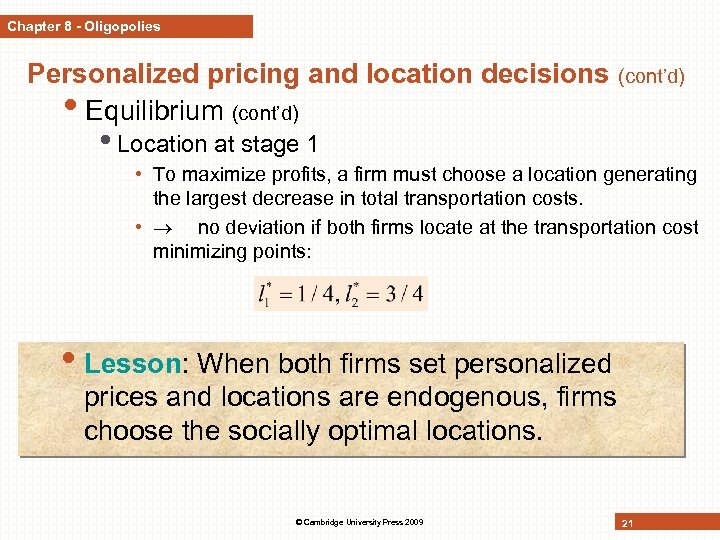 Chapter 8 - Oligopolies Personalized pricing and location decisions • Equilibrium (cont’d) • Location at stage 1 • To maximize profits, a firm must choose a location generating the largest decrease in total transportation costs. • no deviation if both firms locate at the transportation cost minimizing points: • Lesson: When both firms set personalized prices and locations are endogenous, firms choose the socially optimal locations. © Cambridge University Press 2009 21
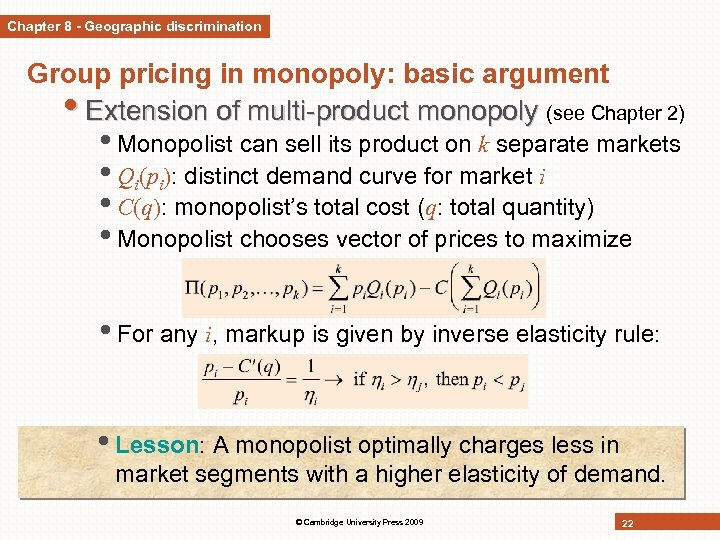 Chapter 8 - Geographic discrimination Group pricing in monopoly: basic argument • Extension of multi-product monopoly (see Chapter 2) • Monopolist can sell its product on k separate markets • Qi(pi): distinct demand curve for market i • C(q): monopolist’s total cost (q: total quantity) • Monopolist chooses vector of prices to maximize • For any i, markup is given by inverse elasticity rule: • Lesson: A monopolist optimally charges less in market segments with a higher elasticity of demand. © Cambridge University Press 2009 22
 Chapter 8 - Geographic discrimination Case. International price discrimination in the textbook market (Cabolis et al. , 2006) • Differences in book prices, US vs. elsewhere • No difference for general audience books • Textbooks substantially more expensive in the US • Why? • No cost factor (most textbooks are printed in the US) • must be due to different demand elasticities • Demand less elastic in the U. S. because teachers require a single comprehensive textbook per course (not so much the tradition in European universities) • Arbitrage is prevented: “International edition. Not for sale in the US” © Cambridge University Press 2009 23
 Chapter 8 - Geographic discrimination Oligopolistic international pricing • Effects of competition? • Geographical price discrimination exists in oligopolistic industries (e. g. , car industry; see Case 8. 4) • But, strategic motives may lead firms to set a uniform price on all geographical segments. • Why? • Suppose firm active on several market segments. • Some segments are more competitive than others. • Commitment to set same price everywhere price on competitive market segments softened price competition profits on these segments. • May outweigh benefit of adapting prices to local conditions. • (See specific model in book) © Cambridge University Press 2009 24
 Chapter 8 - Geographic discrimination Case. Pricing by supermarkets in the UK • Inquiry of UK Competition Commission • April 1999 to July 2000 • Among 15 leading supermarket groups • 8 priced uniformly • 7 adjusted prices to local conditions • For a limited number of products • Average level of difference between minimum and maximum prices for each product: 4. 3 to 19. 2% © Cambridge University Press 2009 25
 Chapter 8 - Review questions • In which industries do we observe group pricing? Provide two examples. • Does an increase in competition lead to more or less (third-degree) price discrimination? Discuss. • How does the ability to geographically price discriminate affect location decisions of firms? • What is an empirical regularity concerning international price discrimination? © Cambridge University Press 2009 26
 Part IV. Pricing strategies and market segmentation Chapter 9. Menu pricing Slides Industrial Organization: Markets and Strategies Paul Belleflamme and Martin Peitz © Cambridge University Press 2009
 Chapter 9 - Objectives Chapter 9. Learning objectives • Be able to make a clear difference between menu pricing and group pricing. • Understand how a monopolist sets menu prices and under which conditions menu pricing leads to higher profits than uniform pricing. • Assess the welfare effects of menu pricing. • Analyze quality- and quantity-based menu pricing in oligopolistic settings. © Cambridge University Press 2009 28
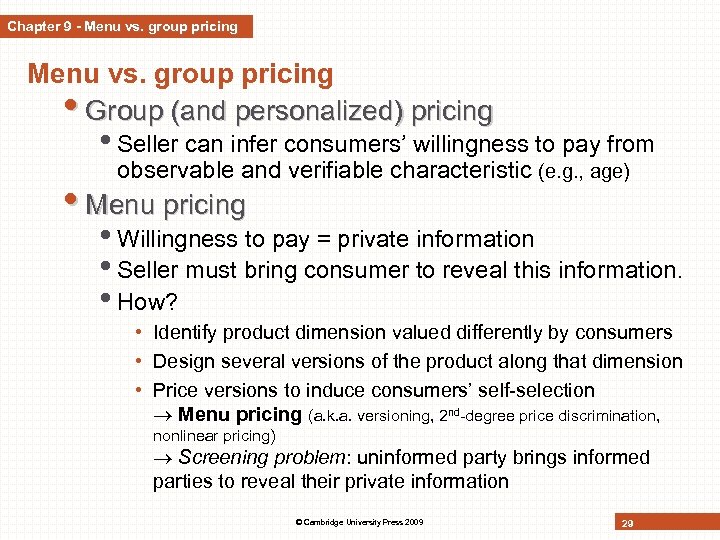 Chapter 9 - Menu vs. group pricing • Group (and personalized) pricing • Seller can infer consumers’ willingness to pay from observable and verifiable characteristic (e. g. , age) • Menu pricing • Willingness to pay = private information • Seller must bring consumer to reveal this information. • How? • Identify product dimension valued differently by consumers • Design several versions of the product along that dimension • Price versions to induce consumers’ self-selection Menu pricing (a. k. a. versioning, 2 nd-degree price discrimination, nonlinear pricing) Screening problem: uninformed party brings informed parties to reveal their private information © Cambridge University Press 2009 29
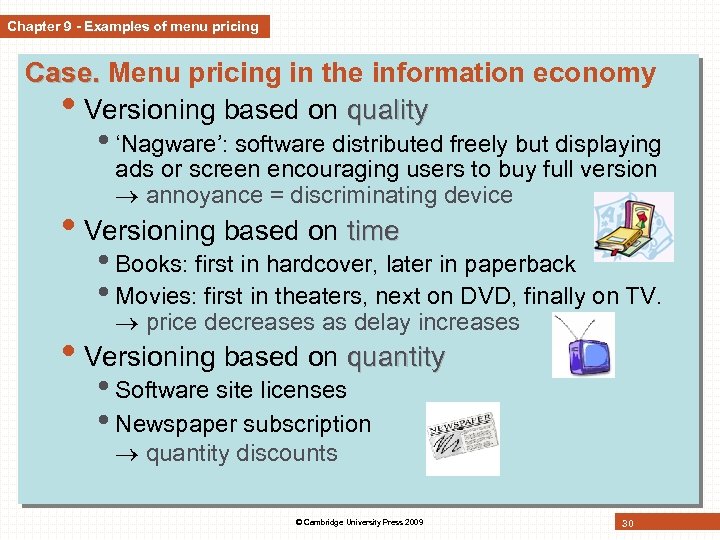 Chapter 9 - Examples of menu pricing Case. Menu pricing in the information economy • Versioning based on quality • ‘Nagware’: software distributed freely but displaying ads or screen encouraging users to buy full version annoyance = discriminating device • Versioning based on time • Books: first in hardcover, later in paperback • Movies: first in theaters, next on DVD, finally on TV. price decreases as delay increases • Versioning based on quantity • Software site licenses • Newspaper subscription quantity discounts © Cambridge University Press 2009 30
 Chapter 9 - Examples of menu pricing Case. Geographical pricing by LCCs • Low Cost Carriers have abandoned many of the price discrimination tactics of the airline industry • ‘Point-to-point’ tickets, ‘no-frills’ flights • But, geographical price discrimination on their website (Bachis and Piga, 2006) • Example: London-Madrid flight • 1 st leg for British traveller, fare offered in £ • Return leg for Spanish traveller, fare offered in € • If booking occurs at same time and no price discrimination, then ratio of prices = exchange rate • Yet, difference of at least 7£ for 450 000 observations • Despite possibility of arbitrage. © Cambridge University Press 2009 31
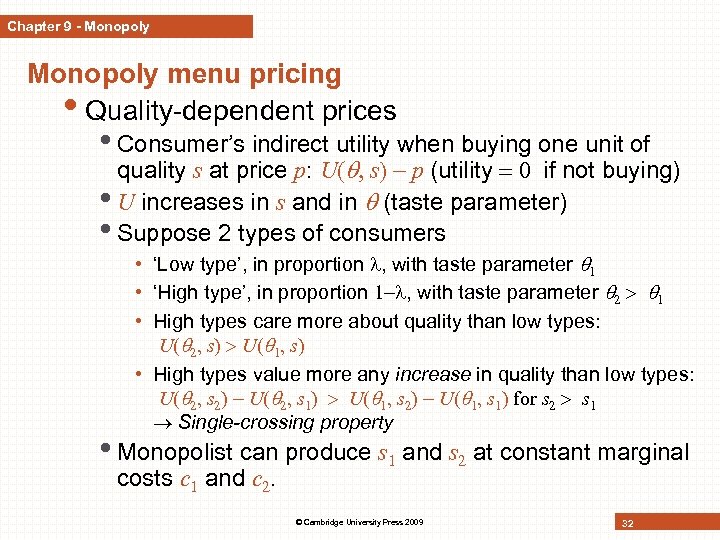 Chapter 9 - Monopoly menu pricing • Quality-dependent prices • Consumer’s indirect utility when buying one unit of quality s at price p: U( , s) p (utility if not buying) • U increases in s and in (taste parameter) • Suppose 2 types of consumers • ‘Low type’, in proportion , with taste parameter • ‘High type’, in proportion , with taste parameter • High types care more about quality than low types: U( , s) • High types value more any increase in quality than low types: U( , s ) for s s Single-crossing property • Monopolist can produce s 1 and s 2 at constant marginal costs c 1 and c 2. © Cambridge University Press 2009 32
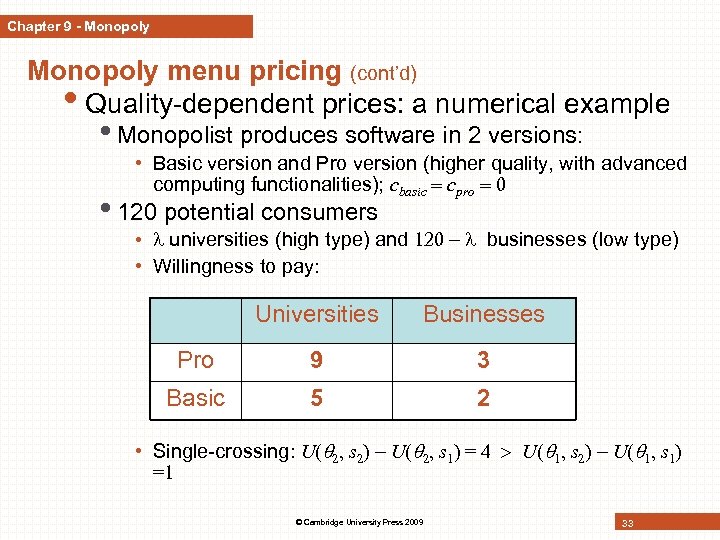 Chapter 9 - Monopoly menu pricing (cont’d) • Quality-dependent prices: a numerical example • Monopolist produces software in 2 versions: • Basic version and Pro version (higher quality, with advanced computing functionalities); cbasic cpro • 120 potential consumers • universities (high type) and businesses (low type) • Willingness to pay: Universities Businesses Pro 9 3 Basic 5 2 • Single-crossing: U( , s ) = 4 U( , s ) =1 © Cambridge University Press 2009 33
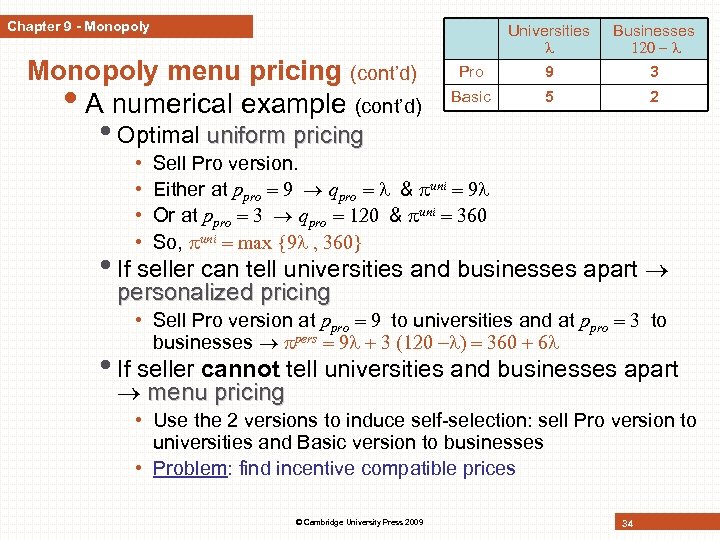 Chapter 9 - Monopoly menu pricing (cont’d) • A numerical example (cont’d) Universities Businesses Pro 9 3 Basic 5 2 • Optimal uniform pricing • • Sell Pro version. Either at ppro qpro & uni Or at ppro qpro & uni So, uni max • If seller can tell universities and businesses apart personalized pricing • Sell Pro version at ppro to universities and at ppro to businesses pers • If seller cannot tell universities and businesses apart menu pricing • Use the 2 versions to induce self-selection: sell Pro version to universities and Basic version to businesses • Problem: find incentive compatible prices © Cambridge University Press 2009 34
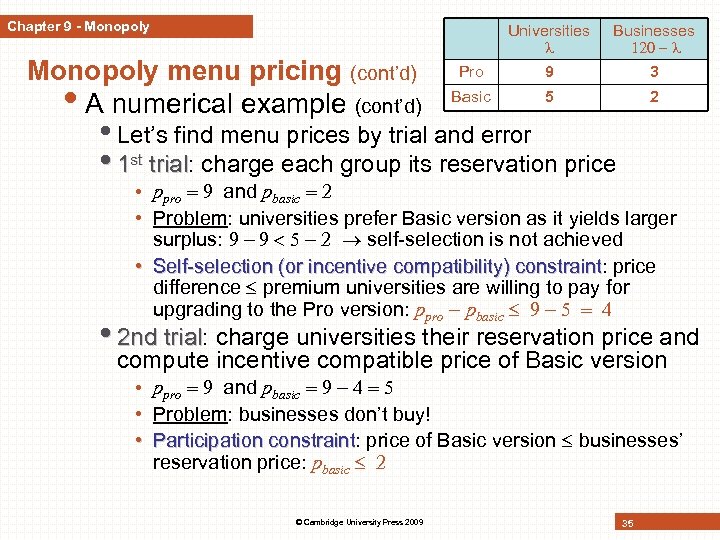 Chapter 9 - Monopoly menu pricing (cont’d) • A numerical example (cont’d) Universities Businesses Pro 9 3 Basic 5 2 • Let’s find menu prices by trial and error • 1 st trial: charge each group its reservation price trial • ppro and pbasic • Problem: universities prefer Basic version as it yields larger surplus: self-selection is not achieved • Self-selection (or incentive compatibility) constraint: price constraint difference premium universities are willing to pay for upgrading to the Pro version: ppro pbasic • 2 nd trial: charge universities their reservation price and trial compute incentive compatible price of Basic version • ppro and pbasic • Problem: businesses don’t buy! • Participation constraint: price of Basic version businesses’ constraint reservation price: pbasic © Cambridge University Press 2009 35
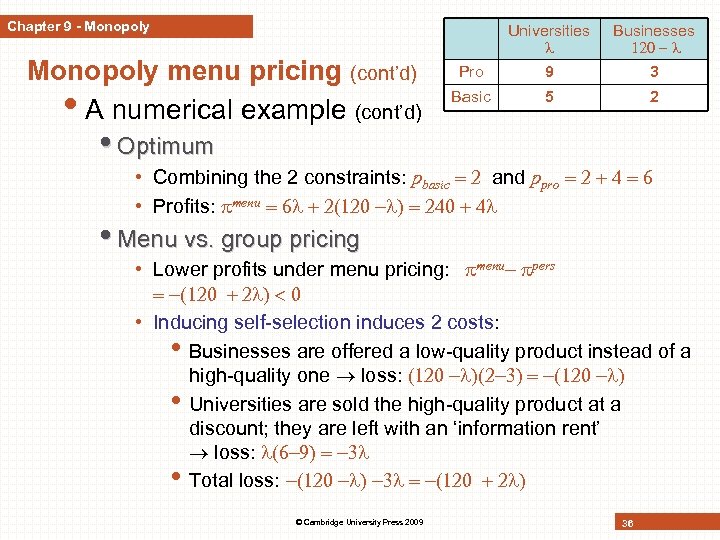 Chapter 9 - Monopoly menu pricing (cont’d) • A numerical example (cont’d) Universities Businesses Pro 9 3 Basic 5 2 • Optimum • Combining the 2 constraints: pbasic and ppro • Profits: menu • Menu vs. group pricing • Lower profits under menu pricing: menu pers • Inducing self-selection induces 2 costs: • Businesses are offered a low-quality product instead of a high-quality one loss: • Universities are sold the high-quality product at a discount; they are left with an ‘information rent’ loss: • Total loss: © Cambridge University Press 2009 36
 Chapter 9 - Monopoly menu pricing: summary • Lesson: Consider a monopolist who offers 2 pairs of price and quality to 2 types of consumers. Prices are chosen so as to fully appropriate lowtype’s consumer surplus. High-type consumers obtain a positive surplus (‘information rent’) as they can always choose the low-quality instead. © Cambridge University Press 2009 37
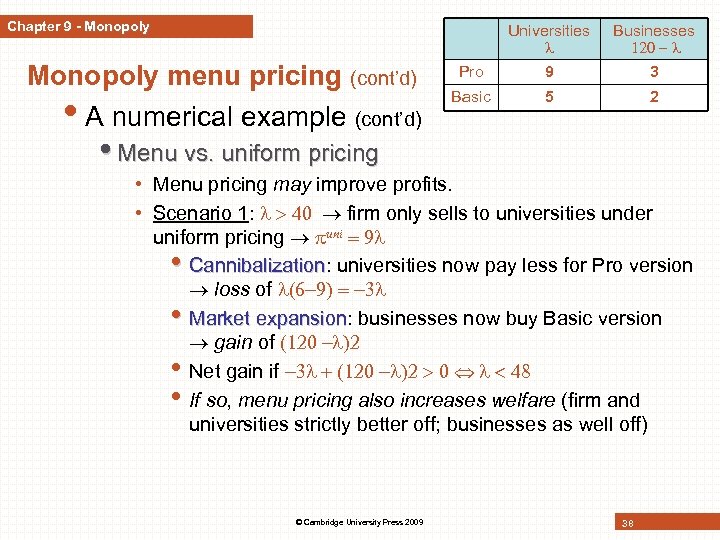 Chapter 9 - Monopoly Universities Monopoly menu pricing (cont’d) • A numerical example (cont’d) Businesses Pro 9 3 Basic 5 2 • Menu vs. uniform pricing • Menu pricing may improve profits. • Scenario 1: firm only sells to universities under uniform pricing uni • Cannibalization: universities now pay less for Pro version Cannibalization loss of • Market expansion: businesses now buy Basic version ansion gain of • Net gain if • If so, menu pricing also increases welfare (firm and universities strictly better off; businesses as well off) © Cambridge University Press 2009 38
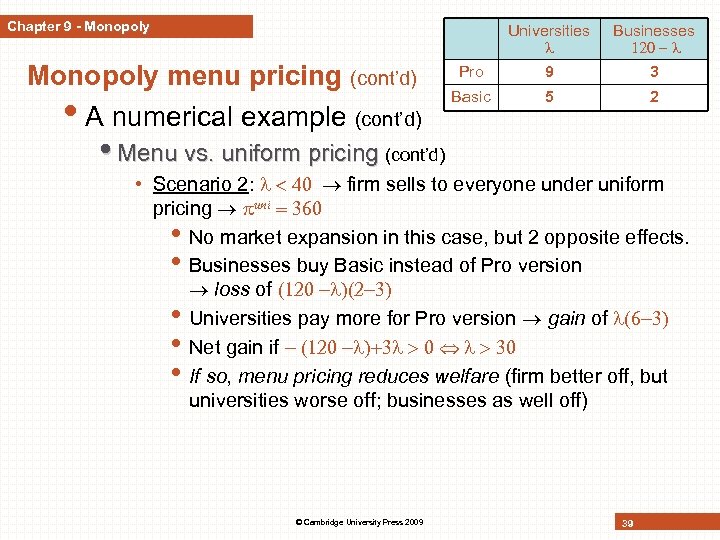 Chapter 9 - Monopoly Universities Monopoly menu pricing (cont’d) • A numerical example (cont’d) Businesses Pro 9 3 Basic 5 2 • Menu vs. uniform pricing (cont’d) • Scenario 2: firm sells to everyone under uniform pricing uni • No market expansion in this case, but 2 opposite effects. • Businesses buy Basic instead of Pro version loss of • Universities pay more for Pro version gain of • Net gain if • If so, menu pricing reduces welfare (firm better off, but universities worse off; businesses as well off) © Cambridge University Press 2009 39
 Chapter 9 - Monopoly menu pricing: summary • Lesson: Menu pricing is optimal (i) if proportion of high-type consumers is neither too small nor too large, and (ii) if going from low to high quality increases surplus proportionally more for hightype consumers than for low-type consumers. • Lesson: Menu pricing improves welfare if selling the low quality leads to an expansion of the market; otherwise, menu pricing deteriorates welfare. © Cambridge University Press 2009 40
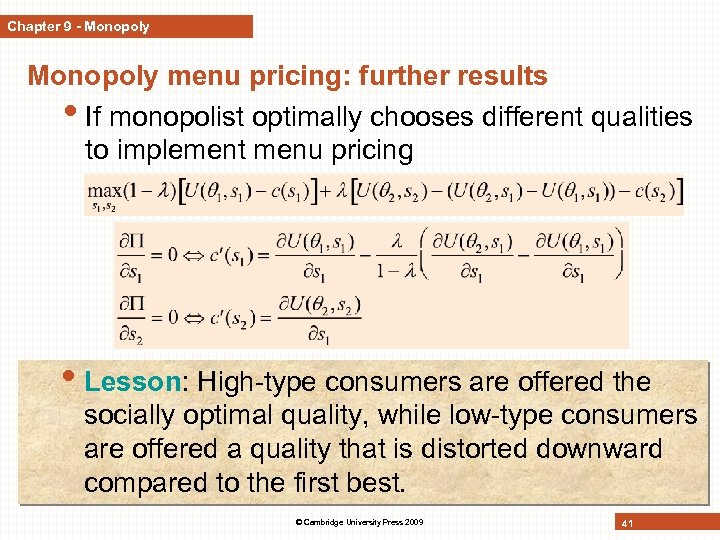 Chapter 9 - Monopoly menu pricing: further results • If monopolist optimally chooses different qualities to implement menu pricing • Lesson: High-type consumers are offered the socially optimal quality, while low-type consumers are offered a quality that is distorted downward compared to the first best. © Cambridge University Press 2009 41
 Chapter 9 - Monopoly menu pricing: further results • Damaged good strategy may be profitable • Firm intentionally damages portion of the goods to price discriminate. Case. Damaged goods • IBM Laser. Printer E identical to original printer, but • • software limited printing to 5 rather than 10 pages/minute Sony Mini. Disc 60’ curbed 74’ disc Sharp DVD players DVE 611 and DV 740 U are almost similar, but DV 740 U does not allow user to play output encoded in PAL format on NTSC televisions (a critical button is hidden on the remote) © Cambridge University Press 2009 42
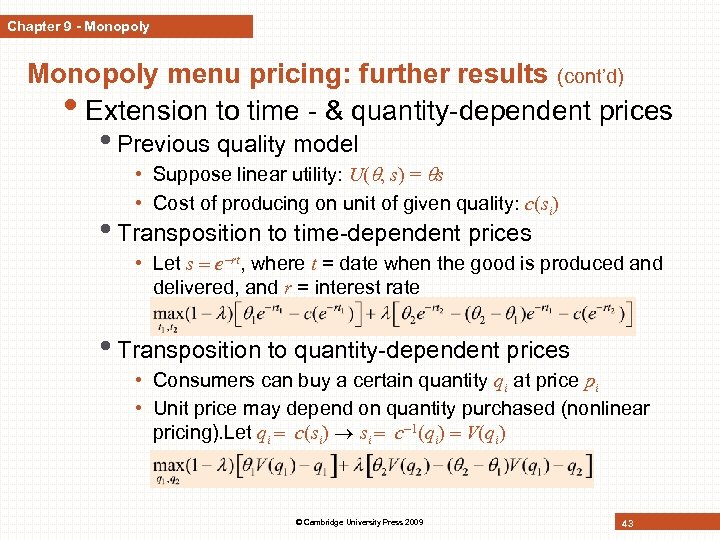 Chapter 9 - Monopoly menu pricing: further results (cont’d) • Extension to time - & quantity-dependent prices • Previous quality model • Suppose linear utility: U( , s) = s • Cost of producing on unit of given quality: c(si) • Transposition to time-dependent prices • Let s e rt, where t = date when the good is produced and delivered, and r = interest rate • Transposition to quantity-dependent prices • Consumers can buy a certain quantity qi at price pi • Unit price may depend on quantity purchased (nonlinear pricing). Let qi c(si) si c (qi V(qi) © Cambridge University Press 2009 43
 Chapter 9 - Menu pricing & imperfect competition Menu pricing under imperfect competition • Monopoly setting gives useful insights. • But, we want to know how menu pricing is affected by - and affects - competition. • E. g. : airline travel • Empirical studies suggest that competition tends to reinforce price discrimination • Borenstein (1991): number of stations offering leaded gas difference between margins on unleaded and leaded gas • 2 extensions of Hotelling model • Quality-based menu pricing • Two-part tariffs (quantity-based menu pricing) © Cambridge University Press 2009 44
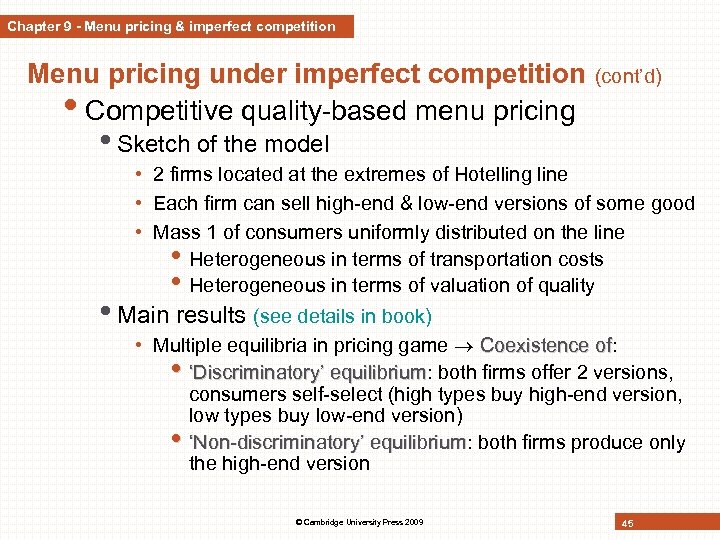 Chapter 9 - Menu pricing & imperfect competition Menu pricing under imperfect competition (cont’d) • Competitive quality-based menu pricing • Sketch of the model • 2 firms located at the extremes of Hotelling line • Each firm can sell high-end & low-end versions of some good • Mass 1 of consumers uniformly distributed on the line • Heterogeneous in terms of transportation costs • Heterogeneous in terms of valuation of quality • Main results (see details in book) • Multiple equilibria in pricing game Coexistence of: of • ‘Discriminatory’ equilibrium: both firms offer 2 versions, equilibrium consumers self-select (high types buy high-end version, low types buy low-end version) • ‘Non-discriminatory’ equilibrium: both firms produce only equilibrium the high-end version © Cambridge University Press 2009 45
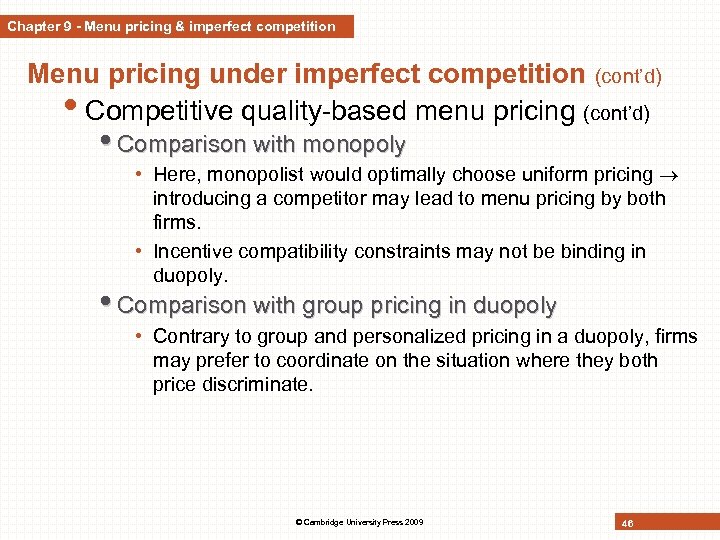 Chapter 9 - Menu pricing & imperfect competition Menu pricing under imperfect competition (cont’d) • Competitive quality-based menu pricing (cont’d) • Comparison with monopoly • Here, monopolist would optimally choose uniform pricing introducing a competitor may lead to menu pricing by both firms. • Incentive compatibility constraints may not be binding in duopoly. • Comparison with group pricing in duopoly • Contrary to group and personalized pricing in a duopoly, firms may prefer to coordinate on the situation where they both price discriminate. © Cambridge University Press 2009 46
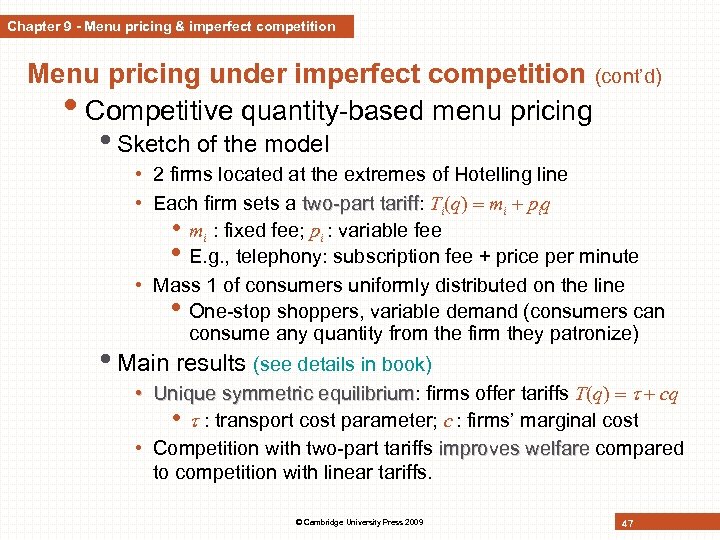 Chapter 9 - Menu pricing & imperfect competition Menu pricing under imperfect competition (cont’d) • Competitive quantity-based menu pricing • Sketch of the model • 2 firms located at the extremes of Hotelling line • Each firm sets a two-part tariff: Ti(q) mi piq tariff • mi : fixed fee; pi : variable fee • E. g. , telephony: subscription fee + price per minute • Mass 1 of consumers uniformly distributed on the line • One-stop shoppers, variable demand (consumers can consume any quantity from the firm they patronize) • Main results (see details in book) • Unique symmetric equilibrium: firms offer tariffs T(q) cq equilibrium • : transport cost parameter; c : firms’ marginal cost • Competition with two-part tariffs improves welfare compared to competition with linear tariffs. © Cambridge University Press 2009 47
 Chapter 9 - Review questions • Suppose a firm can target two groups of consumers by a menu of prices with different qualities but that it can also offer different prices to different consumer groups. What should it do? • When does menu pricing dominate uniform pricing in monopoly? Discuss the countervailing effects. • How does competition affect the use of menu pricing? Discuss. • What are the effects of competition on quantitybased menu pricing? © Cambridge University Press 2009 48
 Part IV. Pricing strategies and market segmentation Chapter 11. Bundling Slides Industrial Organization: Markets and Strategies Paul Belleflamme and Martin Peitz © Cambridge University Press 2009
 Chapter 11 - Objectives Chapter 11. Learning objectives • Identify the difference between bundling (mixed and pure) and tying. • Understand how a monopolist can use bundling and tying as a price discrimination device. • Analyse the effects of bundling on competition in oligopolistic markets. • Understand how bundling, depending on the circumstances, leads to a softer or a tougher price competition. © Cambridge University Press 2010 50
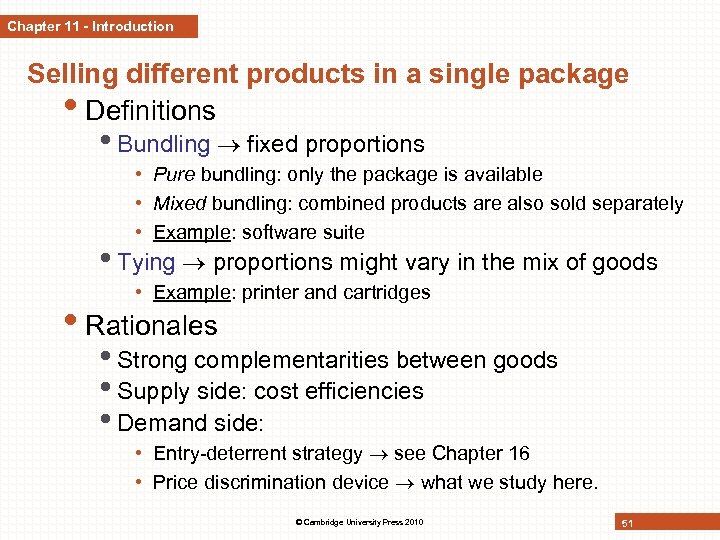 Chapter 11 - Introduction Selling different products in a single package • Definitions • Bundling fixed proportions • Pure bundling: only the package is available • Mixed bundling: combined products are also sold separately • Example: software suite • Tying proportions might vary in the mix of goods • Example: printer and cartridges • Rationales • Strong complementarities between goods • Supply side: cost efficiencies • Demand side: • Entry-deterrent strategy see Chapter 16 • Price discrimination device what we study here. © Cambridge University Press 2010 51
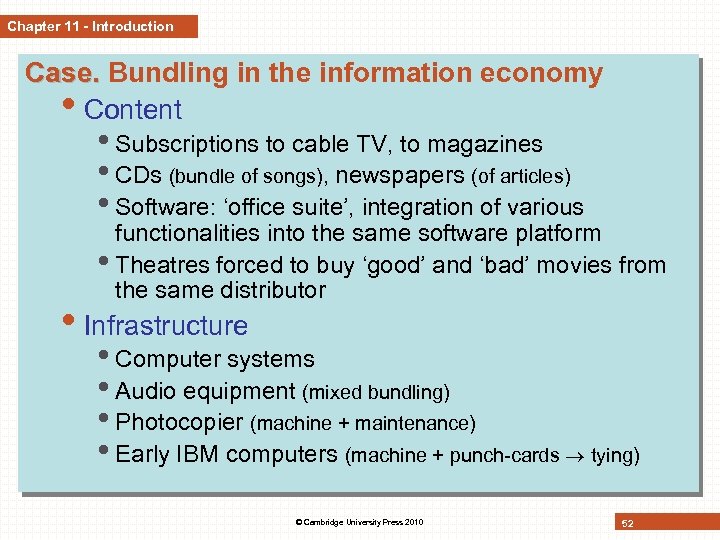 Chapter 11 - Introduction Case. Bundling in the information economy • Content • Subscriptions to cable TV, to magazines • CDs (bundle of songs), newspapers (of articles) • Software: ‘office suite’, integration of various functionalities into the same software platform • Theatres forced to buy ‘good’ and ‘bad’ movies from the same distributor • Infrastructure • Computer systems • Audio equipment (mixed bundling) • Photocopier (machine + maintenance) • Early IBM computers (machine + punch-cards tying) © Cambridge University Press 2010 52
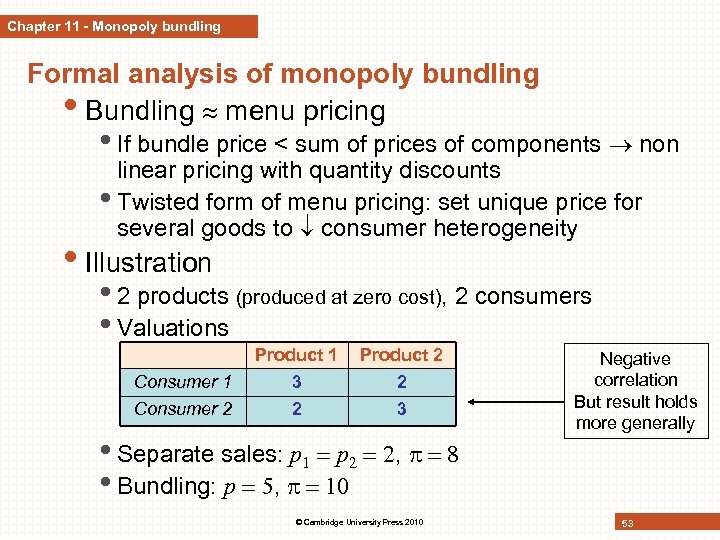 Chapter 11 - Monopoly bundling Formal analysis of monopoly bundling • Bundling menu pricing • If bundle price < sum of prices of components non linear pricing with quantity discounts • Twisted form of menu pricing: set unique price for several goods to consumer heterogeneity • Illustration • 2 products (produced at zero cost), 2 consumers • Valuations Consumer 1 Product 1 3 Product 2 2 Consumer 2 2 3 • Separate sales: p 1 p 2 , • Bundling: p , © Cambridge University Press 2010 Negative correlation But result holds more generally 53
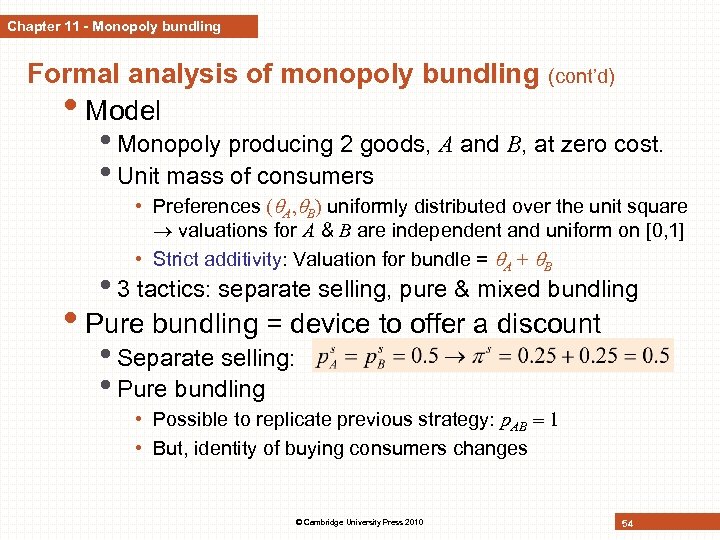 Chapter 11 - Monopoly bundling Formal analysis of monopoly bundling • Model (cont’d) • Monopoly producing 2 goods, A and B, at zero cost. • Unit mass of consumers • Preferences ( A, B) uniformly distributed over the unit square valuations for A & B are independent and uniform on [0, 1] • Strict additivity: Valuation for bundle = A + B • 3 tactics: separate selling, pure & mixed bundling • Pure bundling = device to offer a discount • Separate selling: • Pure bundling • Possible to replicate previous strategy: p. AB • But, identity of buying consumers changes © Cambridge University Press 2010 54
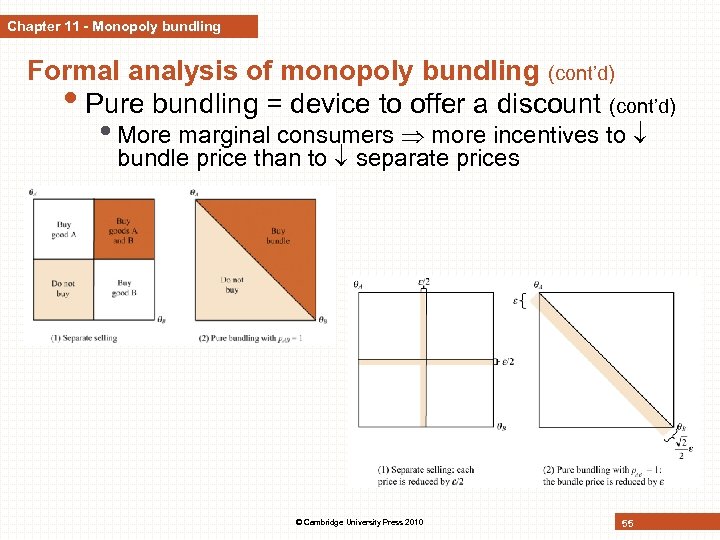 Chapter 11 - Monopoly bundling Formal analysis of monopoly bundling (cont’d) • Pure bundling = device to offer a discount (cont’d) • More marginal consumers more incentives to bundle price than to separate prices © Cambridge University Press 2010 55
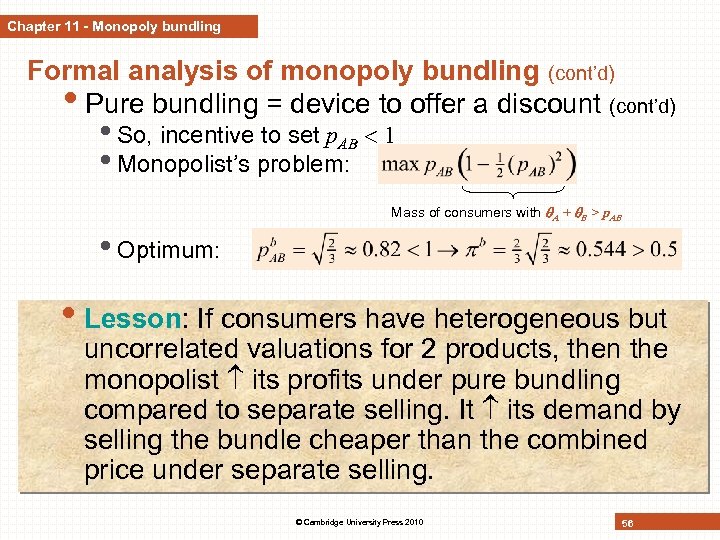 Chapter 11 - Monopoly bundling Formal analysis of monopoly bundling (cont’d) • Pure bundling = device to offer a discount (cont’d) • So, incentive to set p. AB • Monopolist’s problem: Mass of consumers with A + B > p. AB • Optimum: • Lesson: If consumers have heterogeneous but uncorrelated valuations for 2 products, then the monopolist its profits under pure bundling compared to separate selling. It its demand by selling the bundle cheaper than the combined price under separate selling. © Cambridge University Press 2010 56
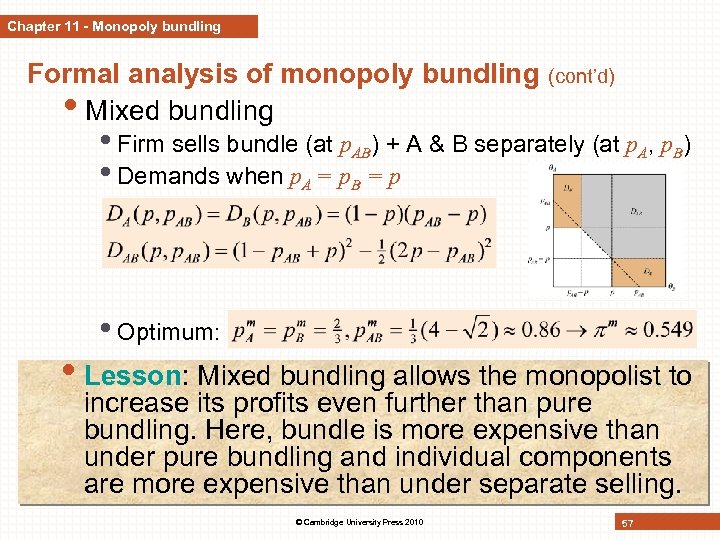 Chapter 11 - Monopoly bundling Formal analysis of monopoly bundling • Mixed bundling (cont’d) • Firm sells bundle (at p. AB) + A & B separately (at p. A, p. B) • Demands when p. A = p. B = p • Optimum: • Lesson: Mixed bundling allows the monopolist to increase its profits even further than pure bundling. Here, bundle is more expensive than under pure bundling and individual components are more expensive than under separate selling. © Cambridge University Press 2010 57
 Chapter 11 - Monopoly bundling Formal analysis of monopoly bundling • Extensions (cont’d) • Interrelated products • Valuation of the bundle: AB = (1+ ) ( A + B) • substitutes • complements • Result: the advantage that pure bundling has over separate selling tends to as the synergies between the 2 products become stronger. • Correlated values • Previous result: pure bundling improves profit over separate selling when the 2 products are independently valued. • Here, suppose A uniformly distributed over [0, 1] and B = A + (1 )(1 A) • values are perfectly positively correlated • values are perfectly negatively correlated • Compare pure bundling and separate selling © Cambridge University Press 2010 58
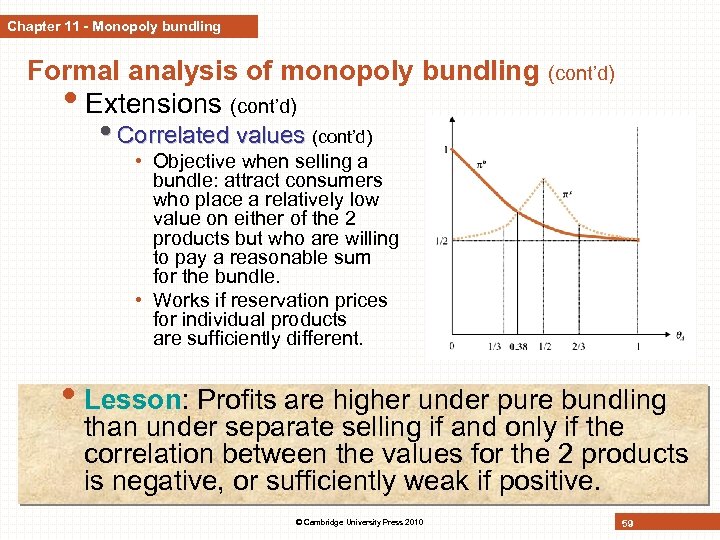 Chapter 11 - Monopoly bundling Formal analysis of monopoly bundling • Extensions (cont’d) • Correlated values (cont’d) • Objective when selling a bundle: attract consumers who place a relatively low value on either of the 2 products but who are willing to pay a reasonable sum for the bundle. • Works if reservation prices for individual products are sufficiently different. • Lesson: Profits are higher under pure bundling than under separate selling if and only if the correlation between the values for the 2 products is negative, or sufficiently weak if positive. © Cambridge University Press 2010 59
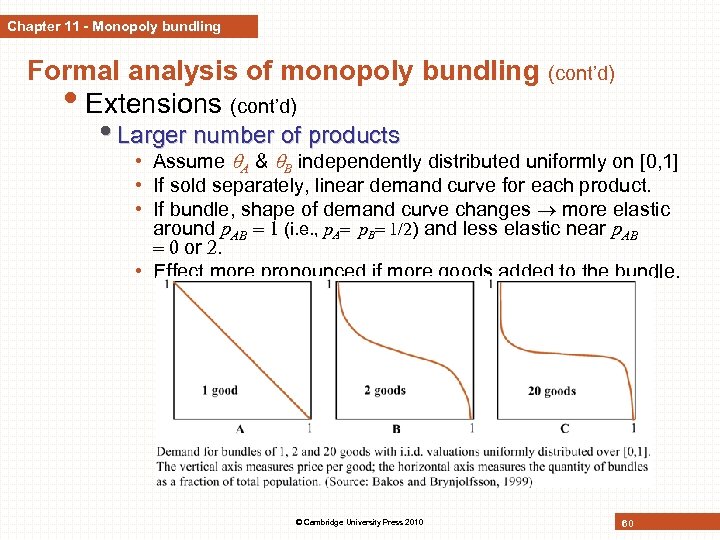 Chapter 11 - Monopoly bundling Formal analysis of monopoly bundling • Extensions (cont’d) • Larger number of products • Assume A & B independently distributed uniformly on [0, 1] • If sold separately, linear demand curve for each product. • If bundle, shape of demand curve changes more elastic around p. AB (i. e. , p. A p. B ) and less elastic near p. AB or • Effect more pronounced if more goods added to the bundle. © Cambridge University Press 2010 60
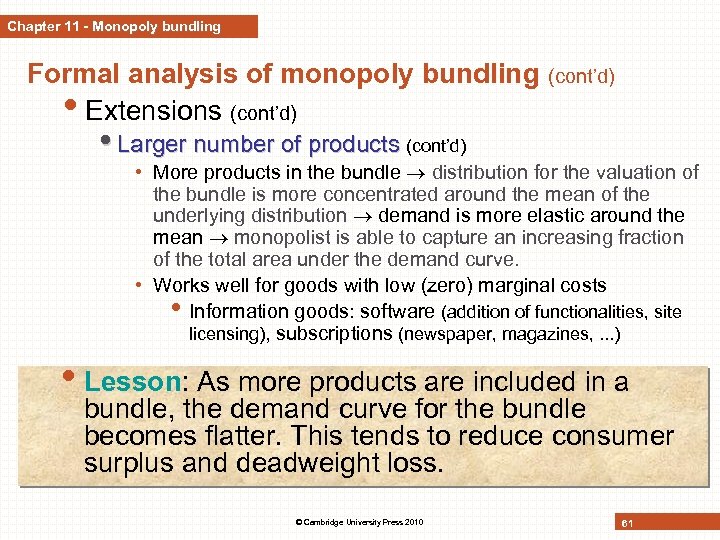 Chapter 11 - Monopoly bundling Formal analysis of monopoly bundling • Extensions (cont’d) • Larger number of products (cont’d) • More products in the bundle distribution for the valuation of the bundle is more concentrated around the mean of the underlying distribution demand is more elastic around the mean monopolist is able to capture an increasing fraction of the total area under the demand curve. • Works well for goods with low (zero) marginal costs • Information goods: software (addition of functionalities, site licensing), subscriptions (newspaper, magazines, . . . ) • Lesson: As more products are included in a bundle, the demand curve for the bundle becomes flatter. This tends to reduce consumer surplus and deadweight loss. © Cambridge University Press 2010 61
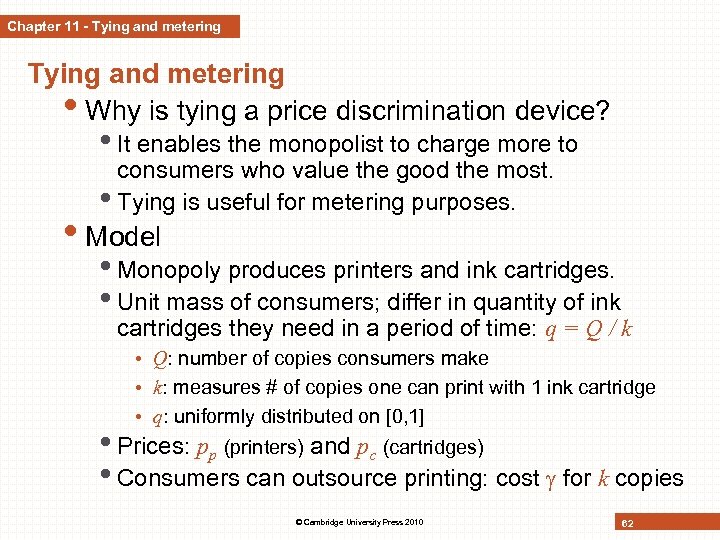 Chapter 11 - Tying and metering • Why is tying a price discrimination device? • It enables the monopolist to charge more to consumers who value the good the most. • Tying is useful for metering purposes. • Model • Monopoly produces printers and ink cartridges. • Unit mass of consumers; differ in quantity of ink cartridges they need in a period of time: q = Q / k • Q: number of copies consumers make • k: measures # of copies one can print with 1 ink cartridge • q: uniformly distributed on [0, 1] • Prices: pp (printers) and pc (cartridges) • Consumers can outsource printing: cost for k copies © Cambridge University Press 2010 62
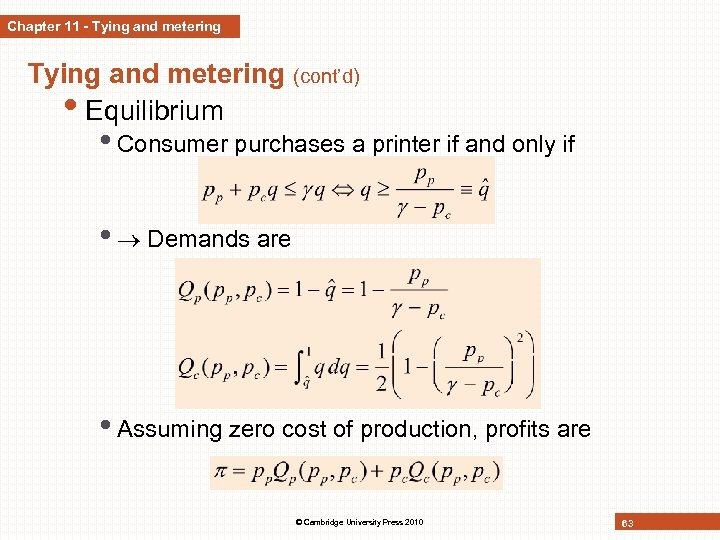 Chapter 11 - Tying and metering (cont’d) • Equilibrium • Consumer purchases a printer if and only if • Demands are • Assuming zero cost of production, profits are © Cambridge University Press 2010 63
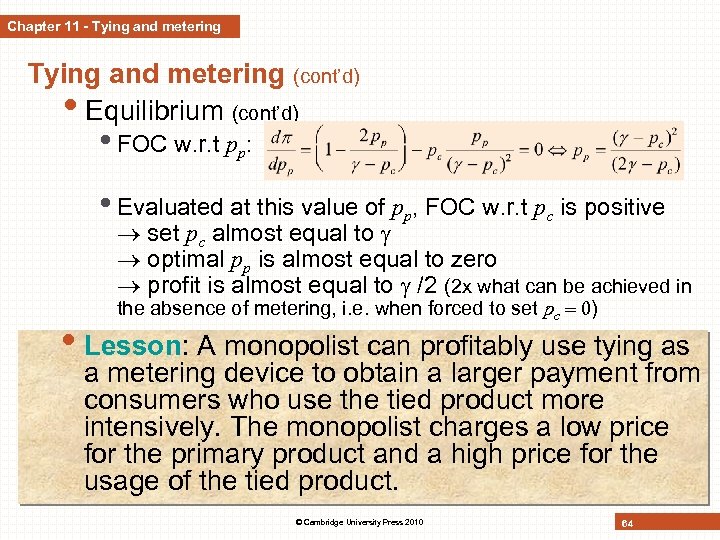 Chapter 11 - Tying and metering (cont’d) • Equilibrium (cont’d) • FOC w. r. t pp: • Evaluated at this value of pp, FOC w. r. t pc is positive set pc almost equal to optimal pp is almost equal to zero profit is almost equal to /2 (2 x what can be achieved in the absence of metering, i. e. when forced to set pc ) • Lesson: A monopolist can profitably use tying as a metering device to obtain a larger payment from consumers who use the tied product more intensively. The monopolist charges a low price for the primary product and a high price for the usage of the tied product. © Cambridge University Press 2010 64
 Chapter 11 - Tying and metering Case. Popcorn in movie theatres • Why does popcorn cost so much at the movies? • Theatres optimally choose to shift profits from admission tickets to concessions because they can ‘meter’ the surplus extracted from a customer by how much of the aftermarket good they demand. • If true, positive correlation between willingness to pay for movies and demand for concessions. • Hartmann and Gil (2008) confirms this conjecture by analysing a data set with approximately 5 years of weekly attendance, box office revenue and concession revenue for a chain of 43 Spanish movie theatres. © Cambridge University Press 2010 65
 Chapter 11 - Competitive bundling • Bundling is often used by competing firms. • Motivation? • Entry deterrence analyzed in Chapter 16 • Price discrimination new question: how does the surplus extraction gains of bundling balance with its competitive effects? • 2 settings • 2 independent goods, one produced by duopoly and the other by a competitive industry bundling softens price competition because it allows firms to differentiate their products • 2 perfect complements (components of a system) bundling intensifies competition because it variety © Cambridge University Press 2010 66
 Chapter 11 - Competitive bundling When bundling softens price competition • Model • Unit mass of consumers • Preferences ( A, B) uniformly distributed over the unit square • Strict additivity: Valuation for bundle = A + B • Firms • Good A produced by firms 1 and 2 at c. A < 1 • Good B produced by perfectly competitive industry at c. B < 1 • Firms 1 and 2 are also able to produce good B. • No incentive to sell it separately (because zero profit) • Question: incentive to bundle B with A? • 2 -stage game • Choice of marketing strategy: ‘A only’ (Specialization), ‘bundle only’ (Pure Bundling) , or ‘A & bundle’ (Mixed Bundling) • Price competition © Cambridge University Press 2010 67
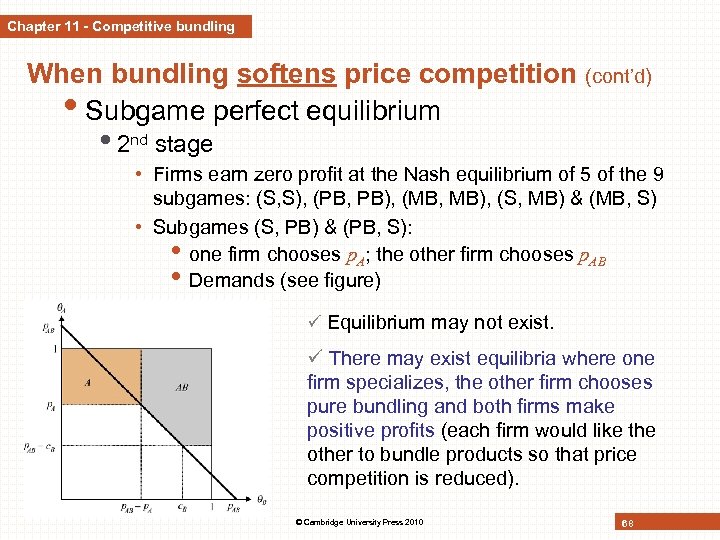 Chapter 11 - Competitive bundling When bundling softens price competition (cont’d) • Subgame perfect equilibrium • 2 nd stage • Firms earn zero profit at the Nash equilibrium of 5 of the 9 subgames: (S, S), (PB, PB), (MB, MB), (S, MB) & (MB, S) • Subgames (S, PB) & (PB, S): • one firm chooses p. A; the other firm chooses p. AB • Demands (see figure) ü Equilibrium may not exist. ü There may exist equilibria where one firm specializes, the other firm chooses pure bundling and both firms make positive profits (each firm would like the other to bundle products so that price competition is reduced). © Cambridge University Press 2010 68
 Chapter 11 - Competitive bundling When bundling softens price competition (cont’d) • Subgame perfect equilibrium • 2 nd stage (cont’d) • Subgames (PB, MB) & (MB, PB): • Bundle sold by both firms price driven down to marginal cost firm having chosen PB makes zero profit. • Firm having chosen MB makes positive profit but lower than if it had chosen S. • 1 st stage: MB is a weakly dominated strategy • Lesson: Consider a homogeneous primary good produced by a duopoly and a secondary good produced competitively. In equilibrium, one firm specializes in the primary good and the other bundles the 2 goods. Both make positive profits though they produce homogeneous goods and compete in price. Bundling acts here as a product differentiation device, which reduces price competition in the primary market. Bundling welfare. © Cambridge University Press 2010 69
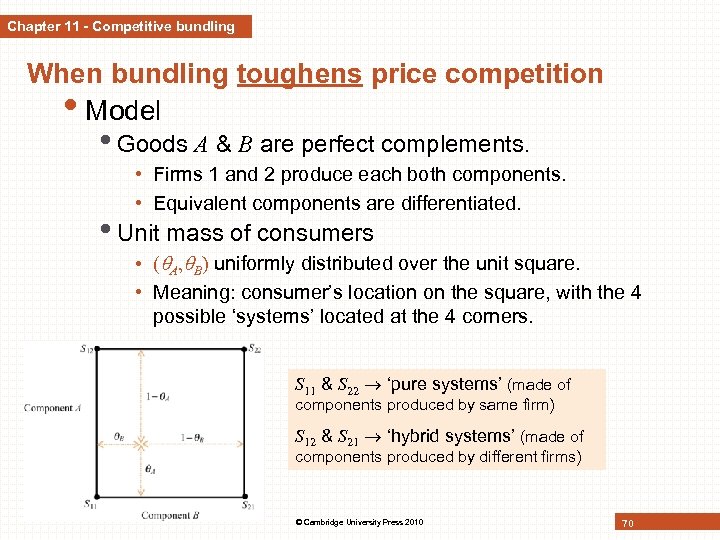 Chapter 11 - Competitive bundling When bundling toughens price competition • Model • Goods A & B are perfect complements. • Firms 1 and 2 produce each both components. • Equivalent components are differentiated. • Unit mass of consumers • ( A, B) uniformly distributed over the unit square. • Meaning: consumer’s location on the square, with the 4 possible ‘systems’ located at the 4 corners. S 11 & S 22 ‘pure systems’ (made of components produced by same firm) S 12 & S 21 ‘hybrid systems’ (made of components produced by different firms) © Cambridge University Press 2010 70
 Chapter 11 - Competitive bundling When bundling toughens price competition (cont’d) • Model • 2 -stage game • Marketing strategy: Separate selling, Pure or Mixed Bundling • Price competition • Main results • Pure bundling is dominated by separate selling. • Separate selling variety: more systems available potential for market expansion • Firms have larger incentives to cut prices under pure bundling than under separate selling (because they internalize the complementarities between the 2 components). • Dominant strategy? • Mixed bundling when the market is not covered • Separate selling when the market is covered. © Cambridge University Press 2010 71
 Chapter 11 - Competitive bundling When bundling toughens price competition (cont’d) • Lesson: Suppose 2 competing firms sell compatible components of a system. • Separate selling always dominates pure bundling. • If consumers have a relatively low reservation price for their ideal system, both firms end up choosing mixed bundling but they would be better off if they could agree to adopt separate selling instead. • If the reservation price is relatively high, both firms select separate selling at the equilibrium. • In general, bundling of perfectly compatible components intensifies competition. © Cambridge University Press 2010 72
 Chapter 11 - Review questions • What is the meaning of pure and mixed bundling? Give a real-world example for each practice. • What is the intuition that bundling (pure or mixed) can increase profits compared to separate selling? • How can bundling reduce competition? • Can bundling increase competition? Explain. © Cambridge University Press 2010 73