


 Скачать презентацию Part IV Pricing strategies and market segmentation Chapter
7a2dcbf5d9cc45d47e33ae2ab33a44fc.ppt
- Количество слайдов: 22
 Part IV. Pricing strategies and market segmentation Chapter 9. Menu pricing Slides Industrial Organization: Markets and Strategies Paul Belleflamme and Martin Peitz © Cambridge University Press 2010
 Chapter 9 - Objectives Chapter 9. Learning objectives • Be able to make a clear difference between menu pricing and group pricing. • Understand how a monopolist sets menu prices and under which conditions menu pricing leads to higher profits than uniform pricing. • Assess the welfare effects of menu pricing. • Analyze quality- and quantity-based menu pricing in oligopolistic settings. © Cambridge University Press 2010 2
 Chapter 9 - Menu vs. group pricing • Group (and personalized) pricing • Seller can infer consumers’ willingness to pay from observable and verifiable characteristic (e. g. , age) • Menu pricing • Willingness to pay = private information • Seller must bring consumer to reveal this information. • How? • Identify product dimension valued differently by consumers • Design several versions of the product along that dimension • Price versions to induce consumers’ self-selection Menu pricing (a. k. a. versioning, 2 nd-degree price discrimination, nonlinear pricing) Screening problem: uninformed party brings informed parties to reveal their private information © Cambridge University Press 2010 3
 Chapter 9 - Examples of menu pricing Case. Menu pricing in the information economy • Versioning based on quality • ‘Nagware’: software distributed freely but displaying ads or screen encouraging users to buy full version annoyance = discriminating device • Versioning based on time • Books: first in hardcover, later in paperback • Movies: first in theaters, next on DVD, finally on TV. price decreases as delay increases • Versioning based on quantity • Software site licenses • Newspaper subscription quantity discounts © Cambridge University Press 2010 4
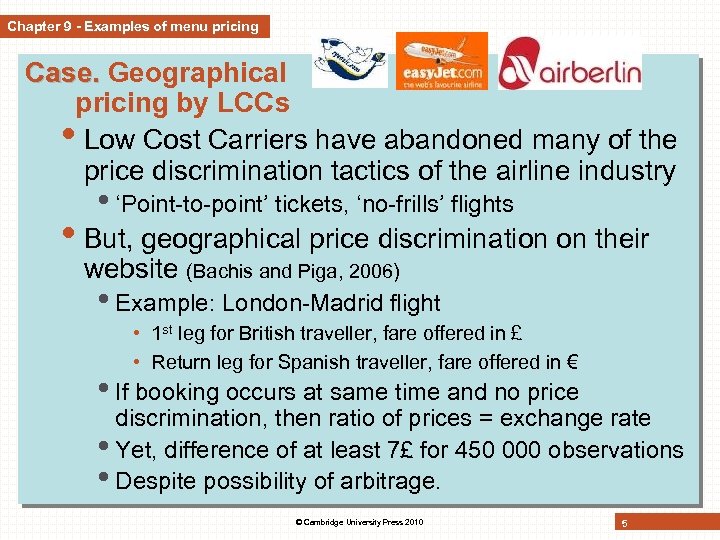 Chapter 9 - Examples of menu pricing Case. Geographical pricing by LCCs • Low Cost Carriers have abandoned many of the price discrimination tactics of the airline industry • ‘Point-to-point’ tickets, ‘no-frills’ flights • But, geographical price discrimination on their website (Bachis and Piga, 2006) • Example: London-Madrid flight • 1 st leg for British traveller, fare offered in £ • Return leg for Spanish traveller, fare offered in € • If booking occurs at same time and no price discrimination, then ratio of prices = exchange rate • Yet, difference of at least 7£ for 450 000 observations • Despite possibility of arbitrage. © Cambridge University Press 2010 5
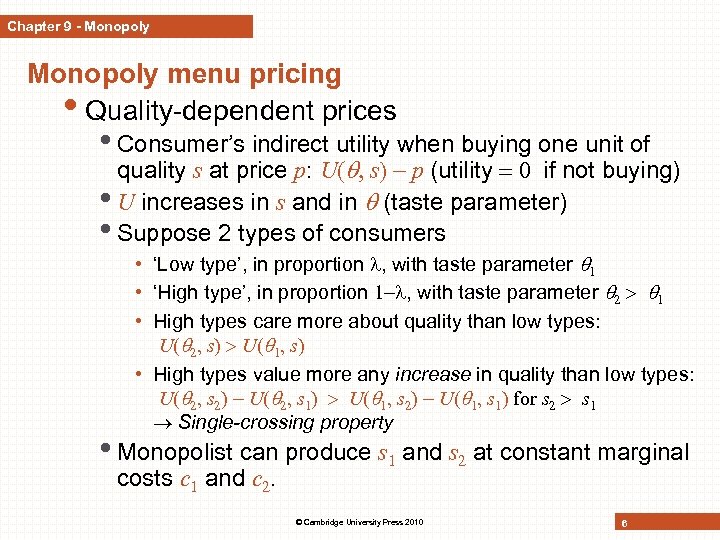 Chapter 9 - Monopoly menu pricing • Quality-dependent prices • Consumer’s indirect utility when buying one unit of quality s at price p: U( , s) p (utility if not buying) • U increases in s and in (taste parameter) • Suppose 2 types of consumers • ‘Low type’, in proportion , with taste parameter • ‘High type’, in proportion , with taste parameter • High types care more about quality than low types: U( , s) • High types value more any increase in quality than low types: U( , s ) for s s Single-crossing property • Monopolist can produce s 1 and s 2 at constant marginal costs c 1 and c 2. © Cambridge University Press 2010 6
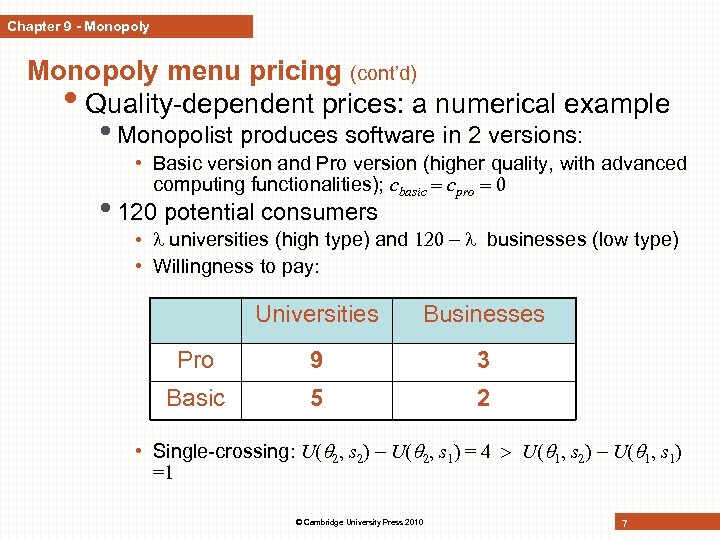 Chapter 9 - Monopoly menu pricing (cont’d) • Quality-dependent prices: a numerical example • Monopolist produces software in 2 versions: • Basic version and Pro version (higher quality, with advanced computing functionalities); cbasic cpro • 120 potential consumers • universities (high type) and businesses (low type) • Willingness to pay: Universities Businesses Pro 9 3 Basic 5 2 • Single-crossing: U( , s ) = 4 U( , s ) =1 © Cambridge University Press 2010 7
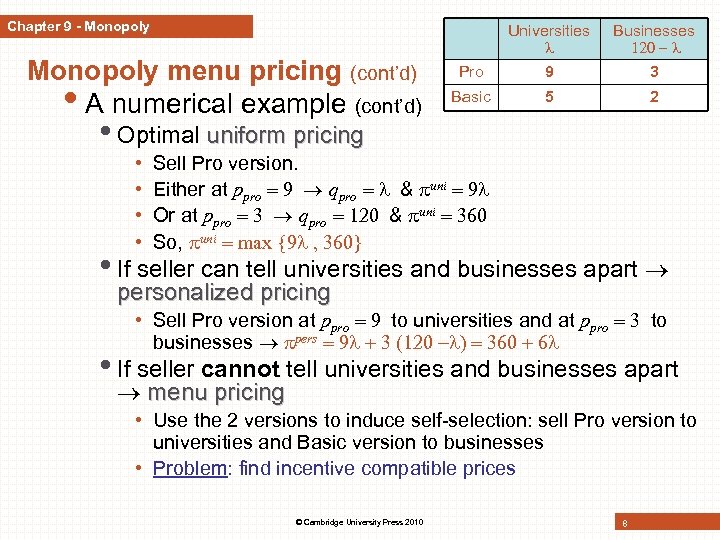 Chapter 9 - Monopoly menu pricing (cont’d) • A numerical example (cont’d) Universities Businesses Pro 9 3 Basic 5 2 • Optimal uniform pricing • • Sell Pro version. Either at ppro qpro & uni Or at ppro qpro & uni So, uni max • If seller can tell universities and businesses apart personalized pricing • Sell Pro version at ppro to universities and at ppro to businesses pers • If seller cannot tell universities and businesses apart menu pricing • Use the 2 versions to induce self-selection: sell Pro version to universities and Basic version to businesses • Problem: find incentive compatible prices © Cambridge University Press 2010 8
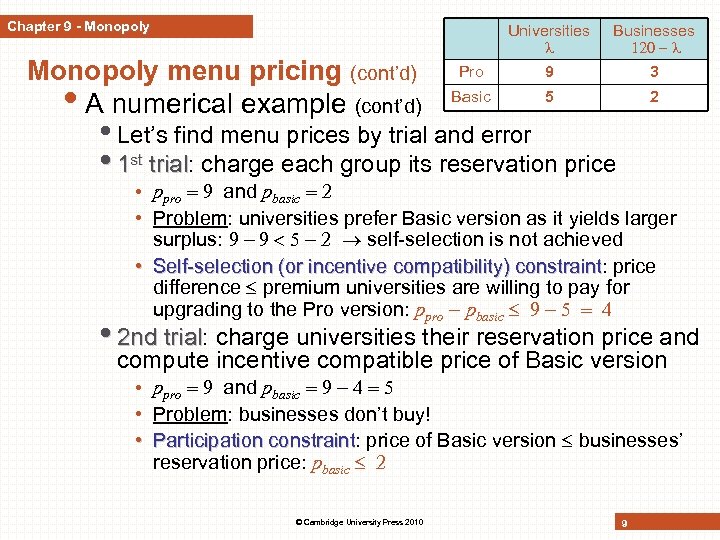 Chapter 9 - Monopoly menu pricing (cont’d) • A numerical example (cont’d) Universities Businesses Pro 9 3 Basic 5 2 • Let’s find menu prices by trial and error • 1 st trial: charge each group its reservation price trial • ppro and pbasic • Problem: universities prefer Basic version as it yields larger surplus: self-selection is not achieved • Self-selection (or incentive compatibility) constraint: price constraint difference premium universities are willing to pay for upgrading to the Pro version: ppro pbasic • 2 nd trial: charge universities their reservation price and trial compute incentive compatible price of Basic version • ppro and pbasic • Problem: businesses don’t buy! • Participation constraint: price of Basic version businesses’ constraint reservation price: pbasic © Cambridge University Press 2010 9
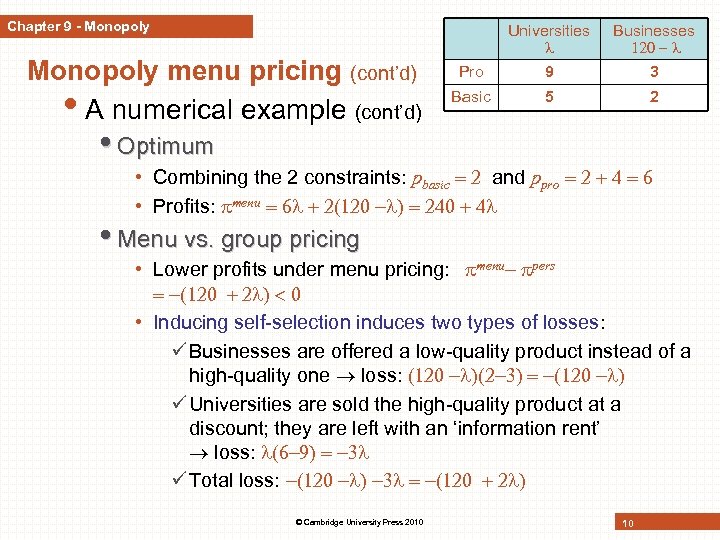 Chapter 9 - Monopoly menu pricing (cont’d) • A numerical example (cont’d) Universities Businesses Pro 9 3 Basic 5 2 • Optimum • Combining the 2 constraints: pbasic and ppro • Profits: menu • Menu vs. group pricing • Lower profits under menu pricing: menu pers • Inducing self-selection induces two types of losses: ü Businesses are offered a low-quality product instead of a high-quality one loss: ü Universities are sold the high-quality product at a discount; they are left with an ‘information rent’ loss: ü Total loss: © Cambridge University Press 2010 10
 Chapter 9 - Monopoly menu pricing: summary • Lesson: Consider a monopolist who offers 2 pairs of price and quality to 2 types of consumers. Prices are chosen so as to fully appropriate lowtype’s consumer surplus. High-type consumers obtain a positive surplus (‘information rent’) as they can always choose the low-quality instead. © Cambridge University Press 2010 11
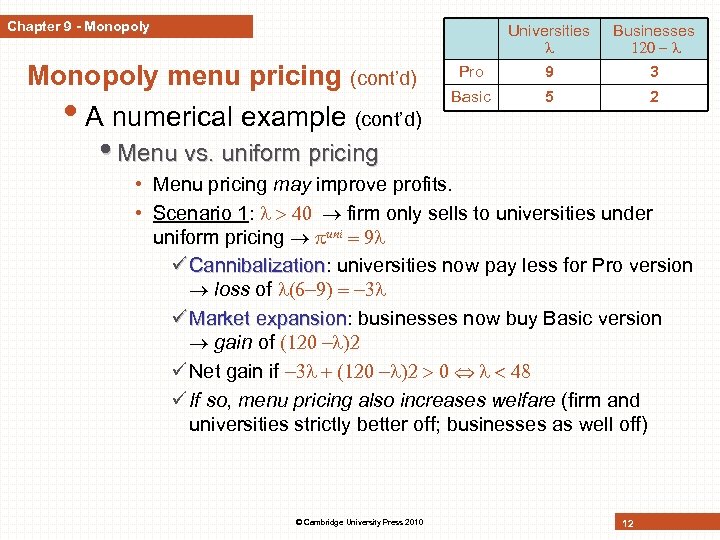 Chapter 9 - Monopoly Universities Monopoly menu pricing (cont’d) • A numerical example (cont’d) Businesses Pro 9 3 Basic 5 2 • Menu vs. uniform pricing • Menu pricing may improve profits. • Scenario 1: firm only sells to universities under uniform pricing uni ü Cannibalization: universities now pay less for Pro version Cannibalization loss of ü Market expansion: businesses now buy Basic version ansion gain of ü Net gain if ü If so, menu pricing also increases welfare (firm and universities strictly better off; businesses as well off) © Cambridge University Press 2010 12
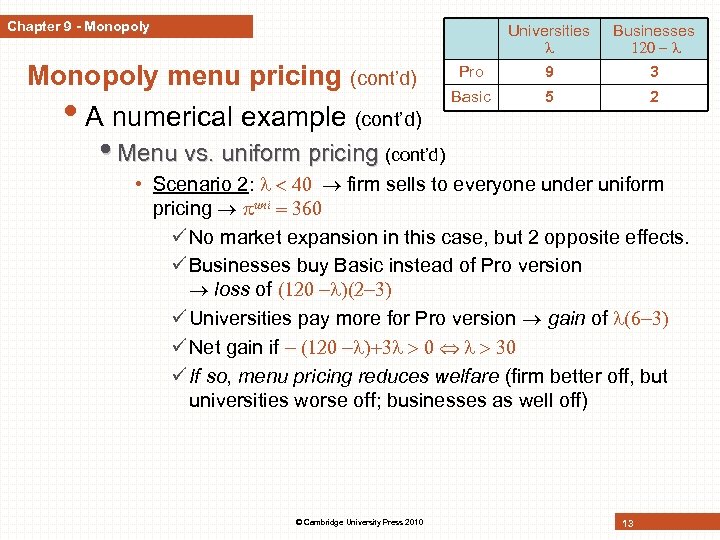 Chapter 9 - Monopoly Universities Monopoly menu pricing (cont’d) • A numerical example (cont’d) Businesses Pro 9 3 Basic 5 2 • Menu vs. uniform pricing (cont’d) • Scenario 2: firm sells to everyone under uniform pricing uni ü No market expansion in this case, but 2 opposite effects. ü Businesses buy Basic instead of Pro version loss of ü Universities pay more for Pro version gain of ü Net gain if ü If so, menu pricing reduces welfare (firm better off, but universities worse off; businesses as well off) © Cambridge University Press 2010 13
 Chapter 9 - Monopoly menu pricing: summary • Lesson: Menu pricing is optimal (i) if proportion of high-type consumers is neither too small nor too large, and (ii) if going from low to high quality increases surplus proportionally more for hightype consumers than for low-type consumers. • Lesson: Menu pricing improves welfare if selling the low quality leads to an expansion of the market; otherwise, menu pricing deteriorates welfare. © Cambridge University Press 2010 14
 Chapter 9 - Monopoly menu pricing: further results • If monopolist optimally chooses different qualities to implement menu pricing • Lesson: High-type consumers are offered the socially optimal quality, while low-type consumers are offered a quality that is distorted downward compared to the first best. © Cambridge University Press 2010 15
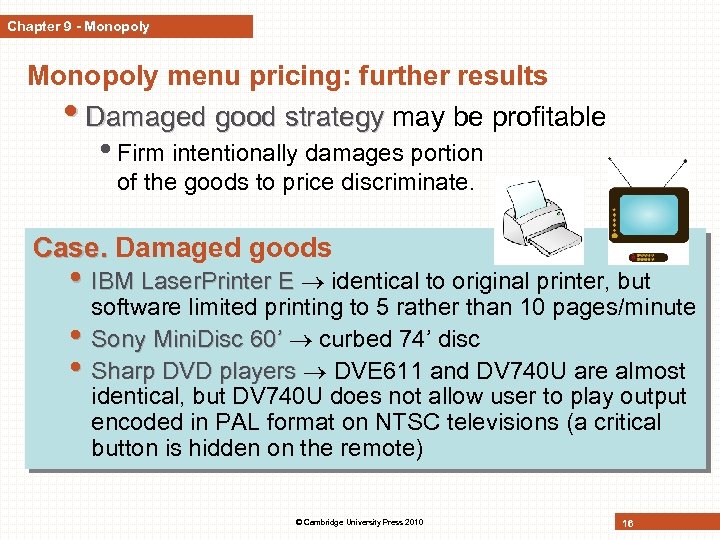 Chapter 9 - Monopoly menu pricing: further results • Damaged good strategy may be profitable • Firm intentionally damages portion of the goods to price discriminate. Case. Damaged goods • IBM Laser. Printer E identical to original printer, but • • software limited printing to 5 rather than 10 pages/minute Sony Mini. Disc 60’ curbed 74’ disc Sharp DVD players DVE 611 and DV 740 U are almost identical, but DV 740 U does not allow user to play output encoded in PAL format on NTSC televisions (a critical button is hidden on the remote) © Cambridge University Press 2010 16
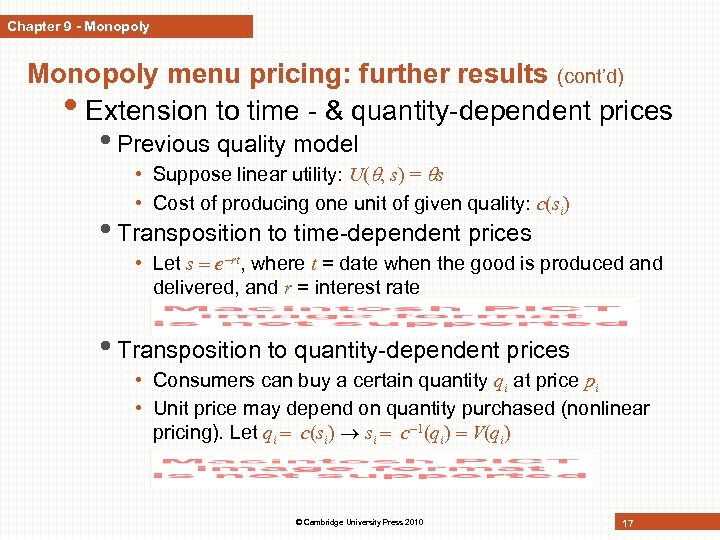 Chapter 9 - Monopoly menu pricing: further results (cont’d) • Extension to time - & quantity-dependent prices • Previous quality model • Suppose linear utility: U( , s) = s • Cost of producing one unit of given quality: c(si) • Transposition to time-dependent prices • Let s e rt, where t = date when the good is produced and delivered, and r = interest rate • Transposition to quantity-dependent prices • Consumers can buy a certain quantity qi at price pi • Unit price may depend on quantity purchased (nonlinear pricing). Let qi c(si) si c (qi V(qi) © Cambridge University Press 2010 17
 Chapter 9 - Menu pricing & imperfect competition Menu pricing under imperfect competition • Monopoly setting gives useful insights. • But, we want to know how menu pricing is affected by - and affects - competition. • E. g. : airline travel • Empirical studies suggest that competition tends to reinforce price discrimination • Borenstein (1991): number of stations offering leaded gas difference between margins on unleaded and leaded gas • 2 extensions of Hotelling model • Quality-based menu pricing • Two-part tariffs (quantity-based menu pricing) © Cambridge University Press 2010 18
 Chapter 9 - Menu pricing & imperfect competition Menu pricing under imperfect competition (cont’d) • Competitive quality-based menu pricing • Sketch of the model • 2 firms located at the extremes of Hotelling line • Each firm can sell high-end & low-end versions of some good • Mass 1 of consumers uniformly distributed on the line ü Heterogeneous in terms of transportation costs ü Heterogeneous in terms of valuation of quality • Main results (see details in book) • Multiple equilibria in pricing game Coexistence of: of ü ‘Discriminatory’ equilibrium: both firms offer 2 versions, equilibrium consumers self-select (high types buy high-end version, low types buy low-end version) ü ‘Non-discriminatory’ equilibrium: both firms produce only equilibrium the high-end version © Cambridge University Press 2010 19
 Chapter 9 - Menu pricing & imperfect competition Menu pricing under imperfect competition (cont’d) • Competitive quality-based menu pricing (cont’d) • Comparison with monopoly • Here, monopolist would optimally choose uniform pricing introducing a competitor may lead to menu pricing by both firms. • In duopoly, firms may prefer to coordinate on the situation where they both price discriminate, while, as a monopolist, each firm would not price discriminate. • Incentive compatibility constraints may not be binding in duopoly. © Cambridge University Press 2010 20
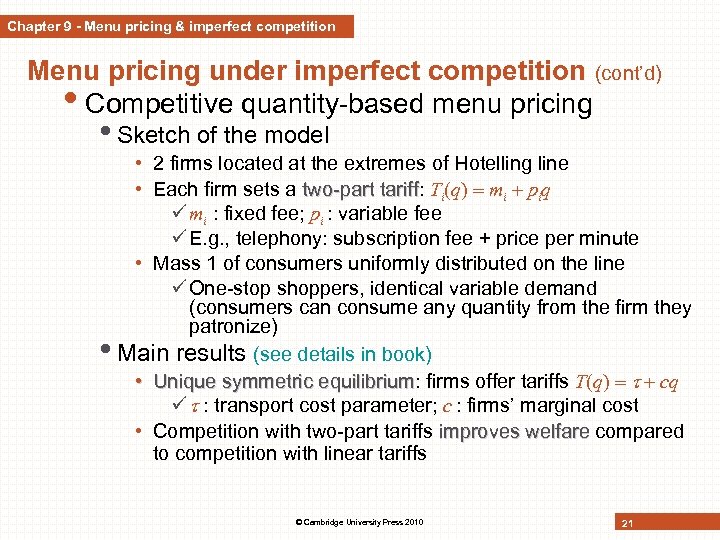 Chapter 9 - Menu pricing & imperfect competition Menu pricing under imperfect competition (cont’d) • Competitive quantity-based menu pricing • Sketch of the model • • 2 firms located at the extremes of Hotelling line • Each firm sets a two-part tariff: Ti(q) mi piq tariff ü mi : fixed fee; pi : variable fee ü E. g. , telephony: subscription fee + price per minute • Mass 1 of consumers uniformly distributed on the line ü One-stop shoppers, identical variable demand (consumers can consume any quantity from the firm they patronize) Main results (see details in book) • Unique symmetric equilibrium: firms offer tariffs T(q) cq equilibrium ü : transport cost parameter; c : firms’ marginal cost • Competition with two-part tariffs improves welfare compared to competition with linear tariffs © Cambridge University Press 2010 21
 Chapter 9 - Review questions • Suppose a firm can target two groups of consumers by a menu of prices with different qualities but that it can also offer different prices to different consumer groups. What should it do? • When does menu pricing dominate uniform pricing in monopoly? Discuss the countervailing effects. • How does competition affect the use of menu pricing? Discuss. • What are the effects of competition on quantitybased menu pricing? © Cambridge University Press 2010 22