


 Скачать презентацию Part III Valuation Hedging and Speculation 1
0c7a7828711910e1fcf29d1855c7e064.ppt
- Количество слайдов: 78
 Part – III Valuation, Hedging, and Speculation 1
 Pricing of a Forward Contract n n n How do we decide as to what price we should transact at in the future, when we enter into a forward contract? Let us first review a forward contract. It entails an obligation on the part of the short to make delivery of the asset on a future date, and an equivalent obligation on the part of the long to take delivery. 2
 Pricing (Cont…) n From the perspective of the short, if he buys the asset at the market price prevailing at the outset and simply holds on to it, he is assured of a selling price at the time of delivery by virtue of the contract. 3
 Pricing (Cont…) n n So if the difference between the forward price as per the contract and the spot price at the outset, were to exceed the cost of carrying the asset until delivery, then there would exist an arbitrage opportunity. Thus the relationship between the spot price and the forward price at any point in time, is a function of the carrying cost. 4
 An Asset That Pays No Income n n Consider an asset that pays no income. Examples include stocks that are unlikely to pay any dividends or bonds that are not scheduled to pay any coupons. In this case the cost of carrying the asset is purely the interest cost. That is, if the spot price is S, the interest cost is r. S. 5
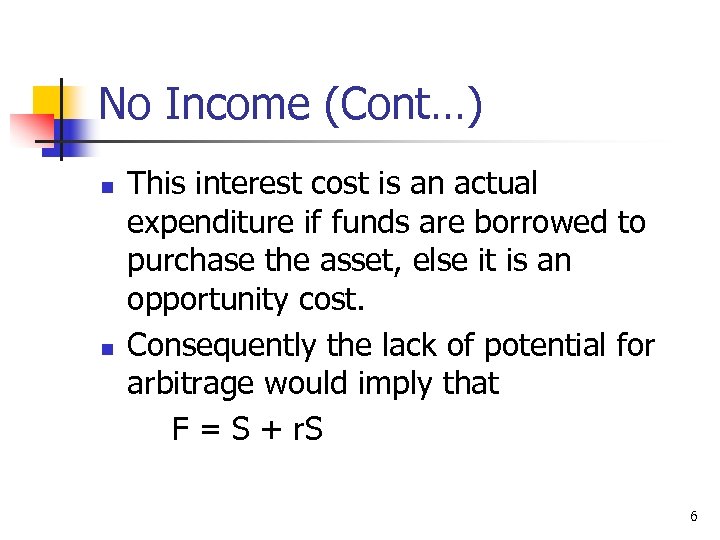 No Income (Cont…) n n This interest cost is an actual expenditure if funds are borrowed to purchase the asset, else it is an opportunity cost. Consequently the lack of potential for arbitrage would imply that F = S + r. S 6
 Cash and Carry Arbitrage n n n What would be the consequence if F > S + r. S If so, an arbitrageur would borrow and buy the asset and go short in a forward contract to deliver at a future date. At the time of delivery he would receive F, return S + r. S, which represents the loan plus interest, and pocket the difference. 7
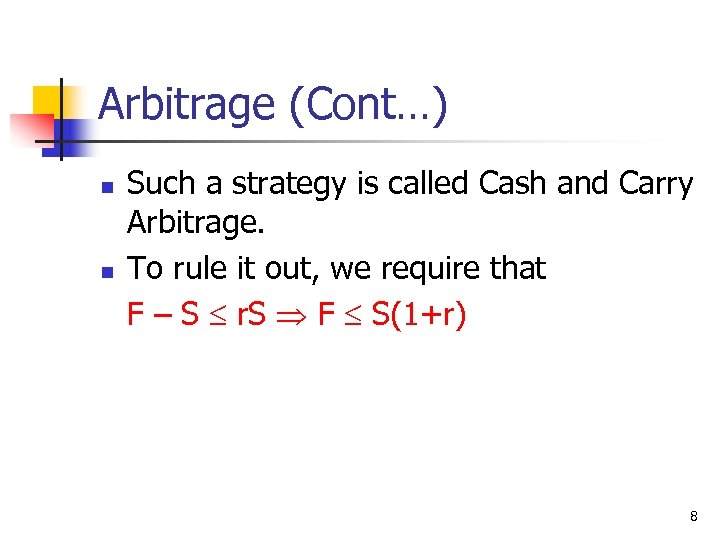 Arbitrage (Cont…) n n Such a strategy is called Cash and Carry Arbitrage. To rule it out, we require that F – S r. S F S(1+r) 8
 Illustration n Assume that TISCO is currently selling for Rs 100 per share, and is not expected to pay any dividends for the next six months. The price of a forward contract for one share of TISCO to be delivered after six months is Rs 106. An arbitrageur is able to borrow at the rate of 5% for six months. 9
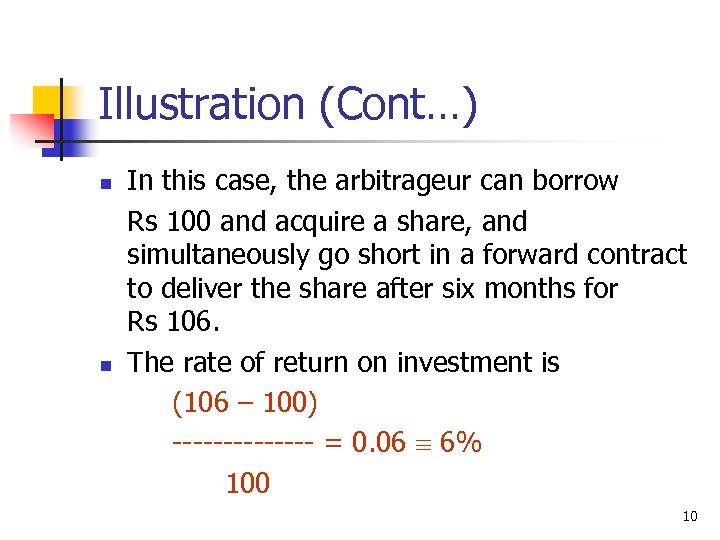 Illustration (Cont…) n n In this case, the arbitrageur can borrow Rs 100 and acquire a share, and simultaneously go short in a forward contract to deliver the share after six months for Rs 106. The rate of return on investment is (106 – 100) ------- = 0. 06 6% 100 10
 Illustration (Cont…) n n n The borrowing cost it must be remembered is only 5%. Consequently cash and carry arbitrage is profitable. This is because the contract is overpriced, that is F > S(1+r) 11
 Cash and Carry Arbitrage (Cont…) n n The rate of return obtained from a cash and carry arbitrage strategy is called the Implied Repo Rate. Thus cash and carry arbitrage is profitable only if the Implied Repo Rate exceeds the borrowing rate. 12
 Synthetic T-Bill n n By engaging in a cash and carry strategy, the arbitrageur has ensured a payoff of Rs 106 after six months for an initial investment of Rs 100. Therefore it is as if he has bought a Zero Coupon Bond with a face value of Rs 106 for a price of Rs 100. 13
 Synthetic T-Bill n n Thus, a combination of a long position in the asset and a short position in the forward contract, is equivalent to a long position in a Zero Coupon instrument. Such a Zero Coupon instrument is called a Synthetic T-Bill. 14
 Synthetic T-Bill (Cont…) n n Symbolically Spot – Forward = Synthetic T-Bill The negative sign indicates a short position in the forward contract. Thus if we have a natural position in two out of the three assets, we can artificially create a position in the third. 15
 Arbitrage-The Long’s Perspective n n We have seen that if F > S + r. S then it can be exploited by an arbitrageur by going short in a forward contract. However, what if F < S + r. S? This too represents an arbitrage opportunity. However to exploit it, one would have to take a long position in a forward 16 contract.
 Reverse Cash and Carry Arbitrage n n n Under such circumstances, the arbitrageur would have to short sell the asset and invest the proceeds at the risk -less rate. He would have to simultaneously go long in a forward contract to reacquire the asset at a predetermined price. Such a strategy is called Reverse Cash and Carry Arbitrage. 17
 Short Sales n n n What is a short sale? It entails the borrowing of an asset from another party in order to sell it. The borrower or the short-seller is responsible for eventually returning the asset to the lender. 18
 Short sales (Cont…) n n He must also compensate the lender for any cash flows that he would have received from the asset had he not parted with it. This is because the lender continues to be the owner of the asset and is consequently entitled to the lost income. 19
 Illustration of Reverse cash and carry arbitrage n n Assume that shares of TISCO are selling at Rs 100 each and that the company is not expected to pay any dividends for the next six months. Let the price of a forward contract that calls for the delivery of one share of TISCO six months hence be Rs 104. 20
 Illustration (Cont…) n n n Consider an arbitrageur who can lend money at a rate of 5% for six months. He can short sell a share of TISCO, receive Rs 100 and invest it at 5% for six months. He can simultaneously go long in a forward contract to acquire the share after six months for Rs 104. 21
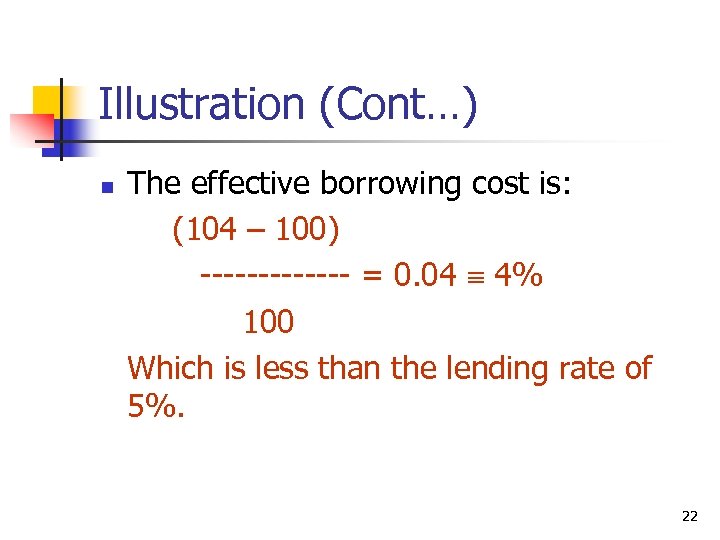 Illustration (Cont…) n The effective borrowing cost is: (104 – 100) ------- = 0. 04 4% 100 Which is less than the lending rate of 5%. 22
 Illustration (Cont…) n n n Consequently reverse cash and carry arbitrage is profitable. This is because F < S(1+r), or in other words the contract is under priced. The cost of borrowing funds using a reverse cash and carry strategy is called the Implied Reverse Repo Rate. 23
 Illustration (Cont…) n n Thus reverse cash and carry is profitable only if the Implied Reverse Repo Rate is less than the lending rate. What the arbitrageur has effectively done is that he has sold a zero coupon instrument with a face value of Rs 104 for a price of Rs 100. 24
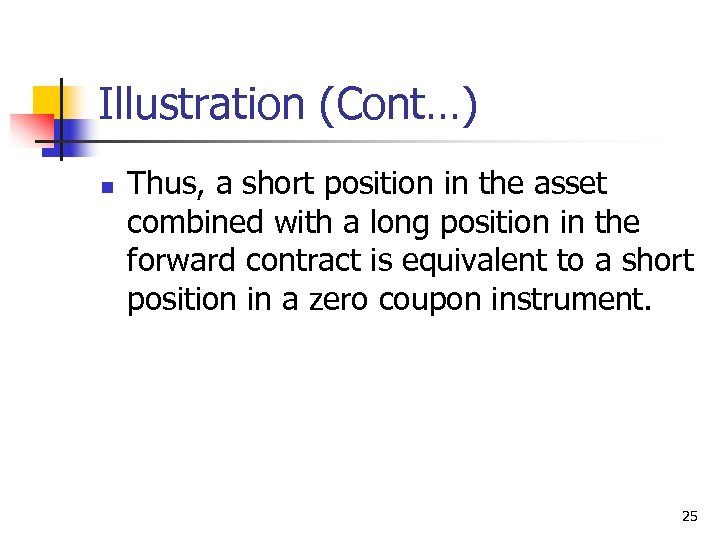 Illustration (Cont…) n Thus, a short position in the asset combined with a long position in the forward contract is equivalent to a short position in a zero coupon instrument. 25
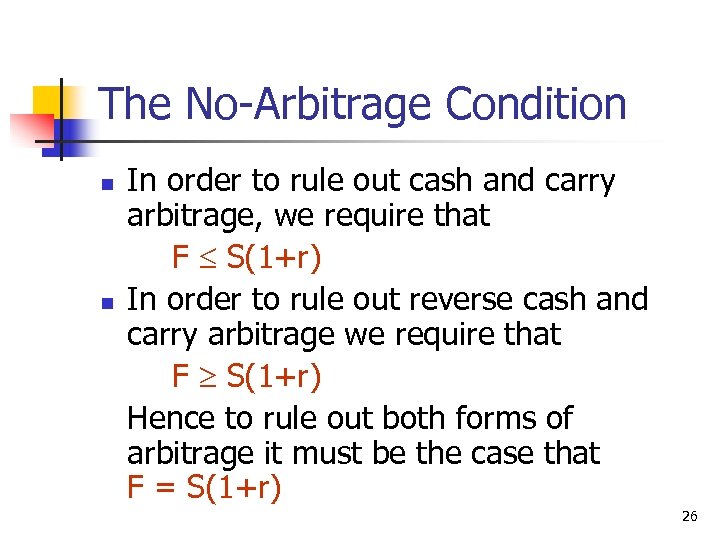 The No-Arbitrage Condition n n In order to rule out cash and carry arbitrage, we require that F S(1+r) In order to rule out reverse cash and carry arbitrage we require that F S(1+r) Hence to rule out both forms of arbitrage it must be the case that F = S(1+r) 26
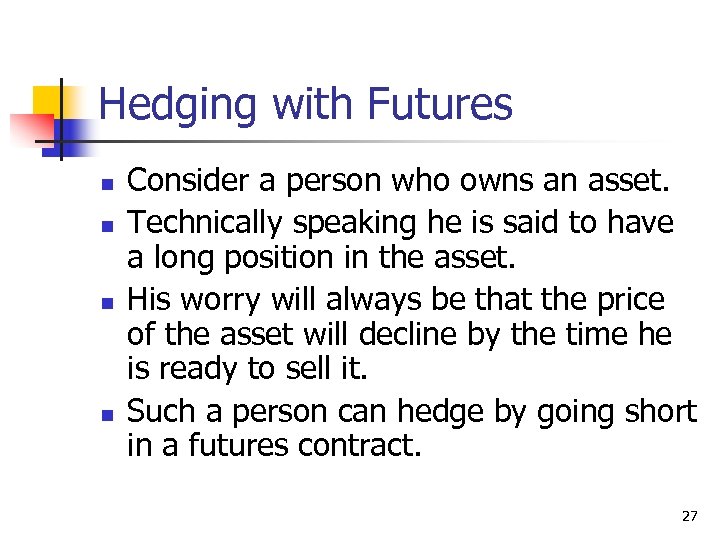 Hedging with Futures n n Consider a person who owns an asset. Technically speaking he is said to have a long position in the asset. His worry will always be that the price of the asset will decline by the time he is ready to sell it. Such a person can hedge by going short in a futures contract. 27
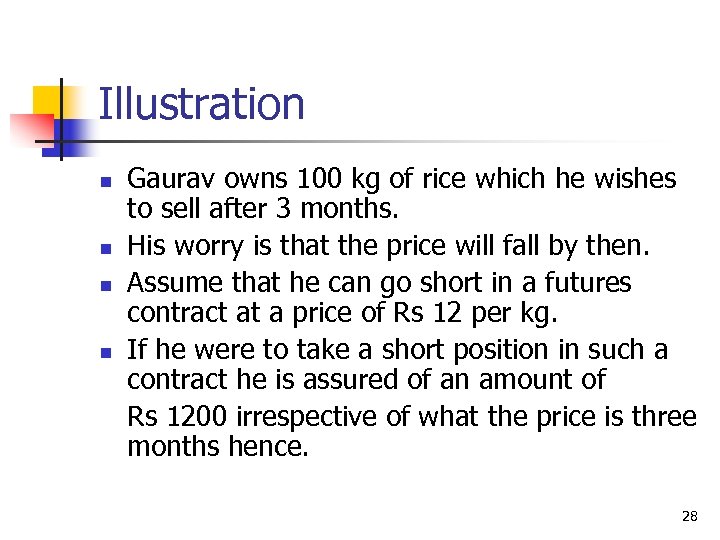 Illustration n n Gaurav owns 100 kg of rice which he wishes to sell after 3 months. His worry is that the price will fall by then. Assume that he can go short in a futures contract at a price of Rs 12 per kg. If he were to take a short position in such a contract he is assured of an amount of Rs 1200 irrespective of what the price is three months hence. 28
 Illustration n n Remember that a short futures position is an obligation to sell. Hence while he is assured of a sum of Rs 1200, he cannot take advantage of the situation if the market price after three months were to be greater than Rs 12 per kg. 29
 An Options Hedge n n n On the contrary assume that Gaurav had bought a put option for hedging. If the market price of the asset were to fall, he can exercise the put and sell at the pre-specified price as per the options contract. However if the market price were to rise, he can forego the option to exercise, and simply sell the asset in the spot market. 30
 Illustration n Assume that Gaurav has bought a put option which gives him the right to sell at Rs 12 per kg after three months. If the spot market price after three months is less than Rs 12, he will exercise the option and sell at Rs 12. However if the spot market price is greater than Rs 12, then he will sell at the market price. 31
 Illustration (Cont…) n n Thus he is assured of a minimum price of Rs 12 per kg. Notice that he cannot be forced to exercise the option, since an option is a right and not an obligation. 32
 Hedging a Short Position n If you have a short position in the asset, it means that you have made a sale transaction without owning the asset. Thus you have to procure it at the prevailing market price. Consequently your worry is that prices would have increased by the time you acquire the asset. 33
 Hedging with Futures n n Such an investor can hedge by going long in a futures contract. This way he can lock in a price at which he can acquire the asset, and will therefore be protected against rising prices. 34
 Illustration n n Vinayak has short sold a share of TISCO and is required to buy it back after 2 weeks. His worry is that the share price will have risen by then. Assume that he can go long in a futures contract at a price of Rs 105. If so he can be assured of being able to buy at this price. 35
 Illustration (Cont…) n n However, if the market price after 2 weeks were to be less than Rs 105, he will be unable to take advantage of the situation. This is because a futures contract is an obligation. 36
 Hedging with Options n n n The situation would be different if Vinayak were to use a call option for hedging. If the market price after 2 weeks were to be higher, he can exercise the option and buy at the pre-specified price as per the contract. However, if the market price were to be lower, he can forget the option and buy at the prevailing market price. 37
 Illustration n Assume that Vinayak has bought call options which give him the right to buy shares of TISCO at Rs 105 per share. If the market price after 2 weeks is greater than Rs 105 then he will exercise the option and buy at Rs 105. Otherwise he will simply buy at the market price. 38
 Futures or Options? n n n As you can see, although both futures and options facilitate hedging, they work differently and are not substitutes for each other. Futures contracts lock in the price at which the hedger can buy or sell the asset. Options however give protection on one side, while permitting the hedger to benefit from favourable price movements on the other side. 39
 Futures or Options? n If options give one-sided protection without precluding the hedger’s ability to benefit from favourable price movements on the other, then why would any one use futures for hedging? 40
 Why Futures? n n n When a futures contract is entered into, the futures price is set in such a way that the value of the contract to both the parties is zero. Thus neither party need pay to get into a futures position. Both of them have to post margins. But this is a performance bond and not a cost. 41
 Options n n n In the case of an option, whether it is a call or a put, the buyer has to pay a price to the writer at the outset, in order to acquire the right. This price is called the Option Price or the Option Premium. This amount cannot be recovered if the buyer were to decide not to exercise the option subsequently. 42
 Option Prices and Exercise Prices n n n The option price should not be confused with the exercise price. The exercise price is what the option holder has to pay per unit of the asset, if he decides to exercise the option. Thus, in our example, the price of Rs 105 that was payable per share of TISCO by Vinayak was the exercise price. 43
 The Hedger’s Choice n n The hedger can either pay nothing and lock in a price to buy or to sell, using a futures contract. Or else he can pay and acquire an option. In this case if the market moves against him, he can exercise the option. Else if it moves in his favour, he can forget the option and transact at the spot price. 44
 The Hedger’s Choice (Cont…) n n Thus options and futures are not interchangeable from the standpoint of hedging. The choice of the instrument would consequently depend on the individual investor. 45
 Speculation n Unlike hedgers who are trying to avoid risk, speculators wish to consciously take on risk. A speculator will take on either a long or a short position depending on his hunch as to whether the market is going to rise or to fall. If he calls the market right, he can make enormous profits. 46
 Speculation (Cont…) n n n Else if he reads the market wrong, he can make substantial losses. Speculation is not the same as `Gambling’ from an economics standpoint. Gambling means to take on a risk for the sheer thrill of risk taking, irrespective of whether or not the returns are commensurate. 47
 Speculation (Cont…) n n Speculation on the other hand means the taking of a Calculated Risk. A speculator will take a bet on the market only if he perceives the expected return to be commensurate with the level of risk involved. 48
 Speculating With Futures n n n Consider an investor who is of the view that the market is going to rise. One way for him to speculate would be to buy the asset in the spot commodity and hold it. However if he buys the asset in the spot commodity, he would have to pay the full price of the asset. 49
 Speculating With Futures (Cont…) n n n Paying the full price means incurring substantial costs or opportunity costs. In addition, if the commodity is a physical asset, the investor would have to take the hassle of storing it and insuring it. All this can be avoided if he were to speculate using the futures market. 50
 Speculating With Futures (Cont…) n n n The principle involved is the same. Such a speculator is betting that the market is going to move up. So instead of buying the asset in the spot market, he can take a long position in the futures market. 51
 Speculating With Futures (Cont…) n If the spot price were to rise the speculator will obviously realize a profit since he can acquire the asset at the initial futures price, and sell it at the terminal spot price. 52
 Speculating With Futures (Cont…) n n n The advantage of speculating with futures is that the entire value of the asset need not be paid in order to acquire a long position. All that the speculator has to do is to deposit the required margin. Secondly, because of the high volumes of transactions involved, transactions costs are much lower in futures markets. 53
 Illustration n Let us assume that the current futures price for a contract calling for delivery of rice three months hence is Rs 12 per kg. Abhishek, a speculator, is of the opinion that the price three months hence will be at least Rs 15. He therefore chooses to speculate by going long in a futures contract, which we will assume is for 100 kg of rice. 54
 Pitfalls n n Remember, a long futures position is an obligation to buy. If Abhishek were to have read the market wrong, and the price after 3 months were to be Rs 9 per kg, then he would incur a loss of Rs 300. 55
 Pitfalls (Cont…) n n This is because while he still has to acquire the rice at Rs 12 per kg, he can only sell it for Rs 9. Thus speculation with futures can lead to substantial gains if one forecasts price movements accurately, but can lead to substantial losses otherwise. 56
 Illustration (Cont…) n n If he is right, and the market price three months hence turns out to be Rs 16 per kg, then he can simply sell the rice at this price after taking delivery under the futures contract. He will obviously make a profit of Rs 400 on the deal. 57
 Using Options for Speculation n It turns out that a speculator like Abhishek could have used an options contract too for speculation. Since he expects the market to rise, he ought to go in for a call option. If the market does indeed rise, he can acquire the asset by exercising the call and paying the exercise price, and then sell it at the market price. 58
 Illustration n Let us assume that call options are available on rice for delivery three months hence, with an exercise price of Rs 12. Assume that each contract is for 100 kg and that Abhishek buys one contract. If his hunch is right and the prevailing market price after three months is Rs 16, then he will exercise his option. 59
 Illustration (Cont…) n n n When he exercises, he will acquire 100 kg at Rs 12 per kg. The rice can then be sold at Rs 16 per kg. Thus in this case too he will make a profit of Rs 400. 60
 The Difference n n n In the case where Abhishek speculated with futures, the cost of reading the market wrong were significant. If the terminal price were to be Rs 9 per kg, he would lose Rs 300. If it were to be Rs 6 per kg, he would lose even more, that is, Rs 600. 61
 The Difference (Cont…) n n n Speculating with options is clearly different. If the terminal price of rice were to be Rs 9 per kg, then Abhishek will simply refrain from exercising. If so, the amount that he will lose is the option premium that was paid initially to take the position. 62
 The Difference (Cont…) n n n If we assume that the option premium per kg of rice is Rs 0. 75, then the amount that is lost will be Rs 75 if the options are not exercised. This will be the case if the terminal asset price is less than or equal to Rs 12. This amount of Rs 75, is the maximum possible loss for Abhishek. 63
 Interchangeable? n n n A speculator who uses futures contracts has to to deposit only a small margin. However to speculate using options, you have to pay a premium that is nonrefundable. In our illustration the premium was Rs 0. 75 per kg. 64
 Interchangeable? (Cont…) n n n If the terminal market price were to be Rs 11. 25 or above then speculating with futures will be more profitable than speculating with options. If the price were to be between Rs 11. 25 and Rs 12, then the loss from the futures position would be less than or equal to Rs 75 for 100 kg. In this price range, the loss from the options position would be Rs 75, which represents the entire premium, since the options will not be exercised. 65
 Interchangeable? (Cont…) n n n If the terminal market price were to exceed Rs 12, then both the options as well as the futures position would be profitable. However, once the cost of the options is deducted, the futures position would lead to a greater profit of Rs 75. If the terminal market price were to be less than Rs 11. 25 per kg then the loss from the options position would be Rs 75. 66
 Interchangeable? (Cont…) n n The maximum possible loss from the futures position is Rs 1125, since the lowest possible market price for the asset is Rs 0. Thus futures and options are not interchangeable from the standpoint of speculation, although they both facilitate speculation. 67
 Speculation by Bears n n A person who anticipates that the market will move up is a Bull. He can speculate by either going long in futures, or by buying call options. An investor who anticipates that the market will fall is called a Bear. A Bear can speculate by going short in futures or by buying put options. 68
 Bears & Futures Contracts n n n Consider a person who feels that the market is going to fall. He can speculate by going short in futures. If his hunch turns out be right, he can acquire the underlying asset at the terminal market price and deliver it under the contract at the initial futures price, which by assumption is higher. 69
 Illustration n n Nisha is a speculator like Abhishek. However she feels that the price of rice after three months will not be more than Rs 9 per kg. The current futures price is Rs 12 per kg. She can take a speculative position by going short in a futures contract. 70
 Illustration (Cont…) n n Assume that her hunch is right and that the market price at the end of three months is Rs 8. She can now acquire the asset in the spot market for Rs 8 and deliver as per the contract at Rs 12, thereby making a profit of Rs 400 for 100 kg. 71
 Bears & Options n n n It turns out that Nisha could have used options too for speculation. Assume that put options are available for the delivery of rice three months hence at an exercise price of Rs 12 per kg. Let the option premium be Rs 0. 50 per kg. If Nisha buys put options equivalent to 100 kg, and if the market price after three months is Rs 8 per kg, then she can buy in the market at Rs 8 and deliver as per the contract at Rs 12. 72
 Interchangeable? n n n In our example, if the terminal asset price were to be Rs 8, then both futures as well as options lead to a profit of Rs 400. However there are certain points to be noted. Firstly, after the option premium is taken into account, the profit from the options strategy will be less. 73
 Interchangeable? (Cont…) n n Secondly if the market were to have risen instead of declining then Nisha would have simply refrained from exercising the put options, and her loss would have been restricted to the initial premium of Rs 50. However, had she chosen a futures contract for hedging, in principle, her loss could have been much higher. 74
 Interchangeable? (Cont…) n n For instance, if the terminal asset price were to be Rs 15 per kg, then if Nisha had used a futures position, she would have to buy at Rs 15 and deliver as per the contract at Rs 12, thereby making a loss of Rs 300. However had she chosen options for speculation, she would have lost only Rs 50. 75
 Interchangeable (Cont…) n n On the contrary for any asset price less than or equal to Rs 12. 50, the profit from the futures position would be higher. If the asset price were to be between Rs 12 and Rs 12. 50, the loss from the futures position would be less than or equal to Rs 50. 76
 Interchangeable (Cont…) n n In such a scenario the options would not be exercised and the loss would be equal to the initial premium of Rs 50. If the terminal asset price were to be less than Rs 12 per kg, the profit from the futures position would always be Rs 50 more than the profit from the options position. 77
 Interchangeable (Cont…) n Once again, while options and futures both facilitate speculation by Bears, they are not interchangeable, in the sense that one strategy does not dominate the other for all possible types of investors. 78