


 Скачать презентацию Part II Market power Chapter 4 Dynamic aspects
1f8195f64a55228c416367d9e8d7654f.ppt
- Количество слайдов: 25
 Part II. Market power Chapter 4. Dynamic aspects of imperfect competition Slides Industrial Organization: Markets and Strategies Paul Belleflamme and Martin Peitz © Cambridge University Press 2009
 Chapter 4 - Objectives Chapter 4. Learning objectives • Understand how competition is affected when decisions are taken sequentially rather than simultaneously. • Analyze entry decisions into an industry and compare the number of firms that freely enter with the number that a social planner would choose. • Distinguish endogenous from exogenous sunk cost industries and analyze how market size affects market concentration. © Cambridge University Press 2009 2
 Chapter 4 - Stackelberg Sequential choice: Stackelberg • Chapter 3: ‘simultaneous’ decisions • Firms aren’t able to observe each other’s decision before making their own. • Here: sequential decisions • Possibility for some firm(s) to act before competitors, who can thus observe past choices. • E. g. : pharma. firm with patent acts before generic producers • Better to be leader or follower? • Depends on nature of strategic variables & on number of firms moving at different stages. • First mover must have some form of commitment. • When and how is such commitment available? © Cambridge University Press 2009 3
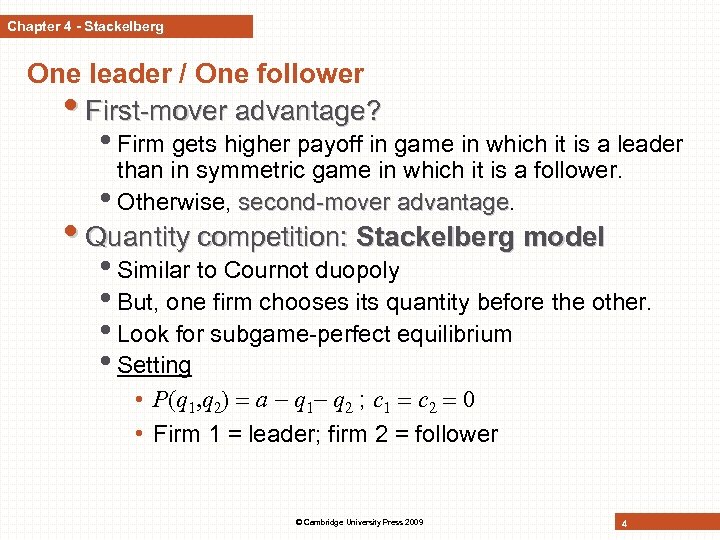 Chapter 4 - Stackelberg One leader / One follower • First-mover advantage? • Firm gets higher payoff in game in which it is a leader than in symmetric game in which it is a follower. • Otherwise, second-mover advantage • Quantity competition: Stackelberg model • Similar to Cournot duopoly • But, one firm chooses its quantity before the other. • Look for subgame-perfect equilibrium • Setting • P(q 1, q 2) a q 1 q 2 ; c 1 c 2 • Firm 1 = leader; firm 2 = follower © Cambridge University Press 2009 4
 Chapter 4 - Stackelberg One leader / One follower (cont’d) • Solve by backward induction • Follower’s decision • Observes q 1, chooses q 2 to max 2 (a q 1 q 2)q 2 • Reaction: q 2(q 1) (a q 1)/2 • Leader’s decision • Anticipates follower’s reaction: max 1 = (a q 1 q 2(q 1)) q 1 = (1/2)(a q 1) q 1 • Equilibrium © Cambridge University Press 2009 5
 Chapter 4 - Stackelberg One leader / One follower (cont’d) • Results • Leader makes higher profit than follower. As firms are symmetric First-mover advantage • Comparison with simultaneous Cournot • q. C a/3 & C a 2/9 • Larger (lower) quantity and profits for leader (follower) w. r. t. Cournot • Intuition: leader has stronger incentives to increase quantity when follower observes and reacts to this quantity, than when follower does not. © Cambridge University Press 2009 6
 Chapter 4 - Stackelberg One leader / One follower (cont’d) • Lesson: In a duopoly producing substitutable products with one firm (the leader) choosing its quantity before the other firm (the follower), the subgame perfect equilibrium is such that • firms enjoy a first-mover advantage; • the leader is better off and the follower is worse off than at the Nash equilibrium of the Cournot game. © Cambridge University Press 2009 7
 Chapter 4 - Stackelberg One leader / One follower (cont’d) • Price competition • Previous result hinges on strategic substitutability • Follower reacts to in leader’s quantity by its own quantity leader finds it profitable to commit to a larger quantity. • Reverse applies under strategic complementarity • If leader acts aggressively, follower reacts aggressively. • Preferable to be the follower and be able to undercut. • Lesson: In a duopoly producing substitutable products under constant unit costs, with one firm choosing its price before the other firm, the subgame-perfect equilibrium is such that at least one firm has a second-mover advantage. © Cambridge University Press 2009 8
 Chapter 4 - Stackelberg One leader / Endogenous number of followers • E. g. : market for a drug whose patent expired • Leader: patent holder / Followers: generic producers • Observation: leader cuts its price, possibly to keep the number of entrants low • Theoretical prediction • Leader always acts more aggressively (i. e. , sets larger quantity or lower price) than followers. • Intuition: leader is also concerned about the effect of its own choices on the number of firms that enter; nature of strategic variables is less important. • Confirms the observations. © Cambridge University Press 2009 9
 Chapter 4 - Stackelberg Commitment • Implicit assumption so far: • Leader can commit to her choice. • Schelling’s analysis of conflicts • Threat: punishment inflicted to a rival if he takes a reat certain action. Goal: prevent this action • Promise: reward granted to a rival if he takes a Promise certain action. Goal: encourage this action • But, threats and promises must be credible to be effective they must be transformed into a commitment: inflict the punishment or grant the commitment reward must be in the best interest of the agent who made threat or the promise. • How? Make the action irreversible. © Cambridge University Press 2009 10
 Chapter 4 - Stackelberg Commitment (cont’d) • Paradox of commitment • It is by limiting my own options that I can manage to influence the rival’s course of actions in my interest. • Case: When Spanish Conquistador Hernando Cortez Case landed in Mexico in 1519, one of his first orders to his men was to burn the ships. Cortez was committed to his mission and did not want to allow himself or his men the option of going back to Spain. • How to achieve irreversibility? • Quantities: install production capacity (+ sunk costs) • Prices: ‘most-favoured customer clause’, print catalogues © Cambridge University Press 2009 11
 Chapter 4 - Free entry: endogenous number of firms • So far, limited number of firms • • Implicit assumption: entry prohibitively costly Here, opposite view • • No entry and exit barriers other than entry costs. Firms enter as long as profits can be reaped. Two-stage game 1. Decision to enter the industry or not 2. Price or quantity competition 3 models • • • Free entry in Cournot model Free entry in Salop model Monopolistic competition © Cambridge University Press 2009 12
 Chapter 4 - Free entry Properties of free entry equilibria • Setting • • Industry with symmetric firms; entry cost e If n active firms, profit is (n), with (n) (n ) Number of firms under free entry, ne such that (ne) e and (ne ) e e ne Case. Entry in small cities in the U. S. • Bresnahan & Reiss (1990, 1991) estimate an entry model • Data from rural retail and professional markets in small U. S. cities. • Results • Firms enter if profit margins are sufficient to cover fixed costs of operating. • Profit margins with additional entry. © Cambridge University Press 2009 13
 Chapter 4 - Free entry Cournot model with free entry • Linear model (more general approach in the book) • • • P(q) a bq, Ci(q) cq, c a Equilibrium: q(n) (a c)/[b(n )] “Business-stealing effect”: q(n ) q(n) effect Free-entry equilibrium Social optimum (second best) © Cambridge University Press 2009 14
 Chapter 4 - Free entry Cournot model with free entry (cont’d) • Lesson: Because of the business-stealing effect, the symmetric Cournot model with free entry exhibits socially excessive entry. © Cambridge University Press 2009 15
 Chapter 4 - Free entry Price competition with free entry • Salop (circle) model of Chapter 3 • • • Firms enter and locate equidistantly on circle with circumference 1 Consumers uniformly distributed on circle They buy at most one unit, from firm with lowest ‘generalized price’ (unit transportation cost, ) If n firms enter, equilibrium price: Free-entry equilibrium © Cambridge University Press 2009 16
 Chapter 4 - Free entry Price competition with free entry (cont’d) • Social optimum (second best) • Planner selects n* to minimize total costs • Lesson: In the Salop circle model, the market generates socially excessive entry. • • Intuition: dominance of business-stealing effect Case. Socially excessive entry of radio stations in the U. S. © Cambridge University Press 2009 17
 Chapter 4 - Free entry Monopolistic competition • 4 features • • • Large number of firms producing different varieties Each firm is negligible No entry or exit barriers economic profits = 0 Each firm enjoys market power • Rather technical see the book S-D-S model (Spence, 1976; Dixit & Stiglitz, 1977) • Lesson: In models of monopolistic competition, the market may generate excessive or insufficient entry, depending on how much an entrant can appropriate of the surplus generated by the introduction of an additional differentiated variety. © Cambridge University Press 2009 18
 Chapter 4 - Sunk costs Industry concentration and firm turnover • So far, exogenous sunk costs • • e = sunk cost, exogenous (i. e. , not affected by decisions in the model); if e ne If market size ne & industry concentration • Lesson: In industries with exogenous sunk costs, industry concentration decreases and approaches zero as market size increases. • Not verified empirically in all industries • • industries with large increase of market demand over time and persistently high concentration To reconcile theory with facts: endogenous sunk costs © Cambridge University Press 2009 19
 Chapter 4 - Sunk costs Industry concentration and firm turnover (cont’d) • A model with endogenous sunk costs • • • Quality-augmented Cournot model 3 -stage game (see companion slides to Chapter 4) 1. Firms decide to enter 2. Firms decide which quality to develop 3. Firms decide which quantity to produce Endogenous sunk costs arise from strategic investments that increase the price-cost margin • • Improvements in quality, advertising, process innovations Intuition: Market size market more valuable active firms invest more some of extra profits are competed away upper bound on entry (lower bound on concentration) © Cambridge University Press 2009 20
 Chapter 4 - Sunk costs Industry concentration and firm turnover (cont’d) • Lesson: In markets with endogenous sunk costs, even as the size of the market grows without bounds, there is a strictly positive upper bound on the equilibrium number of firms. Case. Supermarkets in the U. S. • Ellickson (2007): supermarkets concentration (U. S. , 1998) • Identifies 51 distribution markets • All are highly concentrated (dominated by 4 to 6 chains), independently of the size of the particular distribution market. • Due to endogenous sunk costs? • Quality dimension: available number of products • Can be increased by more shelf space and/or improved logistics • Average number or products has indeed increased • 14, 000 (1980), 22, 000 (1994), 30, 000 (2004) • Investments are incurred within each distribution market. © Cambridge University Press 2009 21
 Chapter 4 - Sunk costs Industry concentration and firm turnover (cont’d) • Dynamic firm entry and exit • • • So far, static models • • OK to predict number of active firms in industries But, unable to generate entry and exit dynamics What do we expect? expect • Market entry (exit) in growing (declining) industries What do we observe? observe • Simultaneous entry and exit in many industries Explanation? Explanation • • Firms are heterogeneous (e. g. , different marginal costs) Their prospects change over time (idiosyncratic shocks) Model • More technical; to be read in the book © Cambridge University Press 2009 22
 Chapter 4 - Sunk costs Industry concentration and firm turnover (cont’d) • Lesson: In monopolistically competitive markets, market size total number of firms in the market only particularly efficient firms stay turnover rate firms tend to be younger in larger markets. Case. Hair salons in Sweden • Asplund and Nocke (2006) compare age distribution of hair salons across local markets. • Hypothesis: estimated age distribution function of firms • with large market size lies above estimated age distribution of firms with small market size. Confirmed by the data. © Cambridge University Press 2009 23
 Chapter 4 - Review questions • Why is there generally a first-mover advantage under sequential quantity competition (with one leader and one follower) and a second-mover advantage under sequential price competition? Explain by referring to the concepts of strategic complements and strategic substitutes. • When firms only face a fixed set-up costs when entering an industry, how is the equilibrium number of firms in the industry determined? Is regulation possibly desirable (to encourage or discourage entry)? Discuss. © Cambridge University Press 2009 24
 Chapter 4 - Review questions (cont’d) • What is the difference between endogenous and exogenous sunk costs? What are the implications for market structure? • Which market environments lead to simultaneous entry and exit in an industry? © Cambridge University Press 2009 25