


 Скачать презентацию Part I Getting started Chapter 2 Firms consumers
e6e53189fc4a606247556a8a5dcc5021.ppt
- Количество слайдов: 19
 Part I. Getting started Chapter 2. Firms, consumers and the market Slides Industrial Organization: Markets and Strategies Paul Belleflamme and Martin Peitz © Cambridge University Press 2009
 Chapter 2 - Objectives Chapter 2. Learning objectives • Prepare for the rest of the course • By getting acquainted with useful concepts • By clarifying main assumptions underlying analytical frameworks • Know better firms and consumers • How are they represented? • How are they assumed to behave? • How do we measure their well-being? • Delineate the scope of market interaction • 2 extremes: perfect competition and monopoly • How to define a market? • How to measure its performance? © Cambridge University Press 2009 2
 Chapter 2 - Firms • Firm seen as a program of profit maximization • Profit = Revenues - Costs • Revenues depend on consumers preferences and on type of market interaction • Costs depend on firm’s technology • Puts relationships within the firm into a “black box” • What we do: • Examine costs, discuss profit maximization • Open the “back box”: principal/agent • Determinants of firm’s boundaries: make or buy? © Cambridge University Press 2009 3
 Chapter 2 - Firms Costs • Economic costs refer to opportunity costs • Cost function: C(q) • Minimal cost to produce output q given the input prices and the production technology • Economies of scale: average costs are decreasing • Favour a concentrated industry (see Chapter 1) • Diseconomies of scale: average costs are increasing • Marginal cost: C’(q) • We will often take it as constant. • Fixed cost + constant marginal cost economies of scale • Economies of scope: average costs of a particular product decrease if product range is increased © Cambridge University Press 2009 4
 Chapter 2 - Firms Costs (cont’d) • Fixed costs • Independent of current output levels • Affect profit level but not decisions such as pricing • Sunk costs • Part of the fixed costs which cannot be recovered • Often exogenous to the firm but may be determined by decisions of firms already active in the market • Important to explain the formation of imperfectly competitive markets • See Chapter 4 • Can be abstracted away in short-run analyses © Cambridge University Press 2009 5
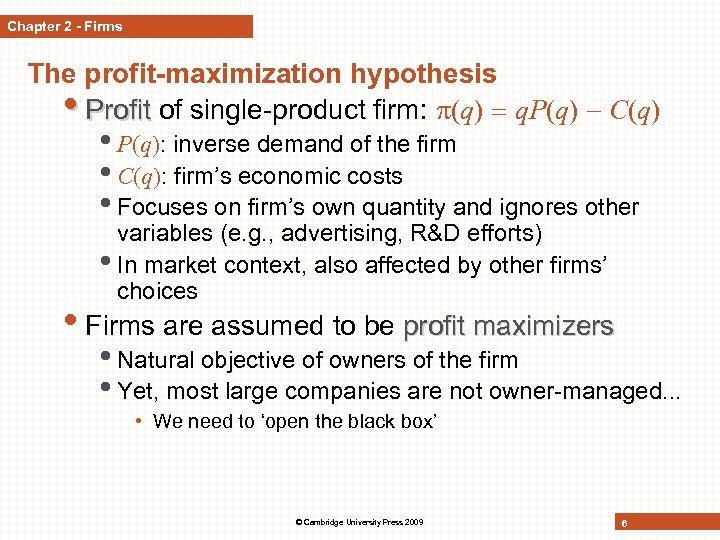 Chapter 2 - Firms The profit-maximization hypothesis • Profit of single-product firm: (q) q. P(q) C(q) • P(q): inverse demand of the firm • C(q): firm’s economic costs • Focuses on firm’s own quantity and ignores other variables (e. g. , advertising, R&D efforts) • In market context, also affected by other firms’ choices • Firms are assumed to be profit maximizers • Natural objective of owners of the firm • Yet, most large companies are not owner-managed. . . • We need to ‘open the black box’ © Cambridge University Press 2009 6
 Chapter 2 - Firms Inside the black-box of a firm • Owners vs. manager • Managers may have different objectives than profitmaximization. • How to align objectives? • See ‘principal/agent model’ in companion slides • Lesson: In a principal-agent relationship between owner and manager with hidden effort, • manager bears the full risk he/she is risk neutral; • otherwise, owner bears part of the risk & incentives are not perfectly aligned. © Cambridge University Press 2009 7
 Chapter 2 - Firms Boundaries of the firm • Compare costs of internal and external provision • OK if easy to allocate opportunity costs to internal provision and if markets exist with established prices • But, external provision may result from bilateral trade • Additional concern: incompleteness of contracts • Most firms are multi-product. Why? multi-product • Economies of scope • Price and non-price strategies • Use of essential facility • Limits to the scope of the firm • Limited managerial span • Organizational costs accelerate with organization size © Cambridge University Press 2009 8
 Chapter 2 - Consumers as decision makers • Consumers are assumed to be rational • They choose what they like best. • Yet, they make errors (as long as errors are nonsystematic, we can deal with them; see Chapter 5). • They are forward-looking. • They form expectations about the future. • Under uncertainty, they maximize expected utility. • Assumption: they have the same prior beliefs. • Consumers may act as strategic players. • E. g. : adoption of network goods (see Chapter 20) © Cambridge University Press 2009 9
 Chapter 2 - Consumers Utility and demand • Consumer’s decision problem of under certainty • Choose • quantities q (q 1, q 2, …, qn) • and quantity q 0 of the Hicksian composite commodity • to maximize quasi-linear utility u(q) q 0 • subject to budget constraint p • q q 0 ≤ y • Equivalent to maxq u(q) y p • q • Solution to FOCs individual demand functions • From individual to aggregate demand • Either any consumer is representative of all others • Or account for taste differences among consumers © Cambridge University Press 2009 10
 Chapter 2 - Welfare analysis of market outcomes • Partial equilibrium approach • Focus on one market at a time • Abstract away cross-market effects • Welfare measures • Firms: sum of firms’ profits • Consumers: consumer surplus • Net benefit from being able to purchase a good or service • Difference between willingness to pay and price actually paid • Potential problems • Income effects • Extension to several consumers • Extension to several goods © Cambridge University Press 2009 11
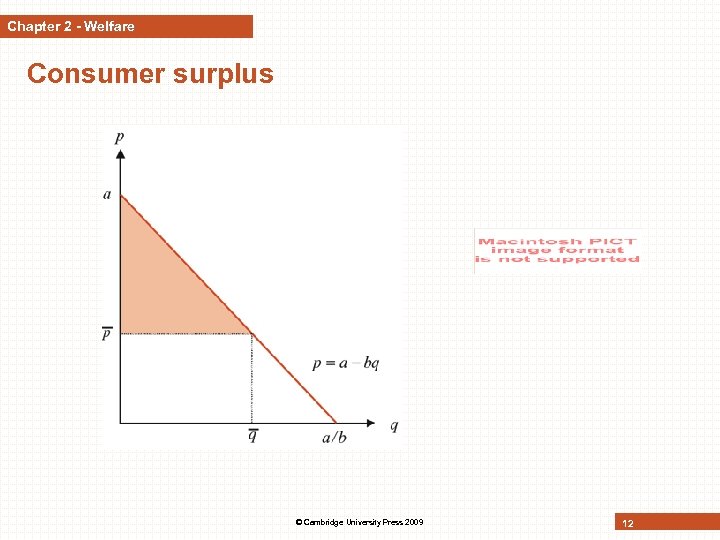 Chapter 2 - Welfare Consumer surplus © Cambridge University Press 2009 12
 Chapter 2 - Market interaction Perfectly competitive paradigm • Firms take the market price as given. • Market price results from combined action of all firms and all consumers. • Firms face a horizontal demand curve • Marginal revenue = price (1) • Profit maximization • marginal revenue = marginal cost (2) • (1) & (2) price = marginal cost • Lesson: A perfectly competitive firm produces at marginal cost equal to the market price. © Cambridge University Press 2009 13
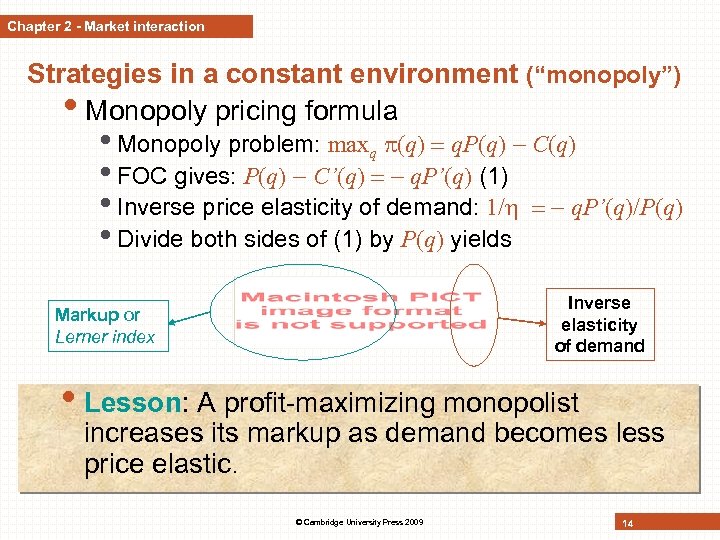 Chapter 2 - Market interaction Strategies in a constant environment (“monopoly”) • Monopoly pricing formula • Monopoly problem: maxq (q) q. P(q) C(q) • FOC gives: P(q) C’(q) q. P’(q) (1) • Inverse price elasticity of demand: q. P’(q)/P(q) • Divide both sides of (1) by P(q) yields Inverse elasticity of demand Markup or Lerner index • Lesson: A profit-maximizing monopolist increases its markup as demand becomes less price elastic. © Cambridge University Press 2009 14
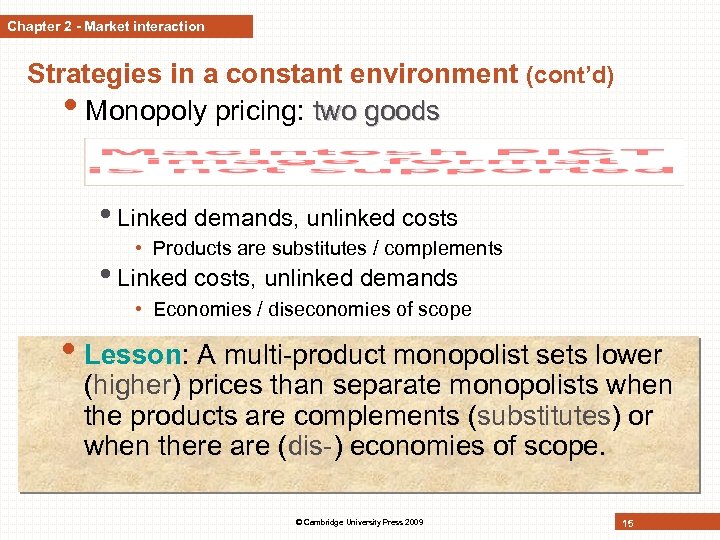 Chapter 2 - Market interaction Strategies in a constant environment (cont’d) • Monopoly pricing: two goods • Linked demands, unlinked costs • Products are substitutes / complements • Linked costs, unlinked demands • Economies / diseconomies of scope • Lesson: A multi-product monopolist sets lower (higher) prices than separate monopolists when the products are complements (substitutes) or when there are (dis-) economies of scope. © Cambridge University Press 2009 15
 Chapter 2 - Market interaction Dominant firm model • Large firm + ‘competitive fringe’ • Example: Market for generics (pharmaceuticals) Example • See particular model in the book Imperfect competition • So far, decisions could be made in isolation • Because negligible firms (perfect competition) • Because single or dominant firm (“monopoloy”) • Outside these extremes • Restricted number of firms on the market • Market outcomes depend on the combination of all firms’ decisions. • Decisions must incorporate this reality game theory © Cambridge University Press 2009 16
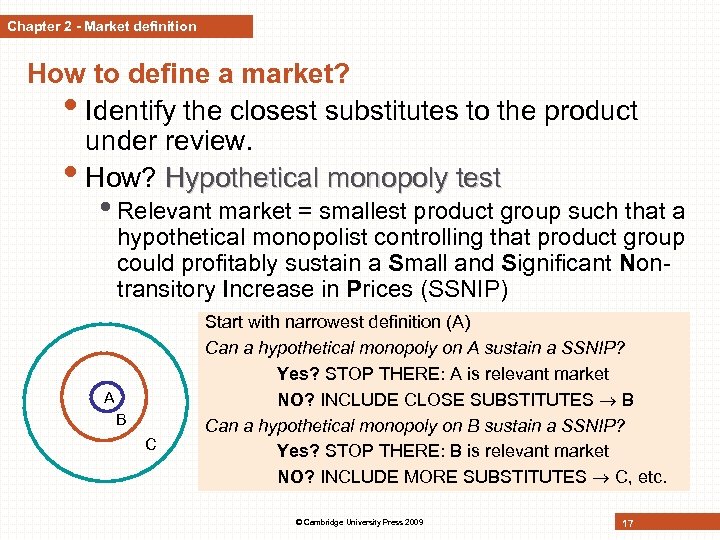 Chapter 2 - Market definition How to define a market? • Identify the closest substitutes to the product under review. • How? Hypothetical monopoly test • Relevant market = smallest product group such that a hypothetical monopolist controlling that product group could profitably sustain a Small and Significant Nontransitory Increase in Prices (SSNIP) A B C Start with narrowest definition (A) Can a hypothetical monopoly on A sustain a SSNIP? Yes? STOP THERE: A is relevant market NO? INCLUDE CLOSE SUBSTITUTES B Can a hypothetical monopoly on B sustain a SSNIP? Yes? STOP THERE: B is relevant market NO? INCLUDE MORE SUBSTITUTES C, etc. © Cambridge University Press 2009 17
 Chapter 2 - Market performance How to assess market power? • Market power = ability to raise price above the perfectly competitive level • Measure 1: Lerner index • Markup: difference between price and marginal costs as a percentage of the price • How to measure it empirically? See Chapter 3 • Measure 2: Concentration indices • Define firm i’s market as • Order n firms by decreasing market share • m-firm concentration ratio: ratio • Herfindahl index: index © Cambridge University Press 2009 18
 Chapter 2 - Review questions • Under which assumptions is the consumer surplus a reasonable measure of the consumer welfare in a particular market? • Explain, in your own words, the monopoly-pricing formula. • Describe the hypothetical monopoly test (or SSNIP test) that is used to define a market. • Give the definition of the Lerner index and Herfindahl indices. What are these measures used for? © Cambridge University Press 2009 19