 Скачать презентацию Part I Background and Motivation Computer Architecture Background
1f8f53d5dc53d5cea6170a2df13ec684.ppt
- Количество слайдов: 67



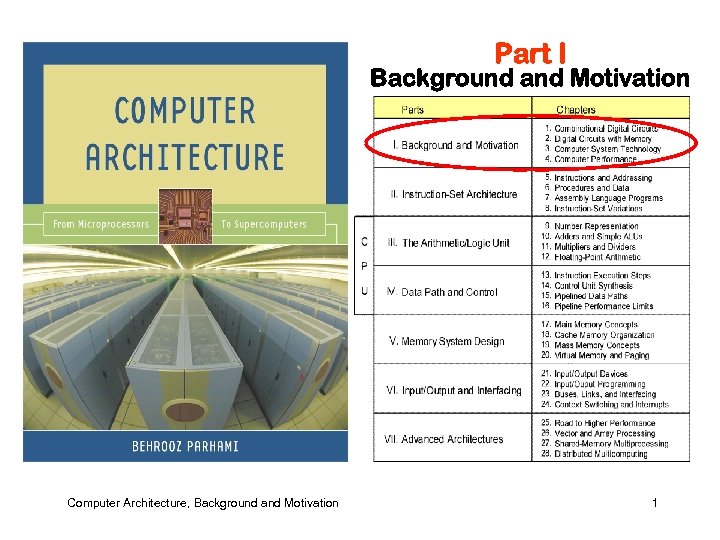
Part I Background and Motivation Computer Architecture, Background and Motivation 1
I Background and Motivation Topics in This Part Chapter 1 Combinational Digital Circuits Chapter 2 Digital Circuits with Memory Chapter 3 Computer System Technology Chapter 4 Computer Performance Computer Architecture, Background and Motivation 2
1 Combinational Digital Circuits Topics in This Chapter 1. 1 Signals, Logic Operators, and Gates 1. 2 Boolean Functions and Expressions 1. 3 Designing Gate Networks 1. 4 Useful Combinational Parts 1. 5 Programmable Combinational Parts 1. 6 Timing and Circuit Considerations Computer Architecture, Background and Motivation 3
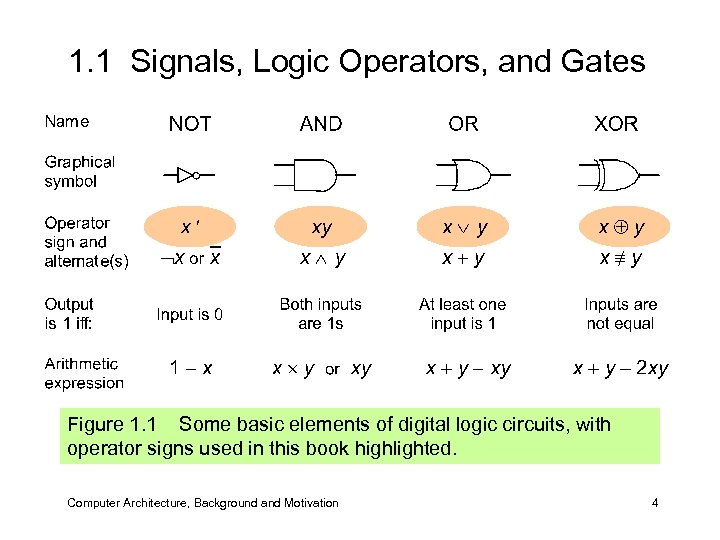
1. 1 Signals, Logic Operators, and Gates Figure 1. 1 Some basic elements of digital logic circuits, with operator signs used in this book highlighted. Computer Architecture, Background and Motivation 4
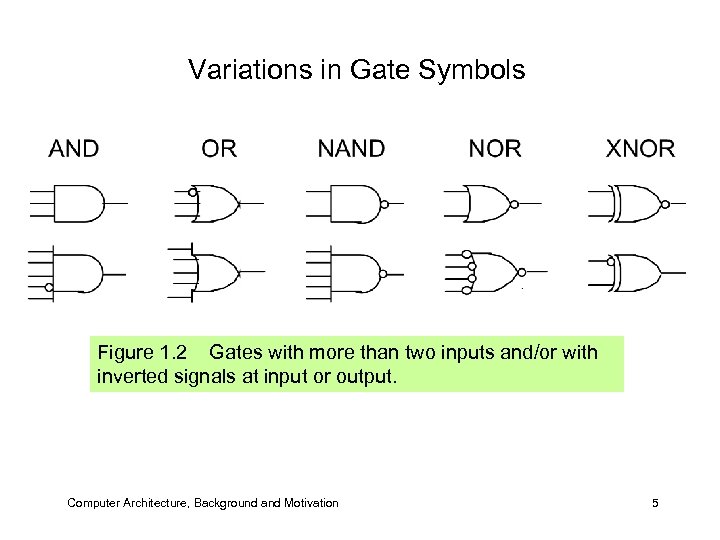
Variations in Gate Symbols Figure 1. 2 Gates with more than two inputs and/or with inverted signals at input or output. Computer Architecture, Background and Motivation 5
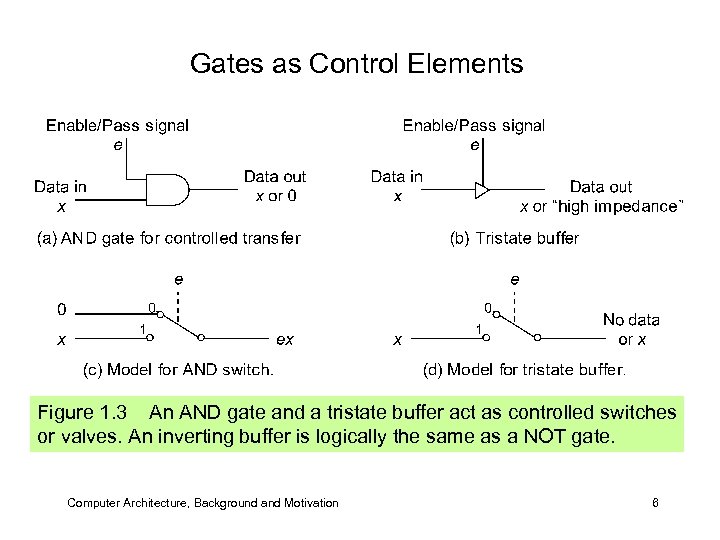
Gates as Control Elements Figure 1. 3 An AND gate and a tristate buffer act as controlled switches or valves. An inverting buffer is logically the same as a NOT gate. Computer Architecture, Background and Motivation 6
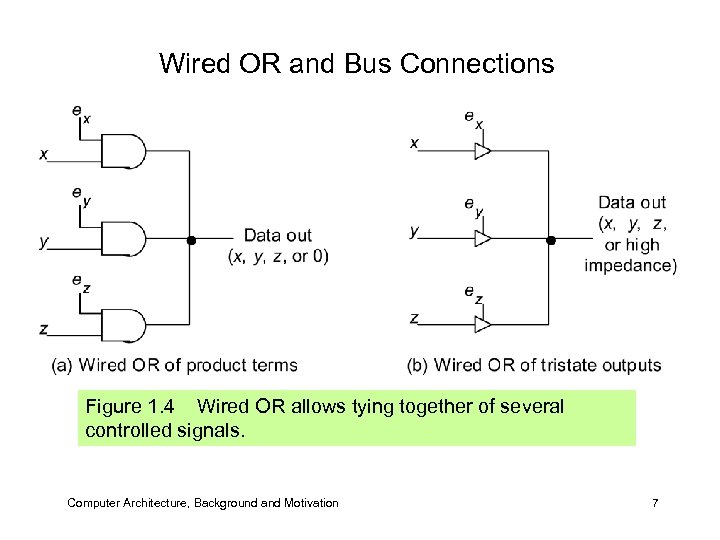
Wired OR and Bus Connections Figure 1. 4 Wired OR allows tying together of several controlled signals. Computer Architecture, Background and Motivation 7
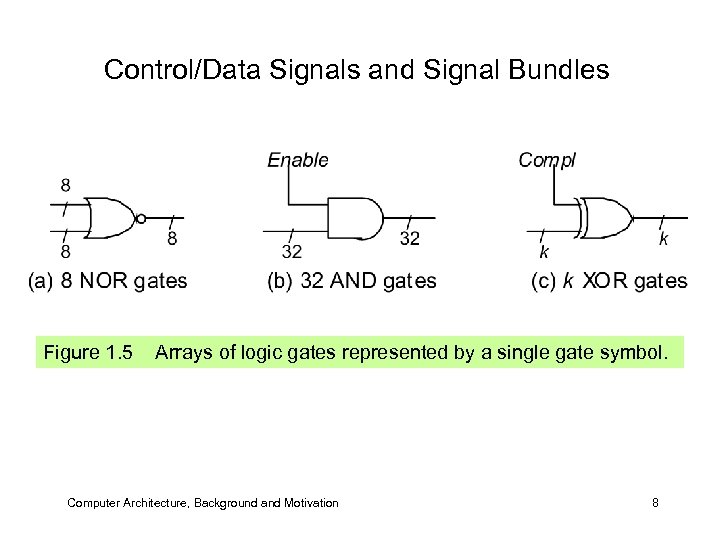
Control/Data Signals and Signal Bundles Figure 1. 5 Arrays of logic gates represented by a single gate symbol. Computer Architecture, Background and Motivation 8
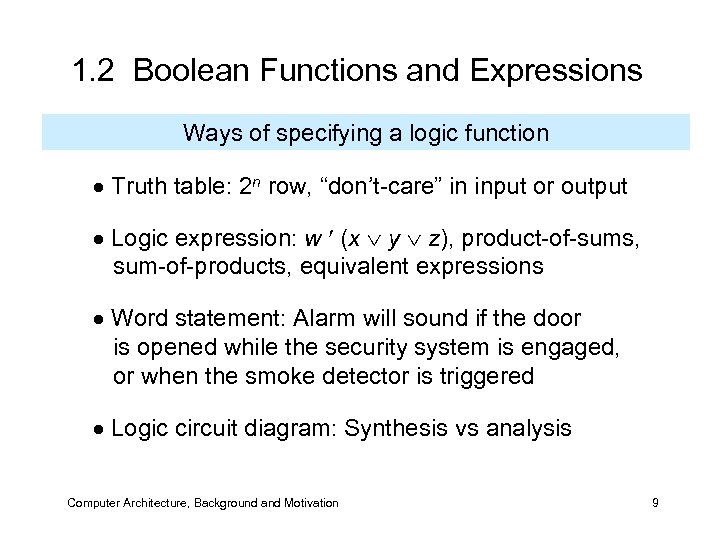
1. 2 Boolean Functions and Expressions Ways of specifying a logic function Truth table: 2 n row, “don’t-care” in input or output Logic expression: w (x y z), product-of-sums, sum-of-products, equivalent expressions Word statement: Alarm will sound if the door is opened while the security system is engaged, or when the smoke detector is triggered Logic circuit diagram: Synthesis vs analysis Computer Architecture, Background and Motivation 9
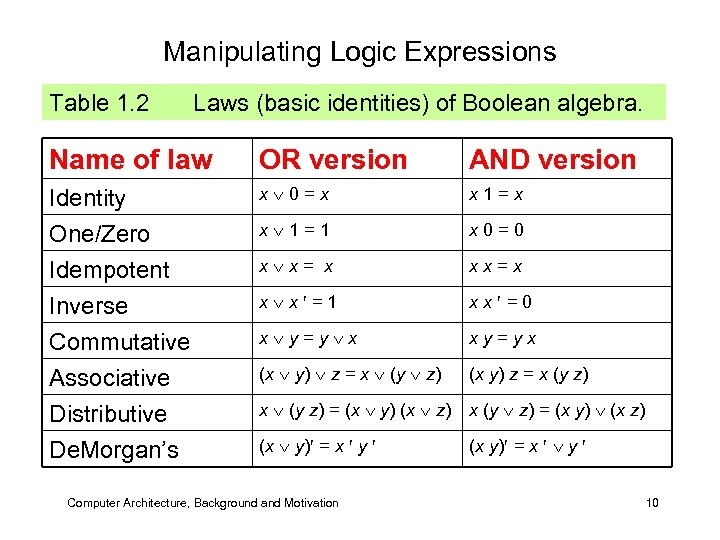
Manipulating Logic Expressions Table 1. 2 Laws (basic identities) of Boolean algebra. Name of law OR version AND version Identity One/Zero Idempotent Inverse Commutative Associative Distributive De. Morgan’s x 0=x x 1=1 x 0=0 x x= x xx=x x x =1 xx =0 x y=y x xy=yx (x y) z = x (y z) (x y) z = x (y z) x (y z) = (x y) (x z) x (y z) = (x y) (x z) (x y) = x y Computer Architecture, Background and Motivation (x y) = x y 10
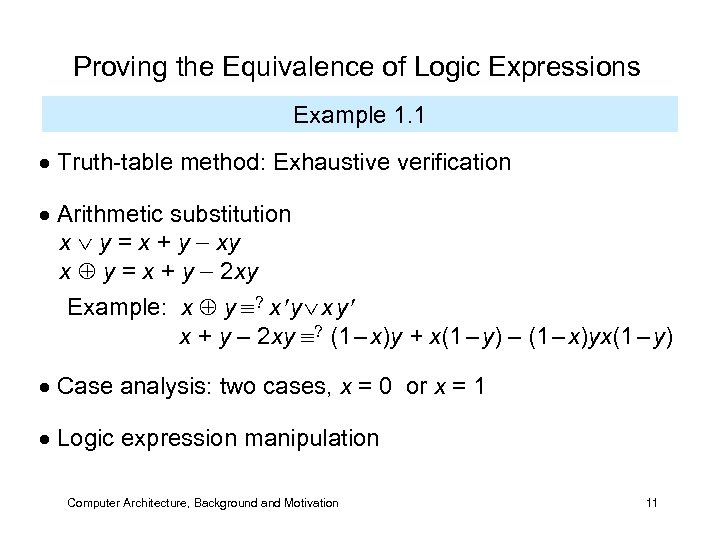
Proving the Equivalence of Logic Expressions Example 1. 1 Truth-table method: Exhaustive verification Arithmetic substitution x y = x + y - xy x y = x + y - 2 xy Example: x y ? x y x + y – 2 xy ? (1 – x)y + x(1 – y) – (1 – x)yx(1 – y) Case analysis: two cases, x = 0 or x = 1 Logic expression manipulation Computer Architecture, Background and Motivation 11
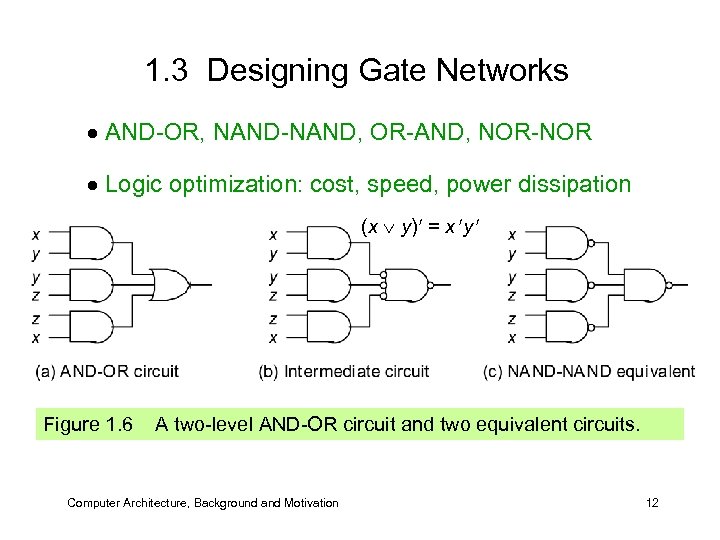
1. 3 Designing Gate Networks AND-OR, NAND-NAND, OR-AND, NOR-NOR Logic optimization: cost, speed, power dissipation (x y) = x y Figure 1. 6 A two-level AND-OR circuit and two equivalent circuits. Computer Architecture, Background and Motivation 12
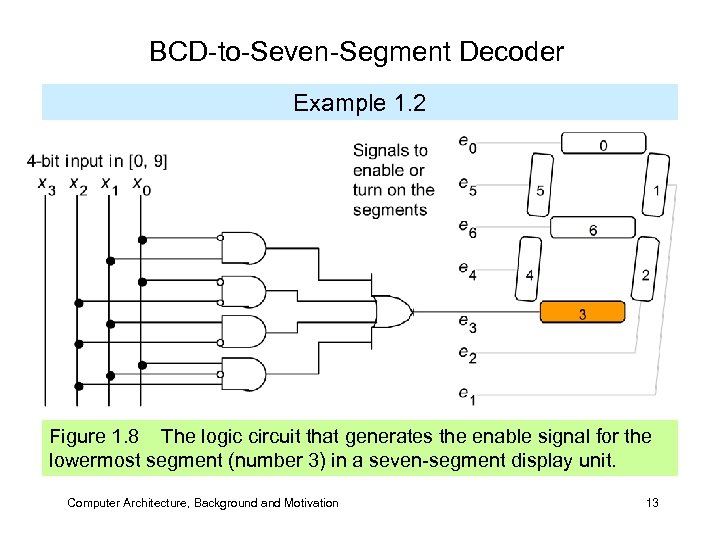
BCD-to-Seven-Segment Decoder Example 1. 2 Figure 1. 8 The logic circuit that generates the enable signal for the lowermost segment (number 3) in a seven-segment display unit. Computer Architecture, Background and Motivation 13
1. 4 Useful Combinational Parts High-level building blocks Much like prefab parts used in building a house Arithmetic components will be covered in Part III (adders, multipliers, ALUs) Here we cover three useful parts: multiplexers, decoders/demultiplexers, encoders Computer Architecture, Background and Motivation 14
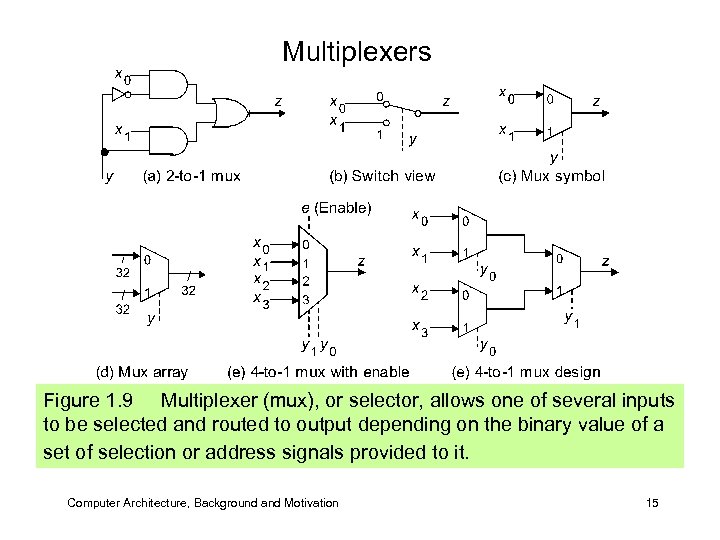
Multiplexers Figure 1. 9 Multiplexer (mux), or selector, allows one of several inputs to be selected and routed to output depending on the binary value of a set of selection or address signals provided to it. Computer Architecture, Background and Motivation 15
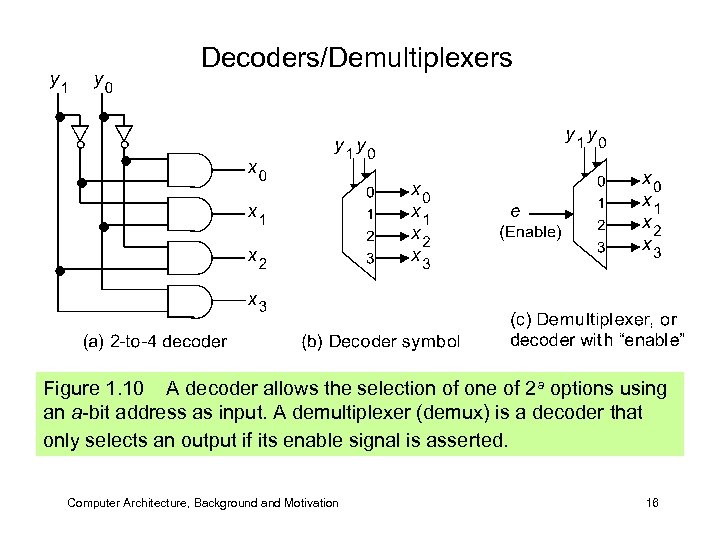
Decoders/Demultiplexers Figure 1. 10 A decoder allows the selection of one of 2 a options using an a-bit address as input. A demultiplexer (demux) is a decoder that only selects an output if its enable signal is asserted. Computer Architecture, Background and Motivation 16
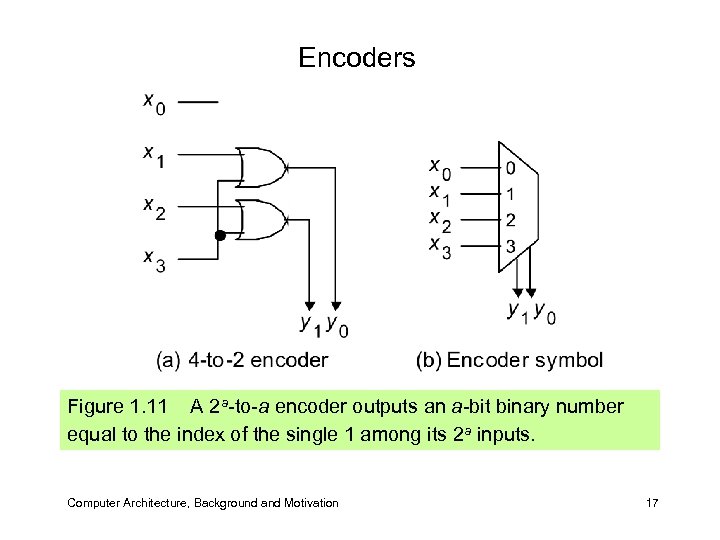
Encoders Figure 1. 11 A 2 a-to-a encoder outputs an a-bit binary number equal to the index of the single 1 among its 2 a inputs. Computer Architecture, Background and Motivation 17
1. 5 Programmable Combinational Parts A programmable combinational part can do the job of many gates or gate networks Programmed by cutting existing connections (fuses) or establishing new connections (antifuses) Programmable ROM (PROM) Programmable array logic (PAL) Programmable logic array (PLA) Computer Architecture, Background and Motivation 18
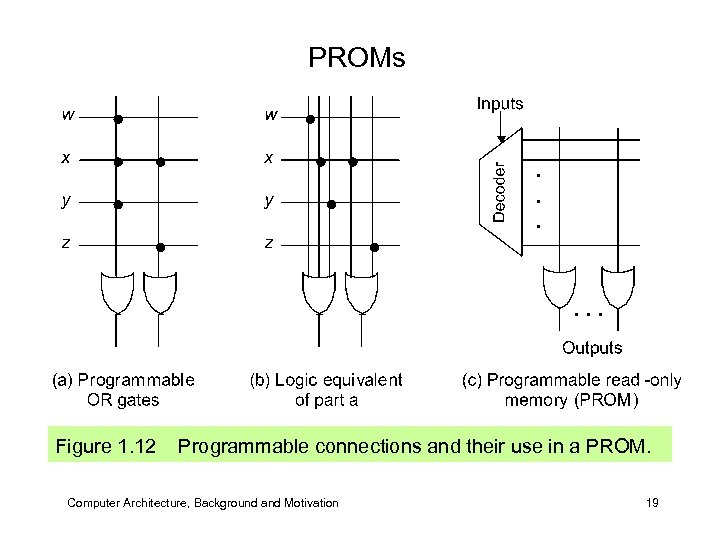
PROMs Figure 1. 12 Programmable connections and their use in a PROM. Computer Architecture, Background and Motivation 19
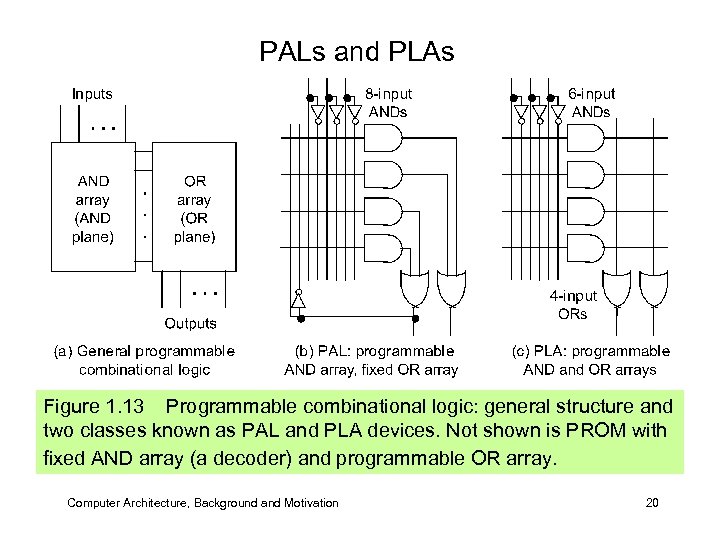
PALs and PLAs Figure 1. 13 Programmable combinational logic: general structure and two classes known as PAL and PLA devices. Not shown is PROM with fixed AND array (a decoder) and programmable OR array. Computer Architecture, Background and Motivation 20
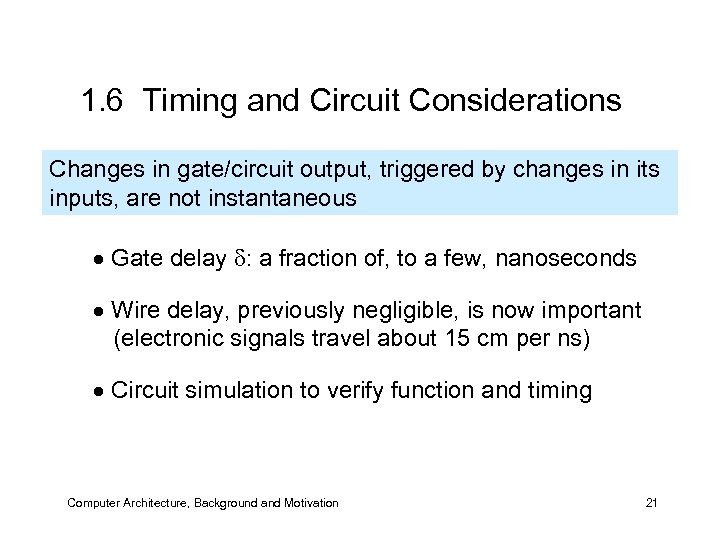
1. 6 Timing and Circuit Considerations Changes in gate/circuit output, triggered by changes in its inputs, are not instantaneous Gate delay d: a fraction of, to a few, nanoseconds Wire delay, previously negligible, is now important (electronic signals travel about 15 cm per ns) Circuit simulation to verify function and timing Computer Architecture, Background and Motivation 21
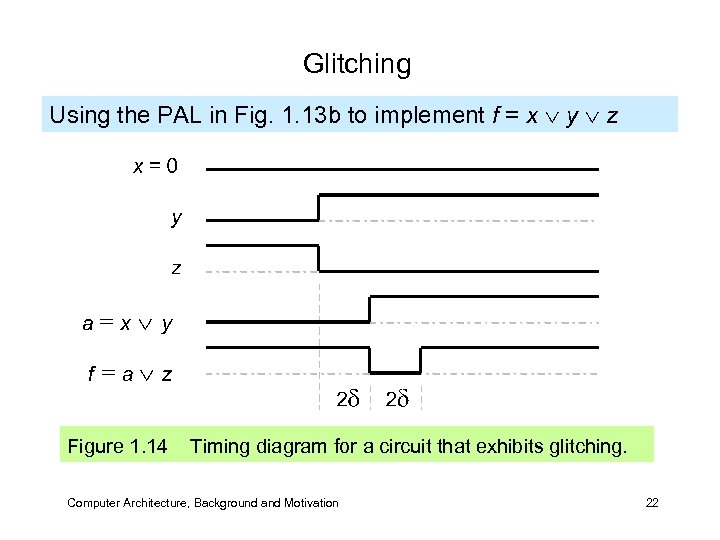
Glitching Using the PAL in Fig. 1. 13 b to implement f = x y z Figure 1. 14 Timing diagram for a circuit that exhibits glitching. Computer Architecture, Background and Motivation 22
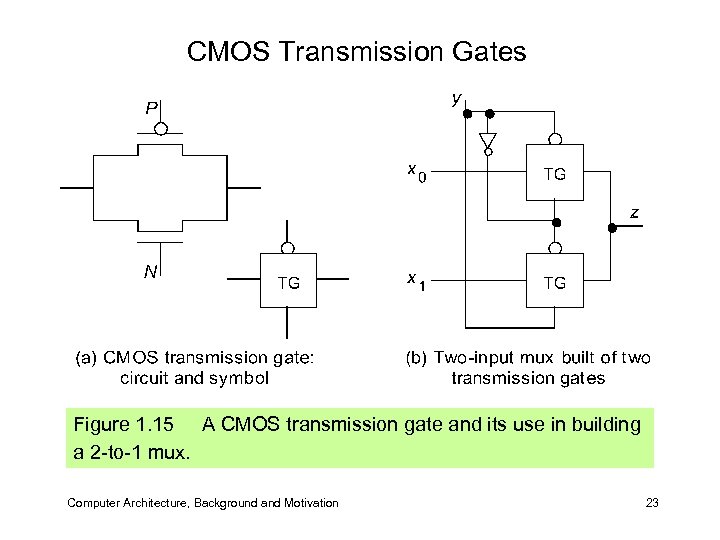
CMOS Transmission Gates Figure 1. 15 A CMOS transmission gate and its use in building a 2 -to-1 mux. Computer Architecture, Background and Motivation 23
2 Digital Circuits with Memory Second of two chapters containing a review of digital design: • Combinational (memoryless) circuits in Chapter 1 • Sequential circuits (with memory) in Chapter 2 Topics in This Chapter 2. 1 Latches, Flip-Flops, and Registers 2. 2 Finite-State Machines 2. 3 Designing Sequential Circuits 2. 4 Useful Sequential Parts 2. 5 Programmable Sequential Parts 2. 6 Clocks and Timing of Events Computer Architecture, Background and Motivation 24
2. 1 Latches, Flip-Flops, and Registers Figure 2. 1 Latches, flip-flops, and registers. Computer Architecture, Background and Motivation 25
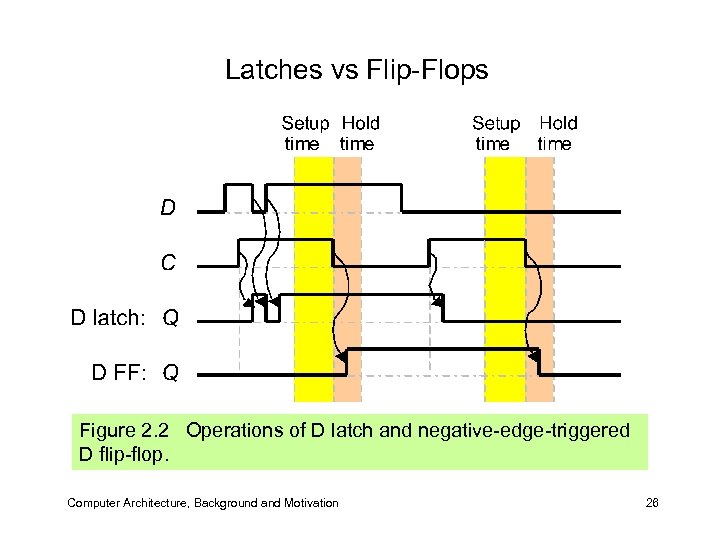
Latches vs Flip-Flops Figure 2. 2 Operations of D latch and negative-edge-triggered D flip-flop. Computer Architecture, Background and Motivation 26
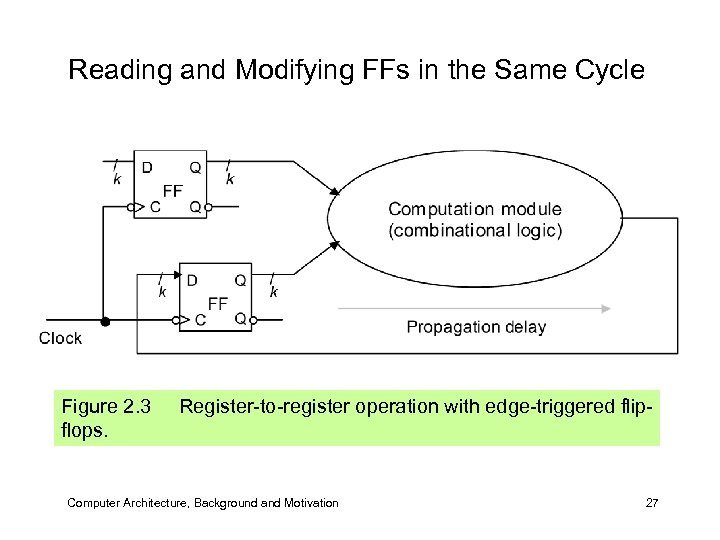
Reading and Modifying FFs in the Same Cycle Figure 2. 3 flops. Register-to-register operation with edge-triggered flip- Computer Architecture, Background and Motivation 27
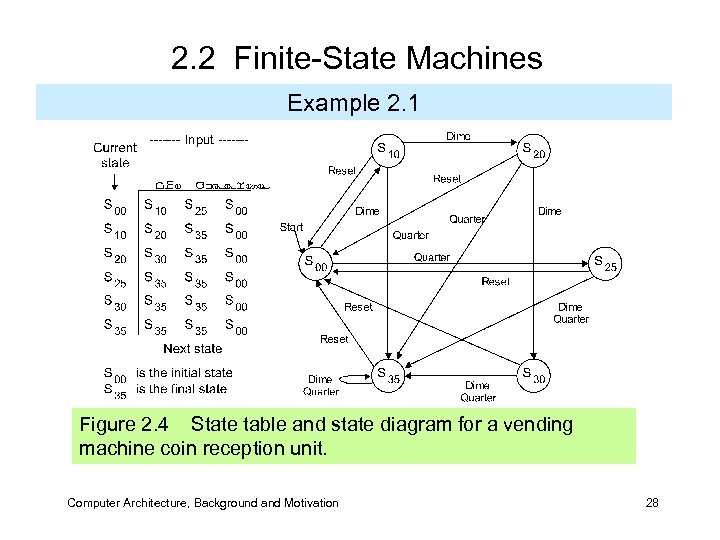
2. 2 Finite-State Machines Example 2. 1 Figure 2. 4 State table and state diagram for a vending machine coin reception unit. Computer Architecture, Background and Motivation 28
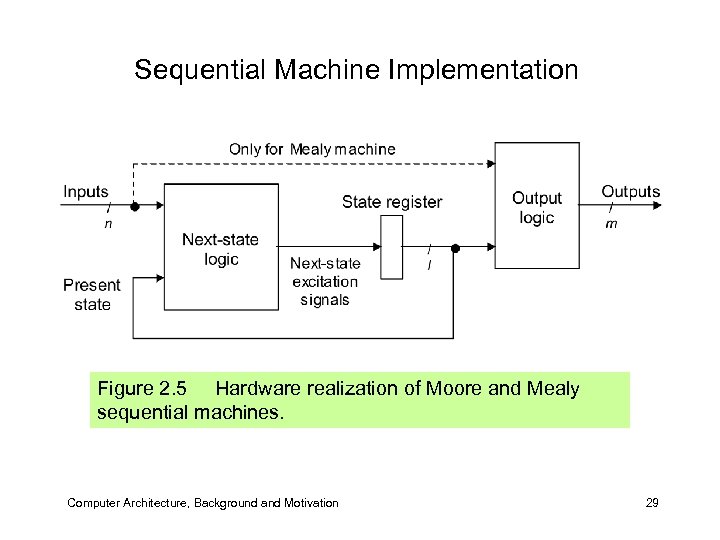
Sequential Machine Implementation Figure 2. 5 Hardware realization of Moore and Mealy sequential machines. Computer Architecture, Background and Motivation 29
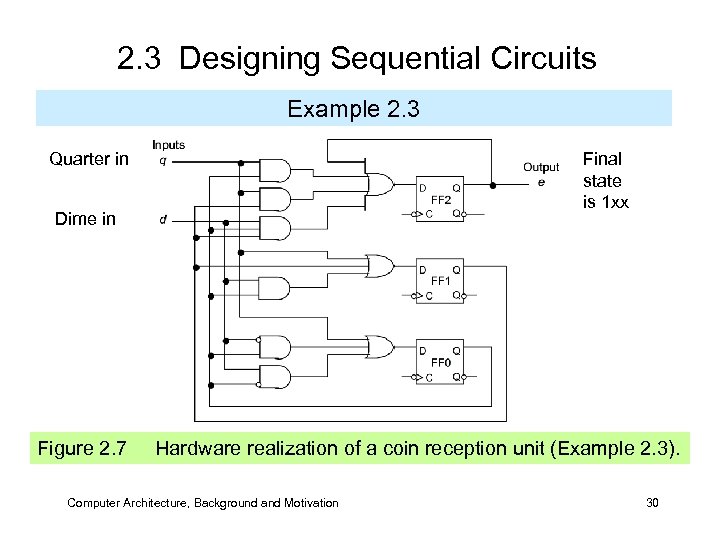
2. 3 Designing Sequential Circuits Example 2. 3 Quarter in Final state is 1 xx Dime in Figure 2. 7 Hardware realization of a coin reception unit (Example 2. 3). Computer Architecture, Background and Motivation 30
2. 4 Useful Sequential Parts High-level building blocks Much like prefab closets used in building a house Other memory components will be covered in Chapter 17 (SRAM details, DRAM, Flash) Here we cover three useful parts: shift register, register file (SRAM basics), counter Computer Architecture, Background and Motivation 31
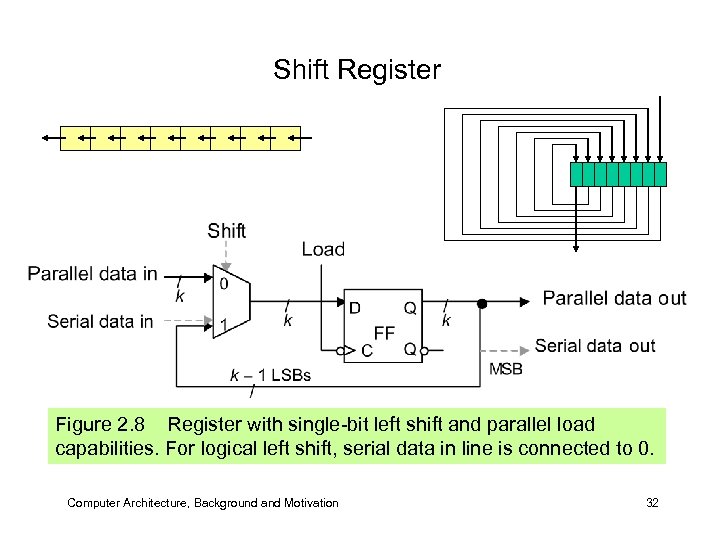
Shift Register Figure 2. 8 Register with single-bit left shift and parallel load capabilities. For logical left shift, serial data in line is connected to 0. Computer Architecture, Background and Motivation 32
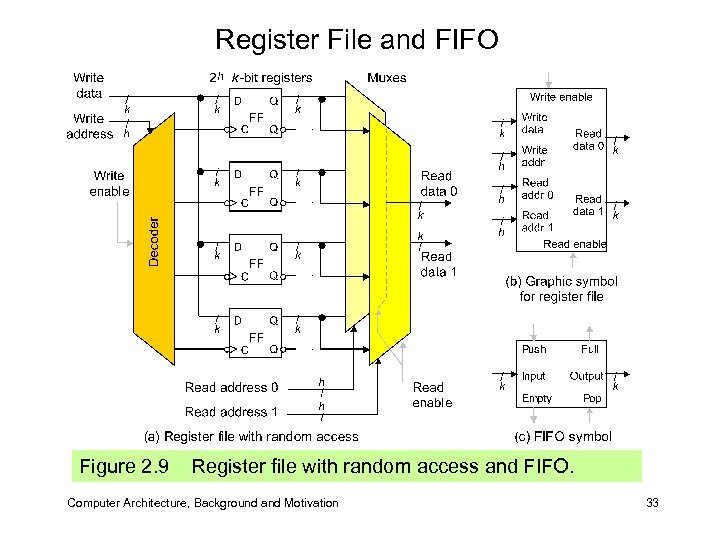
Register File and FIFO Figure 2. 9 Register file with random access and FIFO. Computer Architecture, Background and Motivation 33
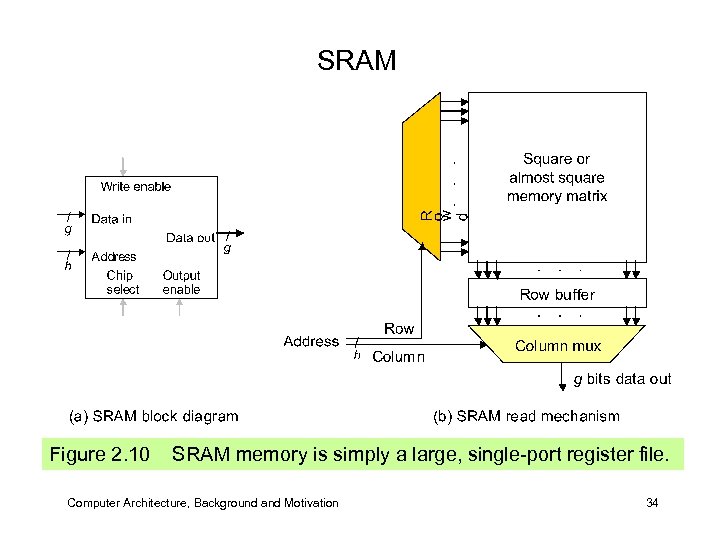
SRAM Figure 2. 10 SRAM memory is simply a large, single-port register file. Computer Architecture, Background and Motivation 34
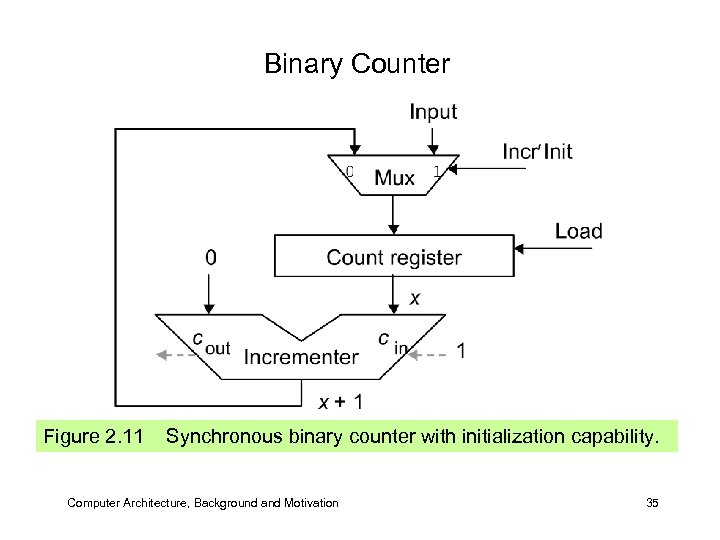
Binary Counter Figure 2. 11 Synchronous binary counter with initialization capability. Computer Architecture, Background and Motivation 35
2. 5 Programmable Sequential Parts A programmable sequential part contain gates and memory elements Programmed by cutting existing connections (fuses) or establishing new connections (antifuses) Programmable array logic (PAL) Field-programmable gate array (FPGA) Both types contain macrocells and interconnects Computer Architecture, Background and Motivation 36
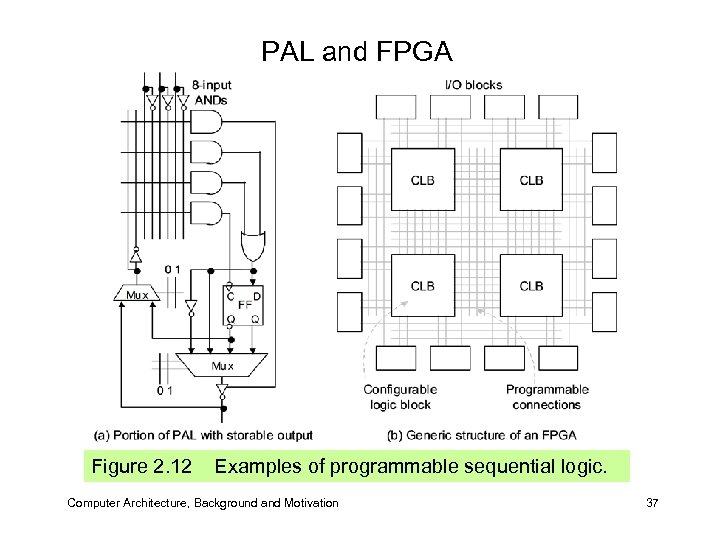
PAL and FPGA Figure 2. 12 Examples of programmable sequential logic. Computer Architecture, Background and Motivation 37
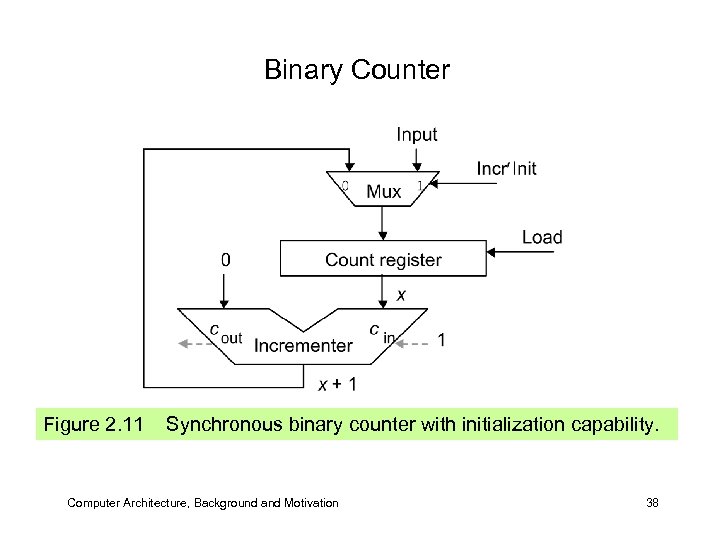
Binary Counter Figure 2. 11 Synchronous binary counter with initialization capability. Computer Architecture, Background and Motivation 38
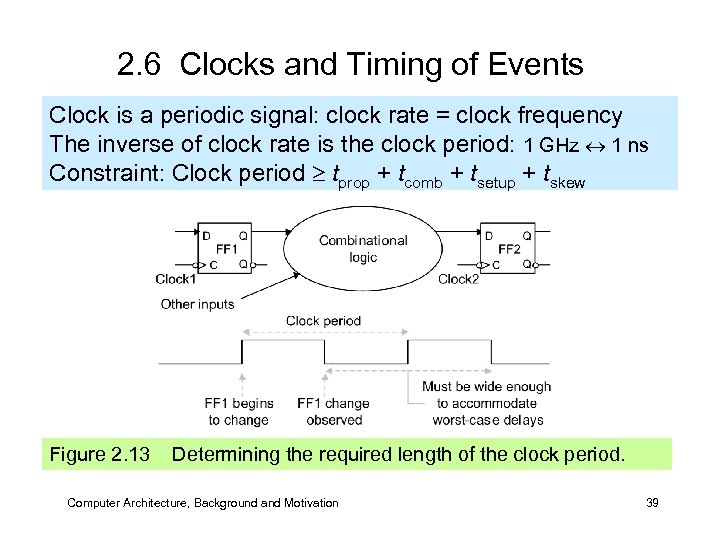
2. 6 Clocks and Timing of Events Clock is a periodic signal: clock rate = clock frequency The inverse of clock rate is the clock period: 1 GHz 1 ns Constraint: Clock period tprop + tcomb + tsetup + tskew Figure 2. 13 Determining the required length of the clock period. Computer Architecture, Background and Motivation 39
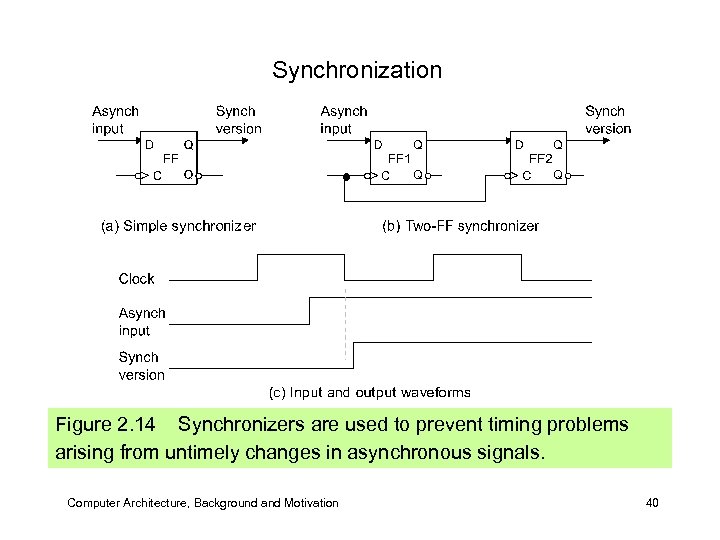
Synchronization Figure 2. 14 Synchronizers are used to prevent timing problems arising from untimely changes in asynchronous signals. Computer Architecture, Background and Motivation 40
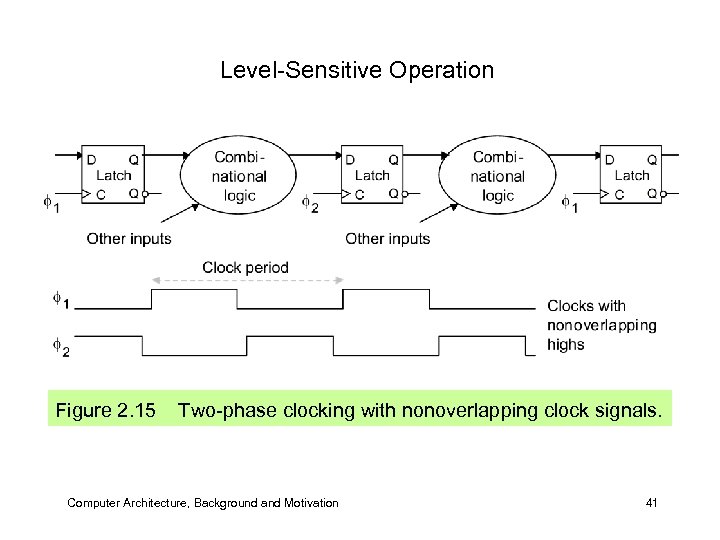
Level-Sensitive Operation Figure 2. 15 Two-phase clocking with nonoverlapping clock signals. Computer Architecture, Background and Motivation 41
3 Computer System Technology Interplay between architecture, hardware, and software • Architectural innovations influence technology • Technological advances drive changes in architecture Topics in This Chapter 3. 1 From Components to Applications 3. 2 Computer Systems and Their Parts 3. 3 Generations of Progress 3. 4 Processor and Memory Technologies 3. 5 Peripherals, I/O, and Communications 3. 6 Software Systems and Applications Computer Architecture, Background and Motivation 42
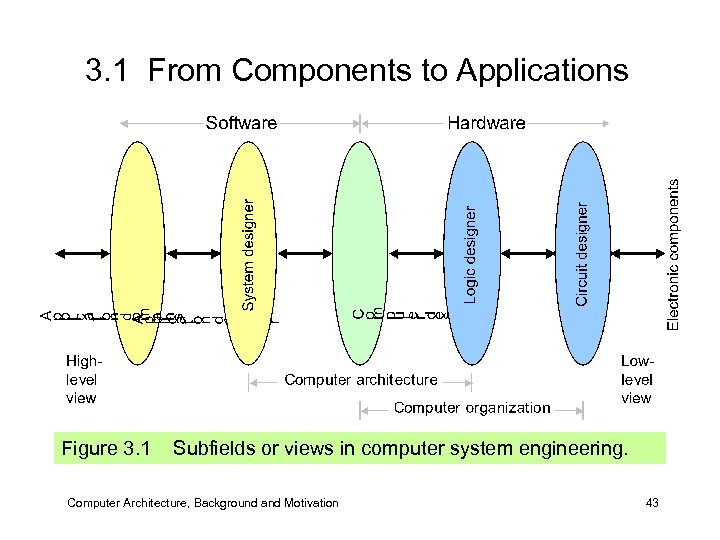
3. 1 From Components to Applications Figure 3. 1 Subfields or views in computer system engineering. Computer Architecture, Background and Motivation 43
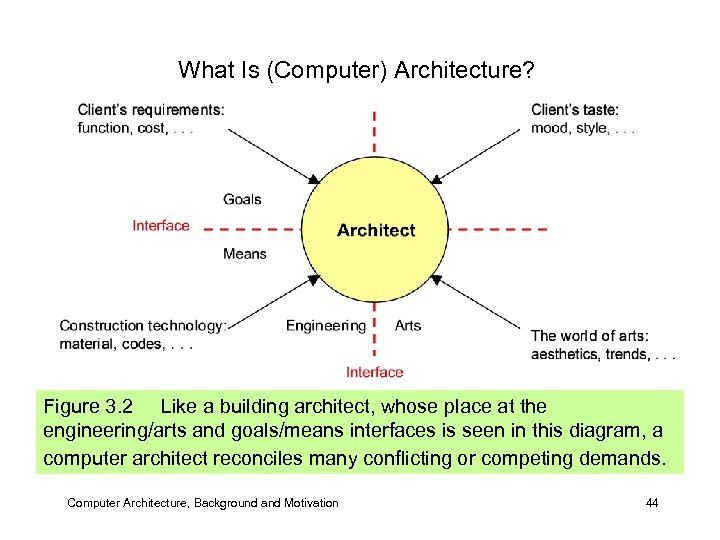
What Is (Computer) Architecture? Figure 3. 2 Like a building architect, whose place at the engineering/arts and goals/means interfaces is seen in this diagram, a computer architect reconciles many conflicting or competing demands. Computer Architecture, Background and Motivation 44
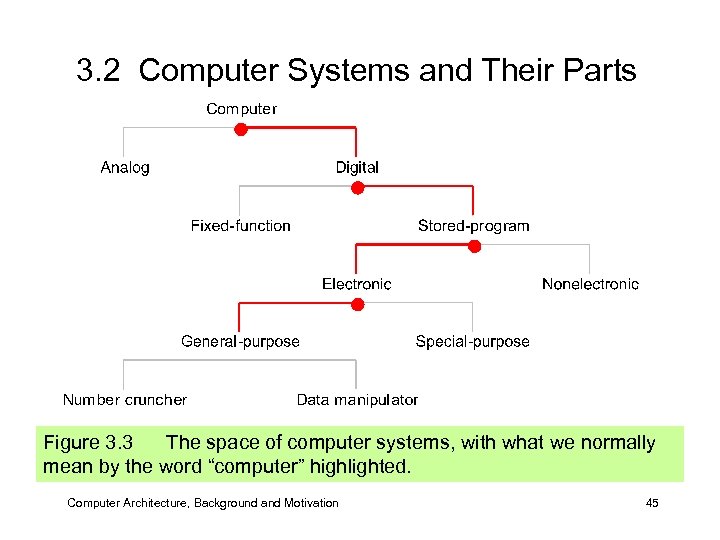
3. 2 Computer Systems and Their Parts Figure 3. 3 The space of computer systems, with what we normally mean by the word “computer” highlighted. Computer Architecture, Background and Motivation 45
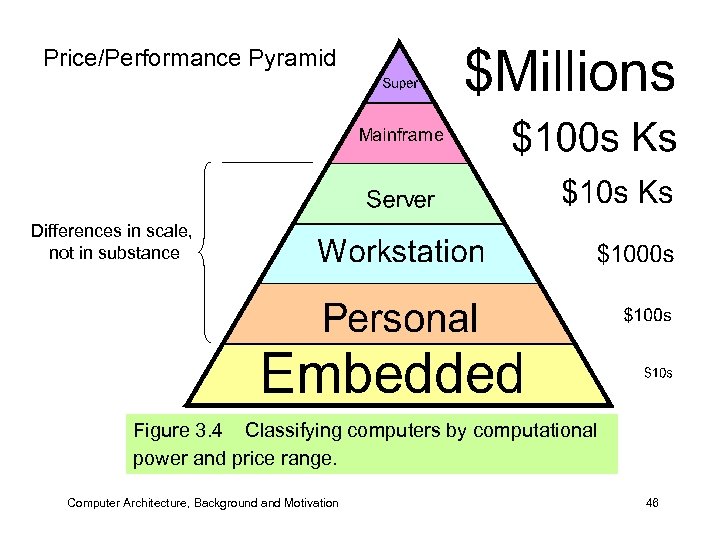
Price/Performance Pyramid Differences in scale, not in substance Figure 3. 4 Classifying computers by computational power and price range. Computer Architecture, Background and Motivation 46
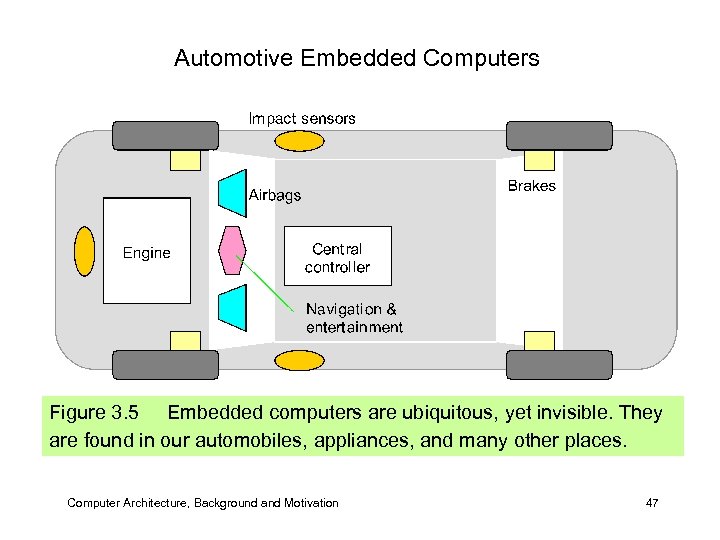
Automotive Embedded Computers Figure 3. 5 Embedded computers are ubiquitous, yet invisible. They are found in our automobiles, appliances, and many other places. Computer Architecture, Background and Motivation 47
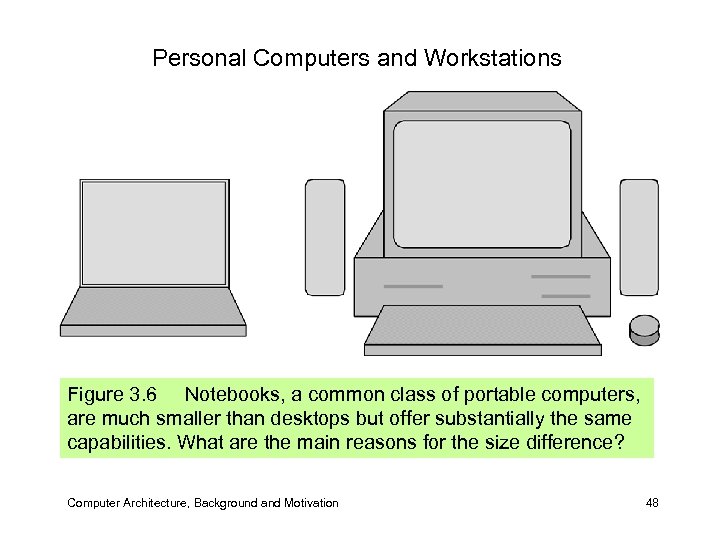
Personal Computers and Workstations Figure 3. 6 Notebooks, a common class of portable computers, are much smaller than desktops but offer substantially the same capabilities. What are the main reasons for the size difference? Computer Architecture, Background and Motivation 48
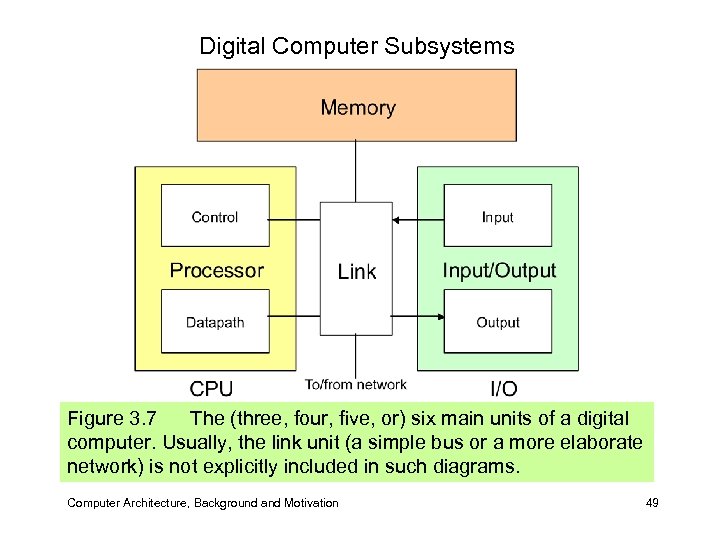
Digital Computer Subsystems Figure 3. 7 The (three, four, five, or) six main units of a digital computer. Usually, the link unit (a simple bus or a more elaborate network) is not explicitly included in such diagrams. Computer Architecture, Background and Motivation 49
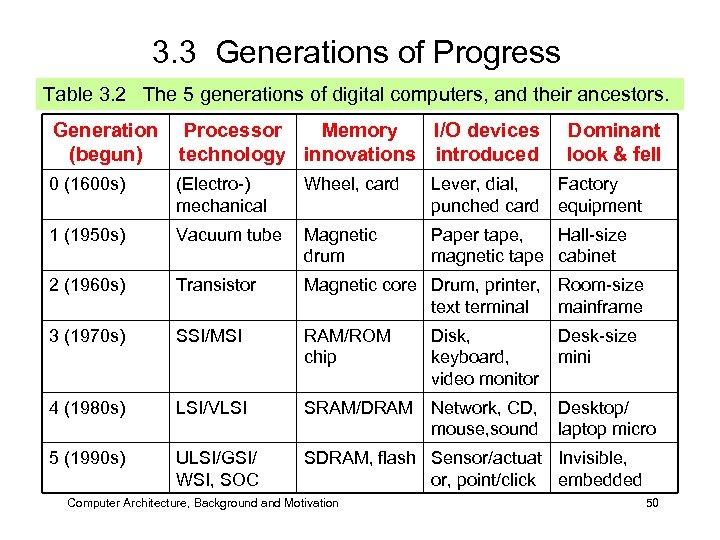
3. 3 Generations of Progress Table 3. 2 The 5 generations of digital computers, and their ancestors. Generation (begun) Processor Memory I/O devices technology innovations introduced 0 (1600 s) (Electro-) mechanical Wheel, card Lever, dial, punched card 1 (1950 s) Vacuum tube Magnetic drum Paper tape, Hall-size magnetic tape cabinet 2 (1960 s) Transistor Magnetic core Drum, printer, Room-size text terminal mainframe 3 (1970 s) SSI/MSI RAM/ROM chip 4 (1980 s) LSI/VLSI SRAM/DRAM Network, CD, mouse, sound 5 (1990 s) ULSI/GSI/ WSI, SOC SDRAM, flash Sensor/actuat Invisible, or, point/click embedded Computer Architecture, Background and Motivation Disk, keyboard, video monitor Dominant look & fell Factory equipment Desk-size mini Desktop/ laptop micro 50
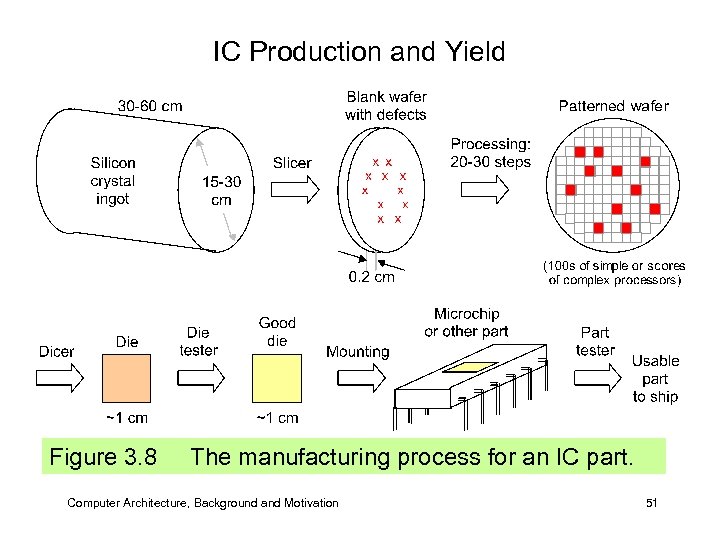
IC Production and Yield Figure 3. 8 The manufacturing process for an IC part. Computer Architecture, Background and Motivation 51
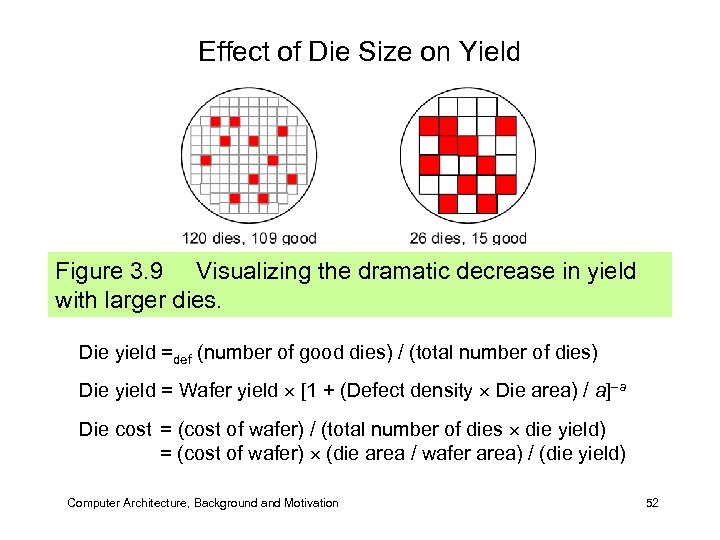
Effect of Die Size on Yield Figure 3. 9 Visualizing the dramatic decrease in yield with larger dies. Die yield =def (number of good dies) / (total number of dies) Die yield = Wafer yield [1 + (Defect density Die area) / a]–a Die cost = (cost of wafer) / (total number of dies die yield) = (cost of wafer) (die area / wafer area) / (die yield) Computer Architecture, Background and Motivation 52
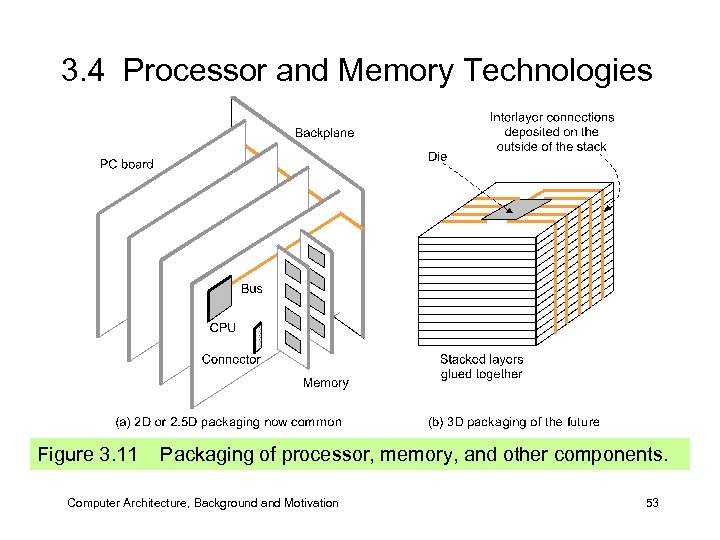
3. 4 Processor and Memory Technologies Figure 3. 11 Packaging of processor, memory, and other components. Computer Architecture, Background and Motivation 53
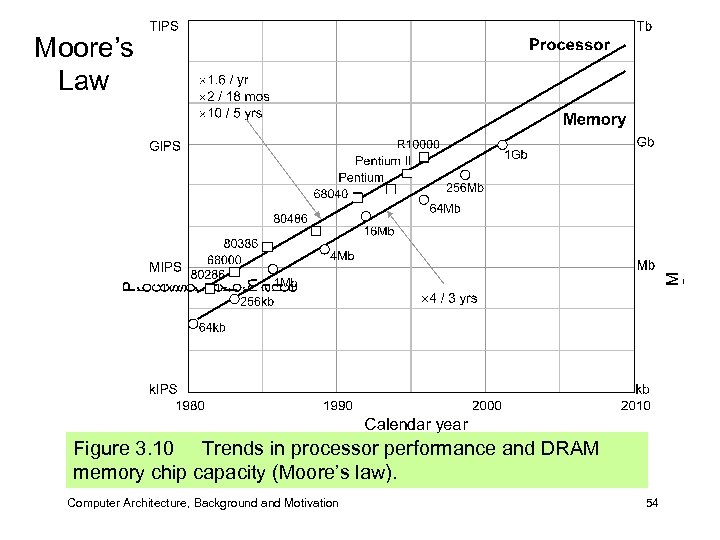
Moore’s Law Figure 3. 10 Trends in processor performance and DRAM memory chip capacity (Moore’s law). Computer Architecture, Background and Motivation 54
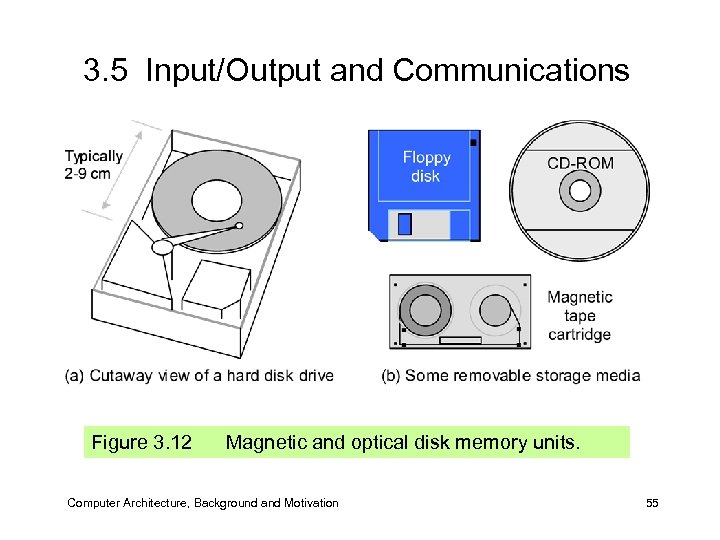
3. 5 Input/Output and Communications Figure 3. 12 Magnetic and optical disk memory units. Computer Architecture, Background and Motivation 55
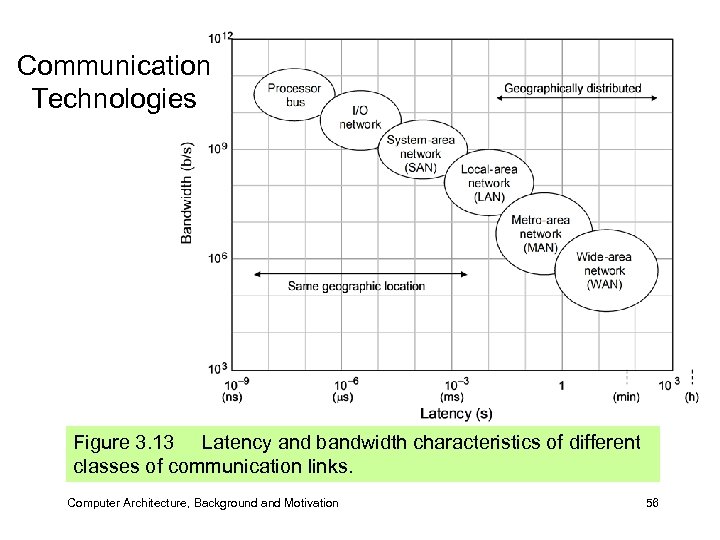
Communication Technologies Figure 3. 13 Latency and bandwidth characteristics of different classes of communication links. Computer Architecture, Background and Motivation 56
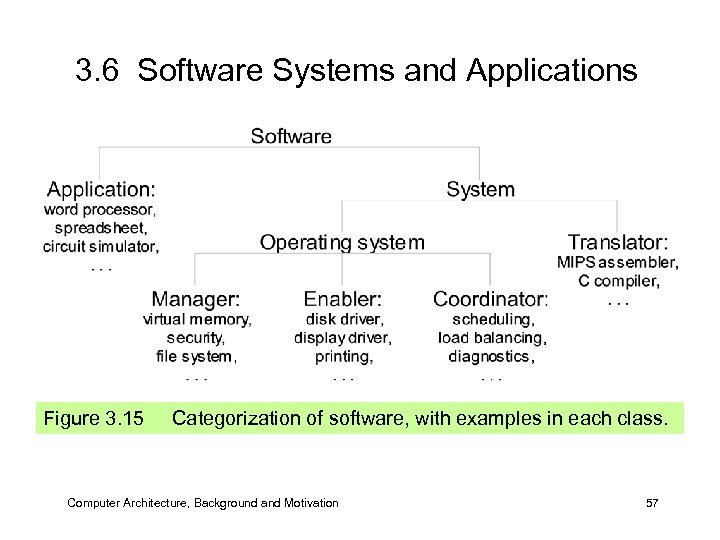
3. 6 Software Systems and Applications Figure 3. 15 Categorization of software, with examples in each class. Computer Architecture, Background and Motivation 57
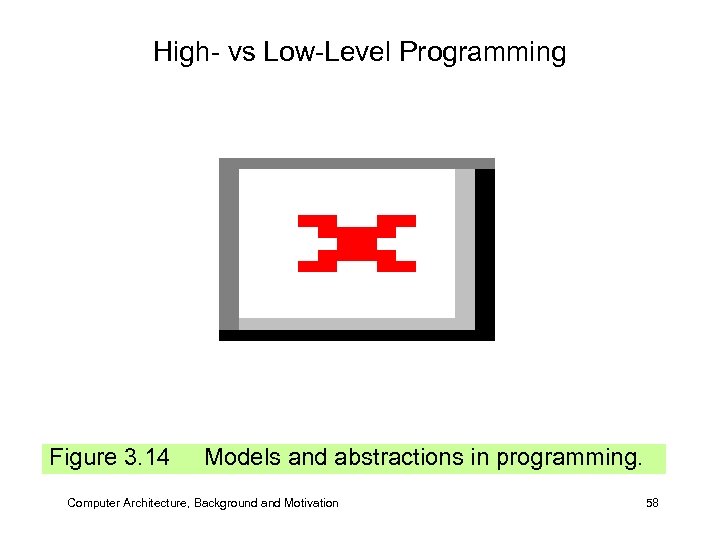
High- vs Low-Level Programming Figure 3. 14 Models and abstractions in programming. Computer Architecture, Background and Motivation 58
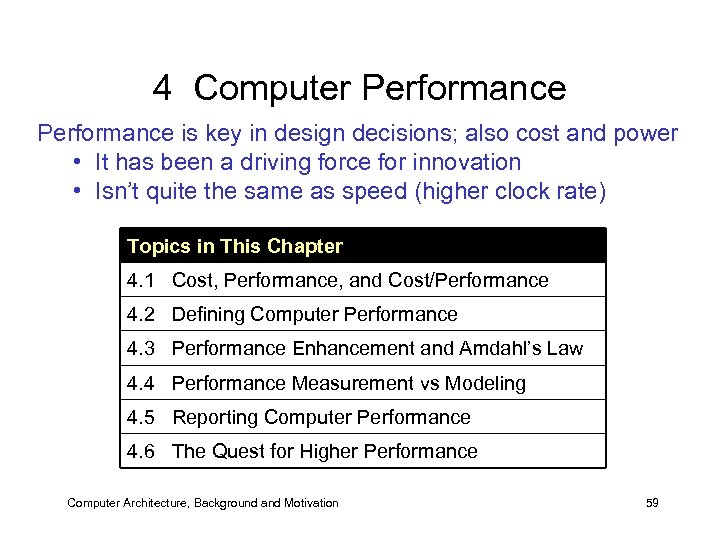
4 Computer Performance is key in design decisions; also cost and power • It has been a driving force for innovation • Isn’t quite the same as speed (higher clock rate) Topics in This Chapter 4. 1 Cost, Performance, and Cost/Performance 4. 2 Defining Computer Performance 4. 3 Performance Enhancement and Amdahl’s Law 4. 4 Performance Measurement vs Modeling 4. 5 Reporting Computer Performance 4. 6 The Quest for Higher Performance Computer Architecture, Background and Motivation 59
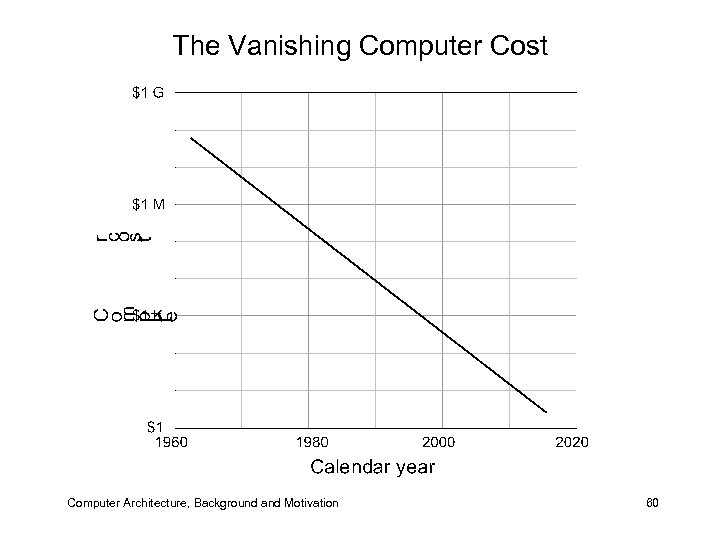
The Vanishing Computer Cost Computer Architecture, Background and Motivation 60
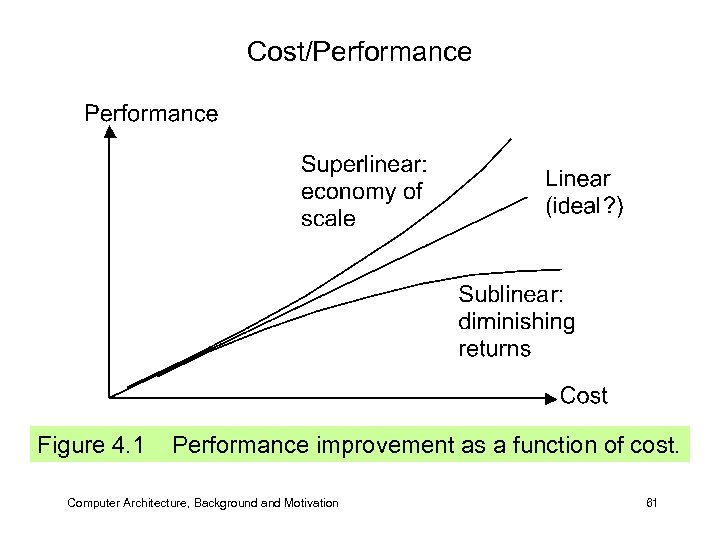
Cost/Performance Figure 4. 1 Performance improvement as a function of cost. Computer Architecture, Background and Motivation 61
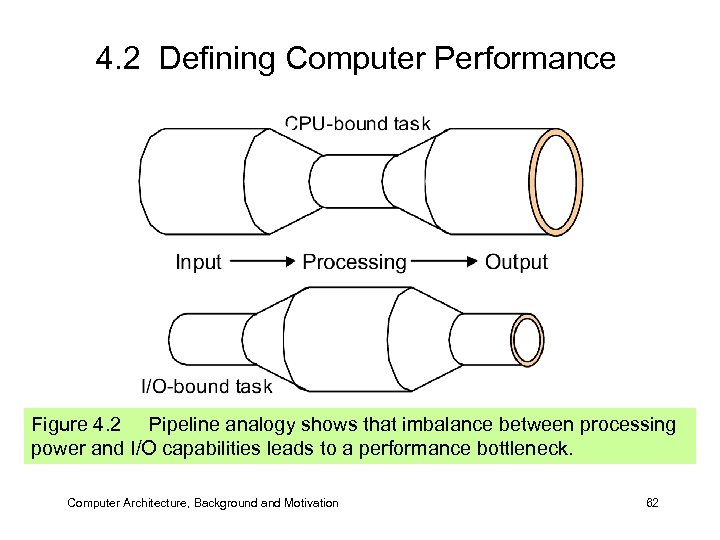
4. 2 Defining Computer Performance Figure 4. 2 Pipeline analogy shows that imbalance between processing power and I/O capabilities leads to a performance bottleneck. Computer Architecture, Background and Motivation 62
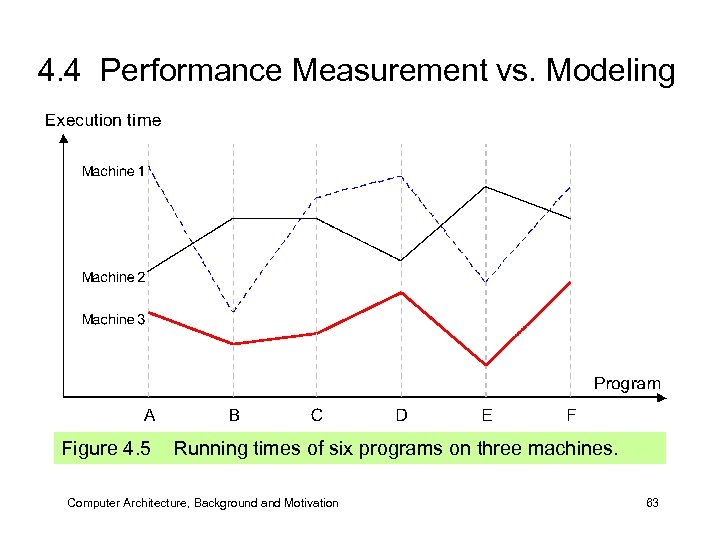
4. 4 Performance Measurement vs. Modeling Figure 4. 5 Running times of six programs on three machines. Computer Architecture, Background and Motivation 63
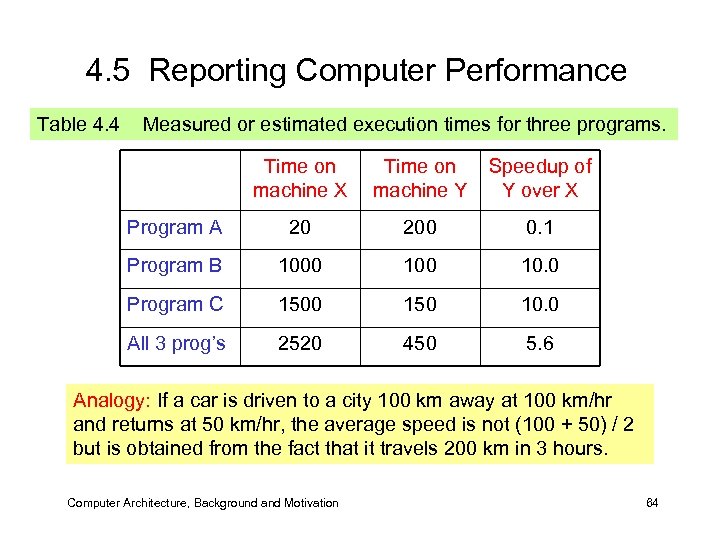
4. 5 Reporting Computer Performance Table 4. 4 Measured or estimated execution times for three programs. Time on machine X Time on machine Y Speedup of Y over X Program A 20 200 0. 1 Program B 1000 10. 0 Program C 1500 150 10. 0 All 3 prog’s 2520 450 5. 6 Analogy: If a car is driven to a city 100 km away at 100 km/hr and returns at 50 km/hr, the average speed is not (100 + 50) / 2 but is obtained from the fact that it travels 200 km in 3 hours. Computer Architecture, Background and Motivation 64
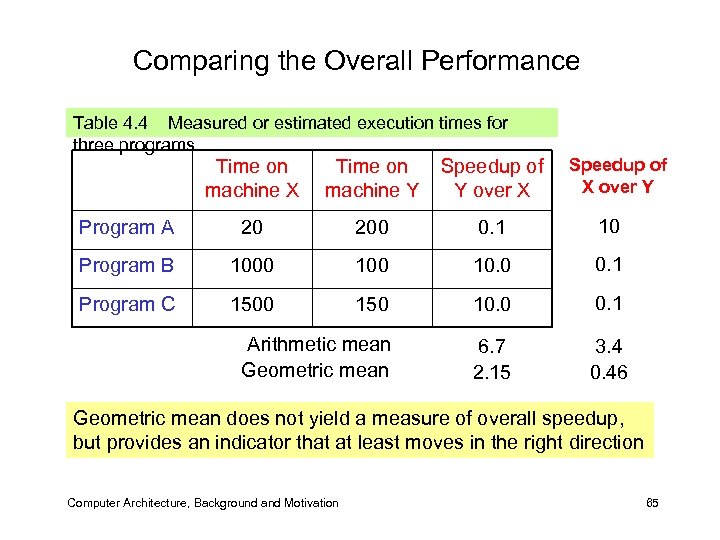
Comparing the Overall Performance Table 4. 4 Measured or estimated execution times for three programs. Speedup of X over Y Time on machine X Time on machine Y Speedup of Y over X Program A 20 200 0. 1 10 Program B 1000 10. 0 0. 1 Program C 1500 150 10. 0 0. 1 Arithmetic mean Geometric mean 6. 7 2. 15 3. 4 0. 46 Geometric mean does not yield a measure of overall speedup, but provides an indicator that at least moves in the right direction Computer Architecture, Background and Motivation 65
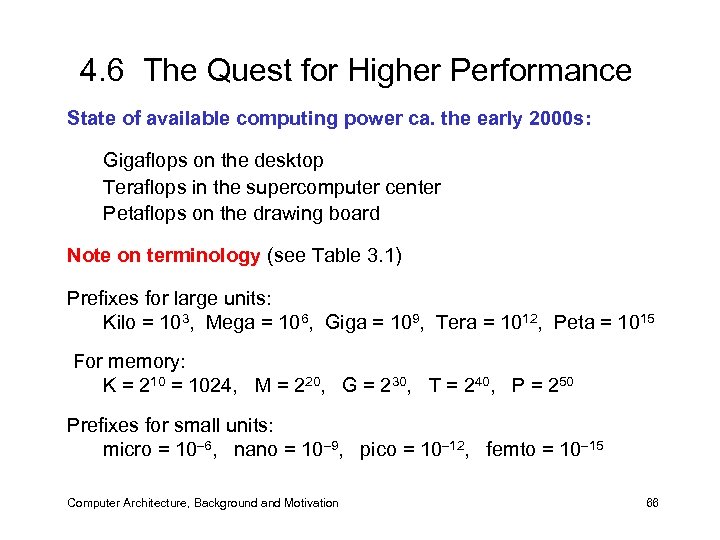
4. 6 The Quest for Higher Performance State of available computing power ca. the early 2000 s: Gigaflops on the desktop Teraflops in the supercomputer center Petaflops on the drawing board Note on terminology (see Table 3. 1) Prefixes for large units: Kilo = 103, Mega = 106, Giga = 109, Tera = 1012, Peta = 1015 For memory: K = 210 = 1024, M = 220, G = 230, T = 240, P = 250 Prefixes for small units: micro = 10 -6, nano = 10 -9, pico = 10 -12, femto = 10 -15 Computer Architecture, Background and Motivation 66
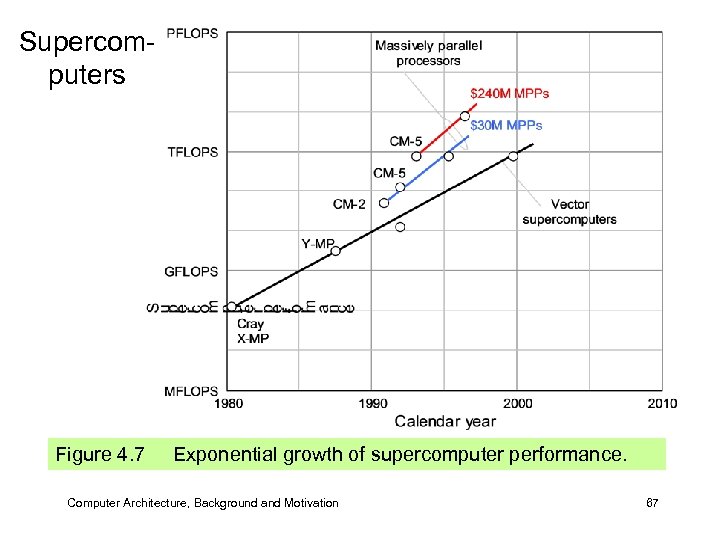
Supercomputers Figure 4. 7 Exponential growth of supercomputer performance. Computer Architecture, Background and Motivation 67
Скачать презентацию Part I Background and Motivation Computer Architecture Background
1f8f53d5dc53d5cea6170a2df13ec684.ppt