


 Скачать презентацию Part 3 Target Market Selection 8 Marketing Research
99b448a6811b86dca6230fb1f32dd130.ppt
- Количество слайдов: 38
 Part 3: Target Market Selection 8. Marketing Research, Decision. Support Systems, and Sales Forecasting 9. Market Segmentation, Targeting, and Positioning 10. Relationship Marketing, Customer Relationship Management (CRM), and One-to. One Marketing Copyright © 2006 by South-Western, a division of Thomson Learning, Inc. All rights reserved.
 Chapter 9 Market Segmentation, Targeting, and Positioning Copyright © 2006 by South-Western, a division of Thomson Learning, Inc. All rights reserved.
 Chapter Objectives 1. Identify the essential components of a market. 2. Outline the role of market segmentation in developing a marketing strategy. 3. Describe the criteria necessary for effective segmentation. 4. Explain each of the four bases for segmenting consumer markets. 5. Identify the steps in the market segmentation process. 6. Discuss four basic strategies for reaching target markets. 7. Summarize the types of positioning strategies. 8. Explain the reasons for positioning and repositioning products. Copyright © 2006 by South-Western, a division of Thomson Learning, Inc. All rights reserved. 3
 Selecting a Target Market n Before a marketing mix strategy can be implemented, the marketer must identify, evaluate, and select a target market. üMarket: people or institutions with sufficient purchasing power, authority, and willingness to buy üTarget market: specific segment of consumers most likely to purchase a particular product Copyright © 2006 by South-Western, a division of Thomson Learning, Inc. All rights reserved. 4
 Types of Markets n Consumer products: goods or services purchased by an ultimate consumer for personal use n Business products: goods or services purchased for use either directly or indirectly in the production of other goods and services for resale n The key to classification is to identify the purchaser and the reasons for buying the goods. Copyright © 2006 by South-Western, a division of Thomson Learning, Inc. All rights reserved. 5
 The Role of Market Segmentation n Market Segmentation Division of the total market into smaller, relatively homogeneous groups n No single marketing mix can satisfy everyone. Therefore, separate marketing mixes should be used for different market segments. Copyright © 2006 by South-Western, a division of Thomson Learning, Inc. All rights reserved. 6
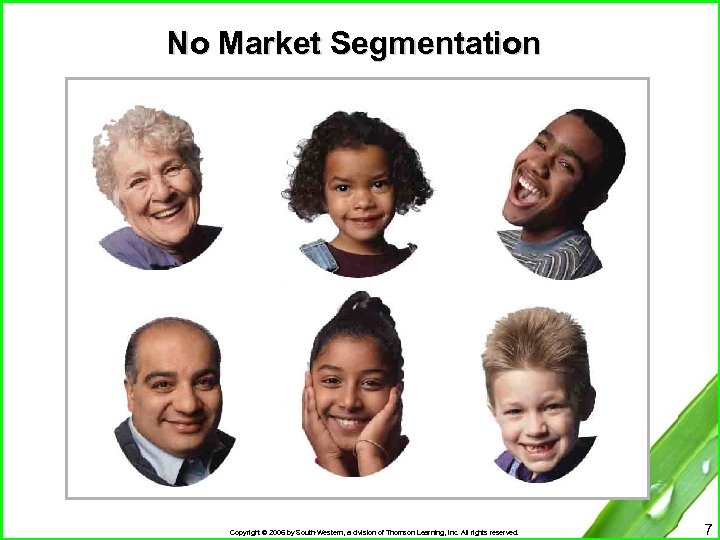 No Market Segmentation Copyright © 2006 by South-Western, a division of Thomson Learning, Inc. All rights reserved. 7
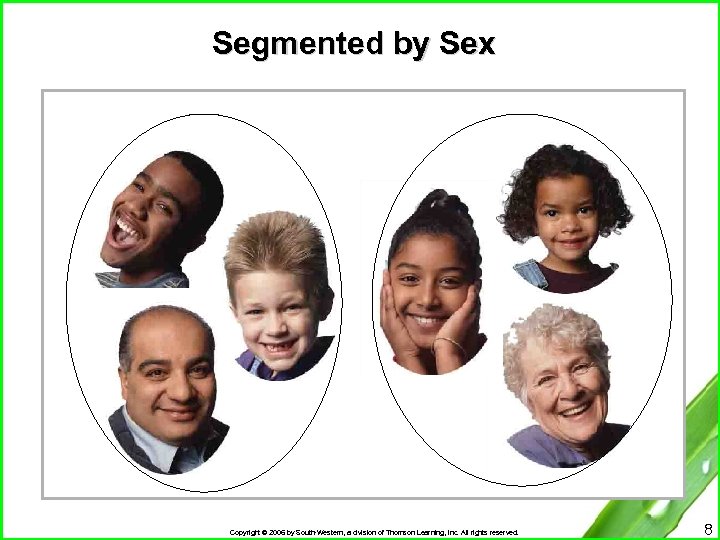 Segmented by Sex Copyright © 2006 by South-Western, a division of Thomson Learning, Inc. All rights reserved. 8
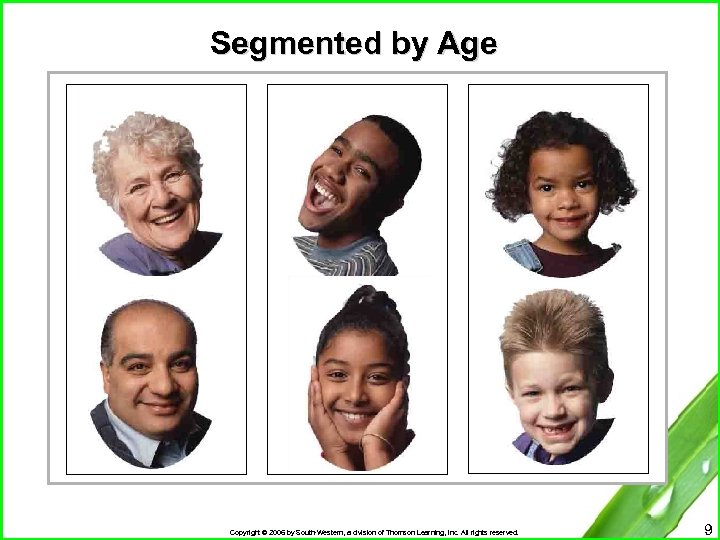 Segmented by Age Copyright © 2006 by South-Western, a division of Thomson Learning, Inc. All rights reserved. 9
 Criteria for Effective Segmentation n Market segmentation cannot be used in all cases. To be effective, segmentation must meet the following basic requirements. üThe market segments must be measurable in terms of both purchasing power and size. üMarketers must be able to effectively promote to and serve a market segment. üMarket segments must be sufficiently large to be potentially profitable. üThe number of segments must match the firm’s capabilities. Copyright © 2006 by South-Western, a division of Thomson Learning, Inc. All rights reserved. 10
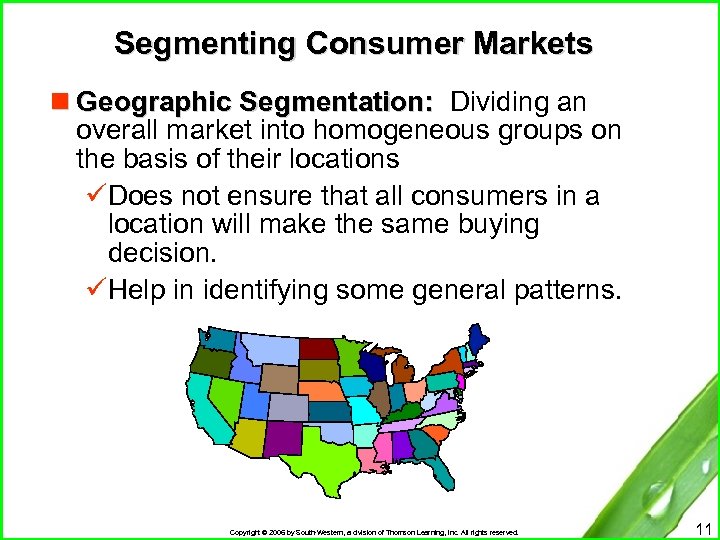 Segmenting Consumer Markets n Geographic Segmentation: Dividing an overall market into homogeneous groups on the basis of their locations üDoes not ensure that all consumers in a location will make the same buying decision. üHelp in identifying some general patterns. Copyright © 2006 by South-Western, a division of Thomson Learning, Inc. All rights reserved. 11
 n Urban Data Classified üCore Based Statistical Area (CBSA) üMetropolitan Statistical Area (MSA) üMicropolitan Statistical Area üConsolidated Metropolitan Statistical Area (CMSA) üPrimary Metropolitan Statistical Area (PMSA) Copyright © 2006 by South-Western, a division of Thomson Learning, Inc. All rights reserved. 12
 n Using Geographic Segmentation üDemand for some goods and services can vary according to the geographic region üMost major brands get 40 -80 percent of their sales from what are called core regions üClimate is another important segmentation factor w Northern consumers, for example, eat more soup than Southerners w Southerners use more chlorine for their swimming pools than Northern residents Copyright © 2006 by South-Western, a division of Thomson Learning, Inc. All rights reserved. 13
 n Geographic Information Service (GIS): computer technology that records several layers of data on a single map üSimplifies the job of analyzing marketing information by placing data in a spatial format. . . The result of which is a geographic map overlaid with digital data about consumers in a particular area. Copyright © 2006 by South-Western, a division of Thomson Learning, Inc. All rights reserved. 14
 Segmenting Consumer Markets n Demographic Segmentation: dividing consumer groups according to characteristics such as sex, age, income, occupation, education, household size, and stage in the family life cycle n A primary source for demographic data in the United States is the Census Bureau Copyright © 2006 by South-Western, a division of Thomson Learning, Inc. All rights reserved. 15
 n Segmenting by Gender üMarketers must ensure that traditional assumptions are not false üRecently, the lines have increasingly blurred üSome companies market successfully to both genders Copyright © 2006 by South-Western, a division of Thomson Learning, Inc. All rights reserved. 16
 n Segmenting by Age üIdentify market segments on the basis of age üProducts designed to meet the specific needs of certain age groups Copyright © 2006 by South-Western, a division of Thomson Learning, Inc. All rights reserved. 17
 n Tweens and Teens üRapidly growing market üSignificant purchasing power üCohert Effect w Tendency among members of a generation to be influenced and drawn together by significant events occurring during their key formative years, roughly 17 to 22 years of age Copyright © 2006 by South-Western, a division of Thomson Learning, Inc. All rights reserved. 18
 n Baby Boomers üBorn from 1946 until 1965 üNearly 42 percent of U. S. adults üValues influenced both by the Vietnam War and the career-driven era üHuge disposable income n Seniors üBy 2025, 1 in 5 over age 65 üMedian age is now 35. 2 years üLife expectancy 74 for men and 79 for women üHeads of households aged 55 -plus control about three-quarters of the country’s total financial assets. Copyright © 2006 by South-Western, a division of Thomson Learning, Inc. All rights reserved. 19
 n Segmenting by Ethnic Group üBy 2050, nearly half of the population of the US will belong to nonwhite minority groups. w Hispanic w African Americans w Asian Americans w Native Americans w People of Mixed Race Copyright © 2006 by South-Western, a division of Thomson Learning, Inc. All rights reserved. 20
 n Family Life Cycle Stages Segmentation üThe process of family formation and dissolution üLife stage, not age per se, is the primary determinant of many consumer purchases n Segmenting by Household Type üToday’s U. S. households are very diverse w Married couples and their children w Blended by divorce or loss of spouse w Headed by single parent, same-sex parents, grandparents Copyright © 2006 by South-Western, a division of Thomson Learning, Inc. All rights reserved. 21
 n Segmenting by Income and Expenditure Patterns üEngel’s Laws, as family income increases: w A smaller percentage of expenditures go for food w The percentage spent on housing and household operations and clothing remains constant w The percentage spent on other items (such as recreation and education) increases Copyright © 2006 by South-Western, a division of Thomson Learning, Inc. All rights reserved. 22
 n Demographic Segmentation Abroad ü Obtaining the data necessary for global demographic segmentation is often difficult ü Many countries do not operate regularly scheduled census programs w For example, the most recent census of Holland is now over 20 years old, and Germany skipped its census from 1970 to 1987 ü Daily life cycle data is difficult to apply in global demographic segmentation efforts Copyright © 2006 by South-Western, a division of Thomson Learning, Inc. All rights reserved. 23
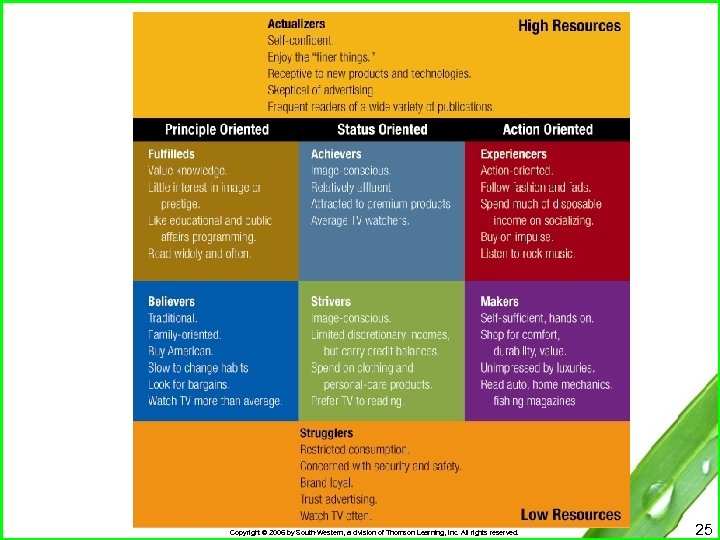
 n Psychographic Segmentation üDivides a population into groups that have similar psychological characteristics, values, and lifestyles üLifestyle: people’s decisions about how to live their daily lives, including family, job, social, and consumer activities üThe most common method for developing psychographic profiles of a population is to conduct a large-scale survey w AIO statements w VALS and VALS 2 “Values and Lifestyles” Copyright © 2006 by South-Western, a division of Thomson Learning, Inc. All rights reserved. 24
 Copyright © 2006 by South-Western, a division of Thomson Learning, Inc. All rights reserved. 25
 n Psychographic Segmentation of Global Markets like those done by Roper Starch can paint useful pictures of the residents of various countries üRoper found six psychographic consumer segments that are common to 35 nations w Strivers w Devouts w Altruists w Intimates w Fun seekers w Creatives Copyright © 2006 by South-Western, a division of Thomson Learning, Inc. All rights reserved. 26
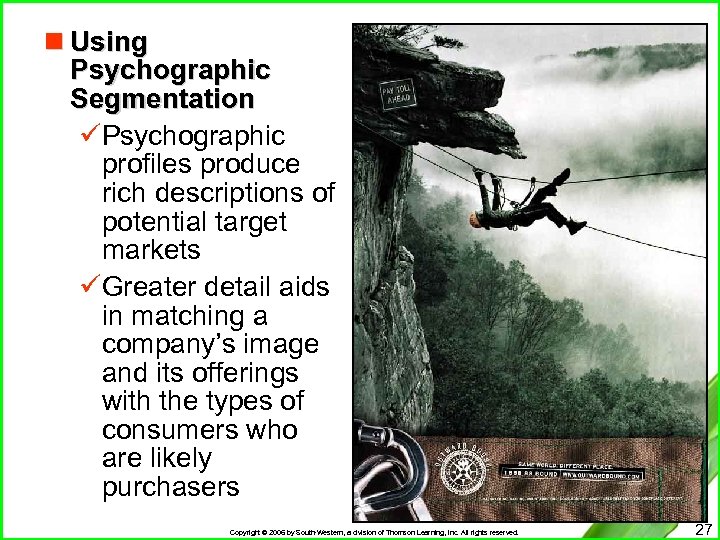 n Using Psychographic Segmentation üPsychographic profiles produce rich descriptions of potential target markets üGreater detail aids in matching a company’s image and its offerings with the types of consumers who are likely purchasers Copyright © 2006 by South-Western, a division of Thomson Learning, Inc. All rights reserved. 27
 n Product-Related Segmentation Dividing a consumer population into homogeneous groups based on characteristics of their relationships to the product üCan take the form of segmenting based on: w Benefits that people seek when they buy w Usage rates for a product w Consumers’ brand loyalty toward a product Copyright © 2006 by South-Western, a division of Thomson Learning, Inc. All rights reserved. 28
 n Benefits üFocuses on the attributes that people seek in a good or service and the benefits that they expect to receive from that good or service üGroups consumers into segments based on what they want a product to do for them n Usage Rates üSegmenting by grouping people according to the amounts of a product that they buy and use üMarkets often divided into heavy-user, moderate-user, and light-user segments üThe 80/20 principle (“Praedo’s Law”) Copyright © 2006 by South-Western, a division of Thomson Learning, Inc. All rights reserved. 29
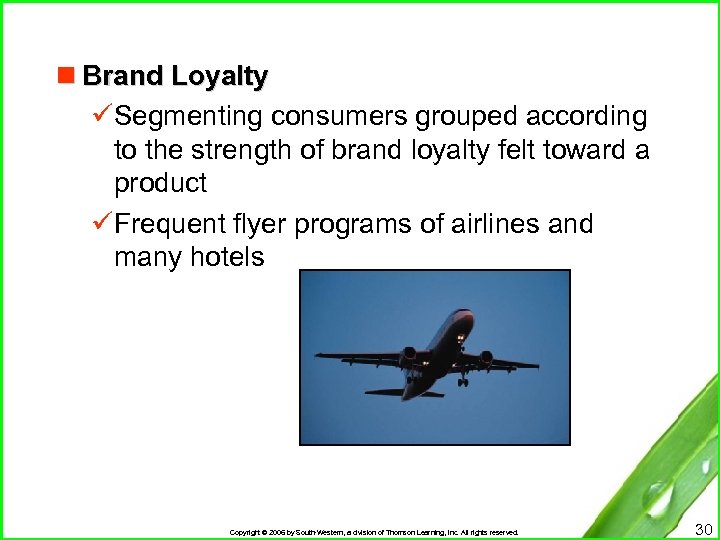 n Brand Loyalty üSegmenting consumers grouped according to the strength of brand loyalty felt toward a product üFrequent flyer programs of airlines and many hotels Copyright © 2006 by South-Western, a division of Thomson Learning, Inc. All rights reserved. 30
 n Using Multiple Segmentation Bases üIncrease accuracy in reaching the right markets üCombine multiple bases w Geographic and Demographic w Product-related with income and expenditure patterns w Others Copyright © 2006 by South-Western, a division of Thomson Learning, Inc. All rights reserved. 31
 The Market Segmentation Process n Develop a Relevant Profile for each Segment n Forecast Market Potential n Forecast Probable Market Share n Select Specific Market Segments Copyright © 2006 by South-Western, a division of Thomson Learning, Inc. All rights reserved. 32
 Strategies for Reaching Target Markets n Undifferentiated Marketing: when a firm produces only one product or product line and promotes it to all customers with a single marketing mix n Differentiated Marketing: when a firm produces numerous products and promotes them with a different marketing mix designed to satisfy smaller segments Copyright © 2006 by South-Western, a division of Thomson Learning, Inc. All rights reserved. 33
 n Concentrated Marketing (niche marketing): when a firm commits all of its marketing resources to serve a single market segment n Micromarketing: involves targeting potential customers at a very basic level, such as by ZIP code, specific occupation, lifestyle, or individual household Copyright © 2006 by South-Western, a division of Thomson Learning, Inc. All rights reserved. 34
 n Selecting and Executing a Strategy üNo single, best choice strategy suits all firms üDeterminants of a market-specific strategy: w Company resources w Product homogeneity w Stage in the product life-cycle w Competitors’ strategy Copyright © 2006 by South-Western, a division of Thomson Learning, Inc. All rights reserved. 35
 üPositioning: a marketing strategy that emphasizes serving a specific market segment by achieving a certain position in buyers’ minds w Attributes w Price/quality w Competitors w Application w Product user w Product class Copyright © 2006 by South-Western, a division of Thomson Learning, Inc. All rights reserved. 36
 üPositioning map Graphic illustration that shows differences in consumers’ perceptions of competing products üReposition Marketing strategy to change the position of its product in consumers’ minds relative to the positions of competing products Copyright © 2006 by South-Western, a division of Thomson Learning, Inc. All rights reserved. 37
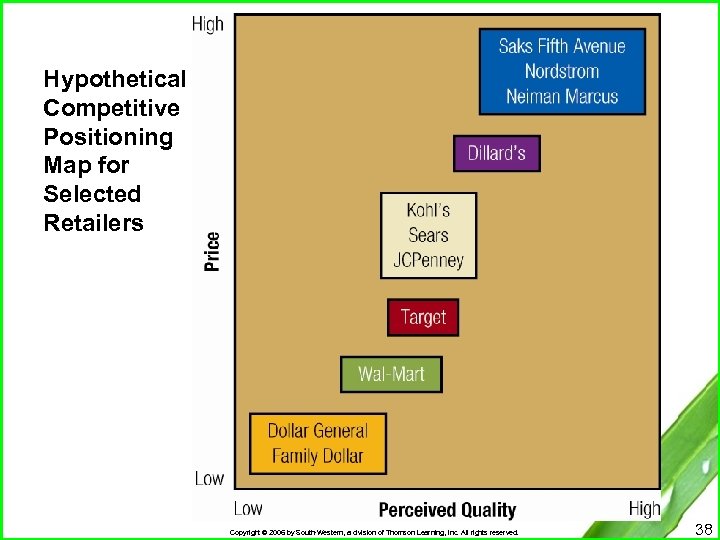 Hypothetical Competitive Positioning Map for Selected Retailers Copyright © 2006 by South-Western, a division of Thomson Learning, Inc. All rights reserved. 38