


 Скачать презентацию PART 3 PERSONALITY ORGANIZATION CHAPTER 9 DYNAMICS OF
6c72d1b7d93fc5e59b94e45bc0dd0f19.ppt
- Количество слайдов: 13
 PART 3: PERSONALITY ORGANIZATION CHAPTER 9: DYNAMICS OF ACTION Getting Started Dynamics of Action Focus on Developing Action This multimedia product and its contents are protected under copyright law. The following are prohibited by law: • any public performance or display, including transmission of any image over a network; • preparation of any derivative work, including the extraction, in whole or in part, of any image; • any rental, lease, or lending of the program. Copyright © 2007 Allyn & Bacon Mayer’s Personality: A Systems Approach
 PART 3: PERSONALITY ORGANIZATION CHAPTER 9: DYNAMICS OF ACTION How Does Action Develop in the Mind? Mood-Congruent Judgment • The sad mood induction… – Imagine you read in the newspaper that a teacher you used to house-sit for recently passed away… – You are told by a young relative that she has cancer and only six months to live… – No one remembers your birthday… – A pet you were really fond of dies… © Copyright 2006 Allyn & Bacon Mayer’s Personality: A Systems Approach
 PART 3: PERSONALITY ORGANIZATION CHAPTER 9: DYNAMICS OF ACTION How Does Action Develop in the Mind? Mood-Congruent Judgment • How likely is your presidential candidate to win tomorrow? • How likely is the economy to improve © Copyright 2006 Allyn & Bacon Mayer’s Personality: A Systems Approach
 PART 3: PERSONALITY ORGANIZATION CHAPTER 9: DYNAMICS OF ACTION How Does Action Develop in the Mind? Mood-Congruent Judgment • The happy mood induction… – You just got a new job and it’s even better than you expected. – You buy a lottery ticket and you win $100. 00 instantly. – You wake up on a Saturday after a number of wintry-cold rainy days and the temperature is in the high sixties. – Your friends throw you a terrific surprise party for your birthday © Copyright 2006 Allyn & Bacon Mayer’s Personality: A Systems Approach
 PART 3: PERSONALITY ORGANIZATION CHAPTER 9: DYNAMICS OF ACTION How Does Action Develop in the Mind? Mood-Congruent Judgment • How likely is your presidential candidate to win tomorrow? • How likely is the economy to improve? © Copyright 2006 Allyn & Bacon Mayer’s Personality: A Systems Approach
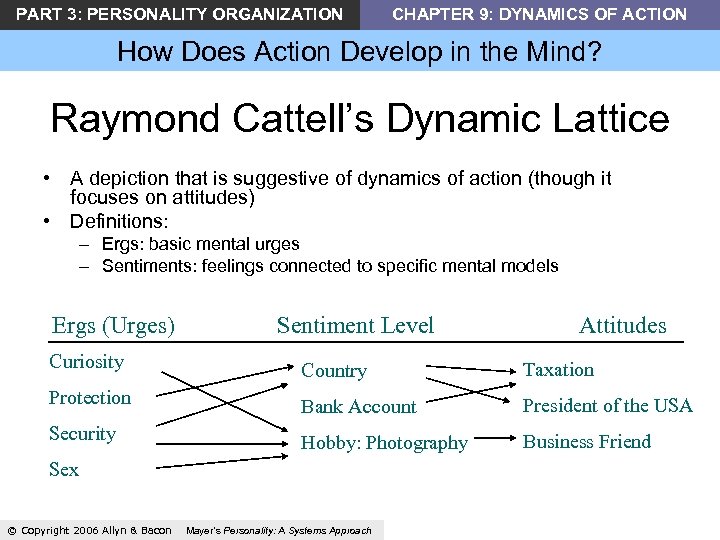 PART 3: PERSONALITY ORGANIZATION CHAPTER 9: DYNAMICS OF ACTION How Does Action Develop in the Mind? Raymond Cattell’s Dynamic Lattice • A depiction that is suggestive of dynamics of action (though it focuses on attitudes) • Definitions: – Ergs: basic mental urges – Sentiments: feelings connected to specific mental models Ergs (Urges) Sentiment Level Attitudes Curiosity Country Taxation Protection Bank Account President of the USA Security Hobby: Photography Business Friend Sex © Copyright 2006 Allyn & Bacon Mayer’s Personality: A Systems Approach
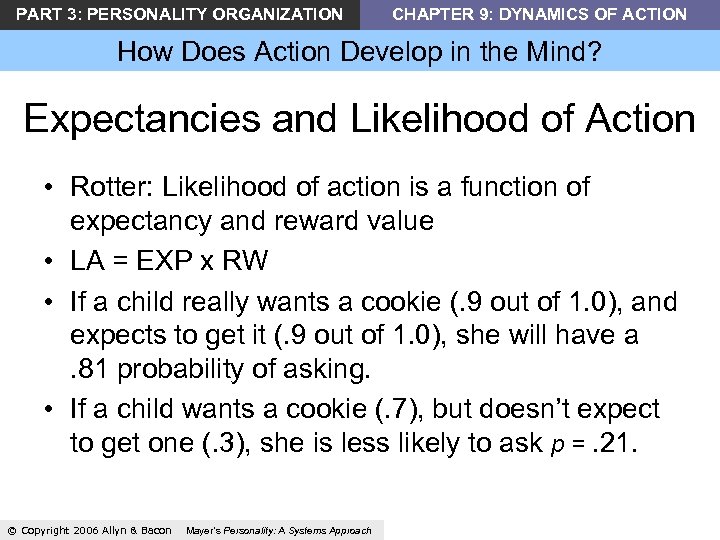 PART 3: PERSONALITY ORGANIZATION CHAPTER 9: DYNAMICS OF ACTION How Does Action Develop in the Mind? Expectancies and Likelihood of Action • Rotter: Likelihood of action is a function of expectancy and reward value • LA = EXP x RW • If a child really wants a cookie (. 9 out of 1. 0), and expects to get it (. 9 out of 1. 0), she will have a. 81 probability of asking. • If a child wants a cookie (. 7), but doesn’t expect to get one (. 3), she is less likely to ask p =. 21. © Copyright 2006 Allyn & Bacon Mayer’s Personality: A Systems Approach
 PART 3: PERSONALITY ORGANIZATION CHAPTER 9: DYNAMICS OF ACTION How Does Action Develop in the Mind? Partial Expressions; Freudian Slips • Early theory: – Consciousness: internal “eye” or sense organ on the brain – Preconcious: things which can become conscious – Unconscious: matters one doesn’t know about • Many human motives are unconscious Eithere is no access – Primary unconscious There is active repression – the Ego, or self, expels thoughts and feelings from consciousness (to be discussed in later section) © Copyright 2006 Allyn & Bacon Mayer’s Personality: A Systems Approach
 PART 3: PERSONALITY ORGANIZATION CHAPTER 9: DYNAMICS OF ACTION How Does Action Develop in the Mind? Partial Expressions; Freudian Slips • Theory: Sometimes, unconscious meanings and motives break through via “parapraxes” • Parapraxes: actions that occur alongside intended actions, I. e. , slips of the tongue – “Gentlemen, this meeting is closed!” – A male student said to a female student, “Don’t take this as a sign of erection, ” (meaning rejection) when telling her he didn’t want to go out with her. – “As I said to my husb…” – “As I said to the president…” (reported in the NY Times) – Condoleeza Rice, National advisor who spends many weekends with the President and his wife. – Reported in Schoeneman, D. (April 26, 2004) “Armani's Exchange. . . Condi's Slip. . . Forget the Alamo. New York Magazine Metro. com © Copyright 2006 Allyn & Bacon Mayer’s Personality: A Systems Approach
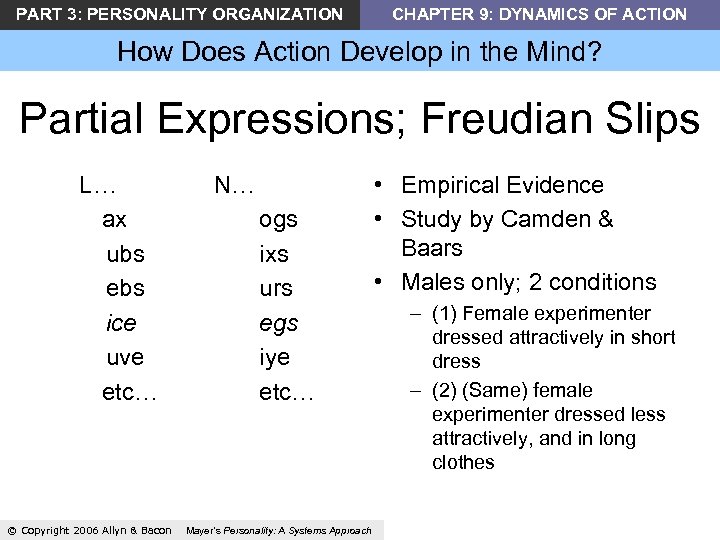 PART 3: PERSONALITY ORGANIZATION CHAPTER 9: DYNAMICS OF ACTION How Does Action Develop in the Mind? Partial Expressions; Freudian Slips L… ax ubs ebs ice uve etc… © Copyright 2006 Allyn & Bacon N… ogs ixs urs egs iye etc… Mayer’s Personality: A Systems Approach • Empirical Evidence • Study by Camden & Baars • Males only; 2 conditions – (1) Female experimenter dressed attractively in short dress – (2) (Same) female experimenter dressed less attractively, and in long clothes
 PART 3: PERSONALITY ORGANIZATION CHAPTER 9: DYNAMICS OF ACTION How Does Action Develop in the Mind? Micro-Facial Expressions • Discoverer: Paul Ekman • Help in detection of deception • Certain especially good secret agents, FBI detectives, etc. , note micro-expressions at 80%; others miss them entirely © Copyright 2006 Allyn & Bacon Mayer’s Personality: A Systems Approach
 PART 3: PERSONALITY ORGANIZATION CHAPTER 9: DYNAMICS OF ACTION How Does Action Develop in the Mind? Micro-Facial Expressions • Case of “Mary, ” who wanted a pass to go home to see her family – She lied to her doctors, saying she was fine, when in fact she wanted to leave to commit suicide – Videotapes revealed micro-expressions of sadness • Case of Nursing students discussing their room mates. – “Angry, no, I never get angry” – Videotapes revealed micro-expressions of: neutrality, anger, disgust, arousal, and neutrality © Copyright 2006 Allyn & Bacon Mayer’s Personality: A Systems Approach
 PART 3: PERSONALITY ORGANIZATION CHAPTER 9: DYNAMICS OF ACTION How Are Acts Performed? ~ end ~ © Copyright 2006 Allyn & Bacon Mayer’s Personality: A Systems Approach