


 Скачать презентацию Part 2 Exotic swap products Asset
064597dedcdbbcb9ee09f7969cf690d0.ppt
- Количество слайдов: 78
 Part 2 – Exotic swap products • Asset swaps • Total return swaps • Forward swaps • Cancellable swaps and swaptions • Spread-lock interest rate swaps • Constant maturity swaps • Credit default swaps • Equity-linked swaps 1
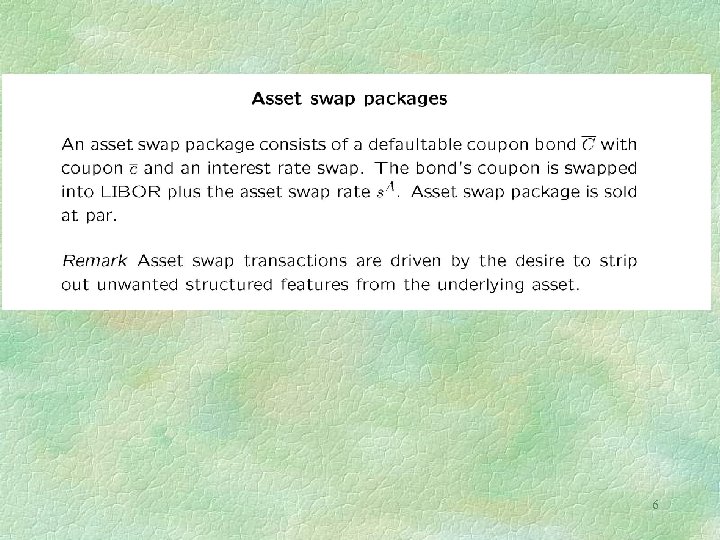
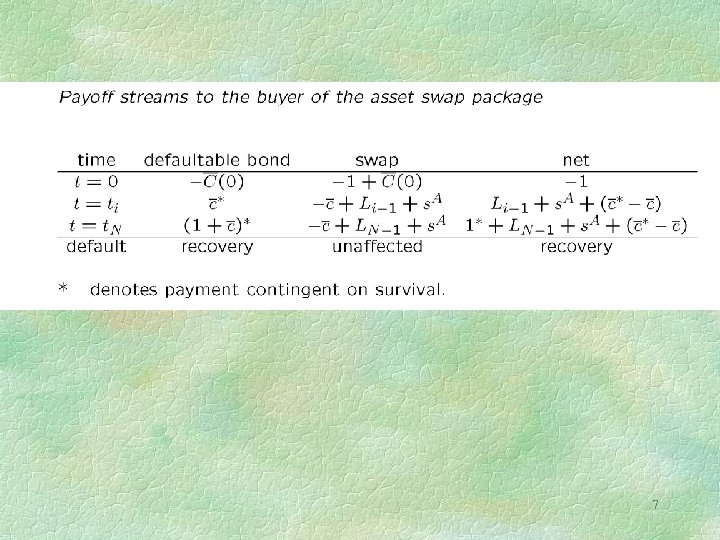
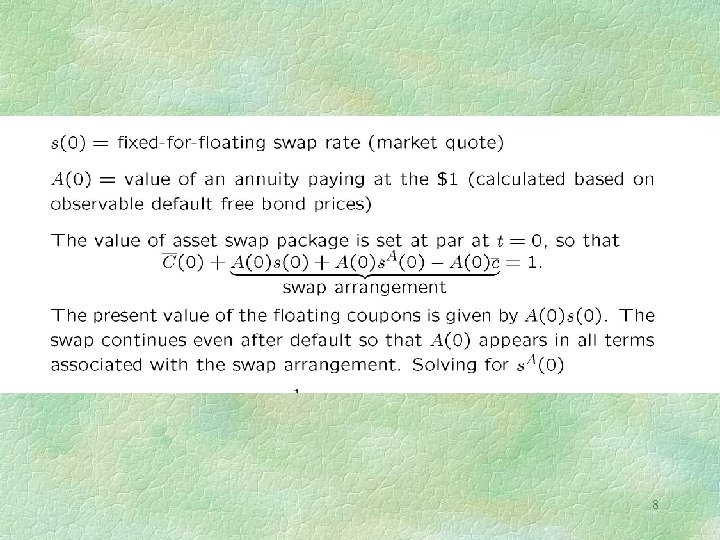
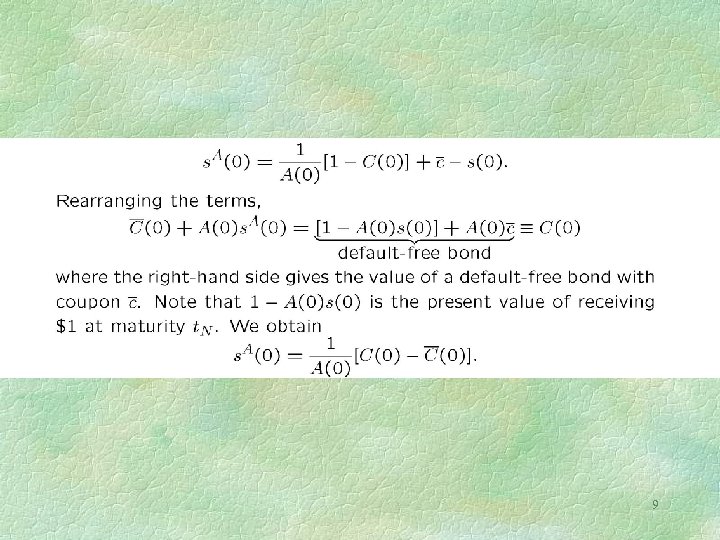
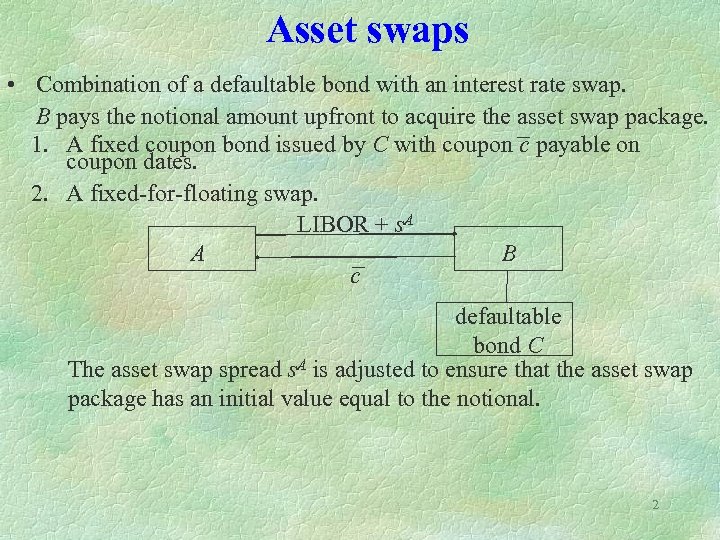 Asset swaps • Combination of a defaultable bond with an interest rate swap. B pays the notional amount upfront to acquire the asset swap package. 1. A fixed coupon bond issued by C with coupon c payable on coupon dates. 2. A fixed-for-floating swap. LIBOR + s. A A B c defaultable bond C The asset swap spread s. A is adjusted to ensure that the asset swap package has an initial value equal to the notional. 2
 • Asset swaps are more liquid than the underlying defaultable bond. • The Asset Swap may be transacted at the time of the security purchase or added to a bond already owned by the investor. • An asset swaption gives B the right to enter an asset swap package at some future date T at a predetermined asset swap spread s. A. 3
 Example 1. An investor believes CAD rates will rise over the medium term. They would like to purchase CAD 50 million 5 yr Floating Rate Notes. 2. There are no 5 yr FRNs available in the market in sufficient size. The investor is aware of XYZ Ltd 5 yr 6. 0% annual fixed coupon Bonds currently trading at a yield of 5. 0%. The bonds are currently priced at 104. 38. 3. The investor can purchase CAD 50 million Fixed Rate Bonds in the market for a total consideration of CAD 51, 955, 000 plus any accrued interest. They can then enter a 5 year Interest Rate Swap (paying fixed) with the Bank as follows: 4
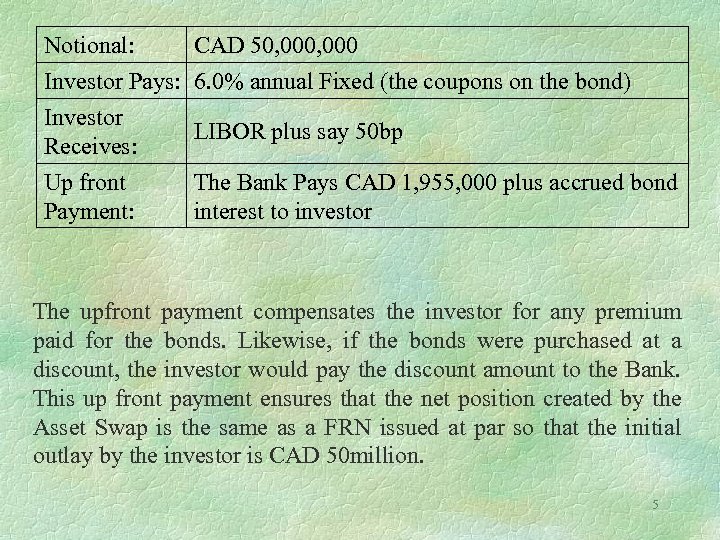 Notional: CAD 50, 000 Investor Pays: 6. 0% annual Fixed (the coupons on the bond) Investor LIBOR plus say 50 bp Receives: Up front Payment: The Bank Pays CAD 1, 955, 000 plus accrued bond interest to investor The upfront payment compensates the investor for any premium paid for the bonds. Likewise, if the bonds were purchased at a discount, the investor would pay the discount amount to the Bank. This up front payment ensures that the net position created by the Asset Swap is the same as a FRN issued at par so that the initial outlay by the investor is CAD 50 million. 5
 6
6
 7
7
 8
8
 9
9
 Pricing 1. From the investors viewpoint, the net cash flows from the Bond plus the Asset Swap are the same as the cash flows from a Floating Rate Note. 2. The yield on the Asset Swap (in the example LIBOR plus 50 bp), will depend upon the relationship between the Bond yield and the Swap Yield for that currency. When converting a fixed rate bond to floating rate, LOWER swap rates relative to bond yields will result in HIGHER Asset Swap yields. When converting FRNs to fixed rate, HIGHER swap rates relative to bond yields will result in HIGHER Asset Swap yields. Remark It is a common mistake to assume that the yield over LIBOR on the Asset Swap (50 bp in the example above) is merely the difference between the Bond Yield (5%) and the 5 yr Swap yield. It is necessary to price the Asset Swap using a complete Interest Rate Swap pricing model. 10
 Target Market Any investor purchasing or holding interest bearing securities. The Asset Swap can either be used to create synthetic securities unavailable in the market, or as an overlay interest rate management technique for existing portfolios. Many investors use Asset Swaps to "arbitrage" the credit markets, as in many instances synthetic FRNs or Bonds produce premium yields compared to traditional securities issued by the same company. 11
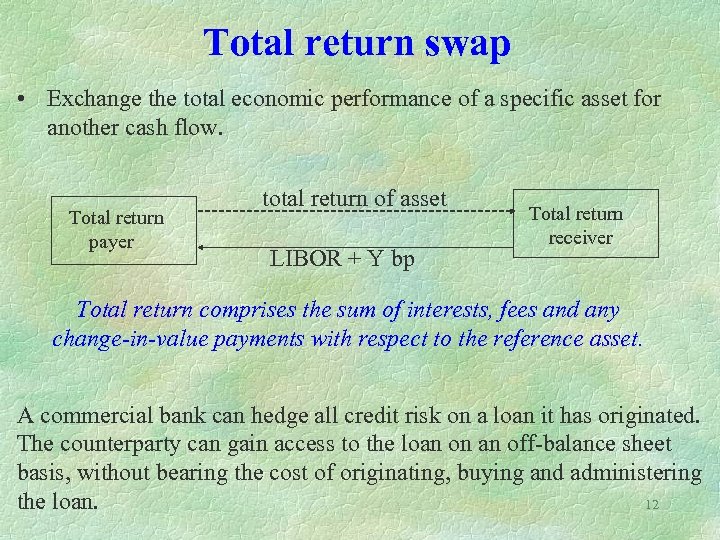 Total return swap • Exchange the total economic performance of a specific asset for another cash flow. Total return payer total return of asset LIBOR + Y bp Total return receiver Total return comprises the sum of interests, fees and any change-in-value payments with respect to the reference asset. A commercial bank can hedge all credit risk on a loan it has originated. The counterparty can gain access to the loan on an off-balance sheet basis, without bearing the cost of originating, buying and administering the loan. 12
 The payments received by the total return receiver are: 1. The coupon of the bond (if there were one since the last payment date Ti 1) 2. The price appreciation of the underlying bond 3. C since the last payment (if there were only). 4. 3. The recovery value of the bond (if there were default). The payments made by the total return receiver are: 1. A regular fee of LIBOR + s. TRS 2. The price depreciation of bond C since the last 3. payment (if there were only). 4. 3. The par value of the bond C if there were a default in the meantime). The coupon payments are netted and swap’s termination date is earlier 13 than bond’s maturity.
 Some essential features 1. The receiver is synthetically long the reference asset without having to fund the investment up front. He has almost the same payoff stream as if he had invested in risky bond directly and funded this investment at LIBOR + s. TRS. 2. The TRS is marked to market at regular intervals, similar to a futures contract on the risky bond. The reference asset should be liquidly traded to ensure objective market prices for making to market (determined using a dealer poll mechanism). 3. The TRS allows the receiver to leverage his position much higher than he would otherwise be able to (may require collateral). The TRS spread should not be driven by the default risk of the underlying asset but also by the credit quality of the receiver. 14
 Used as a financing tool • The receiver wants financing to invest $100 million in the reference bond. It approaches the payer (a financial institution) and agrees to the swap. • The payer invests $100 million in the bond. The payer retains ownership of the bond for the life of the swap and has much less exposure to the risk of the receiver defaulting. • The receiver is in the same position as it would have been if it had borrowed money at LIBOR + s. TRS to buy the bond. He bears the market risk and default risk of the underlying bond. 15
 Motivation of the receiver 1. Investors can create new assets with a specific maturity not currently available in the market. 2. Investors gain efficient off-balance sheet exposure to a desired asset class to which they otherwise would not have access. 3. Investors may achieve a higher leverage on capital – ideal for hedge funds. Otherwise, direct asset ownership is on on-balance sheet funded investment. 4. Investors can reduce administrative costs via an offbalance sheet purchase. 5. Investors can access entire asset classes by receiving the total return on an index. 16
 Motivation of the payer The payer creates a hedge for both the price risk and default risk of the reference asset. * A long-term investor, who feels that a reference asset in the portfolio may widen in spread in the short term but will recover later, may enter into a total return swap that is shorter than the maturity of the asset. This structure is flexible and does not require a sale of the asset (thus accommodates a temporary short-term negative view on an asset). 17
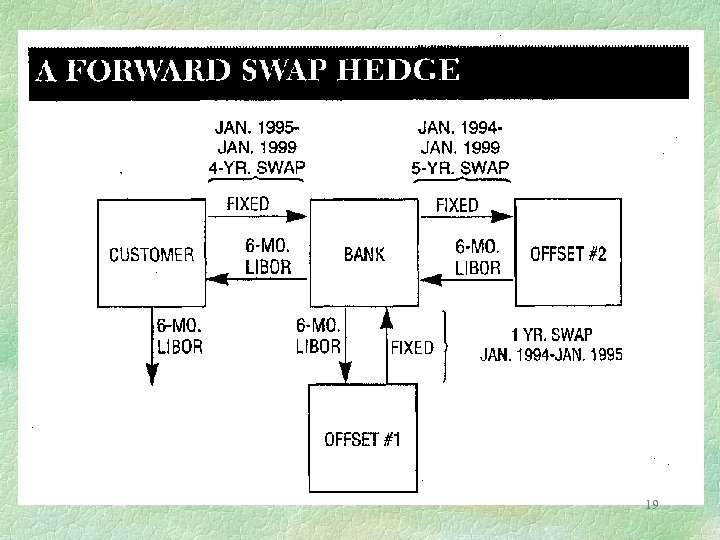
 Forward swaps are executed now but begin at a preset future date. They allow asset and liability managers to implement their view of the yield curve. Two examples: h may orporations • that they will be lower than the spot rate at a future date but at the same time may wish to leave their liabilities floating at an attractive lower rate for a period. alities • refinancing. Suppose a corporation wants to enter into a swap beginning one year’s time for a period of 4 years (one-year-by-four-year swap), the swap house will have to enter into two offsetting swaps immediately to hedge its position. 18
 19
19
 Swaptions Product nature • rate swap by some specified date. The swaption also specifies the maturity date of the swap. • fixed-rate payer (call swaption). • exercises. e The te • ates rike versus the floating rate. he • can be structured into the swap rate. 20
 TARGET MARKET • Investors with floating rate assets may wish to buy Receiver Swaptions which will convert their assets from floating to fixed when rates fall below the strike. • This strategy is similar to a Floor. While under a Floor the investor remains floating but with a guaranteed minimum level, here the asset is converted to a fixed rate. • The option can also be used as a speculative instrument for investors who believe fixed rates will fall. 21
 Hedge against cash flow uncertainties Used to hedge a portfolio strategy that uses an interest rate swap but where the cash flow of the underlying asset or liability is uncertain. Uncertainties come from (i) callability, eg, a callable bond or mortgage loan, (ii) exposure to default risk. Example Consider a S & L Association entering into a 4 -year swap in which it agrees to pay 9% fixed and receive LIBOR. • pass-through securities with a coupon rate of 9%. One year later, mortgage rates decline, resulting in large prepayments. • The purchase swaption strike of would of put a with rate a 9% be useful to offset the original swap position. 22
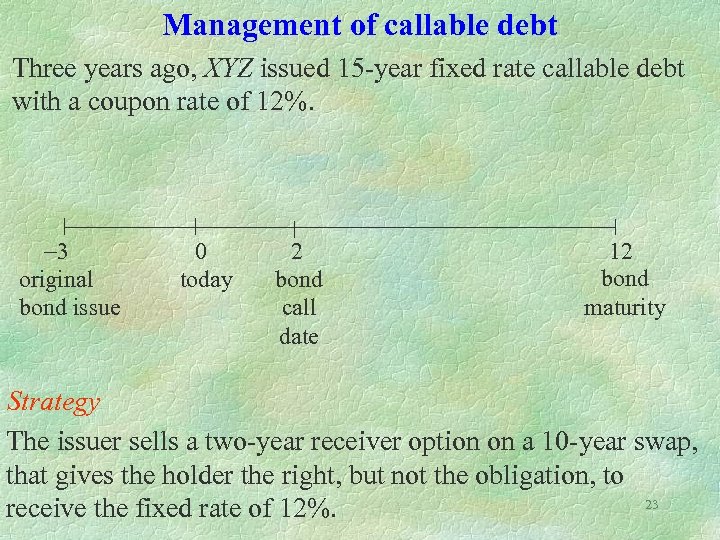 Management of callable debt Three years ago, XYZ issued 15 -year fixed rate callable debt with a coupon rate of 12%. 3 0 2 12 bond original today bond maturity bond issue call date Strategy The issuer sells a two-year receiver option on a 10 -year swap, that gives the holder the right, but not the obligation, to 23 receive the fixed rate of 12%.
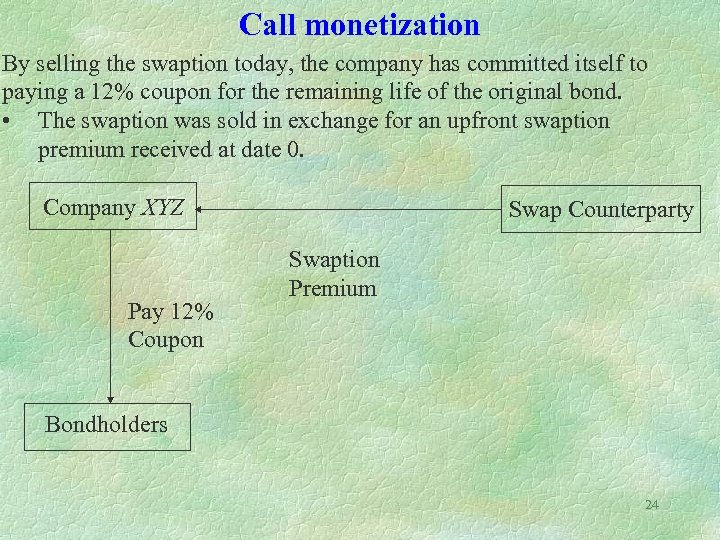 Call monetization By selling the swaption today, the company has committed itself to paying a 12% coupon for the remaining life of the original bond. • The swaption was sold in exchange for an upfront swaption premium received at date 0. Company XYZ Pay 12% Coupon Swap Counterparty Swaption Premium Bondholders 24
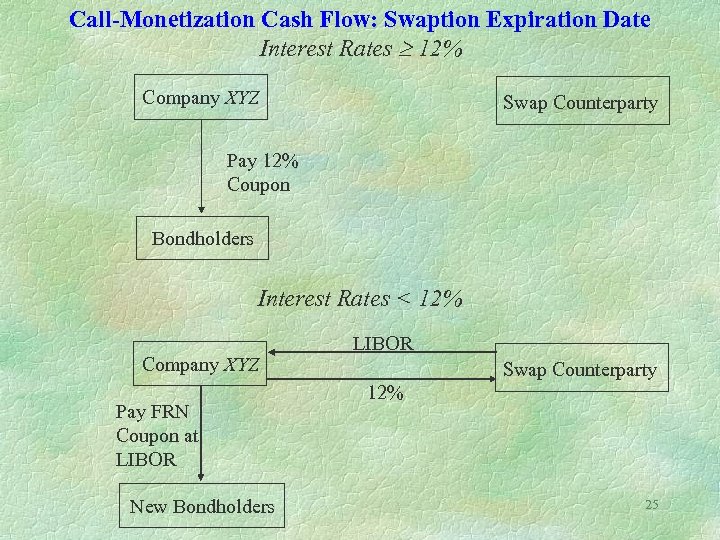 Call-Monetization Cash Flow: Swaption Expiration Date Interest Rates ³ 12% Company XYZ Swap Counterparty Pay 12% Coupon Bondholders Interest Rates < 12% Company XYZ Pay FRN Coupon at LIBOR New Bondholders LIBOR Swap Counterparty 12% 25
 Disasters for the issuer • The fixed rate on a 10 -year swap was below 12% in two years but its debt refunding rate in the capital market was above 12% (due to credit deterioration) • The company would be forced either to enter into a swap that it does not want or liquidate the position at a disadvantage and not be able to refinance its borrowing profitably. 26
 Cancellable Swap • One of the counterparties has the right to terminate the transaction on a predetermined date at no cost. • If the client is the payer of the fixed rate and he (counterparty) has the right to cancel the swap, the rate paid will be higher (lower) than that paid under a plain vanilla Swap. • Usually, it is Bermudan (cancellable on more than one date). • A pre-agreed fixed cancellation fee can be paid to the client upon termination. 27
 Use of cancellable swaps Assume that the following bond is available in the secondary market: Terms of the callable bond Issue Date 1 July 2001 Maturity 1 July 2011 (10 years) Coupon 7. 00% pa annual Call provisions the of Callable issuer the at commencing option 1 July 2006 (5 years) and annually thereafter on each coupon date. Initially callable at a price of 101 decreasing by 0. 50 each year and thereby callable at par on 1 July 2008 and each coupon date thereafter. Bond price Issued at par An investor purchases the bond and enters into the following swap to convert the fixed rate returns from the bond into floating rate payments priced off LIBOR. 28
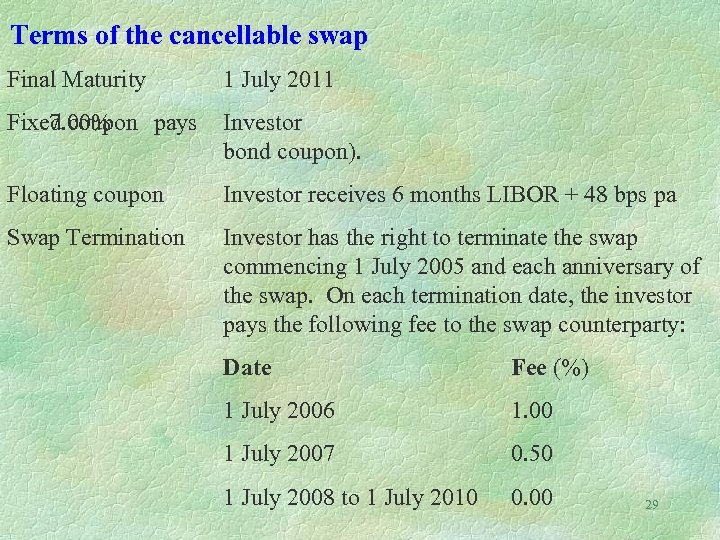 Terms of the cancellable swap Final Maturity 1 July 2011 Fixed coupon pays Investor 7. 00% bond coupon). Floating coupon Investor receives 6 months LIBOR + 48 bps pa Swap Termination Investor has the right to terminate the swap commencing 1 July 2005 and each anniversary of the swap. On each termination date, the investor pays the following fee to the swap counterparty: Date Fee (%) 1 July 2006 1. 00 1 July 2007 0. 50 1 July 2008 to 1 July 2010 0. 00 29
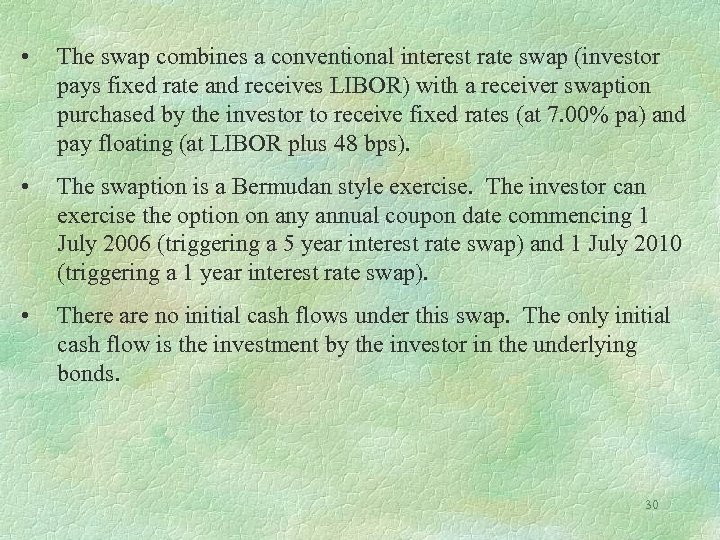 • The swap combines a conventional interest rate swap (investor pays fixed rate and receives LIBOR) with a receiver swaption purchased by the investor to receive fixed rates (at 7. 00% pa) and pay floating (at LIBOR plus 48 bps). • The swaption is a Bermudan style exercise. The investor can exercise the option on any annual coupon date commencing 1 July 2006 (triggering a 5 year interest rate swap) and 1 July 2010 (triggering a 1 year interest rate swap). • There are no initial cash flows under this swap. The only initial cash flow is the investment by the investor in the underlying bonds. 30
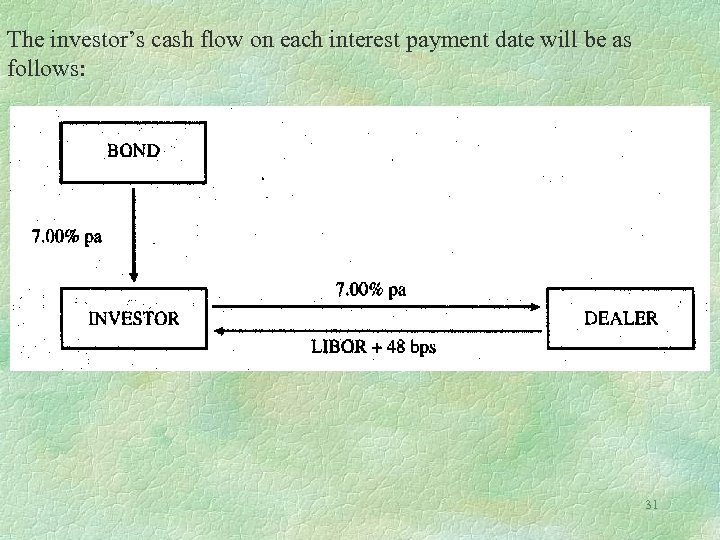 The investor’s cash flow on each interest payment date will be as follows: 31
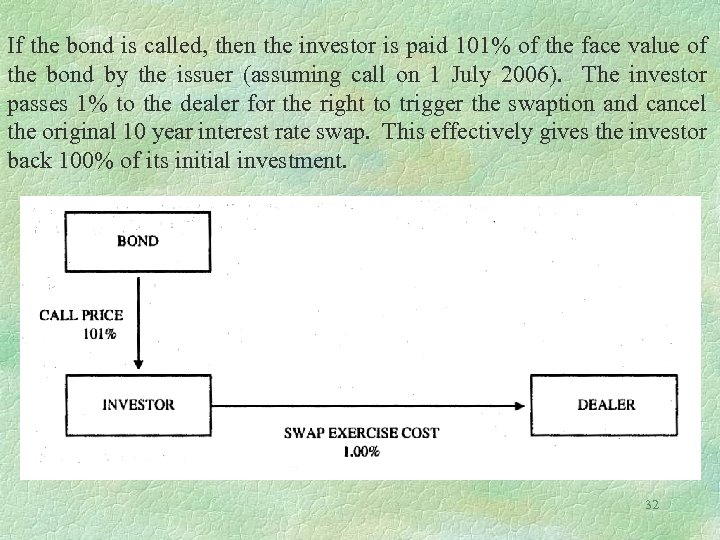 If the bond is called, then the investor is paid 101% of the face value of the bond by the issuer (assuming call on 1 July 2006). The investor passes 1% to the dealer for the right to trigger the swaption and cancel the original 10 year interest rate swap. This effectively gives the investor back 100% of its initial investment. 32
 The pricing of the overall transaction incorporate • Interest rate swap rate. • Pricing of the swaption purchased by the investor. The value of the swaption may be embedded in the fixed rate. 33
 Rationale for doing these transactions • There is a limited universe of non-callable fixed rate bonds. • When interest rates decrease below the coupon, the bond is called. The investor is left with an out-of-the-money interest rate swap position (the swap fixed rate is above market rates). • The swap is expensive to reverse, creating losses for investors. Puttable swaps are structured as a means of mitigating the potential loss resulting from early redemption of the asset swap. 34
 Callable debt management • In August 1992 (two years ago), a corporation issued 7 -year bonds with a fixed coupon rate of 10% payable semiannually on Feb 15 and Aug 15 of each year. • The debt was structured to be callable (at par) offer a 4 -year deferment period and was issued at par value of $100 million. • In August 1994, the bonds are trading in the market at a price of 106, reflecting the general decline in market interest rates and the corporation’s recent upgrade in its credit quality. 35
 Question The corporate treasurer believes that the current interest rate cycle has bottomed. If the bonds were callable today, the firm would realize a considerable savings in annual interest expense. Considerations • The bonds are still in their call protection period. • The treasurer’s fear is that the market rate might rise considerably prior to the call date in August 1996. Notation T = 3 -year Treasury yield that prevails in August, 1996 T + BS = refunding rate of corporation, where BS is the company specific bond credit spread T + SS = prevailing 3 -year swap fixed rate, where SS stands for the swap spread 36
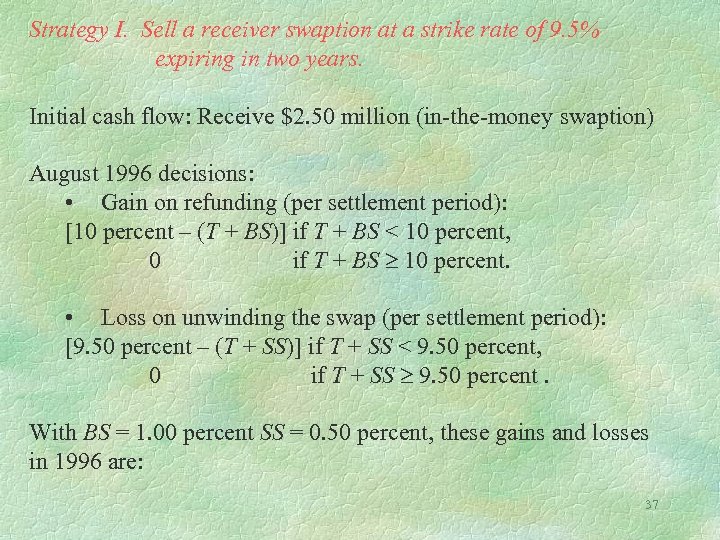 Strategy I. Sell a receiver swaption at a strike rate of 9. 5% expiring in two years. Initial cash flow: Receive $2. 50 million (in-the-money swaption) August 1996 decisions: • Gain on refunding (per settlement period): [10 percent – (T + BS)] if T + BS < 10 percent, 0 if T + BS ³ 10 percent. • Loss on unwinding the swap (per settlement period): [9. 50 percent – (T + SS)] if T + SS < 9. 50 percent, 0 if T + SS ³ 9. 50 percent. With BS = 1. 00 percent SS = 0. 50 percent, these gains and losses in 1996 are: 37
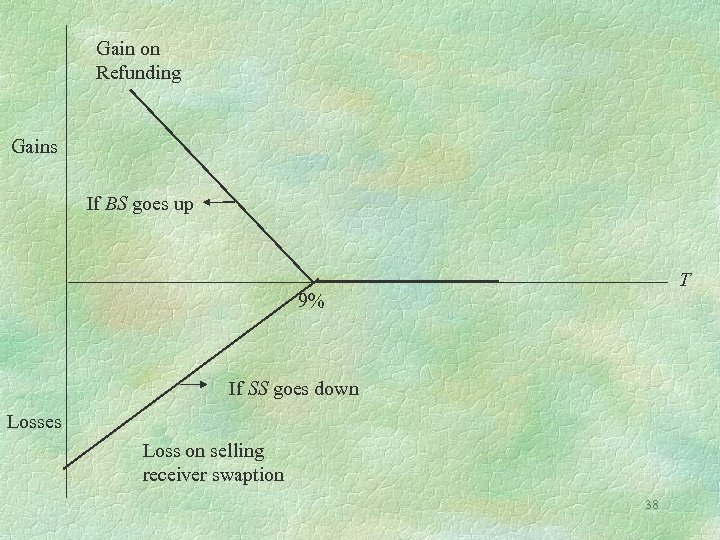 Gain on Refunding Gains If BS goes up T 9% If SS goes down Losses Loss on selling receiver swaption 38
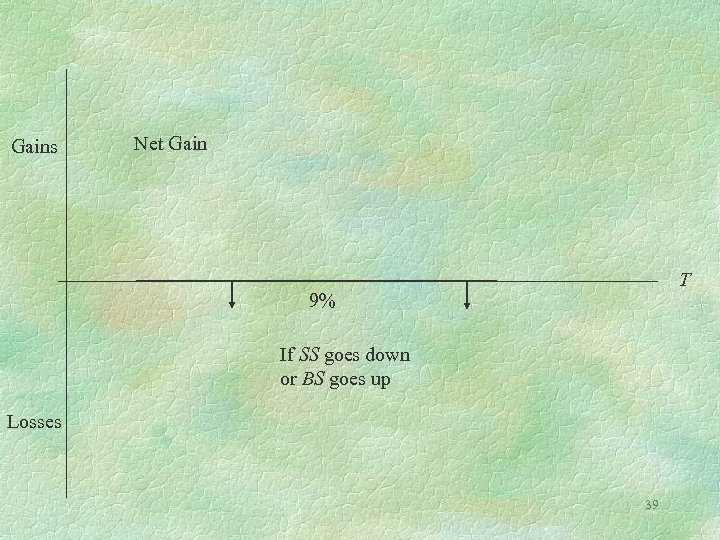 Gains Net Gain T 9% If SS goes down or BS goes up Losses 39
 Comment on the strategy By selling the receiver swaption, the company has been able to simulate the sale of the embedded call feature of the bond, thus fully monetizing that option. The only remaining uncertainty is the basis risk associated with unanticipated changes in swap and bond spreads. 40
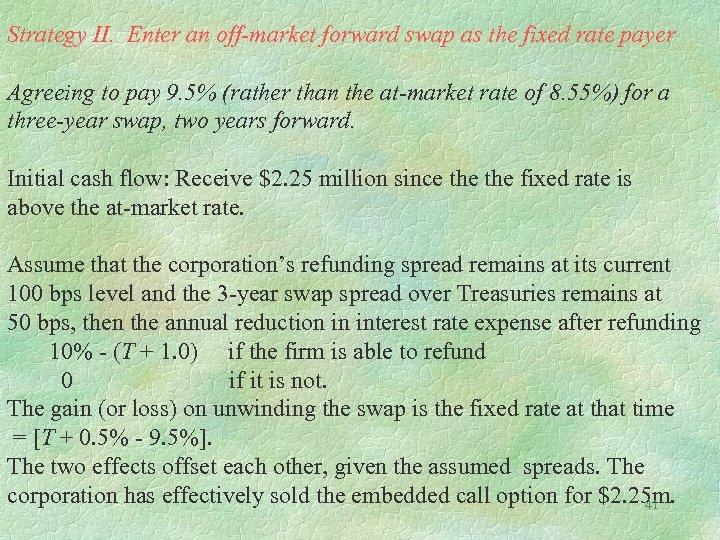 Strategy II. Enter an off-market forward swap as the fixed rate payer Agreeing to pay 9. 5% (rather than the at-market rate of 8. 55%) for a three-year swap, two years forward. Initial cash flow: Receive $2. 25 million since the fixed rate is above the at-market rate. Assume that the corporation’s refunding spread remains at its current 100 bps level and the 3 -year swap spread over Treasuries remains at 50 bps, then the annual reduction in interest rate expense after refunding 10% - (T + 1. 0) if the firm is able to refund 0 if it is not. The gain (or loss) on unwinding the swap is the fixed rate at that time = [T + 0. 5% - 9. 5%]. The two effects offset each other, given the assumed spreads. The corporation has effectively sold the embedded call option for $2. 25 m. 41
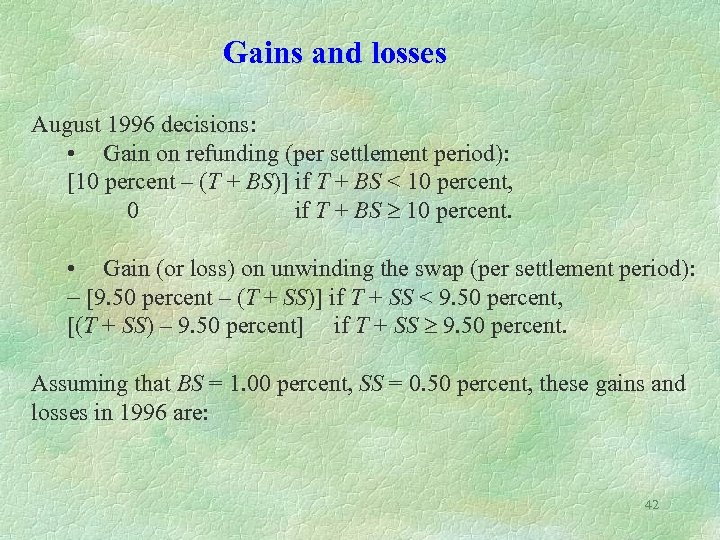 Gains and losses August 1996 decisions: • Gain on refunding (per settlement period): [10 percent – (T + BS)] if T + BS < 10 percent, 0 if T + BS ³ 10 percent. • Gain (or loss) on unwinding the swap (per settlement period): [9. 50 percent – (T + SS)] if T + SS < 9. 50 percent, [(T + SS) – 9. 50 percent] if T + SS ³ 9. 50 percent. Assuming that BS = 1. 00 percent, SS = 0. 50 percent, these gains and losses in 1996 are: 42
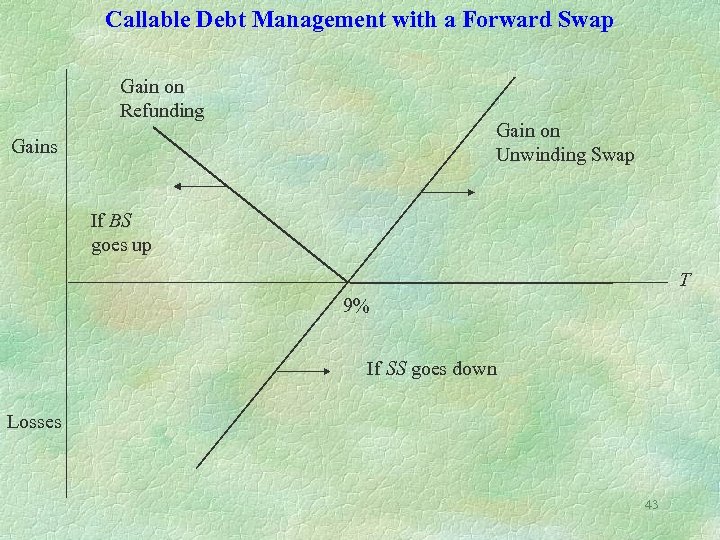 Callable Debt Management with a Forward Swap Gain on Refunding Gain on Unwinding Swap Gains If BS goes up T 9% If SS goes down Losses 43
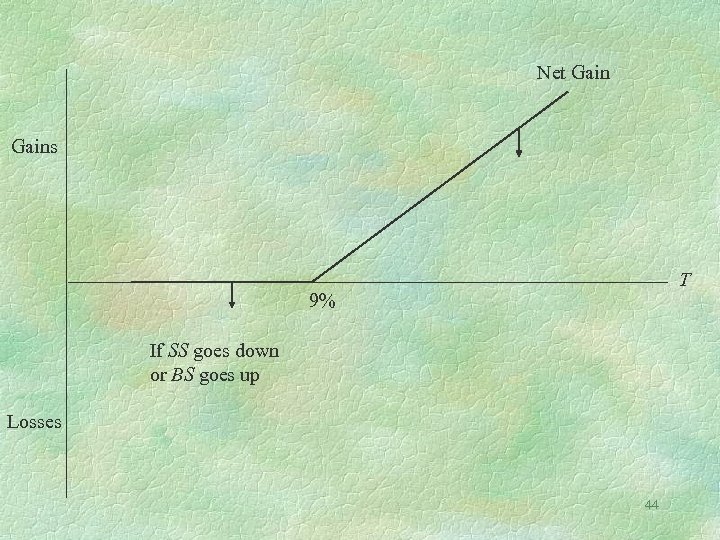 Net Gains T 9% If SS goes down or BS goes up Losses 44
 Comment on the strategy Since the company stands to gain in August 1996 if rates rise, it has not fully monetized the embedded call options. This is because a symmetric payoff instrument (a forward swap) is used to hedge an asymmetric payoff (option) problem. 45
 Spread-lock interest rate swaps Enables an investor to lock in a swap spread and apply it to an interest rate swap executed at some point in the future. • The investor makes an agreement with the bank on (i) swap spread, (ii) a Treasury rate. • The sum of the rate and swap spread equals the fixed rate paid by the investor for the life of the swap, which begins at the end of the three month (say) spread-lock. • The bank pays the investor a floating rate. Say, 3 -month LIBOR. 46
 Example The current 5 yr swap rate is 8% while the 5 yr benchmark government bond rate is 7. 70%, so the current spread is 30 bp an historically low level. A company is looking to pay fixed using an Interest Rate Swap at some point in the year. The company believes however, that the bond rate will continue to fall over the next 6 months. They have therefore decided not to do anything in the short term and look to pay fixed later. It is now six months later and as they predicted, rates did fall. The current 5 yr bond rate is now 7. 40% so the company asks for a 5 yr swap rate and is surprised to learn that the swap rate is 7. 90%. While the bond rate fell 30 bp, the swap rate only fell 10 bp. Why? 47
 Explanations • receive fixed rate. • therefore the spread over bond rates increases. • companies elected to pay fixed, driving the swap spread from 30 bp to 50 bp. • Spread-lock to do better. 48
 • company could have asked for a six month Spread-lock on the 5 yr Swap spread. • say 35 bp. • The company could "buy" the Spread-lock for six months at 35 bp. At the end of the six months, they can then enter a swap at then 5 yr bond yield plus 35 bp, in this example a total of 7. 75%. The Spread-lock therefore increases the saving from 10 bp to 25 bp. 49
 A Spread-lock allows the Interest Rate Swap user to lock in the forward differential between the Interest Rate Swap rate and the underlying Government Bond Yield (usually of the same or similar tenor). The Spread-lock is not an option, so the buyer is obliged to enter the swap at the maturity of the Spread-lock. 50
 CONSTANT MATURITY SWAP • An Interest Rate Swap where the interest rate on one leg is reset periodically but with reference to a market swap rate rather than LIBOR. • The other leg of the swap is generally LIBOR but may be a fixed rate or potentially another Constant Maturity Rate. • Constant Maturity Swaps can either be single currency or Cross Currency Swaps. The prime factor therefore for a Constant Maturity Swap is the shape of the forward implied yield curves. 51
 EXAMPLE – Investor’s perspective • The GBP yield curve is currently positively sloped with the current 6 mth LIBOR at 5. 00% and the 3 yr Swap rate at 6. 50%, the 5 yr swap at 8. 00% and the 7 yr swap at 8. 50%. • The current differential between the 3 yr swap and 6 mth LIBOR is therefore +150 bp. • The investor is unsure as to when the expected flattening will occur, but believes that the differential between 3 yr swap and LIBOR (now 150 bp) will average 50 bp over the next 2 years. 52
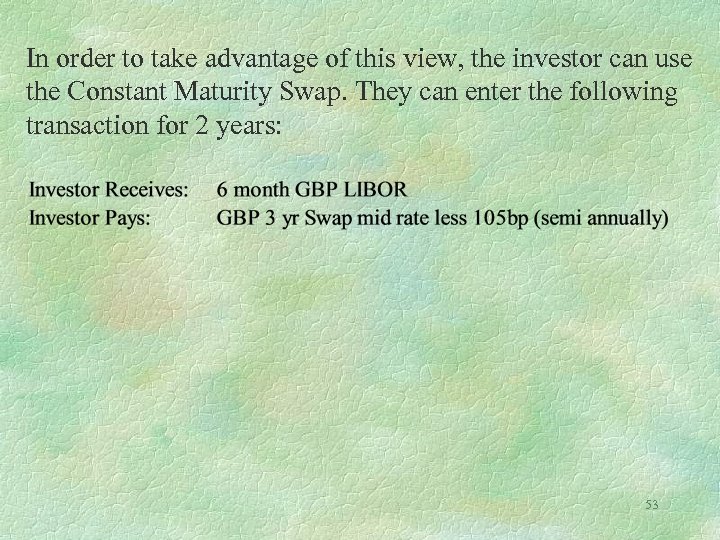 In order to take advantage of this view, the investor can use the Constant Maturity Swap. They can enter the following transaction for 2 years: 53
 • Each six months, if the 3 yr Swap rate is less than 105 bp, the investor will receive a net positive cashflow, and if the differential is greater than 105 bp, pay a net cashflow. • As the current spread is 150 bp, the investor will be required to pay 45 bp for the first 6 months. It is clear that if the investor is correct and the differential does average 50 bp over the two years, this will result in a net flow of 55 bp to the investor. • The advantage is that the timing of the narrowing within the 2 years is immaterial, as long as the differential averages less than 105 bp, the investor "wins". 54
 Example – Corporate perspective • A Swedish company has recently embraced the concept of duration and is keen to manage the duration of its debt portfolio. • In the past, the company has used the Interest Rate Swap market to convert LIBOR based funding into fixed rate and as swap transactions mature has sought to replace them with new 3, 5 and 7 yr swaps. • The debt duration of the company is therefore quite volatile as it continues to shorten until new transactions are booked when it jumps higher. 55
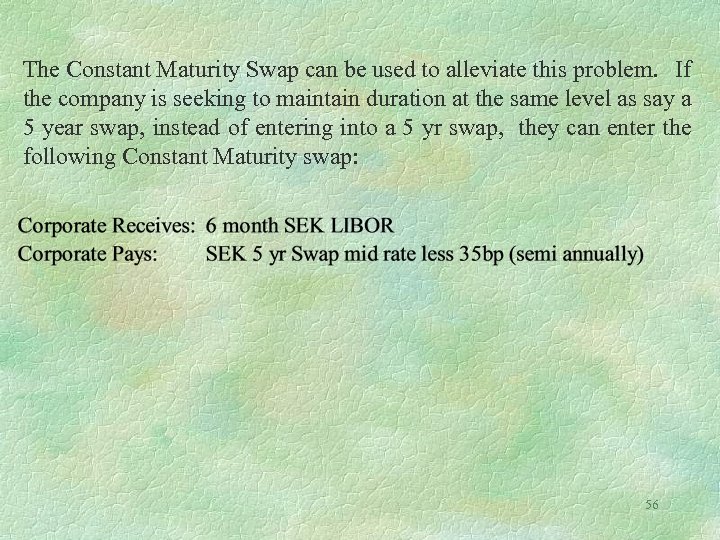 The Constant Maturity Swap can be used to alleviate this problem. If the company is seeking to maintain duration at the same level as say a 5 year swap, instead of entering into a 5 yr swap, they can enter the following Constant Maturity swap: 56
 • The tenor of the swap is not as relevant, and in this case could be for say 5 years. The "duration" of the transaction is almost always at the same level as a 5 yr swap and as time goes by, the duration remains the same unlike the traditional swap. • So here, the duration will remain around 5 yrs for the life of the Constant Maturity Swap, regardless of the tenor of the transaction. • The tenor however, may have a dramatic effect on the pricing of the swap, which is reflected in the premium or discount paid (in this example a discount of 35 bp). 57
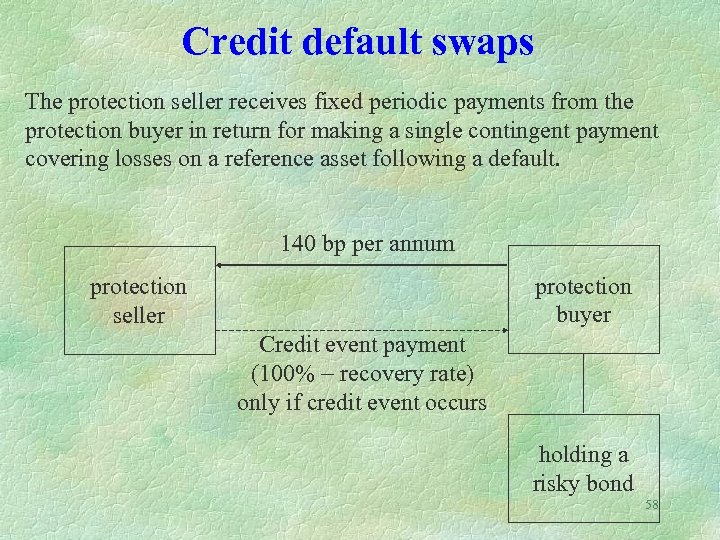 Credit default swaps The protection seller receives fixed periodic payments from the protection buyer in return for making a single contingent payment covering losses on a reference asset following a default. 140 bp per annum protection buyer protection seller Credit event payment (100% recovery rate) only if credit event occurs holding a risky bond 58
 Protection seller • earns investment income with no funding cost • gains customized, synthetic access to the risky bond Protection buyer • hedges the default risk on the reference asset 1. Very often, the bond tenor is longer than the swap tenor. In this way, the protection seller does not have exposure to the full market risk of the bond. 2. Basket default swap gain additional yield by selling default protection on several assets. 59
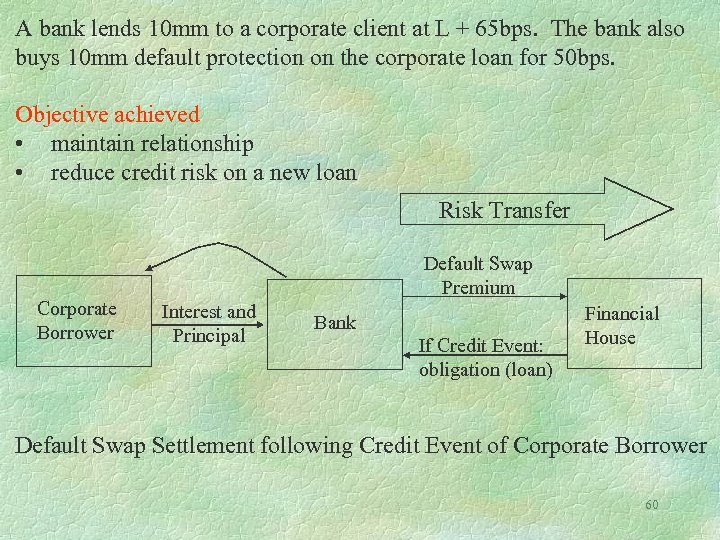 A bank lends 10 mm to a corporate client at L + 65 bps. The bank also buys 10 mm default protection on the corporate loan for 50 bps. Objective achieved • maintain relationship • reduce credit risk on a new loan Risk Transfer Corporate Borrower Default Swap Premium Interest and Principal Bank If Credit Event: obligation (loan) Financial House Default Swap Settlement following Credit Event of Corporate Borrower 60
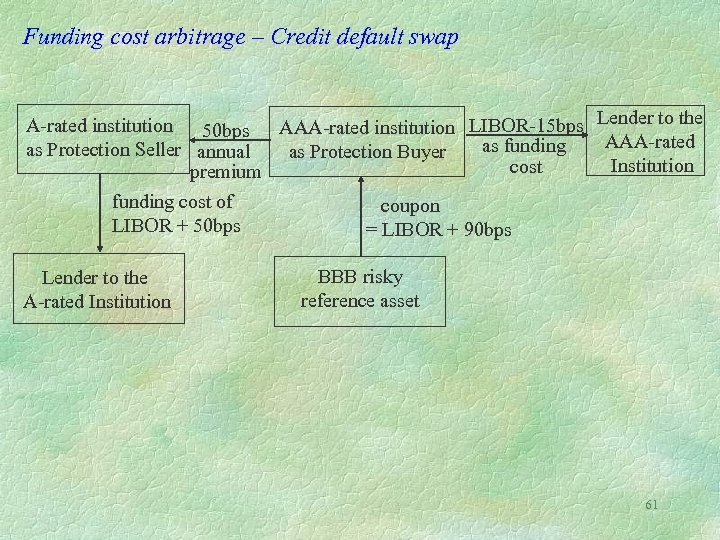 Funding cost arbitrage – Credit default swap A-rated institution 50 bps AAA-rated institution LIBOR-15 bps Lender to the AAA-rated as funding as Protection Seller annual as Protection Buyer Institution cost premium funding cost of coupon LIBOR + 50 bps = LIBOR + 90 bps Lender to the A-rated Institution BBB risky reference asset 61
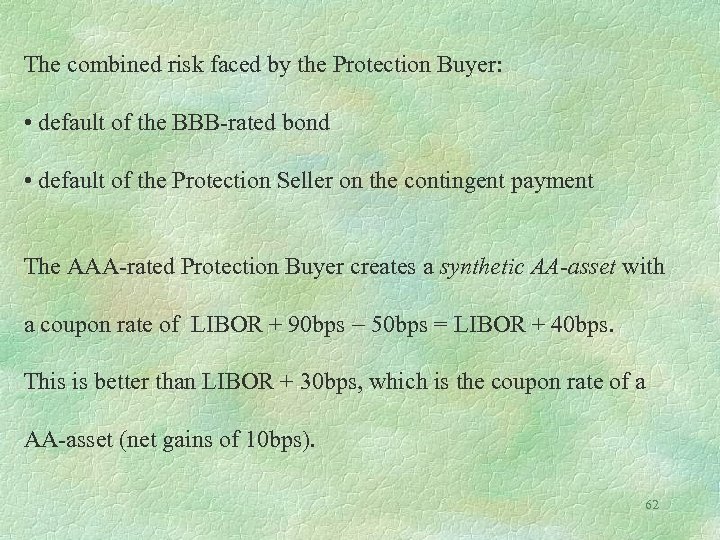 The combined risk faced by the Protection Buyer: • default of the BBB-rated bond • default of the Protection Seller on the contingent payment The AAA-rated Protection Buyer creates a synthetic AA-asset with a coupon rate of LIBOR + 90 bps 50 bps = LIBOR + 40 bps. This is better than LIBOR + 30 bps, which is the coupon rate of a AA-asset (net gains of 10 bps). 62
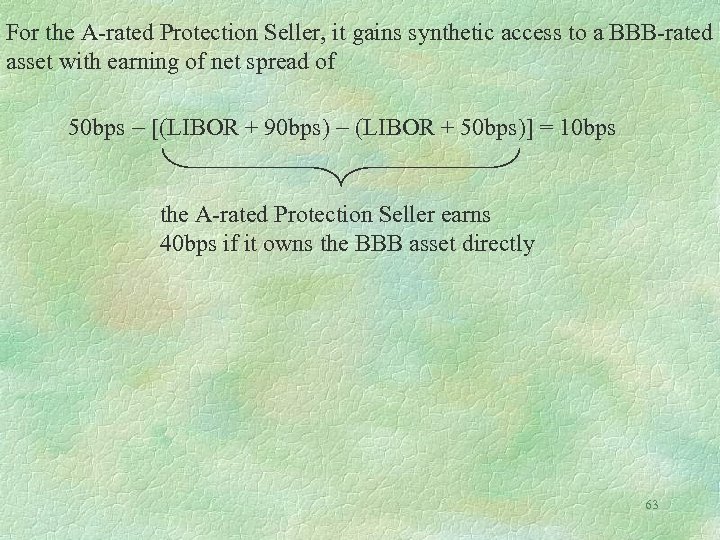 For the A-rated Protection Seller, it gains synthetic access to a BBB-rated asset with earning of net spread of 50 bps [(LIBOR + 90 bps) (LIBOR + 50 bps)] = 10 bps the A-rated Protection Seller earns 40 bps if it owns the BBB asset directly 63
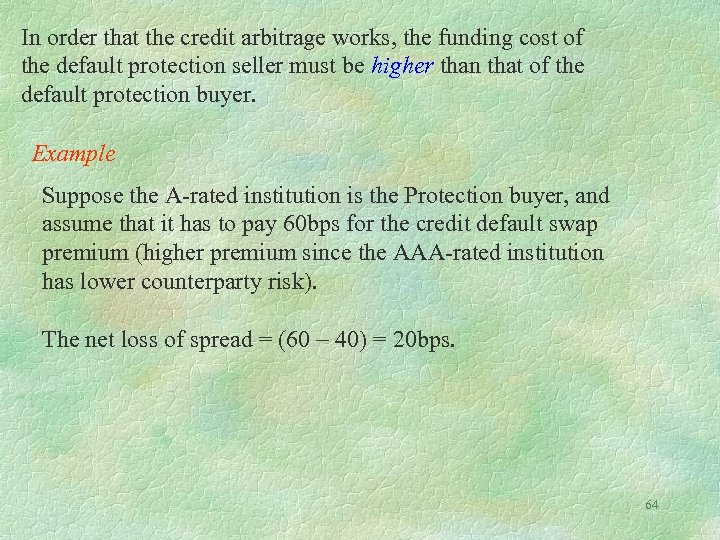 In order that the credit arbitrage works, the funding cost of the default protection seller must be higher than that of the default protection buyer. Example Suppose the A-rated institution is the Protection buyer, and assume that it has to pay 60 bps for the credit default swap premium (higher premium since the AAA-rated institution has lower counterparty risk). The net loss of spread = (60 40) = 20 bps. 64
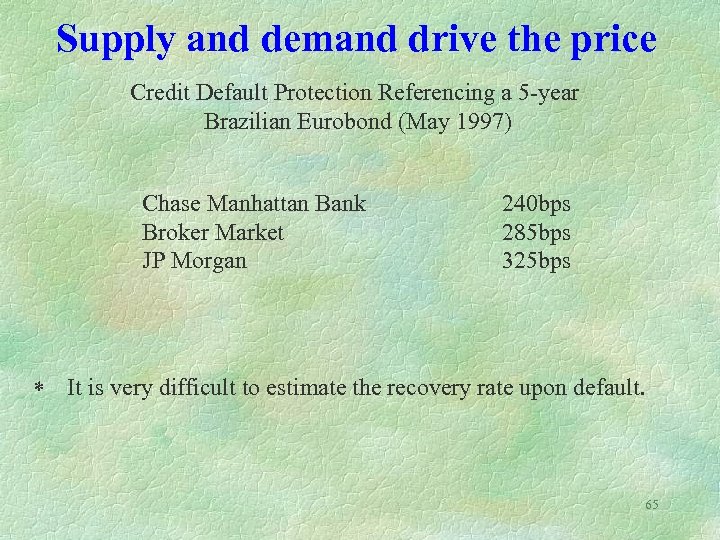 Supply and demand drive the price Credit Default Protection Referencing a 5 -year Brazilian Eurobond (May 1997) Chase Manhattan Bank Broker Market JP Morgan 240 bps 285 bps 325 bps * It is very difficult to estimate the recovery rate upon default. 65
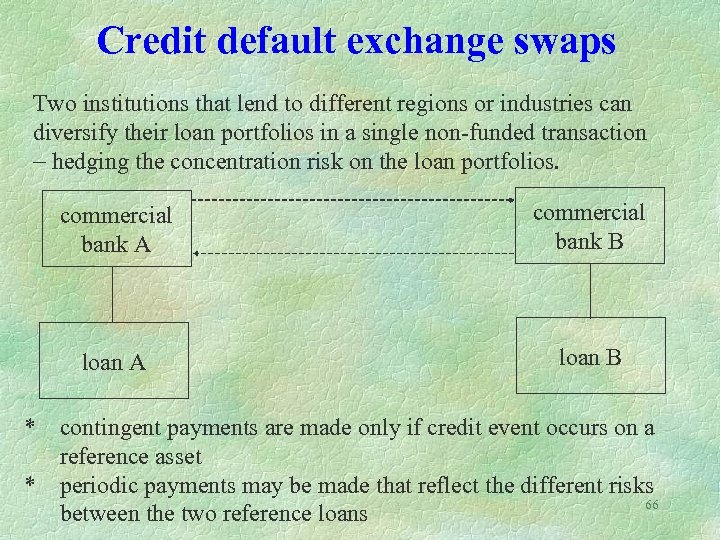 Credit default exchange swaps Two institutions that lend to different regions or industries can diversify their loan portfolios in a single non-funded transaction hedging the concentration risk on the loan portfolios. commercial bank A commercial bank B loan A loan B * contingent payments are made only if credit event occurs on a reference asset * periodic payments may be made that reflect the different risks 66 between the two reference loans
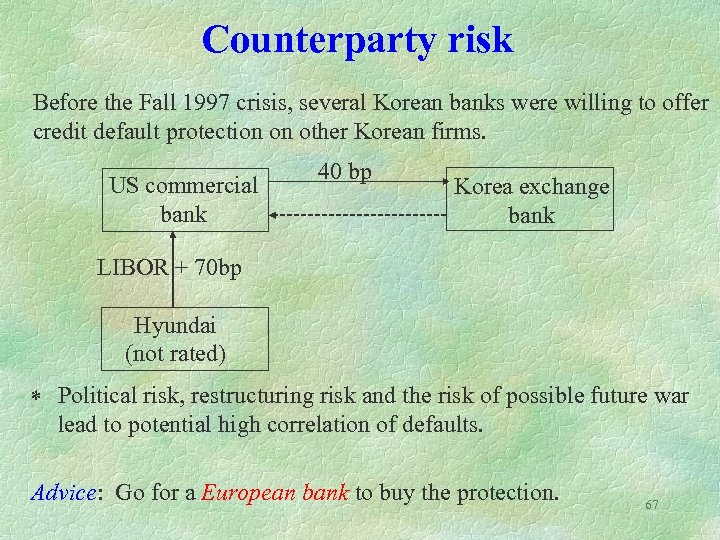 Counterparty risk Before the Fall 1997 crisis, several Korean banks were willing to offer credit default protection on other Korean firms. US commercial bank 40 bp Korea exchange bank LIBOR + 70 bp Hyundai (not rated) * Political risk, restructuring risk and the risk of possible future war lead to potential high correlation of defaults. Advice: Go for a European bank to buy the protection. 67
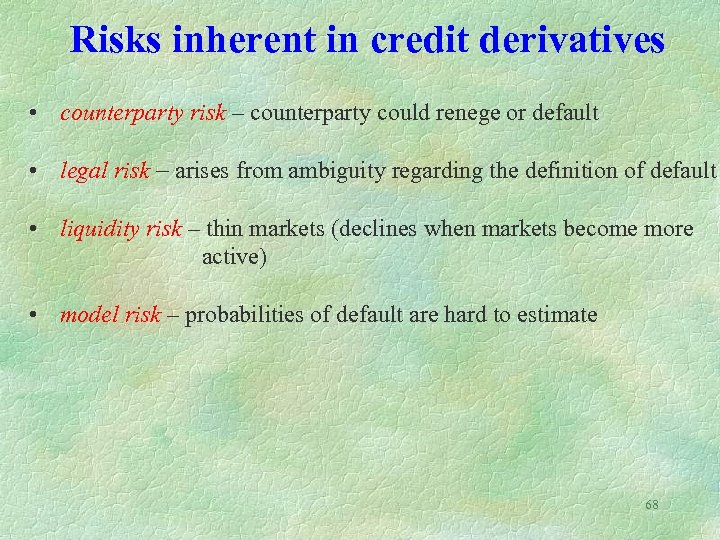 Risks inherent in credit derivatives • counterparty risk – counterparty could renege or default • legal risk arises from ambiguity regarding the definition of default • liquidity risk – thin markets (declines when markets become more active) • model risk – probabilities of default are hard to estimate 68
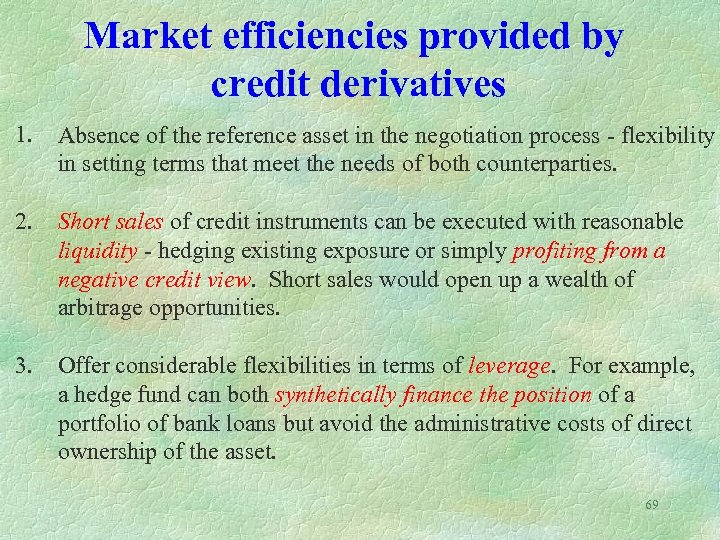 Market efficiencies provided by credit derivatives 1. Absence of the reference asset in the negotiation process - flexibility in setting terms that meet the needs of both counterparties. 2. Short sales of credit instruments can be executed with reasonable liquidity - hedging existing exposure or simply profiting from a negative credit view. Short sales would open up a wealth of arbitrage opportunities. 3. Offer considerable flexibilities in terms of leverage. For example, a hedge fund can both synthetically finance the position of a portfolio of bank loans but avoid the administrative costs of direct ownership of the asset. 69
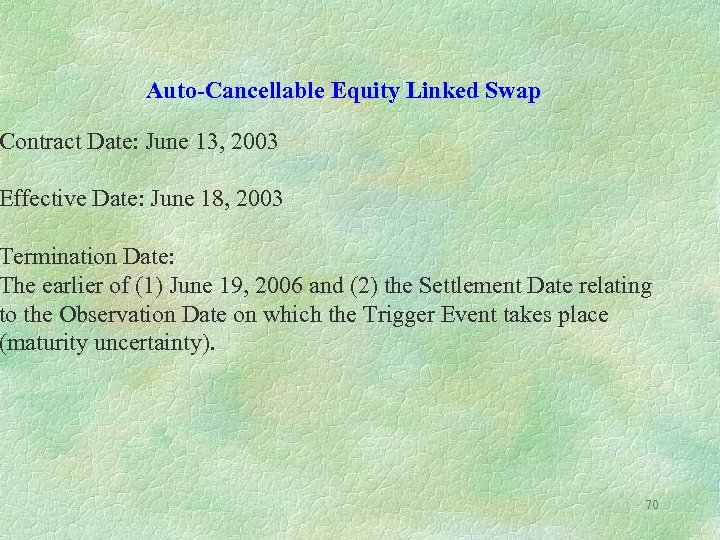 Auto-Cancellable Equity Linked Swap Contract Date: June 13, 2003 Effective Date: June 18, 2003 Termination Date: The earlier of (1) June 19, 2006 and (2) the Settlement Date relating to the Observation Date on which the Trigger Event takes place (maturity uncertainty). 70
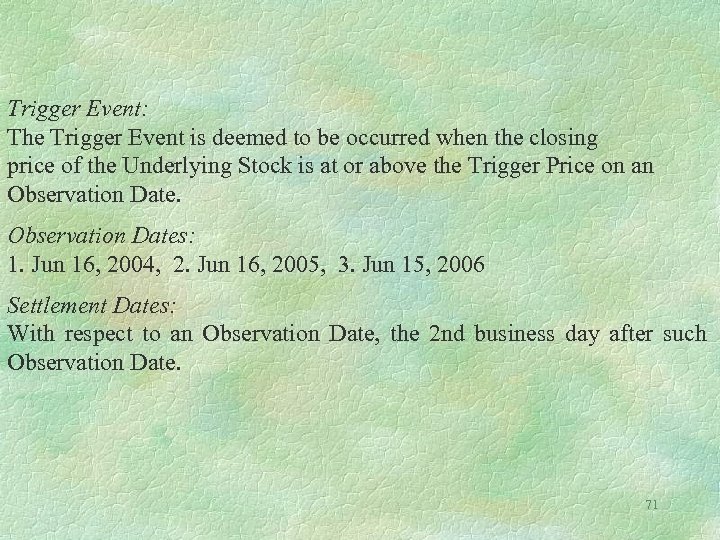 Trigger Event: The Trigger Event is deemed to be occurred when the closing price of the Underlying Stock is at or above the Trigger Price on an Observation Dates: 1. Jun 16, 2004, 2. Jun 16, 2005, 3. Jun 15, 2006 Settlement Dates: With respect to an Observation Date, the 2 nd business day after such Observation Date. 71
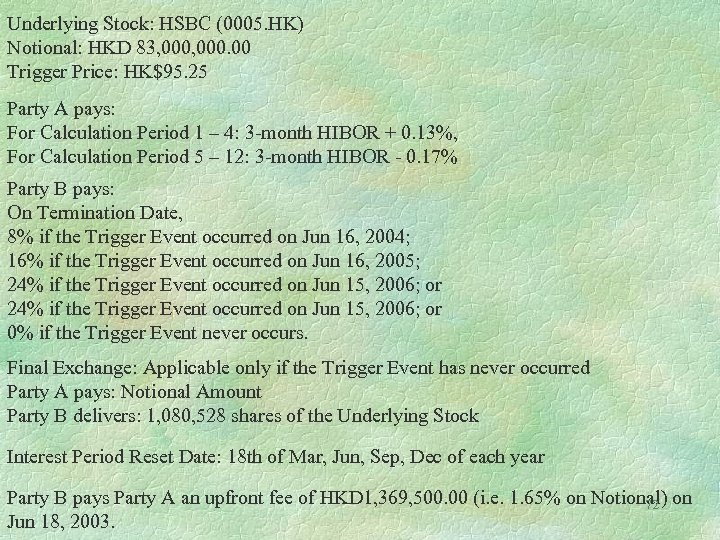 Underlying Stock: HSBC (0005. HK) Notional: HKD 83, 000. 00 Trigger Price: HK$95. 25 Party A pays: For Calculation Period 1 – 4: 3 -month HIBOR + 0. 13%, For Calculation Period 5 – 12: 3 -month HIBOR - 0. 17% Party B pays: On Termination Date, 8% if the Trigger Event occurred on Jun 16, 2004; 16% if the Trigger Event occurred on Jun 16, 2005; 24% if the Trigger Event occurred on Jun 15, 2006; or 0% if the Trigger Event never occurs. Final Exchange: Applicable only if the Trigger Event has never occurred Party A pays: Notional Amount Party B delivers: 1, 080, 528 shares of the Underlying Stock Interest Period Reset Date: 18 th of Mar, Jun, Sep, Dec of each year Party B pays Party A an upfront fee of HKD 1, 369, 500. 00 (i. e. 1. 65% on Notional) on 72 Jun 18, 2003.
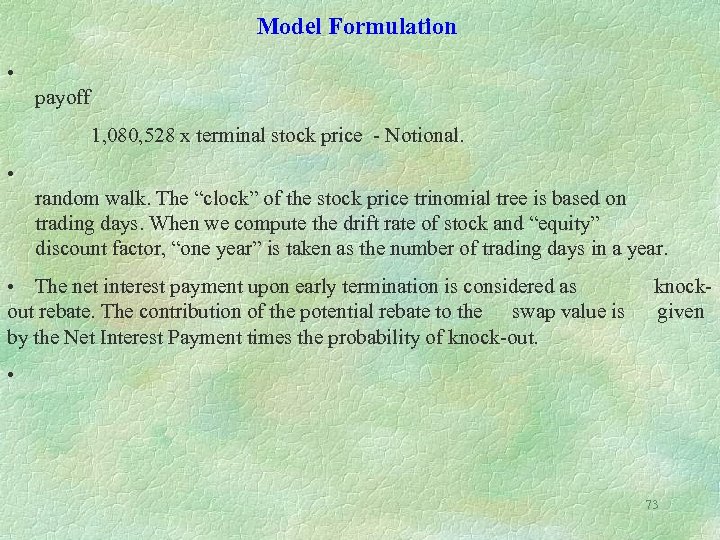 Model Formulation • payoff 1, 080, 528 x terminal stock price - Notional. • random walk. The “clock” of the stock price trinomial tree is based on trading days. When we compute the drift rate of stock and “equity” discount factor, “one year” is taken as the number of trading days in a year. • The net interest payment upon early termination is considered as knockout rebate. The contribution of the potential rebate to the swap value is given by the Net Interest Payment times the probability of knock-out. • 73
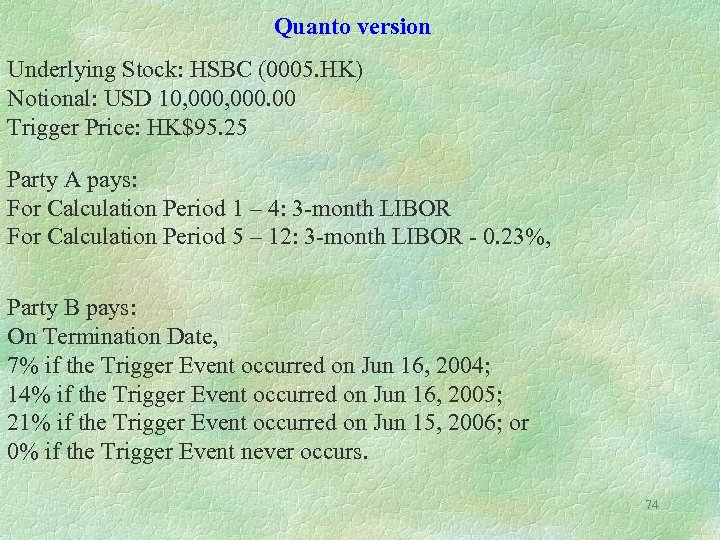 Quanto version Underlying Stock: HSBC (0005. HK) Notional: USD 10, 000. 00 Trigger Price: HK$95. 25 Party A pays: For Calculation Period 1 – 4: 3 -month LIBOR For Calculation Period 5 – 12: 3 -month LIBOR - 0. 23%, Party B pays: On Termination Date, 7% if the Trigger Event occurred on Jun 16, 2004; 14% if the Trigger Event occurred on Jun 16, 2005; 21% if the Trigger Event occurred on Jun 15, 2006; or 0% if the Trigger Event never occurs. 74
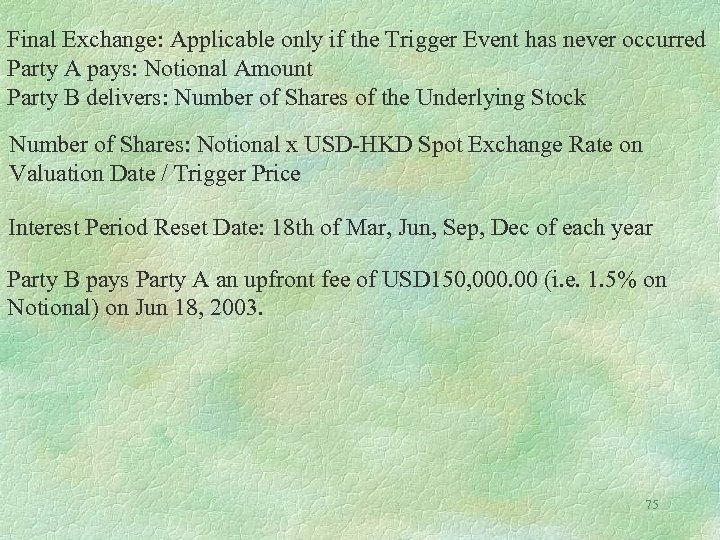 Final Exchange: Applicable only if the Trigger Event has never occurred Party A pays: Notional Amount Party B delivers: Number of Shares of the Underlying Stock Number of Shares: Notional x USD-HKD Spot Exchange Rate on Valuation Date / Trigger Price Interest Period Reset Date: 18 th of Mar, Jun, Sep, Dec of each year Party B pays Party A an upfront fee of USD 150, 000. 00 (i. e. 1. 5% on Notional) on Jun 18, 2003. 75
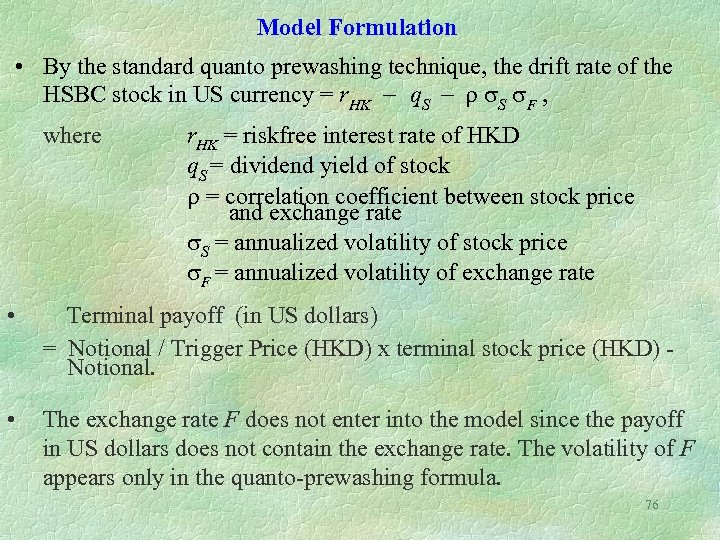 Model Formulation • By the standard quanto prewashing technique, the drift rate of the HSBC stock in US currency = r. HK q. S r s. S s. F , where r. HK = riskfree interest rate of HKD q. S = dividend yield of stock r = correlation coefficient between stock price and exchange rate s. S = annualized volatility of stock price s. F = annualized volatility of exchange rate • Terminal payoff (in US dollars) = Notional / Trigger Price (HKD) x terminal stock price (HKD) - Notional. • The exchange rate F does not enter into the model since the payoff in US dollars does not contain the exchange rate. The volatility of F appears only in the quanto-prewashing formula. 76
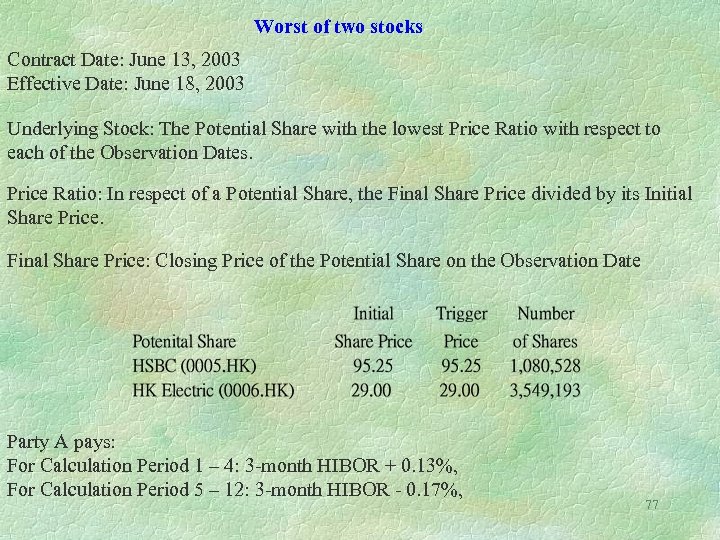 Worst of two stocks Contract Date: June 13, 2003 Effective Date: June 18, 2003 Underlying Stock: The Potential Share with the lowest Price Ratio with respect to each of the Observation Dates. Price Ratio: In respect of a Potential Share, the Final Share Price divided by its Initial Share Price. Final Share Price: Closing Price of the Potential Share on the Observation Date Party A pays: For Calculation Period 1 – 4: 3 -month HIBOR + 0. 13%, For Calculation Period 5 – 12: 3 -month HIBOR - 0. 17%, 77
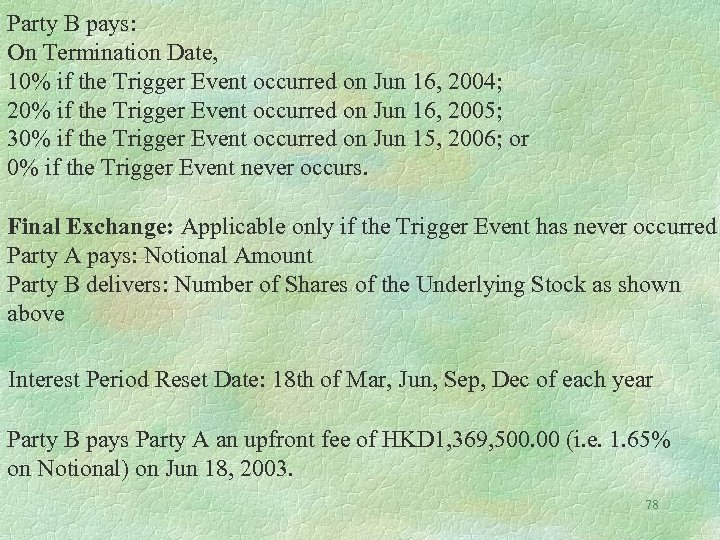 Party B pays: On Termination Date, 10% if the Trigger Event occurred on Jun 16, 2004; 20% if the Trigger Event occurred on Jun 16, 2005; 30% if the Trigger Event occurred on Jun 15, 2006; or 0% if the Trigger Event never occurs. Final Exchange: Applicable only if the Trigger Event has never occurred Party A pays: Notional Amount Party B delivers: Number of Shares of the Underlying Stock as shown above Interest Period Reset Date: 18 th of Mar, Jun, Sep, Dec of each year Party B pays Party A an upfront fee of HKD 1, 369, 500. 00 (i. e. 1. 65% on Notional) on Jun 18, 2003. 78