


 Скачать презентацию Part 13 THE MACROECONOMICS OF OPEN ECONOMIES
3c52da755a40e565328bc4cf8c1528fb.ppt
- Количество слайдов: 26
 Part 13 THE MACROECONOMICS OF OPEN ECONOMIES
 Open-Economy Macroeconomics: Basic Concepts Copyright © 2014 Cengage Learning 28
 Open-Economy Macroeconomics: Basic Concepts ²Open and Closed Economies • A closed economy is one that does not interact with other economies in the world. o There are no exports, no imports, and no capital flows. • An open economy is one that interacts freely with other economies around the world. Copyright © 2014 Cengage Learning
 Open-Economy Macroeconomics: Basic Concepts ²An Open Economy • An open economy interacts with other countries in two ways. o It buys and sells goods and services in world product markets. o It buys and sells capital assets in world financial markets. Copyright © 2014 Cengage Learning
 The Flow of Goods: Exports, Imports, Net Exports ²Exports are goods and services that are produced domestically and sold abroad. ²Imports are goods and services that are produced abroad and sold domestically. ²Net exports (NX) are the value of a nation’s exports minus the value of its imports. ²Net exports are also called the trade balance. Copyright © 2014 Cengage Learning
 The Flow of Goods: Exports, Imports, Net Exports ²A trade deficit is a situation in which net exports (NX) are negative. • Imports > Exports ²A trade surplus is a situation in which net exports (NX) are positive. • Exports > Imports ²Balanced trade refers to when net exports are zero—exports and imports are exactly equal. Copyright © 2014 Cengage Learning
 The Flow of Goods: Exports, Imports, Net Exports ²Factors That Affect Net Exports • Consumer tastes for domestic and foreign goods. • The prices of goods at home and abroad. • The exchange rates at which people can use domestic currency to buy foreign currencies. • The incomes of consumers at home and abroad. • The costs of transporting goods from country to country. • The policies of the government toward international trade. Copyright © 2014 Cengage Learning
 The Flow of Financial Resources: Net Capital Outflow ² Net capital outflow refers to the purchase of foreign assets by domestic residents minus the purchase of domestic assets by foreigners. • A UK resident buys shares in the BMW and a Japanese resident buys a bond issued by the UK government. o When a UK resident buys shares in BMW, the German car company, the purchase raises UK net capital outflow. o When a Japanese resident buys a bond issued by the UK government, the purchase reduces the UK net capital outflow. Copyright © 2014 Cengage Learning
 The Flow of Financial Resources: Net Capital Outflow ²Variables that Influence Net Capital Outflow • The real interest rates being paid on foreign assets. • The real interest rates being paid on domestic assets. • The perceived economic and political risks of holding assets abroad. • The government policies that affect foreign ownership of domestic assets. Copyright © 2014 Cengage Learning
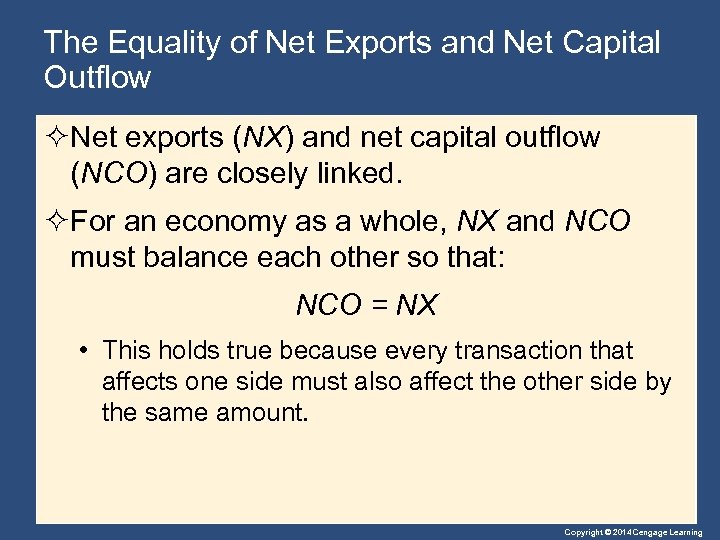 The Equality of Net Exports and Net Capital Outflow ²Net exports (NX) and net capital outflow (NCO) are closely linked. ²For an economy as a whole, NX and NCO must balance each other so that: NCO = NX • This holds true because every transaction that affects one side must also affect the other side by the same amount. Copyright © 2014 Cengage Learning
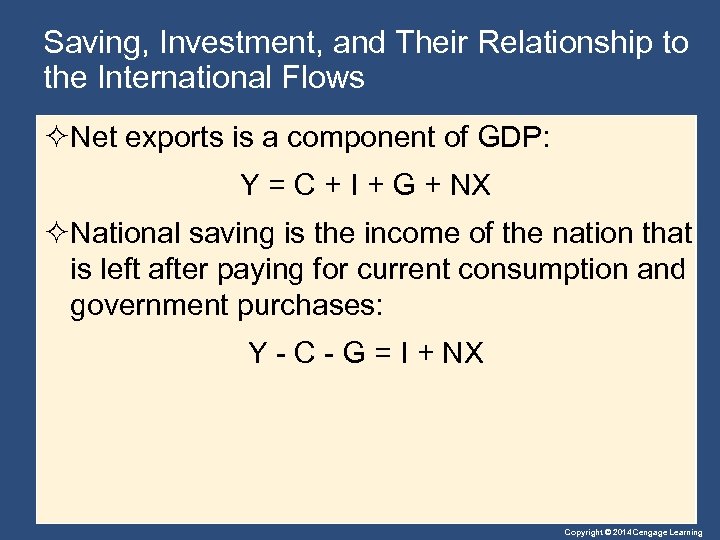 Saving, Investment, and Their Relationship to the International Flows ²Net exports is a component of GDP: Y = C + I + G + NX ²National saving is the income of the nation that is left after paying for current consumption and government purchases: Y - C - G = I + NX Copyright © 2014 Cengage Learning
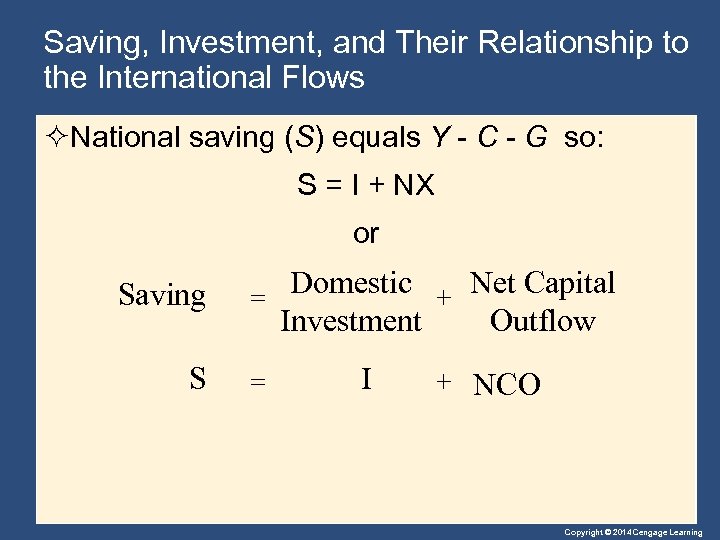 Saving, Investment, and Their Relationship to the International Flows ²National saving (S) equals Y - C - G so: S = I + NX or Saving = S = Domestic + Net Capital Investment Outflow I + NCO Copyright © 2014 Cengage Learning
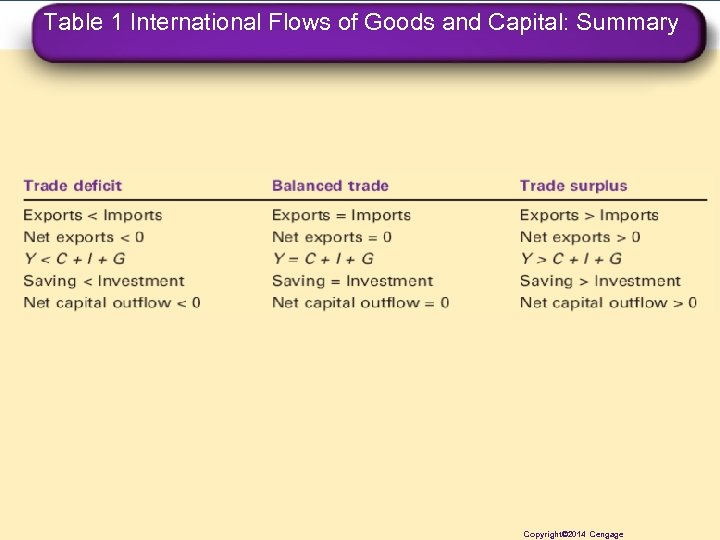 Table 1 International Flows of Goods and Capital: Summary Copyright © 2014 Copyright© 2014 Cengage Learning
 THE PRICES FOR INTERNATIONAL TRANSACTIONS: REAL AND NOMINAL EXCHANGE RATES ²International transactions are influenced by international prices. ²The two most important international prices are the nominal exchange rate and the real exchange rate. Copyright © 2014 Cengage Learning
 Nominal Exchange Rates ² The nominal exchange rate is the rate at which a person can trade the currency of one country for the currency of another. • The nominal exchange rate is expressed in two ways: o In units of foreign currency per euro. o In euros per unit of the foreign currency. • Assume the exchange rate between the Japanese yen and the euro is 80 yen to one euro. o One euro trades for 80 yen. o One yen trades for 1/80 (= 0. 0125) of a euro. Copyright © 2014 Cengage Learning
 Nominal Exchange Rates ²Appreciation refers to an increase in the value of a currency as measured by the amount of foreign currency it can buy. ²Depreciation refers to a decrease in the value of a currency as measured by the amount of foreign currency it can buy. ²If a euro buys: • More foreign currency, there is an appreciation of the euro. • Less there is a depreciation of the euro. Copyright © 2014 Cengage Learning
 Real Exchange Rates ²The real exchange rate is the rate at which a person can trade the goods and services of one country for the goods and services of another. ²The real exchange rate compares the prices of domestic goods and foreign goods in the domestic economy. • If a kilo of Swiss cheese beer is twice as expensive as a kilo of English cheese, the real exchange rate is 1/2 a kilo of Swiss cheese per kilo of English cheese. Copyright © 2014 Cengage Learning
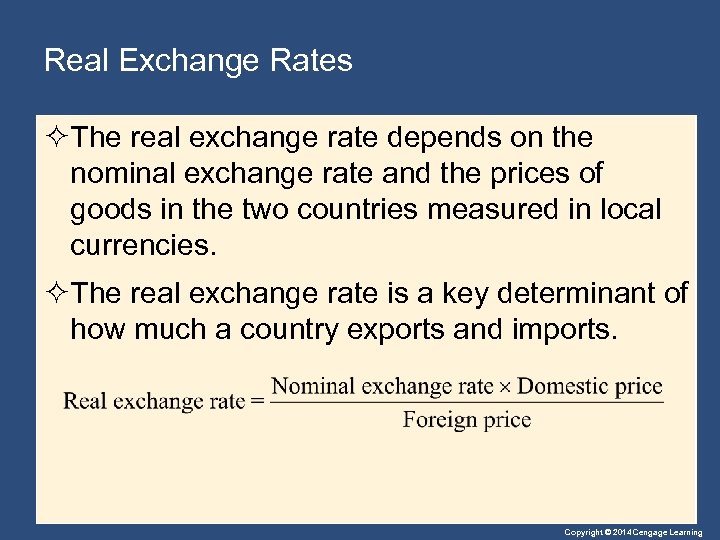 Real Exchange Rates ²The real exchange rate depends on the nominal exchange rate and the prices of goods in the two countries measured in local currencies. ²The real exchange rate is a key determinant of how much a country exports and imports. Copyright © 2014 Cengage Learning
 Real Exchange Rates ² A depreciation (fall) in the UK real exchange rate: • Means that UK goods have become cheaper relative to foreign goods. • This encourages consumers both at home and abroad to buy more UK goods and fewer goods from other countries. • As a result, UK exports rise, and UK imports fall, and both of these changes raise UK net exports. ²An appreciation in the UK real exchange rate: • Means that UK goods have become more expensive compared to foreign goods. • UK net exports fall. Copyright © 2014 Cengage Learning
 A FIRST THEORY OF EXCHANGE RATE DETERMINATION: PURCHASING POWER PARITY ²The purchasing power parity theory is the simplest and most widely accepted theory explaining the variation of currency exchange rates. Copyright © 2014 Cengage Learning
 The Basic Logic of Purchasing Power Parity ²Purchasing power parity is a theory of exchange rates whereby a unit of any given currency should be able to buy the same quantity of goods in all countries. • It is based on a principle called the law of one price. o A good must sell for the same price in all locations. • If the law of one price were not true, unexploited profit opportunities would exist. o The process of taking advantage of differences in prices in different markets is called arbitrage. • Exchange rates move to ensure ppp. Copyright © 2014 Cengage Learning
 Implications of Purchasing Power Parity ²The nominal exchange rate between the currencies of two countries must reflect the different price levels in those countries. ²Because the nominal exchange rate depends on the price levels, it must also depend on the money supply and money demand in each country. • If a central bank prints large quantities of money, the money loses value both in terms of the goods and services it can buy and in terms of the amount of other currencies it can buy. Copyright © 2014 Cengage Learning
 Limitations of Purchasing Power Parity ²Many goods are not easily traded or shipped from one country to another. ²Tradable goods are not always perfect substitutes when they are produced in different countries. Copyright © 2014 Cengage Learning
 Summary ① Net exports are the value of domestic goods and services sold abroad minus the value of foreign goods and services sold domestically. ② Net capital outflow is the acquisition of foreign assets by domestic residents minus the acquisition of domestic assets by foreigners. ③ An economy’s net capital outflow always equals its net exports. ④ An economy’s saving can be used to either finance investment at home or to buy assets abroad. Copyright © 2014 Cengage Learning
 Summary ⑤ The nominal exchange rate is the relative price of the currency of two countries. ⑥ The real exchange rate is the relative price of the goods and services of two countries. ⑦ When the nominal exchange rate changes so that each euro buys more foreign currency, the euro is said to appreciate or strengthen. ⑧ When the nominal exchange rate changes so that each euro buys less foreign currency, the euro is said to depreciate or weaken. Copyright © 2014 Cengage Learning
 Summary ⑨ According to theory of purchasing power parity, a unit of currency should buy the same quantity of goods in all countries. ⑩ The nominal exchange rate between the currencies of two countries should reflect the countries’ price levels in those countries. Copyright © 2014 Cengage Learning