


 Скачать презентацию Parliament of India Composition Powers and Role
4cb1fa40388417e4755728ed5a4dd62a.ppt
- Количество слайдов: 12
 Parliament of India – Composition, Powers and Role -- Dr. Madhu Gupta Department of Political Science, Govt. College for Girls, Sector-11, Chandigarh
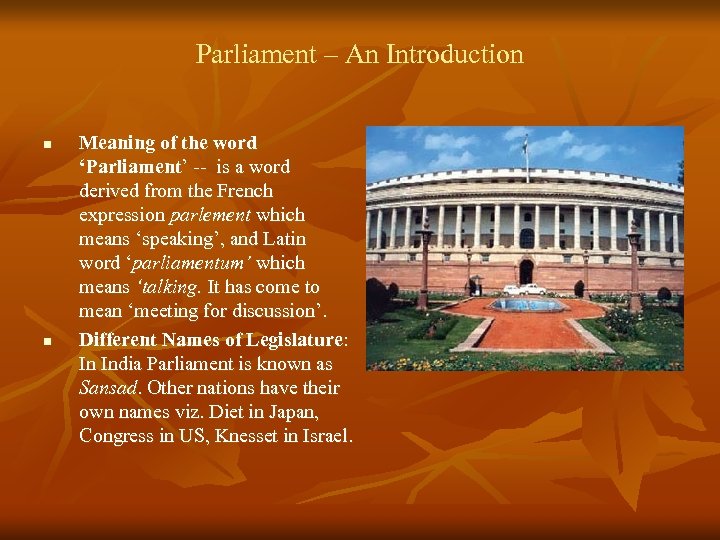 Parliament – An Introduction n n Meaning of the word ‘Parliament’ -- is a word derived from the French expression parlement which means ‘speaking’, and Latin word ‘parliamentum’ which means ‘talking. It has come to mean ‘meeting for discussion’. Different Names of Legislature: In India Parliament is known as Sansad. Other nations have their own names viz. Diet in Japan, Congress in US, Knesset in Israel.
 Basic Characteristics of Parliament India has borrowed this nomenclature from England has adopted what is called as ‘Westminster model of parliamentary system’ but Indian Sansad has its unique set of characteristics such as 1. Union Parliament is non-sovereign 2. Representation to both the Houses is given on the basis of population 3. Provision of joint sitting of both the Houses 4. Provision of nomination in both the Houses
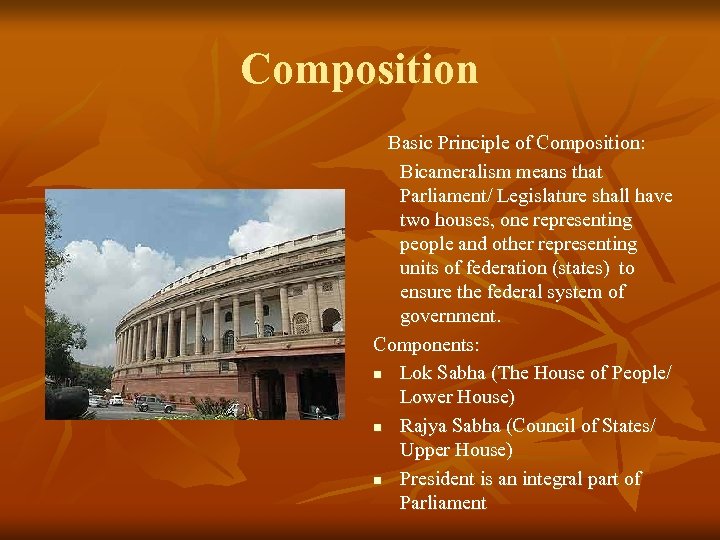 Composition Basic Principle of Composition: Bicameralism means that Parliament/ Legislature shall have two houses, one representing people and other representing units of federation (states) to ensure the federal system of government. Components: n Lok Sabha (The House of People/ Lower House) n Rajya Sabha (Council of States/ Upper House) n President is an integral part of Parliament
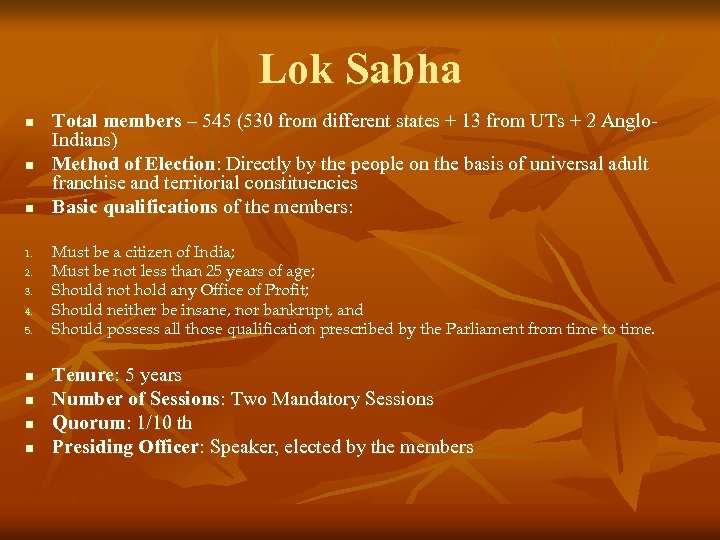 Lok Sabha n n n 1. 2. 3. 4. 5. n n Total members – 545 (530 from different states + 13 from UTs + 2 Anglo. Indians) Method of Election: Directly by the people on the basis of universal adult franchise and territorial constituencies Basic qualifications of the members: Must be a citizen of India; Must be not less than 25 years of age; Should not hold any Office of Profit; Should neither be insane, nor bankrupt, and Should possess all those qualification prescribed by the Parliament from time to time. Tenure: 5 years Number of Sessions: Two Mandatory Sessions Quorum: 1/10 th Presiding Officer: Speaker, elected by the members
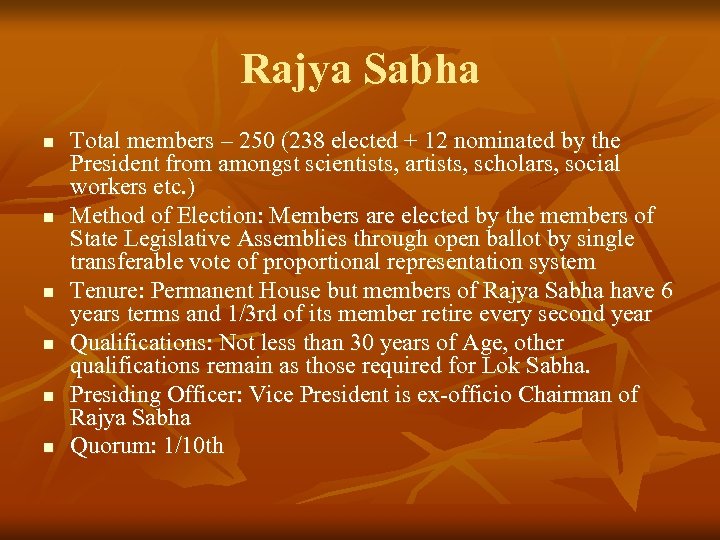 Rajya Sabha n n n Total members – 250 (238 elected + 12 nominated by the President from amongst scientists, artists, scholars, social workers etc. ) Method of Election: Members are elected by the members of State Legislative Assemblies through open ballot by single transferable vote of proportional representation system Tenure: Permanent House but members of Rajya Sabha have 6 years terms and 1/3 rd of its member retire every second year Qualifications: Not less than 30 years of Age, other qualifications remain as those required for Lok Sabha. Presiding Officer: Vice President is ex-officio Chairman of Rajya Sabha Quorum: 1/10 th
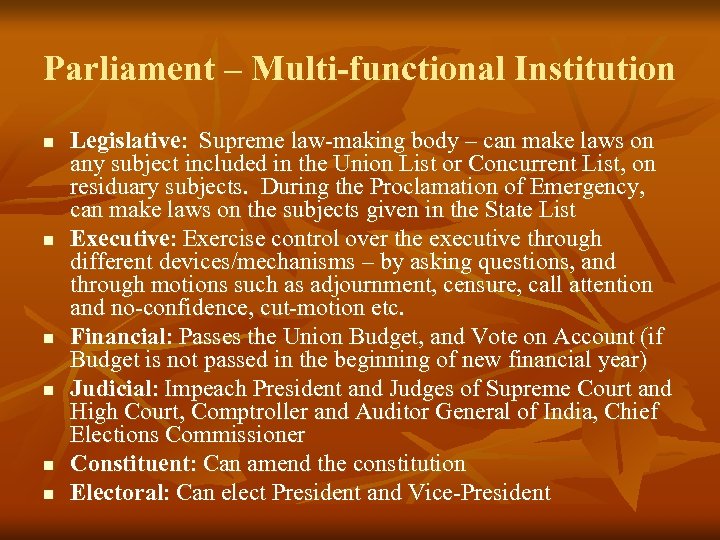 Parliament – Multi-functional Institution n n n Legislative: Supreme law-making body – can make laws on any subject included in the Union List or Concurrent List, on residuary subjects. During the Proclamation of Emergency, can make laws on the subjects given in the State List Executive: Exercise control over the executive through different devices/mechanisms – by asking questions, and through motions such as adjournment, censure, call attention and no-confidence, cut-motion etc. Financial: Passes the Union Budget, and Vote on Account (if Budget is not passed in the beginning of new financial year) Judicial: Impeach President and Judges of Supreme Court and High Court, Comptroller and Auditor General of India, Chief Elections Commissioner Constituent: Can amend the constitution Electoral: Can elect President and Vice-President
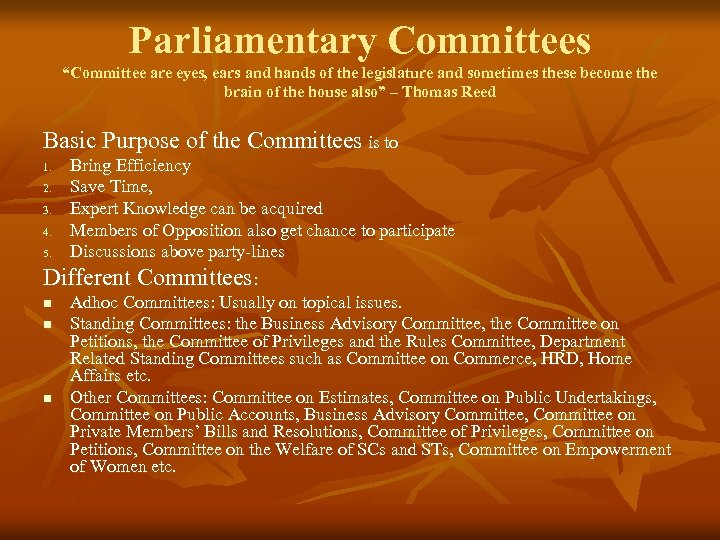 Parliamentary Committees “Committee are eyes, ears and hands of the legislature and sometimes these become the brain of the house also” – Thomas Reed Basic Purpose of the Committees is to Bring Efficiency 2. Save Time, 3. Expert Knowledge can be acquired 4. Members of Opposition also get chance to participate 5. Discussions above party-lines Different Committees: n Adhoc Committees: Usually on topical issues. n Standing Committees: the Business Advisory Committee, the Committee on Petitions, the Committee of Privileges and the Rules Committee, Department Related Standing Committees such as Committee on Commerce, HRD, Home Affairs etc. n Other Committees: Committee on Estimates, Committee on Public Undertakings, Committee on Public Accounts, Business Advisory Committee, Committee on Private Members’ Bills and Resolutions, Committee of Privileges, Committee on Petitions, Committee on the Welfare of SCs and STs, Committee on Empowerment of Women etc. 1.
 Role of Parliament – in Nutshell n n n n To form or end the Government To represent the electorate To legislate To hold the Government accountable for its actions To monitor the expenditure of public funds To be a forum for debate To be a forum for the expression of grievances To call for Information
 Critique of Parliament n n n n n Only a talking-shop of the so-called representatives who are elected most of the times by gaining less than 50% votes Absenteeism, Disruption in the Proceedings etc. Decisions are taken by organizations/ party-in-power outside the Parliament, and Parliament is used just formal ratification. Indo-US nuclear deal is one example. Gender-imbalance Lack of intra-party democracy within parties does not let the debate become non-partisan Number of days of Parliament sittings is declining. In 1951 Lok Sabha sat for 151 days, in 2007 it came down to 66. Inquiry reports are either not tabled, or at times delayed for political reasons. Members are turn-coats and find ways and means to defect. Charges of corruption against members There is a legislative vacuum. Laws on burning issues like surrogacy, cloning, money laundering, euthanasia, terrorism either need be reformed or made. Many sensitive bills are still pending, Women Reservation Bill is one.
 Reforms in Parliament – some suggestions n n n Parliament should sit for a minimum of 120 -140 days Important decisions on policy matters must be discussed in the Parliament before they are taken. Parties must give more representation to women to bring about a desirable gender-balance in the numbers in Parliament People should be given the right to recall, if MPs do not participate in Parliamentary proceedings Ensure more participation of the voters in the election so as to make the concept of representation valid and justifiable.
 References n n n Avasthi, A. P, Indian Government and Politics, Narain Agarwal, Agra, 2001. Badyal, J. S, Indian Government and Politics, Raj Publishers, Jalandhar, 2013. Fadia, B. L, Indian Government and Politics, Sahitya Bhawan Publication, Agra, 2002 Ghai, U. R, Indian Government and Politics, New Academic Publishing, Jalandhar, 2002. Gupta, D. C, Indian Government and Politics, Vikas Publishing House, New Delhi, 1978 Johari, J. C, Indian Government and Politics, Vishal Publication, 1979.