 Скачать презентацию Parking Policy Sustainable Development Vibrant Cities Gerry Murphy
0e87ec5bf67741e8838a8c5376f2657a.ppt
- Количество слайдов: 30



Parking Policy Sustainable Development, Vibrant Cities Gerry Murphy 12 September 2013
Established December 2009 • Responsible for contracting/subsidising/licensing or regulating – Bus, rail, light rail, taxi services • Integration of modes – Integrated ticketing – Journey planning – Real time passenger information • Investment in sustainable transport in our cities Extra in Eastern region Transport Strategies & Plans Land Use Planning & transport Capital Investment Traffic Management Policy
Managing the Demand for Transport • Transport is a derived demand • The demand for transport needs to be managed on the basis of integrated land use and transport objectives • Transport Demand Management Measures – Aligning the location of development with the planning of transport infrastructure and public transport service provision – Mobility Management and the Implementation of Work Place and Area-based Travel Plans
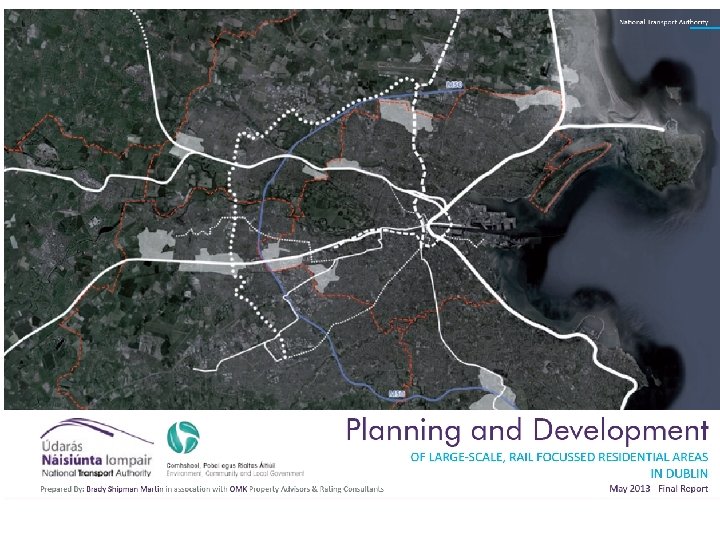
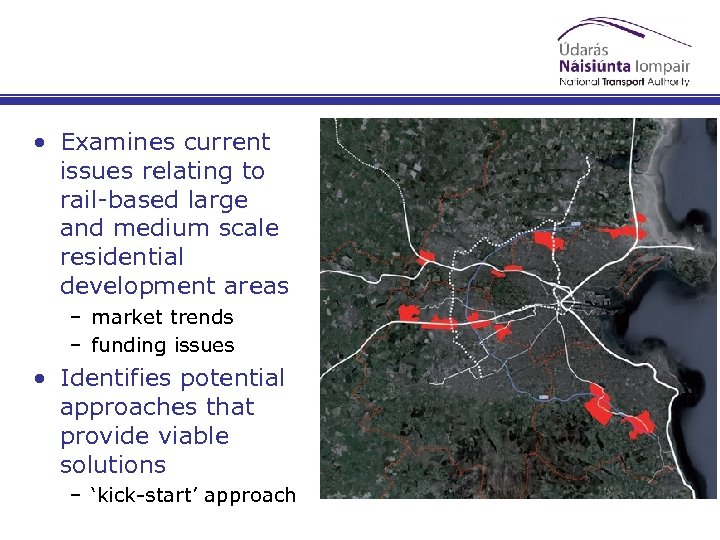
• Examines current issues relating to rail-based large and medium scale residential development areas – market trends – funding issues • Identifies potential approaches that provide viable solutions – ‘kick-start’ approach
Why is the issue of Parking important to an agency like ours? • Parking policy and its application have a key role to play in influencing the design of development including its scale, location and density • Parking supply, control and cost are vital tools in influencing mode choice
Why Provide and Manage Parking? • On the basis of clearly defined transport and development objectives – which includes meeting the collective needs of city and town centre businesses • On the basis of car-based travel need, rather than total transport demand • On the basis of site or area-based operational requirements • On the basis of special mobility needs
Parking Provision and Land Development • The most restrictive levels of parking provision should apply – in the most central locations in towns and cities – and along public transport corridors • Trip-intensive developments should be located in – more central locations – areas best served by public transport • There should be a presumption against the location of trip intensive developments in peripheral areas – few alternative means of access to the car exist • The least restrictive level of parking provision should apply to the least trip intensive forms of development such as distribution – better located in non-central locations • Parking is directly correlated with – development density, trip intensity, centrality, public transport accessibility
Parking and Mode Choice • The availability and pricing of destination parking at places of employment and other trip attracting uses needs to be considered – in combination with a range of alternative modes – with particular mode shares in mind • Within towns and cities, the allocation of road space for on-street parking and car park access can have a major bearing on the ability to provide for other modes of transport
Nodes of Employment • Work Place Travel Plans are a good mechanism by which the requirements of employees can be reconciled • ‘Hard’ and ‘soft’ measures can combine – awareness raising – financial incentives relating to a range of non-car commuting options – facilities for cycle commuting

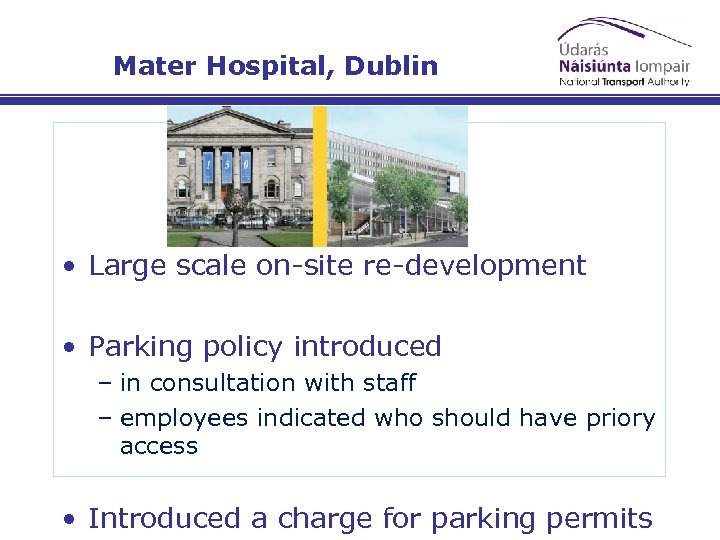
Mater Hospital, Dublin • Large scale on-site re-development • Parking policy introduced – in consultation with staff – employees indicated who should have priory access • Introduced a charge for parking permits
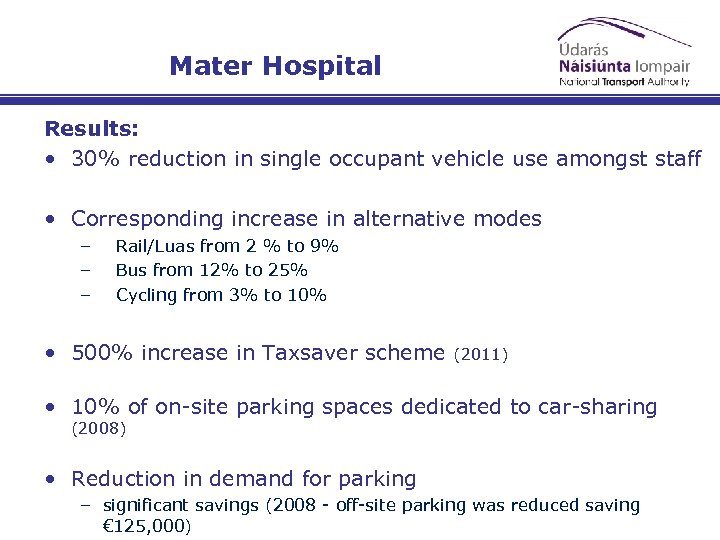
Mater Hospital Results: • 30% reduction in single occupant vehicle use amongst staff • Corresponding increase in alternative modes – – – Rail/Luas from 2 % to 9% Bus from 12% to 25% Cycling from 3% to 10% • 500% increase in Taxsaver scheme (2011) • 10% of on-site parking spaces dedicated to car-sharing (2008) • Reduction in demand for parking – significant savings (2008 - off-site parking was reduced saving € 125, 000)
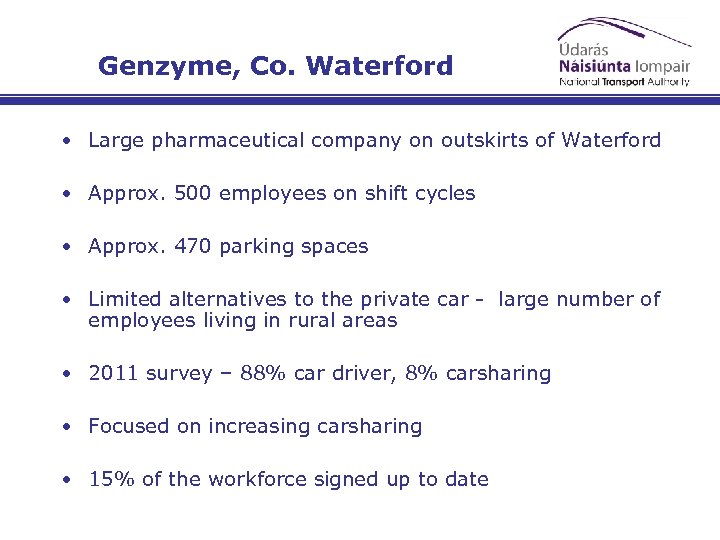
Genzyme, Co. Waterford • Large pharmaceutical company on outskirts of Waterford • Approx. 500 employees on shift cycles • Approx. 470 parking spaces • Limited alternatives to the private car - large number of employees living in rural areas • 2011 survey – 88% car driver, 8% carsharing • Focused on increasing carsharing • 15% of the workforce signed up to date
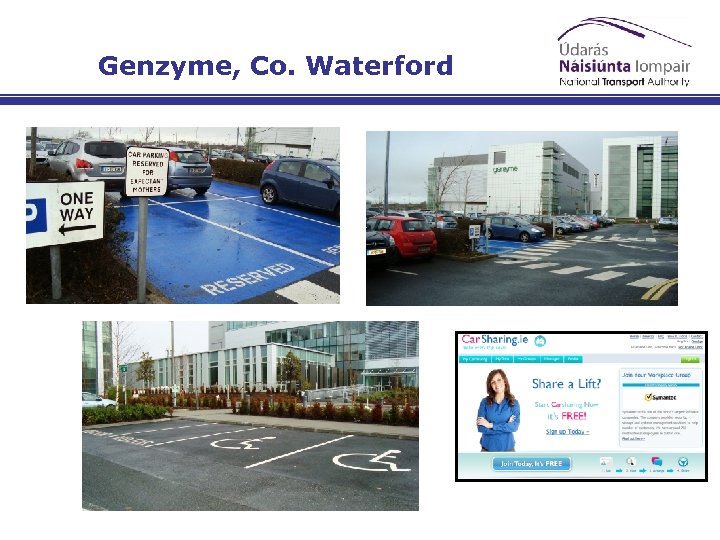
Genzyme, Co. Waterford
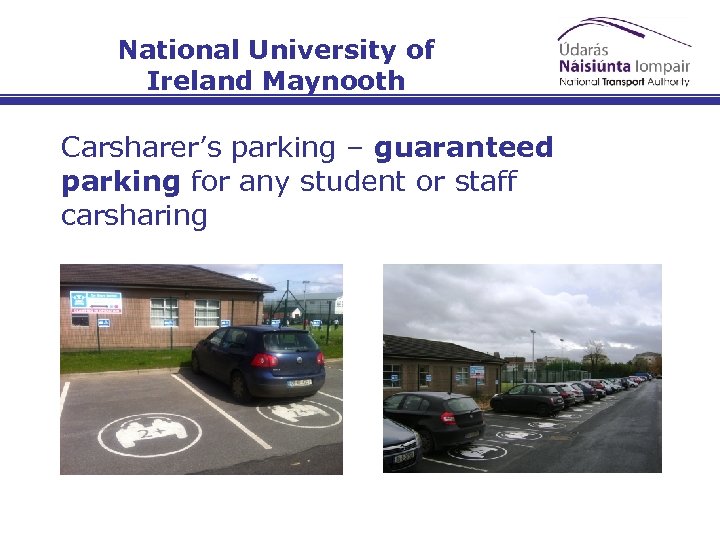
National University of Ireland Maynooth Carsharer’s parking – guaranteed parking for any student or staff carsharing
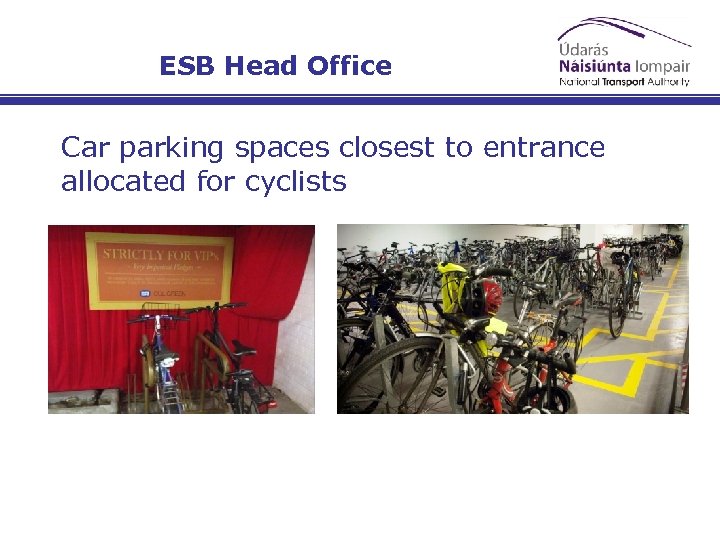
ESB Head Office Car parking spaces closest to entrance allocated for cyclists
Parking Standards The Case for Maximum Parking Standards • A key Transport Demand Management Tool • Specifies the maximum level of parking permitted in new developments, across a range of land uses • The levels of restriction can be based on locational criteria – centrality within urban settlements – or public transport accessibility • The most restrictive standards to apply in areas – within the highest intensity of development – and the highest levels of accessibility by non-car modes
Park and Ride • Promotes the use of public transport for those outside local walking catchment • Intercepts longer distance car-based trips at the edge of built-up areas • Reduces car-based trips in city/ town centres • Reduces the demand for destination parking • Can provide a broader demand for public transport services
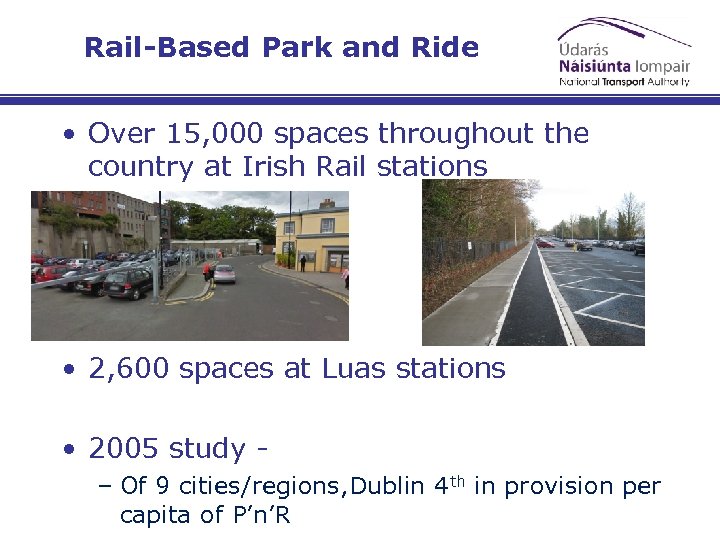
Rail-Based Park and Ride • Over 15, 000 spaces throughout the country at Irish Rail stations • 2, 600 spaces at Luas stations • 2005 study – Of 9 cities/regions, Dublin 4 th in provision per capita of P’n’R
Parking in City and Town Centres A primary objective is to meet the economic, social and cultural needs of city, town and district centres This requires access for the maximum numbers of people , balanced with the operational requirements of businesses, including goods delivery Balance between cars, public transport vehicles, goods vehicles, pedestrians and cyclists
• Excessive levels of destination car parking provision – compromise accessibility by other modes and overall levels of accessibility – compromise the quality of the public realm – safety impact on pedestrians and cyclists, where the highest intensities of movement occur – severance effect at the local level, compromising local trip making by walking and cycling – environment impact (air quality, noise, visual impact)
Management of Parking in City and Town Centres • Needs to be clearly defined in terms of contribution to economic vitality compared to the potential benefits of other modes of transport • Area-based approach, rather than on a site-by-site basis, would seem most amenable to serving these needs – an area-based cap for public on-street and off street car parking – management of car parking access
• Pricing is an essential tool in the management of public parking – To optimise turnover in the use of available parking – To achieve appropriate intended use of available parking (shorter term visitor vs. longer term commuter) • Objectives-led
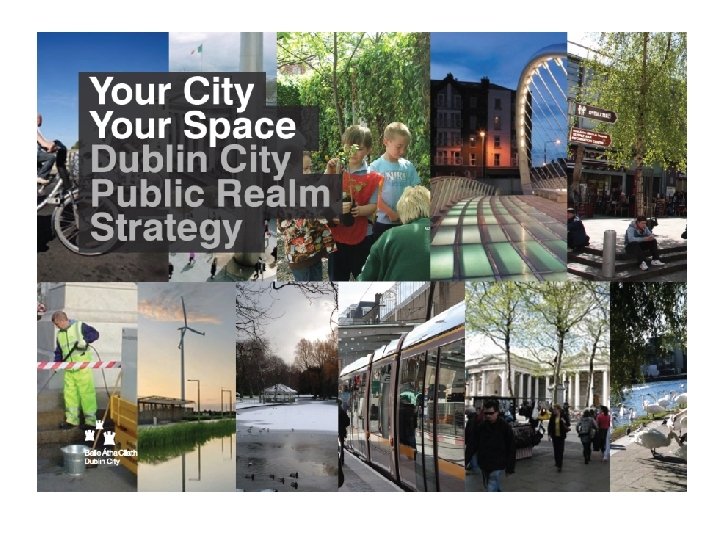
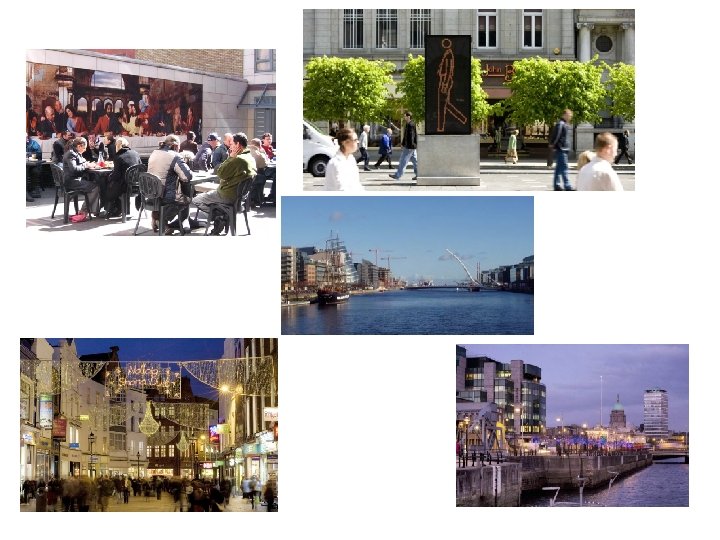
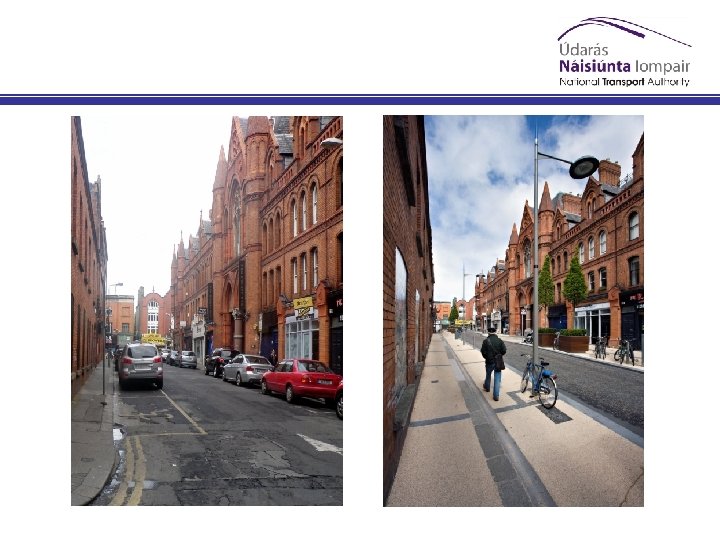
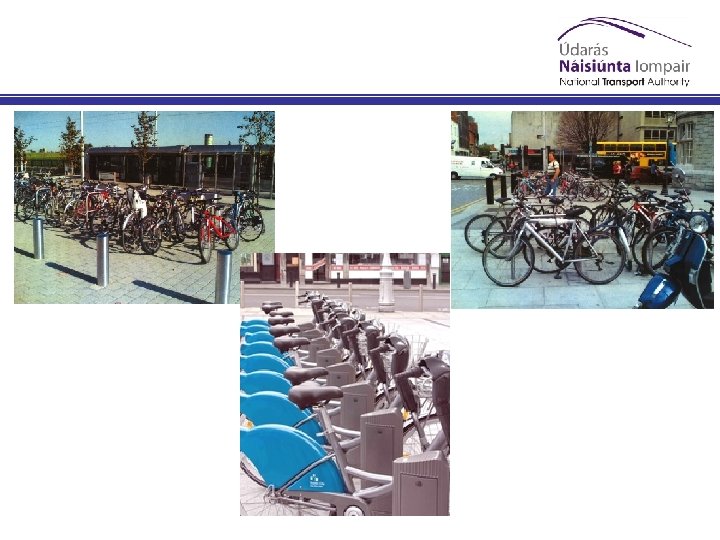
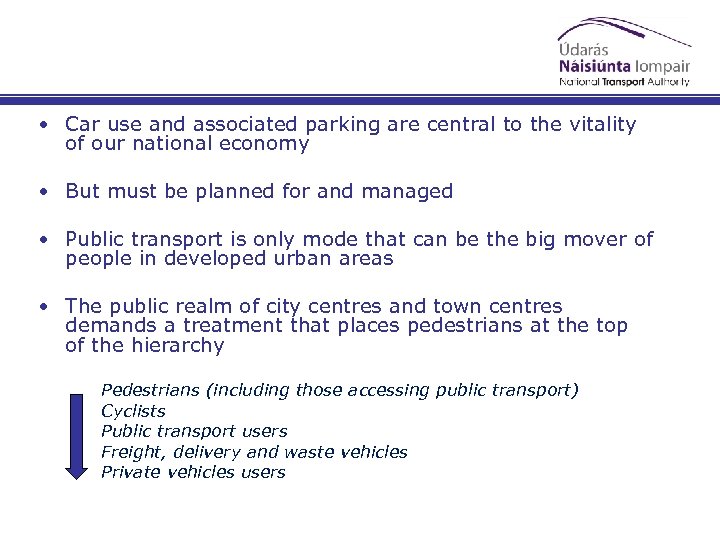
• Car use and associated parking are central to the vitality of our national economy • But must be planned for and managed • Public transport is only mode that can be the big mover of people in developed urban areas • The public realm of city centres and town centres demands a treatment that places pedestrians at the top of the hierarchy Pedestrians (including those accessing public transport) Cyclists Public transport users Freight, delivery and waste vehicles Private vehicles users
Скачать презентацию Parking Policy Sustainable Development Vibrant Cities Gerry Murphy
0e87ec5bf67741e8838a8c5376f2657a.ppt