


 Скачать презентацию Paris Metro Pricing for Qo S in Wireless
a915aedfd580a1356dc73c0a9a92fd65.ppt
- Количество слайдов: 13
 Paris Metro Pricing for Qo. S in Wireless Networks Ravi Jain, Tracy Mullen and Rob Hausman April 19, 2001 {rjain, mullen, hausman}@telcordia. com An SAIC Company Copyright © 2001 Telcordia Technologies. All Rights Reserved.
 Outline Motivation Paris Metro Pricing (PMP) Basic PMP Model PMP for Profit Conclusions Copyright © 2001 Telcordia Technologies. All Rights Reserved. Ravi Jain / 18 -Apr-01/ 2
 Motivation Qo. S is increasingly important as diverse applications proliferate Two basic approaches to Qo. S – Integrated Services: Qo. S guarantees (e. g. with RSVP), but costly – Differentiated Services (Diff-Serv): probabilistic assurances Wireless networks particularly require low-overhead schemes Most previous work on Qo. S focuses on protocols, messages, policies and algorithms for resource allocation However, discussing Qo. S without the user’s willingness to pay is only half the story – Critical to integrate economics and pricing with Qo. S Our approach: Diff-Serv Qo. S integrated with low-overhead pricing – Question: When can this be profitable to the service provider? Copyright © 2001 Telcordia Technologies. All Rights Reserved. Ravi Jain / 18 -Apr-01/ 3
 Paris Metro Pricing (PMP) Odlyzko, 1999 Basic idea: 1 st and 2 nd class train cars are identical except 1 st class tickets cost twice as much User selection: Only users who want seats, fresher air, etc. , pay the premium Qo. S model: Assurance (1 st class typically less crowded) but no guarantees Self-regulating: As 1 st class gets crowded, users stop paying premium and travel 2 nd Low-overhead: No reservations, no seat assignments, etc – only a ticket checker (possibly random spot check) and deterrent (fine) Our approach: PMP for Diff-Serv in wireless networks, with a simple policing function at the base station Copyright © 2001 Telcordia Technologies. All Rights Reserved. Ravi Jain / 18 -Apr-01/ 4
 Implementing PMP in an enterprise wireless PCS system Enterprise wants low-cost in-building wireless voice and data For low cost, the design would use – the unlicensed band spectrum – simple TDMA scheme – low-power, low-mobility air interface – Example: T-PACS-UB indoor wireless TDMA system at isochronous unlicensed band (1920 -1930 MHz) T-PACS-UB has an 8 -slot TDD frame (typically 4 slots up, 4 down) Divide into two channels: high Qo. S and low Qo. S in ratio 1: 1, 1: 3, 3: 1 Network layer – Mobile station marks IP Type-of-Service (TOS) field with Qo. S desired – Sampling or counting at edge routers to bill user for Qo. S used Copyright © 2001 Telcordia Technologies. All Rights Reserved. Ravi Jain / 18 -Apr-01/ 5
 PMP Modeling Gibbens et al (1999) – Developed an analytical economic model comparing PMP with Undifferentiated pricing – With two competing service providers, PMP is unstable, i. e. , both providers would have an incentive to switch to undifferentiated pricing We build on Gibbens model for the single-provider case We focus on enterprises where – network services are outsourced to a third party – accounting is used to track costs and discourage waste – service provider seeks to maximize profit while ensuring customers are satisfied with Qo. S We show – Gibbens model overlooks number of jobs in the system – PMP is profitable for the service provider, even when users can opt out of the system Copyright © 2001 Telcordia Technologies. All Rights Reserved. Ravi Jain / 18 -Apr-01/ 6
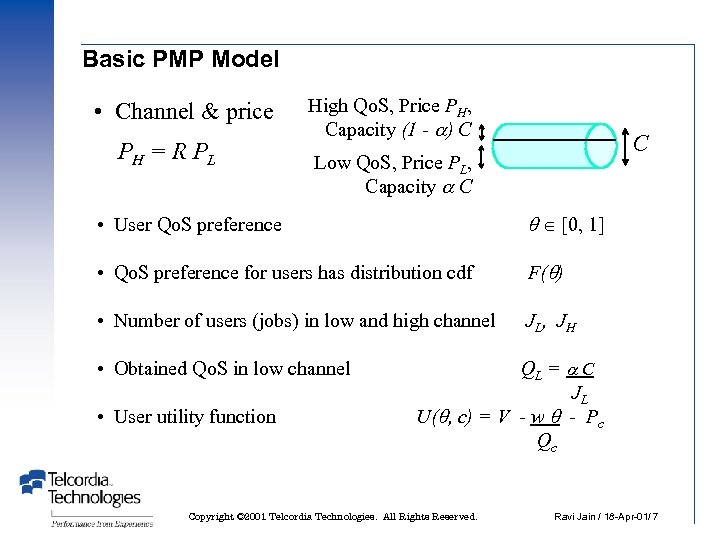 Basic PMP Model • Channel & price PH = R P L High Qo. S, Price PH, Capacity (1 - ) C C Low Qo. S, Price PL, Capacity C • User Qo. S preference [0, 1] • Qo. S preference for users has distribution cdf F( ) • Number of users (jobs) in low and high channel JL , JH • Obtained Qo. S in low channel • User utility function QL = C JL U( , c) = V - w - Pc Qc Copyright © 2001 Telcordia Technologies. All Rights Reserved. Ravi Jain / 18 -Apr-01/ 7
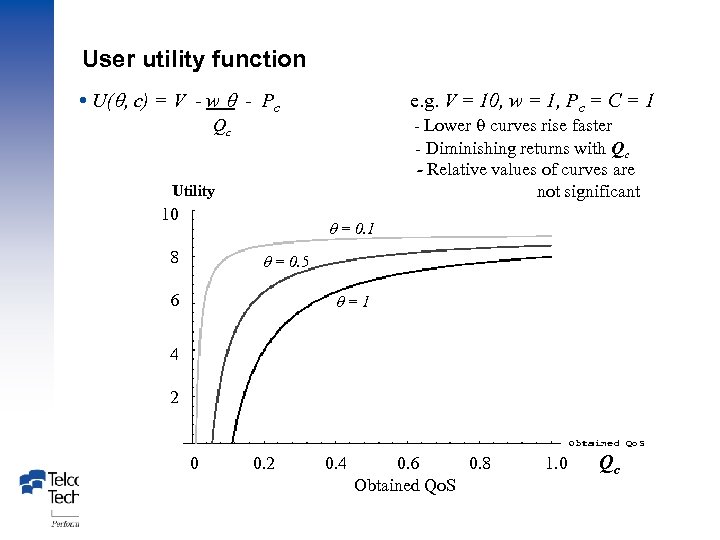 User utility function U( , c) = V - w - Pc e. g. V = 10, w = 1, Pc = C = 1 - Lower curves rise faster - Diminishing returns with Qc - Relative values of curves are not significant Qc Utility 10 = 0. 1 8 = 0. 5 =1 6 4 2 0 0. 2 0. 4 0. 6 0. 8 Obtained Qo. S Copyright © 2001 Telcordia Technologies. All Rights Reserved. 1. 0 Qc Ravi Jain / 18 -Apr-01/ 8
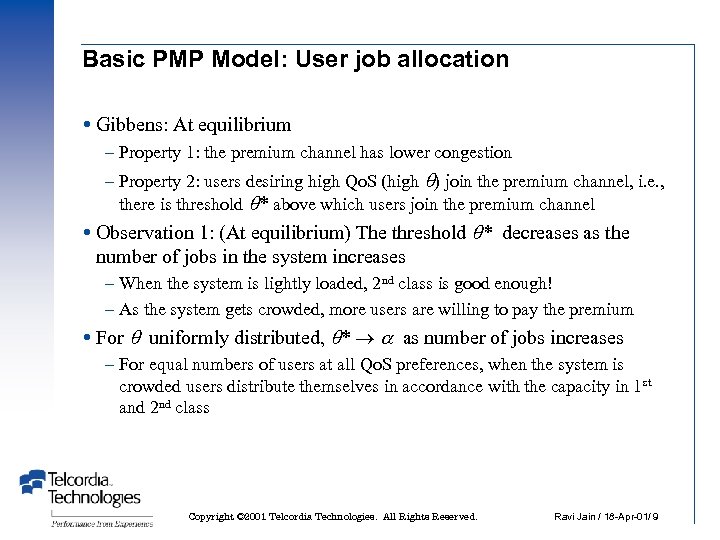 Basic PMP Model: User job allocation Gibbens: At equilibrium – Property 1: the premium channel has lower congestion – Property 2: users desiring high Qo. S (high ) join the premium channel, i. e. , there is threshold * above which users join the premium channel Observation 1: (At equilibrium) The threshold * decreases as the number of jobs in the system increases – When the system is lightly loaded, 2 nd class is good enough! – As the system gets crowded, more users are willing to pay the premium For uniformly distributed, * as number of jobs increases – For equal numbers of users at all Qo. S preferences, when the system is crowded users distribute themselves in accordance with the capacity in 1 st and 2 nd class Copyright © 2001 Telcordia Technologies. All Rights Reserved. Ravi Jain / 18 -Apr-01/ 9
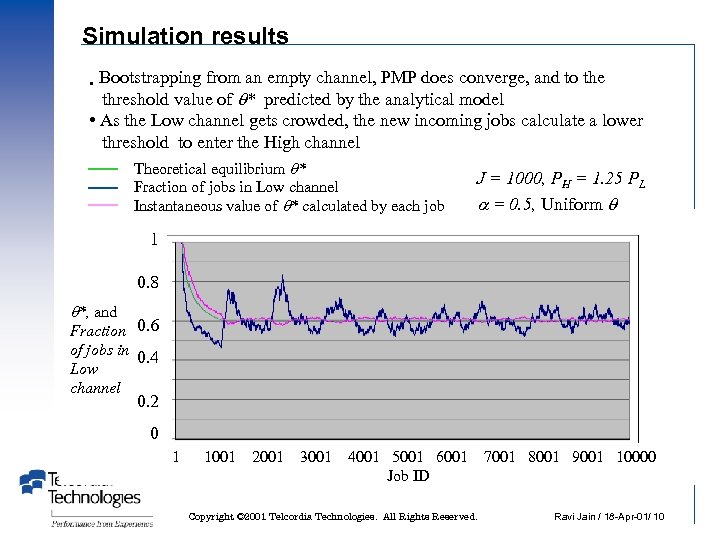 Simulation results Bootstrapping from an empty channel, PMP does converge, and to the threshold value of * predicted by the analytical model • As the Low channel gets crowded, the new incoming jobs calculate a lower threshold to enter the High channel • Theoretical equilibrium * Fraction of jobs in Low channel Instantaneous value of * calculated by each job J = 1000, PH = 1. 25 PL = 0. 5, Uniform 1 0. 8 *, and Fraction 0. 6 of jobs in 0. 4 Low channel 0. 2 0 1 1001 2001 3001 4001 5001 6001 Job ID Copyright © 2001 Telcordia Technologies. All Rights Reserved. 7001 8001 9001 10000 Ravi Jain / 18 -Apr-01/ 10
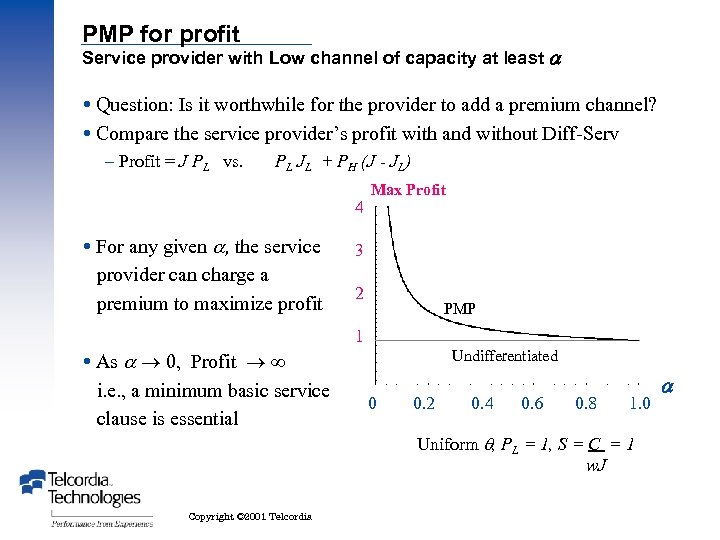 PMP for profit Service provider with Low channel of capacity at least Question: Is it worthwhile for the provider to add a premium channel? Compare the service provider’s profit with and without Diff-Serv – Profit = J PL vs. PL JL + PH (J - JL) 4 For any given , the service provider can charge a premium to maximize profit Max Profit 3 2 PMP 1 As 0, Profit i. e. , a minimum basic service clause is essential Undifferentiated 0 0. 2 0. 4 0. 6 0. 8 1. 0 Uniform , PL = 1, S = C = 1 w. J Copyright © 2001 Telcordia Technologies. All Rights Reserved. Ravi Jain / 18 -Apr-01/ 11
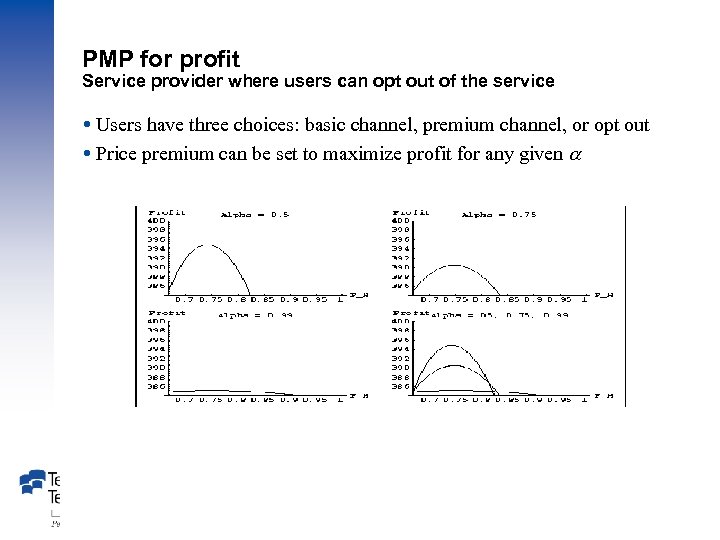 PMP for profit Service provider where users can opt out of the service Users have three choices: basic channel, premium channel, or opt out Price premium can be set to maximize profit for any given Copyright © 2001 Telcordia Technologies. All Rights Reserved. Ravi Jain / 18 -Apr-01/ 12
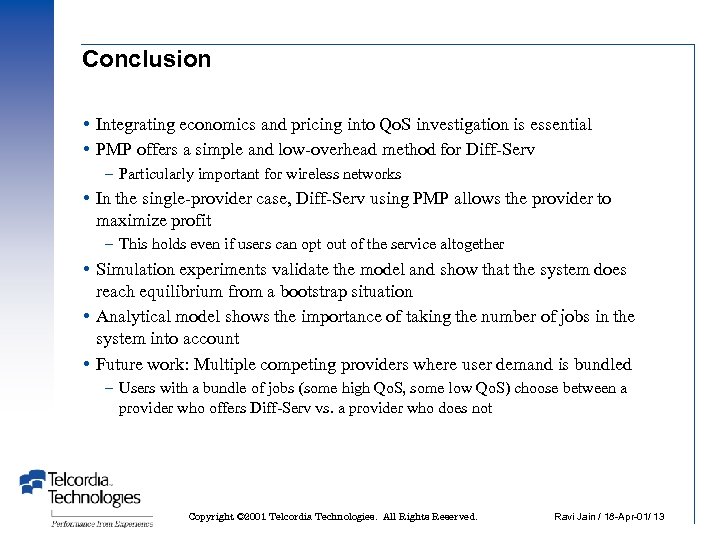 Conclusion Integrating economics and pricing into Qo. S investigation is essential PMP offers a simple and low-overhead method for Diff-Serv – Particularly important for wireless networks In the single-provider case, Diff-Serv using PMP allows the provider to maximize profit – This holds even if users can opt out of the service altogether Simulation experiments validate the model and show that the system does reach equilibrium from a bootstrap situation Analytical model shows the importance of taking the number of jobs in the system into account Future work: Multiple competing providers where user demand is bundled – Users with a bundle of jobs (some high Qo. S, some low Qo. S) choose between a provider who offers Diff-Serv vs. a provider who does not Copyright © 2001 Telcordia Technologies. All Rights Reserved. Ravi Jain / 18 -Apr-01/ 13