


 Скачать презентацию Parents vs TV L Quentin Dixon Harvard Graduate
603a88e914a5441a9a9327497070aedd.ppt
- Количество слайдов: 29
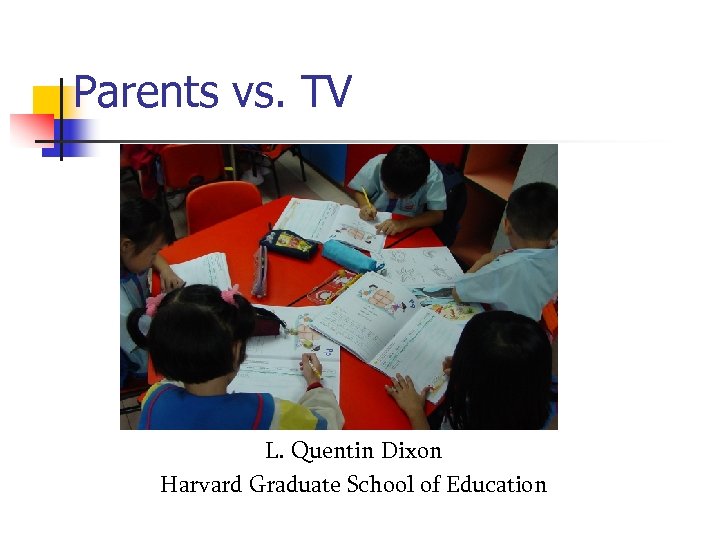 Parents vs. TV L. Quentin Dixon Harvard Graduate School of Education
 Parents vs. TV The Relative Importance of Caregiver Language versus TV Language in Predicting English Vocabulary Skills among Bilingual Kindergarten Children in Singapore
 Today’s Presentation n n n Why Singapore? Previous Research Questions Methods Results Discussion
 Why Singapore? http: //www. goway. com/orientasia/singapore/si_img/singapore_map. gif
 Why Singapore? n 3 major ethnic groups: n n n 77% Chinese 14% Malay 8% Indian 4 official languages: Mandarin, Malay, Tamil, & English Most families are not native-English speakers English is the medium of education n “Mother Tongue” is a required subject
 Why Singapore? http: //www. internationalreports. net/asiapacific/singapore/2002/images/Science. Students. jpg
 Why Singapore? n n Third International Math and Science Study (TIMSS) 1995 Third International Math and Science Study-Repeat (TIMSS-R) 1999 Reading Literacy Study 1991 Progress in Reading Literacy Study (PIRLS) 2001
 Previous Research: TV and L 1 vocabulary n n L 1 English-speaking children learned vocabulary presented through TV (Rice & Woodsmall, 1988) Viewing “Sesame Street” was correlated with vocabulary growth among L 1 Englishspeaking children (Rice, Huston, Truglio, & Wright, 1990).
 Previous Research: TV and L 2 vocabulary n n Home TV viewing significantly predicted Spanish-English bilingual children’s receptive and expressive English vocabulary at the beginning and end of kindergarten in the US (Uchikoshi, 2004). Dutch children learned L 2 vocabulary through viewing subtitled and unsubtitled English TV programs (Koolstra & Beentjes, 1999)
 Previous Research: TV and L 2 vocabulary n Frequency of TV viewing did not significantly predict English vocabulary of bilingual 2 -yearold children in the US (Patterson, 2002)
 Research Question n What is the role of caretaker language, TV language and mother tongue vocabulary in predicting English vocabulary of kindergarten pupils in Singapore?
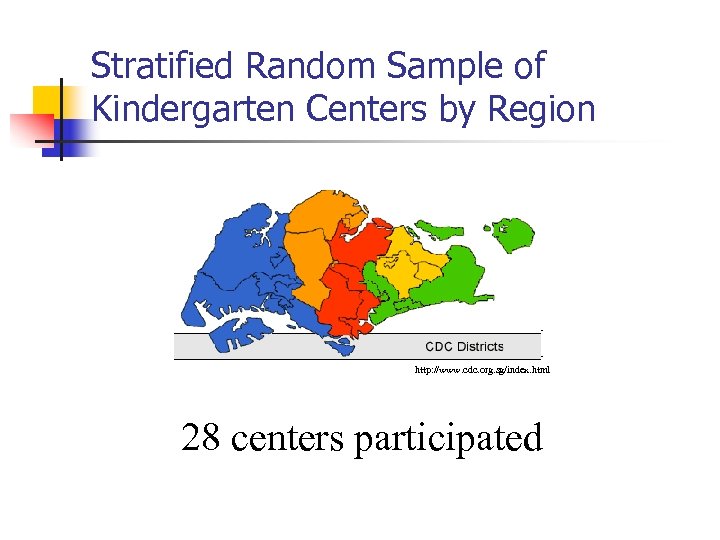 Stratified Random Sample of Kindergarten Centers by Region http: //www. cdc. org. sg/index. html 28 centers participated
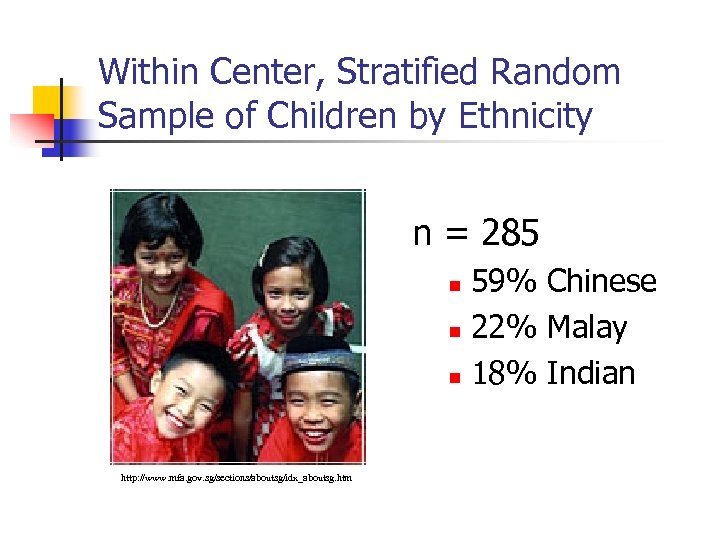 Within Center, Stratified Random Sample of Children by Ethnicity n = 285 59% Chinese n 22% Malay n 18% Indian n http: //www. mfa. gov. sg/sections/aboutsg/idx_aboutsg. htm
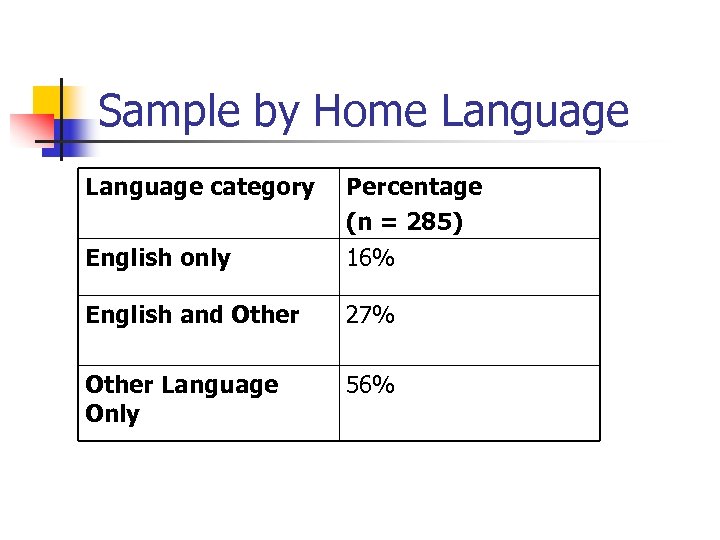 Sample by Home Language category English only Percentage (n = 285) 16% English and Other 27% Other Language Only 56%
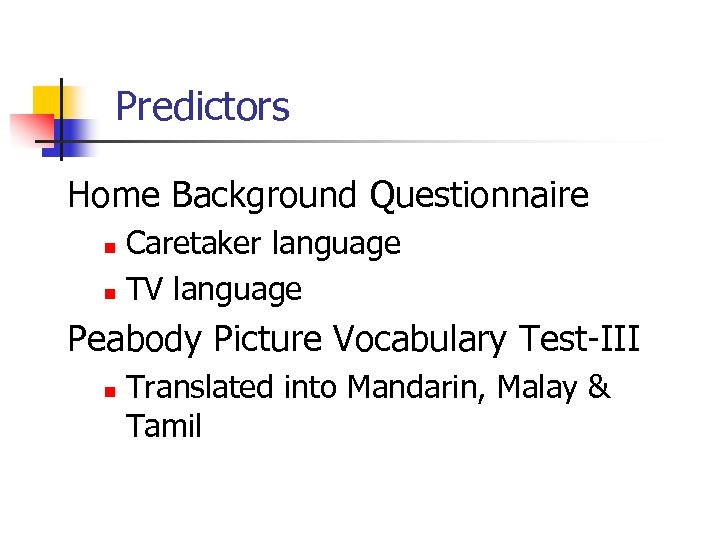 Predictors Home Background Questionnaire Caretaker language n TV language n Peabody Picture Vocabulary Test-III n Translated into Mandarin, Malay & Tamil
 Outcome Measures n Peabody Picture Vocabulary Test III (PPVT-III) in English
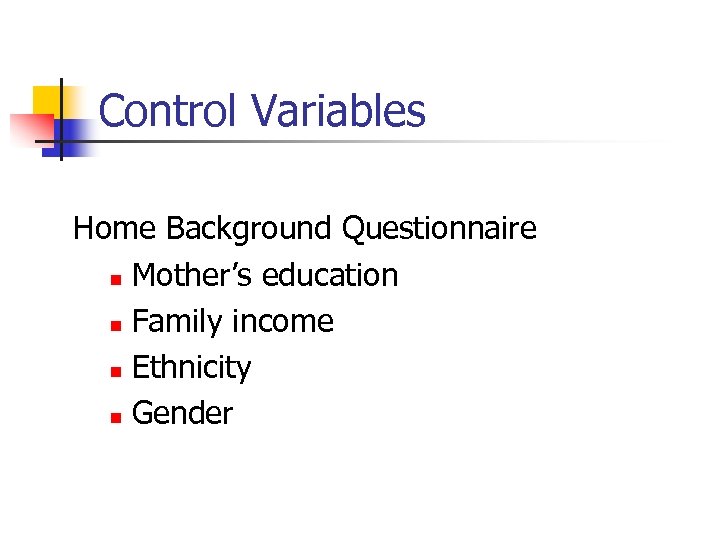 Control Variables Home Background Questionnaire n Mother’s education n Family income n Ethnicity n Gender
 Data Collection Procedures
 Data Collection Procedures n 6 local bilingual Research Assistants administered tests n n n Fluent Mandarin, Malay, & Tamil speakers Trained to administer child assessments All data were collected within a 3 -week period in July, 2003
 Results
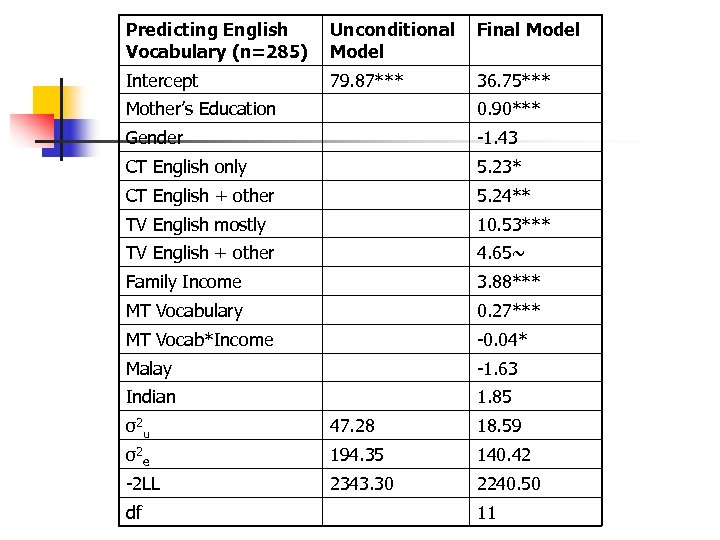 Predicting English Vocabulary (n=285) Unconditional Model Final Model Intercept 79. 87*** 36. 75*** Mother’s Education 0. 90*** Gender -1. 43 CT English only 5. 23* CT English + other 5. 24** TV English mostly 10. 53*** TV English + other 4. 65~ Family Income 3. 88*** MT Vocabulary 0. 27*** MT Vocab*Income -0. 04* Malay -1. 63 Indian 1. 85 σ2 u 47. 28 18. 59 σ2 e 194. 35 140. 42 -2 LL 2343. 30 2240. 50 df 11
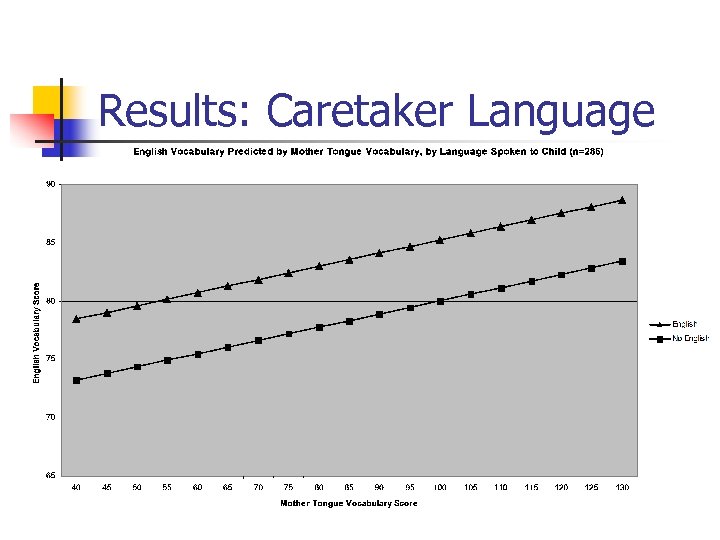 Results: Caretaker Language
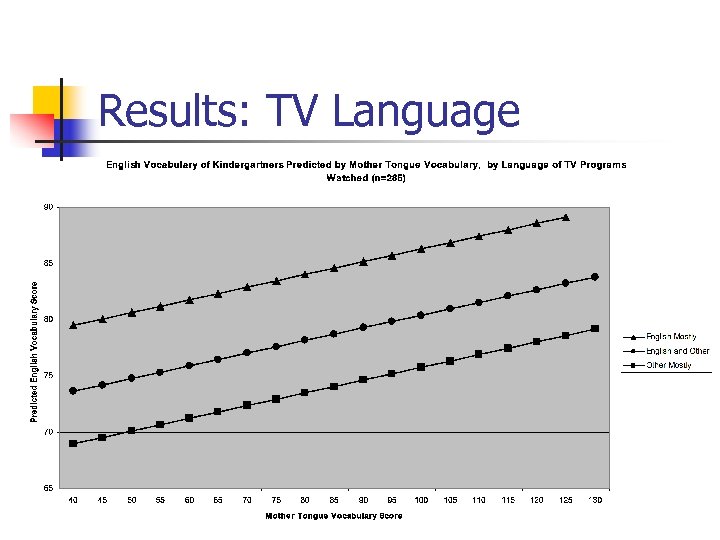 Results: TV Language
 Discussion n Supports studies that indicate children can learn vocabulary from TV (Uchikoshi, 2004; Koolstra & Beentjes, 1999; Rice, Huston, Truglio, & Wright, 1990; Rice & Woodsmall, 1988)
 Discussion Seems to contradict the finding that number of hours of TV viewing did not significantly predict bilingual children’s English vocabulary (Patterson, 2002) BUT Number of hours of TV viewing was not significant
 Limitations n n Correlational Parental report data
 Acknowledgements Catherine Snow Terry Tivnan Barbara Pan John Willett Spencer Research Training Grant
 References Koolstra, C. M. , & Beentjes, J. W. J. (1999). Children's vocabulary acquisition in a foreign language through watching subtitled television programs at home. Educational Technology Research and Development, 47(1), 51 -60. Patterson, J. L. (2002). Relationships of expressive vocabulary to frequency of reading and television experience among bilingual toddlers. Applied Psycholinguistics, 23(4), 493 -508. Rice, M. L. , Huston, A. C. , Truglio, R. , & Wright, J. (1990). Words from "Sesame Street": Learning vocabulary while viewing. Develomental Psychology, 26(3), 421 -428. Rice, M. L. , & Woodsmall, L. (1988). Lessons from television: Children's word learning when viewing. Child Development, 59, 420 -429.
 References Uchikoshi, Y. (2004). Development of early literacy skills of bilingual kindergarteners: An individual growth modeling approach. Harvard, Cambridge, MA.