


 Скачать презентацию Parents Experiences of the IY Parenting Programme A
221f5510f0eb73759554ae39ccdf1689.ppt
- Количество слайдов: 24
 Parents’ Experiences of the IY Parenting Programme: A qualitative study Mairéad Furlong Dr. Sinéad Mc. Gilloway
 Overview Aims of the qualitative study Methodology Results Conclusions and implications Incredible. Years Ireland Study
 Aims of the qualitative study To assess the experiences of parents involved in the Incredible Years’ (IY) BASIC parenting programme Part of a wider process evaluation Specific objectives of the sub-study: (1) to explore the meaning of parenting a child with conduct problems prior to intervention; (2) to assess the experience of training for parents – most helpful aspects, challenges involved, impact of programme on their lives; and (3) to investigate the experiences of the small number of parents who dropped out early from the programme Incredible. Years Ireland Study
 Method Interviewed 32 parents (30 mothers and 2 fathers) of young children aged 3 -7 years with conduct problems 7/32 were parents who dropped out early from the programme Purposive sampling method The interviews were analysed using Interpretative Phenomemological Analysis (Smith & Osborn, 2003) Incredible. Years Ireland Study
 Results Key themes included: (1) Parents’ perceptions about how the programme works (2) Challenges involved in learning the new skills and the impact of the intervention on their lives (3) Experiences of parents who dropped out early from the programme Analysis also explored: (a) pre-intervention parenting experiences; (b) the number of positive outcomes from taking part in the IY programme Incredible. Years Ireland Study
 Mother (5 -year-old boy): “I feel like I’m closer to him and I feel like he’s actually communicating with me now whereas before he was just lost in his own little world, you know. So it made me closer to him and it made me just get past that barrier that he wasn’t letting me past (tremor in voice)…even if the tantrums hadn’t improved, that alone was worth to me a million quid because I had a child who wasn’t even like my own child. He was so distant and I couldn’t get to him, no matter what I did, I couldn’t get to him. And now I feel I get to him. I know I do…And that’s more than I’d thought I’d get out of it (the course)” Incredible. Years Ireland Study
 (1) Parents’ perceptions about how the course works Group related aspects of the course Learned skills and principles Group related components included: The unbiased or non-judgmental support helped to dispel/normalise feelings of guilt and isolation The experiential and collaborative learning format of the course – homework and feedback The sessions were enjoyable The advice and support from the mid-week follow up calls Incredible. Years Ireland Study
 The provision of crèche/child-care facilities Mother (4 -year-old boy): “I thought they (the facilitators/group leaders) were brilliant…You just felt that you could pick up and ring them at any stage and say, ‘Look, this isn’t working for me. I don’t know what to do’. It was like an extra support…It wasn’t just like a class where you were given the work and you go home. You knew that they were there for you. I don’t think the course would have worked if it hadn’t been for them…” Incredible. Years Ireland Study
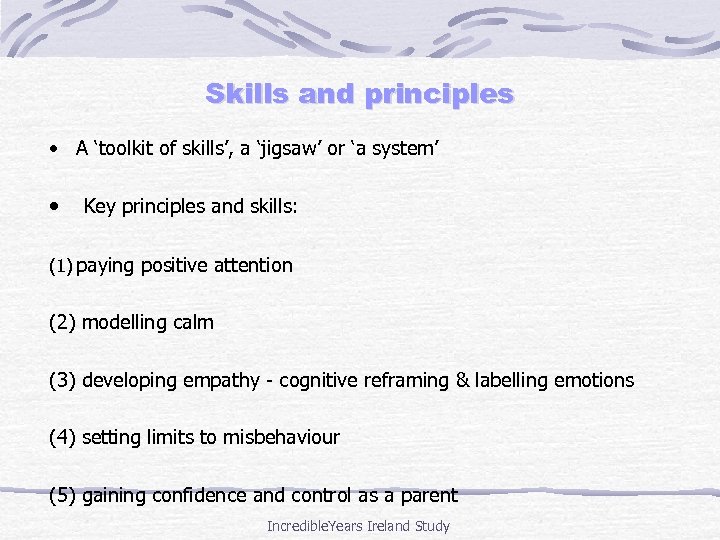 Skills and principles • A ‘toolkit of skills’, a ‘jigsaw’ or ‘a system’ • Key principles and skills: (1) paying positive attention (2) modelling calm (3) developing empathy - cognitive reframing & labelling emotions (4) setting limits to misbehaviour (5) gaining confidence and control as a parent Incredible. Years Ireland Study
 (1) Paying positive attention Shift mindset from focussing on the child’s negative behaviour towards looking for the good in their child, through praise and play Surprise and revelation – pre-treatment saw the child as being ‘born bold’ or a ‘demon’ New style of play (consistent and child-led) and praising specific behaviours => closer parent-child relationship, increased co-operation with the parent (2) Modelling calm Child imitates the behaviour of those around him Incredible. Years Ireland Study
 Learning to step back, calm themselves down and problem solve a very effective skill; required much patience and perseverance: Mother (5 -year-old girl): “She doesn’t end up as upset because I don’t end up giving out to her…that’s why she’s happier and more confident. ” (3) Developing empathy understand the feelings underlying the child’s negative behaviours, e. g. frustration or anxiety Identifying triggers/antecedents of emotions Label the emotion - difficult Incredible. Years Ireland Study
 Understand child has developmental problem vs. being ‘mean’ Children have different temperaments => some parents have a more difficult task than others (4) Limit setting Pre-programme - did not believe in rules, should be ‘child’s friend’, let the child make decisions Learned the benefits of IY techniques, such as time-out, consequences, clear commands, house-rules and ‘ignore’ Children loved rules and boundaries, helped them feel secure; parents feel more respected by their children Incredible. Years Ireland Study
 Mother (6 -year-old boy): “I always thought that you shouldn’t be too bossy and that you shouldn’t set up all these rules, that to get on with them that you needed to be more at their level and let them make decisions and let them nearly make the rules as well, which wasn’t working because they’re two kids. I thought I was being nice doing it but that’s where I was going wrong. They’re happier with the boundaries…It’s much better now because they know exactly where they stand. ” Mother (4 -year-old boy): “Like he used to be crazy in the mornings. I’d open the hall door and he’d go running off and I’d be screaming ‘Get into the car or I’ll murder you’. And then simple thing like before you open the hall door sit down to their level and say ‘We’re going to go to school now. What I need for you to do for me now is…and it works. ” Incredible. Years Ireland Study
 (5) Confidence and control in parenting role ‘Like a jigsaw, it all clicked into place’ ‘System’ in place => believed they could cope and problemsolve around difficulties Other coping resources: (1) learning to affirm themselves as parents; and (2) obtaining wider family support as a result of child’s improved behaviour. ‘Jigsaw’ image – skills easier to understand by the end but many difficulties and puzzlements throughout the course Incredible. Years Ireland Study
 (2) An obstacle course: Challenges along the way (1) Group related concerns Concerns that personal information would be disclosed within the local community; also ‘disruptive group members’ Mixed reviews for vignettes, role-plays and stickers (2) Difficulties with positive attention Puzzled why negative behaviour was not being tackled directly; found the idea of positive attention unrealistic… Incredible. Years Ireland Study
 Mother (4 -year-old girl): “When you’ve actually done the course, you understand that you need to start from the bottom (of the pyramid) and build things up. I think, at the start, that it comes across as a bit fluffy…I wasn’t sure at the beginning that they would be dealing with more of the nitty-gritty…the time-out and the discipline. The positive thing doesn’t make much sense at first. ” Discomfort that praise and rewards might cause their children to become overbearing and arrogant: Mother (6 -year-old girl): “It’s a very ‘Irish’ thing not to give or accept praise…You know there is thing: are you making them bigheaded, are you making them cocky, are you giving them too much confidence? But actually it’s made them the opposite…But at first when you praise them, I found it really odd, awkward. ” Incredible. Years Ireland Study
 (3) Childhood rebellion and sibling misbehaviour Limit setting skills very difficult to implement due to the child’s resistance and rebellion Also coping with emerging misbehaviour of siblings Felt like giving up – exhausted (4) Conflict with partner Increased conflict with partners over the introduction of new techniques in the home Many of the conflicts resolved themselves once partners witnessed the benefits of the programme for themselves Incredible. Years Ireland Study
 (5) Dealing with unresolved childhood issues Many parents (n = 10) reported that the course had caused them to reflect on their own experience of being parented Two participants felt so overwhelmed that they chose to attend counselling Mother (6 -year-old girl): “I think I would have given up the course if I hadn’t had the counsellor because it was too much at one point…And I think a lot of parents there haven’t had the perfect upbringing and I think there’s certain things that could come up out of the course that could upset a lot of people. ” Incredible. Years Ireland Study
 (6) Ongoing behavioural problems and ‘hard work’ of skills At a reduced level – difficulties related to social skills and trying to generalise the improved conduct to school environments ‘Hard work’ (requiring organisation and commitment); concern that they may slip back into their old parenting patterns Incredible. Years Ireland Study
 (7) Struggles of inhospitable environment Mother (4 -year-old girl): “Especially as we used to say, the neighbourhood where we’re from, X street, it’s very hard to raise your children in. This place is overrun with drugs and gangs, whatever. It is a horrible place to raise your children. I don’t personally allow my children out to play unless I’m there to supervise because there’s children and they’re as young as four and five and they are bullies. It is hard. . And like for us to be able to come this far, living in neighbourhood like this and raising our children the way we are, we are doing good because we’re not following the example and just letting the children run out, do you know what I mean? ” Incredible. Years Ireland Study
 (3) Experiences of ‘drop-out’ parents 7 parents interviewed > less than 5 sessions completed Practical or circumstantial reasons (4 parents) (e. g. starting work, falling seriously ill, illness in the family). Alternative intervention (1 parent) 2 parents – course was not what they expected (esp. positive attention). Found course patronising and threatening. Isolated from other parents 5/7 parents – very concerned about child’s behaviour, using other psychological services. 2/7 parents reported that their child’s behaviour had dramatically improved Incredible. Years Ireland Study
 Conclusion and implications Key elements of programme success similar to other studies (e. g. Webster-Stratton et al. 1996; Patterson et al. 2005) The challenge of negotiating various setbacks both throughout and beyond the course are also consistent with other research (e. g. Webster-Stratton et al. 1996; Kelleher & Mc. Gilloway, 2006) Discomfort with the group process and the role of group facilitators in handling any potentially threatening or unpleasant aspects of group participation (e. g. stickers) Discomfort and disbelief that the idea of positive attention could work has not been reported in other qualitative studies Incredible. Years Ireland Study
 Factors: (1) culture of unease around praise in Ireland; and (2) historically, punitive parenting practices may have been common in Ireland (e. g. 10 parents within the present study alluded to their ‘horrible’ experience of being parented) Additional supports may be required for those parents who were affected by the course and had to seek counselling for their own experience of being parented The challenge to be an effective parent in an inhospitable environment is considerable Findings provide important insights into the experiences of Irish parents taking part in the IY parenting programme and should help to inform the future delivery of the programme in an Irish context Incredible. Years Ireland Study
 www. iyirelandstudy. ie