 Скачать презентацию Parental background and young adults housing outcomes in
8ba6c4329988c88ad53e7e5d2bb44ed5.ppt
- Количество слайдов: 15



Parental background and young adults’ housing outcomes in England Wales, 1971 -2011 Rory Coulter (rcc 46@cam. ac. uk) SLLS Annual Conference, Dublin, 19/10/2015
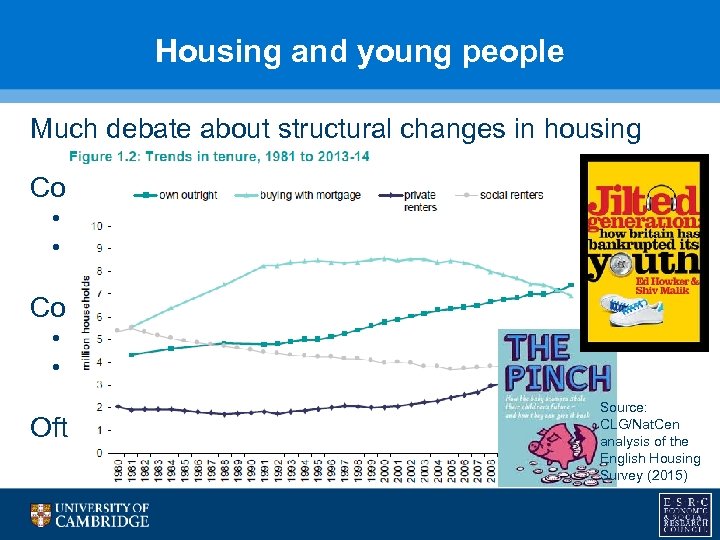
Housing and young people Much debate about structural changes in housing Considerable focus on young adults • Falling ownership and greater private renting • Boomerang children, sharing and ‘doubling up’ Concern about social implications of trends • Living conditions, security and mobility • Costs and wealth (£ 3. 5 tn in property) Often focus on cohort inequalities Source: CLG/Nat. Cen analysis of the English Housing Survey (2015)
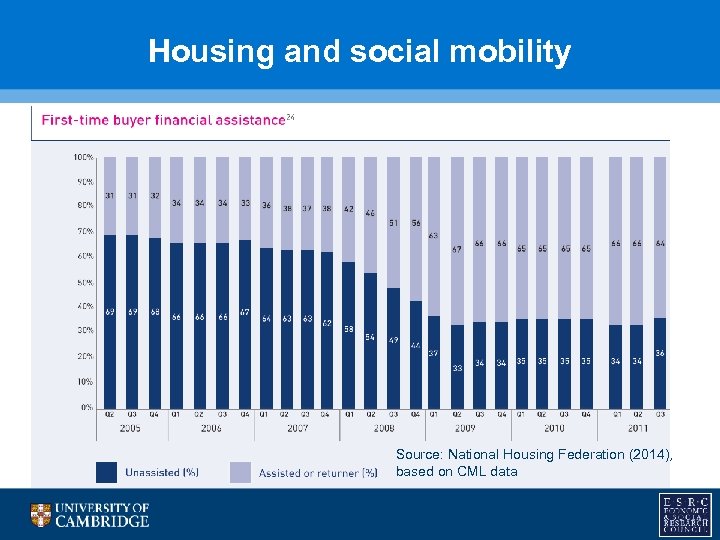
Housing and social mobility Trends also matter for social mobility • ‘Linked lives’ of parents and children Evidence growing difficulty of accessing ownership increasing importance of parental assistance Fear lifting ownership out of reach for young people who cannot draw on parental help • Intergenerational transmission of (dis)advantage in housing system deepening over time Source: National Housing Federation (2014), based on CML data
Research question RQ: How is parental housing tenure associated with young adults’ housing outcomes aged 30 -34, and has this association changed over time? Comparents who owned with social tenants Begin with bivariate analysis then models • Test tenure effects in each cohort after controlling for: (i) life course development (family, education, work etc) (ii) housing market conditions (prices, tenure mix) (iii) other parental attributes (class, family structure)
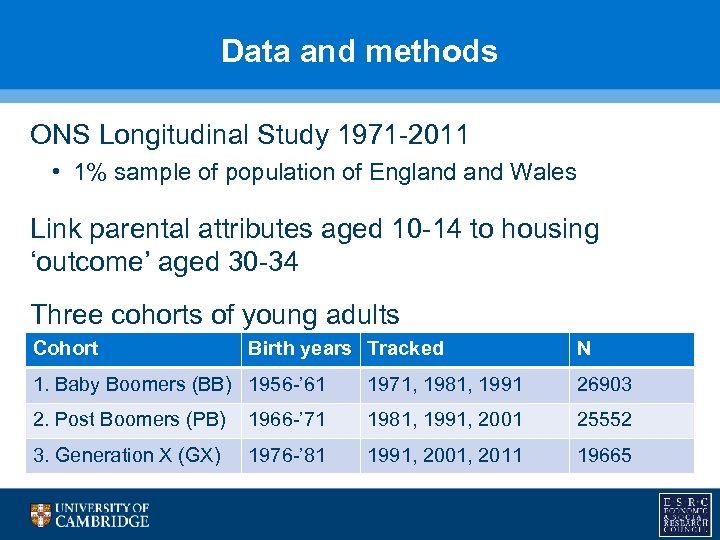
Data and methods ONS Longitudinal Study 1971 -2011 • 1% sample of population of England Wales Link parental attributes aged 10 -14 to housing ‘outcome’ aged 30 -34 Three cohorts of young adults Cohort Birth years Tracked N 1. Baby Boomers (BB) 1956 -’ 61 1971, 1981, 1991 26903 2. Post Boomers (PB) 1966 -’ 71 1981, 1991, 2001 25552 3. Generation X (GX) 1976 -’ 81 1991, 2001, 2011 19665
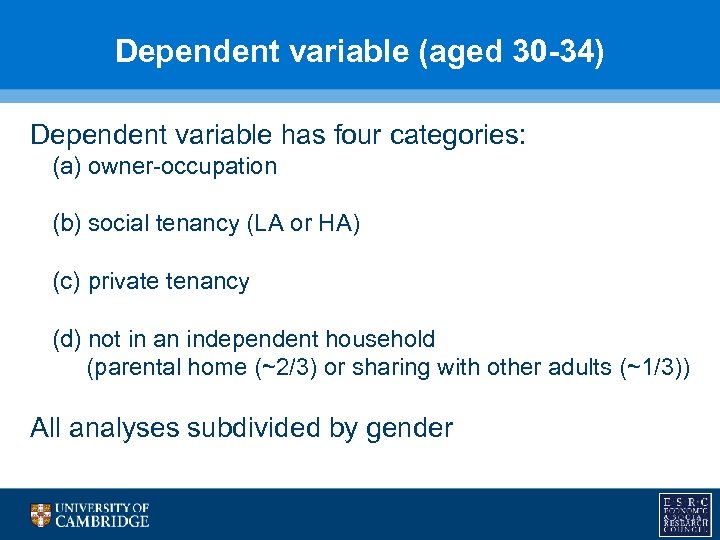
Dependent variable (aged 30 -34) Dependent variable has four categories: (a) owner-occupation (b) social tenancy (LA or HA) (c) private tenancy (d) not in an independent household (parental home (~2/3) or sharing with other adults (~1/3)) All analyses subdivided by gender
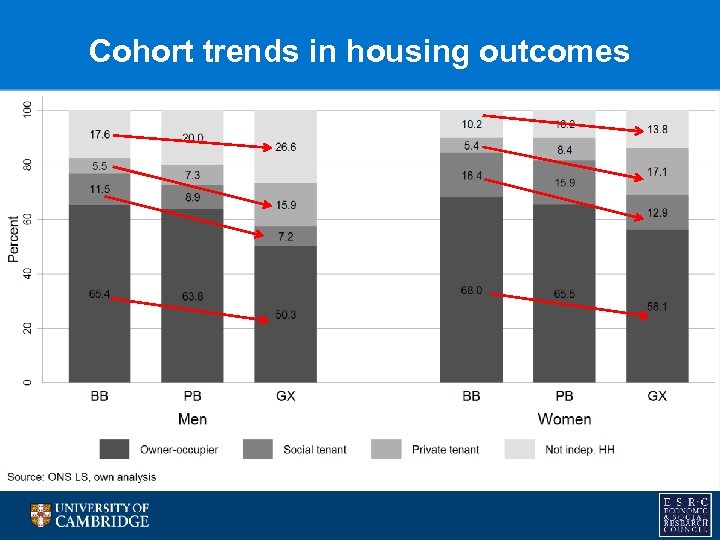
Cohort trends in housing outcomes
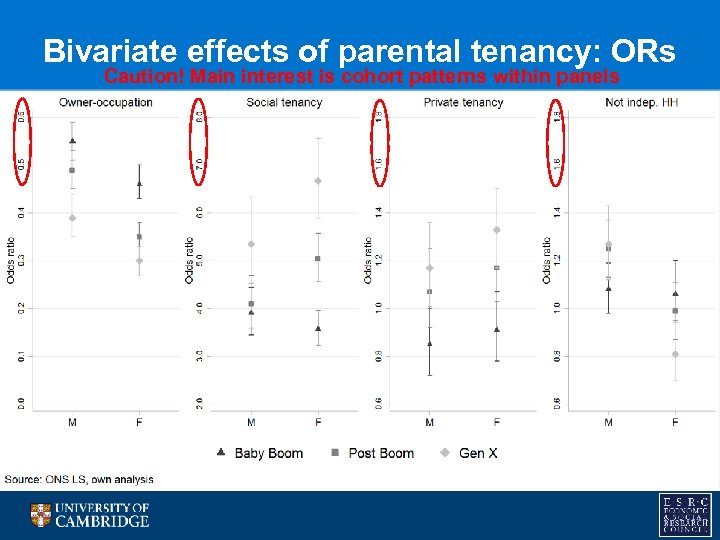
Bivariate effects of parental tenancy: ORs Caution! Main interest is cohort patterns within panels
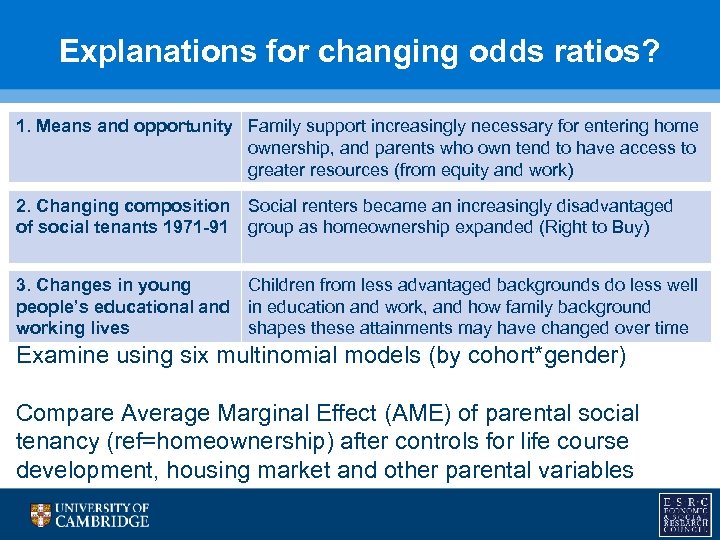
Explanations for changing odds ratios? 1. Means and opportunity Family support increasingly necessary for entering home ownership, and parents who own tend to have access to greater resources (from equity and work) 2. Changing composition Social renters became an increasingly disadvantaged of social tenants 1971 -91 group as homeownership expanded (Right to Buy) 3. Changes in young Children from less advantaged backgrounds do less well people’s educational and in education and work, and how family background working lives shapes these attainments may have changed over time Examine using six multinomial models (by cohort*gender) Compare Average Marginal Effect (AME) of parental social tenancy (ref=homeownership) after controls for life course development, housing market and other parental variables
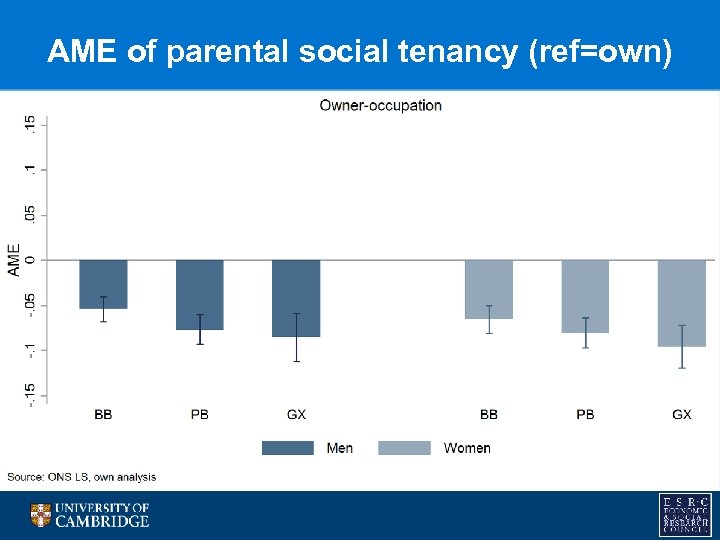
AME of parental social tenancy (ref=own)
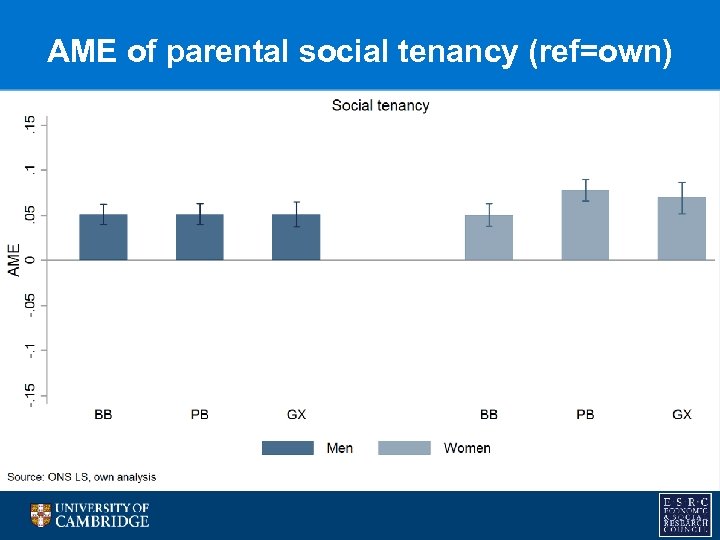
AME of parental social tenancy (ref=own)
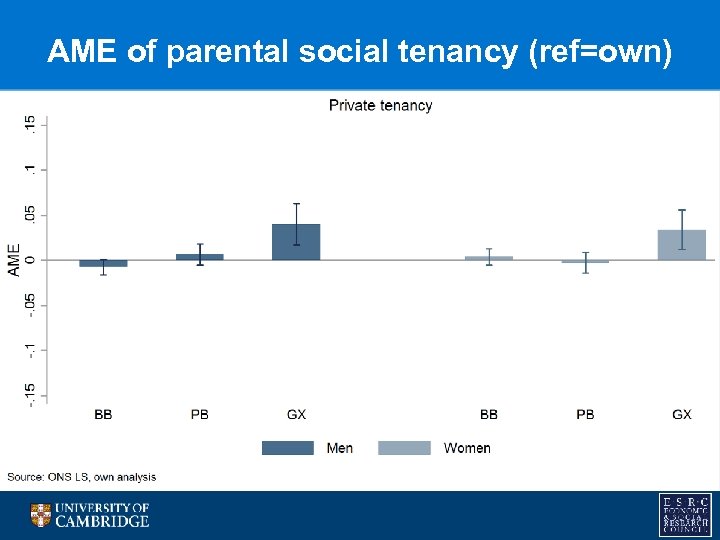
AME of parental social tenancy (ref=own)
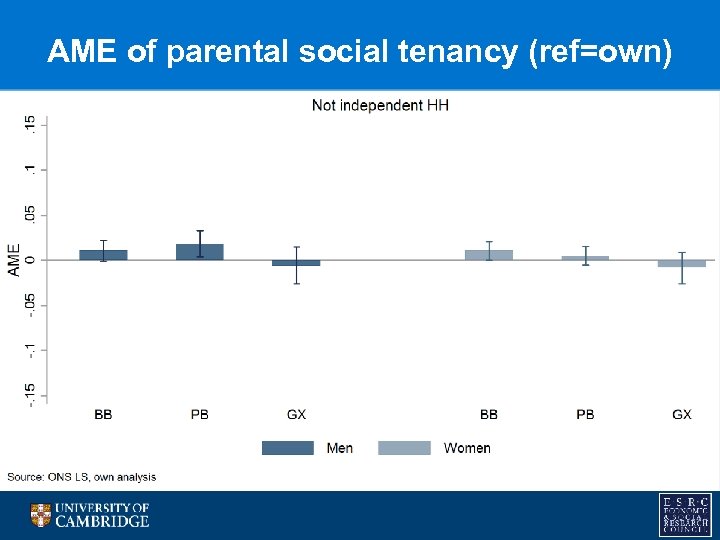
AME of parental social tenancy (ref=own)
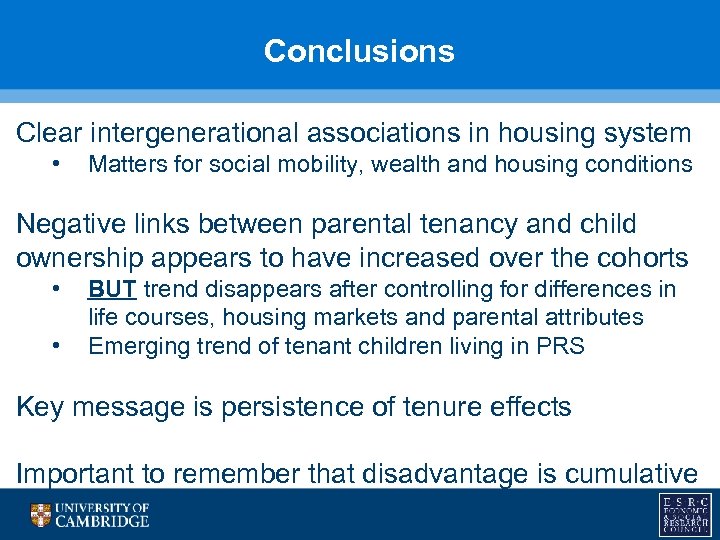
Conclusions Clear intergenerational associations in housing system • Matters for social mobility, wealth and housing conditions Negative links between parental tenancy and child ownership appears to have increased over the cohorts • • BUT trend disappears after controlling for differences in life courses, housing markets and parental attributes Emerging trend of tenant children living in PRS Key message is persistence of tenure effects Important to remember that disadvantage is cumulative
Acknowledgements This research is supported by an Economic and Social Research Council Future Research Leaders award [ES/L 0094981/1]. Additional financial support has been provided by the Isaac Newton Trust. The permission of the Office for National Statistics to use the Longitudinal Study is gratefully acknowledged, as is the help provided by staff of the Centre for Longitudinal Study Information & User Support (Ce. LSIUS). Ce. LSIUS is supported by the ESRC Census of Population Programme under project ES/K 000365/1. I bear sole responsibility for all analyses and interpretations of the data. Census output is Crown copyright and is reproduced with the permission of the Controller of HMSO and the Queen's Printer for Scotland.
Скачать презентацию Parental background and young adults housing outcomes in
8ba6c4329988c88ad53e7e5d2bb44ed5.ppt