 Скачать презентацию Парасексуальный цикл у дрожжей 1 Mitotic recombination
дрожжи - тип спаривания-12-11.ppt
- Количество слайдов: 63



Парасексуальный цикл у дрожжей 1
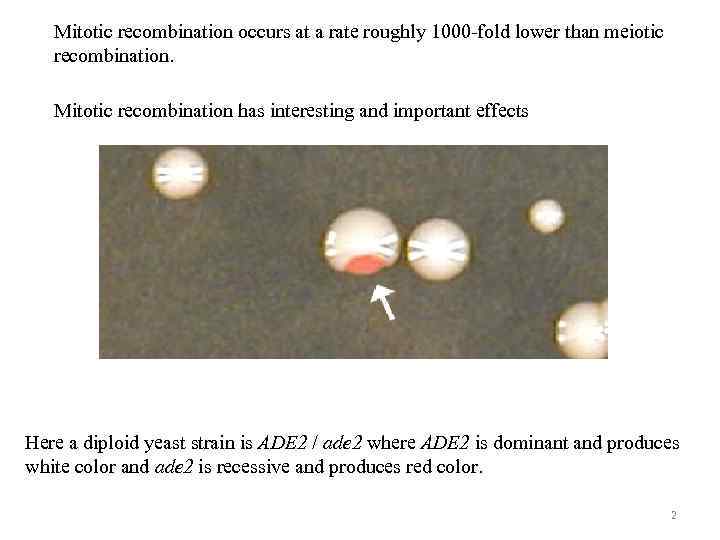
Mitotic recombination occurs at a rate roughly 1000 -fold lower than meiotic Mitotic Recombination and Genetic Mosaics recombination. Mitotic recombination has interesting and important effects Here a diploid yeast strain is ADE 2 / ade 2 where ADE 2 is dominant and produces white color and ade 2 is recessive and produces red color. The red sector is due to a mitotic cross over early in the creation of the colony. 2
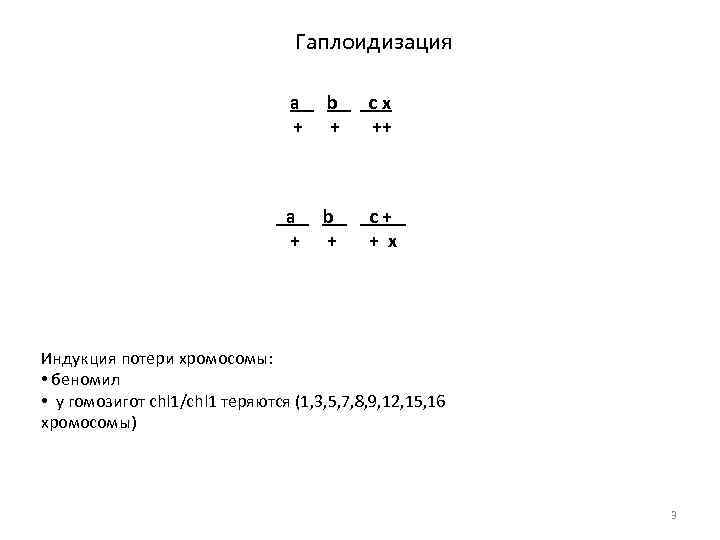
Гаплоидизация a + b + cx ++ a + b + c+ + x Индукция потери хромосомы: • беномил • у гомозигот chl 1/chl 1 теряются (1, 3, 5, 7, 8, 9, 12, 15, 16 хромосомы) 3
Митотический кроссинговер 4
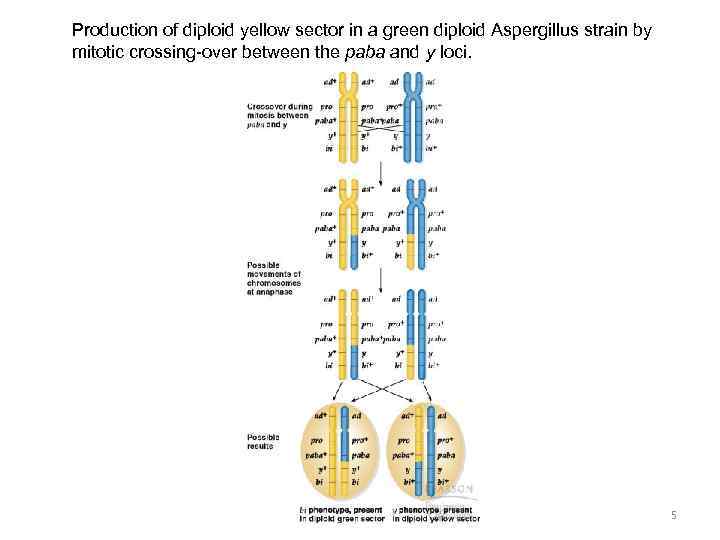
Production of diploid yellow sector in a green diploid Aspergillus strain by mitotic crossing-over between the paba and y loci. 5
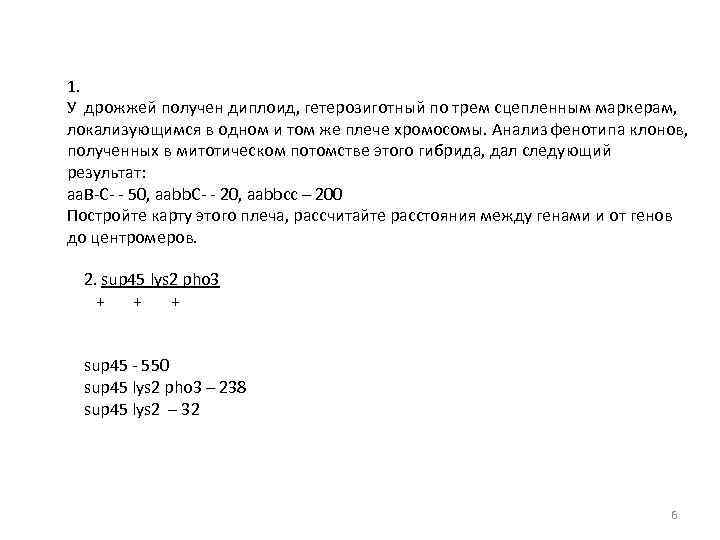
1. У дрожжей получен диплоид, гетерозиготный по трем сцепленным маркерам, локализующимся в одном и том же плече хромосомы. Анализ фенотипа клонов, полученных в митотическом потомстве этого гибрида, дал следующий результат: aa. B-C- - 50, aabb. C- - 20, aabbcc – 200 Постройте карту этого плеча, рассчитайте расстояния между генами и от генов до центромеров. 2. sup 45 lys 2 pho 3 + + + sup 45 - 550 sup 45 lys 2 pho 3 – 238 sup 45 lys 2 – 32 6
7
8
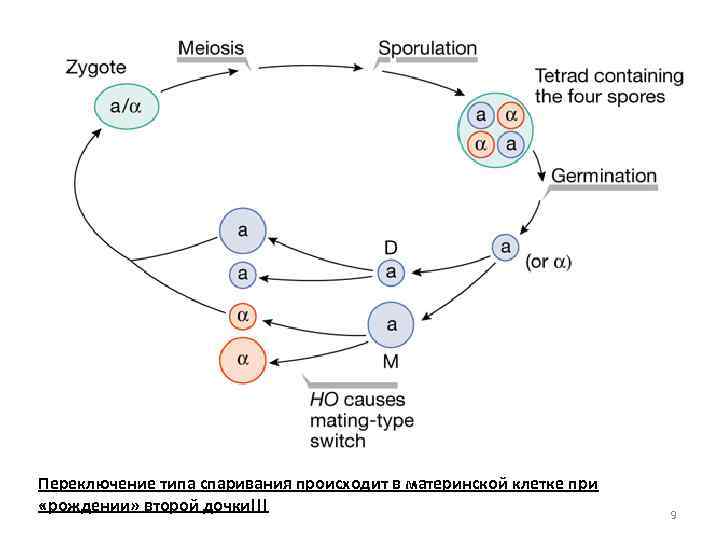
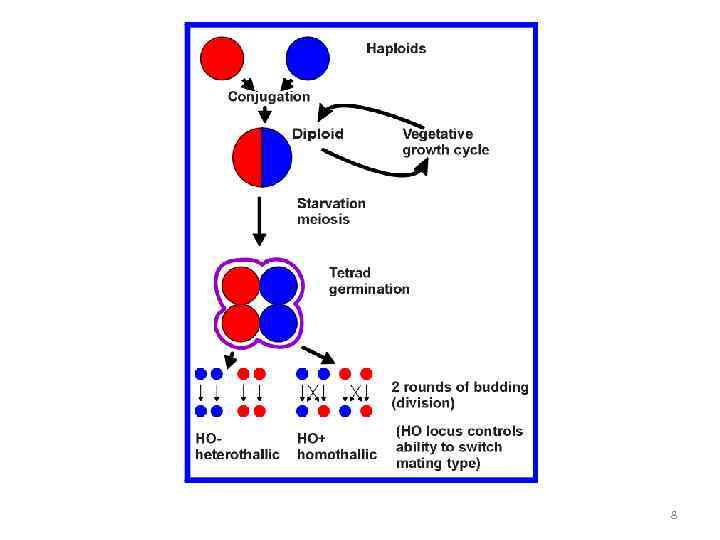
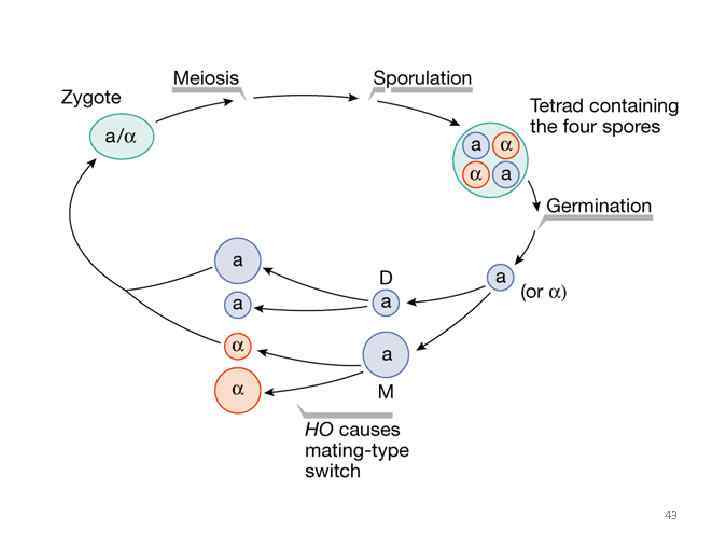
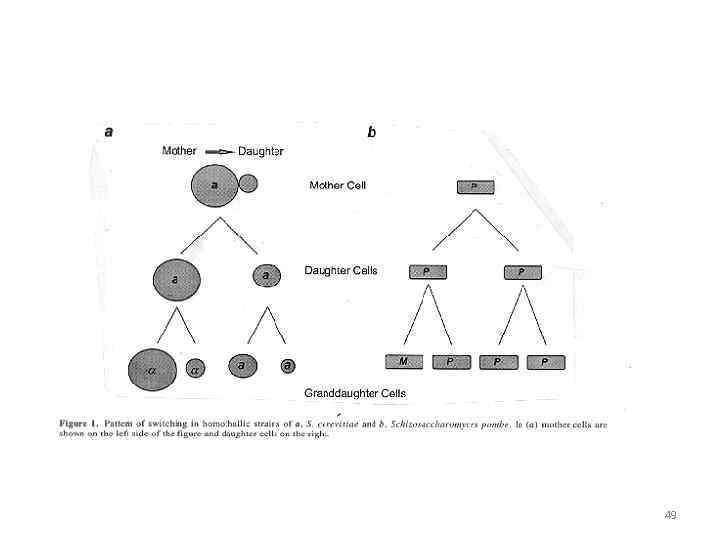
Переключение типа спаривания происходит в материнской клетке при «рождении» второй дочки!!! 9

Southern blot analysis • • The MATalpha allele was cloned by complementation of a MATalpha-, HO- yeast mutant. This was used as a probe on Southern blots of yeast DNA to investigate the structures of the MAT, HMLalpha and HMRa loci: The identity of all these genes was confirmed by cloning and sequencing. The experiment shows that the MAT locus, which is expressing the genetic information in it, changes in length between a and alpha forms, but the silent HMLalpha and HMRa loci stay the same. 10

Southern blot 11
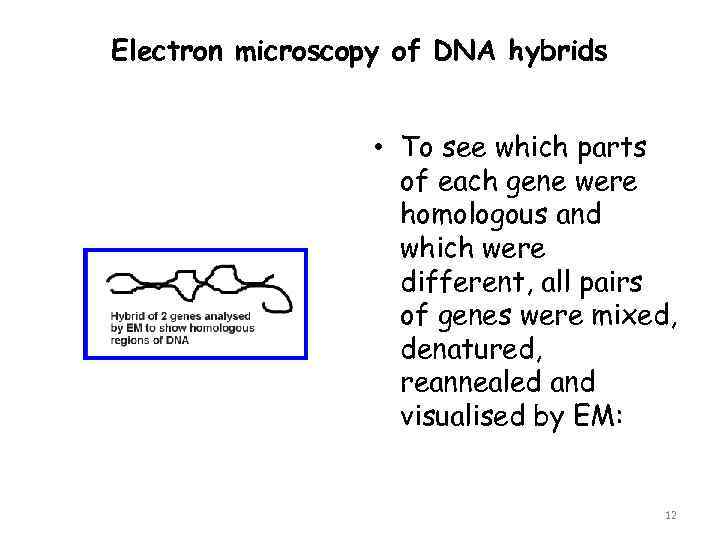
Electron microscopy of DNA hybrids • To see which parts of each gene were homologous and which were different, all pairs of genes were mixed, denatured, reannealed and visualised by EM: 12
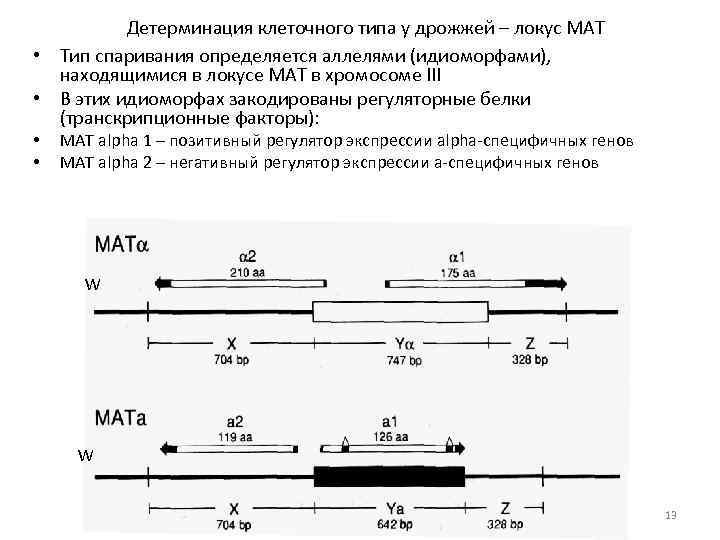
Детерминация клеточного типа у дрожжей – локус МАТ • Тип спаривания определяется аллелями (идиоморфами), находящимися в локусе МАТ в хромосоме III • В этих идиоморфах закодированы регуляторные белки (транскрипционные факторы): • • МАТ alpha 1 – позитивный регулятор экспрессии alpha-специфичных генов МАТ alpha 2 – негативный регулятор экспрессии а-специфичных генов W W 13
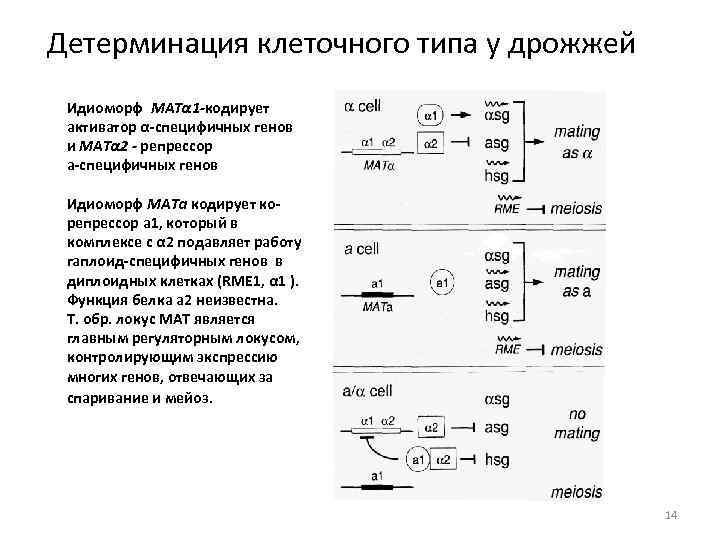
Детерминация клеточного типа у дрожжей Идиоморф MATα 1 -кодирует активатор α-специфичных генов и MATα 2 - репрессор а-специфичных генов Идиоморф MATa кодирует корепрессор a 1, который в комплексе с α 2 подавляет работу гаплоид-специфичных генов в диплоидных клетках (RME 1, α 1 ). Функция белка a 2 неизвестна. Т. обр. локус МАТ является главным регуляторным локусом, контролирующим экспрессию многих генов, отвечающих за спаривание и мейоз. 14
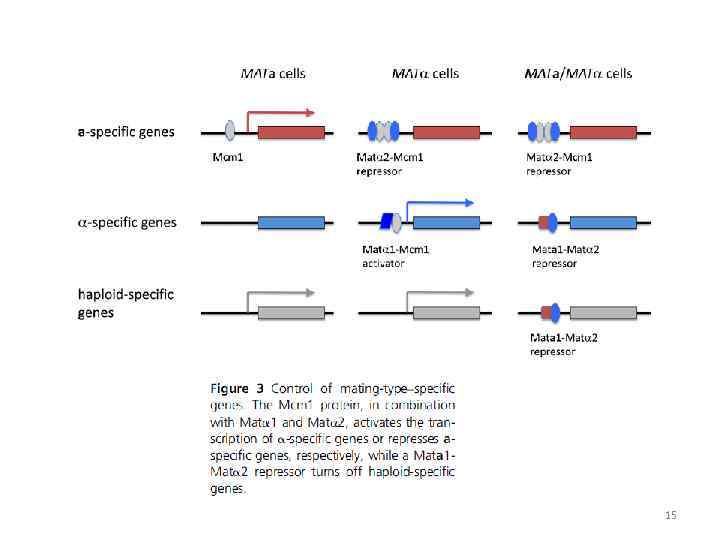
15
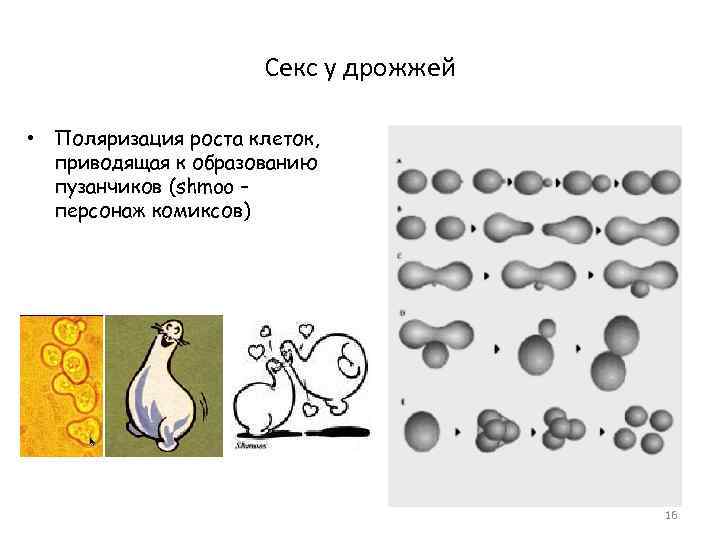
Секс у дрожжей • Поляризация роста клеток, приводящая к образованию пузанчиков (shmoo – персонаж комиксов) 16
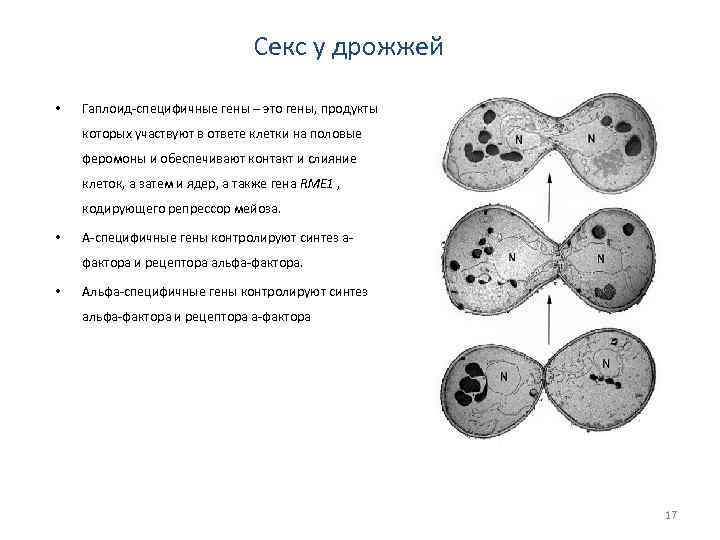
Секс у дрожжей • Гаплоид-специфичные гены – это гены, продукты которых участвуют в ответе клетки на половые феромоны и обеспечивают контакт и слияние клеток, а затем и ядер, а также гена RME 1 , кодирующего репрессор мейоза. • A-специфичные гены контролируют синтез афактора и рецептора альфа-фактора. • Альфа-специфичные гены контролируют синтез альфа-фактора и рецептора а-фактора 17
18
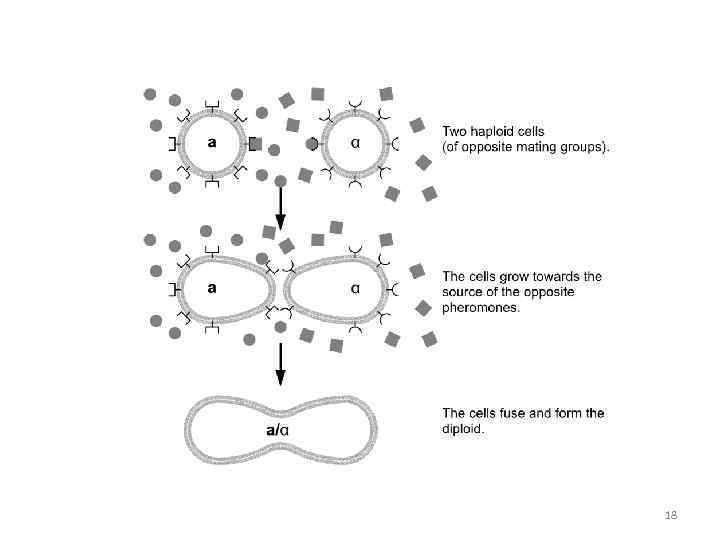
Феромоны дрожжей • Олигопептиды, синтез которых находится под контролем двух пар генов ( MFα 1, MFα 2, MFa 1, MFa 2) : • Феромон альфа – 13 аминокислот, формируется из более длинного предшественника, • феромон а – 12 аминокислотный липопептид. • Рецепторы феромонов – синтезируются под контролем генов STE ( STE 2 – рецептор альфа-феромона, STE 3 – рецептор аферомона. • Рецепторы феромонов – семейство трансмембранных рецепторов, имеют N-терминальный внеклеточный домен, 7 трансмембранных гидрофобных альфа-спиралей и длинный внутриклеточный С-терминальный хвост. 19
Передача сигнала • Феромон соединяется с гетеротримерным G-белком • Происходит изменение конформации рецептора • Субъединицы βγ освобождаются и стимулируют каскад протеинкиназ – Ser-Thr - Ste 20 и далее – каскад МАР киназ. • Мар-киназы фосфорилируют активатор транскрипции – Ste 12 p. • В результате меняется метаболизм клетки: протеолиз феромонов и инактивация рецепторов, • Арест клеточного цикла на стадии G 1 (Far 1 инактивирует циклины) • Изменение формы клетки – грушевидные. 20
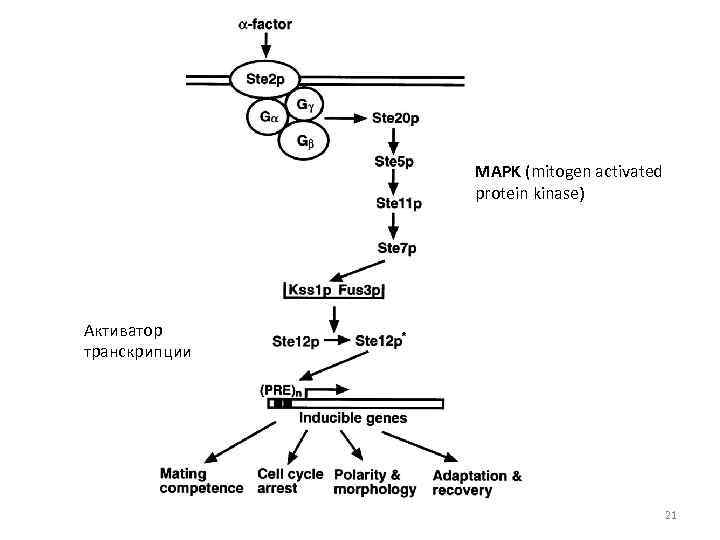
МАРK (mitogen activated protein kinase) Активатор транскрипции 21

22
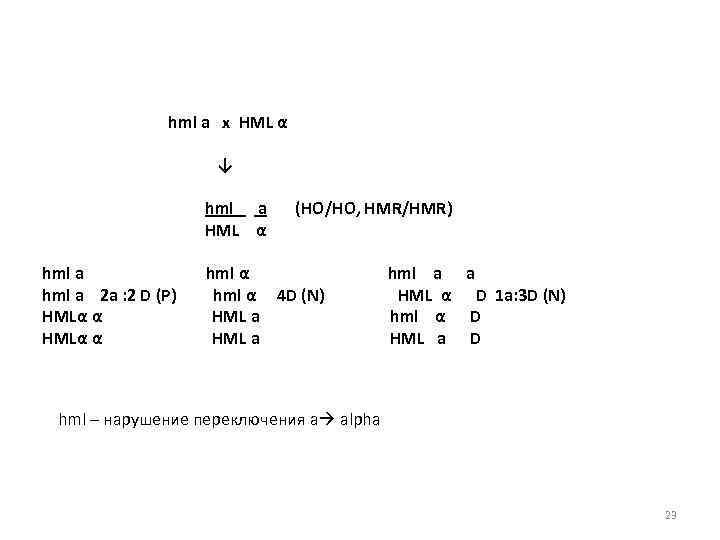
hml a x HML α ↓ hml a HML α hml a 2 a : 2 D (P) HMLα α (HO/HO, HMR/HMR) hml α 4 D (N) HML a hml a a HML α D 1 a: 3 D (N) hml α D HML a D hml – нарушение переключения a alpha 23
24
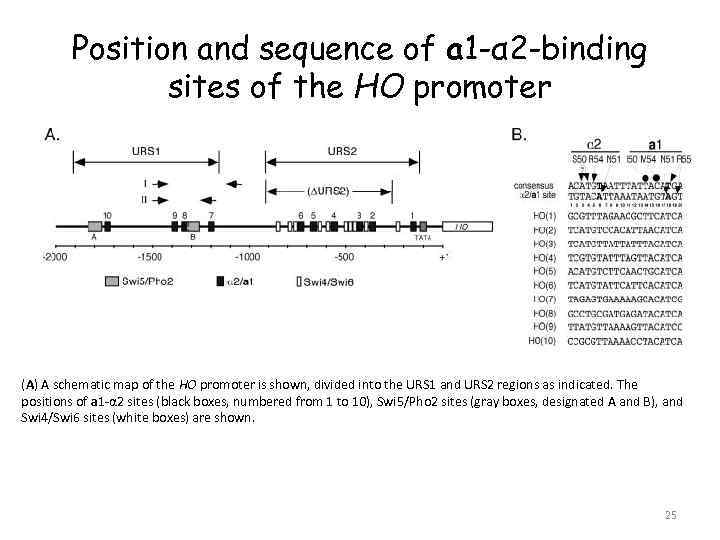
Position and sequence of a 1 -α 2 -binding sites of the HO promoter (A) A schematic map of the HO promoter is shown, divided into the URS 1 and URS 2 regions as indicated. The positions of a 1 -α 2 sites (black boxes, numbered from 1 to 10), Swi 5/Pho 2 sites (gray boxes, designated A and B), and Swi 4/Swi 6 sites (white boxes) are shown. 25
26
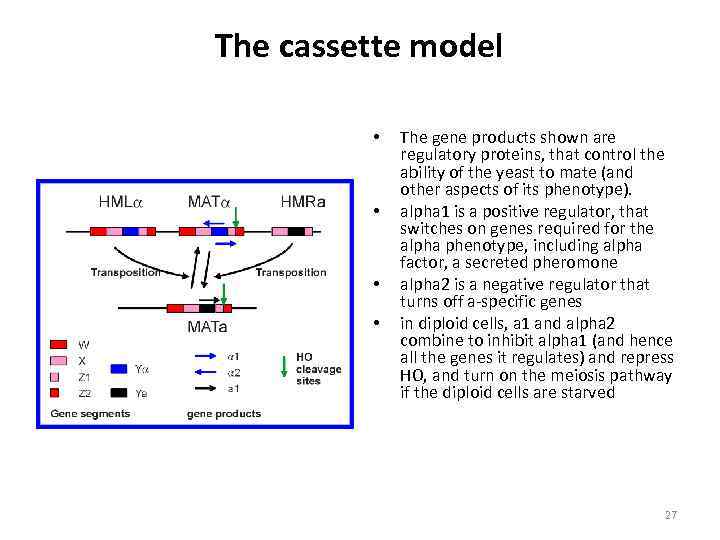
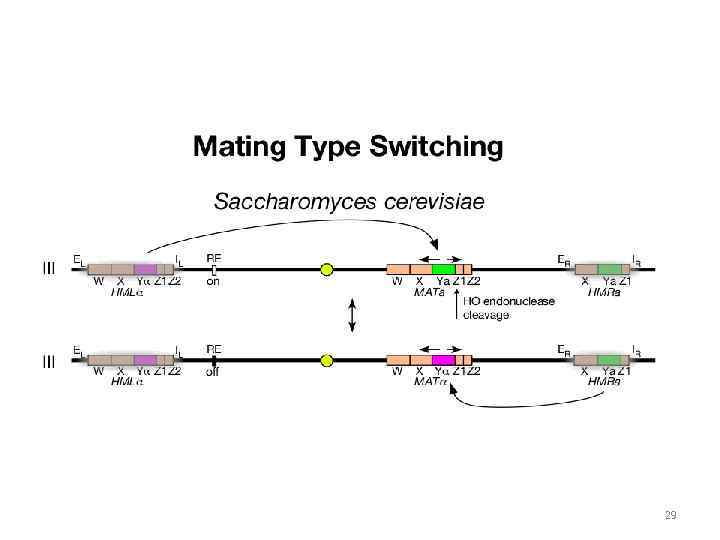
The cassette model • • The gene products shown are regulatory proteins, that control the ability of the yeast to mate (and other aspects of its phenotype). alpha 1 is a positive regulator, that switches on genes required for the alpha phenotype, including alpha factor, a secreted pheromone alpha 2 is a negative regulator that turns off a-specific genes in diploid cells, a 1 and alpha 2 combine to inhibit alpha 1 (and hence all the genes it regulates) and repress HO, and turn on the meiosis pathway if the diploid cells are starved 27
28
29
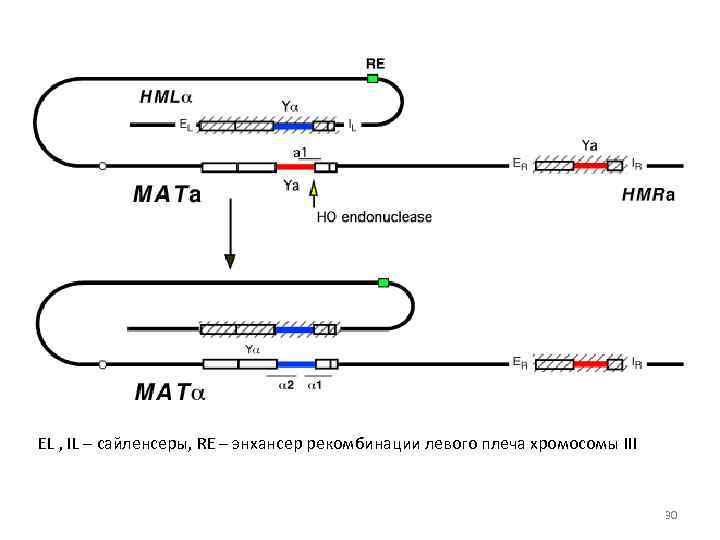
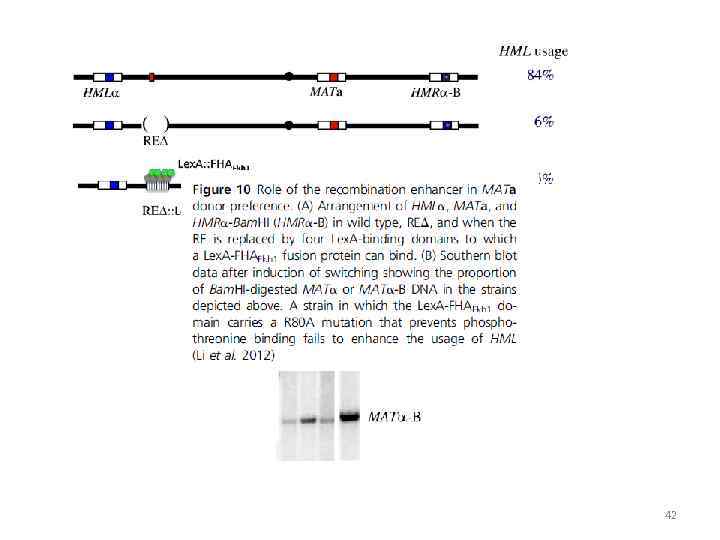
EL , IL – сайленсеры, RE – энхансер рекомбинации левого плеча хромосомы III 30
31
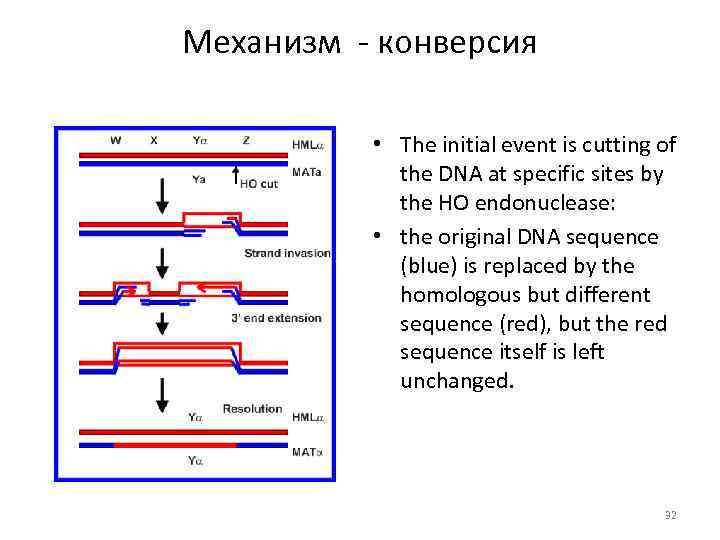
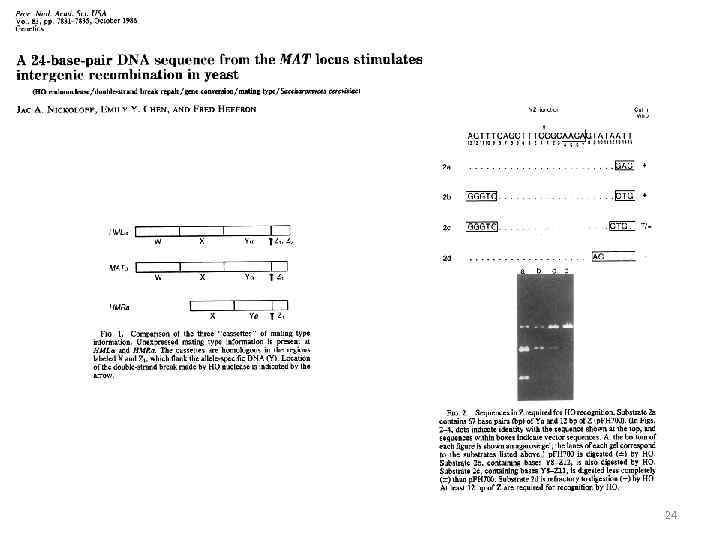
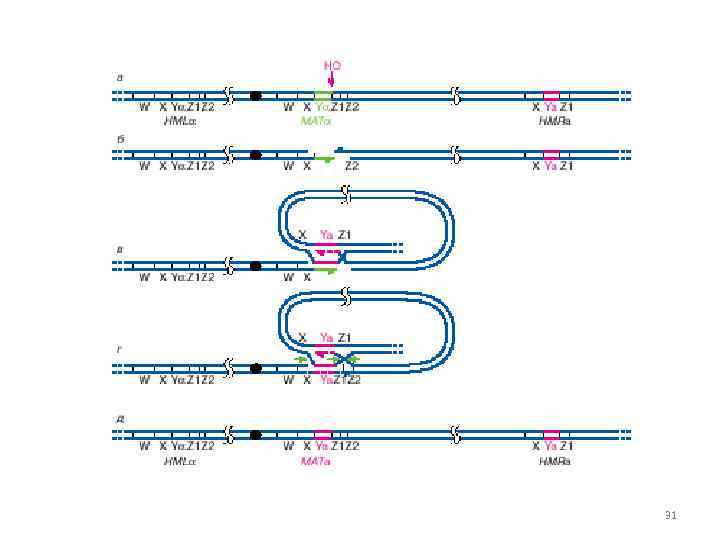
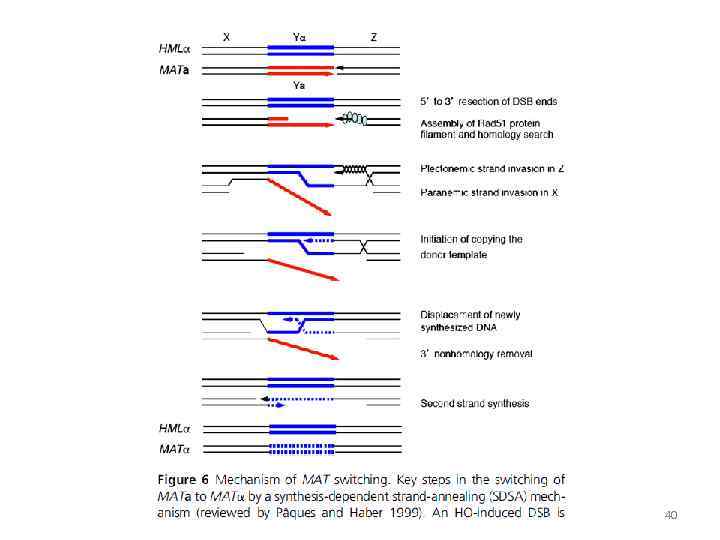
Механизм - конверсия • The initial event is cutting of the DNA at specific sites by the HO endonuclease: • the original DNA sequence (blue) is replaced by the homologous but different sequence (red), but the red sequence itself is left unchanged. 32

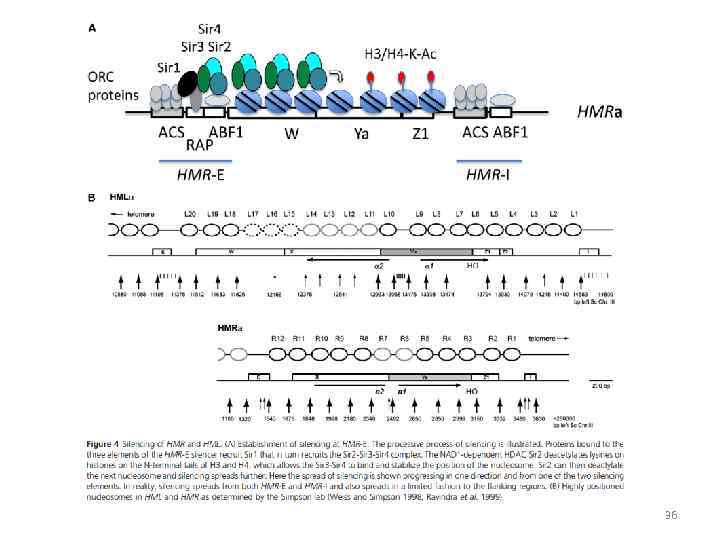
Why aren't HML and HMR expressed all the time? • They have the same DNA sequence as MAT which is expressed. • The reason is that the HML and HMR loci are "silenced" by the products of the SIR genes (Silent Information Regulators). • These proteins interact with regions of DNA ~1000 bp upstream of the loci that are transposed (HML and HMR). These DNA sequences are called "silencers". They can be turned around or moved up to 2. 5 kb away and they are still active. So in the cassette model, transposition moves the genes from a transcriptionally silent site to a transcriptionally active one. • Silencing is believed to act through a localized change in the structure of chromatin. 33

Транскрипционный сайленсинг кассет Sir 2/Sir 3/Sir 4 p Rap 1 p Sir 1 p Abf 1 p ORC Кассета HMRa, сайленсеры E и I и белки, принимающие участие в TGS 34
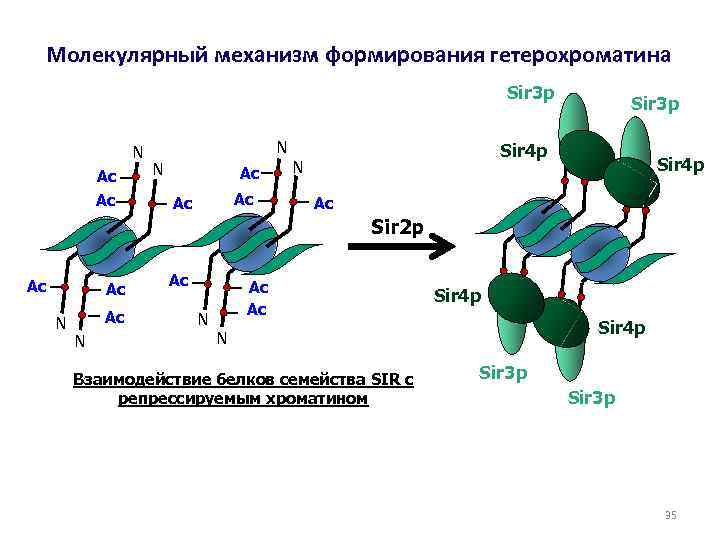
Молекулярный механизм формирования гетерохроматина Sir 3 p N Ac Ac N N Ac Ac Ac Sir 3 p Sir 4 p N Sir 4 p Ac Sir 2 p Ac Ac N Ac Ac Sir 4 p N Взаимодействие белков семейства SIR с репрессируемым хроматином Sir 3 p 35
36
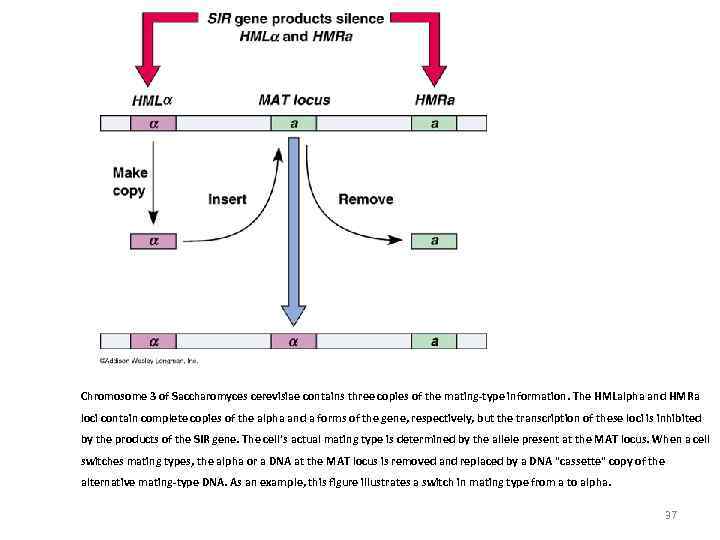
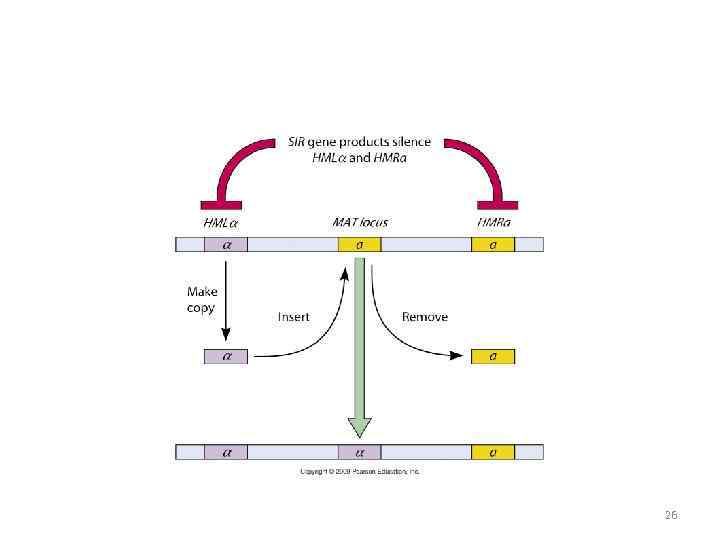
Chromosome 3 of Saccharomyces cerevisiae contains three copies of the mating-type information. The HMLalpha and HMRa loci contain complete copies of the alpha and a forms of the gene, respectively, but the transcription of these loci is inhibited by the products of the SIR gene. The cell's actual mating type is determined by the allele present at the MAT locus. When a cell switches mating types, the alpha or a DNA at the MAT locus is removed and replaced by a DNA "cassette" copy of the alternative mating-type DNA. As an example, this figure illustrates a switch in mating type from a to alpha. 37

Асимметричная экспрессия НО регулируется Ash 1 -репрессором гена SWI 5 (активатор гена НО) Haber, 2012 38

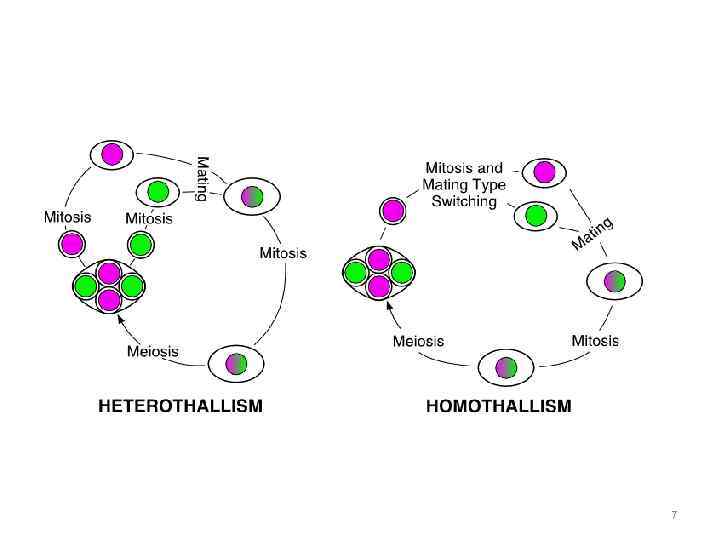
Haploids can switch mating type! • • Mating type switch is due to two silent mating type loci on the same chromosome, which become activated when translocated to the MAT locus The mechanisms of silencing these two copies of the MAT locus has been studied in detail and has conserved features to higher cells: heterochromatin formation The translocation is a gene conversion initiated by the HO nuclease, that cuts like a restriction enzyme within the active mating type locus in the chromosome Laboratory yeast strains lack the HO nuclease and hence have stable haploid phases w w Interestingly, only mother cells can switch This ensures that after cell division two cells of opposite mating type are formed This feature is due to unequal inheritance of a regulatory proteins Also this is a strategy that is conserved an found in differentiation of cell types in multicellular organisms 39
40

41
42
43
Schizosaccharomyces pombe 44

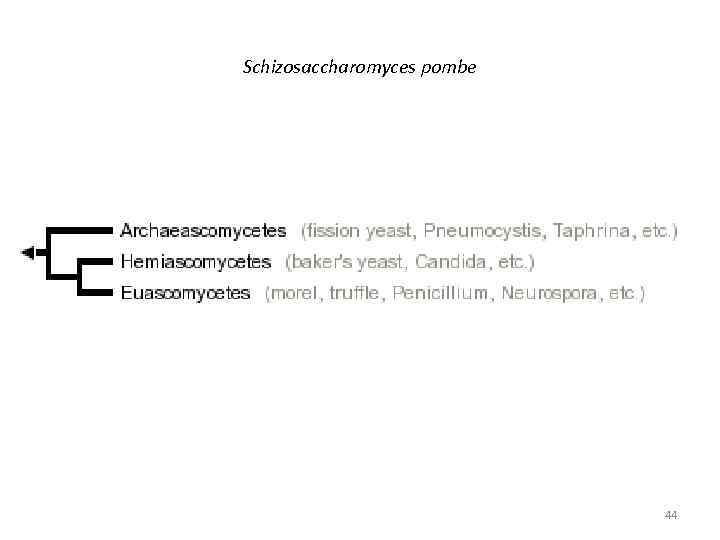
S. cerevisiae ellipsoidal; about 5 µm diameter. Divides by budding S. pombe cylindrical; 3 -4 µm diameter; 7 -15 µm long. Divides by medial fission 45

The Schizosaccharomyces pombe cell cycle. The magenta and green colors indicate the two different mating types (+ and -). These colors are dimmed in spores and stationary phase to indicate genetic inactivity. In diploids, the colors are blended to indicate that the diploid nucleus contains both + and - determinants. 46

47
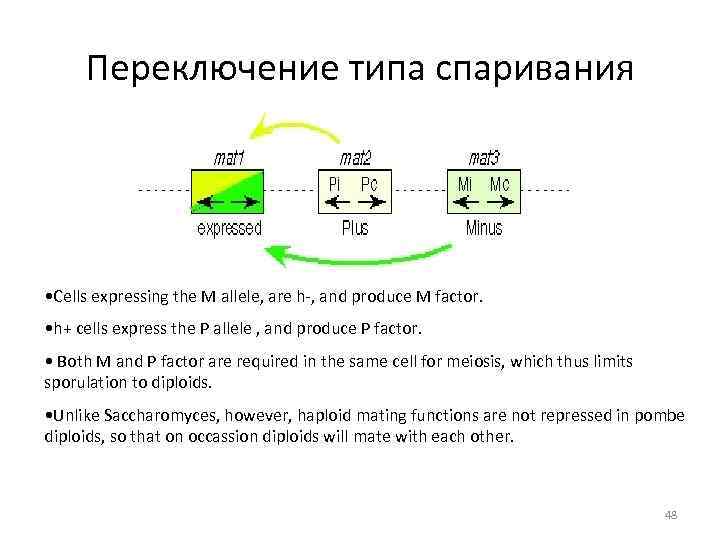
Переключение типа спаривания • Cells expressing the M allele, are h-, and produce M factor. • h+ cells express the P allele , and produce P factor. • Both M and P factor are required in the same cell for meiosis, which thus limits sporulation to diploids. • Unlike Saccharomyces, however, haploid mating functions are not repressed in pombe diploids, so that on occassion diploids will mate with each other. 48
49
50
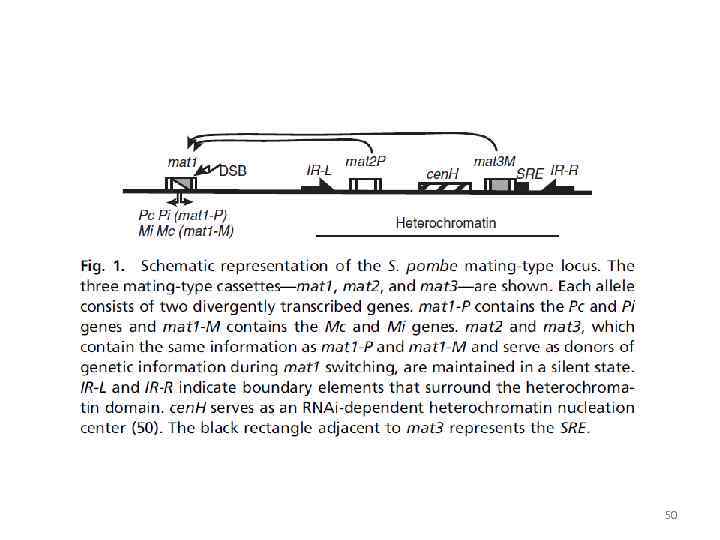
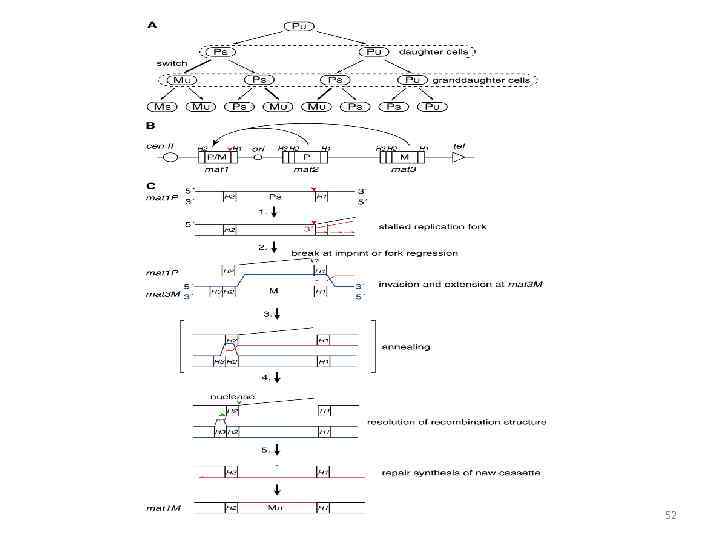
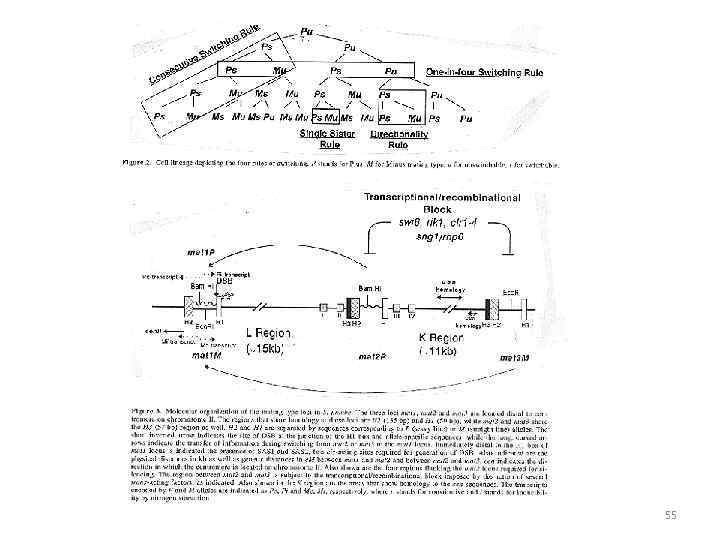
Переключение типа спаривания • У S. pombe два типа спаривания М(minus) или P(plus) • Тип спаривания определяется М или Р состоянием кассеты mat 1 • Молчащие кассеты mat 2 -P или mat 3 -М • Кассеты расположены как прямые повторы трех генов на хромосоме II • Есть области гомологии • Кассеты разделены двумя спейсерными регионами. • Репликативная вилка подходит справа ( есть ori) • Слева от mat 1 есть полярный терминатор и внутри кассеты есть сайт паузирования. 51
52
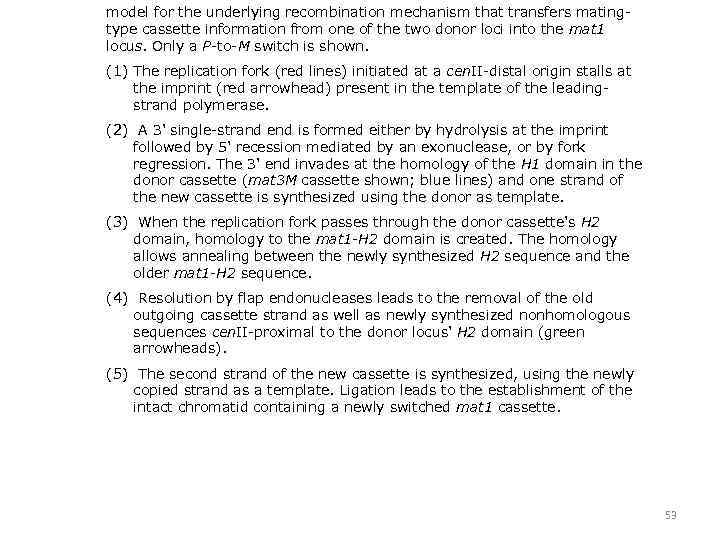
model for the underlying recombination mechanism that transfers matingtype cassette information from one of the two donor loci into the mat 1 locus. Only a P-to-M switch is shown. (1) The replication fork (red lines) initiated at a cen. II-distal origin stalls at the imprint (red arrowhead) present in the template of the leadingstrand polymerase. (2) A 3' single-strand end is formed either by hydrolysis at the imprint followed by 5' recession mediated by an exonuclease, or by fork regression. The 3' end invades at the homology of the H 1 domain in the donor cassette (mat 3 M cassette shown; blue lines) and one strand of the new cassette is synthesized using the donor as template. (3) When the replication fork passes through the donor cassette's H 2 domain, homology to the mat 1 -H 2 domain is created. The homology allows annealing between the newly synthesized H 2 sequence and the older mat 1 -H 2 sequence. (4) Resolution by flap endonucleases leads to the removal of the old outgoing cassette strand as well as newly synthesized nonhomologous sequences cen. II-proximal to the donor locus' H 2 domain (green arrowheads). (5) The second strand of the new cassette is synthesized, using the newly copied strand as a template. Ligation leads to the establishment of the intact chromatid containing a newly switched mat 1 cassette. 53
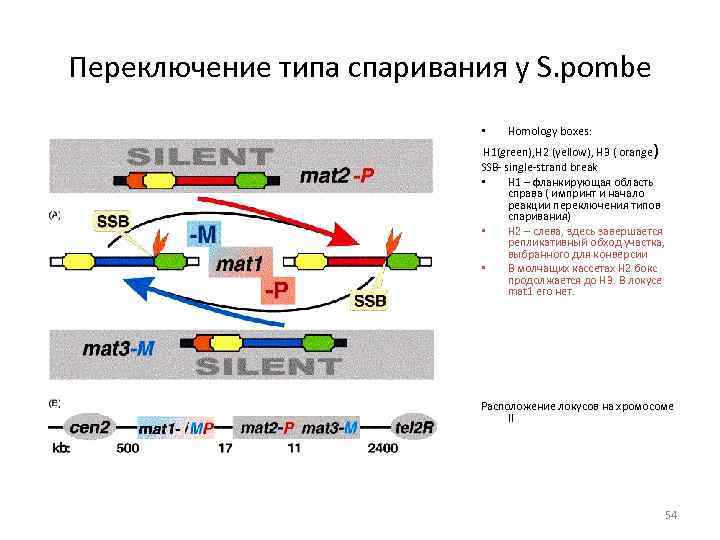
Переключение типа спаривания у S. pombe • Homology boxes: H 1(green), H 2 (yellow), H 3 ( orange) SSB- single-strand break • Н 1 – фланкирующая область справа ( импринт и начало реакции переключения типов спаривания) • Н 2 – слева, здесь завершается репликативный обход участка, выбранного для конверсии • В молчащих кассетах Н 2 бокс продолжается до Н 3. В локусе mat 1 его нет. Расположение локусов на хромосоме II 54
55
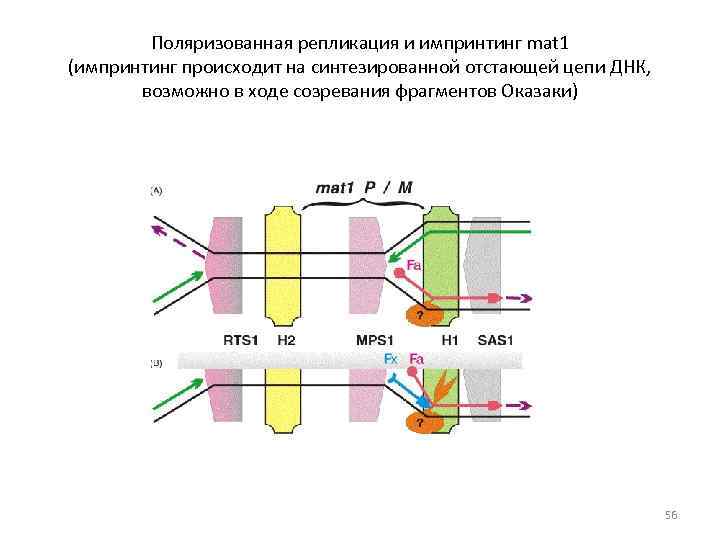
Поляризованная репликация и импринтинг mat 1 (импринтинг происходит на синтезированной отстающей цепи ДНК, возможно в ходе созревания фрагментов Оказаки) 56
примечания • • Для импринтинга и переключения необходимо, чтобы вилка репликации подходила к Н 1 справа С другой стороны вилка репликации блокируется сильным сайтом терминации репликации RTS 1 ( 700 bp слева от mat 1). Внутри кассеты mat 1 -M есть сайт направленного паузирования (340 bp слева от импринта Н 1 – mat 1 pause site MPS 1 Временная остановка вилки репликации в MPS 1 после того, как сайта импринтинга пройден справа критична для фиксации импринта в Н 1. 57
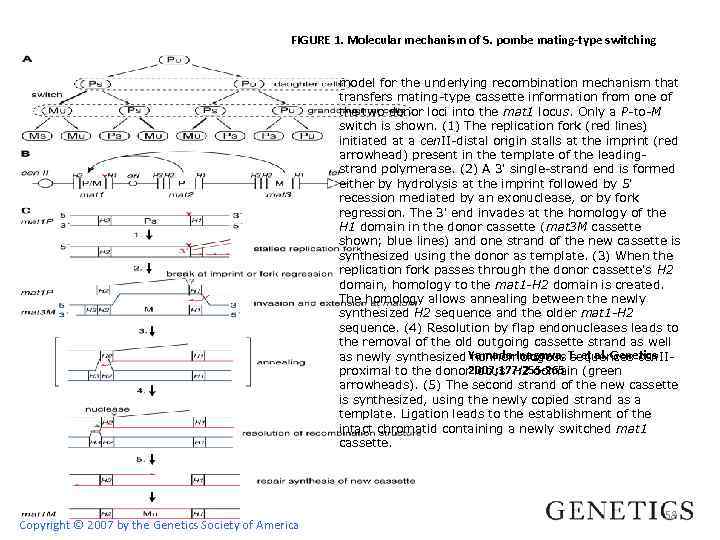
FIGURE 1. Molecular mechanism of S. pombe mating-type switching model for the underlying recombination mechanism that transfers mating-type cassette information from one of the two donor loci into the mat 1 locus. Only a P-to-M switch is shown. (1) The replication fork (red lines) initiated at a cen. II-distal origin stalls at the imprint (red arrowhead) present in the template of the leadingstrand polymerase. (2) A 3' single-strand end is formed either by hydrolysis at the imprint followed by 5' recession mediated by an exonuclease, or by fork regression. The 3' end invades at the homology of the H 1 domain in the donor cassette (mat 3 M cassette shown; blue lines) and one strand of the new cassette is synthesized using the donor as template. (3) When the replication fork passes through the donor cassette's H 2 domain, homology to the mat 1 -H 2 domain is created. The homology allows annealing between the newly synthesized H 2 sequence and the older mat 1 -H 2 sequence. (4) Resolution by flap endonucleases leads to the removal of the old outgoing cassette strand as well as newly synthesized Yamada-Inagawa, T. et al. Genetics nonhomologous sequences cen. IIproximal to the donor 2007; 177: 255 -265 (green locus' H 2 domain arrowheads). (5) The second strand of the new cassette is synthesized, using the newly copied strand as a template. Ligation leads to the establishment of the intact chromatid containing a newly switched mat 1 cassette. Copyright © 2007 by the Genetics Society of America 58

59
60
S. pombe pheromone MAPK pathway - Mam 2 P factor receptor and the Map 3 M-factor receptor. - Coupled to Gpa 1, a monomeric Gα subunit. - Activation of a MAPK pathway : Byr 2 MAPKKK, the Byr 1 MAPKK, and the Spk 1 MAPK. - Gpa 1 and Ras 1, the only Ras homolog in S. pombe, functionally converge on the Byr 2 MAPKKK of the pathway. Ras 1 directly binds Byr 2. Ras 1 is also part of a protein complex involving the Shk 1 PAK/MAP 4 K family member, which is similar to the S. cerevisiae Ste 20 MAP 4 K. - Activation of Ras 1 in response to pheromone signaling appears to be due to pheromone-induced expression of the Ste 6 GEF = Ras 1 is not directly activated by the pheromone receptors. 61
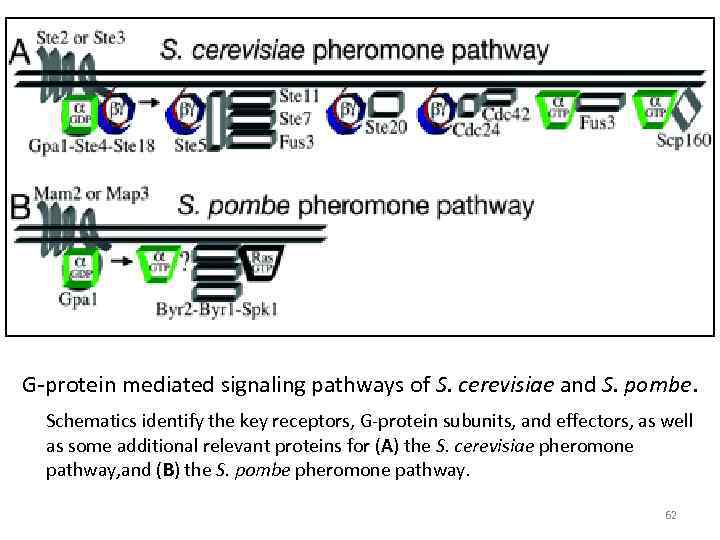
G-protein mediated signaling pathways of S. cerevisiae and S. pombe. Schematics identify the key receptors, G-protein subunits, and effectors, as well as some additional relevant proteins for (A) the S. cerevisiae pheromone pathway, and (B) the S. pombe pheromone pathway. 62
Гаплоиды и диплоиды в природе и лаборатории • • • In nature, yeast cells always grow as diploids, probably because this increases their chance to survive mutation of an essential gene (because there is another copy) Under nitrogen starvation, diploid cells sporulate and then haploid spores germinate, provided that they have received functional copies of all essential genes This often means that only a single spore (if any) of a tetrad survives How to make sure that this single spore can find a mating partner to form a diploid again? The answer is mating type switch! After the first division the mother cell switches mating type and mates with its daughter to form a diploid, which then of course is homozygous for all genes and starts a new clone of cells If mating type can be switched and diploid is the prefered form, why then sporulate and have mating types? There are probably several reasons: (1) Spores are hardy and survive very harsh conditions (2) Sporulation is a way to ”clean” the genome from accumulated mutations (3) Meiosis is a way to generate new combinations of alleles, which may turn out to be advantageous, i. e. better than the previous one (4) Sometimes cells may find a mating partner from a different tetrad and form a new clone, with possibly advantageous allele combination In order to do yeast genetics and to grow haploid cells in the laboratory, mating type switch must be prevented: all laboratory strains are HO mutants and can not switch So how does this mysterious switch of sex work? 63
Скачать презентацию Парасексуальный цикл у дрожжей 1 Mitotic recombination
дрожжи - тип спаривания-12-11.ppt