 Скачать презентацию Parameterization and Parameter Estimation of Distributed Models For
abbcc94f7a1a33fafacaa4085708847c.ppt
- Количество слайдов: 29



Parameterization and Parameter Estimation of Distributed Models For Flash Flood and River Prediction Koray K. Yilmaz Hoshin Gupta Maitreya Yadav Thorsten Wagener koray@hwr. arizona. edu, hoshin. gupta@hwr. arizona. edu, thorsten@engr. psu. edu, muy 125@psu. edu NWS OFFICE OF HYDROLOGIC DEVELOPMENT Annual Meeting, 01/20/2006 1
Objectives • Parameterization of semi-distributed and distributed hydrologic models within Hydrology Laboratory-Research Modeling System (HL-RMS) framework • Distributed parameter estimation - automated and/or semi-automated (e. g. regularization) • A priori methods for parameter estimation in un-gauged basins using direct inference from watershed properties and statistical regression analysis 2
Work Completed Until Previous Annual Presentation (01/17/05) • Hydrology Laboratory-Research Modeling System (HL-RMS) was implemented at the University of Arizona and tested • Literature review of the frameworks developed for incorporating watershed physical properties (i. e. geology, soil properties, remote sensing) to model structure identification and parameter estimation 3
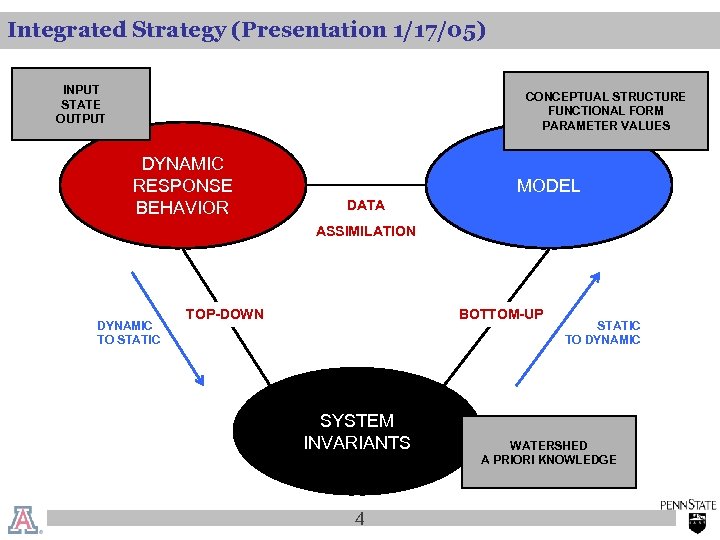
Integrated Strategy (Presentation 1/17/05) INPUT STATE OUTPUT CONCEPTUAL STRUCTURE FUNCTIONAL FORM PARAMETER VALUES DYNAMIC RESPONSE BEHAVIOR MODEL DATA ASSIMILATION DYNAMIC TO STATIC TOP-DOWN BOTTOM-UP SYSTEM INVARIANTS 4 STATIC TO DYNAMIC WATERSHED A PRIORI KNOWLEDGE
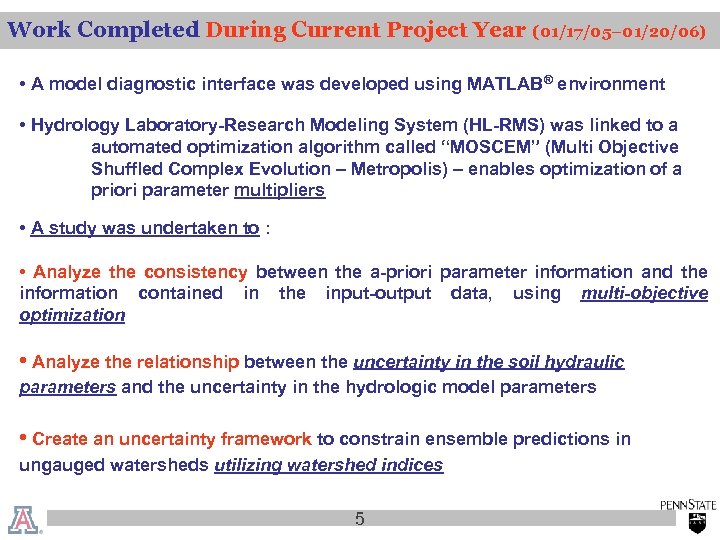
Work Completed During Current Project Year (01/17/05– 01/20/06) • A model diagnostic interface was developed using MATLAB® environment • Hydrology Laboratory-Research Modeling System (HL-RMS) was linked to a automated optimization algorithm called “MOSCEM” (Multi Objective Shuffled Complex Evolution – Metropolis) – enables optimization of a priori parameter multipliers • A study was undertaken to : • Analyze the consistency between the a-priori parameter information and the information contained in the input-output data, using multi-objective optimization • Analyze the relationship between the uncertainty in the soil hydraulic parameters and the uncertainty in the hydrologic model parameters • Create an uncertainty framework to constrain ensemble predictions in ungauged watersheds utilizing watershed indices 5
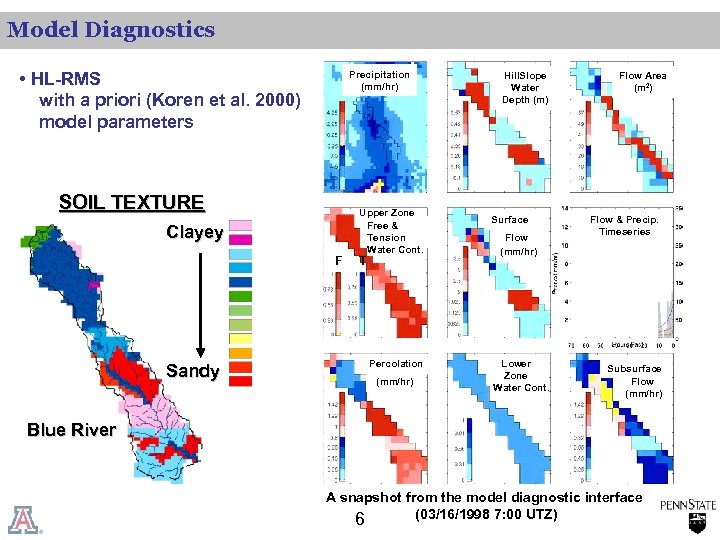
Model Diagnostics • HL-RMS with a priori (Koren et al. 2000) model parameters Precipitation (mm/hr) SOIL TEXTURE Clayey F Sandy Upper Zone Free & Tension Water Cont. T Percolation (mm/hr) Hill. Slope Water Depth (m) Surface Flow (mm/hr) Lower Zone Water Cont. Flow Area (m 2) Flow & Precip. Timeseries Subsurface Flow (mm/hr) Blue River A snapshot from the model diagnostic interface (03/16/1998 7: 00 UTZ) 6
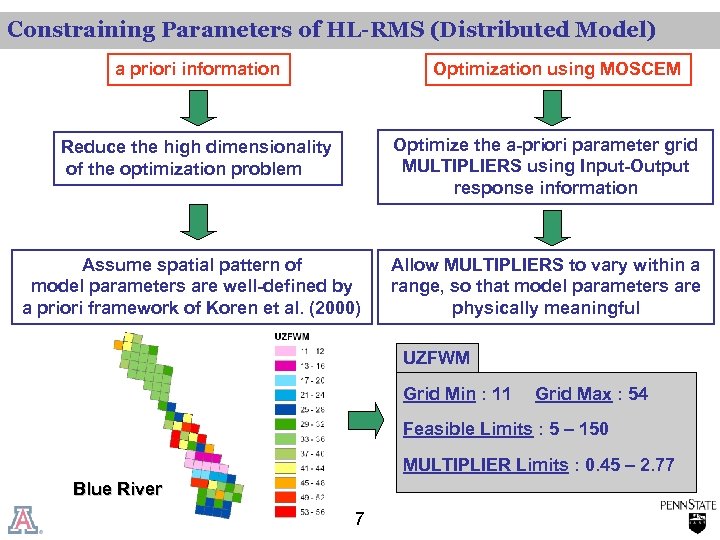
Constraining Parameters of HL-RMS (Distributed Model) a priori information Optimization using MOSCEM Reduce the high dimensionality of the optimization problem Optimize the a-priori parameter grid MULTIPLIERS using Input-Output response information Assume spatial pattern of model parameters are well-defined by a priori framework of Koren et al. (2000) Allow MULTIPLIERS to vary within a range, so that model parameters are physically meaningful UZFWM Grid Min : 11 Grid Max : 54 Feasible Limits : 5 – 150 MULTIPLIER Limits : 0. 45 – 2. 77 Blue River 7
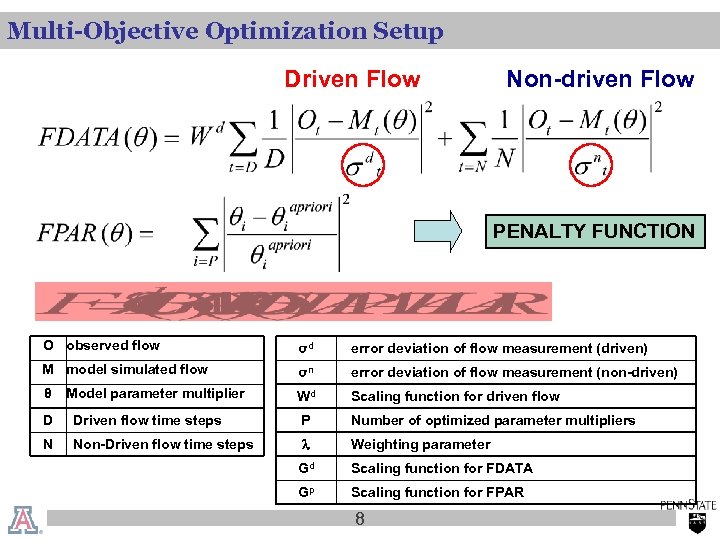
Multi-Objective Optimization Setup Driven Flow Non-driven Flow PENALTY FUNCTION O observed flow σd error deviation of flow measurement (driven) M model simulated flow σn error deviation of flow measurement (non-driven) θ Wd Scaling function for driven flow Model parameter multiplier D Driven flow time steps P Number of optimized parameter multipliers N Non-Driven flow time steps Weighting parameter Gd Scaling function for FDATA Gp Scaling function for FPAR 8
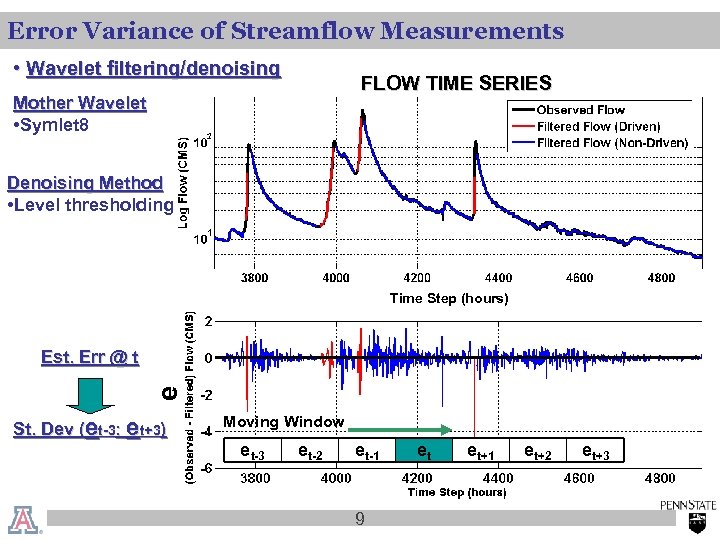
Error Variance of Streamflow Measurements • Wavelet filtering/denoising FLOW TIME SERIES Mother Wavelet • Symlet 8 Denoising Method • Level thresholding Time Step (hours) e Est. Err @ t St. Dev (et-3: et+3) Moving Window et-3 et-2 et-1 9 et et+1 et+2 et+3
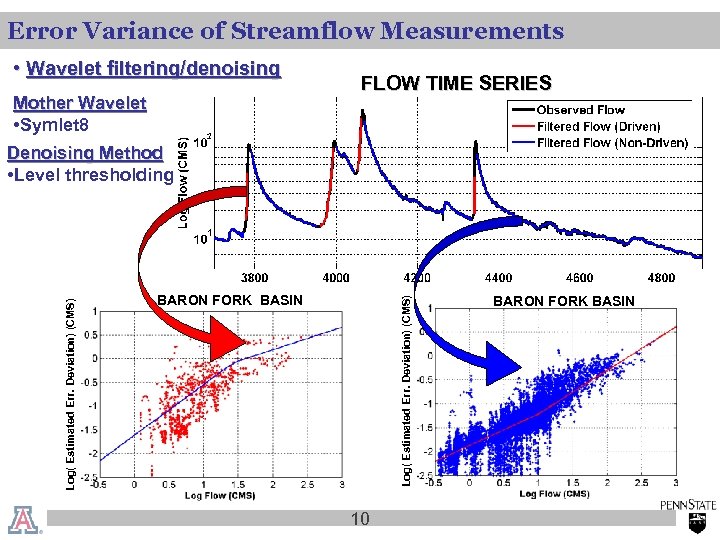
Error Variance of Streamflow Measurements • Wavelet filtering/denoising Mother Wavelet • Symlet 8 FLOW TIME SERIES BARON FORK BASIN Log( Estimated Err. Deviation) (CMS) Denoising Method • Level thresholding 10 BARON FORK BASIN
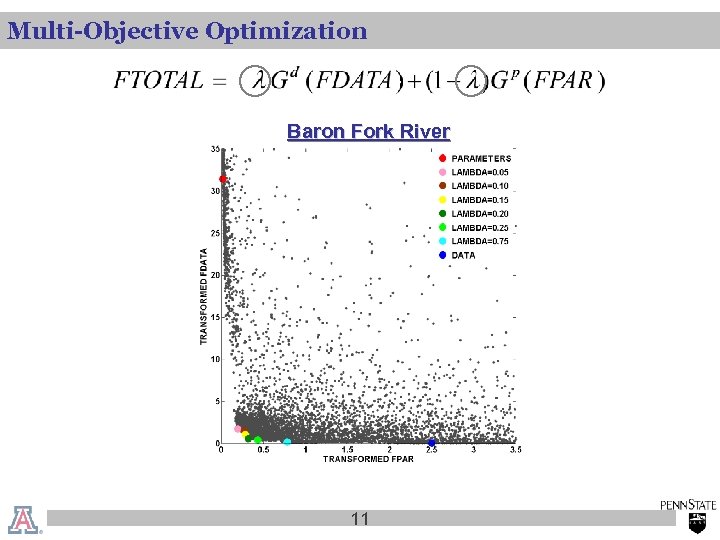
Multi-Objective Optimization Baron Fork River 11
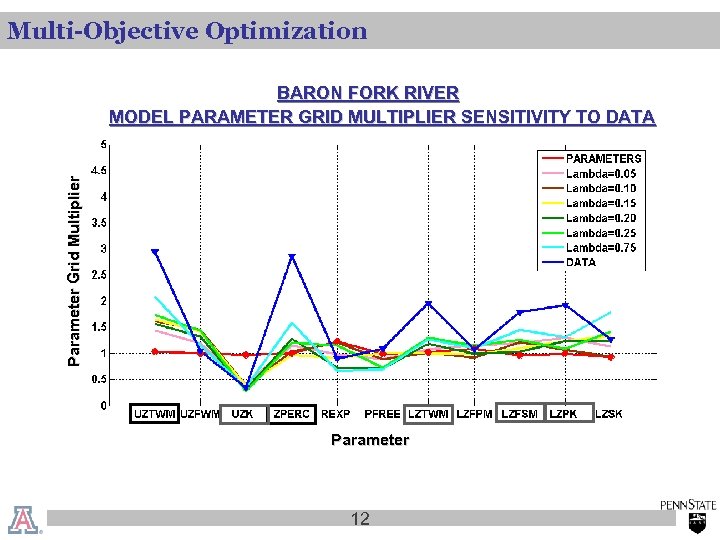
Multi-Objective Optimization Parameter Grid Multiplier BARON FORK RIVER MODEL PARAMETER GRID MULTIPLIER SENSITIVITY TO DATA Parameter 12
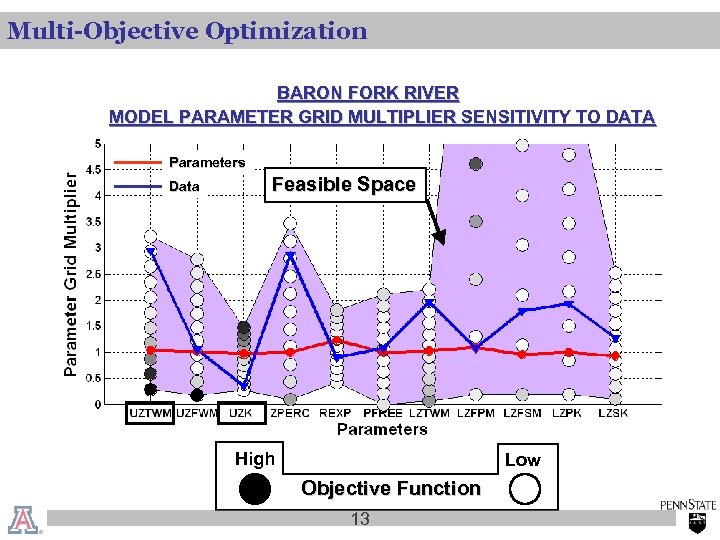
Multi-Objective Optimization BARON FORK RIVER MODEL PARAMETER GRID MULTIPLIER SENSITIVITY TO DATA Parameters Data Feasible Space High Low Objective Function 13
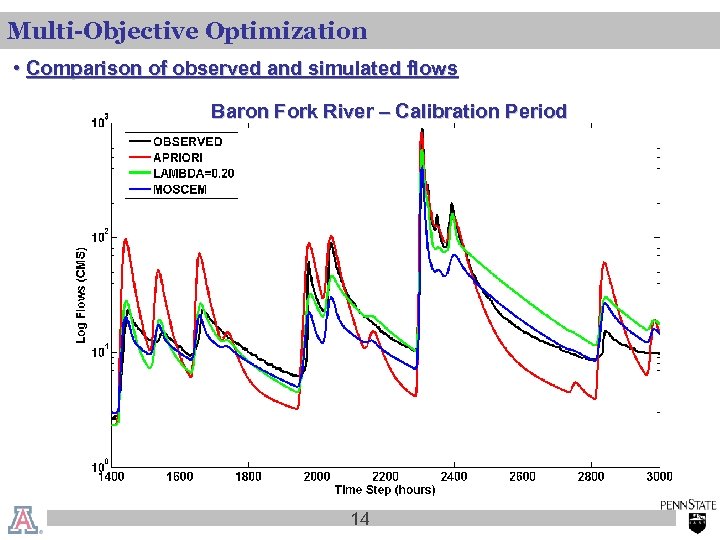
Multi-Objective Optimization • Comparison of observed and simulated flows Baron Fork River – Calibration Period 14
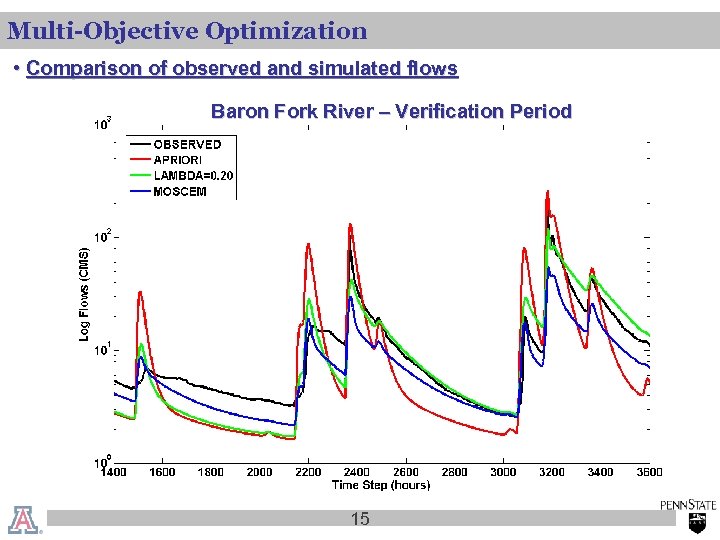
Multi-Objective Optimization • Comparison of observed and simulated flows Baron Fork River – Verification Period 15
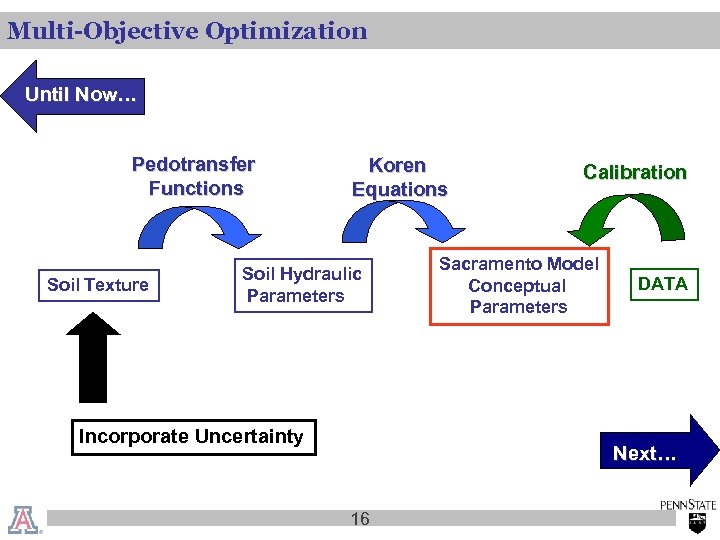
Multi-Objective Optimization Until Now… Pedotransfer Functions Soil Texture Koren Equations Soil Hydraulic Parameters Incorporate Uncertainty Calibration Sacramento Model Conceptual Parameters DATA Next… 16
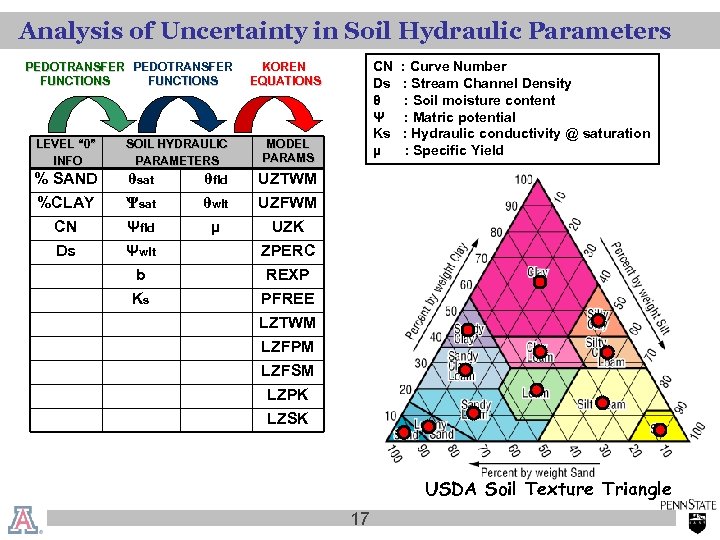
Analysis of Uncertainty in Soil Hydraulic Parameters PEDOTRANSFER FUNCTIONS LEVEL “ 0” INFO % SAND %CLAY CN Ds SOIL HYDRAULIC PARAMETERS θsat θfld Ψsat θwlt Ψfld Ψwlt µ b Ks CN Ds θ Ψ Ks µ KOREN EQUATIONS MODEL PARAMS : Curve Number : Stream Channel Density : Soil moisture content : Matric potential : Hydraulic conductivity @ saturation : Specific Yield UZTWM UZFWM UZK ZPERC REXP PFREE LZTWM LZFPM LZFSM LZPK LZSK USDA Soil Texture Triangle 17
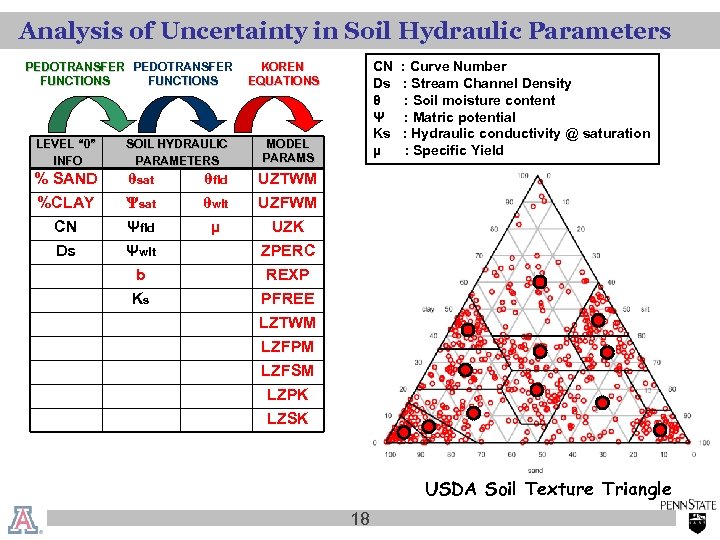
Analysis of Uncertainty in Soil Hydraulic Parameters PEDOTRANSFER FUNCTIONS LEVEL “ 0” INFO % SAND %CLAY CN Ds SOIL HYDRAULIC PARAMETERS θsat θfld Ψsat θwlt Ψfld Ψwlt µ b Ks CN Ds θ Ψ Ks µ KOREN EQUATIONS MODEL PARAMS : Curve Number : Stream Channel Density : Soil moisture content : Matric potential : Hydraulic conductivity @ saturation : Specific Yield UZTWM UZFWM UZK ZPERC REXP PFREE LZTWM LZFPM LZFSM LZPK LZSK USDA Soil Texture Triangle 18
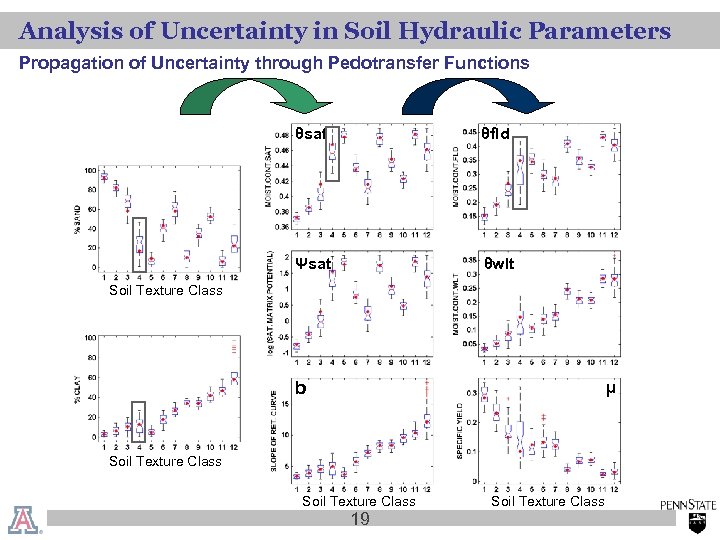
Analysis of Uncertainty in Soil Hydraulic Parameters Propagation of Uncertainty through Pedotransfer Functions θsat θfld Ψsat θwlt Soil Texture Class µ b Soil Texture Class 19 Soil Texture Class
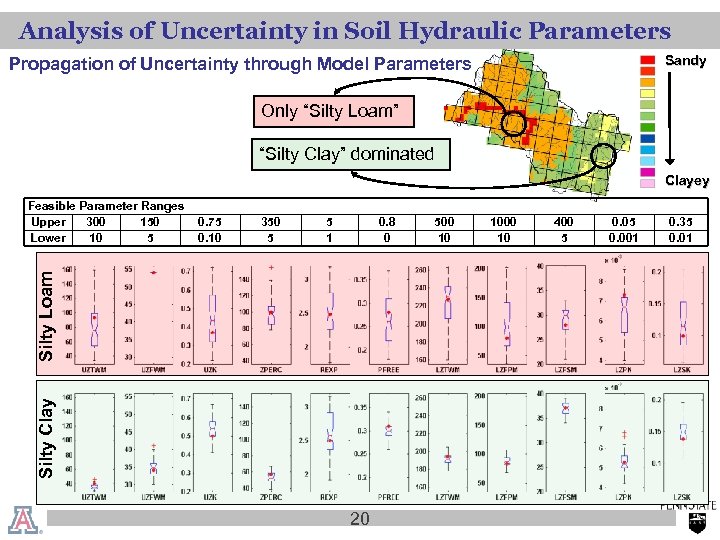
Analysis of Uncertainty in Soil Hydraulic Parameters Sandy Propagation of Uncertainty through Model Parameters Only “Silty Loam” “Silty Clay” dominated Clayey 0. 75 0. 10 350 5 5 1 0. 8 0 Silty Clay Silty Loam Feasible Parameter Ranges Upper 300 150 Lower 10 5 20 500 10 1000 10 400 5 0. 001 0. 35 0. 01
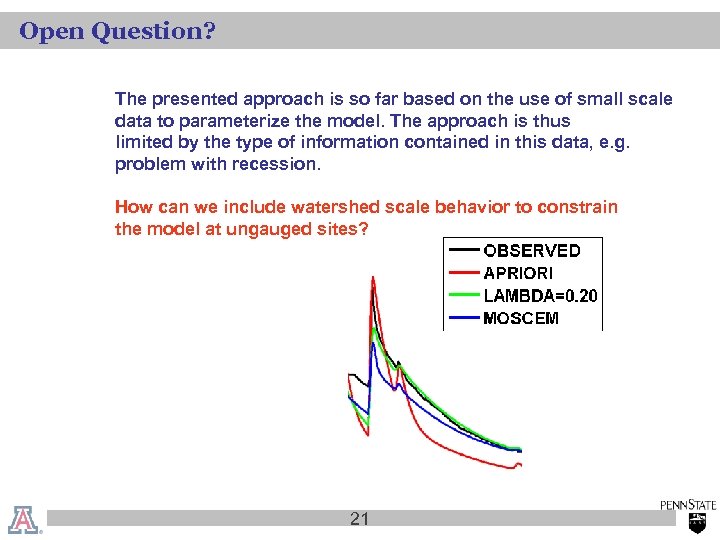
Open Question? The presented approach is so far based on the use of small scale data to parameterize the model. The approach is thus limited by the type of information contained in this data, e. g. problem with recession. How can we include watershed scale behavior to constrain the model at ungauged sites? 21
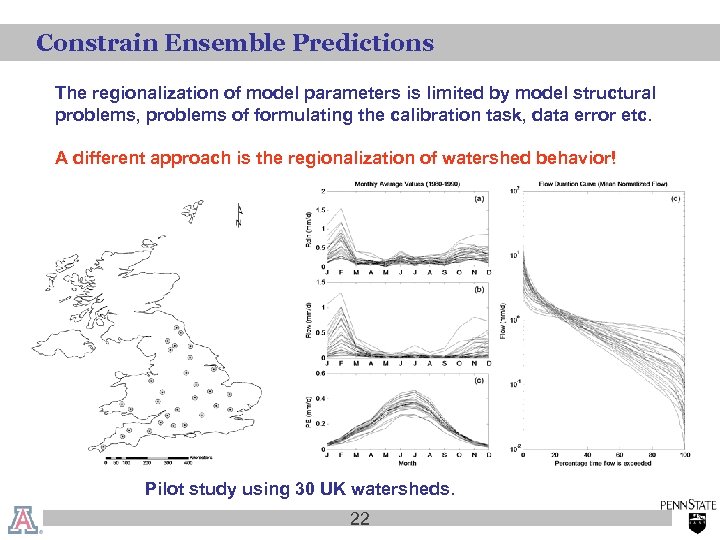
Constrain Ensemble Predictions The regionalization of model parameters is limited by model structural problems, problems of formulating the calibration task, data error etc. A different approach is the regionalization of watershed behavior! Pilot study using 30 UK watersheds. 22
![Initial test regionalizing two characteristics: [1] The Runoff Ratio (Runoff/Precipitation) [2] Mean slope of](https://present5.com/presentation/abbcc94f7a1a33fafacaa4085708847c/image-23.jpg "Initial test regionalizing two characteristics: [1] The Runoff Ratio (Runoff/Precipitation) [2] Mean slope of")
Initial test regionalizing two characteristics: [1] The Runoff Ratio (Runoff/Precipitation) [2] Mean slope of the flow duration curve (FDC Slope) Watershed characteristics used are DPSBAR (topographic slope) and BFIHOST, a baseflow index derived from physical characteristics. 23
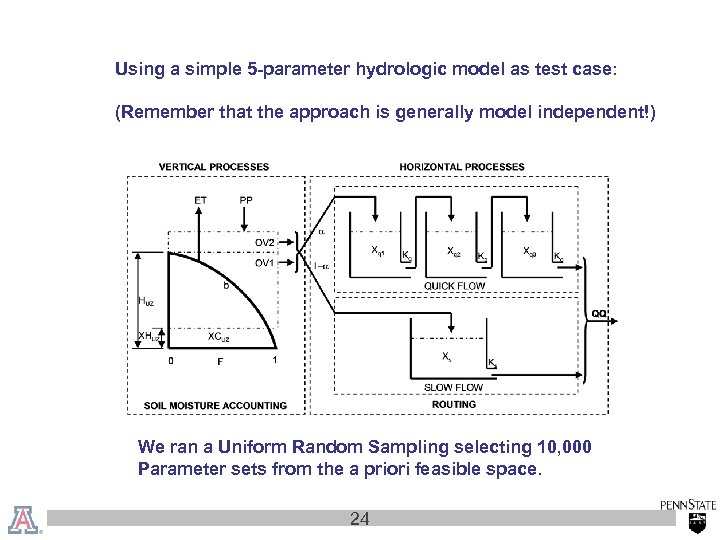
Using a simple 5 -parameter hydrologic model as test case: (Remember that the approach is generally model independent!) We ran a Uniform Random Sampling selecting 10, 000 Parameter sets from the a priori feasible space. 24
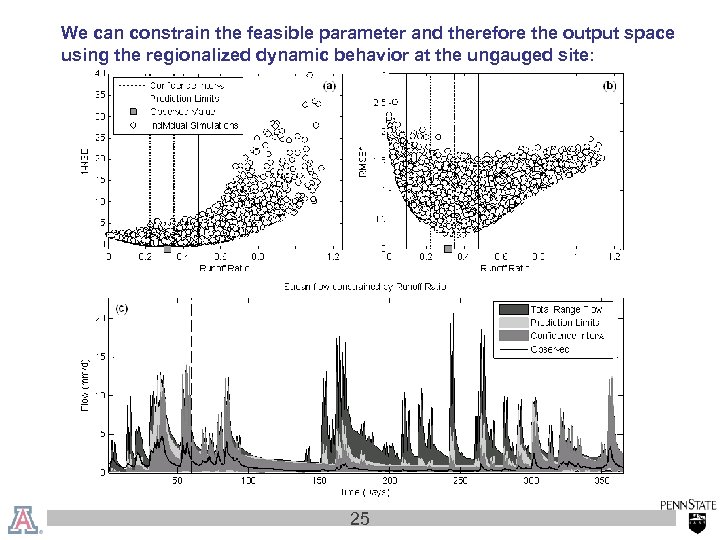
We can constrain the feasible parameter and therefore the output space using the regionalized dynamic behavior at the ungauged site: 25
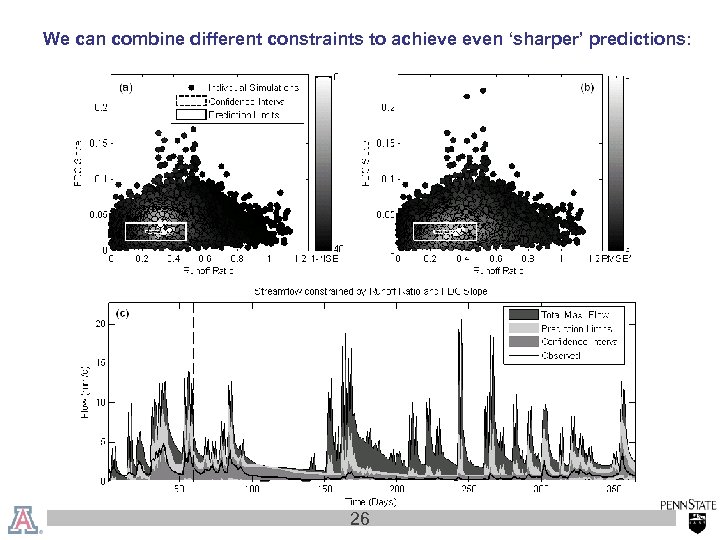
We can combine different constraints to achieve even ‘sharper’ predictions: 26
Conclusions 1) Investigated a structured & logical Multi-Criteria Approach to assimilating Information into a distributed hydrologic model: • • A-priori Watershed Properties information (local information) Watershed Input-Output Response information (global information) 2) Includes a way to handle estimates of uncertainty: • • Watershed Soil Property uncertainty Streamflow Data uncertainty 3) Towards ensemble predictions in gauged and ungauged watersheds utilizing information derived at different scales 27
Future Work • Faster Computing Time (parallel computing, use of computer clusters) • Improved Handling of Multipliers - Currently highly effected by the outliers in the a priori parameter grids - Will look into clustering, non-linear transformation techniques • Procedures for Diagnosing & Fixing Model Deficiencies • Constraining hydrologic model behavior in ungauged basins within an uncertainty framework using regionalized watershed behavior • More Complete Treatment of Uncertainty - Uncertainty arising from the pedotransfer functions - other aspects such as input, model structure uncertainty 28
Recent References for more Information • Yilmaz, K. , Hogue, T. S. , Hsu, K. -L. , Sorooshian, S. , Gupta, H. V. and Wagener, T. 2005. Evaluation of rain gauge, radar and satellite-based precipitation estimates with emphasis on hydrologic forecasting. Journal of Hydrometeorology. 6(4), 497– 517. • Wagener, T. and Gupta, H. V. 2005. Model identification for hydrological forecasting under uncertainty. Stochastic Environmental Research and Risk Analysis. DOI 10. 1007/s 00477 -005 -0006 -5. • Yadav, M. , Wagener, T. and Gupta, H. V. Regionalization of dynamic watershed behavior. In Andréassian, V. , Chahinian, N. , Hall, A. , Perrin, C. and Schaake, J. (eds. ) Large sample basin experiments for hydrological model parameterization Results of the MOdel Parameter Estimation Experiment (MOPEX) Paris (2004) and Foz de Iguaçu (2005) workshops. IAHS Redbook. In Press. • Mc. Intyre, N. , Lee, H. , Wheater, H. S. , Young, A. and Wagener, T. 2005. Ensemble prediction of runoff in ungauged watersheds. Water Resources Research, 41, W 12434, doi: 10. 1029/2005 WR 004289. • Wagener, T. and Wheater, H. S. 2006. Parameter estimation and regionalization for continuous rainfall -runoff models including uncertainty. Journal of Hydrology. In Press. (Available online 2 September 2005) • Hogue, T. S. , Yilmaz, K. , Wagener, T. and Gupta, H. V. Modeling ungauged basins with the Sacramento model. In Andréassian, V. , Chahinian, N. , Hall, A. , Perrin, C. and Schaake, J. (eds. ) Large sample basin experiments for hydrological model parameterization Results of the MOdel Parameter Experiment (MOPEX) Paris (2004) and Foz de Iguaçu (2005) workshops. IAHS Redbook. In Press. 29
Скачать презентацию Parameterization and Parameter Estimation of Distributed Models For
abbcc94f7a1a33fafacaa4085708847c.ppt