


 Скачать презентацию Paradox of Food Waste Strategies for Policy
401c95b80d9c406f7b6c5f43c7c361fe.ppt
- Количество слайдов: 65
 Paradox of Food Waste – Strategies for Policy Makers
 Overview Food waste is an issue that affects all aspects of society – producers, growers, retail, hospitality, consumers and those who experience food poverty. This module seeks to upskill policy makers in different strategies that can be adopted on a local, regional and national basis to tackle food waste and food poverty. The module spans the challenge of food waste, the key sources and collects best practice as the basis to informed policy and change measures.
 Today – SOME KEY STATS: • Around one billion people will eat too much • Around one billion people will go to bed hungry • Over 20, 000 people will die from hunger • An estimated one third of all food produced in the world ends up as waste. Source: http: //www. stopfoodwaste. ie/food-we-waste/irelands-food-waste-forum/
 Today – SOME KEY STATS: All the world’s nearly one billion hungry people could be lifted out of malnourishment on less than a quarter of the food that is wasted in the United States, United Kingdom and Europe. Tristram Stuart 2009, Waste: Uncovering the Global Food Scandal
 Food Waste, a UK perspective 15 million tonnes of food is discarded every year in the UK alone. Worryingly, almost 4 million tonnes is thrown away despite still being edible. In addition to the actual waste of food, the costs of the energy to produce, transport, store and dispose the food are also wasted.
 Food Waste, an Irish perspective There about 750, 000 tonnes of organic waste generated each year by businesses in Ireland. Of this, over 300, 000 comes from commercial businesses (e. g. food retail, hotels, food wholesale, hospitals, restaurants, etc. ) and over 400, 000 tonnes is generated by the industrial food producing sector. It has been estimated that each tonne of food waste can cost between € 2, 000 – € 5, 000 – sometimes less, often times more. https: //www. youtube. com/watch? v=VGTPKKOVoz 4
 WHY REDUCE FOOD WASTE? Reducing food waste is good for the economy, good for food security and good for the climate. • The costs of decreasing food waste are relatively low, but the potential benefits are substantial. • Less food waste leads to more efficiency, more economic productivity and reductions in emissions of greenhouse gases that contribute to climate change.
 TYPES OF FOOD WASTE As well as the food wasted at home, there are large amounts of edible food that do not even reach consumers but still end up in the bin, often referred to as surplus food (from production, distribution & retail). The reasons for this include short-dated stock, overproduction, distribution delays, end-of-line production, misshapen fruit and vegetables, unsold food from the service industry, etc.
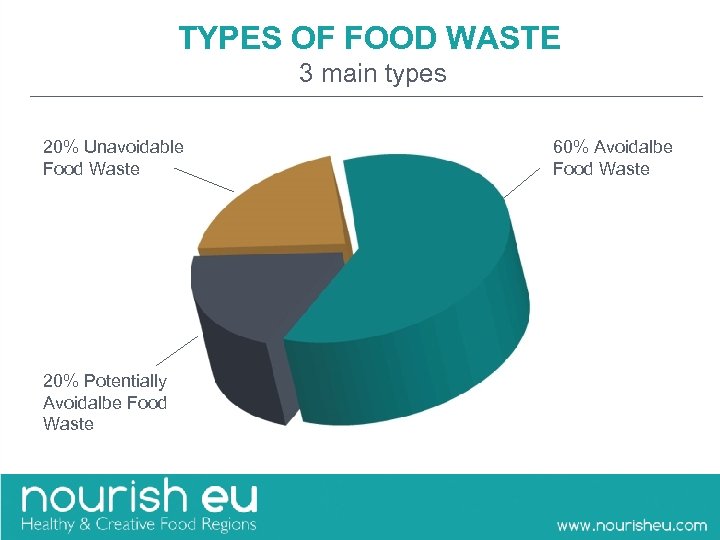 TYPES OF FOOD WASTE 3 main types 20% Unavoidable Food Waste 20% Potentially Avoidalbe Food Waste 60% Avoidalbe Food Waste
 TYPES OF FOOD WASTE 3 main types broken down 60% Avoidable: plate scrapings, leftovers , gone off fruit and veg, passed date items, damaged stock which cannot be used due to Health & Safety, etc. 20% Potentially Avoidable: bread crusts or heels made into bread crumbs, vegetable trimmings used for stock and soups, meat and fish bones used for stock, discarded butter for cooking, old fruit for jams and smoothies, etc. 20% Unavoidable: banana skins, animal bones (before or after used to make stock), unusable prep waste (e. g. potato peels with soil on them), etc
 FOOD WASTE PREVENTION Assessing your Area To prevent Food Waste you must first identify where and why food waste is being generated. Then come up with solutions to prevent this waste as close to the wasting point as possible. Before you start, consider: • The main food waste producing business types in your area • Typical quantities of food waste generated by different business • The main types of food waste generated by different business
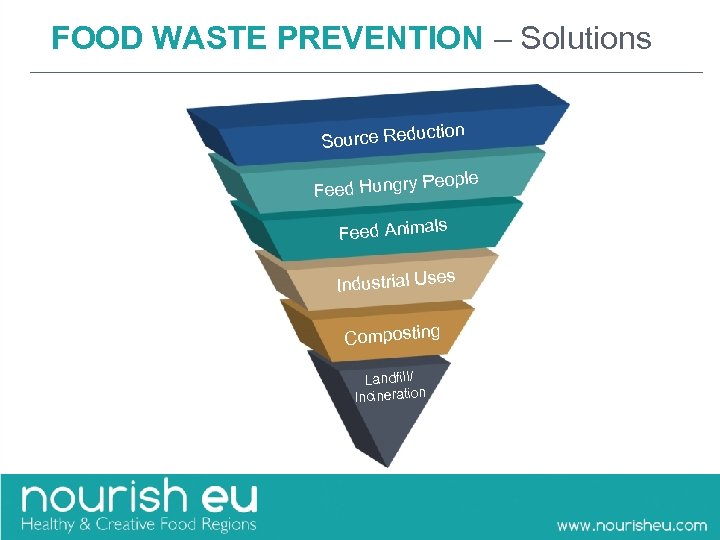 FOOD WASTE PREVENTION – Solutions ction Source Redu People Feed Hungry Feed Animals s Industrial Use Composting Landfill/ Incineration
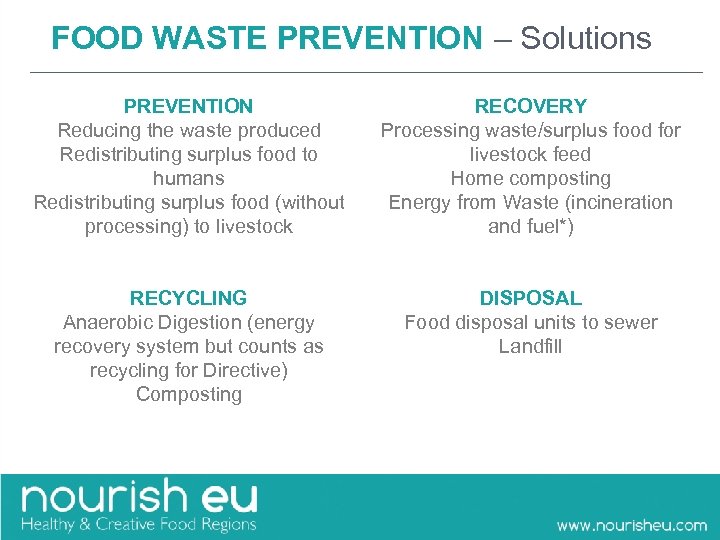 FOOD WASTE PREVENTION – Solutions PREVENTION Reducing the waste produced Redistributing surplus food to humans Redistributing surplus food (without processing) to livestock RECOVERY Processing waste/surplus food for livestock feed Home composting Energy from Waste (incineration and fuel*) RECYCLING Anaerobic Digestion (energy recovery system but counts as recycling for Directive) Composting DISPOSAL Food disposal units to sewer Landfill
 SPOTLIGHT – FOOD WASTE AND FOOD POVERTY IN IRELAND
 Food Waste & Food Poverty in Ireland While large amounts of food waste are generated in Ireland each year, a recent report estimated that around 10% of Irish people are in danger of food poverty and St. Vincent de Paul spends almost € 10 m annually helping families and individuals put food on the table.
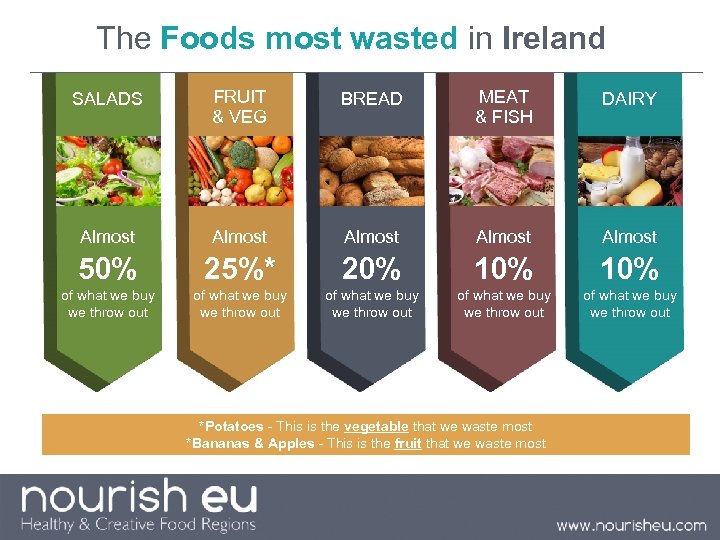 The Foods most wasted in Ireland FRUIT & VEG BREAD MEAT DAIRY & FISH Almost Almost 50% 25%* 20% 10% of what we buy we throw out of what we buy we throw out SALADS *Potatoes - This is the vegetable that we waste most *Bananas & Apples - This is the fruit that we waste most
 Household Food Waste in Ireland According to www. stopfoodwaste. ie Irish households are throwing away 1 million tonnes of food waste every year costing households on average € 700. Despite the advent of brown bins and composting, most of this is still ending up in landfills which has a massive impact on our environment and resources.
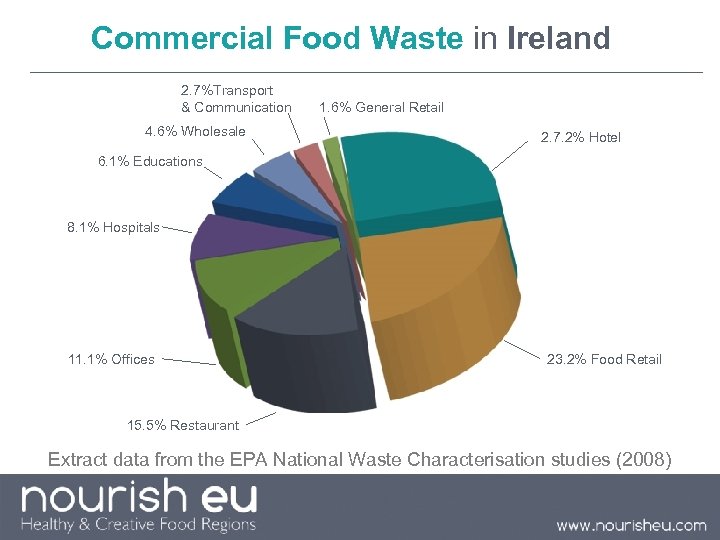 Commercial Food Waste in Ireland 2. 7%Transport & Communication 4. 6% Wholesale 1. 6% General Retail 2. 7. 2% Hotel 6. 1% Educations 8. 1% Hospitals 11. 1% Offices 23. 2% Food Retail 15. 5% Restaurant Extract data from the EPA National Waste Characterisation studies (2008)
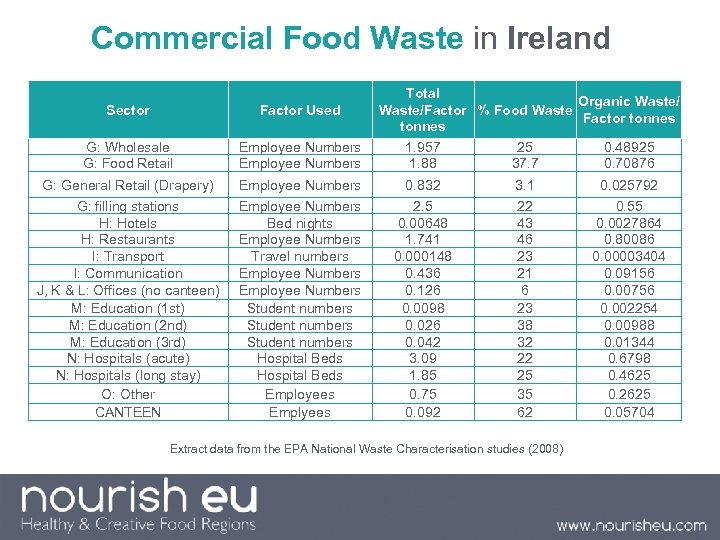 Commercial Food Waste in Ireland Total Organic Waste/Factor % Food Waste Factor tonnes 1. 957 25 0. 48925 1. 88 37. 7 0. 70876 Sector Factor Used G: Wholesale G: Food Retail Employee Numbers G: General Retail (Drapery) Employee Numbers 0. 832 3. 1 0. 025792 G: filling stations H: Hotels H: Restaurants I: Transport I: Communication J, K & L: Offices (no canteen) M: Education (1 st) M: Education (2 nd) M: Education (3 rd) N: Hospitals (acute) N: Hospitals (long stay) O: Other CANTEEN Employee Numbers Bed nights Employee Numbers Travel numbers Employee Numbers Student numbers Hospital Beds Employees Emplyees 2. 5 0. 00648 1. 741 0. 000148 0. 436 0. 126 0. 0098 0. 026 0. 042 3. 09 1. 85 0. 75 0. 092 22 43 46 23 21 6 23 38 32 22 25 35 62 0. 55 0. 0027864 0. 80086 0. 00003404 0. 09156 0. 00756 0. 002254 0. 00988 0. 01344 0. 6798 0. 4625 0. 2625 0. 05704 Extract data from the EPA National Waste Characterisation studies (2008)
 Food Waste in Ireland • In Ireland there is almost half a million tonnes of organic waste generated each year by households and commercial businesses • The majority of this is food based waste through it also includes garden and landscape wastes • The organic waste is split almost 50: 50 between commercial and household • In addition there is significant quantities of process based organic wastes from industrial food processors and producers, much of which goes for rendering
 Food Waste in Ireland - Retailers Irish retailers are also under pressure to reduce food waste.
 Food Waste in Ireland – Some Useful Links www. ghawards. ie www. localprevention. ie www. greenhealthcareprogramme. ie www. foodwaste. ie http: //www. unileverfoodsolutions. ie/ourservices/your-kitchen/wiseuponfoodwaste
 SPOTLIGHT ON FOOD WASTE AND FOOD POVERTY IN THE UK
 Food Waste in Britain There is an estimated 15 million tonnes of food wasted in Britain from the plough to the plate. Tristram Stuart 2009, Waste: Uncovering the Global Food Scandal
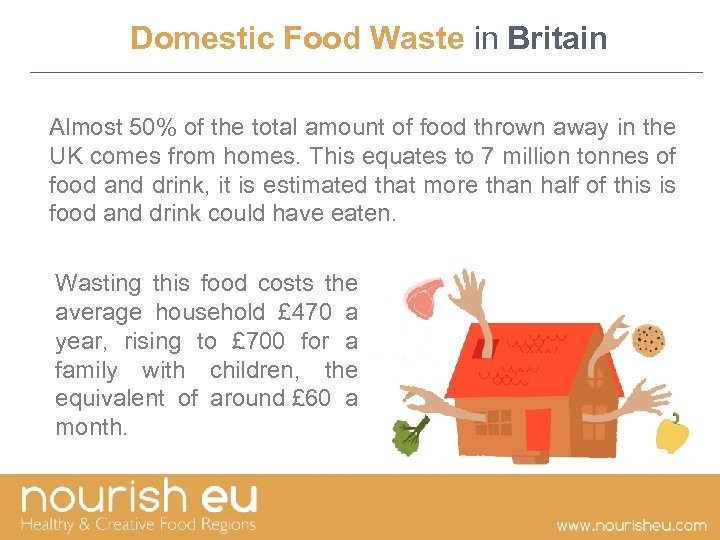 Domestic Food Waste in Britain Almost 50% of the total amount of food thrown away in the UK comes from homes. This equates to 7 million tonnes of food and drink, it is estimated that more than half of this is food and drink could have eaten. Wasting this food costs the average household £ 470 a year, rising to £ 700 for a family with children, the equivalent of around £ 60 a month.
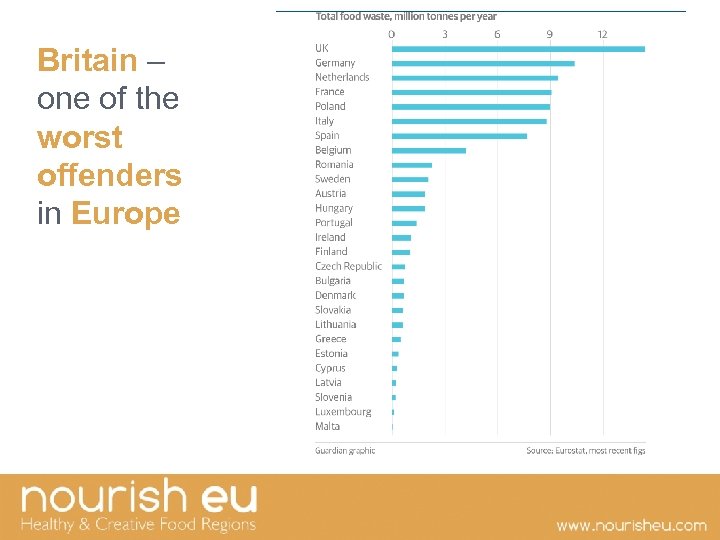 Britain – one of the worst offenders in Europe
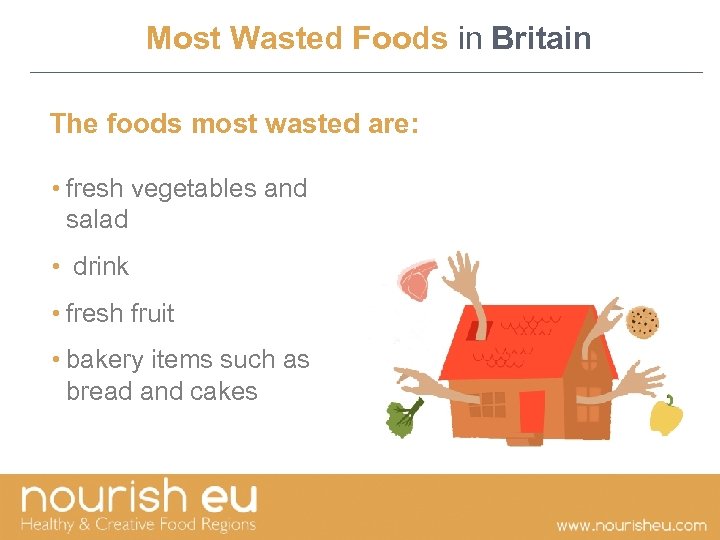 Most Wasted Foods in Britain The foods most wasted are: • fresh vegetables and salad • drink • fresh fruit • bakery items such as bread and cakes
 Food Waste, receiving attention… Supermarkets are under increasing pressure from the public to improve significant waste reductions. The UK government remains adamant that this movement should continue to be voluntary for all supermarkets. France has recently passed a new law in which supermarkets will be banned from throwing away or destroying unsold food, enforcing that ‘waste’ food must instead be donated to charities or be made into animal feed.
 Spotlight on Love Food Hate Waste This is an organisation supported by Waste and Resources Action Plan (WRAP), a not-for-profit organisation in the UK. Their goal is to raise awareness of food waste, and helping people to reduce their own household waste by using up leftovers and buying more than they need. Their comprehensive website includes a shopping list, sell by date information and a smartphone app, which provides recipes on how to use up leftovers They work with a wide range of partners, from community organisations, chefs, UK Governments, UK businesses, trade bodies and local authorities through to individuals looking for practical advice.
 '10 cities' Love Food Hate Waste The Love Food Hate Waste ‘ 10 cities’ campaign is working in Belfast, Birmingham, Cardiff, Glasgow, Greater Manchester, Leeds, Liverpool City Region, Newcastle, Nottingham and Sheffield. The campaign involves Local Authorities, community groups, the public sector, local businesses, and the grocery industry and includes a range activities including Cascade Training, practical cookery classes, kitchen skills programme – Save More, food champion networks, cookery demonstrations, and memorable experiential events in each city. They are collecting pledges from city dwellers committed to Do One Thing Differently to act on their own food waste.
 Food Waste & Tackling Food Poverty Some 43 million people are thought to be at risk of food poverty in Europe. Food Poverty is a key focus of the community and charity sector who are working to tackle the issue. Likewise, policy makers are taking steps to address same.
 Policy Approaches – Northern Ireland A Fitter Future for All: Framework for Preventing and Addressing Overweight and Obesity in Northern Ireland 2012 -2022 The Obesity prevention strategy for Northern Ireland seeks to develop a coordinated approach to address food poverty. The strategy sets medium-term outcomes (2016 to 2019) that ensure local support, resources and facilities are available to those experiencing food poverty. - See more at: https: //www. food. gov. uk/northern-ireland/nutritionni/ninutritionhomeless#sthash. AEzn. Rg 86. dpuf
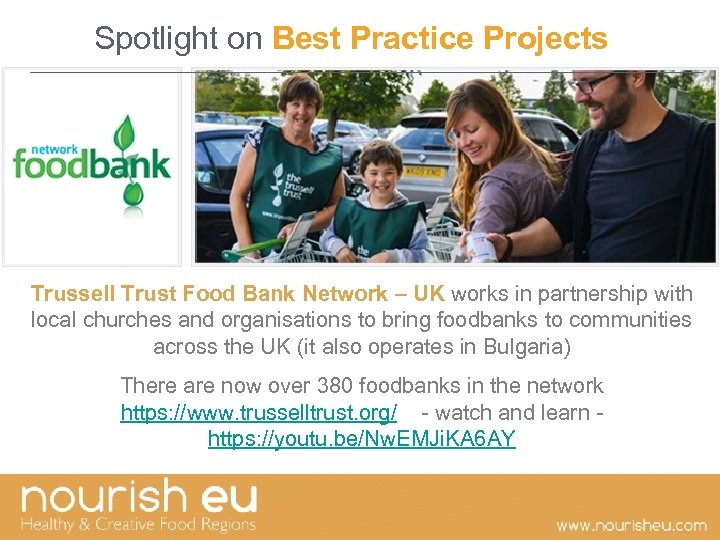 Spotlight on Best Practice Projects Trussell Trust Food Bank Network – UK works in partnership with local churches and organisations to bring foodbanks to communities across the UK (it also operates in Bulgaria) There are now over 380 foodbanks in the network https: //www. trusselltrust. org/ - watch and learn - https: //youtu. be/Nw. EMJi. KA 6 AY
 One such Food Bank – Craigavon Food Bank 4 STEP PROCESSS. . . 1) Food is donated Schools, churches, businesses and individuals donate nonperishable, in-date food to the foodbank. All food given out by foodbanks is donated. ‘Supermarket Collections’ are one of the main ways that food is donated: These are food drives held at supermarkets where volunteers give shoppers a ‘foodbank shopping list’ and ask them to buy an extra item or two for local people in crisis. http: //craigavonarea. foodbank. org. uk/
 One such Food Bank – Craigavon Food Bank 2. Food is sorted and stored Volunteers sort food to check that it’s in date and pack it into boxes ready to be given to people in need. 3. Frontline care professionals identify people in need Care professionals such as doctors, health visitors, social workers, CAB and police identify people in crisis and issue them with a foodbank voucher.
 One such Food Bank – Craigavon Food Bank 4. Clients receive food Foodbank clients bring their voucher to a foodbank centre where it can be redeemed for three days emergency food. Volunteers meet clients over a cup of tea or free hot meal and are able to signpost people to agencies able to solve the longer-term problem. As it involves a wide catchment area, Craigavon foodbank also runs a rural delivery service, which takes emergency foodboxes to clients living in rural areas who cannot afford to get to a foodbank.
 Real life stories For Charlotte, the foodbank was a life saver 21 year-old college student Charlotte had not eaten properly for weeks and could not afford gas to heat her flat when she came to the foodbank in January. After leaving state care she was determined to make something of her life and was funding herself through college. Working two evening jobs to make ends meet, she was made redundant from both within a month. As a 21 -year-old in full time education with no children she did not qualify for benefits. She sold everything she had and, with nowhere else to turn, she asked her local councillor for help; they referred her to the foodbank. When she arrived she was ill, dehydrated and in the first stages of malnutrition. For Charlotte, the foodbank was a life saver. She says she has no idea what she would have done without it. She was so impressed by the support she received that she began volunteering at the foodbank.
 Another great example… Foodcycle is a UK national charity that combines volunteers, surplus food and spare kitchen spaces to create tasty, nutritious meals for people at risk of food poverty and social isolation. They run over 24 projects across the UK, united by the simple idea that food waste and food poverty should not coexist. Their model is simple: they combine surplus food, volunteers and spare kitchen spaces to create nutritious three-course meals for people at risk of food poverty and social isolation. https: //vimeo. com/51527043
 FOOD WASTE INITIATIVES to learn from …
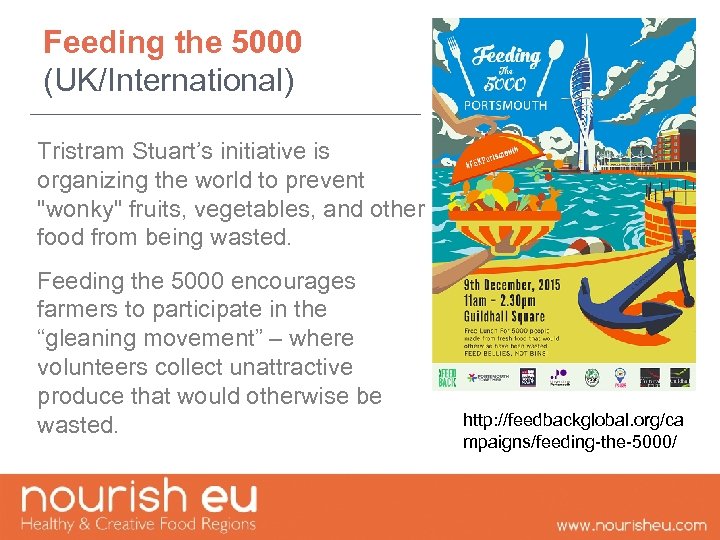 Feeding the 5000 (UK/International) Tristram Stuart’s initiative is organizing the world to prevent "wonky" fruits, vegetables, and other food from being wasted. Feeding the 5000 encourages farmers to participate in the “gleaning movement” – where volunteers collect unattractive produce that would otherwise be wasted. http: //feedbackglobal. org/ca mpaigns/feeding-the-5000/
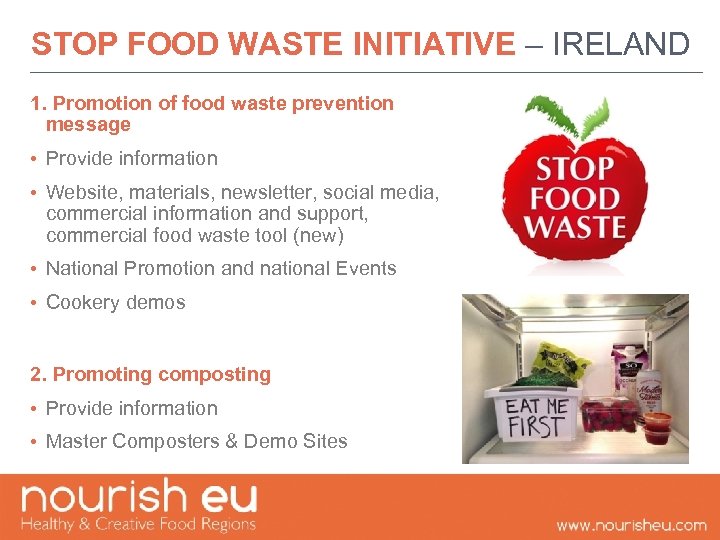 STOP FOOD WASTE INITIATIVE – IRELAND 1. Promotion of food waste prevention message • Provide information • Website, materials, newsletter, social media, commercial information and support, commercial food waste tool (new) • National Promotion and national Events • Cookery demos 2. Promoting composting • Provide information • Master Composters & Demo Sites
 Healthy Food for All – IRELAND Healthy Food for All (HFf. A) is a multi-agency initiative seeking to promote access, availability and affordability of healthy food for low-income groups on the island of Ireland. The initiative sets out to demonstrate the relationship between food poverty and other policy concerns such as health inequalities, welfare adequacy, education disadvantage, food production and distribution, retail planning and food safety. It seeks to identify and galvanise interest in, and commitment to, eliminating food poverty through raising public awareness, policy advocacy, promotion of best practice models and networking local initiatives with national structures.
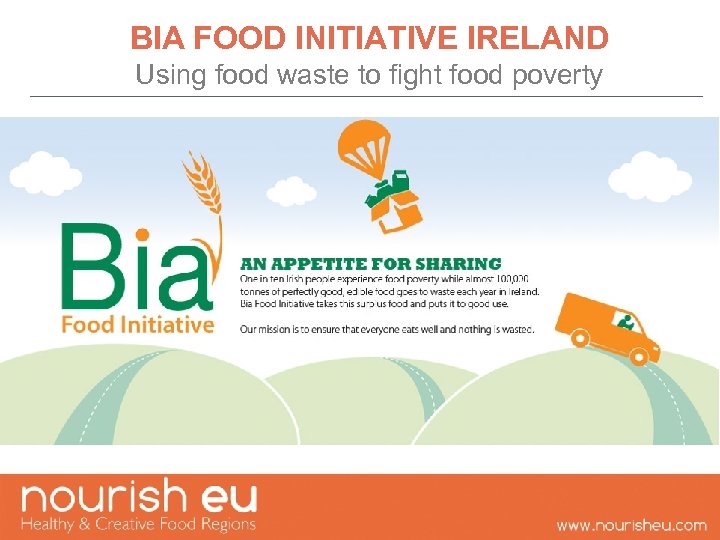 BIA FOOD INITIATIVE IRELAND Using food waste to fight food poverty
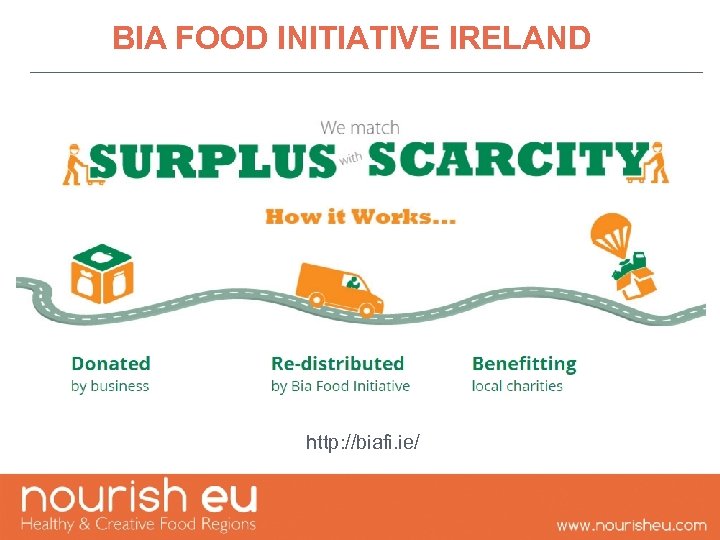 BIA FOOD INITIATIVE IRELAND http: //biafi. ie/
 FOOD CLOUD, Ireland Using food waste to fight food poverty Since 2012, Food. Cloud have been connecting businesses with too much food to charities who have too little. In 2014 they partnered with Tesco to redistribute surplus food from all of their stores in the country. Businesses can upload their daily surplus food to the Food. Cloud app or website and appropriate local charities get alerted and can collect the food. To date they have provided nearly 1. 5 million meals to charities across Ireland helped use over 650 tonnes of food that would otherwise have ended up as waste. http: //foodcloud. net/
 Watch & Learn https: //www. youtube. com/watch? v=81 EDgq. Rq 4 xw&list=PLu s 1 k. Yt. OHque. LZv 3 K 76 BE 6 p. RHIF 0 Crq. IL
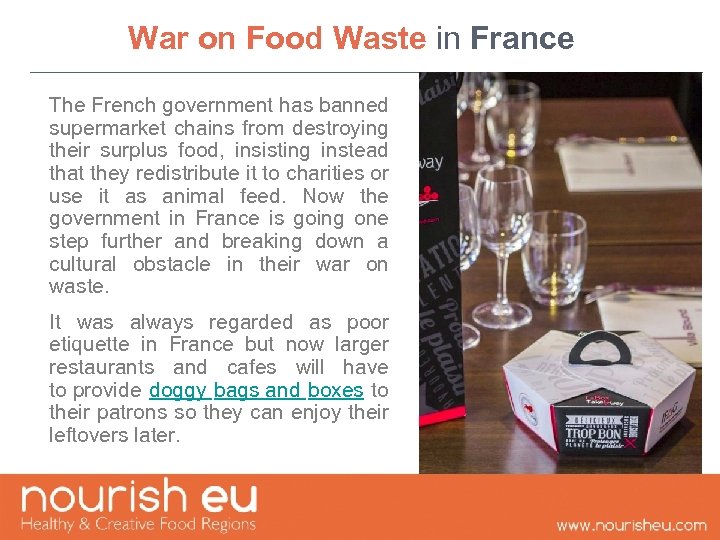 War on Food Waste in France The French government has banned supermarket chains from destroying their surplus food, insisting instead that they redistribute it to charities or use it as animal feed. Now the government in France is going one step further and breaking down a cultural obstacle in their war on waste. It was always regarded as poor etiquette in France but now larger restaurants and cafes will have to provide doggy bags and boxes to their patrons so they can enjoy their leftovers later.
 War on Food Waste in the UK In 2011, Re. Food launched Vision 2020: UK roadmap to zero food waste to landfill. Using insight and experience from industry stakeholders, the report is a comprehensive guide to minimising both avoidable and unavoidable food waste in the UK. Since its launch, Re. Food has been promoting the importance of a comprehensive national waste strategy and lobbying the government to make policy changes surrounding the food waste debate.
 Lessons from Europe
 Stop Spild Af Mad (Stop Wasting. Food) (Denmark) Danish food expert Selina Juul’s campaign inspired Danish supermarket Rema 1000 to replace buy-one-get-one-free and other quantity-based discounts with general discounts in all of its stores. Such discounts, frequently implemented by grocery stores to get produce off the shelves, often result in food being wasted at home.
 Save Food from the Fridge (The Netherlands) Jihyun Ryou, Korean designer and expert on food preservation, launched this project that attempts to prevent waste in homes. She outlines several ideas for keeping foods fresher longer without the use of modern kitchen technologies
 Policy Agenda for Sustainable Food Systems (The Netherlands) In 2009, the Dutch Parliament issued a policy paper (Policy Agenda for Sustainable Food Systems) identifying a number of issues that could significantly contribute to the achievement of a more sustainable food chain. The adopted policy, aimed at a 20 percent food waste reduction by 2015, set a number of projects directed at raising consumers awareness and promoting technologies to reduce wastage in the agro-chain production. The document also urges legislators to repeal regulations which enhance food wastage, such as expiration dates regulations, liability for food donors and use of byproducts as animal feedstuff.
 Policy Agenda for Sustainable Food Systems (The Netherlands) Among the Dutch most notable initiatives, the Small Business Innovation Research instrument (part of the Impulse Programme for Sustainable Agro-chains) provides institutional support for initiatives aimed at preventing and reducing food waste. Through this, the Ministry of Agriculture, Nature and Food Quality provides grants and reimburses costs for research or training projects, feasibility studies, pilot projects, etc.
 Other Initiatives from Around the World. .
 City of Austin’s Zero Waste Initiative (Texas, United States) The Austin City Council recently voted unanimously in support of a city ordinance to require all restaurants over 460 square meters (5, 000 square feet) to separate all compostable materials from other waste by 2016. Smaller restaurants will have to undertake the initiative by 2017. This is part of Austin’s goal to reduce the amount of waste sent to landfills by 90 percent by 2040.
 WATCH & LEARN Very interesting TEDx Talks Recipe for cutting food waste Peter Lehner | TEDx. Manhattan https: //www. youtube. com/watch? v=Uw. OHp. WTRsb. E
 What can governments, policy makers & other senior influencers do to reduce food waste?
 Policy makers and local governments are uniquely placed to ensure that different policies across departments, and the way these are communicated and implemented, support efforts to reduce food waste. Please consider how the following strategies could be adopted at a local level to make a difference. . .
 1) Raise Awareness It is important that Policy Makers and Senior Influencers raise awareness of the urgent need to tackle food waste, the benefits of doing so and how this fits in to regional or national priorities. This can be done through a range of audience specific channels, trusted intermediaries and with tailored and effective messages, and crucially directing people to where they can get inspiration and help to take action is a critical first step
 2) Education & Training It is important that both children and adults are provided with the knowledge and skills necessary to manage food at home and in the workplace in such a way that supports food waste prevention and efficient and competitive business, and this needs to be reflected in school curricula and access to adult education. Educating businesses on waste reduction is also a very worthy investment – see Module 4 : How to ‘Lean and Green’ Food Services
 3) Integrated advice on healthy eating & food waste It is important that there is an integrated approach to policies around food waste and healthy eating, as encouraging consumers or schools and other institutions to purchase healthier and often more perishable food, without equipping them with the necessary skills to use such produce, risks more food being wasted. Many of the behaviours and skills key to reducing food waste are also relevant - for example better planning and portion control will help reduce waste, and also support moves to eating the right amounts of food. Building confidence and skills around managing and preparing food is important to help reduce waste, and could also support moves to adopt a more balanced diet and reductions in food borne illness.
 4) Strategies for the collection of food waste Supporting the establishment of Food Banks in an area is a very worthwhile investment. 5) Procurement strategies & contracts A significant percentage of meals eaten by people around the world will be provided for directly, or indirectly via contractors, as part of government services. For example at least 30% of all meals in the UK are provided through the education, healthcare and other government funded institutions. This provides an opportunity to influence waste arising during preparation and via diners.
 At a government level, measures that can be utilised include Tax and food safety regulations that can act to promote the redistribution of surplus food for human consumption. Regulations that influence what food waste and related by-products can safely be used as animal feed
 Strategies for Policies that relate to food packaging Whilst there are legitimate concerns about over-packaging food, the appropriate amounts of modern packaging can act to significantly reduce food waste through protecting food from damage, extending shelf-life etc. Action focussed purely on reducing the amount of packaging, without considering the benefits to food waste prevention, can have unintended consequences. Similarly communication around packaging needs to be balanced, to ensure that consumers and other users of food bought pre-packed get the maximum benefit from the packaging (and also recycle that packaging to minimise its impact further).
 Food labelling & hygiene/safety policy Clear communication of nutritional content and instructions to maintain food safety are paramount, but guidance can also be given to those providing and using such information to encourage the use of the most appropriate and helpful information to help reduce waste, for example applying ‘best before’ rather than ‘use by’ dates where possible, communicating whether products can be frozen, when and for how long, and how best to store foods for maximum safe and high quality life. This covers both mandatory requirements and non-mandatory best practice.