


 Скачать презентацию Paper Dictionary Its Virtual Version Making a
63d9baa4bdb6314d014ce145de34ca46.ppt
- Количество слайдов: 18
 Paper Dictionary & Its Virtual Version Making a Traditional Dictionary into an Electronic Lexicon Udaya Narayana Singh CIIL, Mysore
 1. Paper Dictionaries n ‘Easy to use’ theory u u u Easy to browse – with a flip, pages will open, and alphabetically, entries will flow on Easy to procure – in terms of distribution & availability Easy to buy – cheaper than usual reference books, and more the popularity, the greater are chances of a cheaper and localized (say, Asian? ) edition or a paper back version Easy to replicate – In different sizes (royal/demy/crown, etc) and word-volumes (10, 000 most frequent words, 30, 000 word dic, or large comprehensive dictionaries, etc) Easy to use – all you require is the power of vision, a definite search requirement, a knowledge of order of alphabets, and an idea of arrangements of sub-entries and information under a lemma Easy to apply – does not make any assumptions about users’ knowledge, and hence makes everything (including most obvious grammatical descriptions) explicit
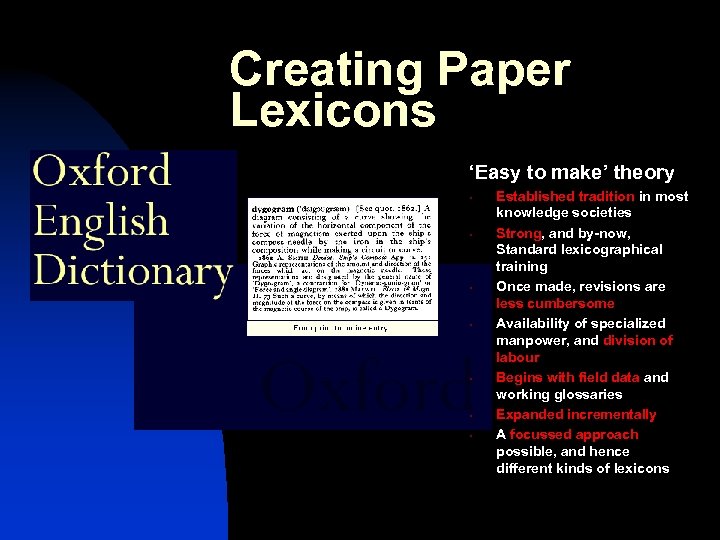 Creating Paper Lexicons ‘Easy to make’ theory • • Established tradition in most knowledge societies Strong, and by-now, Standard lexicographical training Once made, revisions are less cumbersome Availability of specialized manpower, and division of labour Begins with field data and working glossaries Expanded incrementally A focussed approach possible, and hence different kinds of lexicons
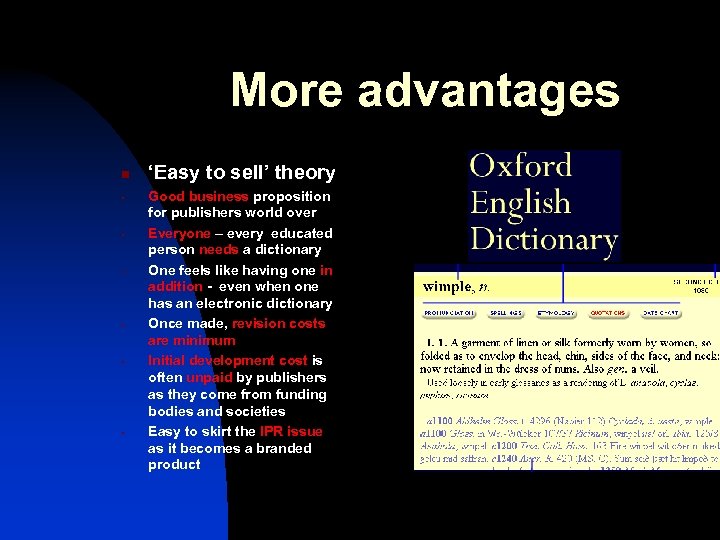 More advantages n • • • ‘Easy to sell’ theory Good business proposition for publishers world over Everyone – every educated person needs a dictionary One feels like having one in addition - even when one has an electronic dictionary Once made, revision costs are minimum Initial development cost is often unpaid by publishers as they come from funding bodies and societies Easy to skirt the IPR issue as it becomes a branded product
 2. Basic Disadvantages n n n Slim ones are not comprehensive Comprehensive ones are bulky Bulky ones tear off easily Weight makes them difficult to handle, even if binding lasts long Difficult to make it more than bilingual – almost impossible beyond trilingual Complicated entries become invariably longer – consequently difficult to use Addition of contexts is ideal but expensive – to create/buy/refer to Spelling variation usually not taken care of Further, one must know the exact spelling to refer to One must have also mastered the pattern to know if a search is inside a head-entry as a sub- or sub-entry Once published, a paper lexicon becomes dated whereas the concerned language, as we know, is ever-evolving Size restrictions hamper their coverage
 3. Problems with Paper Lexicons in an Electronic Age n n n n Working on two modes at a time difficult Working bi-modally is also time consuming & clumsy For translators, and users of bilingual resources, reading orientation is not easy – traveling from one system to another Big difference in terms of space, color, shade, light, background & type-styles For each purpose, a different paper lexicon is needed Often several are used as same words are described differently in diff. lexicons Since paper lexicons are not necessarily culled out of texts/corpora/data/records, co-referencing is limited
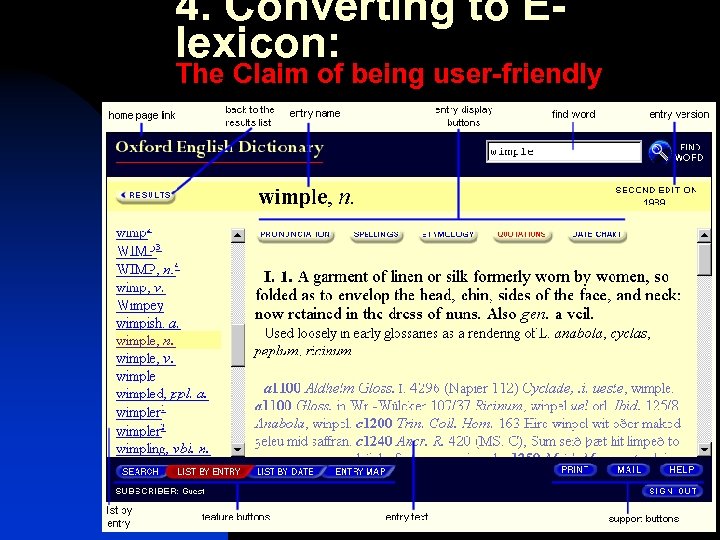 4. Converting to Elexicon: The Claim of being user-friendly
 5. Distinct advantages n n Many volumes with addon parts get compressed into one e-lexicon Time taken to create truly large dictionaries, such as OED (=44 years, 18841928) with its supplementaries (1933 & 1972 -86) get converted into e-mode in 10 years (1990 -2000) 34 million pound sterling spent on e-conversion. But once it is created, updating is hastle-free. Storage and retrieval become quick and easy
 6. More plus-points • • • • Watch out the volume, too: Search zilions of information with the click of a mouse Use it as a word-finder (= meaning known but the word forgotten) Find all foreign words & expressions Find dialectal variations Find all instances of classical borrowing Find collocations and contexts Find out the etymon Search for quotations from a large bank Search for contemporary use from on-line texts Search for all usages -- author-wise, genre-wise and age-wise Use it as a companion volume to social & literary history Display entries according to your needs – in detail or in brief Turn on and off pronunciation and variant spellings Gain access to new and revised words every month/quarter One need not wait for the next edition for updation
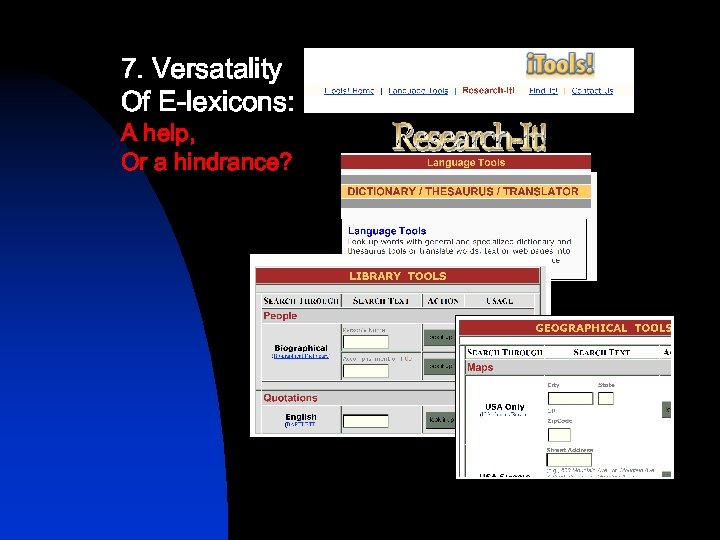 7. Versatality Of E-lexicons: A help, Or a hindrance?
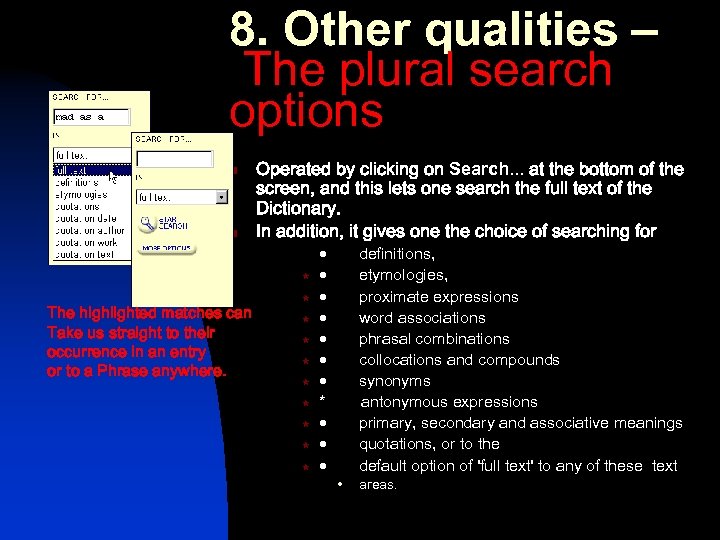 8. Other qualities – The plural search options n n Operated by clicking on Search. . . at the bottom of the screen, and this lets one search the full text of the Dictionary. In addition, it gives one the choice of searching for « The highlighted matches can Take us straight to their occurrence in an entry or to a Phrase anywhere. « « « « « · definitions, · etymologies, · proximate expressions · word associations · phrasal combinations · collocations and compounds · synonyms * antonymous expressions · primary, secondary and associative meanings · quotations, or to the · default option of 'full text' to any of these text • areas.
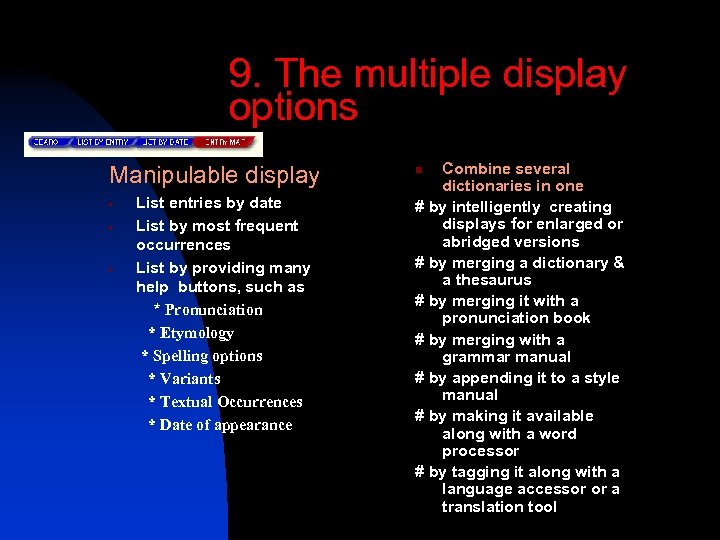 9. The multiple display options Manipulable display • • • List entries by date List by most frequent occurrences List by providing many help buttons, such as * Pronunciation * Etymology * Spelling options * Variants * Textual Occurrences * Date of appearance Combine several dictionaries in one # by intelligently creating displays for enlarged or abridged versions # by merging a dictionary & a thesaurus # by merging it with a pronunciation # by merging with book a grammar manual # by appending it to a style manual # by making it available along with a word processor # by tagging it along with a language accessor or a translation tool n
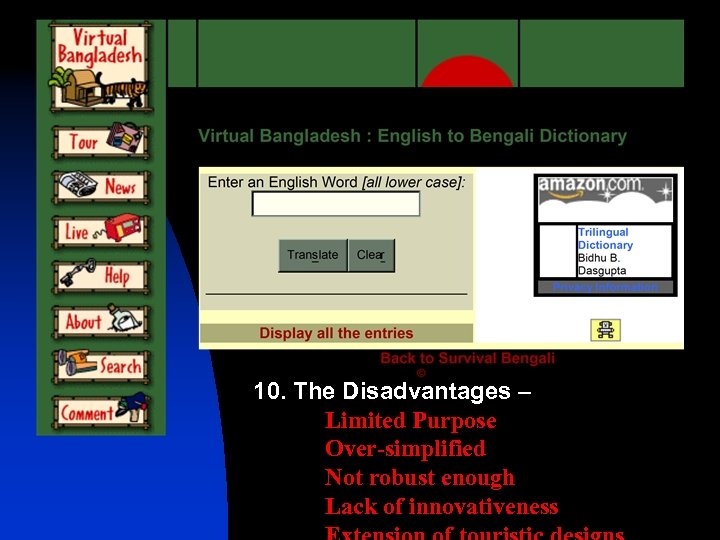 10. The Disadvantages – Limited Purpose Over-simplified Not robust enough Lack of innovativeness
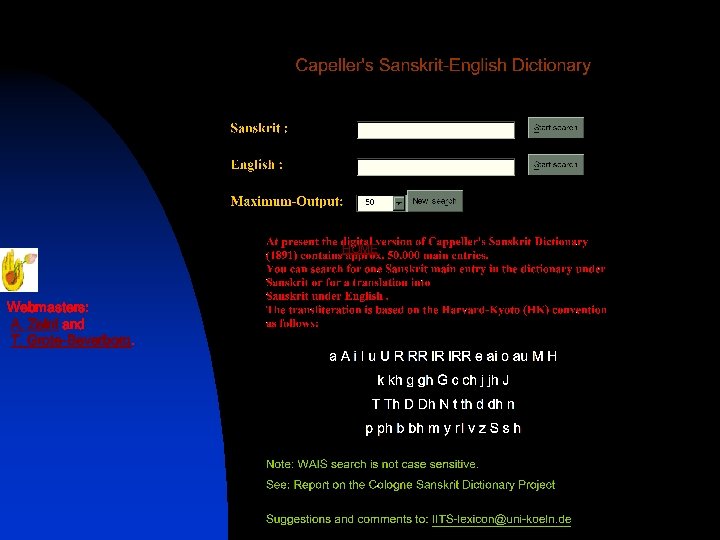 HOME Webmasters: A. Zeini and T. Grote-Beverborg.
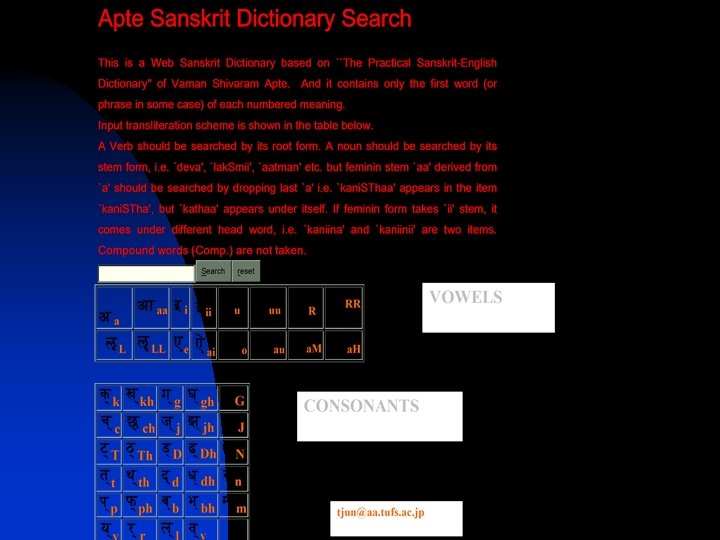
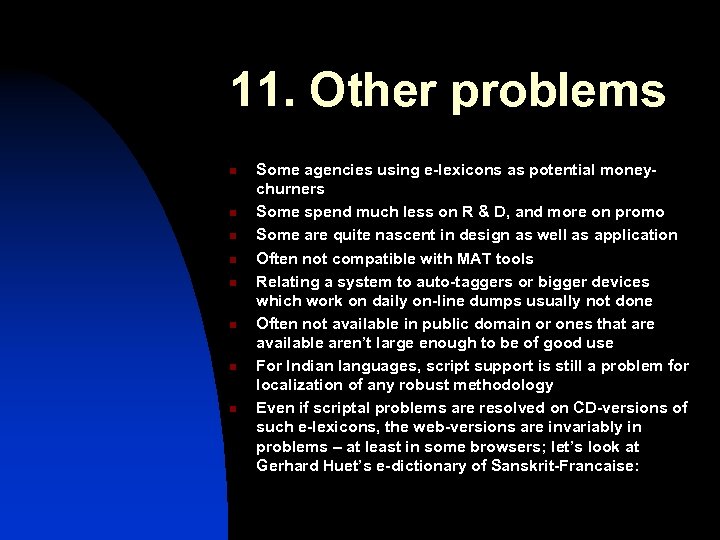 11. Other problems n n n n Some agencies using e-lexicons as potential moneychurners Some spend much less on R & D, and more on promo Some are quite nascent in design as well as application Often not compatible with MAT tools Relating a system to auto-taggers or bigger devices which work on daily on-line dumps usually not done Often not available in public domain or ones that are available aren’t large enough to be of good use For Indian languages, script support is still a problem for localization of any robust methodology Even if scriptal problems are resolved on CD-versions of such e-lexicons, the web-versions are invariably in problems – at least in some browsers; let’s look at Gerhard Huet’s e-dictionary of Sanskrit-Francaise:
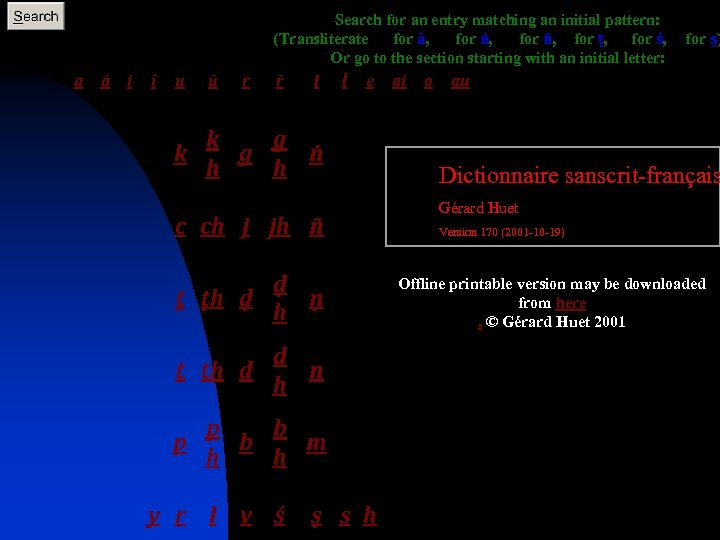 ū ṛ Search for an entry matching an initial pattern: (Transliterate aa for ā, "n for ṅ, ~n for ñ, . t for ṭ, "s for ś, . s for ṣ) Or go to the section starting with an initial letter: ṝ ḷ ḹ e ai o au a ā i ī u k g ṅ h h Dictionnaire sanscrit-français Gérard Huet c ch j jh ñ ḍ ṭ ṭh ḍ ṇ h Offline printable version may be downloaded from here. © Gérard Huet 2001 Version 170 (2001 -10 -19) d t th d n h p p b b m h h y r l v ś ṣ s h
 12. Where do we go from here? n n n n Priority 1: Solve the Indian languages script problem on both UNIX and Windows environments. With Linux localization done by NCST, let’s tackle the other. Priority 2: Let’s convert all available lexical resources into Elexicons, with of course, necessary editing and add-on features. Priority 3: Enhance Indian languages corpora – add voice corpora as well as efficient tagging devices. Priority 4: Quick look-ups for translators could be made ready even before fashionable products are launched, purely to enable translators work on-line. Priority 5: Set up large-scale longer-term institutions or instruments for lexicographical work which would be authoritative, comprehensive, multi-utility, and also constantly up -dating. Priority 6: Design things in a manner so as to make the lexical resources useful for more difficult products such as MAT systems, etc. Priority 7: Link up as many Indian languages pairs as possible, and if possible, use trilingual formats, by involving both English and Hindi.