


 Скачать презентацию Pangeanic in the EXPERT Project EXPloiting Empirical
fabc20f51e4b19378289c53067848965.ppt
- Количество слайдов: 1
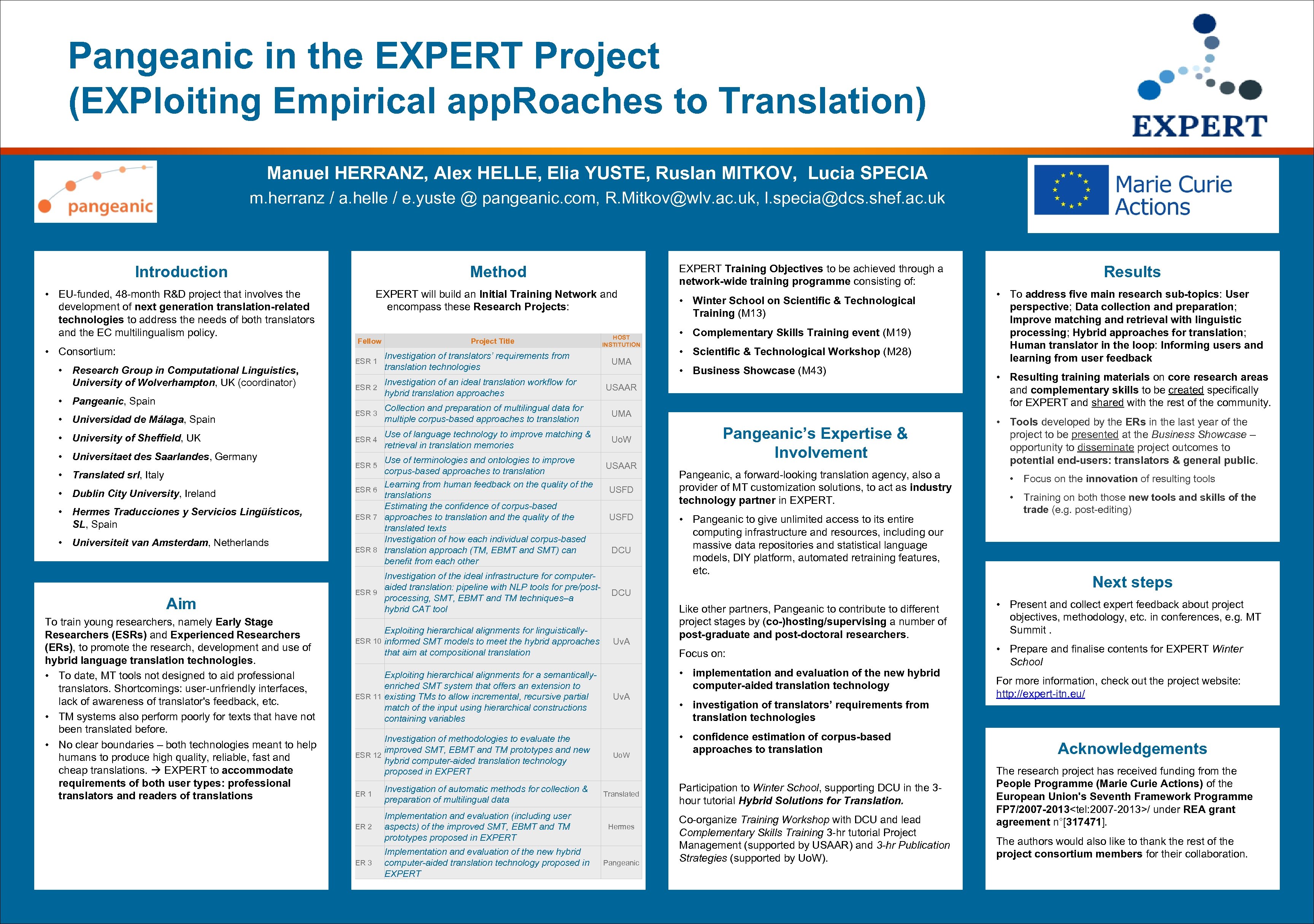 Pangeanic in the EXPERT Project (EXPloiting Empirical app. Roaches to Translation) Manuel HERRANZ, Alex HELLE, Elia YUSTE, Ruslan MITKOV, Lucia SPECIA m. herranz / a. helle / e. yuste @ pangeanic. com, R. Mitkov@wlv. ac. uk, l. specia@dcs. shef. ac. uk EXPERT Training Objectives to be achieved through a network-wide training programme consisting of: Introduction Method • EU-funded, 48 -month R&D project that involves the development of next generation translation-related technologies to address the needs of both translators and the EC multilingualism policy. EXPERT will build an Initial Training Network and encompass these Research Projects: • Consortium: • Research Group in Computational Linguistics, University of Wolverhampton, UK (coordinator) • Pangeanic, Spain • Universidad de Málaga, Spain • University of Sheffield, UK • Universitaet des Saarlandes, Germany • Translated srl, Italy • Dublin City University, Ireland • Hermes Traducciones y Servicios Lingüísticos, SL, Spain • Universiteit van Amsterdam, Netherlands Aim To train young researchers, namely Early Stage Researchers (ESRs) and Experienced Researchers (ERs), to promote the research, development and use of hybrid language translation technologies. • To date, MT tools not designed to aid professional translators. Shortcomings: user-unfriendly interfaces, lack of awareness of translator's feedback, etc. • TM systems also perform poorly for texts that have not been translated before. • No clear boundaries – both technologies meant to help humans to produce high quality, reliable, fast and cheap translations. EXPERT to accommodate requirements of both user types: professional translators and readers of translations Fellow Project Title Investigation of translators’ requirements from ESR 1 translation technologies Investigation of an ideal translation workflow for ESR 2 hybrid translation approaches HOST INSTITUTION UMA • Winter School on Scientific & Technological Training (M 13) • Complementary Skills Training event (M 19) • Scientific & Technological Workshop (M 28) • Business Showcase (M 43) USAAR ESR 3 Collection and preparation of multilingual data for multiple corpus-based approaches to translation UMA ESR 4 Use of language technology to improve matching & retrieval in translation memories Uo. W Use of terminologies and ontologies to improve corpus-based approaches to translation Learning from human feedback on the quality of the ESR 6 translations Estimating the confidence of corpus-based ESR 7 approaches to translation and the quality of the translated texts Investigation of how each individual corpus-based ESR 8 translation approach (TM, EBMT and SMT) can benefit from each other ESR 5 USAAR USFD DCU Investigation of the ideal infrastructure for computeraided translation: pipeline with NLP tools for pre/post. ESR 9 processing, SMT, EBMT and TM techniques–a hybrid CAT tool Uv. A Pangeanic, a forward-looking translation agency, also a provider of MT customization solutions, to act as industry technology partner in EXPERT. • Pangeanic to give unlimited access to its entire computing infrastructure and resources, including our massive data repositories and statistical language models, DIY platform, automated retraining features, etc. DCU Exploiting hierarchical alignments for linguistically. ESR 10 informed SMT models to meet the hybrid approaches that aim at compositional translation Pangeanic’s Expertise & Involvement Exploiting hierarchical alignments for a semanticallyenriched SMT system that offers an extension to ESR 11 existing TMs to allow incremental, recursive partial match of the input using hierarchical constructions containing variables Investigation of methodologies to evaluate the improved SMT, EBMT and TM prototypes and new ESR 12 hybrid computer-aided translation technology proposed in EXPERT ER 1 Investigation of automatic methods for collection & preparation of multilingual data ER 2 Implementation and evaluation (including user aspects) of the improved SMT, EBMT and TM prototypes proposed in EXPERT ER 3 Implementation and evaluation of the new hybrid computer-aided translation technology proposed in EXPERT Results • To address five main research sub-topics: User perspective; Data collection and preparation; Improve matching and retrieval with linguistic processing; Hybrid approaches for translation; Human translator in the loop: Informing users and learning from user feedback • Resulting training materials on core research areas and complementary skills to be created specifically for EXPERT and shared with the rest of the community. • Tools developed by the ERs in the last year of the project to be presented at the Business Showcase – opportunity to disseminate project outcomes to potential end-users: translators & general public. • Focus on the innovation of resulting tools • Training on both those new tools and skills of the trade (e. g. post-editing) Next steps Like other partners, Pangeanic to contribute to different project stages by (co-)hosting/supervising a number of post-graduate and post-doctoral researchers. • Present and collect expert feedback about project objectives, methodology, etc. in conferences, e. g. MT Summit. Focus on: • Prepare and finalise contents for EXPERT Winter School • implementation and evaluation of the new hybrid computer-aided translation technology Uv. A Uo. W Translated Hermes Pangeanic • investigation of translators’ requirements from translation technologies • confidence estimation of corpus-based approaches to translation Participation to Winter School, supporting DCU in the 3 hour tutorial Hybrid Solutions for Translation. Co-organize Training Workshop with DCU and lead Complementary Skills Training 3 -hr tutorial Project Management (supported by USAAR) and 3 -hr Publication Strategies (supported by Uo. W). For more information, check out the project website: http: //expert-itn. eu/ Acknowledgements The research project has received funding from the People Programme (Marie Curie Actions) of the European Union's Seventh Framework Programme FP 7/2007 -2013