


 Скачать презентацию Panel — IS History The Origins of IS
cabf363c7c910d005d95faf79e7ed4c5.ppt
- Количество слайдов: 35
 Panel - IS History: The Origins of IS in Different Regions Ping Zhang, Syracuse University Niels Bjørn-Andersen, AIS LEO award winner, Copenhagen Business School Phillip Ein-Dor, AIS LEO award winner, Tel Aviv University Frank Land, AIS LEO award winner, London School of Economics Carol Saunders, AIS LEO award winner, University of Central Florida
 Why Focusing on IS History? • What for: History shapes a field, gives a unique identity of a field • Why now: To maintain the legacy and heritage of the IS field by starting now when many pioneers in our field are still among us • What to do: To collect, preserve, interpret, write and disseminate the history of the IS field ECIS 13 Panel on IS History 2
 IS History Initiatives • ECIS 13 Panel: The origins of IS in different regions • PACIS 13 Panel: What IS history is and how to best represent it • AMCIS 13 Panel: Timeline and institutional roles of IS • http: //history. aisnet. org • IS History group at Mendeley ECIS 13 Panel on IS History 3
 ECIS Panel Questions • Q 1. What have been the origins and development of global IS communities and infrastructure? • Q 2. What have been the intellectual challenges and advances in different regions? Have we missed some sections or topics that should be part of the IS domain? • Q 3. What do our recollections on Q 1 and Q 2 reveal about the success (or failure) of our academic discipline? What can we learn to benefit our discipline’s future? ECIS 13 Panel on IS History 4
 Panel - IS History: The Origins of IS in Different Regions Frank Land AIS LEO award winner, London School of Economics
 Q 1. What have been the origins and development of global IS communities and infrastructure? Pre-History Office Machinery communities, O&M communities Origins in Practice in early 1950 s Users, Vendors, Consultants, Gurus
 Q 1. What have been the origins and development of global IS communities and infrastructure? IS as Academic Discipline • Training new skills – Polytechnics in 50 s and 60 s, Universities in late 60 s – NCC • Emphasis Technical, and on Development • Little theory ECIS 13 Panel on IS History - Frank 7
 Q 2. What have been the intellectual challenges Challenges for practitioners • IS people as outsiders • What is value of IS • Difficulty of Proof Academic Challenges • Explaining IS Phenomenon • Placing IS in Context • Achieving acceptance of IS as discipline ECIS 13 Panel on IS History - Frank 8
 Q 2: What have we missed? • • Emphasis on benefits and how to get them Missing: the Dark Side such as Pornography Embedded systems: the motor car as IS Cyberwarfare ECIS 13 Panel on IS History - Frank 9
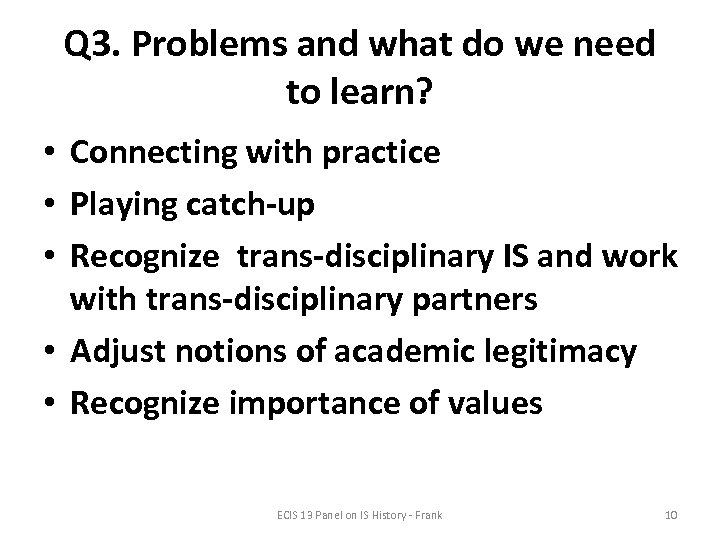 Q 3. Problems and what do we need to learn? • Connecting with practice • Playing catch-up • Recognize trans-disciplinary IS and work with trans-disciplinary partners • Adjust notions of academic legitimacy • Recognize importance of values ECIS 13 Panel on IS History - Frank 10
 IS History: The origin of IS in Different Regions Case of Scandinavia Niels Bjørn-Andersen Copenhagen Business School ECIS Utrecht 6 th June 2013
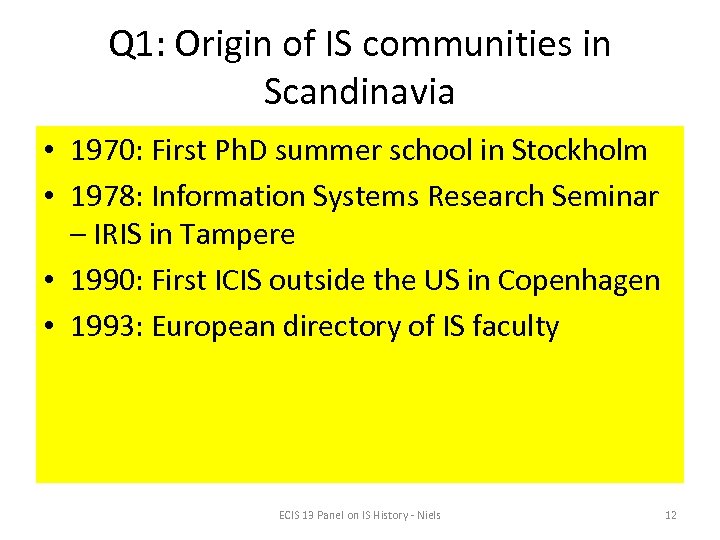 Q 1: Origin of IS communities in Scandinavia • 1970: First Ph. D summer school in Stockholm • 1978: Information Systems Research Seminar – IRIS in Tampere • 1990: First ICIS outside the US in Copenhagen • 1993: European directory of IS faculty ECIS 13 Panel on IS History - Niels 12
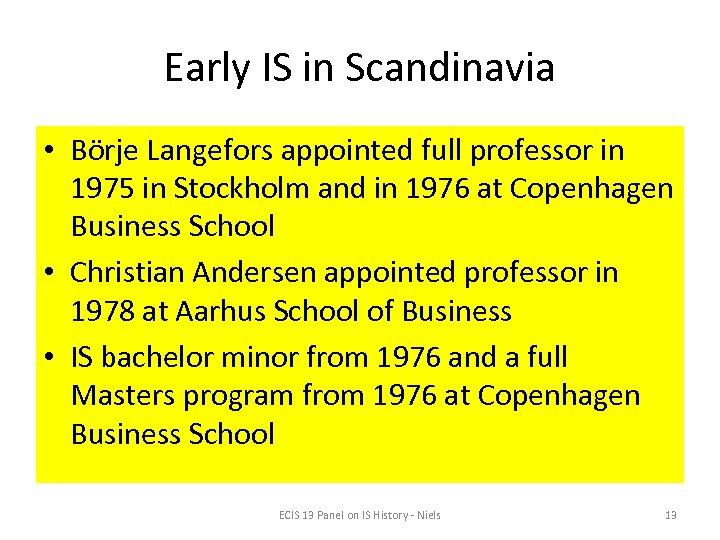 Early IS in Scandinavia • Börje Langefors appointed full professor in 1975 in Stockholm and in 1976 at Copenhagen Business School • Christian Andersen appointed professor in 1978 at Aarhus School of Business • IS bachelor minor from 1976 and a full Masters program from 1976 at Copenhagen Business School ECIS 13 Panel on IS History - Niels 13
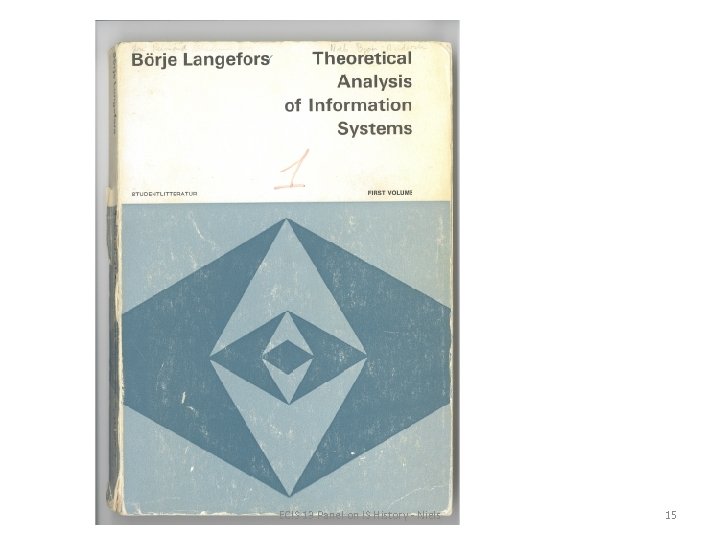
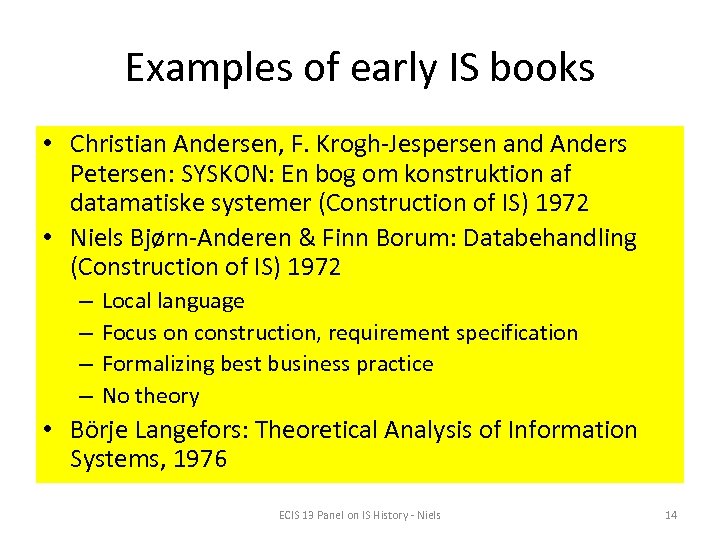 Examples of early IS books • Christian Andersen, F. Krogh-Jespersen and Anders Petersen: SYSKON: En bog om konstruktion af datamatiske systemer (Construction of IS) 1972 • Niels Bjørn-Anderen & Finn Borum: Databehandling (Construction of IS) 1972 – – Local language Focus on construction, requirement specification Formalizing best business practice No theory • Börje Langefors: Theoretical Analysis of Information Systems, 1976 ECIS 13 Panel on IS History - Niels 14
 ECIS 13 Panel on IS History - Niels 15
 • International Federation of Information Processing was founded by UNESCO founded in 1960 – first successes were the ACOL 60 and the CODASYL standard • Technical Committees established for relevant topics when the community was strong enough for it, like e. g. Technical Committee 8 on Information Systems ECIS 13 Panel on IS History - Niels 16
 • Established in 1976 • Börje Langefors as chairman • National representatives included also Niels Bjørn. Andersen, Burt Swanson, Arne Sølvbjerg, Axel Verrijn. Stuart, later Gordon Davis • Established from start two Working Groups: – WG 8. 1 - Design and Evaluation of Information Systems – WG 8. 2 - The Interaction of Information Systems and the Organization ECIS 13 Panel on IS History - Niels 17
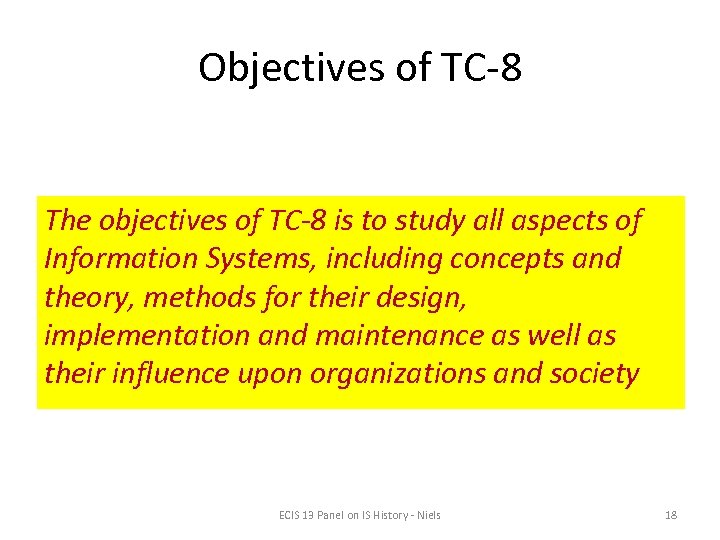 Objectives of TC-8 The objectives of TC-8 is to study all aspects of Information Systems, including concepts and theory, methods for their design, implementation and maintenance as well as their influence upon organizations and society ECIS 13 Panel on IS History - Niels 18
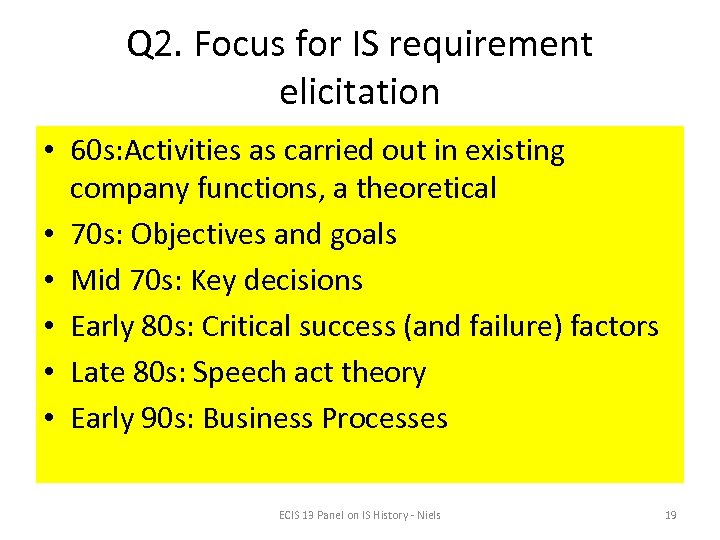 Q 2. Focus for IS requirement elicitation • 60 s: Activities as carried out in existing company functions, a theoretical • 70 s: Objectives and goals • Mid 70 s: Key decisions • Early 80 s: Critical success (and failure) factors • Late 80 s: Speech act theory • Early 90 s: Business Processes ECIS 13 Panel on IS History - Niels 19
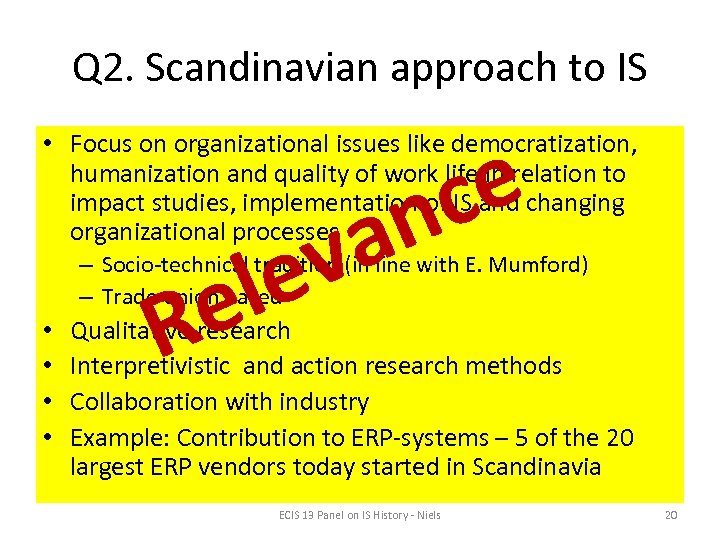 Q 2. Scandinavian approach to IS e c n a • Focus on organizational issues like democratization, humanization and quality of work life in relation to impact studies, implementation of IS and changing organizational processes e R v le – Socio-technical tradition (in line with E. Mumford) – Trade union based • • Qualitative research Interpretivistic and action research methods Collaboration with industry Example: Contribution to ERP-systems – 5 of the 20 largest ERP vendors today started in Scandinavia ECIS 13 Panel on IS History - Niels 20
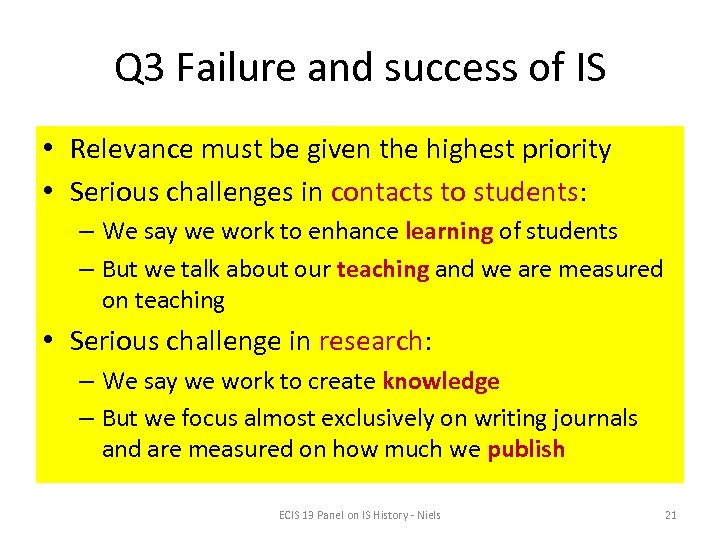 Q 3 Failure and success of IS • Relevance must be given the highest priority • Serious challenges in contacts to students: – We say we work to enhance learning of students – But we talk about our teaching and we are measured on teaching • Serious challenge in research: – We say we work to create knowledge – But we focus almost exclusively on writing journals and are measured on how much we publish ECIS 13 Panel on IS History - Niels 21
 Direction forward • We need to be more relevant • We need to provide (measurable) value to our three key constituents – Students – Industry/public administration (IT managers /CIOs) – Policy makers (politicians, citizens) • We need to be more strategic and address decision makers – good news is that we have better possibilities than our b-school colleagues ECIS 13 Panel on IS History - Niels 22
 Panel - IS History: The Origins of IS in Different Regions Phillip Ein-Dor Tel-Aviv University Academic College of Tel-Aviv-Yaffo
 Methodology v Delineate region – Eastern Mediterranean & Middle East v Publications as index of IS discipline development v Survey of seven major journals’ Contents sections v Politically incorrect use of author names – problem of identifying expats v Association by affiliation ECIS 13 Panel on IS History - Phillip 24
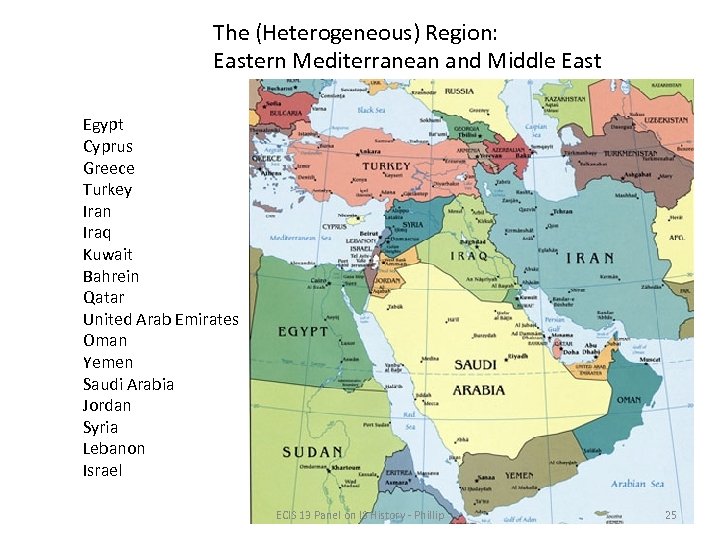 The (Heterogeneous) Region: Eastern Mediterranean and Middle East Egypt Cyprus Greece Turkey Iran Iraq Kuwait Bahrein Qatar United Arab Emirates Oman Yemen Saudi Arabia Jordan Syria Lebanon Israel ECIS 13 Panel on IS History - Phillip 25
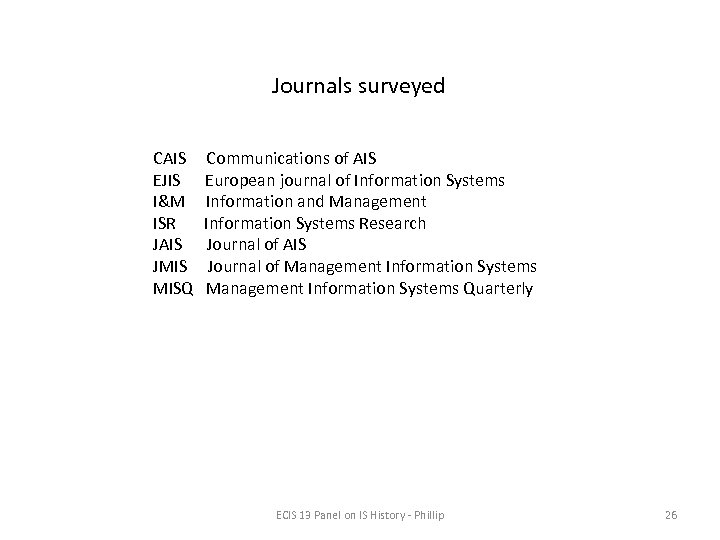 Journals surveyed CAIS Communications of AIS EJIS European journal of Information Systems I&M Information and Management ISR Information Systems Research JAIS Journal of AIS JMIS Journal of Management Information Systems MISQ Management Information Systems Quarterly ECIS 13 Panel on IS History - Phillip 26
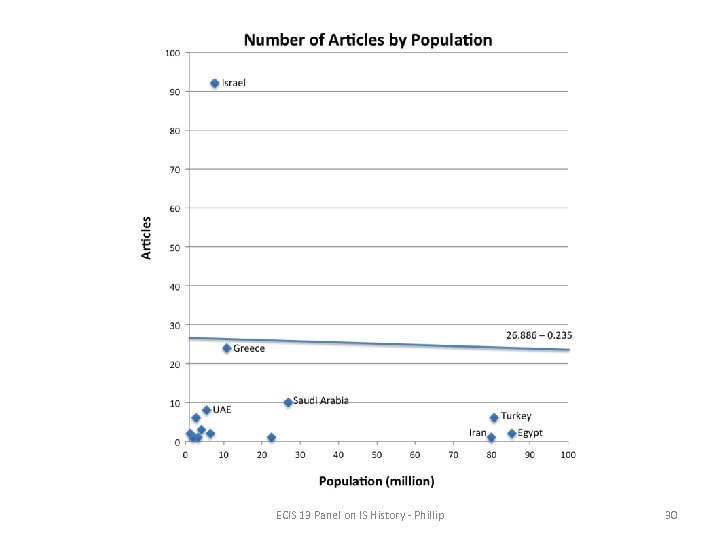
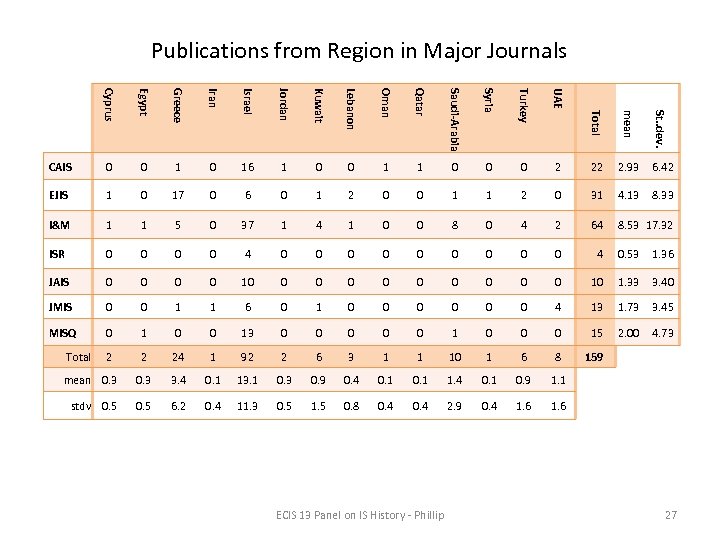 Publications from Region in Major Journals Cyprus Egypt Greece Iran Israel Jordan Kuwait Lebanon Oman Qatar Saudi-Arabia Syria Turkey UAE Total mean St. . dev. CAIS 0 0 16 1 0 0 1 1 0 0 0 2 22 2. 93 6. 42 EJIS 1 0 17 0 6 0 1 2 0 0 1 1 2 0 31 4. 13 8. 33 I&M 1 1 5 0 37 1 4 1 0 0 8 0 4 2 64 8. 53 17. 32 ISR 0 0 4 0 0 0 0 0 4 0. 53 1. 36 JAIS 0 0 10 0 0 0 0 10 1. 33 3. 40 JMIS 0 0 1 1 6 0 1 0 0 0 4 13 1. 73 3. 45 MISQ 0 1 0 0 13 0 0 0 15 2. 00 4. 73 2 2 24 1 92 2 6 3 1 1 10 1 6 8 159 mean 0. 3 3. 4 0. 1 13. 1 0. 3 0. 9 0. 4 0. 1 1. 4 0. 1 0. 9 1. 1 stdv 0. 5 6. 2 0. 4 11. 3 0. 5 1. 5 0. 8 0. 4 2. 9 0. 4 1. 6 Total ECIS 13 Panel on IS History - Phillip 27
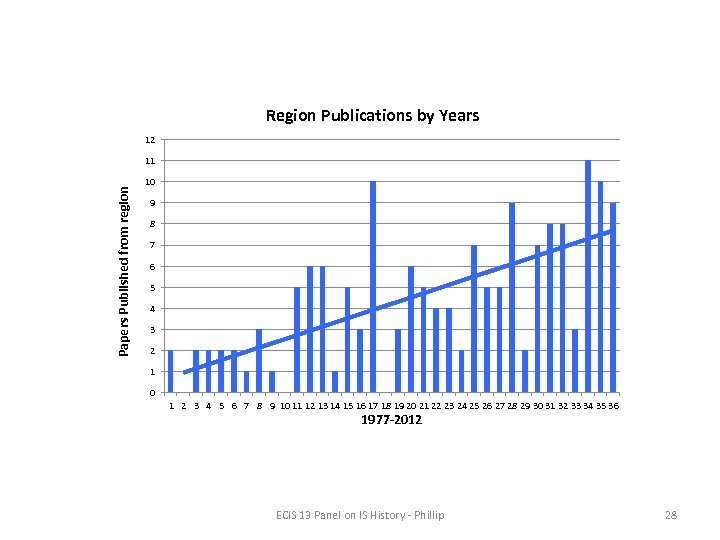 Region Publications by Years 12 Papers Published from region 11 10 9 8 7 6 5 4 3 2 1 0 1 2 3 4 5 6 7 8 9 10 11 12 13 14 15 16 17 18 19 20 21 22 23 24 25 26 27 28 29 30 31 32 33 34 35 36 1977 -2012 ECIS 13 Panel on IS History - Phillip 28
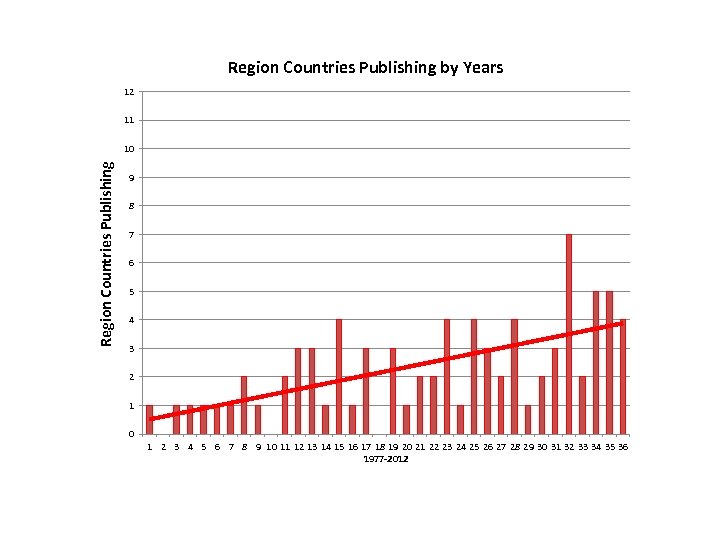 Region Countries Publishing by Years 12 11 Region Countries Publishing 10 9 8 7 6 5 4 3 2 1 0 1 2 3 4 5 6 7 8 9 10 11 12 13 14 15 16 17 18 19 20 21 22 23 24 25 26 27 28 29 30 31 32 33 34 35 36 1977 -2012
 ECIS 13 Panel on IS History - Phillip 30
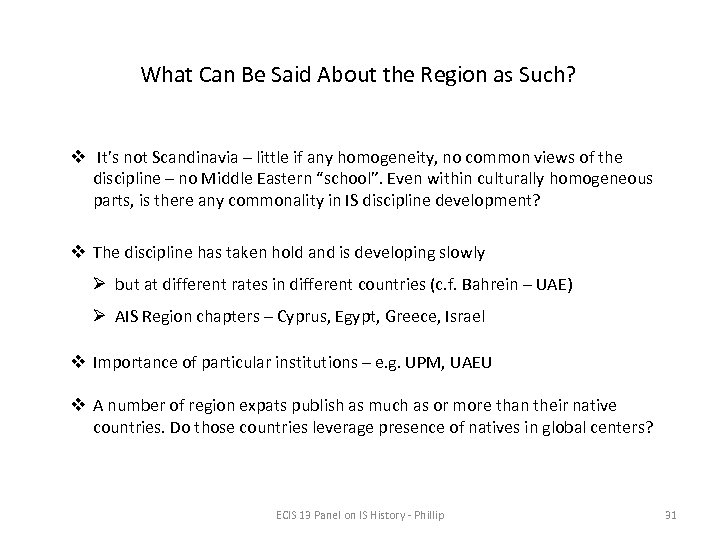 What Can Be Said About the Region as Such? v It’s not Scandinavia – little if any homogeneity, no common views of the discipline – no Middle Eastern “school”. Even within culturally homogeneous parts, is there any commonality in IS discipline development? v The discipline has taken hold and is developing slowly Ø but at different rates in different countries (c. f. Bahrein – UAE) Ø AIS Region chapters – Cyprus, Egypt, Greece, Israel v Importance of particular institutions – e. g. UPM, UAEU v A number of region expats publish as much as or more than their native countries. Do those countries leverage presence of natives in global centers? ECIS 13 Panel on IS History - Phillip 31
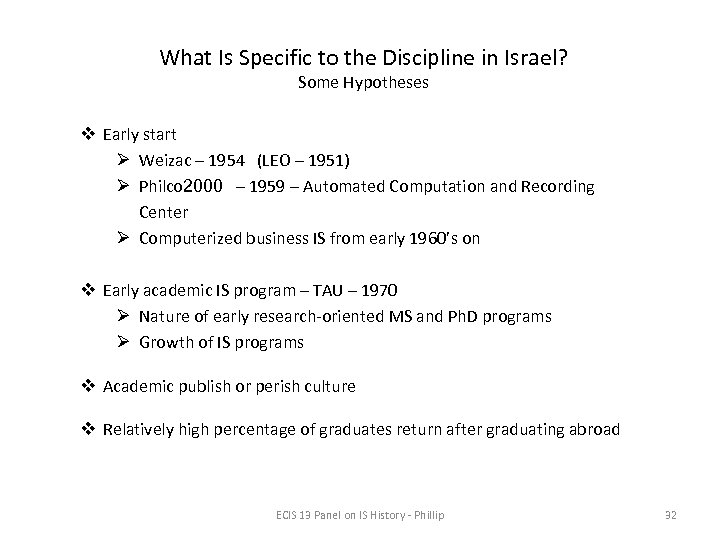 What Is Specific to the Discipline in Israel? Some Hypotheses v Early start Ø Weizac – 1954 (LEO – 1951) Ø Philco 2000 – 1959 – Automated Computation and Recording Center Ø Computerized business IS from early 1960’s on v Early academic IS program – TAU – 1970 Ø Nature of early research-oriented MS and Ph. D programs Ø Growth of IS programs v Academic publish or perish culture v Relatively high percentage of graduates return after graduating abroad ECIS 13 Panel on IS History - Phillip 32
 IS History: The origin of IS in Different Regions Case of ICIS Carol Saunders University of Central Florida Dr. Theo and Friedl Schoeller Research Center for Business and Society ECIS Utrecht 6 th June 2013
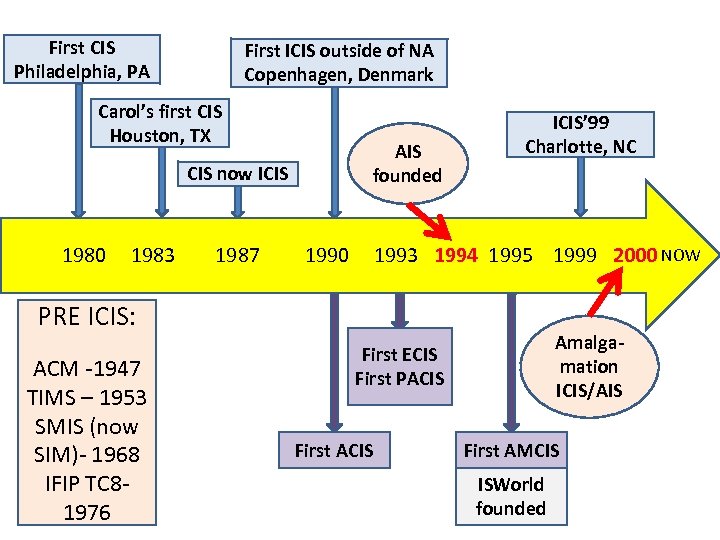 First CIS Philadelphia, PA First ICIS outside of NA Copenhagen, Denmark Carol’s first CIS Houston, TX CIS now ICIS AIS founded ICIS’ 99 Charlotte, NC 1980 1983 1987 1990 1993 1994 1995 1999 2000 NOW PRE ICIS: ACM -1947 TIMS – 1953 SMIS (now SIM)- 1968 IFIP TC 8 - 1976 Amalgamation ICIS/AIS First ECIS First PACIS First AMCIS ISWorld founded
 Thank You! Ping Zhang, Syracuse University, pzhang@syr. edu Niels Bjørn-Andersen, AIS LEO award winner, Copenhagen Business School Phillip Ein-Dor, AIS LEO award winner, Tel Aviv University Frank Land, AIS LEO award winner, London School of Economics Carol Saunders, AIS LEO award winner, University of Central Florida