 Скачать презентацию PALM BEACH FELLOWSHIP OF CHRISTIANS AND JEWS
48a92c96f228c607751245312844d0d5.ppt
- Количество слайдов: 47



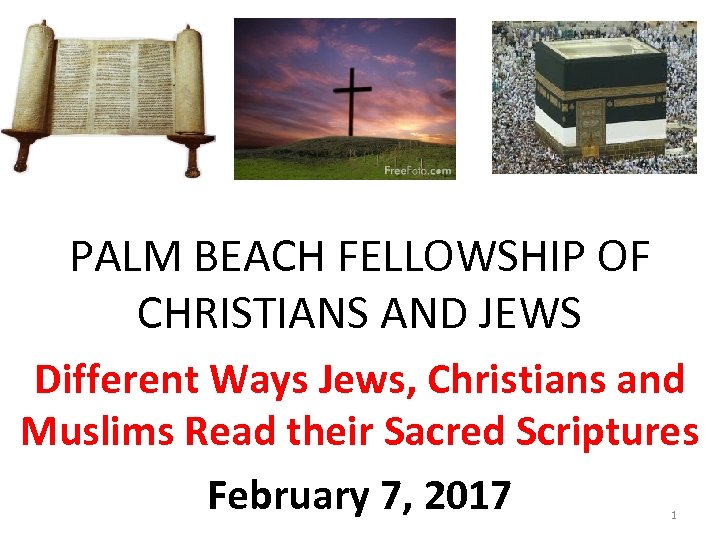
PALM BEACH FELLOWSHIP OF CHRISTIANS AND JEWS Different Ways Jews, Christians and Muslims Read their Sacred Scriptures February 7, 2017 1
Administrative Matters • Welcome and Brief Introductions • Discussion Among Panelists 5: 30 to 6: 45 • Questions and Answers 6: 45 to 7: 00 • Slides available at https: //www. palmbeachfellowship. net/what-wedo/programs/ 2
Overview of Islam • 2 nd largest religion in world (1. 2 to 1. 5 B Muslims) • Only 18% – 20% of Muslims are in Arab Countries • 33% of Muslims are in Southeast Asia • Fastest growing religion in the US • Root: salaam (peace, purity, submission, obedience) • “Islam” means obedience to and submission to God 3
Scripture Scholars Speak Out • America Values Religious Voices • DESCRIPTION AND SIGN UP TO GET LETTERS http: //huc. edu/news/2017/01/18/american-valuesreligious-voices-100 -days-100 -letters • THE LETTERS http: //www. valuesandvoices. com/the-letters/ 4
Rabbi Howard Shapiro • • • Raised in the Boston area; attended Brandeis U. Ordained from Hebrew Union College Served as Chaplain in US Army in Vietnam Served as Rabbi in Springfield, NJ Came to Temple Israel in 1981; retired in 2009 Vice-Chair of the Reform Pension Board Rabbi Emeritus to Temple Israel Consultant to the Jewish Federation of PBC Has worked on Fellowship courses since 2000 5
Canon Thomas O’Brien • Grew up in The Bronx; attended parochial school, Manhattan Prep, Notre Dame and Yale Law School • Served as a Line Officer in the USN including deployments to Vietnam and the Mediterranean • Corporate Lawyer in NY and FL from 1971 to 2001 • Became an Episcopalian in 1989; attended RC Seminary in Boynton Beach from 1999 to 2002 • Teacher of Scripture and Theology since 1998 • Has led Fellowship Courses since 1998 6
Dr. Nasir Ahmad Imam at Masjid Al Ansar, Miami, since 1977 Practicing Maxillofacial Oral Surgeon Frequent Lecturer on Health and Religion in US Former instructor in Medical School, elementary school and high school • BS from Miami-Dade College and Florida Memorial U; Dental training from Meharry Medical College • Born and raised in Chicago, IL • Married with 10 children and 33 grandchildren • • 7
Overview of Hebrew Bible (Ta. Na. Kh) • “Bible” is from Greek words meaning “The Books” • Written in Hebrew (except for parts of Daniel) • Hebrew Bible has 39 books (depending on how some are counted) • Three Divisions – Torah (Law or Instruction) – Nevi’im (Prophets) – Ketubim (Writings) • Lots of other writings didn’t “make the cut” 8
Overview of Christian Scriptures • • • All written in Greek Written from 49 to 110 CE 27 Books 4 Gospels (Matthew, Mark, Luke and John) Acts of the Apostles – written by “Luke” 7 authentic Letters of Paul (49 CE to 62 CE) 5 Letters “attributed” to Paul 9 Letters of Paul’s followers and of others Lots of other writings didn’t “make the cut” 9
Overview of the Qur’an • God revealed to Muhammad in Arabic over 22 years • Means the “Revelation” or the “Recitation” • Final, perfect, complete, untranslatable, unaltered, eternal, uncreated, literal, exact Words of God • 114 chapters (Suras) – Longest to shortest; about 6, 000 Verses [23, 000 in HS; 8, 000 in CS] • Muslims believe: like the Torah and Evangel (Gospels), taken from a tablet in Arabic in heaven 10
Muslim Beliefs Regarding the Qur’an • By the command of God the angel Gabriel recited the Qur’an to Prophet Muhammad 13 years in Mecca and 10 years in Medina. His followers memorized it immediately and the scribes wrote the entire Qur’an during his life. Prophet Muhammad instructed the followers regarding the order and sequence of all the chapters and verses in his lifetime. • It was collected and compiled in book form by the first Khalif, Abu Bakr Siddeeq, after Prophet Muhammad’s death. 11
“Not if You Were the Last Panda” • http: //www. youtube. com/watch? v=R 7 -7 egsq. Yi. M • Why is it funny? 12
“Not if You Were the Last Panda” • Why is it funny? • Takes two ways of looking at Scripture and pushes them to their limits – Literalism – the stories are “factually” true – Anthropomorphism – giving human qualities to that which is not human • Amusing when done with animals • But we do it in the Bible regarding God (walks in Garden, speaks with humans, smells offerings, is fickle and changes mind, fearful of humans becoming like gods etc. ) 13
Bible and Qur’an: “the Word of God” • Common reason given why Christians, Jews and Muslims read from Scripture as part of worship • Need to distinguish between the “authority” of Scripture and the “authorship” of Scripture 14
“Word of God” • WHAT DOES THIS PHRASE MEAN ? ? • The phrase itself is a source of contention and division within Christianity, within Judaism and within Islam • For almost all Muslims, the Qur’an is believed to be dictated by the Angel Gabriel to Muhammad 15
Literalists and Fundamentalists “Author” of the Bible and the Qur’an is God is the direct source of all that is in the Bible and the Qur’an God cannot err; the Bible and Qur’an cannot err God’s authorship is the source of Bible’s and the Qur’an’s authority Non-literal reading would allow interpreting the Bible and the Qur’an “however people want” “God said it; I believe it; that settles it. ” Satisfies deep need for certitude in faith matters 16
“Flash Points” for Literalists • Evolution vs. Intelligent Design • Homosexuality – issues relating to full inclusion in religious groups (ordination, blessings of same gender relationships) • Historical Accuracy of Scripture (Promises to Abraham; the Christian Gospels and the Qur’an) 17
Modern Biblical Scholarship • Awareness of anachronisms, contradictions, repetitions (doublets), different names for some characters, some places and for God • Theories on authorship of Torah (J, E, D, P) and the Gospels (3 -Source Theory) • Includes analysis of the entire contexts in which the various books were written • Recognition that “God language” is inherently metaphorical 18
Problems with Bible and Qur’an Claims • Bible & Qur’an are true only for those who believe they are “true” (distinguish TRUE and PROFOUNDLY TRUE) • Claims based solely on the Bible or Qur’an are irrelevant to persons who do not believe in them • For some believers, the Bible’s truth (and the Qur’an’s truth) does not mean that the Bible (or the Qur’an) is true in every respect as history or as factual truth • No evidence outside the Bible or the Qur’an for Abraham, Ishmael, Isaac, Jacob, Moses, Joshua • Contradictory archeological evidence for some claims in the Bible (e. g. carbon dating the walls of Jericho; Abraham’s camels) 19
Non-Literalists • Bible written, revised, edited by humans in Ancient Israel (Ta. Na. Kh); 1 st Century (Christian Scripture) • Qur’an written by humans in the 8 th and 9 th Centuries • Authors of the multiple books of the Bible had genuine experiences of the Sacred/God and expressed these experiences in story, myth, poem, proverb etc. • Muhammad had genuine experiences of Allah and expressed these experiences in story and sayings • Called the “Word of God” because believers have found the books of the Bible and the Qur’an (overall) to express true perceptions of God/the Sacred and what it means to be fully human 20
Non-Literal Understanding (con’t) • Bible and Quran are “pathways” to knowing about God, but are not the only pathways • Bible and Qur’an need not be historically, factually or scientifically accurate to be “PROFOUNDLY TRUE” about God and human relationships • The theological Truth of the Bible and the Qur’an are found in their stories and metaphors • These stories and metaphors need to be understood in their historical, political, social, and religious contexts 21
Historical-Critical Method/Quran • https: //www. theatlantic. com/magazine/archive/19 99/01/what-is-the-koran/304024/ • http: //www. theatlantic. com/past/docs/issues/99 ja n/koran 2. htm • http: //www. theatlantic. com/past/docs/issues/99 ja n/koran 3. htm • http: //www. mohammedamin. com/Reviews/Qurani c-Studies-Sources-and-Methods-of-Scriptural. Interpretation. html (critical of Wansbrough) 22
Jewish Biblical Interpretation (Midrash) • How Jews read their Sacred Scriptures • Considers the text of Ta. Na. Kh • Also uses the Oral Torah – Developed first by Pharisees – Adopted by Rabbis after 70 CE – “Tradition” that it was also given to Moses – Has been written down 23
Oral Torah in Writing • Mishnah – 200 to 220 CE – Compilation of interpretations • Gamara – 500 CE – Compilation of interpretations of the Mishnah • Talmud – 600 CE – Mishnah + Gamara – Babylonian Talmud is most complete – Talmud of Land of Israel not as complete 24
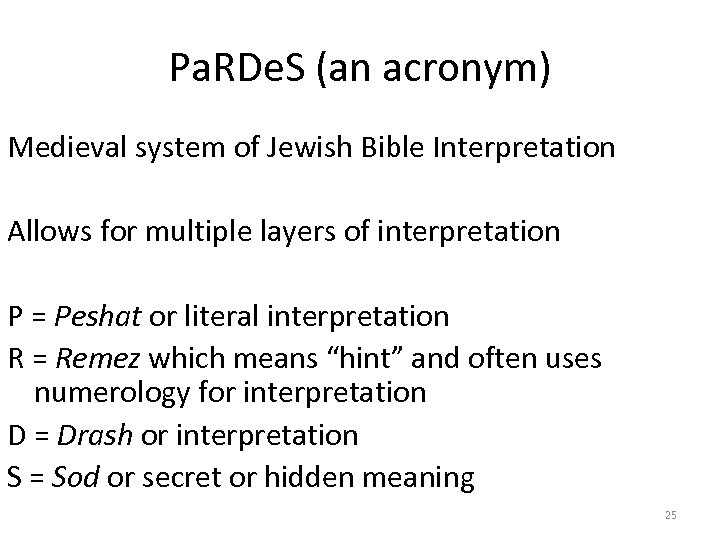
Pa. RDe. S (an acronym) Medieval system of Jewish Bible Interpretation Allows for multiple layers of interpretation P = Peshat or literal interpretation R = Remez which means “hint” and often uses numerology for interpretation D = Drash or interpretation S = Sod or secret or hidden meaning 25
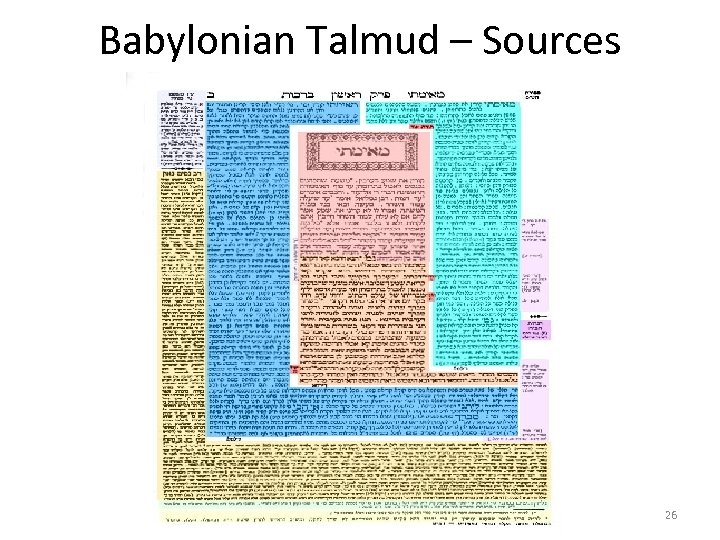
Babylonian Talmud – Sources 26
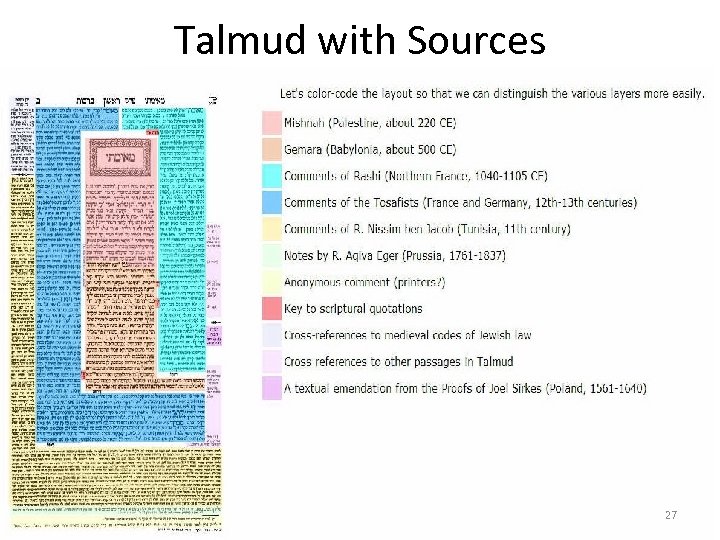
Talmud with Sources 27
Christian Interpretation (Historically) • Legalistic and literal (Rome and West) • Allegorical (Alexandria and Eastern) – See characters a representational – Influenced by Neo-Platonism • Grounded in supersessionism after 4 th Century – Christianity superseded Judaism – God of OT was God of Wrath vs. NT God of Love – OT was primarily a prophesy of Jesus as Messiah who “fulfilled” these prophesies 28
Christian Interpretation – 2 • Until Reformation, only clergy interpreted the Bible • Reformation + Printing + Translations into additional languages = Bible more accessible • Focus on text, not on others’ interpretations 29
Islamic Interpretation of the Qur’an • Not primarily a law book; mostly general principles • Reveals God’s Will for (and God’s relationship with) humans, not “what” God is • “Doctrine of Abrogation” means that later suras can “trump” earlier suras • Scholars divide suras into Meccan (early) and Medinan (later) • Importance of Hadith (collection of Mohammed’s sayings) and the Sunnah (examples from Mohammed’s life) 30
Qur’an Speaks of the Books of Moses; Moses is mentioned 115 times • 46. 12 – And before the Quran was the Scripture of Musa [Moses], a guide and a mercy. And this Quran is a confirmation of it. It is in the Arabic language to warn those who do wrong and it is glad tidings for the doers of good. • 5. 47 – Indeed, We revealed the Torah wherein was Guidance and light. The Prophets who submitted judged by it for the Jews, as did the Rabbis and the scholars as they were entrusted with the Book of Allah and they were witnesses to it. So do not fear the people but fear Me, and do not sell My Verses for a little price. And whoever does not judge by what Allah has revealed, then those are the 31 disbelievers.
Qur’an Speaks of the Gospels; Qur’an mentions Jesus 25 times • 5. 49 – And on their footsteps We sent Jesus, son of Maryam, confirming what was before him of the Torah, and We gave him the Injeel [the original Gospel of Jesus], the Gospel in it was Guidance and light and confirming what was before him of the Torah and a Guidance and an admonition for those who are God conscious. 32
Qur’an Says It is Not New Doctrine and It Confirms What Was Written Before • 46. 9 – [Allah tells Muhammad to] say, “I am no bringer of a new doctrine among the Messengers nor do I know what will be done with me or with you. I only follow that which is revealed to me, and I am not but a clear warner. ” • 10. 37 – And it was not possible that this Quran could be Produced by any other than Allah. It is a confirmation of that which was before it and a detailed explanation of the Book, about which there is no doubt, from the Lord of the worlds. 33
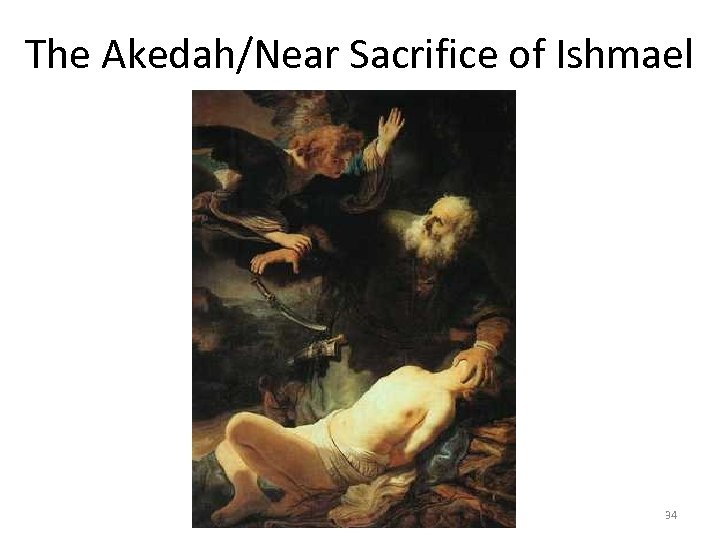
The Akedah/Near Sacrifice of Ishmael 34
Genesis 22: 1 -19 and Surah 37: 99 -112 • Known in Judaism as the Akedah (“the binding of Isaac”) • For Christians: “The Near Sacrifice of Isaac” • For Muslims: “The Near Sacrifice of Ishmael” 35
The Story in the Hebrew Bible Text says: “God tested Abraham. ” God directed him to take Isaac to the land of Moriah and offer him there as a burnt offering Abraham complied and took wood for the burnt offering and had Isaac carry the wood Abraham laid Isaac on the altar on top of the wood and took a knife to kill his son Angel of the LORD stopped Abraham and said, “Now I know that you fear God, since you have not withheld your son, your only son, from me. ” 36
![Story in the Qur’an – Surah 37: 99 -112 99. He [Abraham] said: "I](https://present5.com/presentation/48a92c96f228c607751245312844d0d5/image-37.jpg "Story in the Qur’an – Surah 37: 99 -112 99. He [Abraham] said: \"I")
Story in the Qur’an – Surah 37: 99 -112 99. He [Abraham] said: "I will go to my Lord! He will surely guide me! 100. "O my Lord! Grant me a righteous (son)!" 101. So We gave him the good news of a boy ready to suffer and forbear. 102. Then, when (the son) reached (the age of) (serious) work with him, he said: "O my son! I see in vision that I offer thee in sacrifice: Now see what is thy view!" (The son) said: "O my father! Do as thou art commanded: thou will find me, if Allah so wills one practicing Patience and Constancy!" 37
Near Sacrifice of Ishmael – 2 103. So when they had both submitted their wills (to Allah), and he had laid him prostrate on his forehead (for sacrifice), 104. We called out to him "O Abraham! 105. "Thou hast already fulfilled the vision!" - thus indeed do We reward those who do right. 106. For this was obviously a trial- 107. And We ransomed him with a momentous sacrifice: 108. And We left (this blessing) for him among generations (to come) in later times: 38
Near Sacrifice of Ishmael – 3 109. "Peace and salutation to Abraham!" 110. Thus indeed do We reward those who do right. 111. For he was one of our believing Servants. 112. And We gave him the good news of Isaac - a prophet - one of the Righteous. 39
Early Christian Interpretations of The Binding of Isaac • Isaac as a “type” (as in “stereotype”) of Jesus – Carries wood (Jesus carries cross) – Innocent sacrifice – Part of “prediction/fulfillment theology” • Paul: Abraham is a model of “Faith” (Rom. 4) – Obedience in Gen. 12 shows “righteousness” (right relationship with God) prior to Abraham’s “works” (circumcision) – Obedience in Gen. 22 follows from Faith in God 40
Jewish Interpretations of Akedah • Shows Abraham’s Faith and Obedience • Statement Against Child Sacrifice • Origin of Shofar (Ram’s Horn) • Abraham’s lineage goes through Isaac 41
Islamic Understandings of Near Sacrifice of Ishmael • Shows submission to Allah by Abraham • Abraham’s lineage goes through Ishmael to Muhammad and other Arabs – “I will make a nation of him also” Gen. 20: 13 • Abraham brought Hagar & Ishmael to Mecca (H. 4: 583); Ishmael built the Kaaba with Abraham • Commemorated by animal sacrifices on Eid al-Adha (the “Festival of the Sacrifice” and one of the holiest days in Islam) 42
English Translations of the Qur’an • http: //religionnews. com/2016/10/06/a-new-quranattempts-to-bridge-divide-between-christians-andmuslims/ • Nasir Recommends the English Translation by A. Yusuf Ali available through Amazon at: https: //smile. amazon. com/Holy-Quran-Abdullah-Ali Yusuf/dp/8171513557/ref=sr_1_4? s=books&ie=UTF 8&qid=1485465863&sr=1 -4&keywords=a. +yusuf+ali 43
Why We Care about Scripture • Bible and Qur’an are sacred in status and function • Bible and Qur’an are doorways to God/Sacred – informs our understandings of God and our relationships with God, each other and creation • Muslims believe: dictated by Allah to Muhammad • Bible written by persons who had genuine encounters with the Sacred (inspired by God and therefore the “Word of God”) • “Facticity” is NOT the test of the TRUTH of the Bible – Bible is not intended as history or science 44
Why We Care about the Bible – 2 • Reflects understandings of Ancient Israel and of the 1 st Century – contexts and factual knowledge have changed in 2, 000+ years • Need to read the Bible with discernment – you don’t “check your mind at the door” • Christians – tend to focus on the Text • Jews – consider the Text and are in “conversation” with the Commentaries 45
The Bible is Theology, Not History “It is not important to focus on whether the events in the Bible actually happened, but on the truth that they are always happening. ” 46
Walker, there is no road; the road is made by walking. 47
Скачать презентацию PALM BEACH FELLOWSHIP OF CHRISTIANS AND JEWS
48a92c96f228c607751245312844d0d5.ppt