


 Скачать презентацию Pakistan Floods 2010 Damage and Needs Assessment Pakistan
2b9a6606978eddf85cf028d3d35b0160.ppt
- Количество слайдов: 67
 Pakistan Floods 2010 Damage and Needs Assessment Pakistan Development Forum Islamabad 14, 15 November 2010
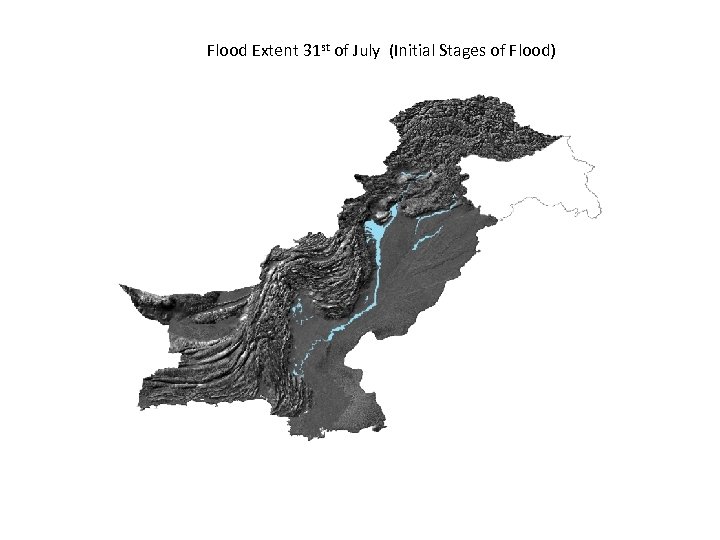 Flood Extent 31 st of July (Initial Stages of Flood)
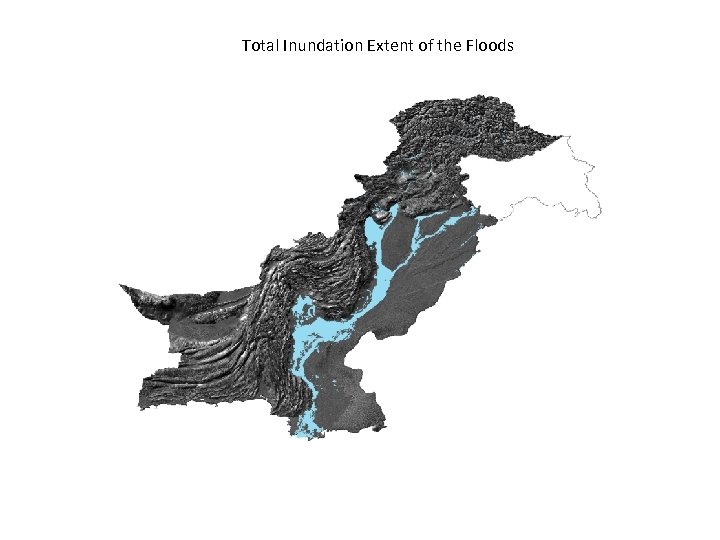 Total Inundation Extent of the Floods
 THE PURPOSE OF THE DNA IS TO ASSESS THE DAMAGE AND LOSSES CAUSED AND CALCULATE THE COST OF RECONSTRUCTION The DNA IS… The DNA is NOT… ü an overview of sector level program strategies and policy options prescriptive, does not present a menu of projects ü based on cost of replacing what was lost with a build back better/smarter factor inclusive of development costs ü ü based on replacing permanent assets and services a quantification of public needs requirements ‘Early Recovery’ – defined as transitional services- these are covered in UN report Inclusive of private needs requirements Objective of the DNA: To provide the strategic underpinnings for medium- to long-term post-floods reconstruction and recovery planning, prioritization, and programming
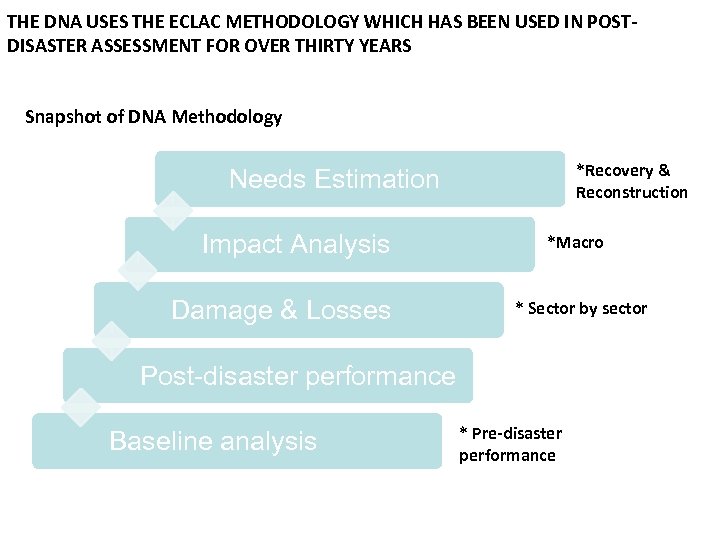 THE DNA USES THE ECLAC METHODOLOGY WHICH HAS BEEN USED IN POSTDISASTER ASSESSMENT FOR OVER THIRTY YEARS Snapshot of DNA Methodology *Recovery & Reconstruction Needs Estimation Impact Analysis Damage & Losses *Macro * Sector by sector Post-disaster performance Baseline analysis * Pre-disaster performance
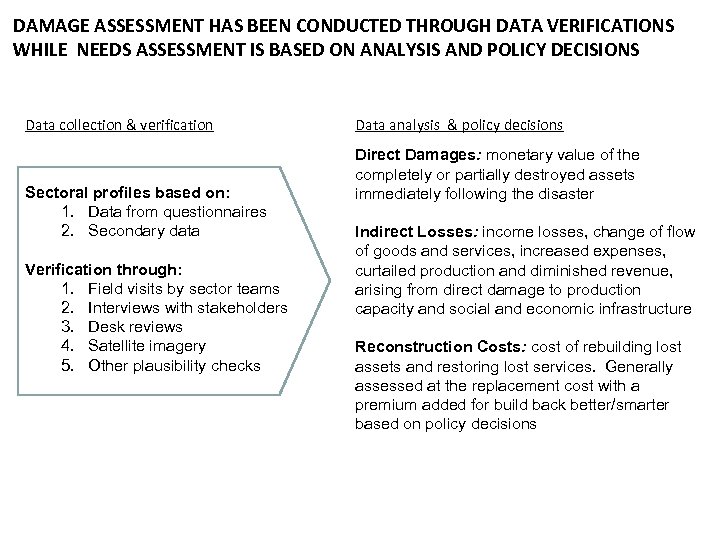 DAMAGE ASSESSMENT HAS BEEN CONDUCTED THROUGH DATA VERIFICATIONS WHILE NEEDS ASSESSMENT IS BASED ON ANALYSIS AND POLICY DECISIONS Data collection & verification Sectoral profiles based on: 1. Data from questionnaires 2. Secondary data Verification through: 1. Field visits by sector teams 2. Interviews with stakeholders 3. Desk reviews 4. Satellite imagery 5. Other plausibility checks Data analysis & policy decisions Direct Damages: monetary value of the completely or partially destroyed assets immediately following the disaster Indirect Losses: income losses, change of flow of goods and services, increased expenses, curtailed production and diminished revenue, arising from direct damage to production capacity and social and economic infrastructure Reconstruction Costs: cost of rebuilding lost assets and restoring lost services. Generally assessed at the replacement cost with a premium added for build back better/smarter based on policy decisions
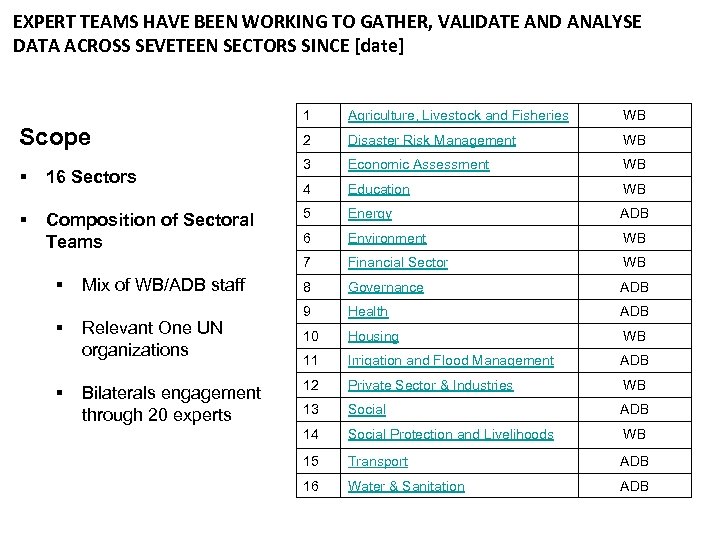 EXPERT TEAMS HAVE BEEN WORKING TO GATHER, VALIDATE AND ANALYSE DATA ACROSS SEVETEEN SECTORS SINCE [date] 1 § Composition of Sectoral Teams § § § Mix of WB/ADB staff Relevant One UN organizations Bilaterals engagement through 20 experts WB 3 Economic Assessment WB 4 Education WB 5 Energy ADB 6 Environment WB Financial Sector WB 8 Governance ADB 9 Health ADB 10 Housing WB 11 Irrigation and Flood Management ADB 12 Private Sector & Industries WB 13 Social ADB 14 16 Sectors Disaster Risk Management 7 § WB 2 Scope Agriculture, Livestock and Fisheries Social Protection and Livelihoods WB 15 Transport ADB 16 Water & Sanitation ADB
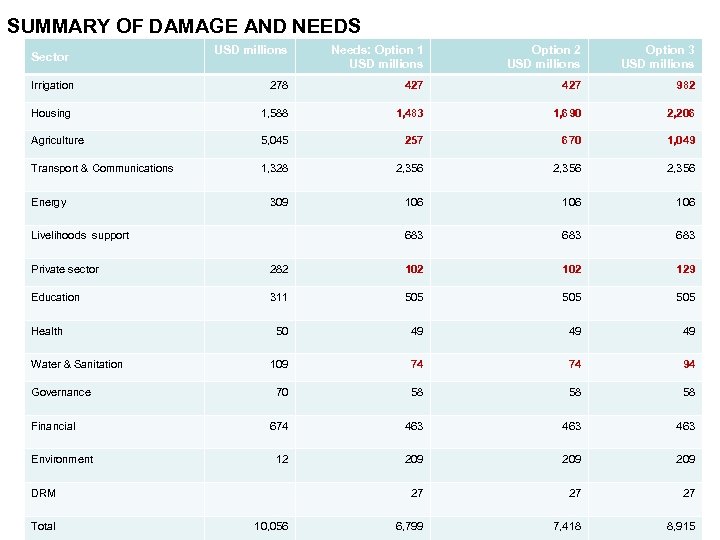 SUMMARY OF DAMAGE AND NEEDS USD millions Needs: Option 1 USD millions Option 2 USD millions Option 3 USD millions Irrigation 278 427 982 Housing 1, 588 1, 483 1, 690 2, 206 Agriculture 5, 045 257 670 1, 049 Transport & Communications 1, 328 2, 356 309 106 106 683 683 Sector Energy Livelihoods support Private sector 282 102 129 Education 311 505 505 50 49 49 49 109 74 74 94 70 58 58 58 674 463 463 12 209 209 27 27 27 6, 799 7, 418 8, 915 Health Water & Sanitation Governance Financial Environment DRM Total 10, 056
 Agriculture, Livestock & Fisheries
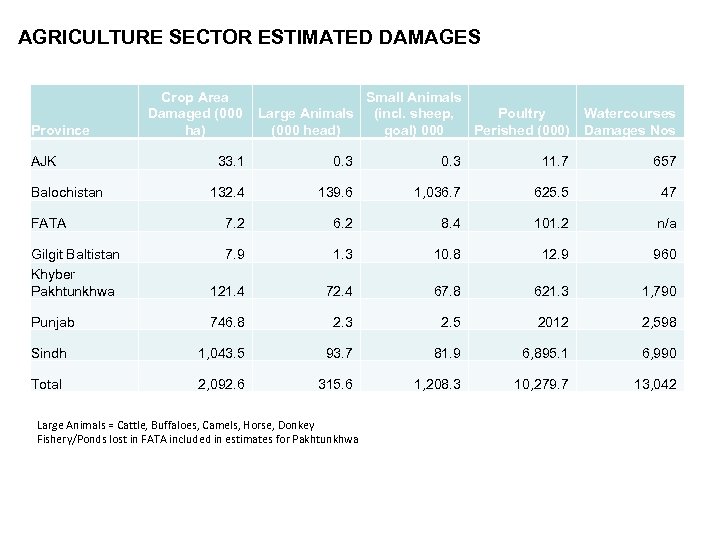 AGRICULTURE SECTOR ESTIMATED DAMAGES Province AJK Crop Area Small Animals Damaged (000 Large Animals (incl. sheep, Poultry Watercourses ha) (000 head) goal) 000 Perished (000) Damages Nos 33. 1 0. 3 11. 7 657 132. 4 139. 6 1, 036. 7 625. 5 47 FATA 7. 2 6. 2 8. 4 101. 2 n/a Gilgit Baltistan Khyber Pakhtunkhwa 7. 9 1. 3 10. 8 12. 9 960 121. 4 72. 4 67. 8 621. 3 1, 790 Punjab 746. 8 2. 3 2. 5 2012 2, 598 Sindh 1, 043. 5 93. 7 81. 9 6, 895. 1 6, 990 Total 2, 092. 6 315. 6 1, 208. 3 10, 279. 7 13, 042 Balochistan Large Animals = Cattle, Buffaloes, Camels, Horse, Donkey Fishery/Ponds lost in FATA included in estimates for Pakhtunkhwa
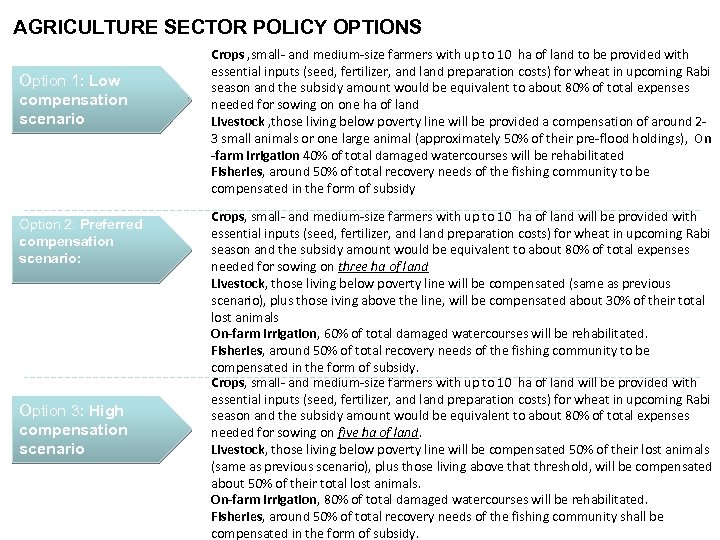 AGRICULTURE SECTOR POLICY OPTIONS Option 1: Low compensation scenario Option 2: Preferred compensation scenario: Option 3: High compensation scenario Crops , small- and medium-size farmers with up to 10 ha of land to be provided with essential inputs (seed, fertilizer, and land preparation costs) for wheat in upcoming Rabi season and the subsidy amount would be equivalent to about 80% of total expenses needed for sowing on one ha of land Livestock , those living below poverty line will be provided a compensation of around 23 small animals or one large animal (approximately 50% of their pre-flood holdings), On -farm irrigation 40% of total damaged watercourses will be rehabilitated Fisheries, around 50% of total recovery needs of the fishing community to be compensated in the form of subsidy Crops, small- and medium-size farmers with up to 10 ha of land will be provided with essential inputs (seed, fertilizer, and land preparation costs) for wheat in upcoming Rabi season and the subsidy amount would be equivalent to about 80% of total expenses needed for sowing on three ha of land Livestock, those living below poverty line will be compensated (same as previous scenario), plus those iving above the line, will be compensated about 30% of their total lost animals On-farm irrigation, 60% of total damaged watercourses will be rehabilitated. Fisheries, around 50% of total recovery needs of the fishing community to be compensated in the form of subsidy. Crops, small- and medium-size farmers with up to 10 ha of land will be provided with essential inputs (seed, fertilizer, and land preparation costs) for wheat in upcoming Rabi season and the subsidy amount would be equivalent to about 80% of total expenses needed for sowing on five ha of land. Livestock, those living below poverty line will be compensated 50% of their lost animals (same as previous scenario), plus those living above that threshold, will be compensated about 50% of their total lost animals. On-farm irrigation, 80% of total damaged watercourses will be rehabilitated. Fisheries, around 50% of total recovery needs of the fishing community shall be compensated in the form of subsidy.
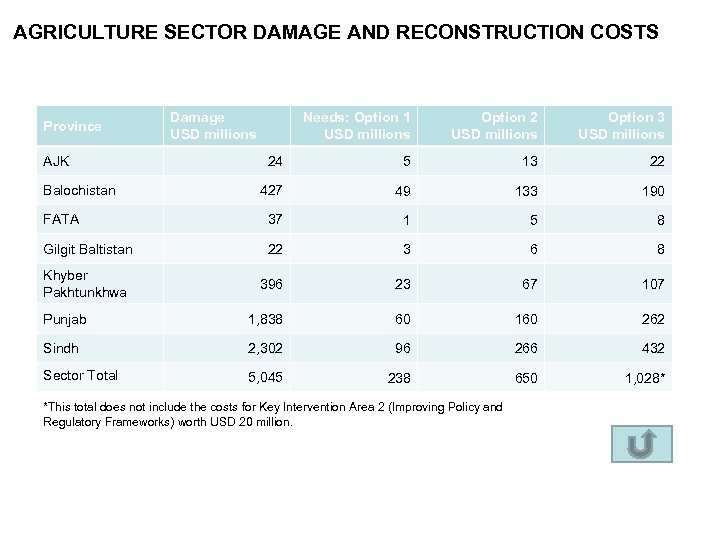 AGRICULTURE SECTOR DAMAGE AND RECONSTRUCTION COSTS Needs: Option 1 USD millions Option 2 USD millions Option 3 USD millions 24 5 13 22 427 49 133 190 FATA 37 1 5 8 Gilgit Baltistan 22 3 6 8 Khyber Pakhtunkhwa 396 23 67 107 Punjab 1, 838 60 160 262 Sindh 2, 302 96 266 432 Sector Total 5, 045 238 650 1, 028* Province AJK Balochistan Damage USD millions *This total does not include the costs for Key Intervention Area 2 (Improving Policy and Regulatory Frameworks) worth USD 20 million.
 Disaster Risk Management
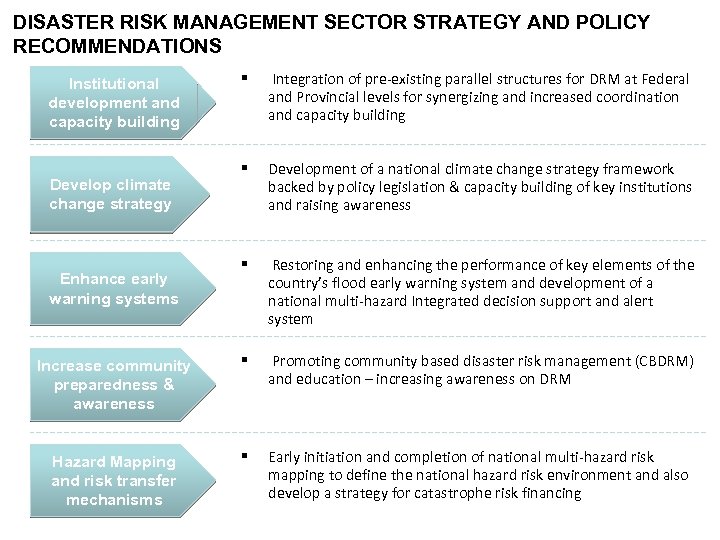 DISASTER RISK MANAGEMENT SECTOR STRATEGY AND POLICY RECOMMENDATIONS § Integration of pre-existing parallel structures for DRM at Federal and Provincial levels for synergizing and increased coordination and capacity building § Development of a national climate change strategy framework backed by policy legislation & capacity building of key institutions and raising awareness § Restoring and enhancing the performance of key elements of the country’s flood early warning system and development of a national multi-hazard Integrated decision support and alert system Increase community preparedness & awareness § Promoting community based disaster risk management (CBDRM) and education – increasing awareness on DRM Hazard Mapping and risk transfer mechanisms § Early initiation and completion of national multi-hazard risk mapping to define the national hazard risk environment and also develop a strategy for catastrophe risk financing Institutional development and capacity building Develop climate change strategy Enhance early warning systems
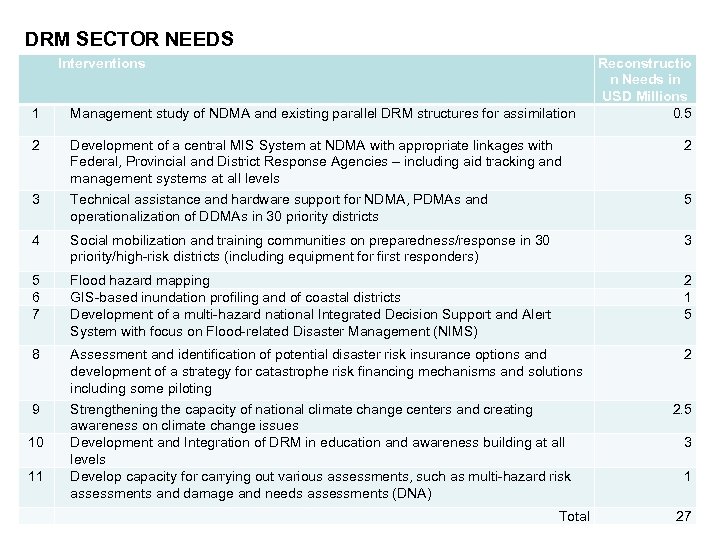 DRM SECTOR NEEDS Interventions Reconstructio n Needs in USD Millions 0. 5 1 Management study of NDMA and existing parallel DRM structures for assimilation 2 Development of a central MIS System at NDMA with appropriate linkages with Federal, Provincial and District Response Agencies – including aid tracking and management systems at all levels Technical assistance and hardware support for NDMA, PDMAs and operationalization of DDMAs in 30 priority districts 2 4 Social mobilization and training communities on preparedness/response in 30 priority/high-risk districts (including equipment for first responders) 3 5 6 7 Flood hazard mapping GIS-based inundation profiling and of coastal districts Development of a multi-hazard national Integrated Decision Support and Alert System with focus on Flood-related Disaster Management (NIMS) 2 1 5 8 Assessment and identification of potential disaster risk insurance options and development of a strategy for catastrophe risk financing mechanisms and solutions including some piloting Strengthening the capacity of national climate change centers and creating awareness on climate change issues Development and Integration of DRM in education and awareness building at all levels Develop capacity for carrying out various assessments, such as multi-hazard risk assessments and damage and needs assessments (DNA) 2 3 9 10 11 Total 5 2. 5 3 1 27
 Economic Assessment
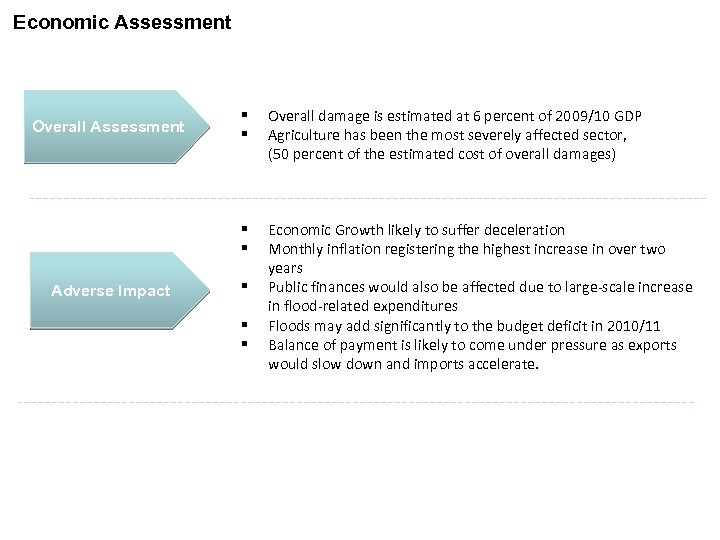 Economic Assessment Adverse Impact § § Overall damage is estimated at 6 percent of 2009/10 GDP Agriculture has been the most severely affected sector, (50 percent of the estimated cost of overall damages) § § Overall Assessment Economic Growth likely to suffer deceleration Monthly inflation registering the highest increase in over two years Public finances would also be affected due to large-scale increase in flood-related expenditures Floods may add significantly to the budget deficit in 2010/11 Balance of payment is likely to come under pressure as exports would slow down and imports accelerate. § § §
 Education 3/19/2018 1: 17 PM
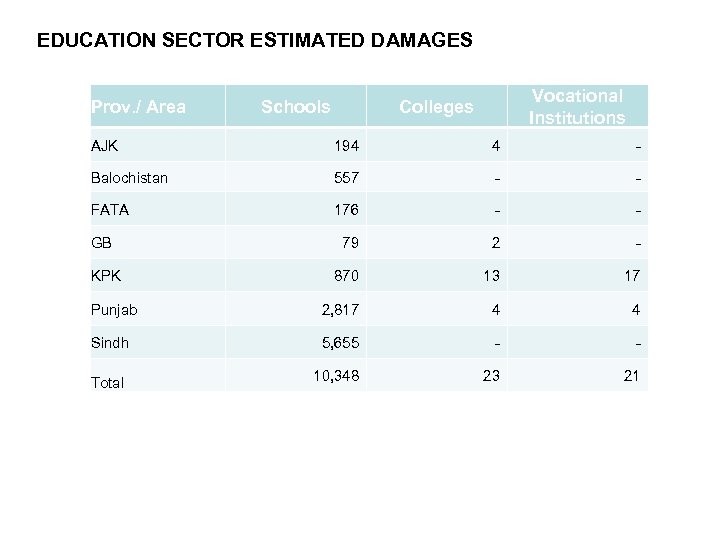 EDUCATION SECTOR ESTIMATED DAMAGES Prov. / Area Schools Vocational Institutions Colleges AJK 194 4 - Balochistan 557 - - FATA 176 - - GB 79 2 - KPK 870 13 17 Punjab 2, 817 4 4 Sindh 5, 655 - - Total 10, 348 23 21
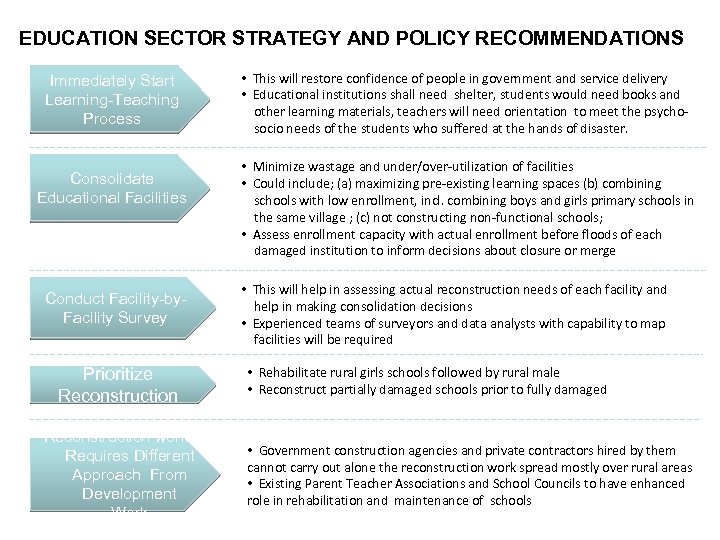 EDUCATION SECTOR STRATEGY AND POLICY RECOMMENDATIONS Immediately Start Learning-Teaching Process Consolidate Educational Facilities Conduct Facility-by. Facility Survey Prioritize Reconstruction work Requires Different Approach From Development Work • This will restore confidence of people in government and service delivery • Educational institutions shall need shelter, students would need books and other learning materials, teachers will need orientation to meet the psychosocio needs of the students who suffered at the hands of disaster. • Minimize wastage and under/over-utilization of facilities • Could include; (a) maximizing pre-existing learning spaces (b) combining schools with low enrollment, incl. combining boys and girls primary schools in the same village ; (c) not constructing non-functional schools; • Assess enrollment capacity with actual enrollment before floods of each damaged institution to inform decisions about closure or merge • This will help in assessing actual reconstruction needs of each facility and help in making consolidation decisions • Experienced teams of surveyors and data analysts with capability to map facilities will be required • Rehabilitate rural girls schools followed by rural male • Reconstruct partially damaged schools prior to fully damaged • Government construction agencies and private contractors hired by them cannot carry out alone the reconstruction work spread mostly over rural areas • Existing Parent Teacher Associations and School Councils to have enhanced role in rehabilitation and maintenance of schools
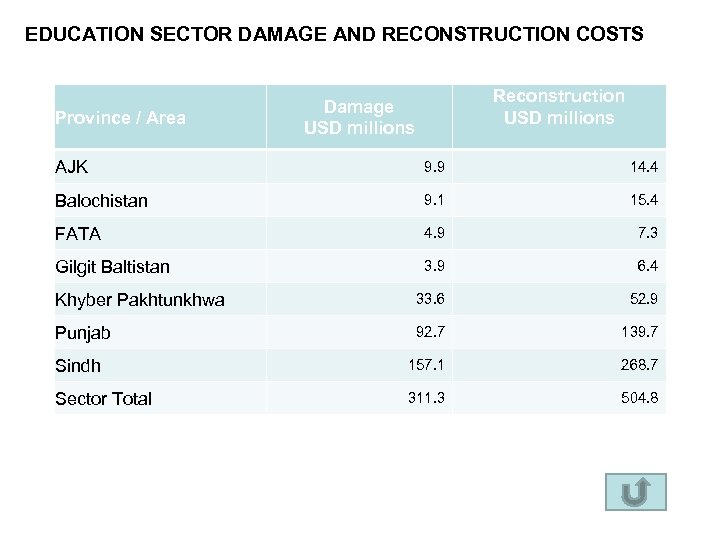 EDUCATION SECTOR DAMAGE AND RECONSTRUCTION COSTS Province / Area Reconstruction USD millions Damage USD millions AJK 9. 9 14. 4 Balochistan 9. 1 15. 4 FATA 4. 9 7. 3 Gilgit Baltistan 3. 9 6. 4 Khyber Pakhtunkhwa 33. 6 52. 9 Punjab 92. 7 139. 7 Sindh 157. 1 268. 7 Sector Total 311. 3 504. 8
 Energy 3/19/2018 1: 17 PM
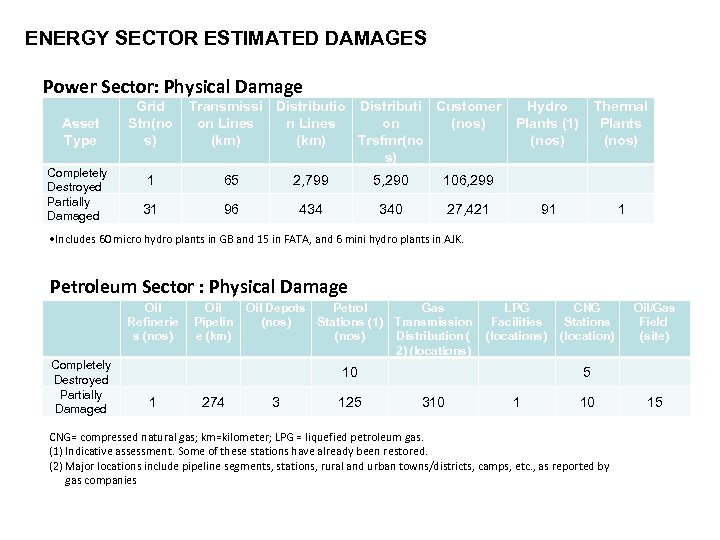 ENERGY SECTOR ESTIMATED DAMAGES Power Sector: Physical Damage Asset Type Completely Destroyed Partially Damaged Grid Stn(no s) Transmissi Distributio Distributi Customer Hydro Thermal on Lines on (nos) Plants (1) Plants (km) Trsfmr(no (nos) s) 1 65 2, 799 5, 290 106, 299 31 96 434 340 27, 421 91 1 • Includes 60 micro hydro plants in GB and 15 in FATA, and 6 mini hydro plants in AJK. Petroleum Sector : Physical Damage Oil Refinerie s (nos) Completely Destroyed Partially Damaged Oil Pipelin e (km) Oil Depots Petrol Gas LPG (nos) Stations (1) Transmission Facilities (nos) Distribution ( (locations) 2) (locations) 10 1 274 3 125 CNG Stations (location) Oil/Gas Field (site) 5 310 1 10 CNG= compressed natural gas; km=kilometer; LPG = liquefied petroleum gas. (1) Indicative assessment. Some of these stations have already been restored. (2) Major locations include pipeline segments, stations, rural and urban towns/districts, camps, etc. , as reported by gas companies 15
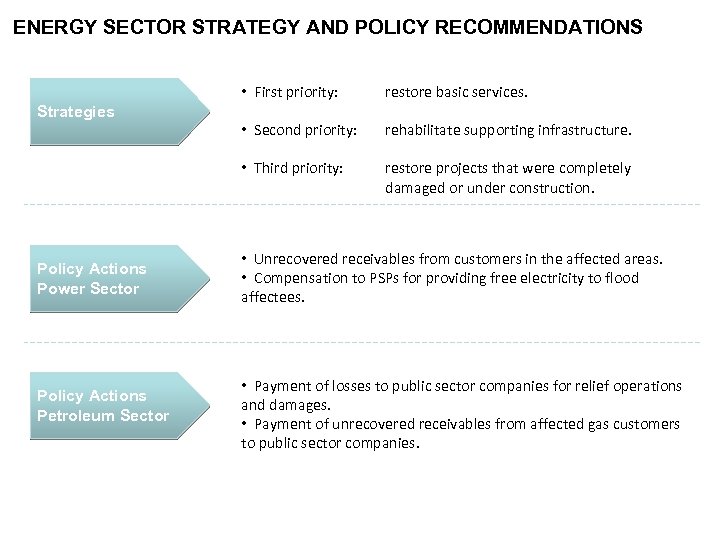 ENERGY SECTOR STRATEGY AND POLICY RECOMMENDATIONS • First priority: Policy Actions Power Sector Policy Actions Petroleum Sector • Second priority: rehabilitate supporting infrastructure. • Third priority: Strategies restore basic services. restore projects that were completely damaged or under construction. • Unrecovered receivables from customers in the affected areas. • Compensation to PSPs for providing free electricity to flood affectees. • Payment of losses to public sector companies for relief operations and damages. • Payment of unrecovered receivables from affected gas customers to public sector companies.
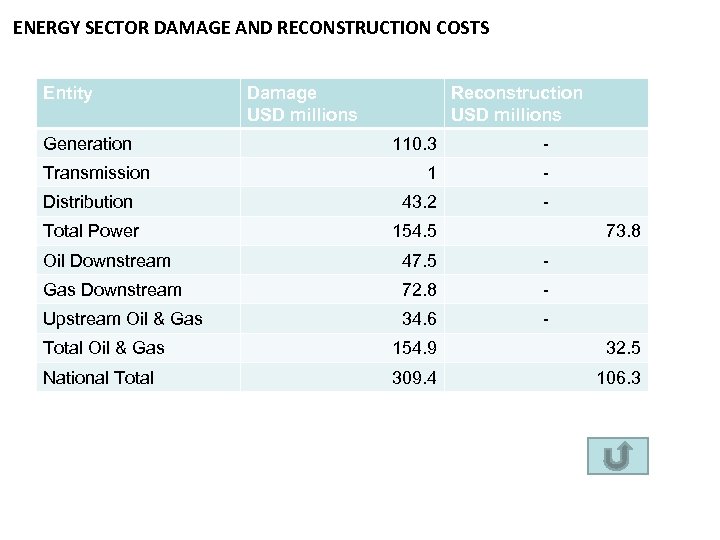 ENERGY SECTOR DAMAGE AND RECONSTRUCTION COSTS Entity Generation Damage USD millions Reconstruction USD millions 110. 3 - 1 - Distribution 43. 2 - Total Power 154. 5 Transmission 73. 8 Oil Downstream 47. 5 - Gas Downstream 72. 8 - Upstream Oil & Gas 34. 6 - Total Oil & Gas 154. 9 32. 5 National Total 309. 4 106. 3
 Environment
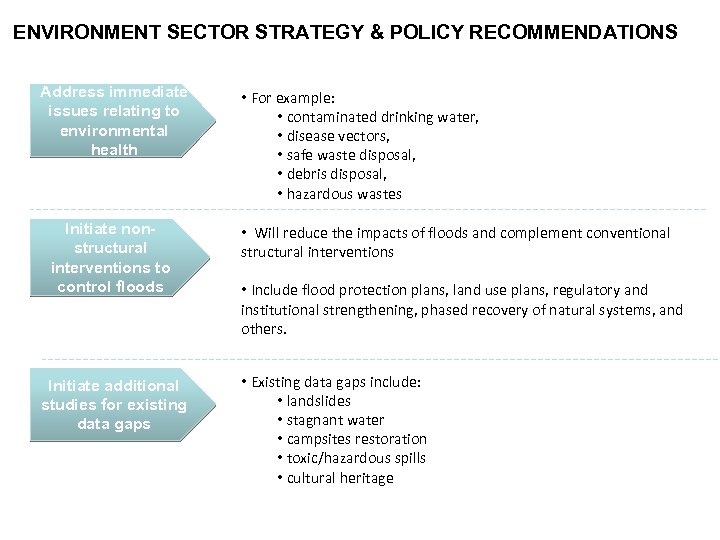 ENVIRONMENT SECTOR STRATEGY & POLICY RECOMMENDATIONS Address immediate issues relating to environmental health Initiate nonstructural interventions to control floods Initiate additional studies for existing data gaps • For example: • contaminated drinking water, • disease vectors, • safe waste disposal, • debris disposal, • hazardous wastes • Will reduce the impacts of floods and complement conventional structural interventions • Include flood protection plans, land use plans, regulatory and institutional strengthening, phased recovery of natural systems, and others. • Existing data gaps include: • landslides • stagnant water • campsites restoration • toxic/hazardous spills • cultural heritage
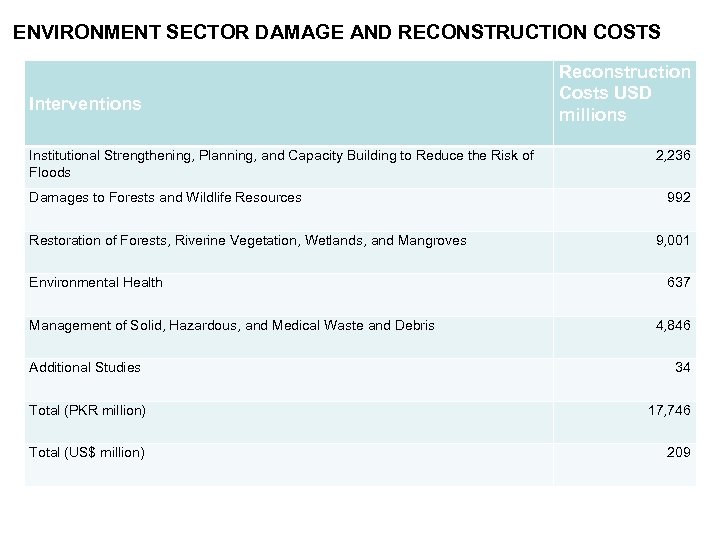 ENVIRONMENT SECTOR DAMAGE AND RECONSTRUCTION COSTS Interventions Institutional Strengthening, Planning, and Capacity Building to Reduce the Risk of Floods Damages to Forests and Wildlife Resources Restoration of Forests, Riverine Vegetation, Wetlands, and Mangroves Environmental Health Management of Solid, Hazardous, and Medical Waste and Debris Additional Studies Reconstruction Costs USD millions 2, 236 992 9, 001 637 4, 846 34 Total (PKR million) 17, 746 Total (US$ million) 209
 Financial Sector
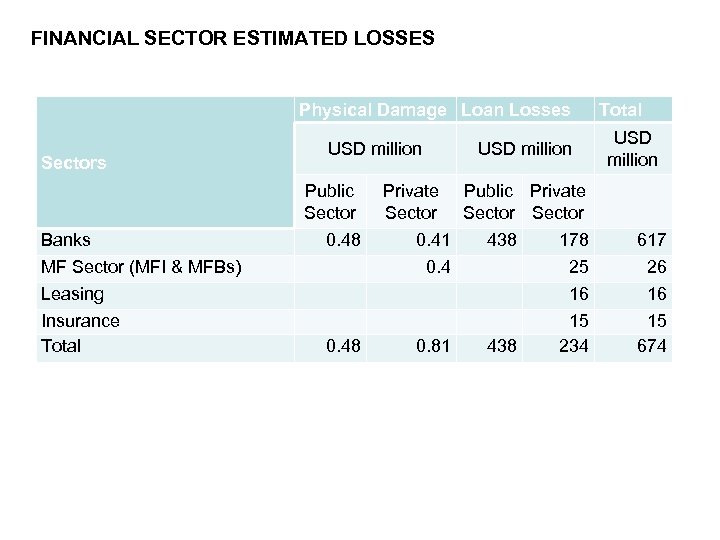 FINANCIAL SECTOR ESTIMATED LOSSES Physical Damage Loan Losses Sectors Banks MF Sector (MFI & MFBs) Leasing Insurance Total USD million Public Sector 0. 48 USD million Private Public Private Sector 0. 41 438 178 Total USD million 617 0. 4 25 16 26 16 0. 48 0. 81 438 15 234 15 674
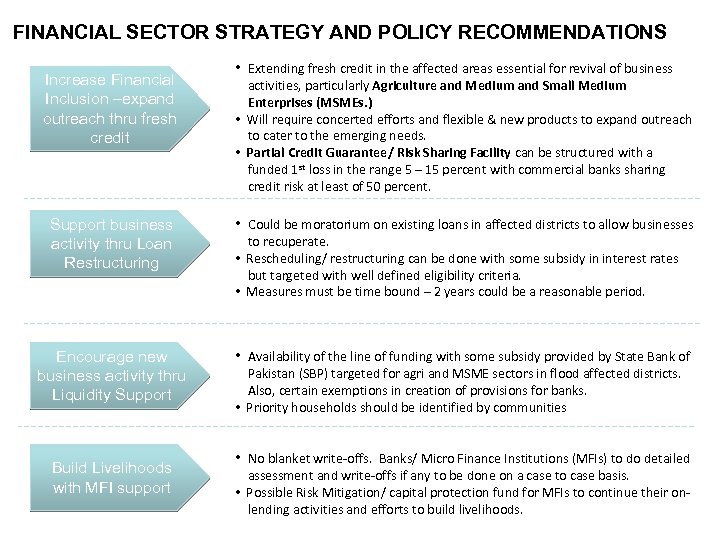 FINANCIAL SECTOR STRATEGY AND POLICY RECOMMENDATIONS Increase Financial Inclusion –expand outreach thru fresh credit • Extending fresh credit in the affected areas essential for revival of business activities, particularly Agriculture and Medium and Small Medium Enterprises (MSMEs. ) • Will require concerted efforts and flexible & new products to expand outreach to cater to the emerging needs. • Partial Credit Guarantee/ Risk Sharing Facility can be structured with a funded 1 st loss in the range 5 – 15 percent with commercial banks sharing credit risk at least of 50 percent. Support business activity thru Loan Restructuring • Could be moratorium on existing loans in affected districts to allow businesses Encourage new business activity thru Liquidity Support • Availability of the line of funding with some subsidy provided by State Bank of Build Livelihoods with MFI support to recuperate. • Rescheduling/ restructuring can be done with some subsidy in interest rates but targeted with well defined eligibility criteria. • Measures must be time bound – 2 years could be a reasonable period. Pakistan (SBP) targeted for agri and MSME sectors in flood affected districts. Also, certain exemptions in creation of provisions for banks. • Priority households should be identified by communities • No blanket write-offs. Banks/ Micro Finance Institutions (MFIs) to do detailed assessment and write-offs if any to be done on a case to case basis. • Possible Risk Mitigation/ capital protection fund for MFIs to continue their onlending activities and efforts to build livelihoods.
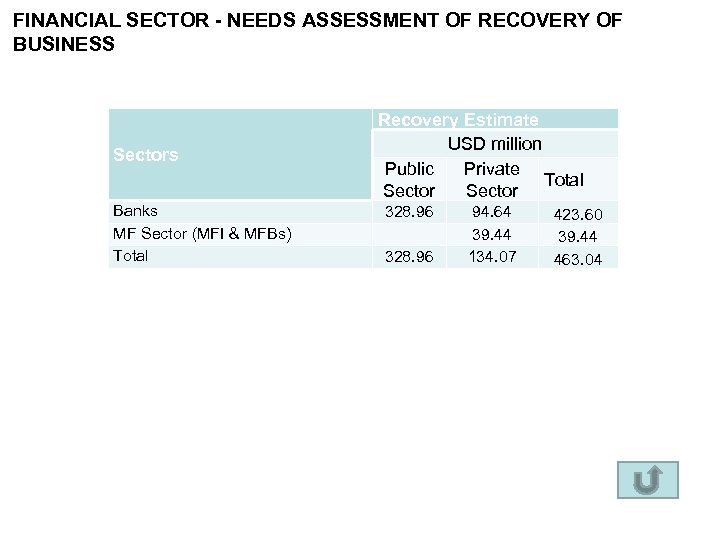 FINANCIAL SECTOR - NEEDS ASSESSMENT OF RECOVERY OF BUSINESS Sectors Banks MF Sector (MFI & MFBs) Total Recovery Estimate USD million Public Private Total Sector 328. 96 94. 64 39. 44 134. 07 423. 60 39. 44 463. 04
 Governance & Governance Infrastructure
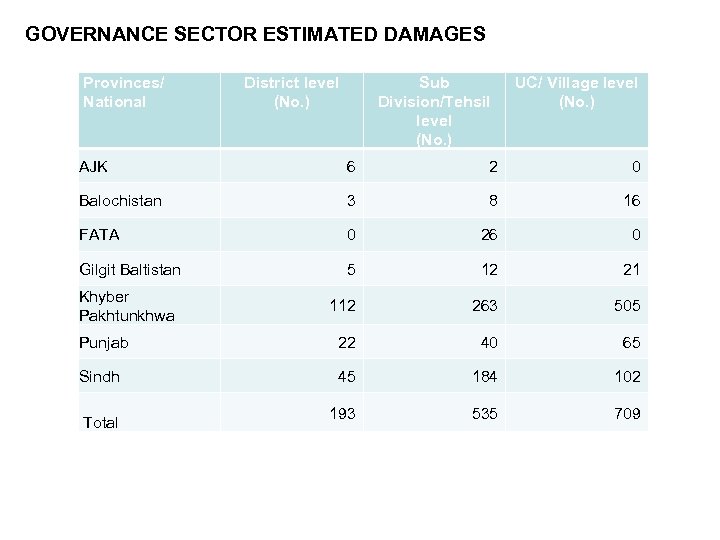 GOVERNANCE SECTOR ESTIMATED DAMAGES Provinces/ National District level (No. ) Sub Division/Tehsil level (No. ) UC/ Village level (No. ) AJK 6 2 0 Balochistan 3 8 16 FATA 0 26 0 Gilgit Baltistan 5 12 21 112 263 505 Punjab 22 40 65 Sindh 45 184 102 193 535 709 Khyber Pakhtunkhwa Total
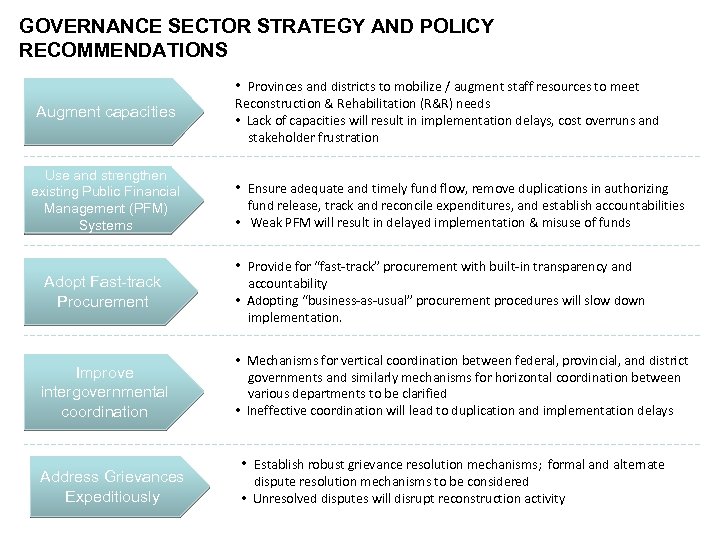 GOVERNANCE SECTOR STRATEGY AND POLICY RECOMMENDATIONS • Provinces and districts to mobilize / augment staff resources to meet Augment capacities Use and strengthen existing Public Financial Management (PFM) Systems Adopt Fast-track Procurement Improve intergovernmental coordination Address Grievances Expeditiously Reconstruction & Rehabilitation (R&R) needs • Lack of capacities will result in implementation delays, cost overruns and stakeholder frustration • Ensure adequate and timely fund flow, remove duplications in authorizing fund release, track and reconcile expenditures, and establish accountabilities • Weak PFM will result in delayed implementation & misuse of funds • Provide for “fast-track” procurement with built-in transparency and accountability • Adopting “business-as-usual” procurement procedures will slow down implementation. • Mechanisms for vertical coordination between federal, provincial, and district governments and similarly mechanisms for horizontal coordination between various departments to be clarified • Ineffective coordination will lead to duplication and implementation delays • Establish robust grievance resolution mechanisms; formal and alternate dispute resolution mechanisms to be considered • Unresolved disputes will disrupt reconstruction activity
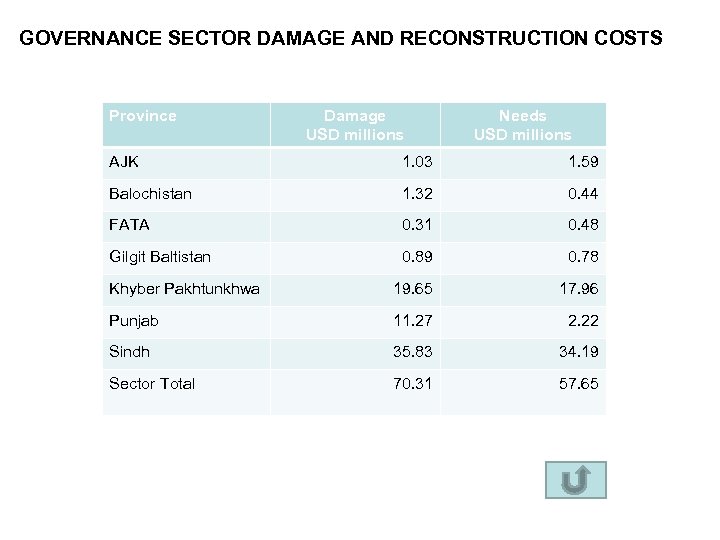 GOVERNANCE SECTOR DAMAGE AND RECONSTRUCTION COSTS Province Damage USD millions Needs USD millions AJK 1. 03 1. 59 Balochistan 1. 32 0. 44 FATA 0. 31 0. 48 Gilgit Baltistan 0. 89 0. 78 Khyber Pakhtunkhwa 19. 65 17. 96 Punjab 11. 27 2. 22 Sindh 35. 83 34. 19 Sector Total 70. 31 57. 65
 Health
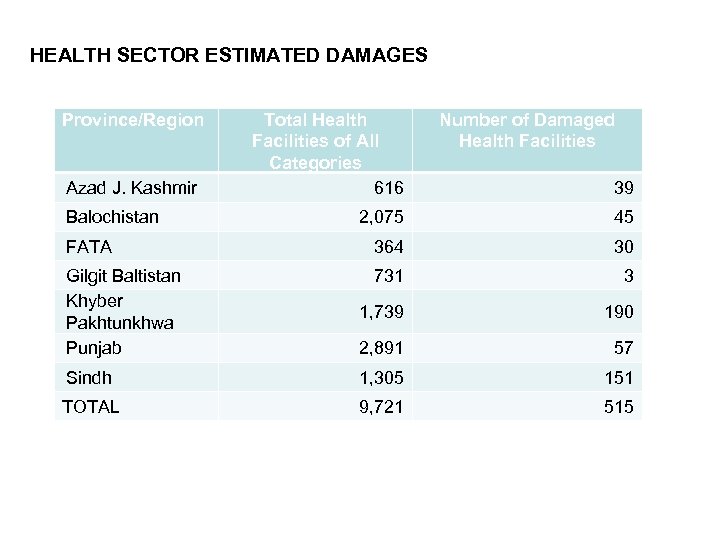 HEALTH SECTOR ESTIMATED DAMAGES Province/Region Azad J. Kashmir Balochistan Total Health Facilities of All Categories 616 Number of Damaged Health Facilities 39 2, 075 45 FATA 364 30 Gilgit Baltistan Khyber Pakhtunkhwa Punjab 731 3 1, 739 190 2, 891 57 Sindh 1, 305 151 TOTAL 9, 721 515
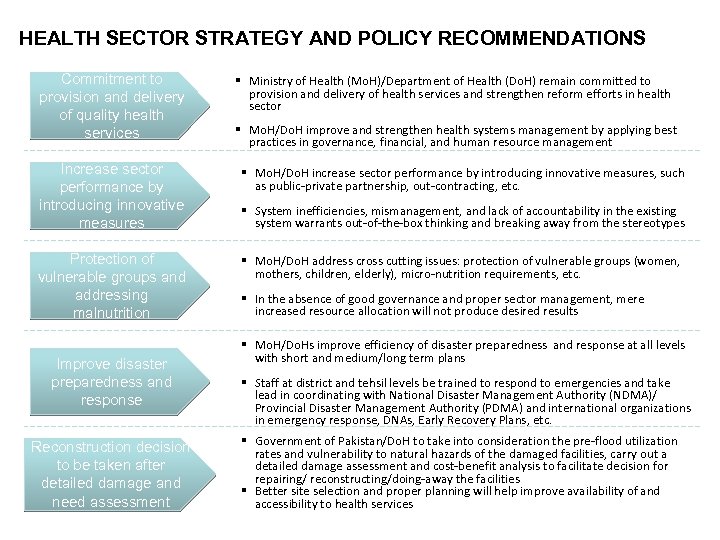 HEALTH SECTOR STRATEGY AND POLICY RECOMMENDATIONS Commitment to provision and delivery of quality health services § Ministry of Health (Mo. H)/Department of Health (Do. H) remain committed to provision and delivery of health services and strengthen reform efforts in health sector § Mo. H/Do. H improve and strengthen health systems management by applying best practices in governance, financial, and human resource management Increase sector performance by introducing innovative measures § Mo. H/Do. H increase sector performance by introducing innovative measures, such as public-private partnership, out-contracting, etc. Protection of vulnerable groups and addressing malnutrition § Mo. H/Do. H address cross cutting issues: protection of vulnerable groups (women, mothers, children, elderly), micro-nutrition requirements, etc. Improve disaster preparedness and response Reconstruction decision to be taken after detailed damage and need assessment § System inefficiencies, mismanagement, and lack of accountability in the existing system warrants out-of-the-box thinking and breaking away from the stereotypes § In the absence of good governance and proper sector management, mere increased resource allocation will not produce desired results § Mo. H/Do. Hs improve efficiency of disaster preparedness and response at all levels with short and medium/long term plans § Staff at district and tehsil levels be trained to respond to emergencies and take lead in coordinating with National Disaster Management Authority (NDMA)/ Provincial Disaster Management Authority (PDMA) and international organizations in emergency response, DNAs, Early Recovery Plans, etc. § Government of Pakistan/Do. H to take into consideration the pre-flood utilization rates and vulnerability to natural hazards of the damaged facilities, carry out a detailed damage assessment and cost-benefit analysis to facilitate decision for repairing/ reconstructing/doing-away the facilities § Better site selection and proper planning will help improve availability of and accessibility to health services
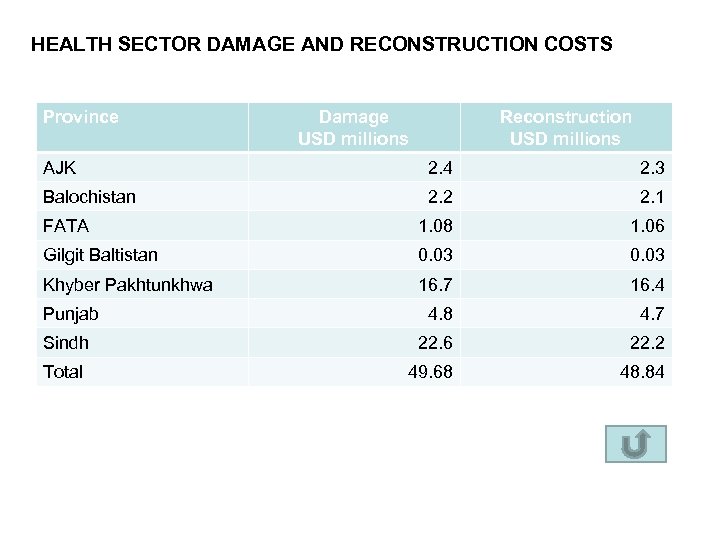 HEALTH SECTOR DAMAGE AND RECONSTRUCTION COSTS Province Damage USD millions Reconstruction USD millions AJK 2. 4 2. 3 Balochistan 2. 2 2. 1 FATA 1. 08 1. 06 Gilgit Baltistan 0. 03 Khyber Pakhtunkhwa 16. 7 16. 4 Punjab 4. 8 4. 7 Sindh 22. 6 22. 2 49. 68 48. 84 Total
 Housing
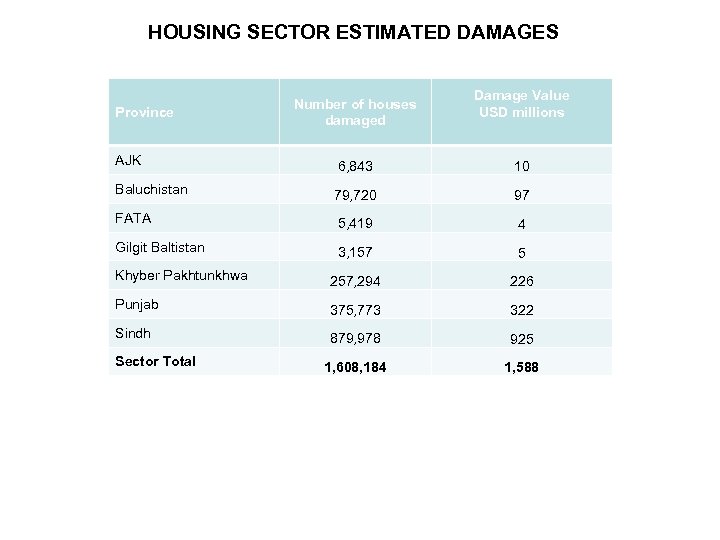 HOUSING SECTOR ESTIMATED DAMAGES Province Number of houses damaged Damage Value USD millions AJK 6, 843 10 Baluchistan 79, 720 97 FATA 5, 419 4 Gilgit Baltistan 3, 157 5 Khyber Pakhtunkhwa 257, 294 226 Punjab 375, 773 322 Sindh 879, 978 925 1, 608, 184 1, 588 Sector Total
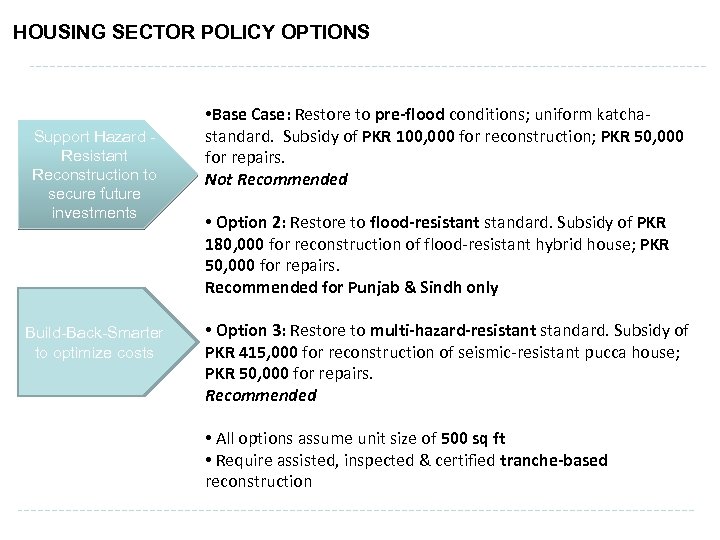 HOUSING SECTOR POLICY OPTIONS Support Hazard Resistant Reconstruction to secure future investments Build-Back-Smarter to optimize costs • Base Case: Restore to pre-flood conditions; uniform katchastandard. Subsidy of PKR 100, 000 for reconstruction; PKR 50, 000 for repairs. Not Recommended • Option 2: Restore to flood-resistant standard. Subsidy of PKR 180, 000 for reconstruction of flood-resistant hybrid house; PKR 50, 000 for repairs. Recommended for Punjab & Sindh only • Option 3: Restore to multi-hazard-resistant standard. Subsidy of PKR 415, 000 for reconstruction of seismic-resistant pucca house; PKR 50, 000 for repairs. Recommended • All options assume unit size of 500 sq ft • Require assisted, inspected & certified tranche-based reconstruction
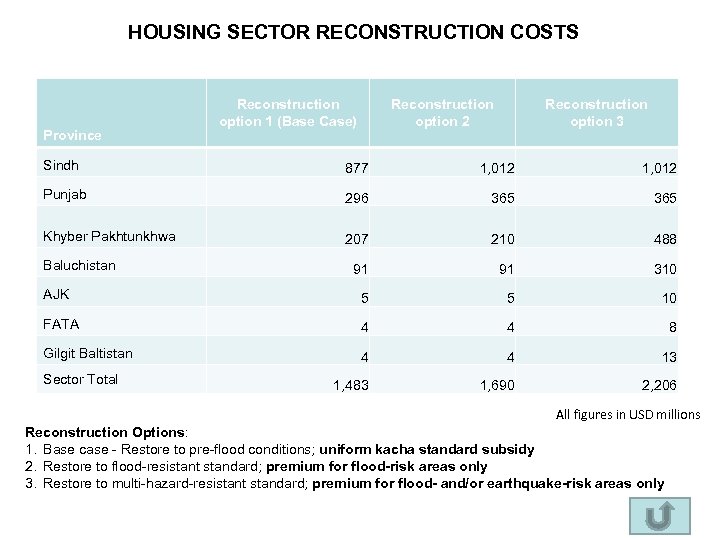 HOUSING SECTOR RECONSTRUCTION COSTS Province Reconstruction option 1 (Base Case) Reconstruction option 2 Reconstruction option 3 Sindh 877 1, 012 Punjab 296 365 Khyber Pakhtunkhwa 207 210 488 91 91 310 AJK 5 5 10 FATA 4 4 8 Gilgit Baltistan 4 4 13 1, 483 1, 690 2, 206 Baluchistan Sector Total All figures in USD millions Reconstruction Options: 1. Base case - Restore to pre-flood conditions; uniform kacha standard subsidy 2. Restore to flood-resistant standard; premium for flood-risk areas only 3. Restore to multi-hazard-resistant standard; premium for flood- and/or earthquake-risk areas only
 Irrigation and Flood Sector
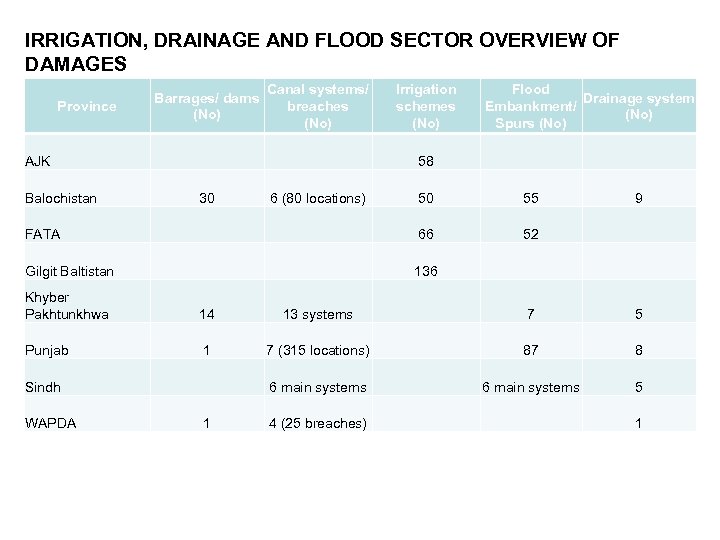 IRRIGATION, DRAINAGE AND FLOOD SECTOR OVERVIEW OF DAMAGES Province Barrages/ dams (No) Canal systems/ breaches (No) AJK Balochistan Irrigation schemes (No) Flood Drainage system Embankment/ (No) Spurs (No) 58 30 6 (80 locations) 50 55 FATA 66 52 Gilgit Baltistan 9 136 Khyber Pakhtunkhwa 14 13 systems 7 5 Punjab 1 7 (315 locations) 87 8 6 main systems 5 Sindh WAPDA 1 4 (25 breaches) 1
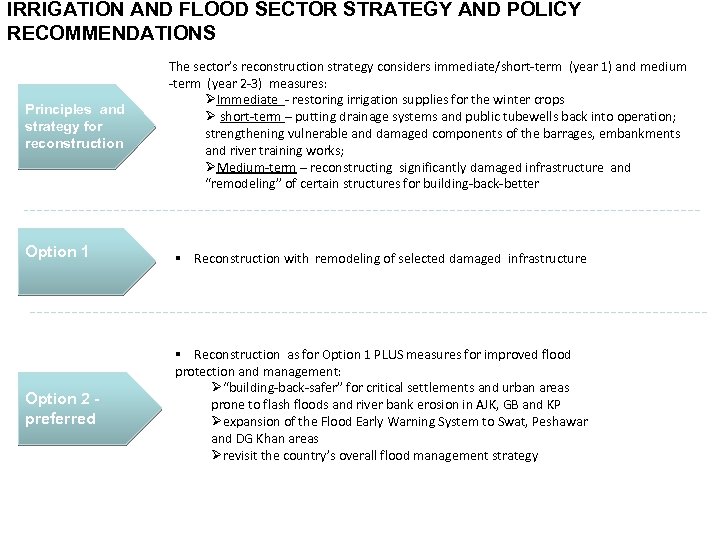 IRRIGATION AND FLOOD SECTOR STRATEGY AND POLICY RECOMMENDATIONS Principles and strategy for reconstruction The sector’s reconstruction strategy considers immediate/short-term (year 1) and medium -term (year 2 -3) measures: ØImmediate - restoring irrigation supplies for the winter crops Ø short-term – putting drainage systems and public tubewells back into operation; strengthening vulnerable and damaged components of the barrages, embankments and river training works; ØMedium-term – reconstructing significantly damaged infrastructure and “remodeling” of certain structures for building-back-better Option 1 § Reconstruction with remodeling of selected damaged infrastructure Option 2 - preferred § Reconstruction as for Option 1 PLUS measures for improved flood protection and management: Ø“building-back-safer” for critical settlements and urban areas prone to flash floods and river bank erosion in AJK, GB and KP Øexpansion of the Flood Early Warning System to Swat, Peshawar and DG Khan areas Ørevisit the country’s overall flood management strategy
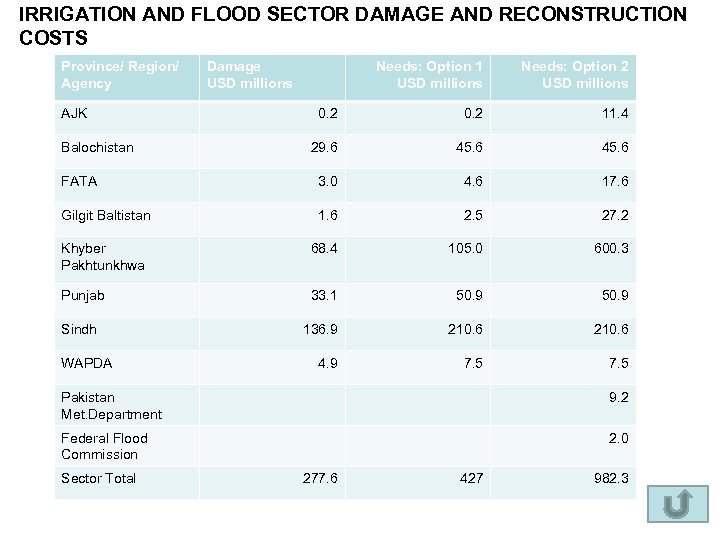 IRRIGATION AND FLOOD SECTOR DAMAGE AND RECONSTRUCTION COSTS Province/ Region/ Agency Needs: Option 1 USD millions Needs: Option 2 USD millions 0. 2 11. 4 29. 6 45. 6 FATA 3. 0 4. 6 17. 6 Gilgit Baltistan 1. 6 2. 5 27. 2 Khyber Pakhtunkhwa 68. 4 105. 0 600. 3 Punjab 33. 1 50. 9 Sindh 136. 9 210. 6 4. 9 7. 5 AJK Balochistan WAPDA Damage USD millions Pakistan Met. Department 9. 2 Federal Flood Commission 2. 0 Sector Total 277. 6 427 982. 3
 Private Sector & Industries
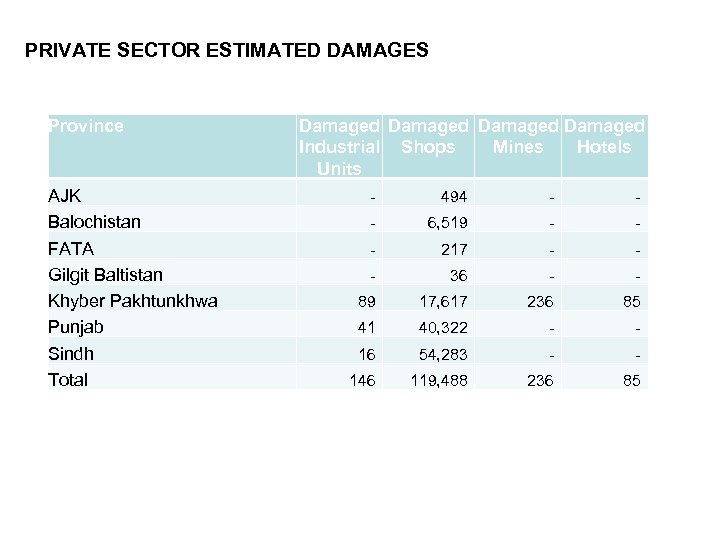 PRIVATE SECTOR ESTIMATED DAMAGES Province AJK Balochistan FATA Gilgit Baltistan Khyber Pakhtunkhwa Punjab Sindh Total Damaged Industrial Shops Mines Hotels Units - 494 - - 6, 519 - - 217 - - 36 - 89 17, 617 236 85 41 40, 322 - 16 54, 283 - 146 119, 488 236 85
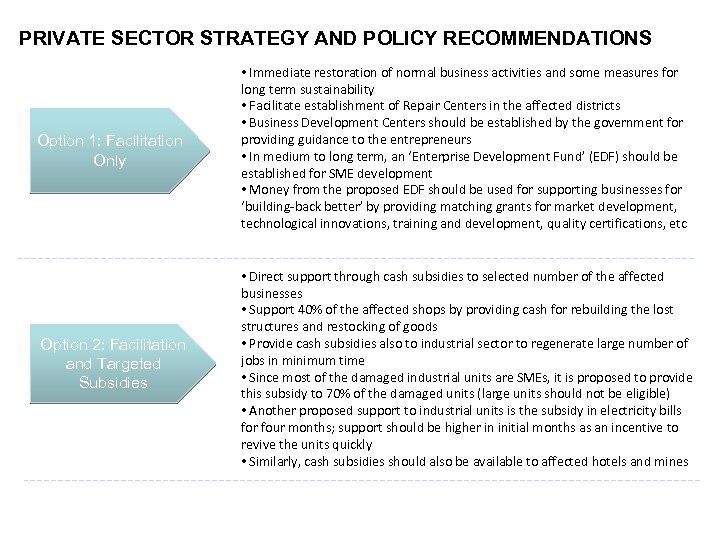 PRIVATE SECTOR STRATEGY AND POLICY RECOMMENDATIONS Option 1: Facilitation Only • Immediate restoration of normal business activities and some measures for long term sustainability • Facilitate establishment of Repair Centers in the affected districts • Business Development Centers should be established by the government for providing guidance to the entrepreneurs • In medium to long term, an ‘Enterprise Development Fund’ (EDF) should be established for SME development • Money from the proposed EDF should be used for supporting businesses for ‘building-back better’ by providing matching grants for market development, technological innovations, training and development, quality certifications, etc Option 2: Facilitation and Targeted Subsidies • Direct support through cash subsidies to selected number of the affected businesses • Support 40% of the affected shops by providing cash for rebuilding the lost structures and restocking of goods • Provide cash subsidies also to industrial sector to regenerate large number of jobs in minimum time • Since most of the damaged industrial units are SMEs, it is proposed to provide this subsidy to 70% of the damaged units (large units should not be eligible) • Another proposed support to industrial units is the subsidy in electricity bills for four months; support should be higher in initial months as an incentive to revive the units quickly • Similarly, cash subsidies should also be available to affected hotels and mines
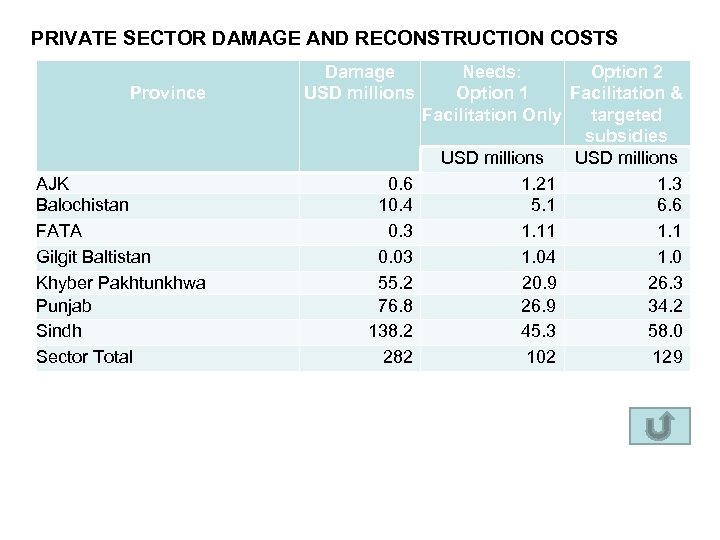 PRIVATE SECTOR DAMAGE AND RECONSTRUCTION COSTS Province AJK Balochistan FATA Gilgit Baltistan Khyber Pakhtunkhwa Punjab Sindh Sector Total Damage USD millions Needs: Option 2 Option 1 Facilitation & Facilitation Only targeted subsidies USD millions 0. 6 1. 21 1. 3 10. 4 5. 1 6. 6 0. 3 1. 11 1. 1 0. 03 1. 04 1. 0 55. 2 20. 9 26. 3 76. 8 26. 9 34. 2 138. 2 45. 3 58. 0 282 102 129
 Social & Gender
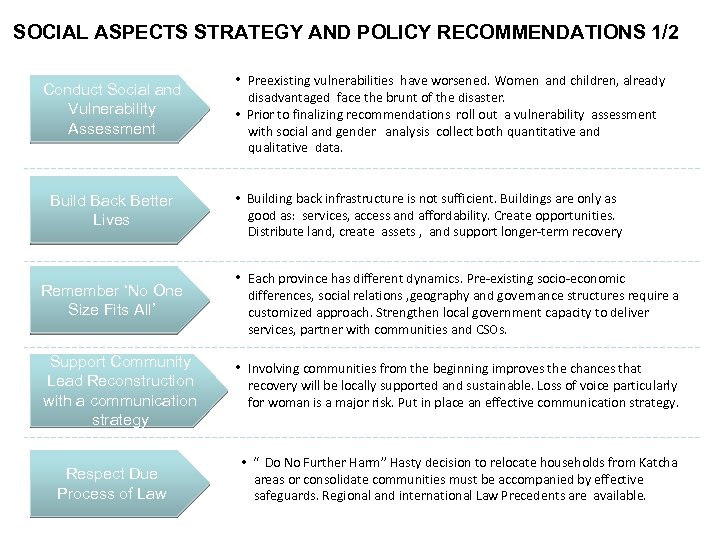 SOCIAL ASPECTS STRATEGY AND POLICY RECOMMENDATIONS 1/2 Conduct Social and Vulnerability Assessment Build Back Better Lives Remember ‘No One Size Fits All’ Support Community Lead Reconstruction with a communication strategy Respect Due Process of Law • Preexisting vulnerabilities have worsened. Women and children, already disadvantaged face the brunt of the disaster. • Prior to finalizing recommendations roll out a vulnerability assessment with social and gender analysis collect both quantitative and qualitative data. • Building back infrastructure is not sufficient. Buildings are only as good as: services, access and affordability. Create opportunities. Distribute land, create assets , and support longer-term recovery • Each province has different dynamics. Pre-existing socio-economic differences, social relations , geography and governance structures require a customized approach. Strengthen local government capacity to deliver services, partner with communities and CSOs. • Involving communities from the beginning improves the chances that recovery will be locally supported and sustainable. Loss of voice particularly for woman is a major risk. Put in place an effective communication strategy. • “ Do No Further Harm” Hasty decision to relocate households from Katcha areas or consolidate communities must be accompanied by effective safeguards. Regional and international Law Precedents are available.
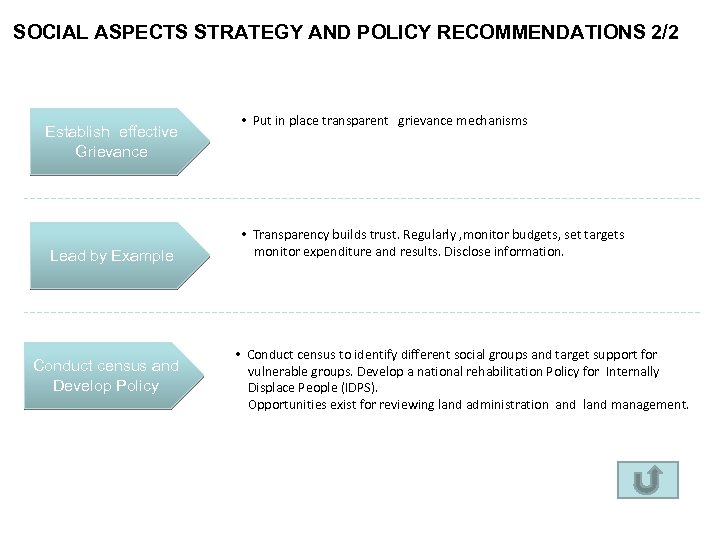 SOCIAL ASPECTS STRATEGY AND POLICY RECOMMENDATIONS 2/2 Establish effective Grievance Lead by Example Conduct census and Develop Policy • Put in place transparent grievance mechanisms • Transparency builds trust. Regularly , monitor budgets, set targets monitor expenditure and results. Disclose information. • Conduct census to identify different social groups and target support for vulnerable groups. Develop a national rehabilitation Policy for Internally Displace People (IDPS). Opportunities exist for reviewing land administration and land management.
 Livelihoods & Social Protection 3/19/2018 1: 17 PM
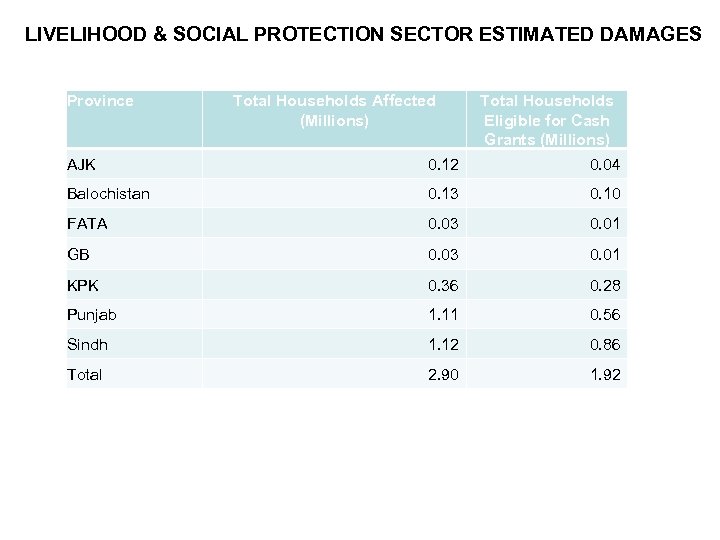 LIVELIHOOD & SOCIAL PROTECTION SECTOR ESTIMATED DAMAGES Province Total Households Affected (Millions) Total Households Eligible for Cash Grants (Millions) AJK 0. 12 0. 04 Balochistan 0. 13 0. 10 FATA 0. 03 0. 01 GB 0. 03 0. 01 KPK 0. 36 0. 28 Punjab 1. 11 0. 56 Sindh 1. 12 0. 86 Total 2. 90 1. 92
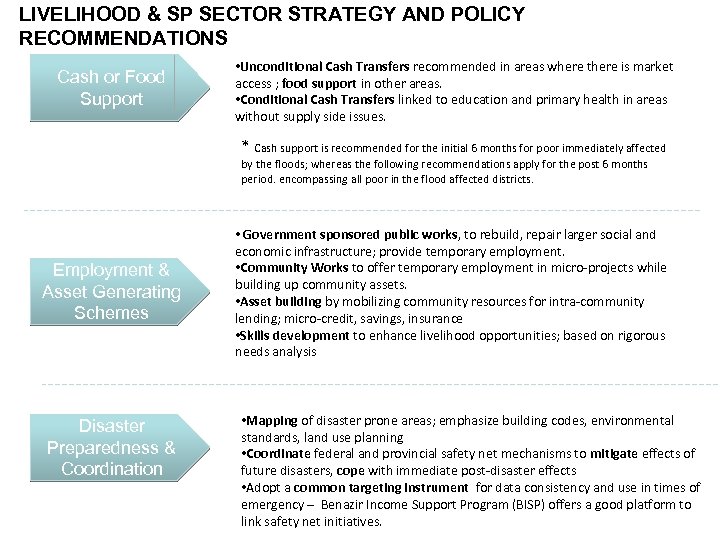 LIVELIHOOD & SP SECTOR STRATEGY AND POLICY RECOMMENDATIONS Cash or Food Support • Unconditional Cash Transfers recommended in areas where there is market access ; food support in other areas. • Conditional Cash Transfers linked to education and primary health in areas without supply side issues. * Cash support is recommended for the initial 6 months for poor immediately affected by the floods; whereas the following recommendations apply for the post 6 months period. encompassing all poor in the flood affected districts. Employment & Asset Generating Schemes Disaster Preparedness & Coordination • Government sponsored public works, to rebuild, repair larger social and economic infrastructure; provide temporary employment. • Community Works to offer temporary employment in micro-projects while building up community assets. • Asset building by mobilizing community resources for intra-community lending; micro-credit, savings, insurance • Skills development to enhance livelihood opportunities; based on rigorous needs analysis • Mapping of disaster prone areas; emphasize building codes, environmental standards, land use planning • Coordinate federal and provincial safety net mechanisms to mitigate effects of future disasters, cope with immediate post-disaster effects • Adopt a common targeting instrument for data consistency and use in times of emergency – Benazir Income Support Program (BISP) offers a good platform to link safety net initiatives.
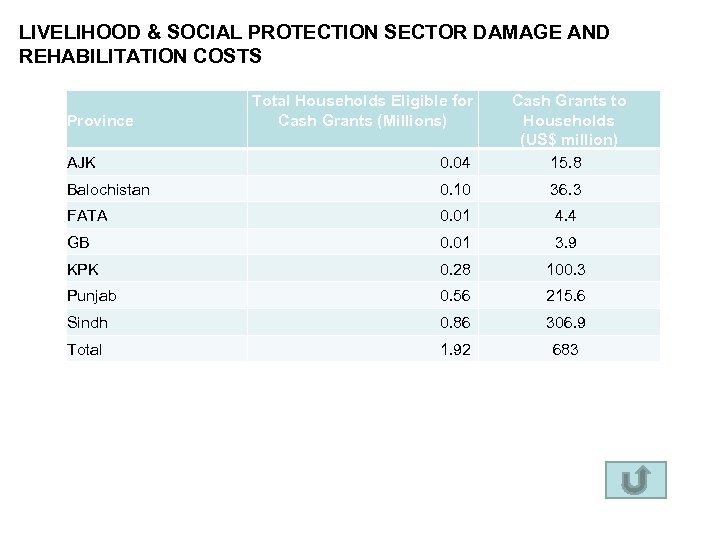 LIVELIHOOD & SOCIAL PROTECTION SECTOR DAMAGE AND REHABILITATION COSTS AJK 0. 04 Cash Grants to Households (US$ million) 15. 8 Balochistan 0. 10 36. 3 FATA 0. 01 4. 4 GB 0. 01 3. 9 KPK 0. 28 100. 3 Punjab 0. 56 215. 6 Sindh 0. 86 306. 9 Total 1. 92 683 Province Total Households Eligible for Cash Grants (Millions)
 Transport & Communication
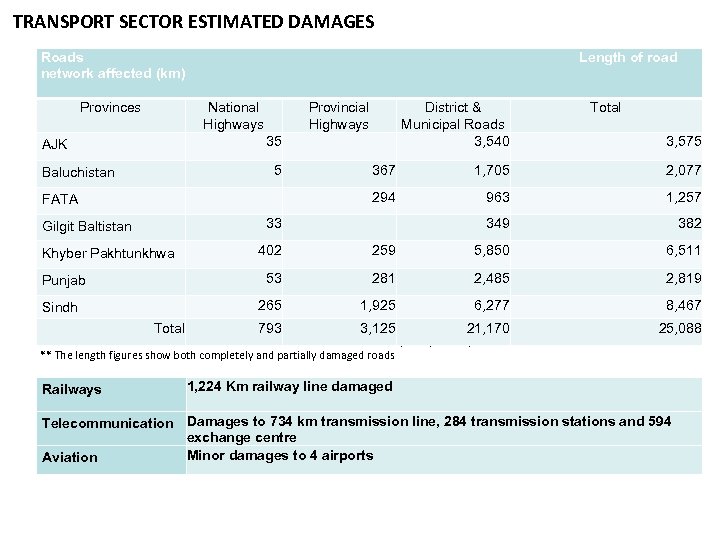 TRANSPORT SECTOR ESTIMATED DAMAGES Roads Length of road network affected (km) Provinces National Highways Provincial Highways 35 AJK 5 District & Municipal Roads 3, 540 Total 3, 575 FATA 367 1, 705 2, 077 294 Baluchistan 963 1, 257 349 382 33 Gilgit Baltistan 402 259 5, 850 6, 511 Punjab 53 281 2, 485 2, 819 Sindh 265 1, 925 6, 277 8, 467 793 3, 125 21, 170 25, 088 Khyber Pakhtunkhwa Total * 10% of the total road network is affected out of which 7% roads are completely destroyed ** The length figures show both completely and partially damaged roads Railways 1, 224 Km railway line damaged Telecommunication Damages to 734 km transmission line, 284 transmission stations and 594 exchange centre Minor damages to 4 airports Aviation
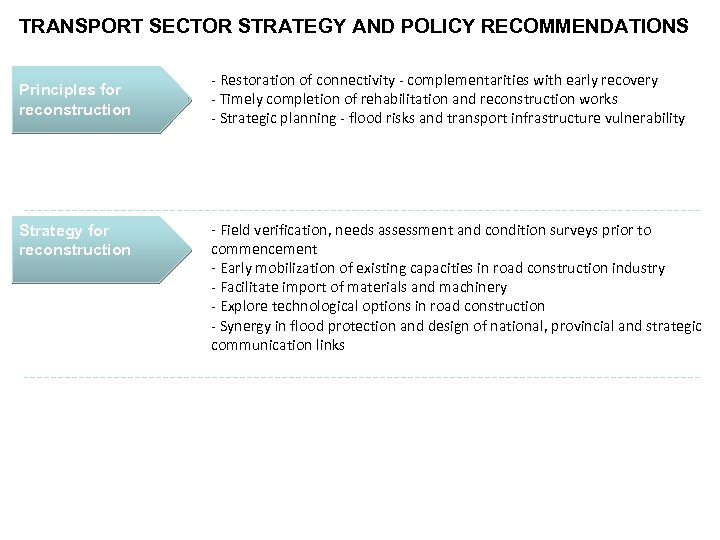 TRANSPORT SECTOR STRATEGY AND POLICY RECOMMENDATIONS Principles for reconstruction Strategy for reconstruction - Restoration of connectivity - complementarities with early recovery - Timely completion of rehabilitation and reconstruction works - Strategic planning - flood risks and transport infrastructure vulnerability - Field verification, needs assessment and condition surveys prior to commencement - Early mobilization of existing capacities in road construction industry - Facilitate import of materials and machinery - Explore technological options in road construction - Synergy in flood protection and design of national, provincial and strategic communication links
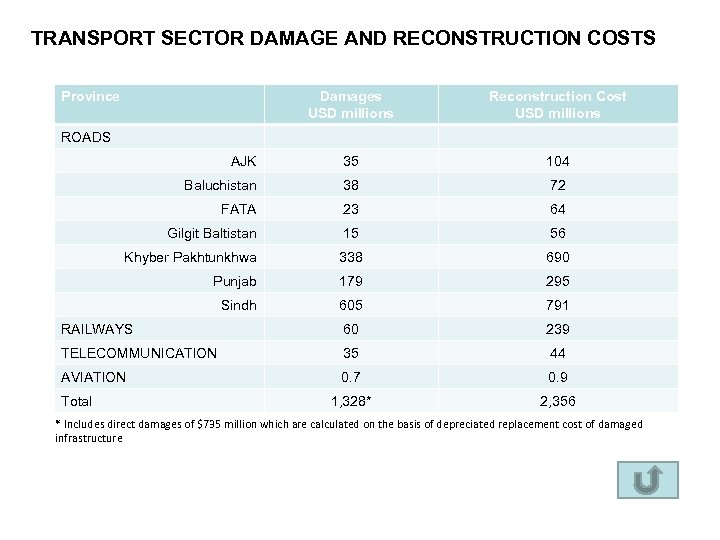 TRANSPORT SECTOR DAMAGE AND RECONSTRUCTION COSTS Province Damages USD millions Reconstruction Cost USD millions AJK 35 104 Baluchistan 38 72 FATA 23 64 Gilgit Baltistan 15 56 Khyber Pakhtunkhwa 338 690 Punjab 179 295 Sindh 605 791 RAILWAYS 60 239 TELECOMMUNICATION 35 44 AVIATION 0. 7 0. 9 1, 328* 2, 356 ROADS Total * Includes direct damages of $735 million which are calculated on the basis of depreciated replacement cost of damaged infrastructure
 Water & Sanitation 3/19/2018 1: 17 PM
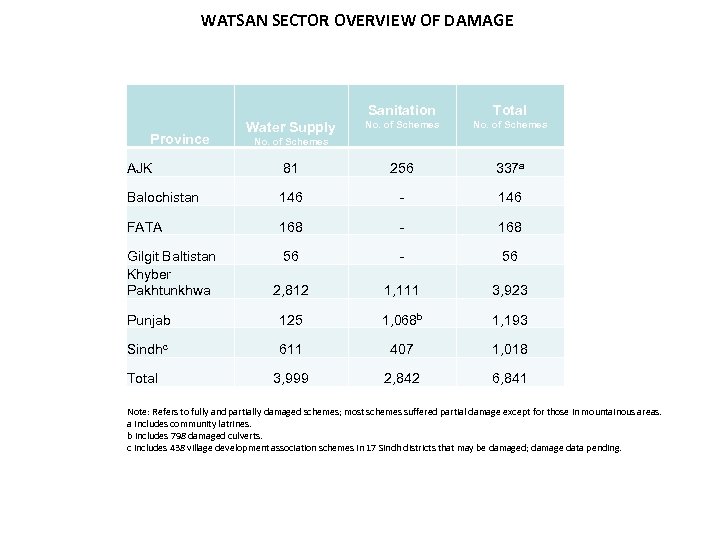 WATSAN SECTOR OVERVIEW OF DAMAGE Sanitation Province Water Supply Total No. of Schemes AJK 81 256 337 a Balochistan 146 - 146 FATA 168 - 168 Gilgit Baltistan Khyber Pakhtunkhwa 56 - 56 2, 812 1, 111 3, 923 Punjab 125 1, 068 b 1, 193 Sindhc 611 407 1, 018 3, 999 2, 842 6, 841 Total Note: Refers to fully and partially damaged schemes; most schemes suffered partial damage except for those in mountainous areas. a Includes community latrines. b Includes 798 damaged culverts. c Includes 438 village development association schemes in 17 Sindh districts that may be damaged; damage data pending.
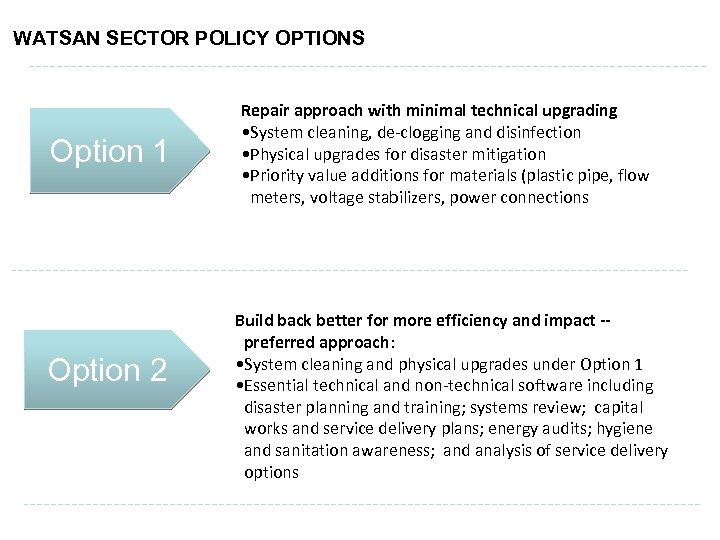 WATSAN SECTOR POLICY OPTIONS Option 1 Option 2 Repair approach with minimal technical upgrading • System cleaning, de-clogging and disinfection • Physical upgrades for disaster mitigation • Priority value additions for materials (plastic pipe, flow meters, voltage stabilizers, power connections Build back better for more efficiency and impact -preferred approach: • System cleaning and physical upgrades under Option 1 • Essential technical and non-technical software including disaster planning and training; systems review; capital works and service delivery plans; energy audits; hygiene and sanitation awareness; and analysis of service delivery options
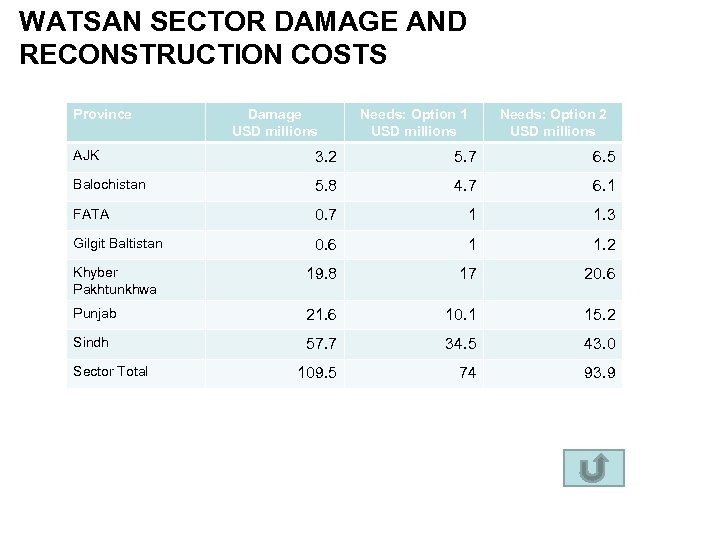 WATSAN SECTOR DAMAGE AND RECONSTRUCTION COSTS Province Damage USD millions Needs: Option 1 USD millions Needs: Option 2 USD millions AJK 3. 2 5. 7 6. 5 Balochistan 5. 8 4. 7 6. 1 FATA 0. 7 1 1. 3 Gilgit Baltistan 0. 6 1 1. 2 Khyber Pakhtunkhwa 19. 8 17 20. 6 Punjab 21. 6 10. 1 15. 2 Sindh 57. 7 34. 5 43. 0 109. 5 74 93. 9 Sector Total