 Скачать презентацию Pakistan Challenges in Political Global Economic Policy Institute
a9baf000a0e7722c8c4316ca4835b975.ppt
- Количество слайдов: 28



Pakistan; Challenges in Political. Global Economic Policy Institute Economic Development ICEA Feb 13 th 2007 Professor Paul E M Reynolds LONDON Tel + 44 20 874 86788 Mob & SMS + 44 7974 188087 E mails paulreynolds@email. com paulemreynolds@gmail. com
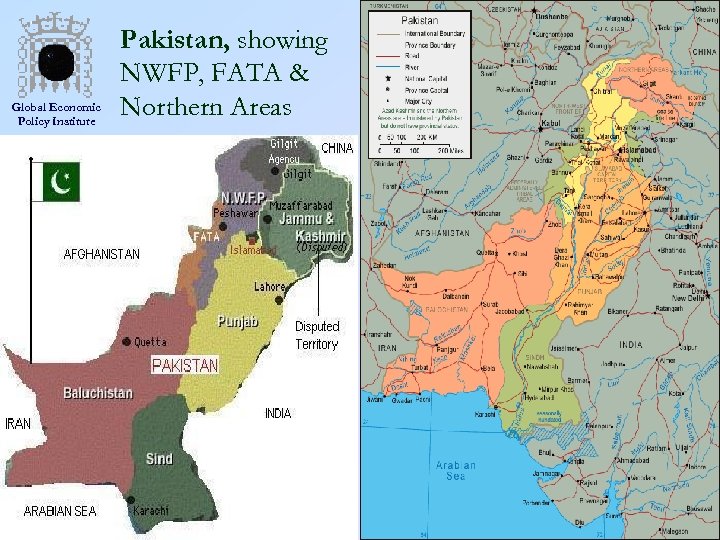
Global Economic Policy Institute Pakistan, showing NWFP, FATA & Northern Areas
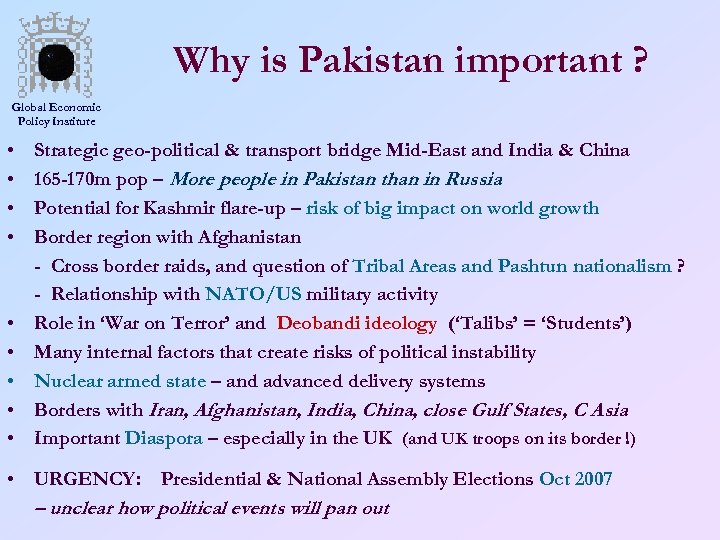
Why is Pakistan important ? Global Economic Policy Institute • • • Strategic geo-political & transport bridge Mid-East and India & China 165 -170 m pop – More people in Pakistan than in Russia Potential for Kashmir flare-up – risk of big impact on world growth Border region with Afghanistan - Cross border raids, and question of Tribal Areas and Pashtun nationalism ? - Relationship with NATO/US military activity Role in ‘War on Terror’ and Deobandi ideology (‘Talibs’ = ‘Students’) Many internal factors that create risks of political instability Nuclear armed state – and advanced delivery systems Borders with Iran, Afghanistan, India, China, close Gulf States, C Asia Important Diaspora – especially in the UK (and UK troops on its border !) • URGENCY: Presidential & National Assembly Elections Oct 2007 – unclear how political events will pan out
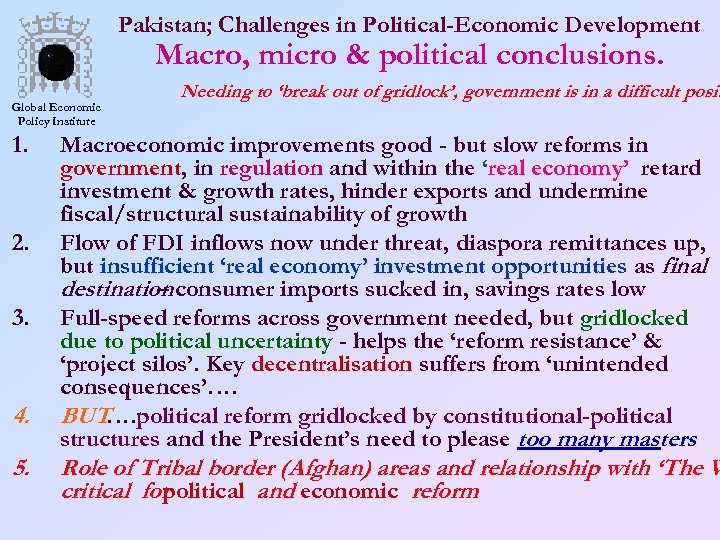
Pakistan; Challenges in Political-Economic Development Macro, micro & political conclusions. Global Economic Policy Institute 1. 2. 3. 4. 5. Needing to ‘break out of gridlock’, government is in a difficult posit Macroeconomic improvements good - but slow reforms in government, in regulation and within the ‘real economy’ retard investment & growth rates, hinder exports and undermine fiscal/structural sustainability of growth Flow of FDI inflows now under threat, diaspora remittances up, but insufficient ‘real economy’ investment opportunities as final destination consumer imports sucked in, savings rates low – Full-speed reforms across government needed, but gridlocked due to political uncertainty - helps the ‘reform resistance’ & ‘project silos’. Key decentralisation suffers from ‘unintended consequences’…. BUT…. political reform gridlocked by constitutional-political structures and the President’s need to please too many masters Role of Tribal border (Afghan) areas and relationship with ‘The W critical for political and economic reform
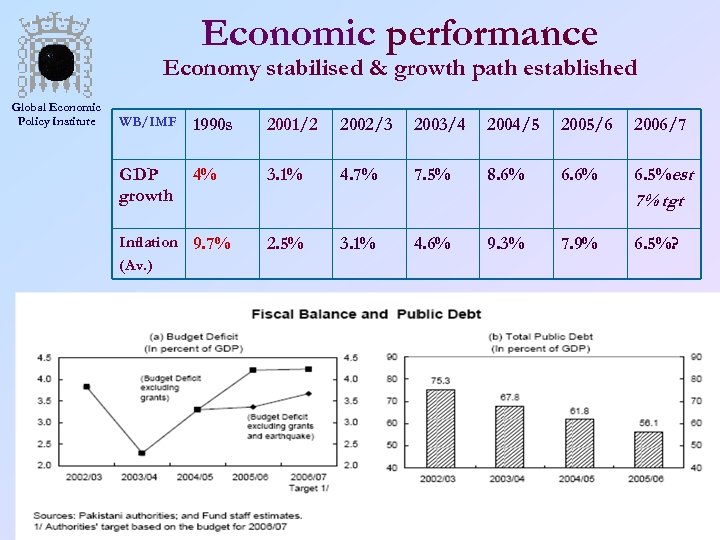
Economic performance Economy stabilised & growth path established Global Economic Policy Institute WB/IMF 1990 s 2001/2 2002/3 2003/4 2004/5 2005/6 2006/7 GDP growth 4% 3. 1% 4. 7% 7. 5% 8. 6% 6. 5%est Inflation 9. 7% (Av. ) 7% tgt 2. 5% 3. 1% 4. 6% 9. 3% 7. 9% 6. 5%?
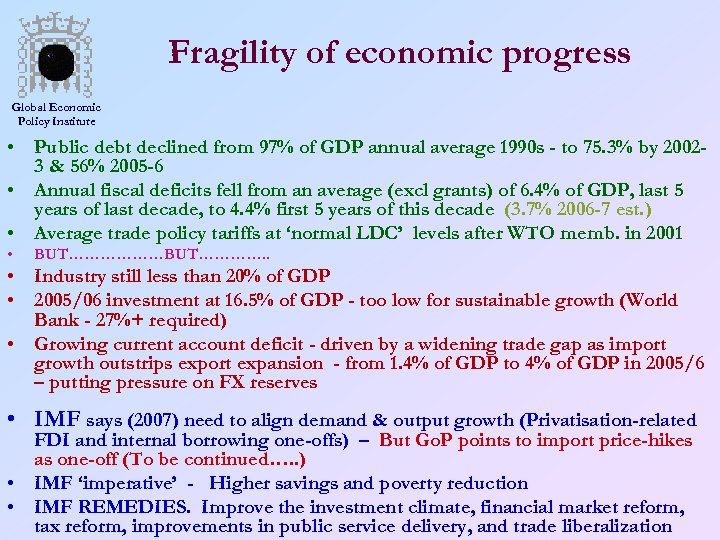
Fragility of economic progress Global Economic Policy Institute • Public debt declined from 97% of GDP annual average 1990 s - to 75. 3% by 20023 & 56% 2005 -6 • Annual fiscal deficits fell from an average (excl grants) of 6. 4% of GDP, last 5 years of last decade, to 4. 4% first 5 years of this decade (3. 7% 2006 -7 est. ) • Average trade policy tariffs at ‘normal LDC’ levels after WTO memb. in 2001 • BUT………………BUT…………. . • Industry still less than 20% of GDP • 2005/06 investment at 16. 5% of GDP - too low for sustainable growth (World Bank - 27%+ required) • Growing current account deficit - driven by a widening trade gap as import growth outstrips export expansion - from 1. 4% of GDP to 4% of GDP in 2005/6 – putting pressure on FX reserves • IMF says (2007) need to align demand & output growth (Privatisation-related FDI and internal borrowing one-offs) – But Go. P points to import price-hikes as one-off (To be continued…. . ) • IMF ‘imperative’ - Higher savings and poverty reduction • IMF REMEDIES. Improve the investment climate, financial market reform, tax reform, improvements in public service delivery, and trade liberalization
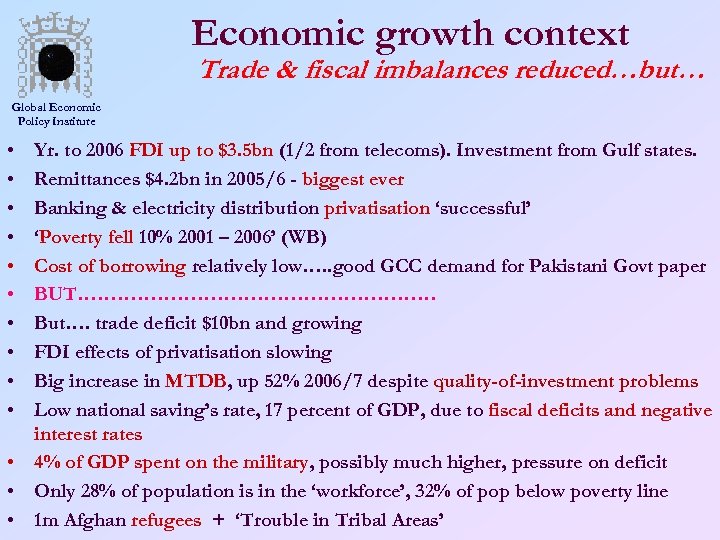
Economic growth context Trade & fiscal imbalances reduced…but… Global Economic Policy Institute • • • Yr. to 2006 FDI up to $3. 5 bn (1/2 from telecoms). Investment from Gulf states. Remittances $4. 2 bn in 2005/6 - biggest ever Banking & electricity distribution privatisation ‘successful’ ‘Poverty fell 10% 2001 – 2006’ (WB) Cost of borrowing relatively low…. . good GCC demand for Pakistani Govt paper BUT……………………… But…. trade deficit $10 bn and growing FDI effects of privatisation slowing Big increase in MTDB, up 52% 2006/7 despite quality-of-investment problems Low national saving’s rate, 17 percent of GDP, due to fiscal deficits and negative interest rates • 4% of GDP spent on the military, possibly much higher, pressure on deficit • Only 28% of population is in the ‘workforce’, 32% of pop below poverty line • 1 m Afghan refugees + ‘Trouble in Tribal Areas’
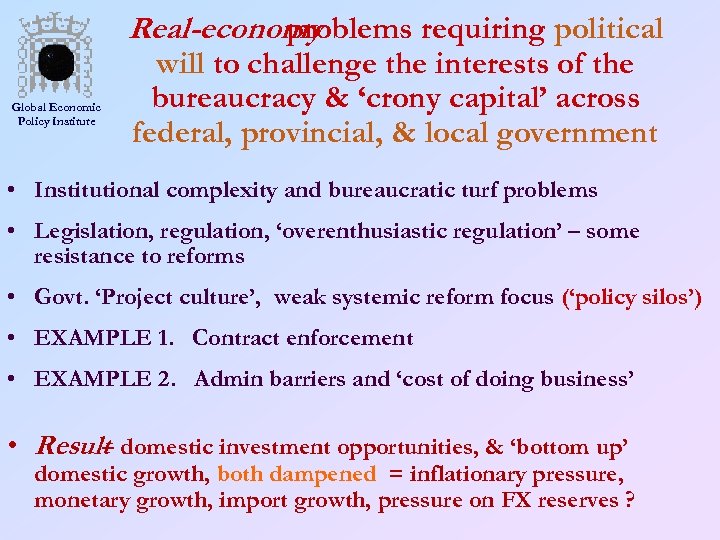
Real-economy problems requiring political Global Economic Policy Institute will to challenge the interests of the bureaucracy & ‘crony capital’ across federal, provincial, & local government • Institutional complexity and bureaucratic turf problems • Legislation, regulation, ‘overenthusiastic regulation’ – some resistance to reforms • Govt. ‘Project culture’, weak systemic reform focus (‘policy silos’) • EXAMPLE 1. Contract enforcement • EXAMPLE 2. Admin barriers and ‘cost of doing business’ • Result domestic investment opportunities, & ‘bottom up’ – domestic growth, both dampened = inflationary pressure, monetary growth, import growth, pressure on FX reserves ?
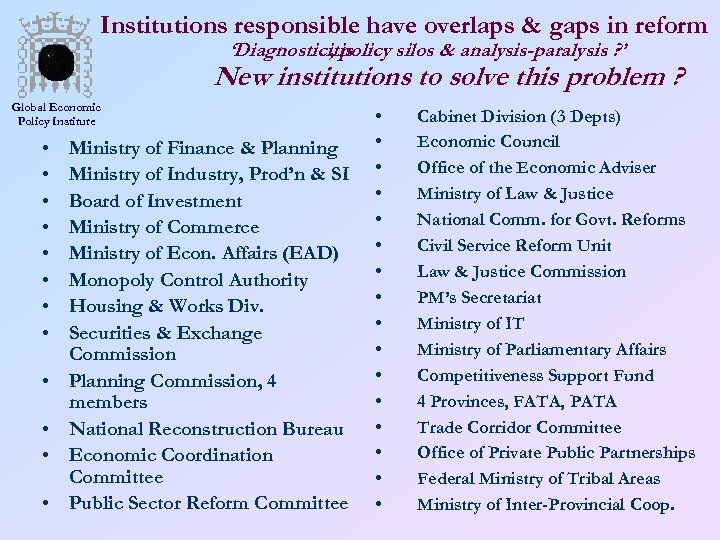
Institutions responsible have overlaps & gaps in reform ‘Diagnosticitis , policy silos & analysis-paralysis ? ’ New institutions to solve this problem ? Global Economic Policy Institute • • • Ministry of Finance & Planning Ministry of Industry, Prod’n & SI Board of Investment Ministry of Commerce Ministry of Econ. Affairs (EAD) Monopoly Control Authority Housing & Works Div. Securities & Exchange Commission Planning Commission, 4 members National Reconstruction Bureau Economic Coordination Committee Public Sector Reform Committee • • • • Cabinet Division (3 Depts) Economic Council Office of the Economic Adviser Ministry of Law & Justice National Comm. for Govt. Reforms Civil Service Reform Unit Law & Justice Commission PM’s Secretariat Ministry of IT Ministry of Parliamentary Affairs Competitiveness Support Fund 4 Provinces, FATA, PATA Trade Corridor Committee Office of Private Public Partnerships Federal Ministry of Tribal Areas Ministry of Inter-Provincial Coop.
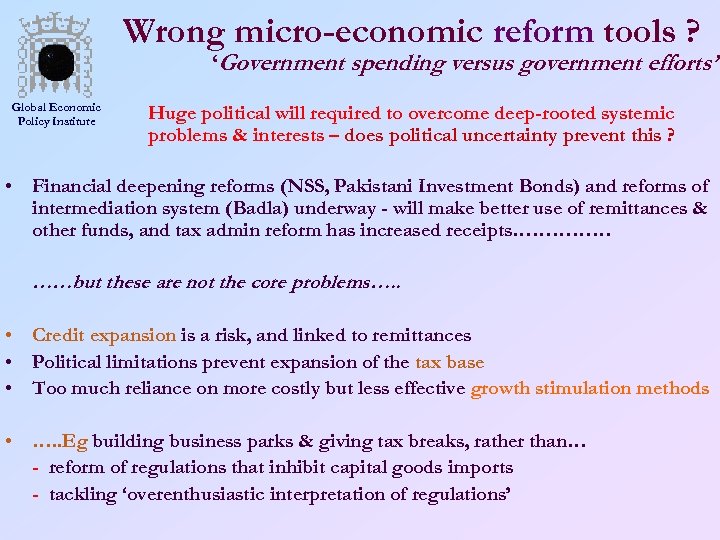
Wrong micro-economic reform tools ? ‘Government spending versus government efforts’ Global Economic Policy Institute Huge political will required to overcome deep-rooted systemic problems & interests – does political uncertainty prevent this ? • Financial deepening reforms (NSS, Pakistani Investment Bonds) and reforms of intermediation system (Badla) underway - will make better use of remittances & other funds, and tax admin reform has increased receipts…………… ……but these are not the core problems…. . • Credit expansion is a risk, and linked to remittances • Political limitations prevent expansion of the tax base • Too much reliance on more costly but less effective growth stimulation methods • …. . Eg building business parks & giving tax breaks, rather than… - reform of regulations that inhibit capital goods imports - tackling ‘overenthusiastic interpretation of regulations’
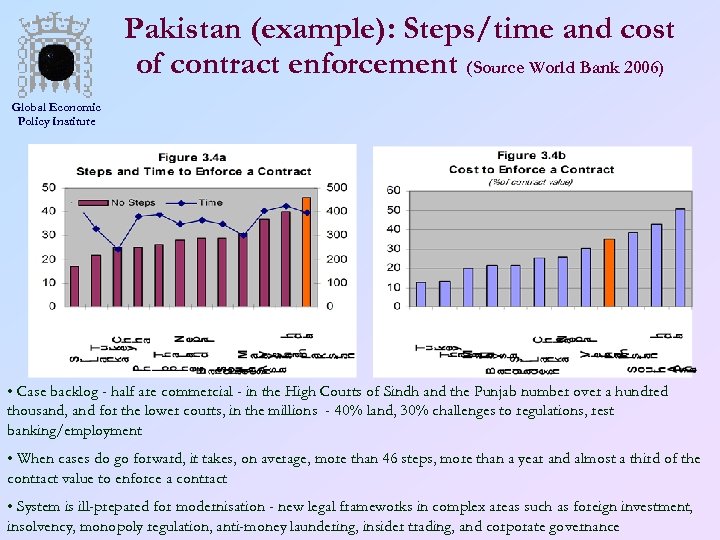
Pakistan (example): Steps/time and cost of contract enforcement (Source World Bank 2006) Global Economic Policy Institute • Case backlog - half are commercial - in the High Courts of Sindh and the Punjab number over a hundred thousand, and for the lower courts, in the millions - 40% land, 30% challenges to regulations, rest banking/employment • When cases do go forward, it takes, on average, more than 46 steps, more than a year and almost a third of the contract value to enforce a contract • System is ill-prepared for modernisation - new legal frameworks in complex areas such as foreign investment, insolvency, monopoly regulation, anti-money laundering, insider trading, and corporate governance
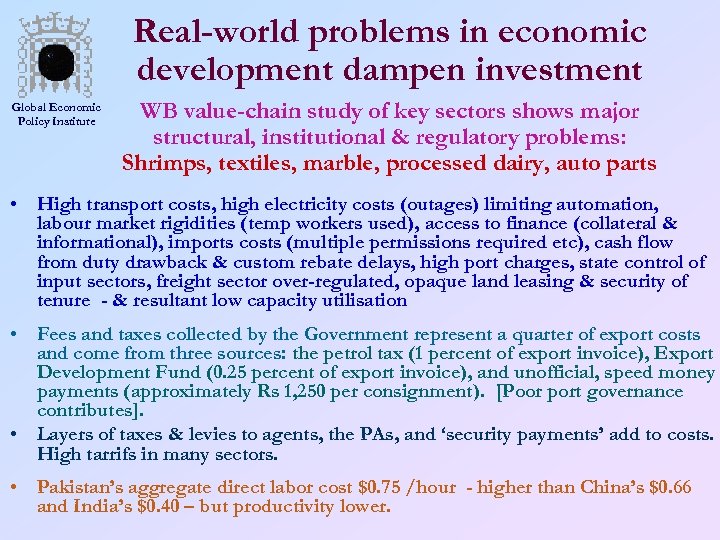
Real-world problems in economic development dampen investment Global Economic Policy Institute WB value-chain study of key sectors shows major structural, institutional & regulatory problems: Shrimps, textiles, marble, processed dairy, auto parts • High transport costs, high electricity costs (outages) limiting automation, labour market rigidities (temp workers used), access to finance (collateral & informational), imports costs (multiple permissions required etc), cash flow from duty drawback & custom rebate delays, high port charges, state control of input sectors, freight sector over-regulated, opaque land leasing & security of tenure - & resultant low capacity utilisation • Fees and taxes collected by the Government represent a quarter of export costs and come from three sources: the petrol tax (1 percent of export invoice), Export Development Fund (0. 25 percent of export invoice), and unofficial, speed money payments (approximately Rs 1, 250 per consignment). [Poor port governance contributes]. • Layers of taxes & levies to agents, the PAs, and ‘security payments’ add to costs. High tarrifs in many sectors. • Pakistan’s aggregate direct labor cost $0. 75 /hour - higher than China’s $0. 66 and India’s $0. 40 – but productivity lower.
Global Economic Policy Institute Resistance to pro-growth regulatory reforms ? • 2004/5 World Bank project on regulatory reform ’Impact has been minimal’ • 2005 Better business regulations IFC. Admin barriers report not published. • 2006 IFC/World Bank business regulations, pending…
Global Economic Policy Institute • • • Future economic reform challenges Regulatory quality and the link to rent-seeking Poor domestic export performance relative to expectations, and the lack of investment to overcome high costs Capital infrastructure problems – access to debt & equity finance for export development, and absence of venture capital & ‘real sector’ investment funds Low ‘growth productivity’ in the use of inward financing from remittances and capital repatriation This challenge combined with industrial and labour rigidities/monopolistic markets = ‘not enough productive places to put the money’ How to apply telecom sector’s success in attracting investment to other ‘regulatorydependent’ sectors like electricity, water, transport and hydrocarbons. How to address investment and economic growth inhibitors (How to support the Ministry of Law & Justice in tidying up of existing legislation and regulations) Addressing urgent need to tackle problems created by the separate MTBF and MTDF, (eg poor use of assets, lower investment) How to address the negative impact on domestic investment and growth arising from the domestic financing of the budget deficit.
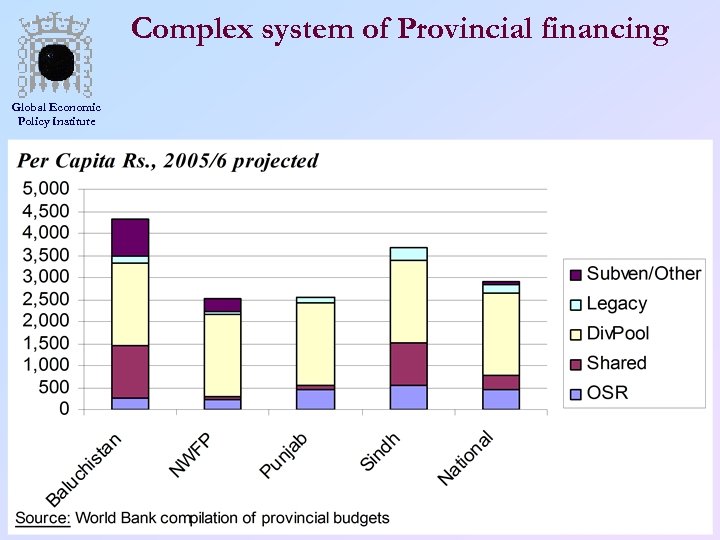
Fiscal decentralisation issues Pakistan is highly centralised fiscally Global Economic Policy Institute Growth & political reform requires change Reforms started in 2001 but within existing structures • Sub-national governments in Pakistan - very low subnational tax collection rates by international comparisons • Only 0. 9 percent in GDP of revenues in 2005/6. India’s - 6. 1 percent, or 7 percent based on more recent figures (World Bank 2005: xxvii) • Provinces in Pakistan are highly dependent on federal shared revenues and grants – complex system. • All provinces receive identical per capita levels of divisible pool allocations • All provinces are characterized by low own revenue mobilization, although some differences are evident across provinces.
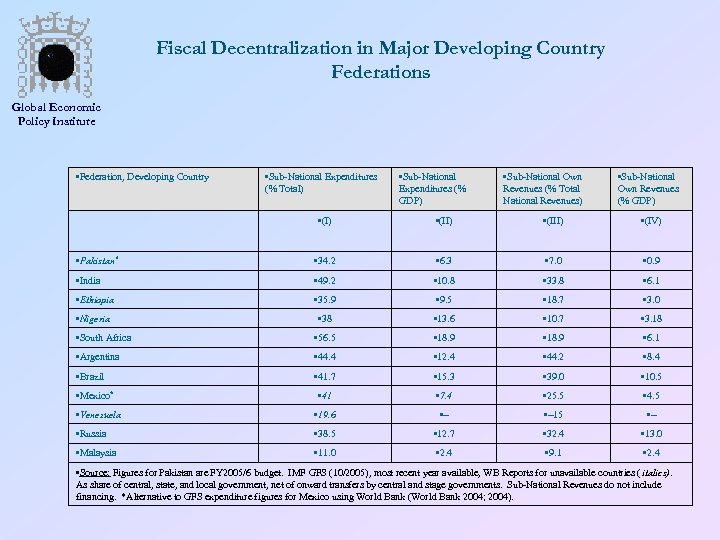
Fiscal Decentralization in Major Developing Country Federations Global Economic Policy Institute • Federation, Developing Country • Sub-National Expenditures (% Total) • Sub-National Expenditures (% GDP) • Sub-National Own Revenues (% Total National Revenues) • Sub-National Own Revenues (% GDP) • (II) • (III) • (IV) • Pakistan* • 34. 2 • 6. 3 • 7. 0 • 0. 9 • India • 49. 2 • 10. 8 • 33. 8 • 6. 1 • Ethiopia • 35. 9 • 9. 5 • 18. 7 • 3. 0 • Nigeria • 38 • 13. 6 • 10. 7 • 3. 18 • South Africa • 56. 5 • 18. 9 • 6. 1 • Argentina • 44. 4 • 12. 4 • 44. 2 • 8. 4 • Brazil • 41. 7 • 15. 3 • 39. 0 • 10. 5 • 41 • 7. 4 • 25. 5 • 4. 5 • Venezuela • 19. 6 • ~15 • ~ • Russia • 38. 5 • 12. 7 • 32. 4 • 13. 0 • Malaysia • 11. 0 • 2. 4 • 9. 1 • 2. 4 • Mexico* • Source: Figures for Pakistan are FY 2005/6 budget. IMF GFS (10/2005), most recent year available, WB Reports for unavailable countries ( italics). As share of central, state, and local government, net of onward transfers by central and stage governments. Sub-National Revenues do not include financing. *Alternative to GFS expenditure figures for Mexico using World Bank (World Bank 2004; 2004).
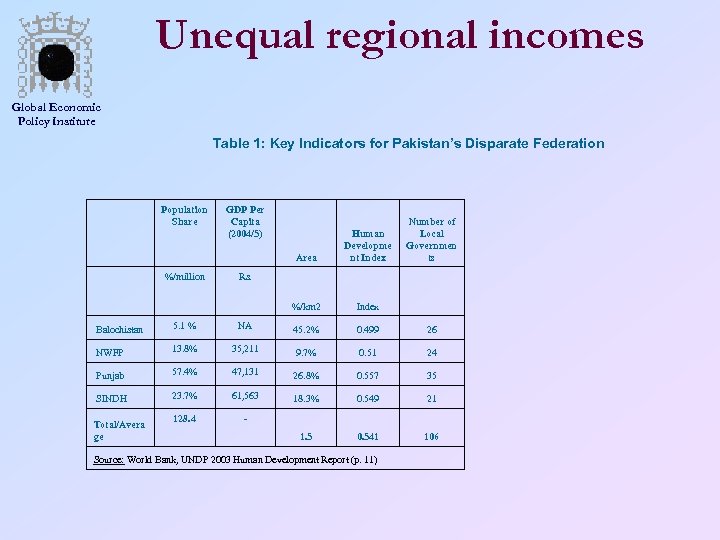
Unequal regional incomes Global Economic Policy Institute Table 1: Key Indicators for Pakistan’s Disparate Federation Population Share GDP Per Capita (2004/5) Area %/km 2 %/million Human Developme nt Index Number of Local Governmen ts Index Rs. Balochistan 5. 1 % NA 45. 2% 0. 499 26 NWFP 13. 8% 35, 211 9. 7% 0. 51 24 Punjab 57. 4% 47, 131 26. 8% 0. 557 35 SINDH 23. 7% 61, 563 18. 3% 0. 549 21 128. 4 1. 5 0. 541 106 Total/Avera ge Source: World Bank, UNDP 2003 Human Development Report (p. 11)
Complex system of Provincial financing Global Economic Policy Institute
Global Economic Policy Institute The status of the Tribal Areas ‘across the Durand Line’ • Historical Afghan territorial claims over Pashtun NWFP, PATA, FATA, & Pashtun areas in Baluchistan • Administered by Punjab British Commissioner, then 1901 direct Delhi rule of NWFP Province - settled & FATA tribal areas separate, both as NWFP Afghan buffer zone • Separate status, continued post-independence – constitutional FATA buffer zone and tool against Pashtun nationalism on both sides of the border; not elected (A 247). NWFP Governor formally represents President • Pre- & post- colonial regimes – ‘no troops deal’ with (paid) Maliks & Lungis • Frontier Crimes Regulations (1901 to today), FATA de facto constitutionally separate, Presidential control, Political Agent rule in FATA agencies ‘absolute’ • President has authority over all governance & military arrangements in FATA (1973 constitution A 247/5). Via primary legislation – FCR, permits detention-no-trial • PAs – (executive-judiciary-legislature) appoint own para-militaries – can fire Maliks – appoint Maliks to Jirga courts – no full appellate path or normal rights • FATA areas a channel for very large-scale US funds to Afghan mujahadeen during Soviet occupation – but govt. wary of Pashtun cross-border nationalism • 1980 -2000 – roots of ISI culture & skill balancing different Pashtun interests
Global Economic Policy Institute The role of FATA in the Pakistani Political System • 12 seats in the National Assembly, 8 in the Senate, elected by appointed (all male) FATA Maliks in the pay of the Presidency/military & each easily dismissed • But parliament cannot legislate on FATA, and general Pakistani laws do not fully apply in FATA • FATA parliamentarians linked to pro-Deobani groups (JUI-F) • No representation over FATA, or in NWFP legislature • Alleged tit-for-tat: support in parliament, for peace, arms/drugs trade, & Deobandi ‘freedom to act’ without political competition • Political parties & national/regional secular political groups banned in FATA Since Afghan Soviet occupation, (& huge US mujahadeen financing), pro. Deobandis groups & Maliks have grown under such political ‘cover’, and replaced ‘old school Maliks’ • JUI-F – coalition partners of govt. in Balochistan ! • Presidency has inherited this system – propped by ‘negotiated balance’ • President’s international trump card: better to accept a complex negotiated balan risk a Deobandi government / Pashtun state (may well be true !)
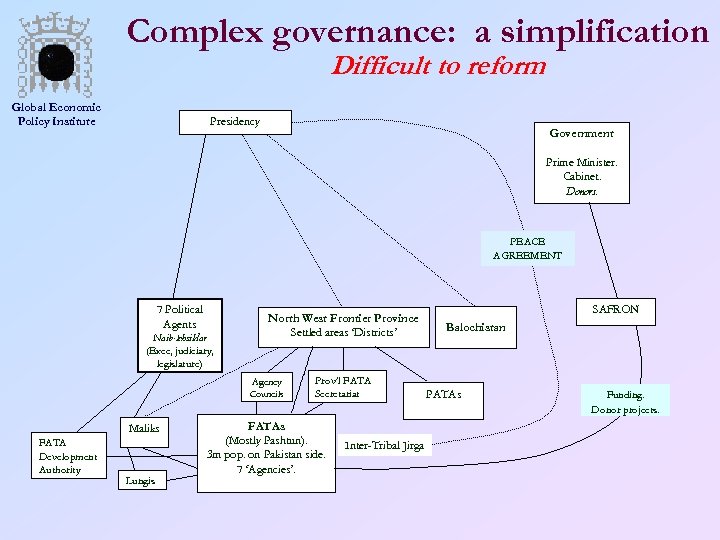
Complex governance: a simplification Difficult to reform Global Economic Policy Institute Presidency Government Prime Minister. Cabinet. Donors. PEACE AGREEMENT 7 Political Agents Naib-tehsildar (Exec, judiciary, legislature) North West Frontier Province Settled areas ‘Districts’ Agency Councils Maliks FATA Development Authority Lungis Prov’l FATA Secretariat FATAs (Mostly Pashtun). 3 m pop. on Pakistan side. 7 ‘Agencies’. Inter-Tribal Jirga SAFRON Balochistan PATAs Funding. Donor projects.
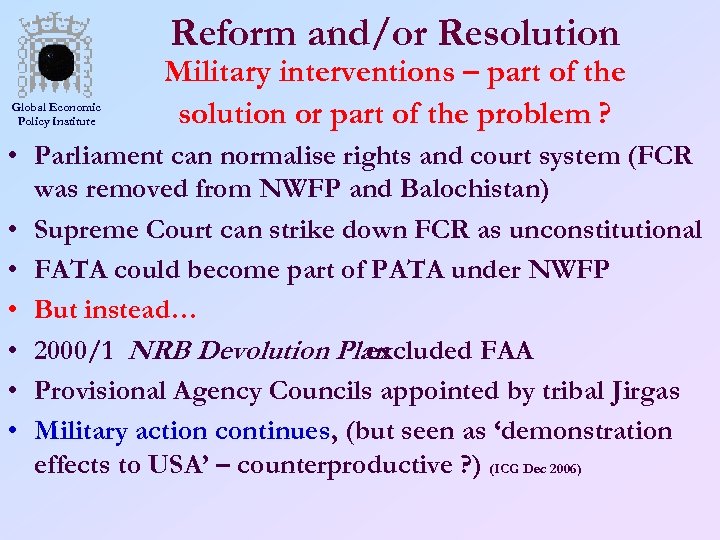
Reform and/or Resolution Global Economic Policy Institute Military interventions – part of the solution or part of the problem ? • Parliament can normalise rights and court system (FCR was removed from NWFP and Balochistan) • Supreme Court can strike down FCR as unconstitutional • FATA could become part of PATA under NWFP • But instead… • 2000/1 NRB Devolution Plan excluded FAA • Provisional Agency Councils appointed by tribal Jirgas • Military action continues, (but seen as ‘demonstration effects to USA’ – counterproductive ? ) (ICG Dec 2006)
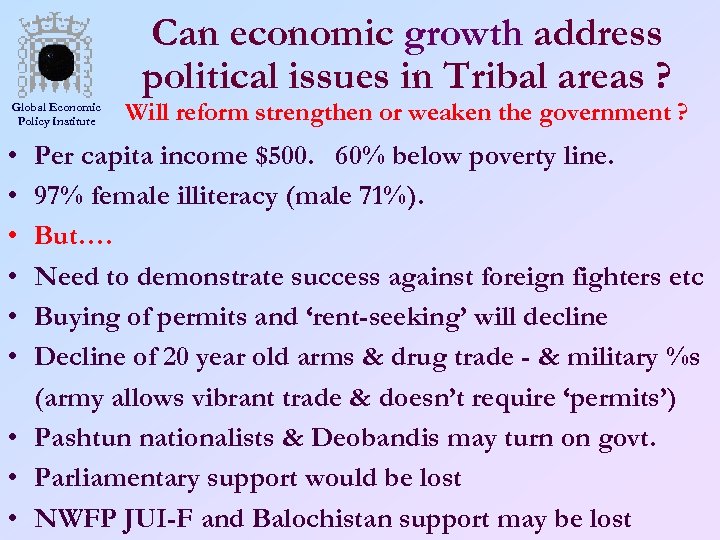
Can economic growth address political issues in Tribal areas ? Global Economic Policy Institute • • • Will reform strengthen or weaken the government ? Per capita income $500. 60% below poverty line. 97% female illiteracy (male 71%). But…. Need to demonstrate success against foreign fighters etc Buying of permits and ‘rent-seeking’ will decline Decline of 20 year old arms & drug trade - & military %s (army allows vibrant trade & doesn’t require ‘permits’) • Pashtun nationalists & Deobandis may turn on govt. • Parliamentary support would be lost • NWFP JUI-F and Balochistan support may be lost
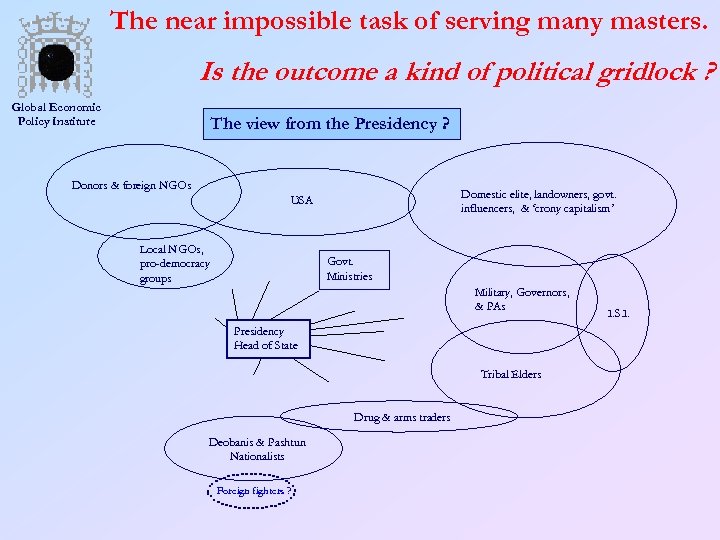
The near impossible task of serving many masters. Is the outcome a kind of political gridlock ? Global Economic Policy Institute The view from the Presidency ? Donors & foreign NGOs Domestic elite, landowners, govt. influencers, & ‘crony capitalism’ USA Local NGOs, pro-democracy groups Govt. Ministries Military, Governors, & PAs Presidency Head of State Tribal Elders Drug & arms traders Deobanis & Pashtun Nationalists Foreign fighters ? I. S. I.
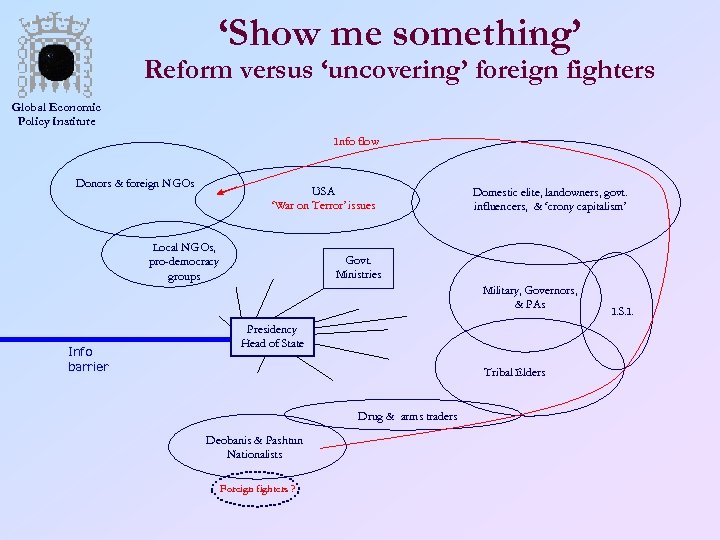
‘Show me something’ Reform versus ‘uncovering’ foreign fighters Global Economic Policy Institute Info flow Donors & foreign NGOs USA ‘War on Terror’ issues Local NGOs, pro-democracy groups Domestic elite, landowners, govt. influencers, & ‘crony capitalism’ Govt. Ministries Military, Governors, & PAs Info barrier Presidency Head of State Tribal Elders Drug & arms traders Deobanis & Pashtun Nationalists Foreign fighters ? I. S. I.
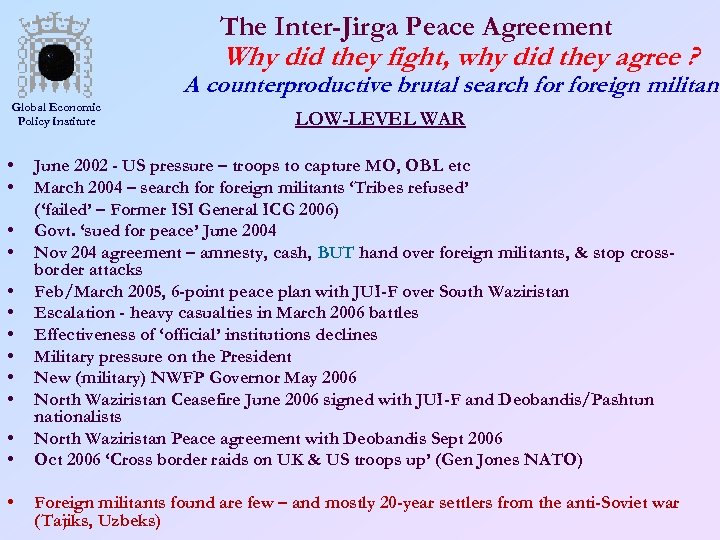
The Inter-Jirga Peace Agreement Why did they fight, why did they agree ? A counterproductive brutal search foreign militant Global Economic Policy Institute • • • • LOW-LEVEL WAR June 2002 - US pressure – troops to capture MO, OBL etc March 2004 – search foreign militants ‘Tribes refused’ (‘failed’ – Former ISI General ICG 2006) Govt. ‘sued for peace’ June 2004 Nov 204 agreement – amnesty, cash, BUT hand over foreign militants, & stop crossborder attacks Feb/March 2005, 6 -point peace plan with JUI-F over South Waziristan Escalation - heavy casualties in March 2006 battles Effectiveness of ‘official’ institutions declines Military pressure on the President New (military) NWFP Governor May 2006 North Waziristan Ceasefire June 2006 signed with JUI-F and Deobandis/Pashtun nationalists North Waziristan Peace agreement with Deobandis Sept 2006 Oct 2006 ‘Cross border raids on UK & US troops up’ (Gen Jones NATO) Foreign militants found are few – and mostly 20 -year settlers from the anti-Soviet war (Tajiks, Uzbeks)
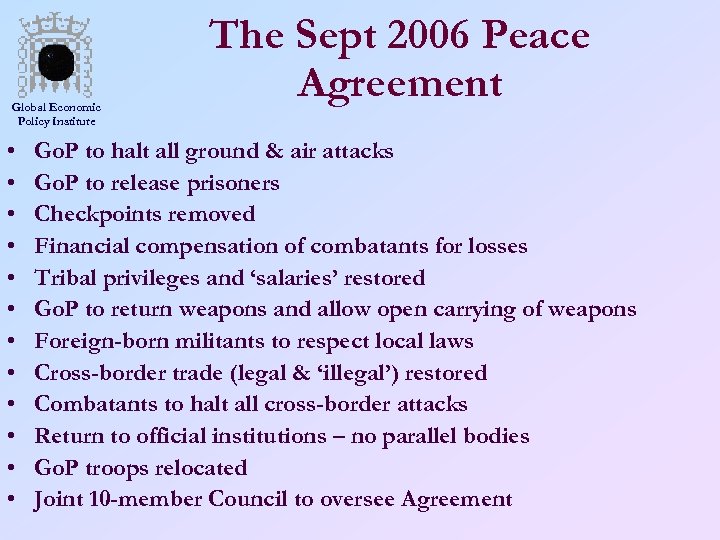
Global Economic Policy Institute • • • The Sept 2006 Peace Agreement Go. P to halt all ground & air attacks Go. P to release prisoners Checkpoints removed Financial compensation of combatants for losses Tribal privileges and ‘salaries’ restored Go. P to return weapons and allow open carrying of weapons Foreign-born militants to respect local laws Cross-border trade (legal & ‘illegal’) restored Combatants to halt all cross-border attacks Return to official institutions – no parallel bodies Go. P troops relocated Joint 10 -member Council to oversee Agreement
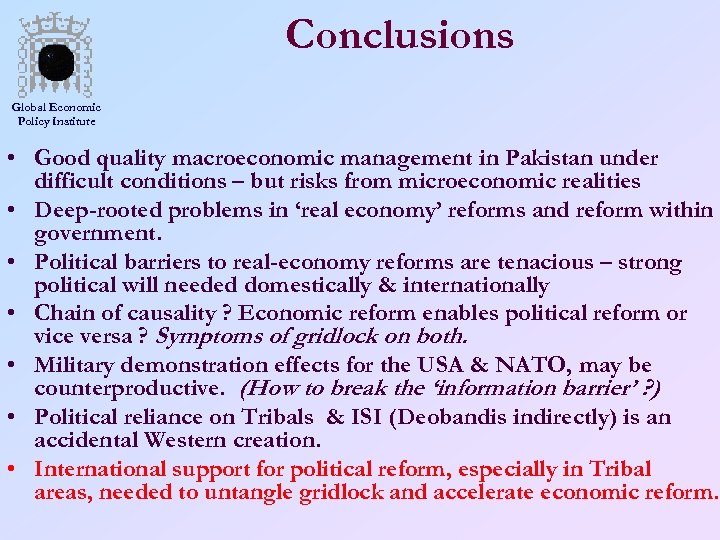
Conclusions Global Economic Policy Institute • Good quality macroeconomic management in Pakistan under difficult conditions – but risks from microeconomic realities • Deep-rooted problems in ‘real economy’ reforms and reform within government. • Political barriers to real-economy reforms are tenacious – strong political will needed domestically & internationally • Chain of causality ? Economic reform enables political reform or vice versa ? Symptoms of gridlock on both. • Military demonstration effects for the USA & NATO, may be counterproductive. (How to break the ‘information barrier’ ? ) • Political reliance on Tribals & ISI (Deobandis indirectly) is an accidental Western creation. • International support for political reform, especially in Tribal areas, needed to untangle gridlock and accelerate economic reform.
Скачать презентацию Pakistan Challenges in Political Global Economic Policy Institute
a9baf000a0e7722c8c4316ca4835b975.ppt