 Скачать презентацию Paired bilingual associative links as the basis of
5c8c07b17eef0d696179ea5505c3bc4b.ppt
- Количество слайдов: 31



Paired bilingual associative links as the basis of codeswitching mechanism Tamara Dotsenko bisar@bk. ru Yuliya Leshchenko naps 1976@mail. ru Tatyana Ostapenko osttania@yandex. ru Perm State Pedagogical University
Code-switching in modern linguistics Code-switching – concurrent use of two or more languages in one and the same speech act (Figueroa 1995, Hansen 2000)
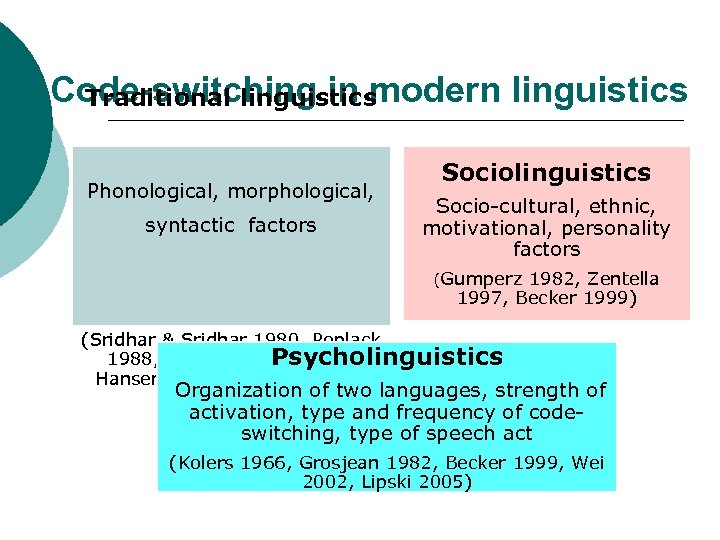
Code-switching in modern linguistics Traditional linguistics Phonological, morphological, syntactic factors Sociolinguistics Socio-cultural, ethnic, motivational, personality factors (Gumperz 1982, Zentella 1997, Becker 1999) (Sridhar & Sridhar 1980, Poplack Psycholinguistics 1988, Myers-Scotton 1993, Hansen 2000, Muysken 2000) Organization of two languages, strength of activation, type and frequency of codeswitching, type of speech act (Kolers 1966, Grosjean 1982, Becker 1999, Wei 2002, Lipski 2005)
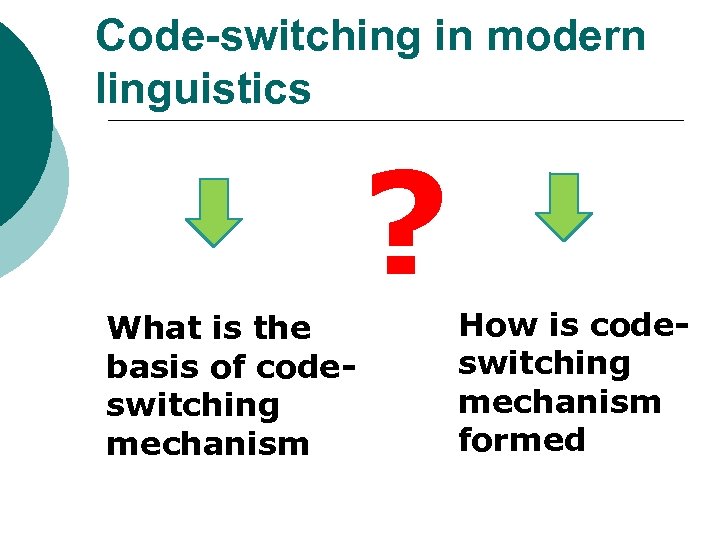
Code-switching in modern linguistics ? What is the basis of codeswitching mechanism How is codeswitching mechanism formed
Mental lexicon models Mental lexicon – base of speech production, «language in its prespeech availability» (Karaulov 1999)
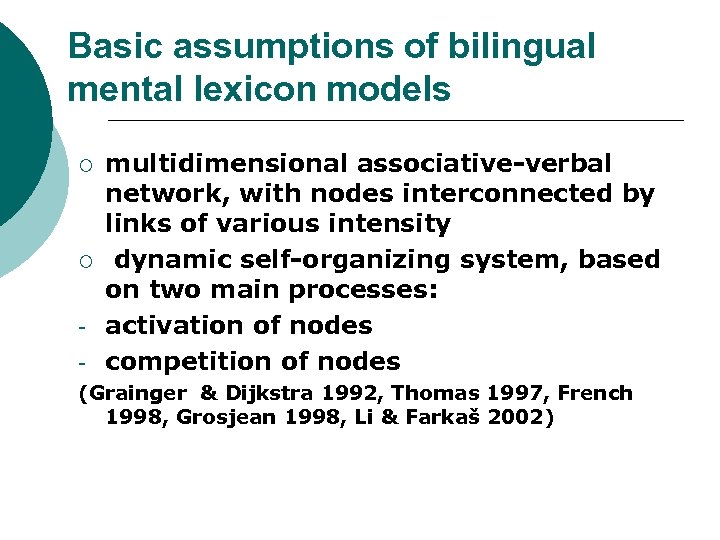
Basic assumptions of bilingual mental lexicon models ¡ ¡ - multidimensional associative-verbal network, with nodes interconnected by links of various intensity dynamic self-organizing system, based on two main processes: activation of nodes competition of nodes (Grainger & Dijkstra 1992, Thomas 1997, French 1998, Grosjean 1998, Li & Farkaš 2002)
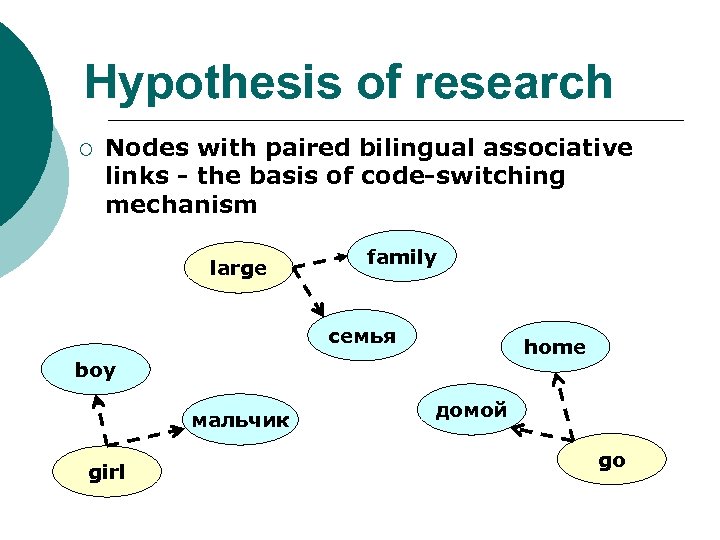
Hypothesis of research ¡ Nodes with paired bilingual associative links - the basis of code-switching mechanism large family cемья home boy мальчик girl домой go
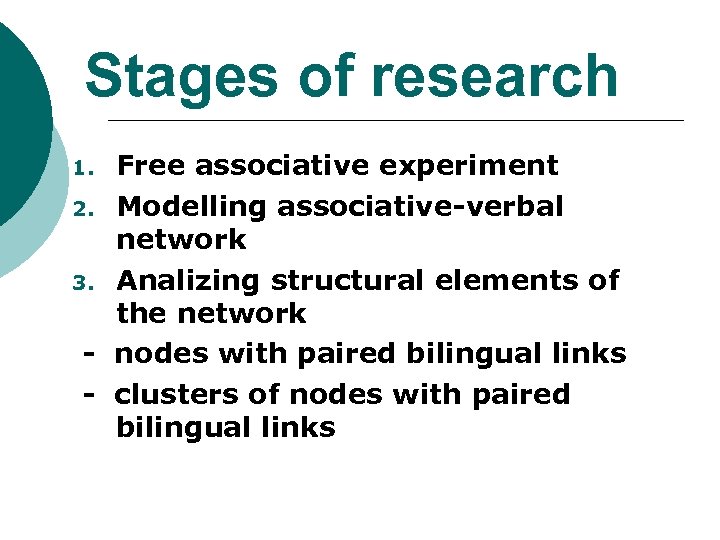
Stages of research Free associative experiment 2. Modelling associative-verbal network 3. Analizing structural elements of the network - nodes with paired bilingual links - clusters of nodes with paired bilingual links 1.
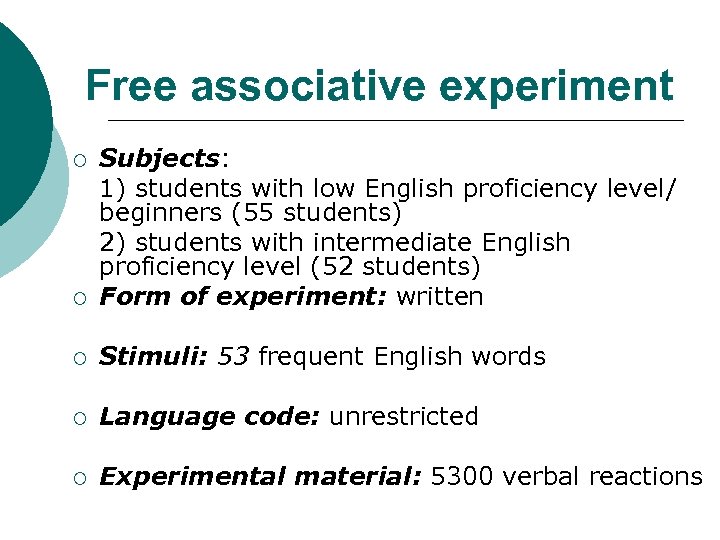
Free associative experiment ¡ Subjects: 1) students with low English proficiency level/ beginners (55 students) 2) students with intermediate English proficiency level (52 students) Form of experiment: written ¡ Stimuli: 53 frequent English words ¡ Language code: unrestricted ¡ Experimental material: 5300 verbal reactions ¡
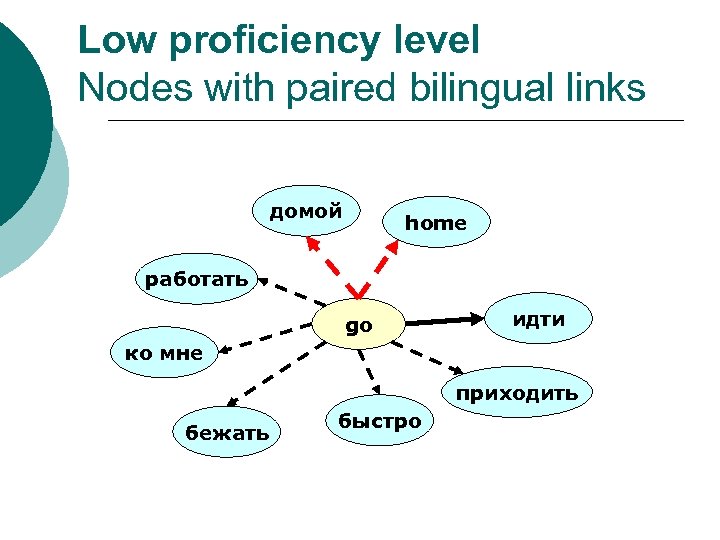
Low proficiency level Nodes with paired bilingual links домой home работать go идти ко мне приходить бежать быстро
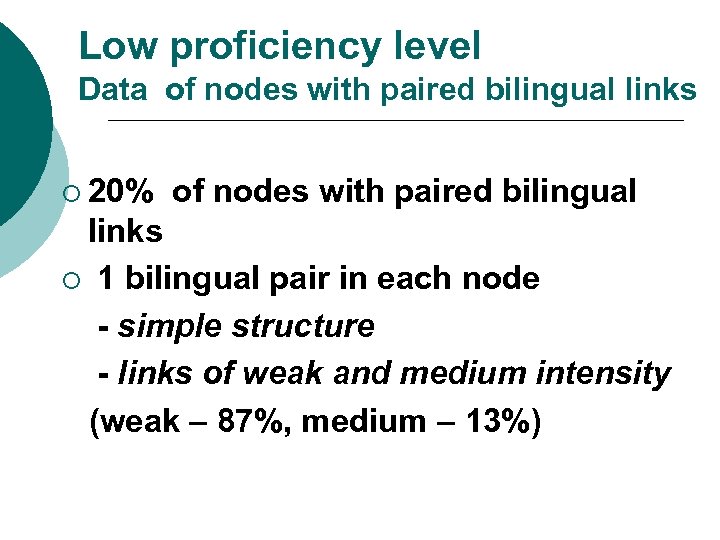
Low proficiency level Data of nodes with paired bilingual links ¡ 20% of nodes with paired bilingual links ¡ 1 bilingual pair in each node - simple structure - links of weak and medium intensity (weak – 87%, medium – 13%)
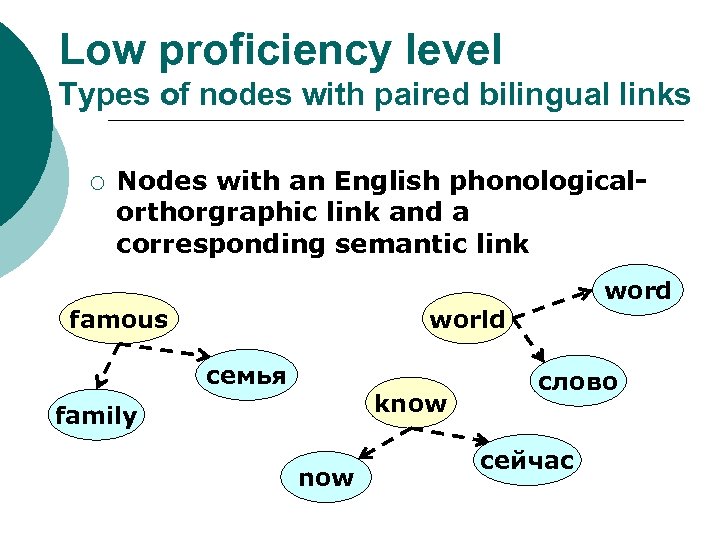
Low proficiency level Types of nodes with paired bilingual links ¡ Nodes with an English phonologicalorthorgraphic link and a corresponding semantic link famous word world семья know family now слово сейчас
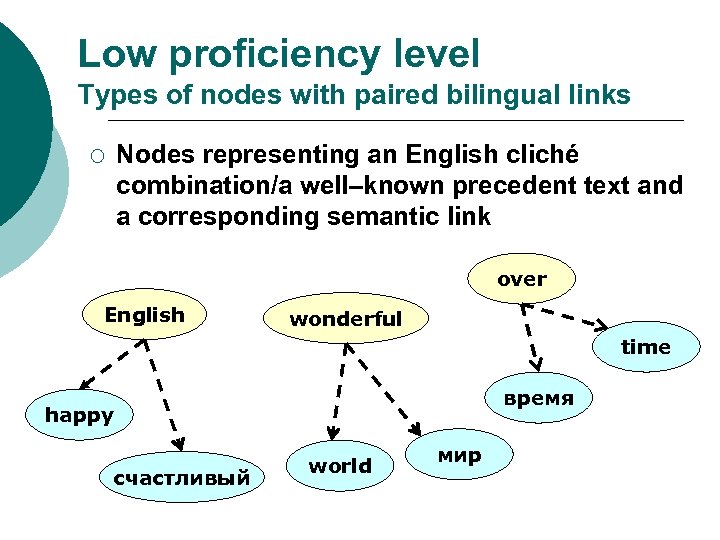
Low proficiency level Types of nodes with paired bilingual links Nodes representing an English cliché combination/a well–known precedent text and a corresponding semantic link ¡ over English wonderful time время happy счастливый world мир
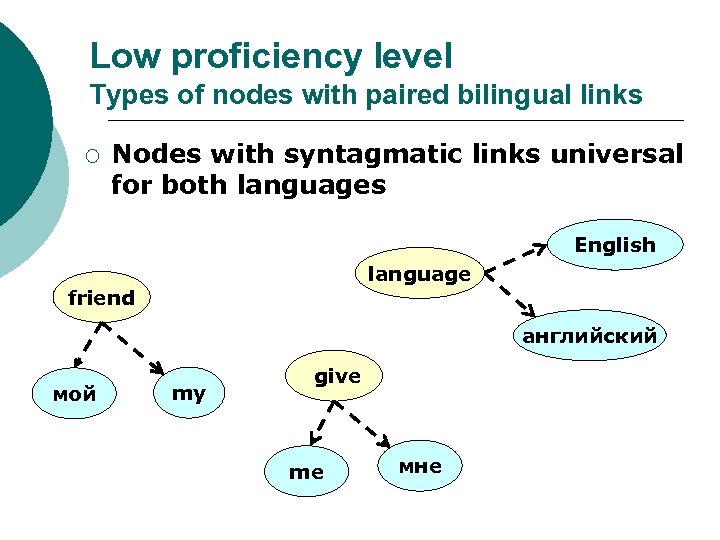
Low proficiency level Types of nodes with paired bilingual links ¡ Nodes with syntagmatic links universal for both languages English language friend английский мой my give me мне
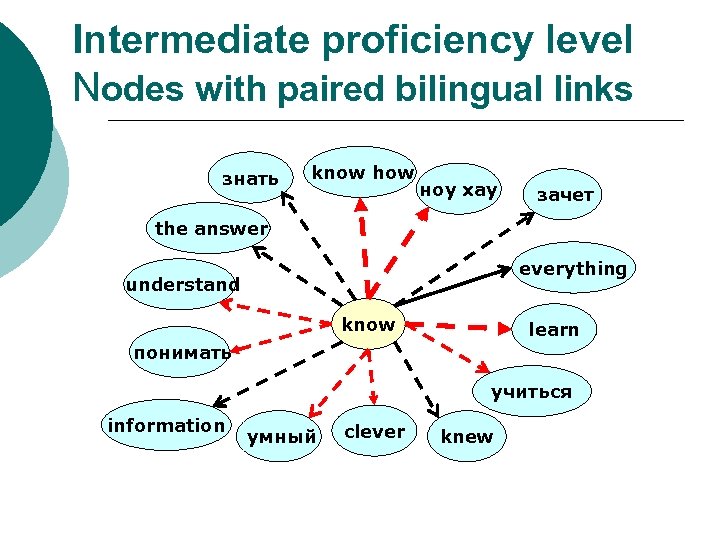
Intermediate proficiency level Nodes with paired bilingual links знать know how ноу хау зачет the answer everything understand know learn понимать учиться information умный clever knew
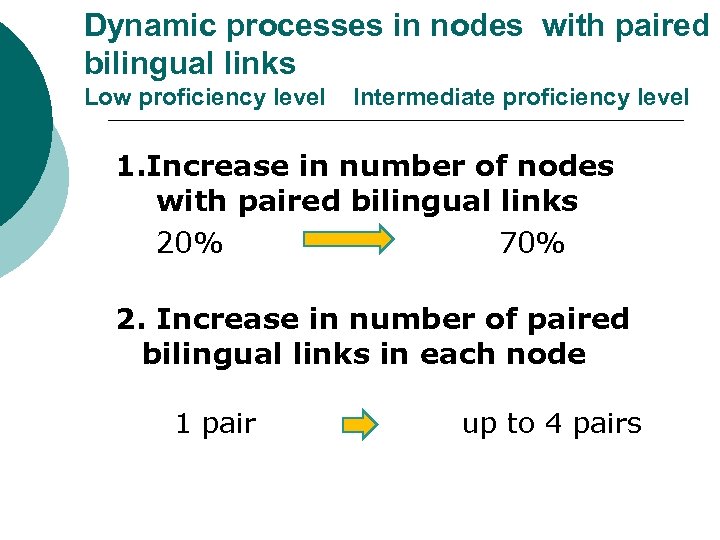
Dynamic processes in nodes with paired bilingual links Low proficiency level Intermediate proficiency level 1. Increase in number of nodes with paired bilingual links 20% 70% 2. Increase in number of paired bilingual links in each node 1 pair up to 4 pairs
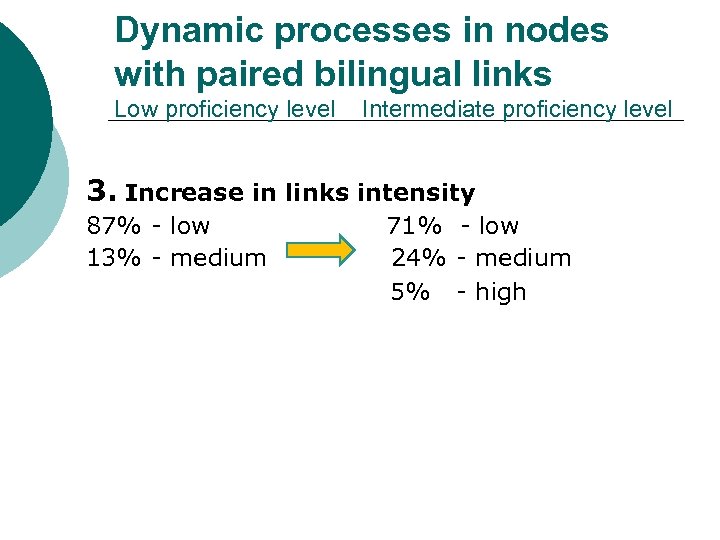
Dynamic processes in nodes with paired bilingual links Low proficiency level Intermediate proficiency level 3. Increase in links intensity 87% - low 13% - medium 71% - low 24% - medium 5% - high
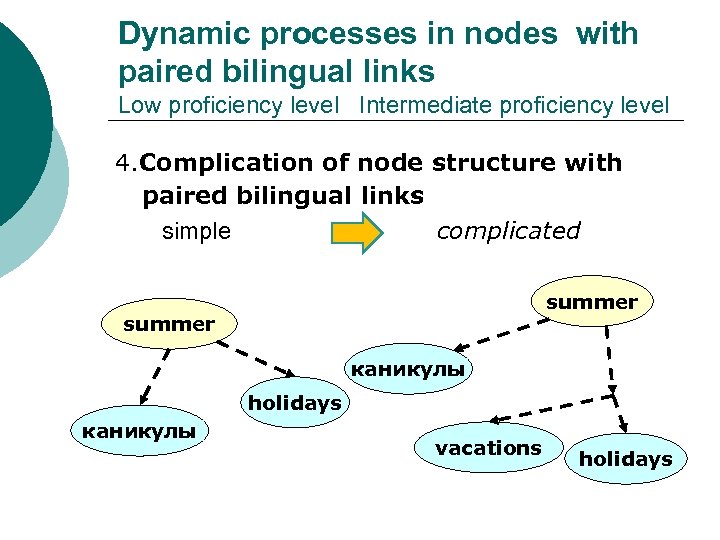
Dynamic processes in nodes with paired bilingual links Low proficiency level Intermediate proficiency level 4. Complication of node structure with paired bilingual links simple complicated summer каникулы holidays каникулы vacations holidays
Dynamic processes in nodes with paired bilingual links Low proficiency level Intermediate proficiency level 5. Substitution of nodes with phonological-orthographic links by nodes with derivational and semantic links
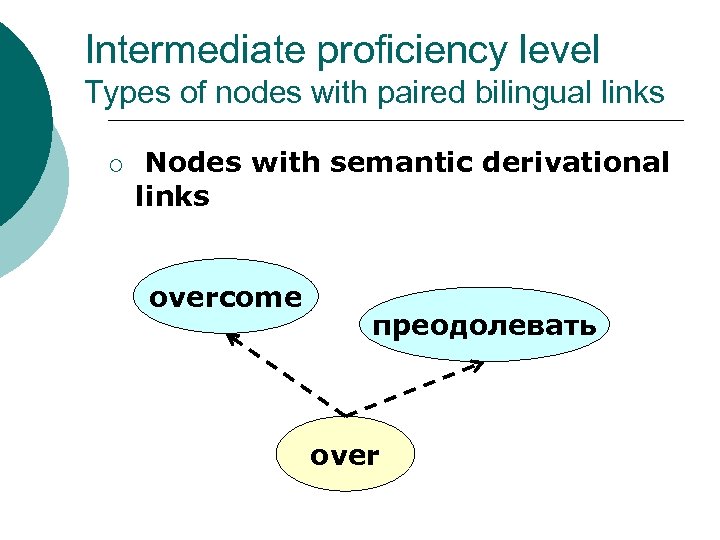
Intermediate proficiency level Types of nodes with paired bilingual links ¡ Nodes with semantic derivational links overcome преодолевать over
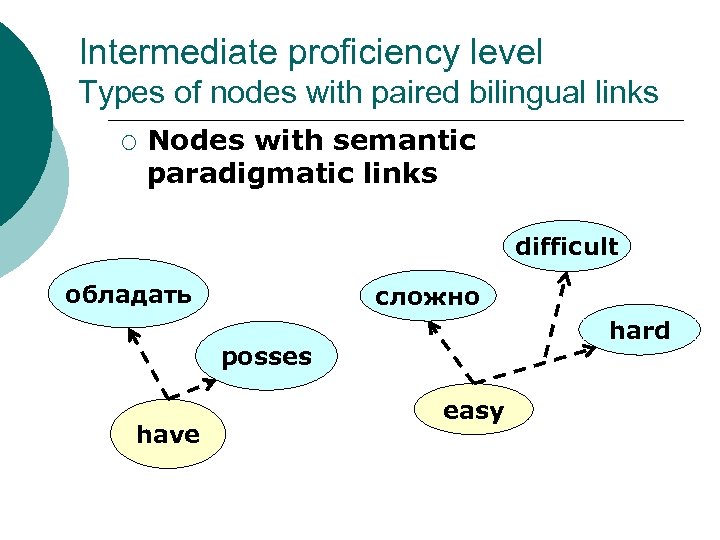
Intermediate proficiency level Types of nodes with paired bilingual links ¡ Nodes with semantic paradigmatic links difficult обладать сложно hard posses have easy
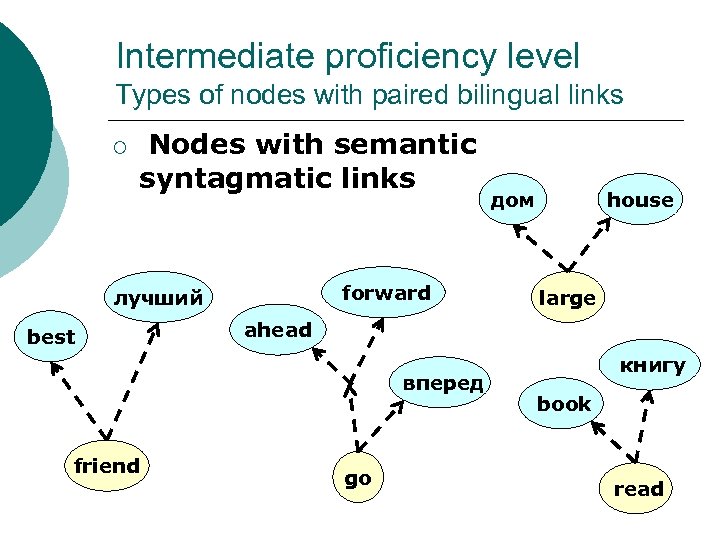
Intermediate proficiency level Types of nodes with paired bilingual links ¡ Nodes with semantic syntagmatic links forward лучший best house large ahead вперед friend дом go книгу book read
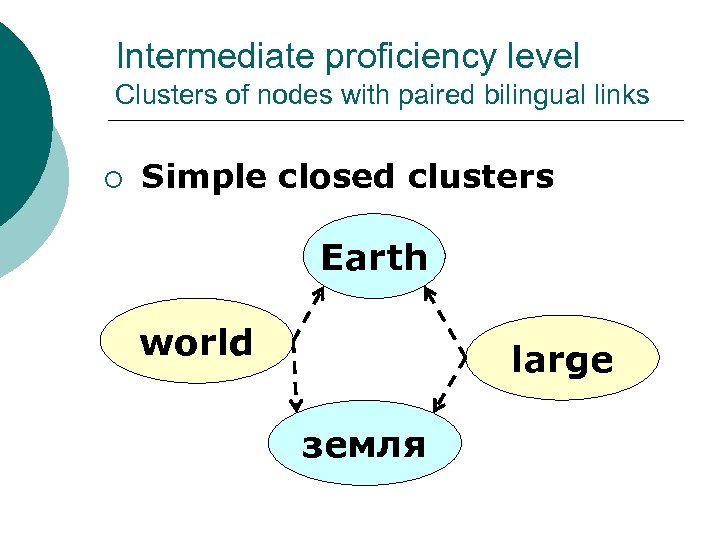
Intermediate proficiency level Clusters of nodes with paired bilingual links ¡ Simple closed clusters Earth world large земля
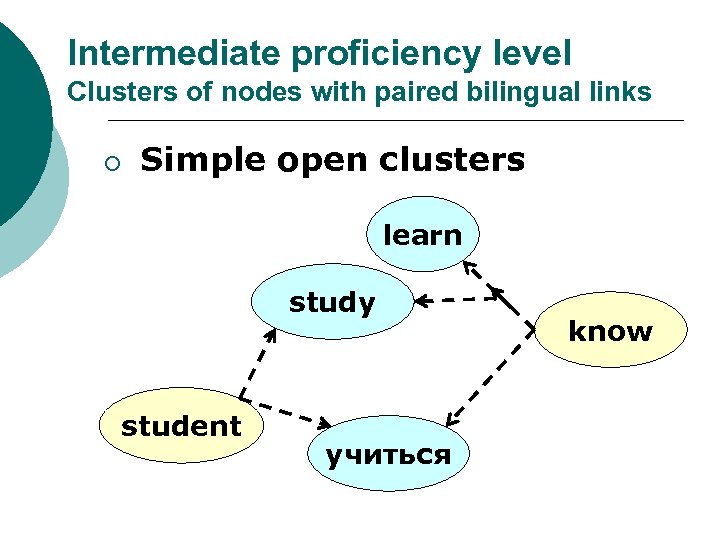
Intermediate proficiency level Clusters of nodes with paired bilingual links ¡ Simple open clusters learn study student учиться know
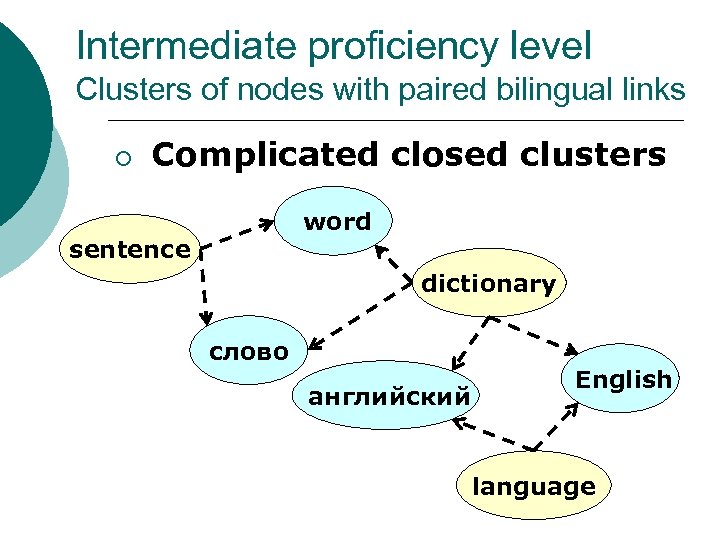
Intermediate proficiency level Clusters of nodes with paired bilingual links ¡ Complicated closed clusters word sentence dictionary слово английский English language
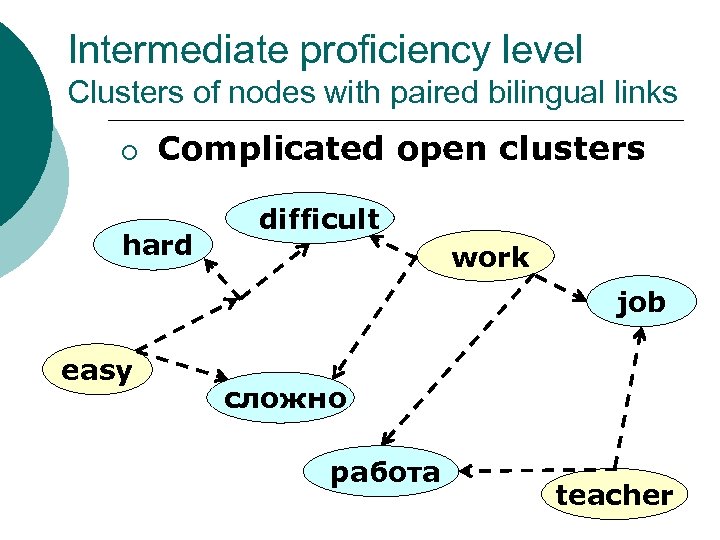
Intermediate proficiency level Clusters of nodes with paired bilingual links ¡ Complicated open clusters hard difficult work job easy сложно работа teacher
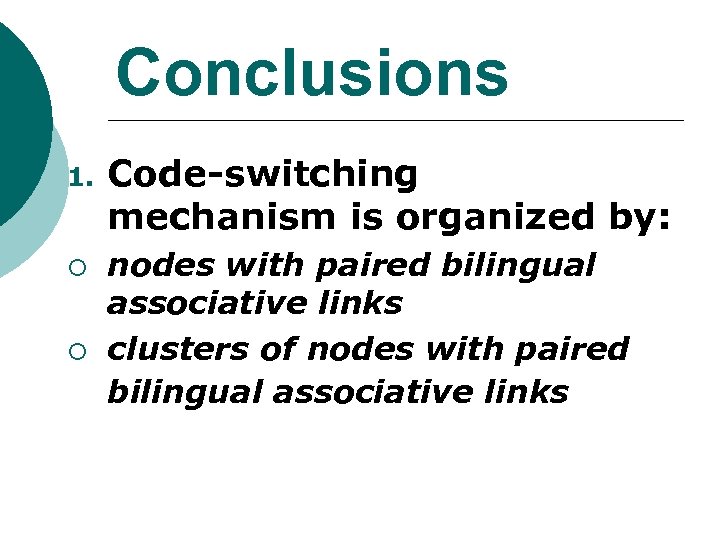
Conclusions 1. ¡ ¡ Code-switching mechanism is organized by: nodes with paired bilingual associative links clusters of nodes with paired bilingual associative links
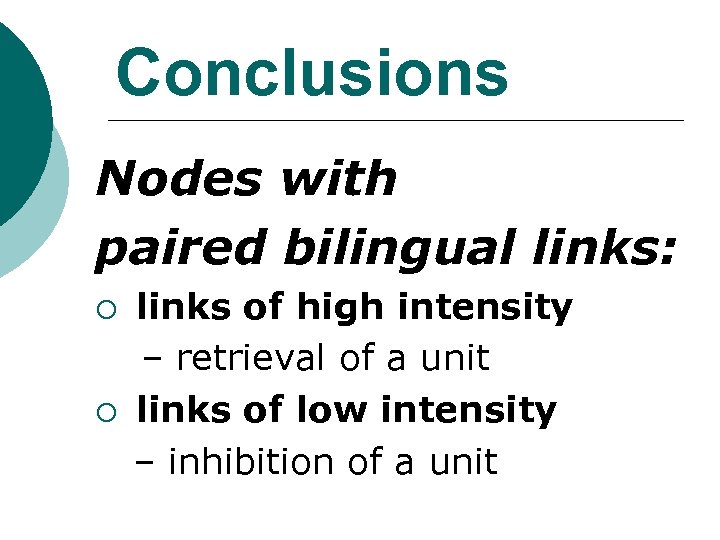
Conclusions Nodes with paired bilingual links: ¡ ¡ links of high intensity – retrieval of a unit links of low intensity – inhibition of a unit
Conclusions Clusters of nodes with paired bilingual links: ¡ simple – CS within a twocomponent syntagm ¡ complicated – CS within a multy-component syntagm
Conclusions Clusters of nodes with paired bilingual links: ¡ closed – regular codeswitching routes ¡ open – variety of codeswitching routes
Conclusions Formation of codeswitching mechanism: 2. ¡ increase in number of nodes with paired bilingual links, increase in links intensity, complication of node structure ¡ emergence of node clusters with paired bilingual links of various configuration
Скачать презентацию Paired bilingual associative links as the basis of
5c8c07b17eef0d696179ea5505c3bc4b.ppt