


 Скачать презентацию page 1 of 11 Progress developing an evaluation
5361afd2188015622ae04493d12f43f9.ppt
- Количество слайдов: 11
 page 1 of 11 Progress developing an evaluation methodology for fusion R&D M. S. Tillack ARIES Project Meeting March 4, 2008
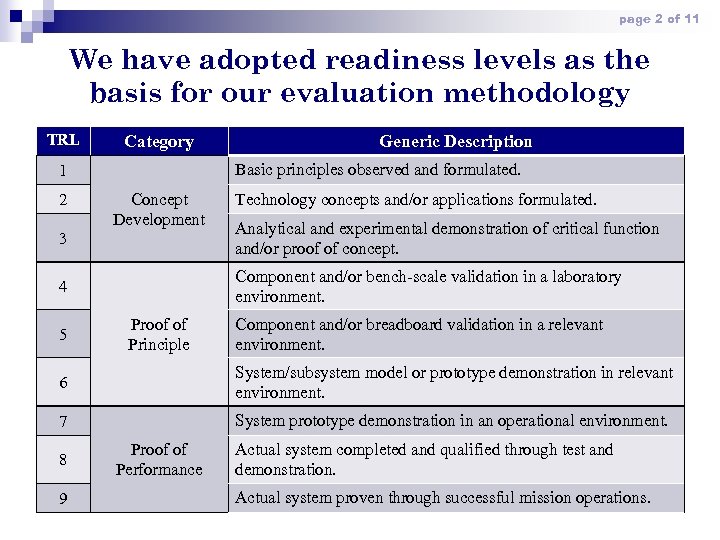 page 2 of 11 We have adopted readiness levels as the basis for our evaluation methodology TRL Category Basic principles observed and formulated. 1 2 Generic Description Concept Development Technology concepts and/or applications formulated. 3 Analytical and experimental demonstration of critical function and/or proof of concept. 4 Component and/or bench-scale validation in a laboratory environment. 5 Proof of Principle Component and/or breadboard validation in a relevant environment. 6 System/subsystem model or prototype demonstration in relevant environment. 7 System prototype demonstration in an operational environment. 8 9 Proof of Performance Actual system completed and qualified through test and demonstration. Actual system proven through successful mission operations.
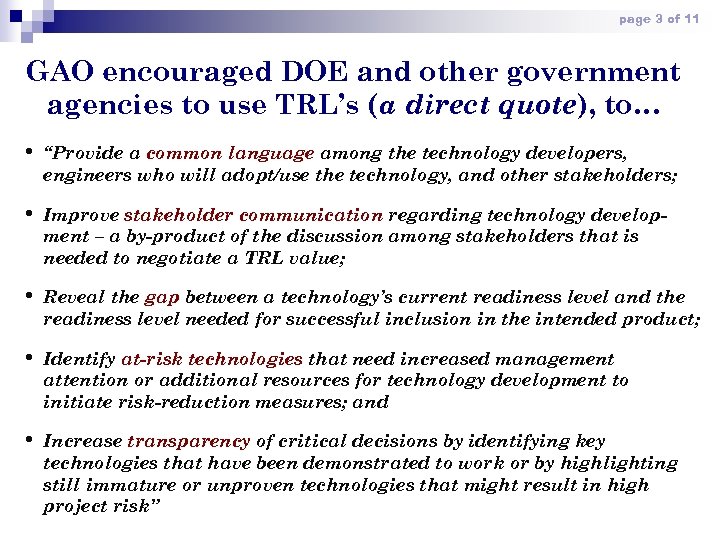 page 3 of 11 GAO encouraged DOE and other government agencies to use TRL’s (a direct quote), to… • “Provide a common language among the technology developers, engineers who will adopt/use the technology, and other stakeholders; • Improve stakeholder communication regarding technology development – a by-product of the discussion among stakeholders that is needed to negotiate a TRL value; • Reveal the gap between a technology’s current readiness level and the readiness level needed for successful inclusion in the intended product; • Identify at-risk technologies that need increased management attention or additional resources for technology development to initiate risk-reduction measures; and • Increase transparency of critical decisions by identifying key technologies that have been demonstrated to work or by highlighting still immature or unproven technologies that might result in high project risk”
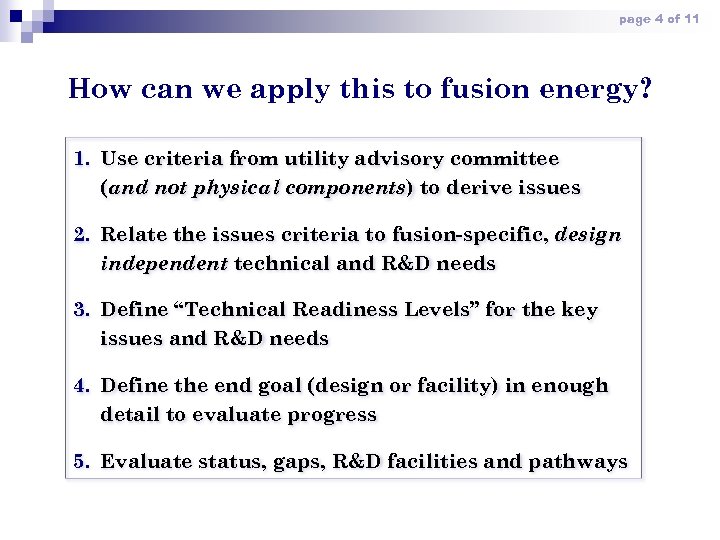 page 4 of 11 How can we apply this to fusion energy? 1. Use criteria from utility advisory committee (and not physical components) to derive issues 2. Relate the issues criteria to fusion-specific, design independent technical and R&D needs 3. Define “Technical Readiness Levels” for the key issues and R&D needs 4. Define the end goal (design or facility) in enough detail to evaluate progress 5. Evaluate status, gaps, R&D facilities and pathways
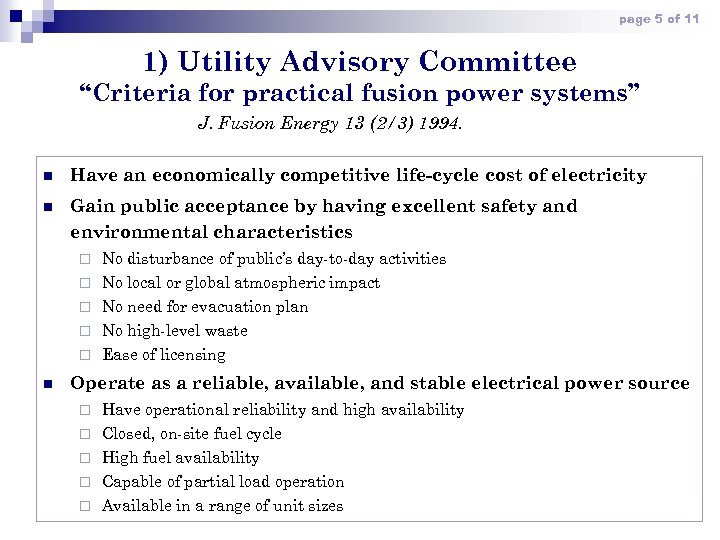 page 5 of 11 1) Utility Advisory Committee “Criteria for practical fusion power systems” J. Fusion Energy 13 (2/3) 1994. n Have an economically competitive life-cycle cost of electricity n Gain public acceptance by having excellent safety and environmental characteristics ¨ No disturbance of public’s day-to-day activities No local or global atmospheric impact ¨ No need for evacuation plan ¨ No high-level waste ¨ Ease of licensing ¨ n Operate as a reliable, available, and stable electrical power source ¨ ¨ ¨ Have operational reliability and high availability Closed, on-site fuel cycle High fuel availability Capable of partial load operation Available in a range of unit sizes
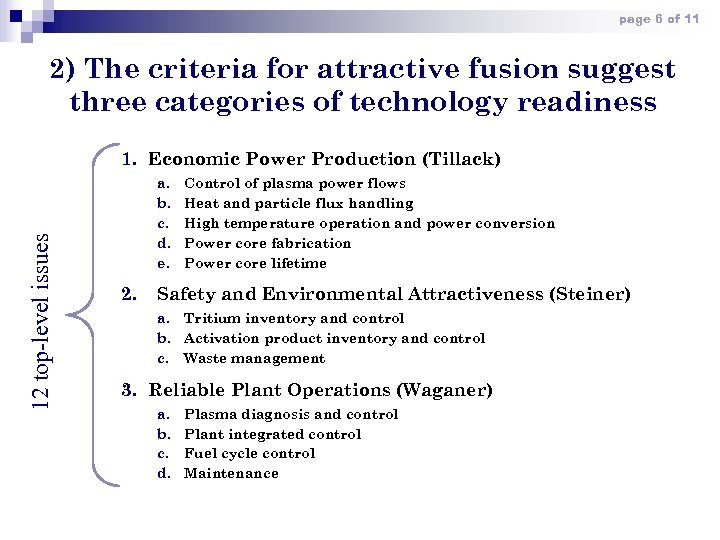 page 6 of 11 2) The criteria for attractive fusion suggest three categories of technology readiness 12 top-level issues 1. Economic Power Production (Tillack) a. b. c. d. e. 2. Control of plasma power flows Heat and particle flux handling High temperature operation and power conversion Power core fabrication Power core lifetime Safety and Environmental Attractiveness (Steiner) a. Tritium inventory and control b. Activation product inventory and control c. Waste management 3. Reliable Plant Operations (Waganer) a. b. c. d. Plasma diagnosis and control Plant integrated control Fuel cycle control Maintenance
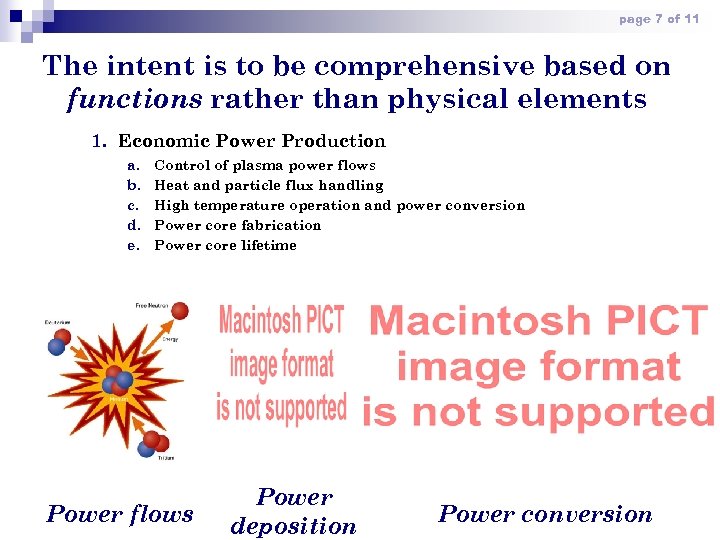 page 7 of 11 The intent is to be comprehensive based on functions rather than physical elements 1. Economic Power Production a. b. c. d. e. Control of plasma power flows Heat and particle flux handling High temperature operation and power conversion Power core fabrication Power core lifetime Power flows Power deposition Power conversion
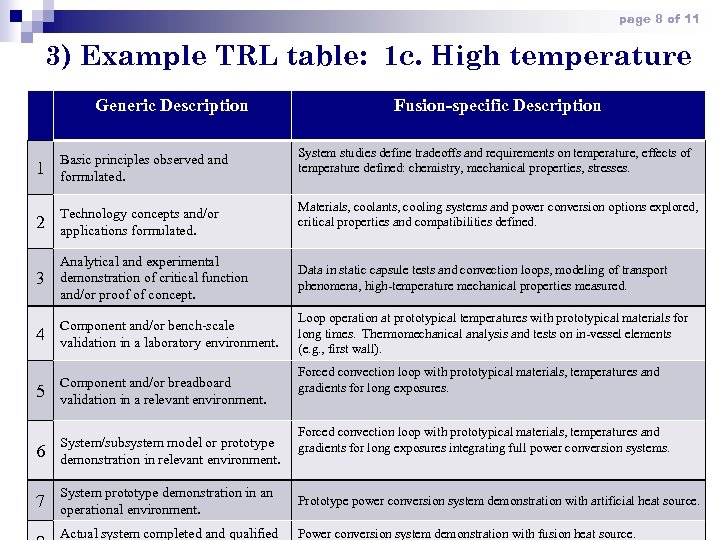 page 8 of 11 3) Example TRL table: 1 c. High temperature Generic Description Fusion-specific Description System studies define tradeoffs and requirements on temperature, effects of temperature defined: chemistry, mechanical properties, stresses. temperaturedefined: chemistry, mechanical properties, stresses. 1 Basic principles observed and formulated. 2 Technology concepts and/or applications formulated. 3 Analytical and experimental demonstration of critical function and/or proof of concept. Data in static capsule tests and convection loops, modeling of transport phenomena, high-temperature mechanical properties measured. 4 Component and/or bench-scale validation in a laboratory environment. Loop operation at prototypical temperatures with prototypical materials for long times. Thermomechanical analysis and tests on in-vessel elements (e. g. , first wall). 5 Component and/or breadboard validation in a relevant environment. 6 System/subsystem model or prototype demonstration in relevant environment. 7 System prototype demonstration in an operational environment. Prototype power conversion system demonstration with artificial heat source. Actual system completed and qualified Power conversion system demonstration with fusion heat source. Materials, coolants, cooling systems and power conversion options explored, critical properties and compatibilities defined. Forced convection loop with prototypical materials, temperatures and gradients for long exposures integrating full power conversion systems.
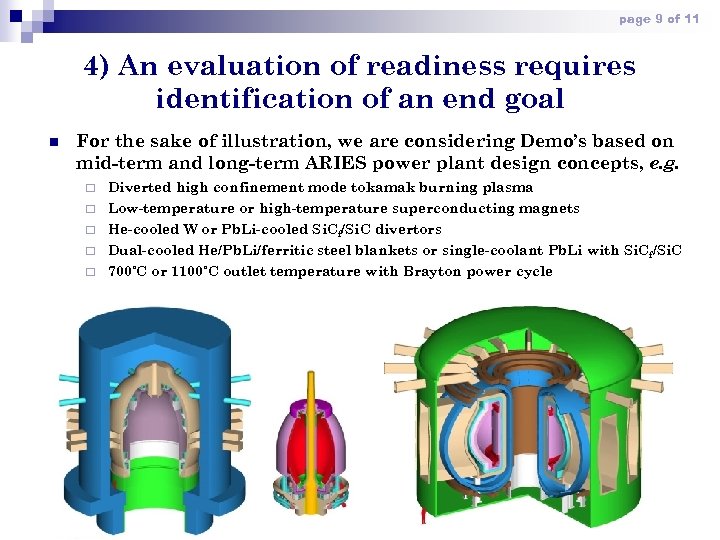 page 9 of 11 4) An evaluation of readiness requires identification of an end goal n For the sake of illustration, we are considering Demo’s based on mid-term and long-term ARIES power plant design concepts, e. g. ¨ Diverted high confinement mode tokamak burning plasma Low-temperature or high-temperature superconducting magnets ¨ He-cooled W or Pb. Li-cooled Si. Cf/Si. C divertors ¨ Dual-cooled He/Pb. Li/ferritic steel blankets or single-coolant Pb. Li with Si. Cf/Si. C ¨ 700˚C or 1100˚C outlet temperature with Brayton power cycle ¨
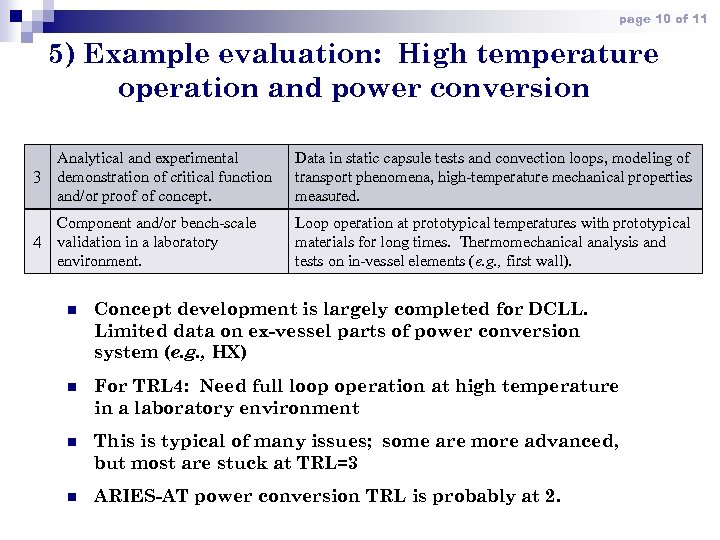 page 10 of 11 5) Example evaluation: High temperature operation and power conversion Analytical and experimental 3 demonstration of critical function and/or proof of concept. Data in static capsule tests and convection loops, modeling of transport phenomena, high-temperature mechanical properties measured. Component and/or bench-scale 4 validation in a laboratory environment. Loop operation at prototypical temperatures with prototypical materials for long times. Thermomechanical analysis and tests on in-vessel elements (e. g. , first wall). n Concept development is largely completed for DCLL. Limited data on ex-vessel parts of power conversion system (e. g. , HX) n For TRL 4: Need full loop operation at high temperature in a laboratory environment n This is typical of many issues; some are more advanced, but most are stuck at TRL=3 n ARIES-AT power conversion TRL is probably at 2.
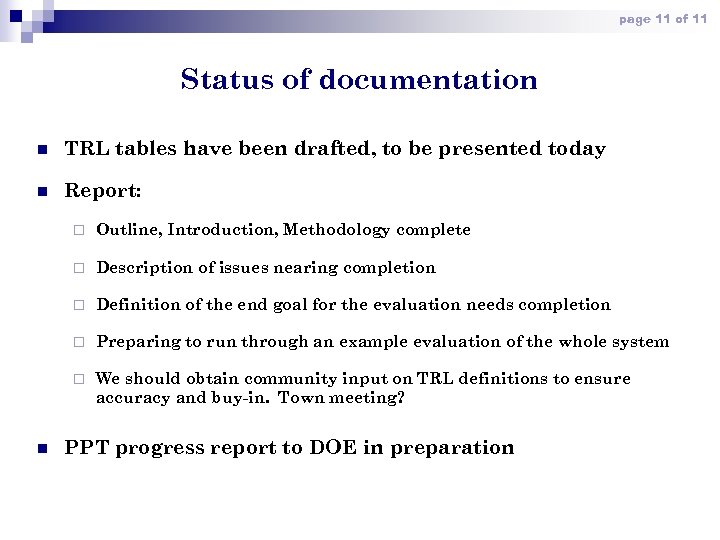 page 11 of 11 Status of documentation n TRL tables have been drafted, to be presented today n Report: ¨ ¨ Description of issues nearing completion ¨ Definition of the end goal for the evaluation needs completion ¨ Preparing to run through an example evaluation of the whole system ¨ n Outline, Introduction, Methodology complete We should obtain community input on TRL definitions to ensure accuracy and buy-in. Town meeting? PPT progress report to DOE in preparation