


 Скачать презентацию PAF introduction The PAF also called UNIL
0347acfc72cda07112470d1400b77d7d.ppt
- Количество слайдов: 79
 PAF introduction
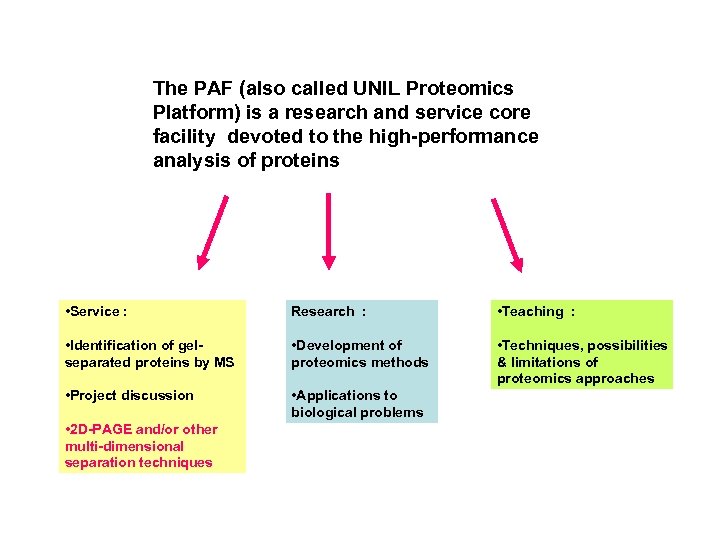 The PAF (also called UNIL Proteomics Platform) is a research and service core facility devoted to the high-performance analysis of proteins • Service : Research : • Teaching : • Identification of gelseparated proteins by MS • Development of proteomics methods • Techniques, possibilities & limitations of proteomics approaches • Project discussion • Applications to biological problems • 2 D-PAGE and/or other multi-dimensional separation techniques
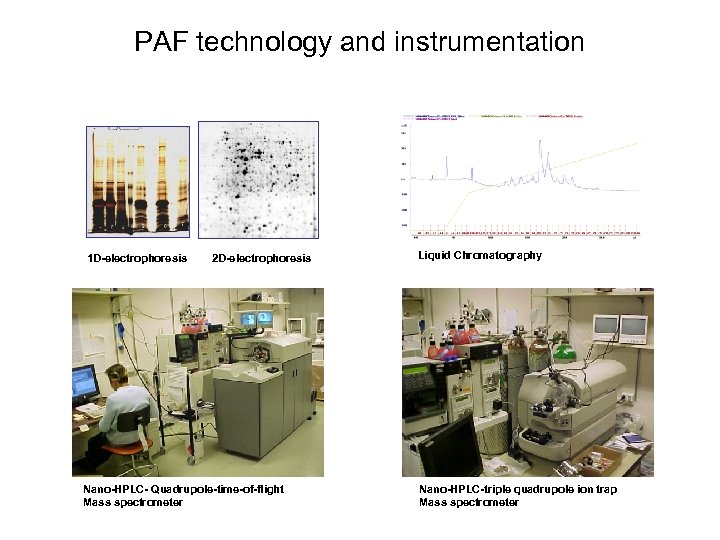 PAF technology and instrumentation 1 D-electrophoresis 2 D-electrophoresis Nano-HPLC- Quadrupole-time-of-flight Mass spectrometer Liquid Chromatography Nano-HPLC-triple quadrupole ion trap Mass spectrometer
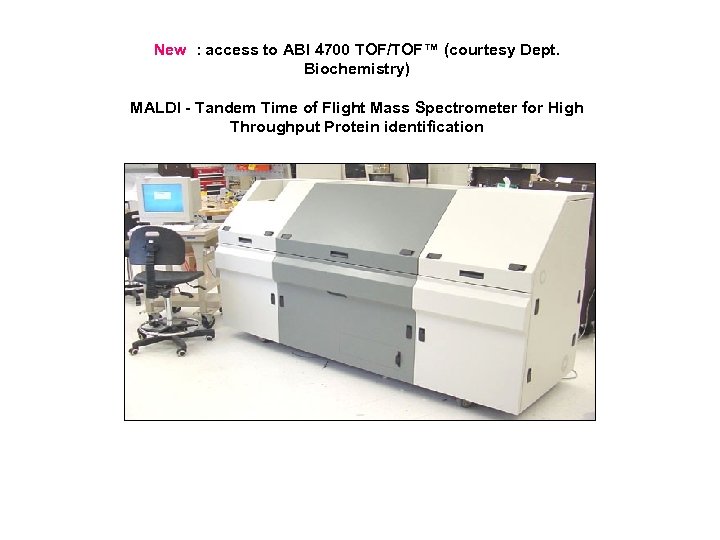 New : access to ABI 4700 TOF/TOF™ (courtesy Dept. Biochemistry) MALDI - Tandem Time of Flight Mass Spectrometer for High Throughput Protein identification
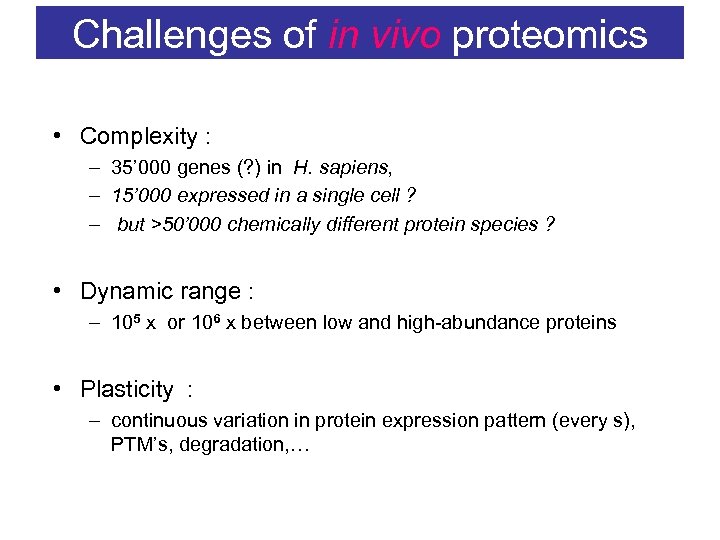 Challenges of in vivo proteomics • Complexity : – 35’ 000 genes (? ) in H. sapiens, – 15’ 000 expressed in a single cell ? – but >50’ 000 chemically different protein species ? • Dynamic range : – 105 x or 106 x between low and high-abundance proteins • Plasticity : – continuous variation in protein expression pattern (every s), PTM’s, degradation, …
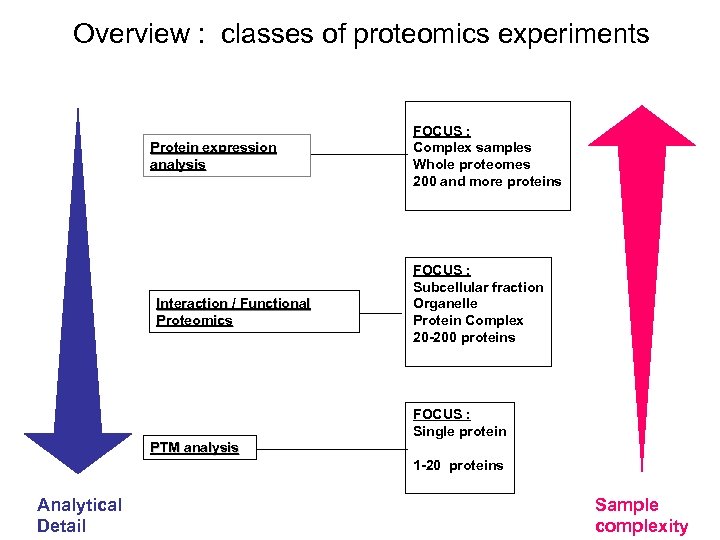 Overview : classes of proteomics experiments Protein expression analysis Interaction / Functional Proteomics FOCUS : Complex samples Whole proteomes 200 and more proteins FOCUS : Subcellular fraction Organelle Protein Complex 20 -200 proteins FOCUS : Single protein PTM analysis 1 -20 proteins Analytical Detail Sample complexity
 Proteomics • 2 D-PAGE • Mass Spectrometry for proteomics • Proteomics workflows and applications
 2 D-PAGE
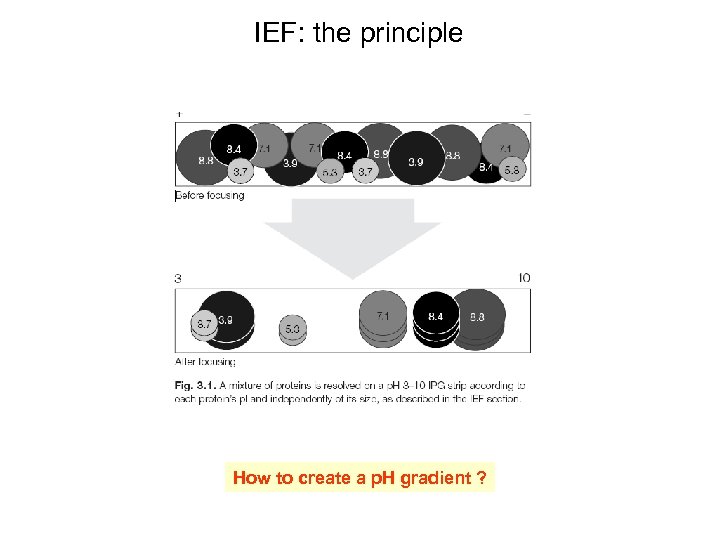 IEF: the principle How to create a p. H gradient ?
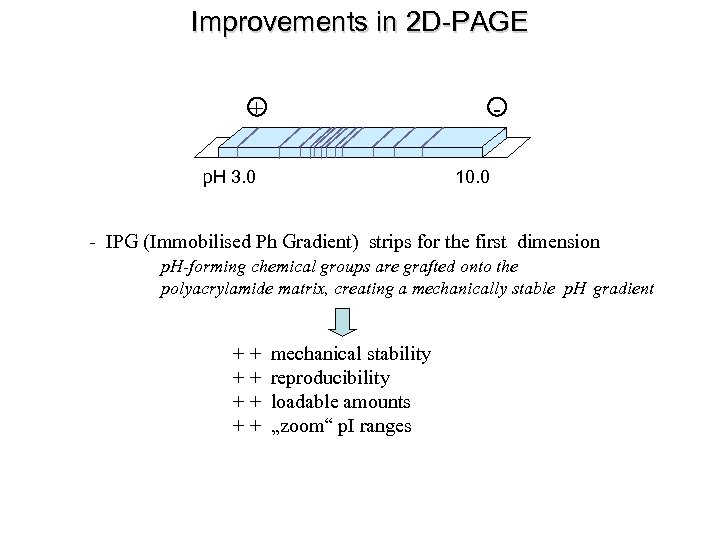 Improvements in 2 D-PAGE + - p. H 3. 0 10. 0 - IPG (Immobilised Ph Gradient) strips for the first dimension p. H-forming chemical groups are grafted onto the polyacrylamide matrix, creating a mechanically stable p. H gradient ++ ++ mechanical stability reproducibility loadable amounts „zoom“ p. I ranges
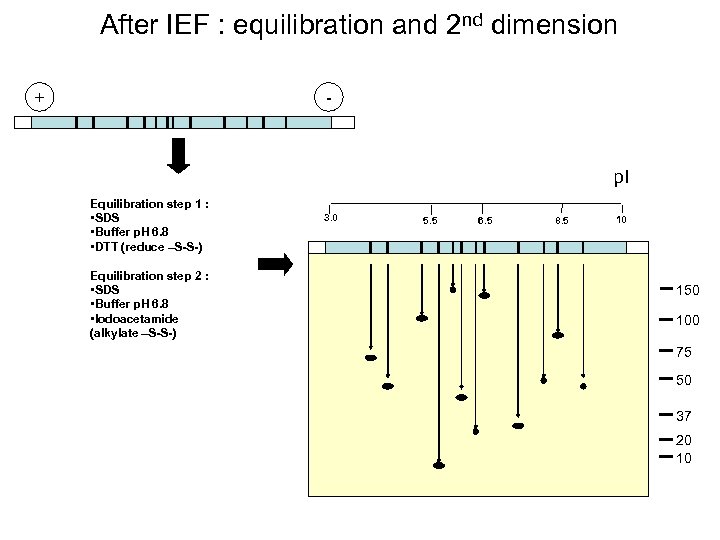 After IEF : equilibration and 2 nd dimension + - p. I Equilibration step 1 : • SDS • Buffer p. H 6. 8 • DTT (reduce –S-S-) Equilibration step 2 : • SDS • Buffer p. H 6. 8 • Iodoacetamide (alkylate –S-S-) 3. 0 5. 5 6. 5 8. 5 10 150 100 75 50 37 20 10
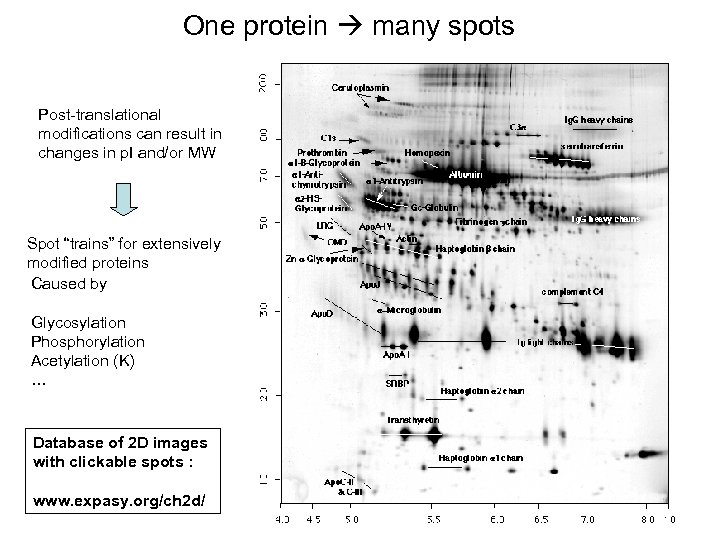 One protein many spots Post-translational modifications can result in changes in p. I and/or MW Spot “trains” for extensively modified proteins Caused by Glycosylation Phosphorylation Acetylation (K) … Database of 2 D images with clickable spots : www. expasy. org/ch 2 d/
 2 D-PAGE and image analysis are used for studying changes in composition of the proteome
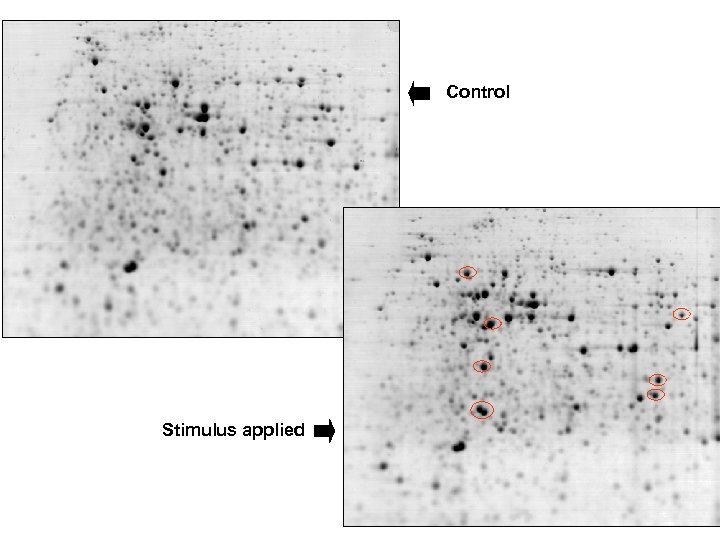 Control Stimulus applied
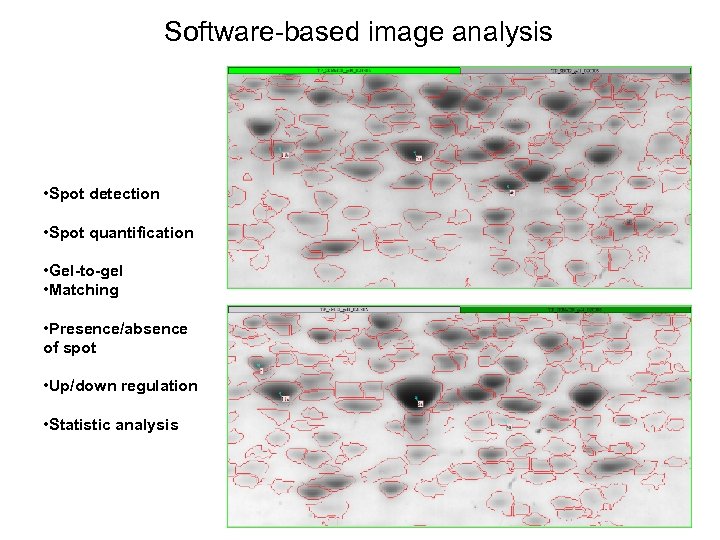 Software-based image analysis • Spot detection • Spot quantification • Gel-to-gel • Matching • Presence/absence of spot • Up/down regulation • Statistic analysis
 Mass Spectrometry in proteomics
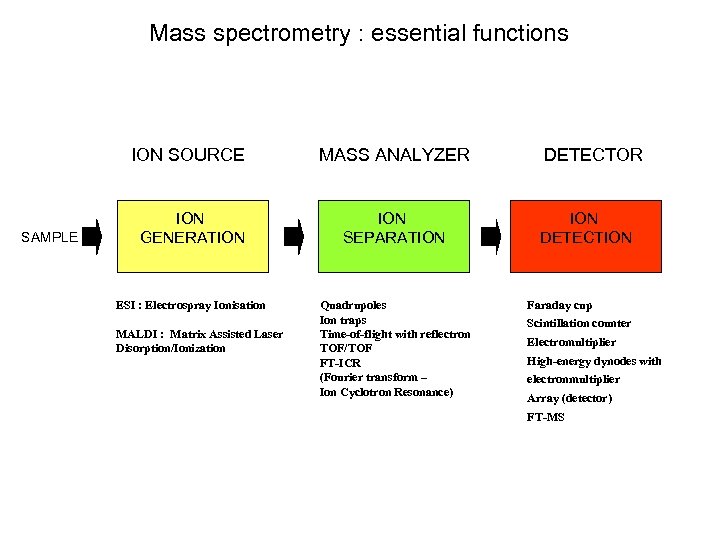 Mass spectrometry : essential functions ION SOURCE SAMPLE MASS ANALYZER ION GENERATION SEPARATION ESI : Electrospray Ionisation Quadrupoles Ion traps Time-of-flight with reflectron TOF/TOF FT-ICR (Fourier transform – Ion Cyclotron Resonance) MALDI : Matrix Assisted Laser Disorption/Ionization DETECTOR ION DETECTION Faraday cup Scintillation counter Electromultiplier High-energy dynodes with electronmultiplier Array (detector) FT-MS
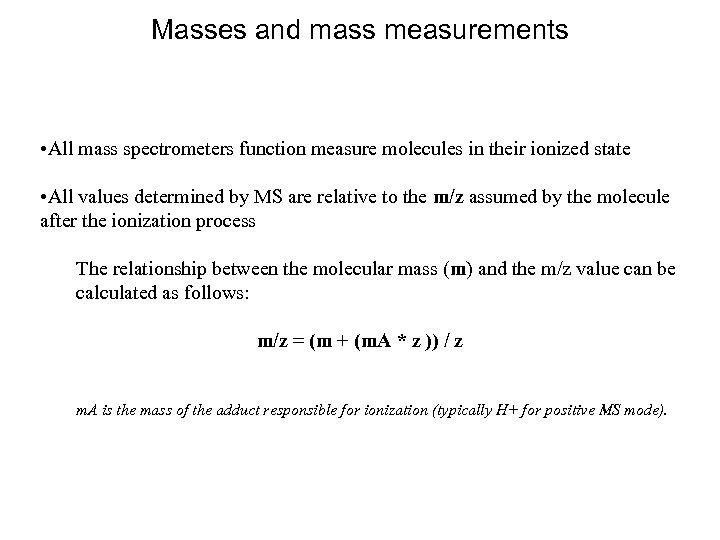 Masses and mass measurements • All mass spectrometers function measure molecules in their ionized state • All values determined by MS are relative to the m/z assumed by the molecule after the ionization process The relationship between the molecular mass (m) and the m/z value can be calculated as follows: m/z = (m + (m. A * z )) / z m. A is the mass of the adduct responsible for ionization (typically H+ for positive MS mode).
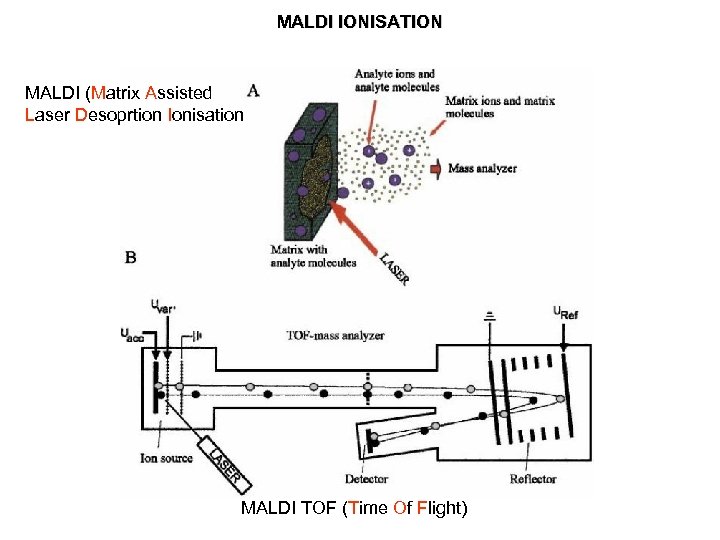 MALDI IONISATION MALDI (Matrix Assisted Laser Desoprtion Ionisation MALDI TOF (Time Of Flight)
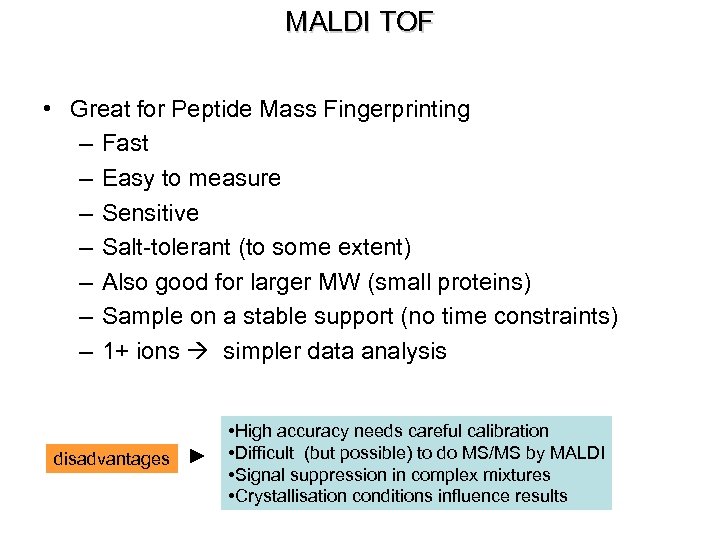 MALDI TOF • Great for Peptide Mass Fingerprinting – Fast – Easy to measure – Sensitive – Salt-tolerant (to some extent) – Also good for larger MW (small proteins) – Sample on a stable support (no time constraints) – 1+ ions simpler data analysis disadvantages • High accuracy needs careful calibration • Difficult (but possible) to do MS/MS by MALDI • Signal suppression in complex mixtures • Crystallisation conditions influence results
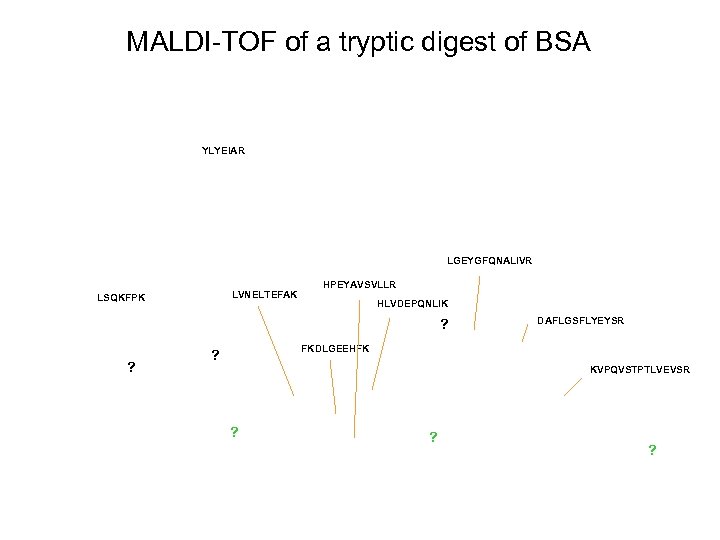 MALDI-TOF of a tryptic digest of BSA YLYEIAR LGEYGFQNALIVR LVNELTEFAK LSQKFPK HPEYAVSVLLR HLVDEPQNLIK ? ? DAFLGSFLYEYSR FKDLGEEHFK ? KVPQVSTPTLVEVSR ? ? ?
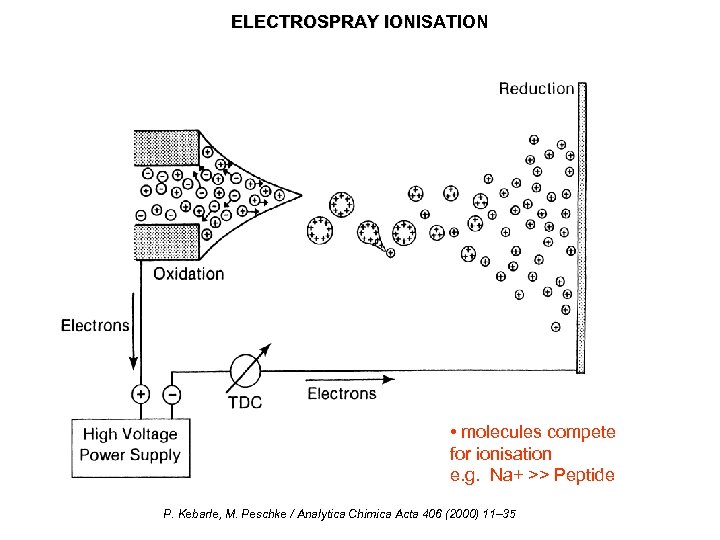 ELECTROSPRAY IONISATION • molecules compete for ionisation e. g. Na+ >> Peptide P. Kebarle, M. Peschke / Analytica Chimica Acta 406 (2000) 11– 35
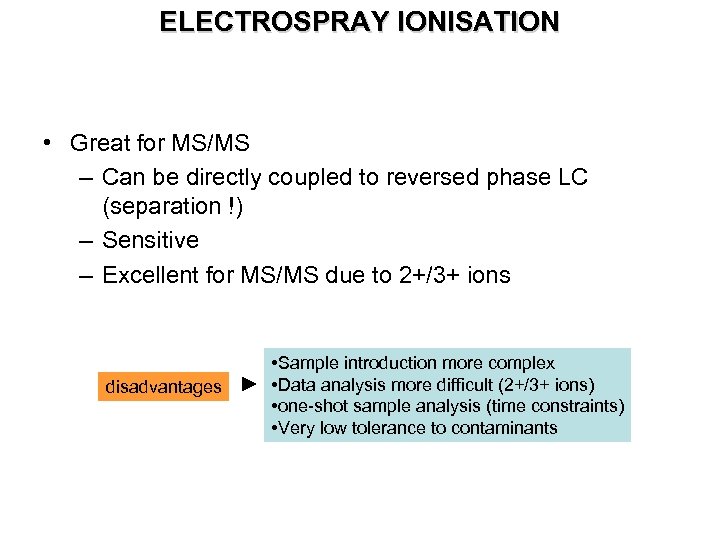 ELECTROSPRAY IONISATION • Great for MS/MS – Can be directly coupled to reversed phase LC (separation !) – Sensitive – Excellent for MS/MS due to 2+/3+ ions disadvantages • Sample introduction more complex • Data analysis more difficult (2+/3+ ions) • one-shot sample analysis (time constraints) • Very low tolerance to contaminants
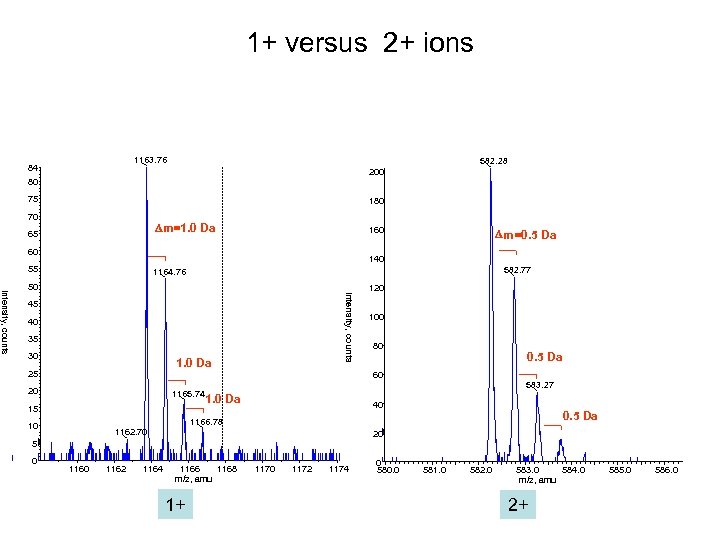 1+ versus 2+ ions 1163. 76 84 582. 28 200 80 75 180 70 Dm=1. 0 Da 65 160 60 Dm=0. 5 Da 140 55 582. 77 1164. 76 Intensity, counts 50 45 40 35 30 1. 0 Da 25 120 100 80 0. 5 Da 60 20 1165. 74 15 1. 0 Da 583. 27 40 0. 5 Da 1166. 78 10 1162. 70 20 5 0 1162 1164 1166 1168 m/z, amu 1+ 1170 1172 1174 0 580. 0 581. 0 582. 0 583. 0 584. 0 m/z, amu 2+ 585. 0 586. 0
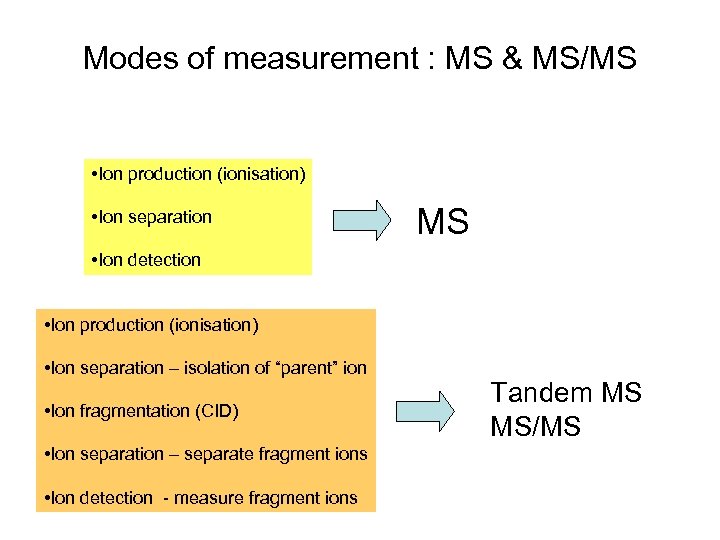 Modes of measurement : MS & MS/MS • Ion production (ionisation) • Ion separation MS • Ion detection • Ion production (ionisation) • Ion separation – isolation of “parent” ion • Ion fragmentation (CID) • Ion separation – separate fragment ions • Ion detection - measure fragment ions Tandem MS MS/MS
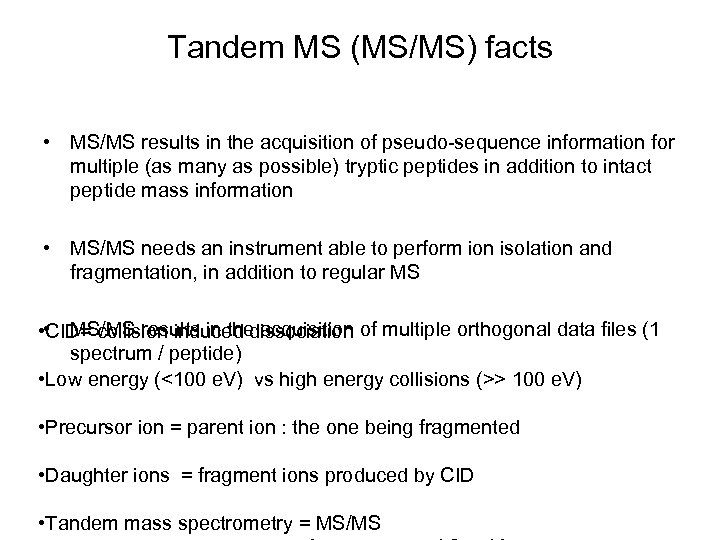 Tandem MS (MS/MS) facts • MS/MS results in the acquisition of pseudo-sequence information for multiple (as many as possible) tryptic peptides in addition to intact peptide mass information • MS/MS needs an instrument able to perform ion isolation and fragmentation, in addition to regular MS • • MS/MS results in the acquisition of multiple orthogonal data files (1 CID= collision induced dissociation spectrum / peptide) • Low energy (<100 e. V) vs high energy collisions (>> 100 e. V) • Precursor ion = parent ion : the one being fragmented • Daughter ions = fragment ions produced by CID • Tandem mass spectrometry = MS/MS
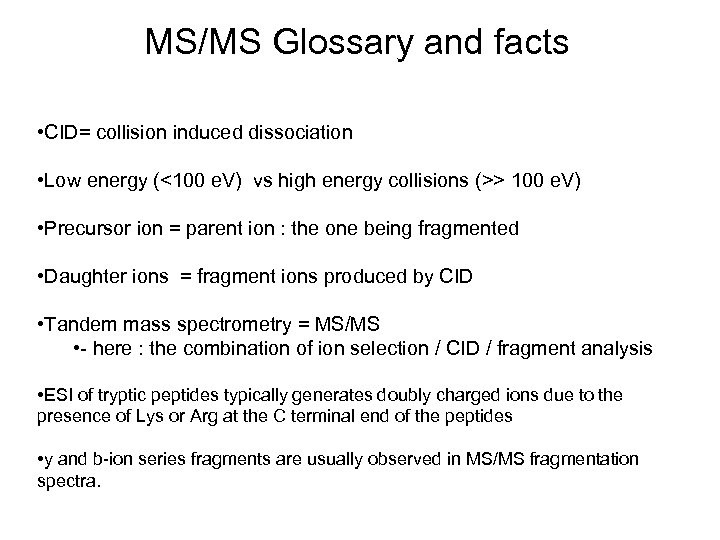 MS/MS Glossary and facts • CID= collision induced dissociation • Low energy (<100 e. V) vs high energy collisions (>> 100 e. V) • Precursor ion = parent ion : the one being fragmented • Daughter ions = fragment ions produced by CID • Tandem mass spectrometry = MS/MS • - here : the combination of ion selection / CID / fragment analysis • ESI of tryptic peptides typically generates doubly charged ions due to the presence of Lys or Arg at the C terminal end of the peptides • y and b-ion series fragments are usually observed in MS/MS fragmentation spectra.
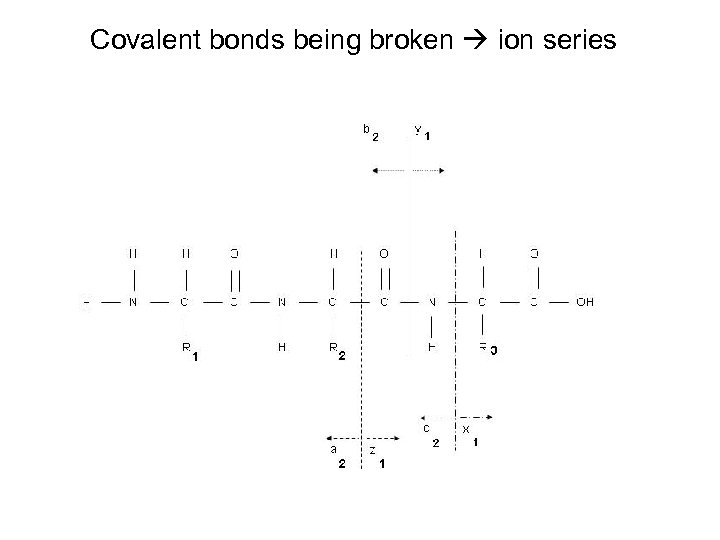 Covalent bonds being broken ion series
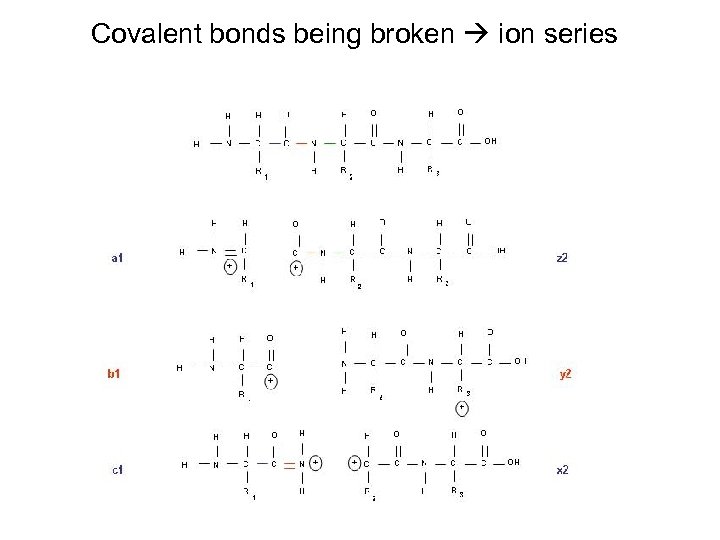 Covalent bonds being broken ion series
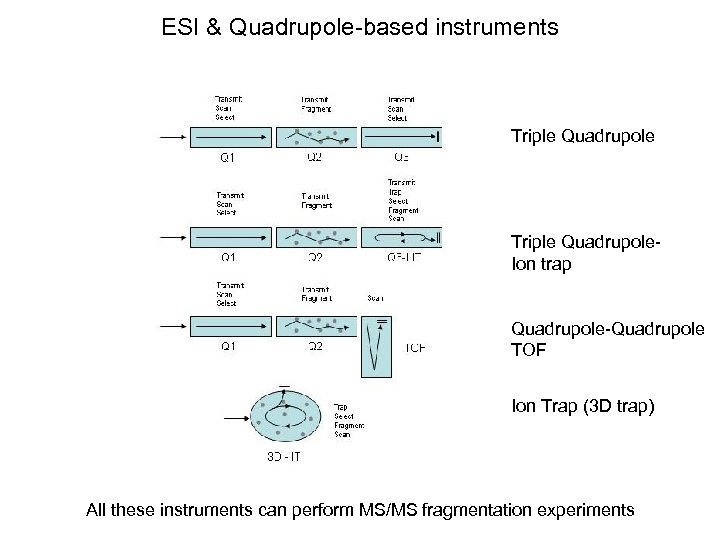 ESI & Quadrupole-based instruments Triple Quadrupole. Ion trap Quadrupole-Quadrupole TOF Ion Trap (3 D trap) All these instruments can perform MS/MS fragmentation experiments
 • Identifying proteins by mass spectrometry
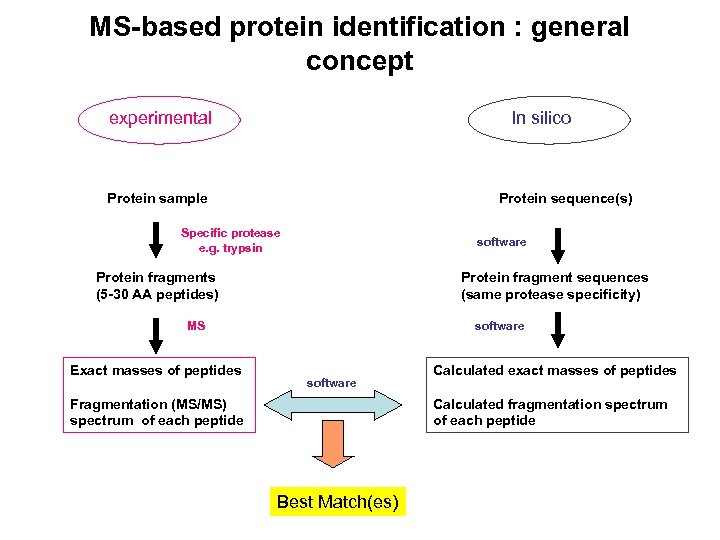 MS-based protein identification : general concept experimental In silico Protein sample Protein sequence(s) Specific protease e. g. trypsin software Protein fragment sequences (same protease specificity) Protein fragments (5 -30 AA peptides) MS Exact masses of peptides software Fragmentation (MS/MS) spectrum of each peptide Calculated exact masses of peptides Calculated fragmentation spectrum of each peptide Best Match(es)
 • Protein identification by Peptide Mass Fingerprinting (PMF)
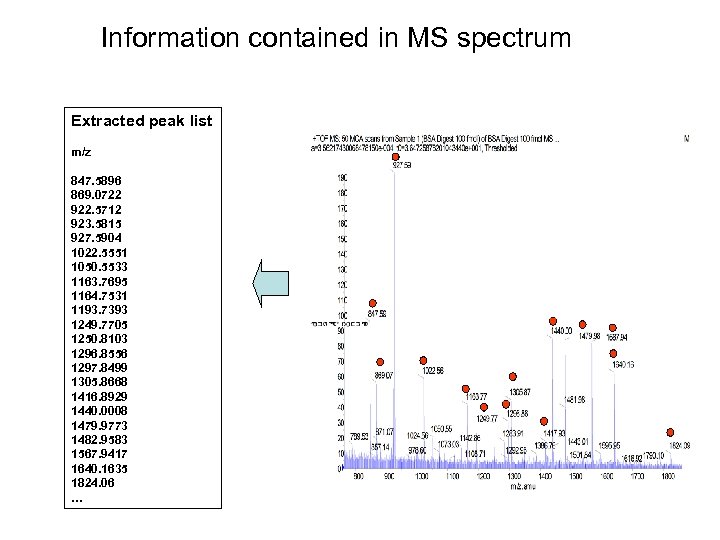 Information contained in MS spectrum Extracted peak list m/z 847. 5896 869. 0722 922. 5712 923. 5815 927. 5904 1022. 5551 1050. 5533 1163. 7695 1164. 7531 1193. 7393 1249. 7705 1250. 8103 1296. 8556 1297. 8499 1305. 8668 1416. 8929 1440. 0008 1479. 9773 1482. 9583 1567. 9417 1640. 1635 1824. 06 …
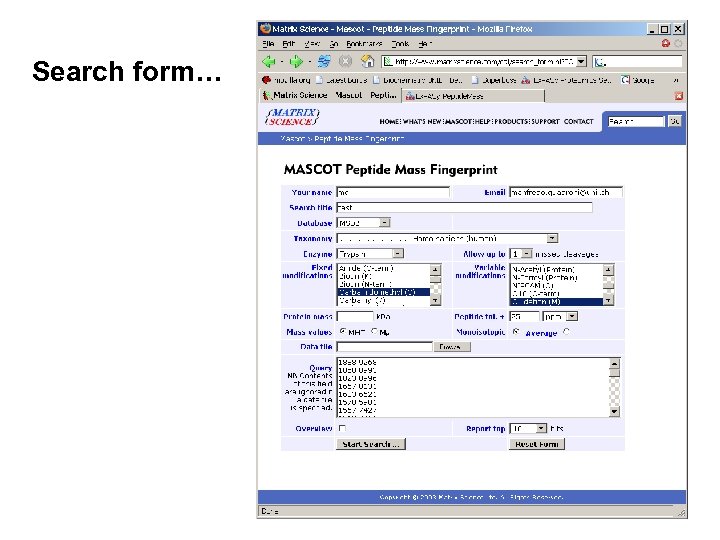 Search form…
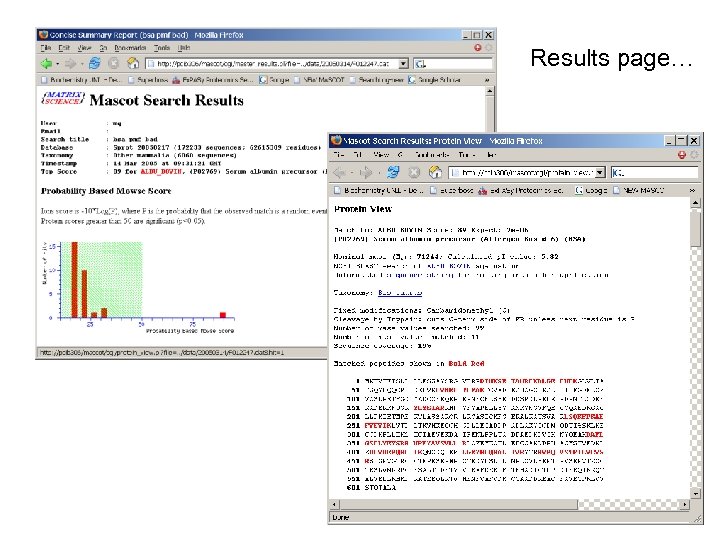 Results page…
 • Protein identification by MS/MS
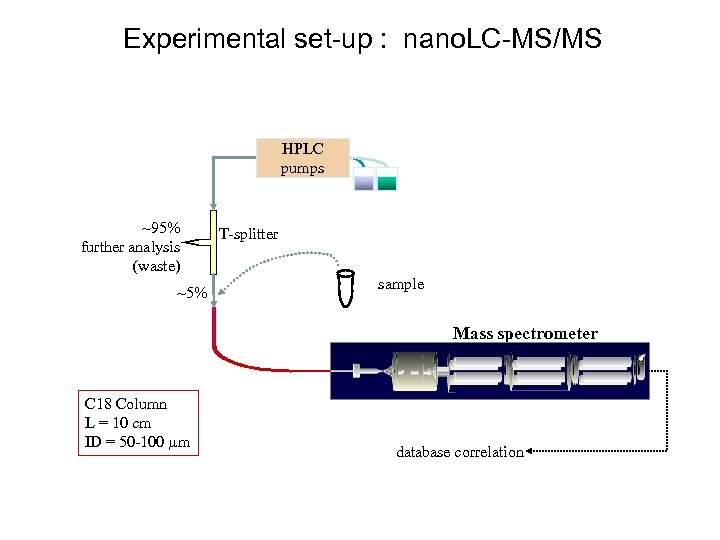 Experimental set-up : nano. LC-MS/MS HPLC pumps ~95% further analysis (waste) ~5% T-splitter sample Mass spectrometer C 18 Column L = 10 cm ID = 50 -100 µm database correlation
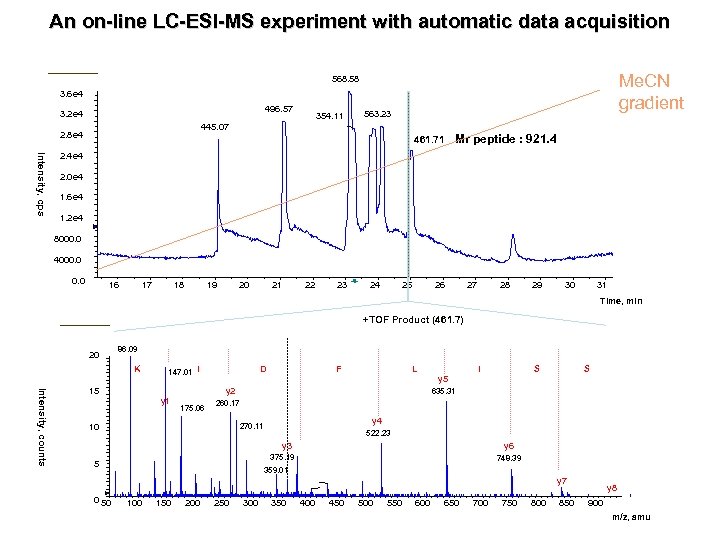 An on-line LC-ESI-MS experiment with automatic data acquisition Me. CN gradient 568. 58 3. 6 e 4 496. 57 3. 2 e 4 354. 11 563. 23 445. 07 2. 8 e 4 461. 71 Mr peptide : 921. 4 Intensity, cps 2. 4 e 4 2. 0 e 4 1. 6 e 4 1. 2 e 4 8000. 0 4000. 0 16 17 18 19 20 21 22 23 24 25 26 27 28 29 30 31 Time, min +TOF Product (461. 7) 20 86. 09 K Intensity, counts 15 147. 01 I y 1 D F L y 2 175. 06 y 5 I S S 635. 31 260. 17 y 4 270. 11 10 522. 23 y 6 375. 19 5 748. 39 359. 01 y 7 0 50 100 150 200 250 300 350 400 450 500 550 600 650 700 750 800 850 y 8 900 m/z, amu
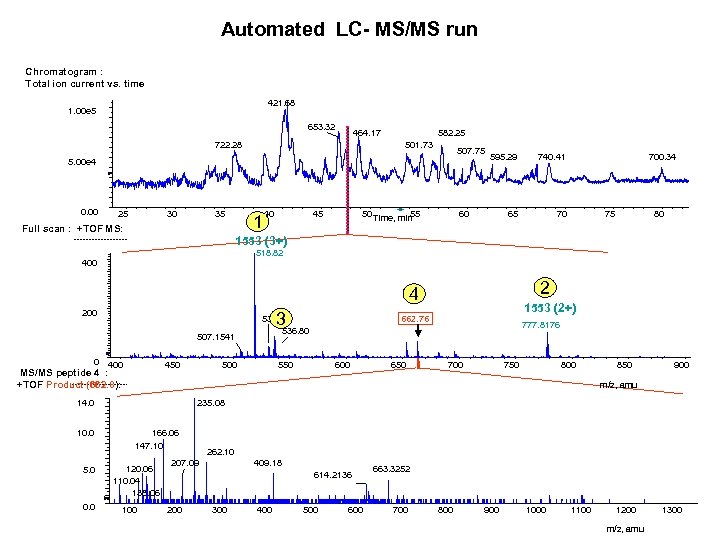 Automated LC- MS/MS run Chromatogram : Total ion current vs. time 421. 68 1. 00 e 5 653. 32 464. 17 722. 28 582. 25 501. 73 507. 75 5. 00 e 4 0. 00 25 30 35 1 Full scan : +TOF MS: 40 45 50 Time, min 55 595. 29 740. 41 65 70 60 700. 34 75 80 1553 (3+) 518. 82 400 2 4 200 3 507. 1541 0 400 450 MS/MS peptide 4 : +TOF Product (662. 8): 5. 0 0. 0 500 1553 (2+) 662. 76 550 600 650 777. 8176 700 750 800 850 900 m/z, amu 235. 08 14. 0 10. 0 531. 47 536. 80 166. 06 147. 10 120. 06 110. 04 138. 06 100 262. 10 207. 09 409. 18 614. 2136 200 300 400 500 663. 3252 700 800 900 1000 1100 1200 m/z, amu 1300
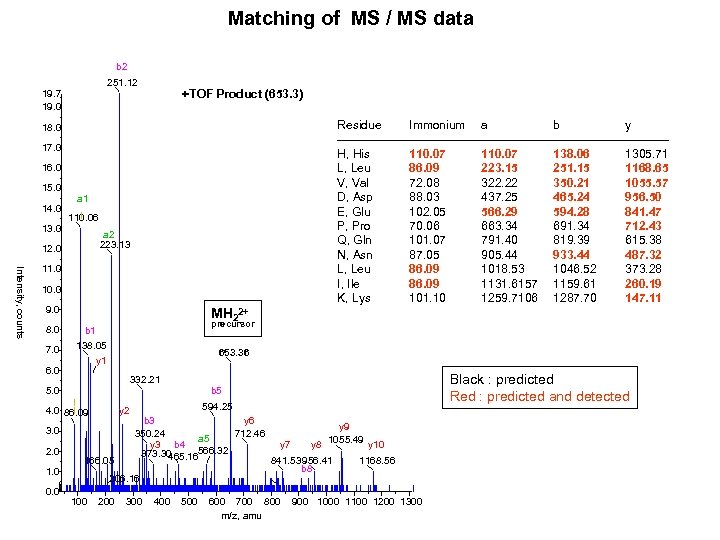 Matching of MS / MS data b 2 251. 12 19. 7 19. 0 +TOF Product (653. 3) Residue Immonium a b y -----------------------------------------H, His 110. 07 138. 06 1305. 71 L, Leu 86. 09 223. 15 251. 15 1168. 65 V, Val 72. 08 322. 22 350. 21 1055. 57 D, Asp 88. 03 437. 25 465. 24 956. 50 E, Glu 102. 05 566. 29 594. 28 841. 47 P, Pro 70. 06 663. 34 691. 34 712. 43 Q, Gln 101. 07 791. 40 819. 39 615. 38 N, Asn 87. 05 905. 44 933. 44 487. 32 L, Leu 86. 09 1018. 53 1046. 52 373. 28 I, Ile 86. 09 1131. 6157 1159. 61 260. 19 K, Lys 101. 10 1259. 7106 1287. 70 147. 11 18. 0 17. 0 16. 0 15. 0 14. 0 13. 0 a 1 I 110. 06 a 2 223. 13 12. 0 Intensity, counts 11. 0 10. 0 9. 0 MH 22+ precursor 8. 0 b 1 7. 0 138. 05 y 1 6. 0 653. 36 332. 21 5. 0 I 4. 0 86. 09 I 3. 0 2. 0 1. 0 0. 0 b 5 594. 25 b 3 y 6 y 9 350. 24 712. 46 a 5 1055. 49 y 10 y 3 b 4 y 7 y 8 566. 32 373. 30 465. 16 166. 05 841. 53 956. 41 1168. 56 b 8 206. 16 100 y 2 200 300 400 500 600 700 800 m/z, amu 900 1000 1100 1200 1300 Black : predicted Red : predicted and detected
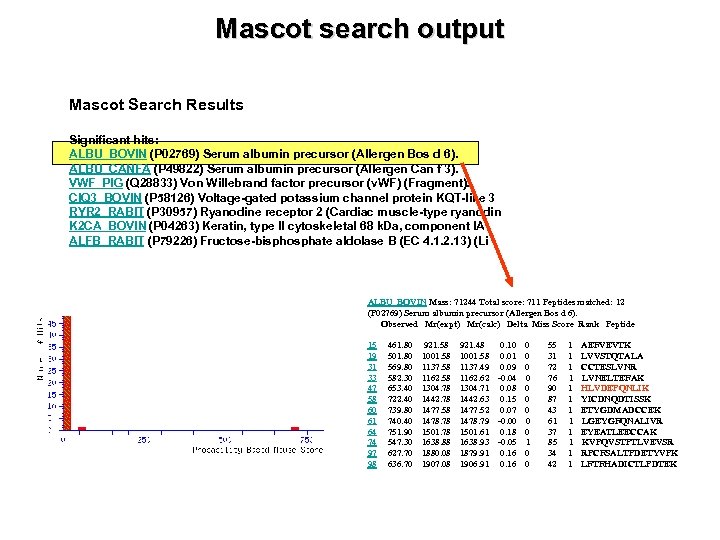 Mascot search output Mascot Search Results Significant hits: ALBU_BOVIN (P 02769) Serum albumin precursor (Allergen Bos d 6). ALBU_CANFA (P 49822) Serum albumin precursor (Allergen Can f 3). VWF_PIG (Q 28833) Von Willebrand factor precursor (v. WF) (Fragment). CIQ 3_BOVIN (P 58126) Voltage-gated potassium channel protein KQT-like 3 RYR 2_RABIT (P 30957) Ryanodine receptor 2 (Cardiac muscle-type ryanodin K 2 CA_BOVIN (P 04263) Keratin, type II cytoskeletal 68 k. Da, component IA ALFB_RABIT (P 79226) Fructose-bisphosphate aldolase B (EC 4. 1. 2. 13) (Li ALBU_BOVIN Mass: 71244 Total score: 711 Peptides matched: 12 (P 02769) Serum albumin precursor (Allergen Bos d 6). Observed Mr(expt) Mr(calc) Delta Miss Score Rank Peptide 15 461. 80 921. 58 921. 48 0. 10 0 55 1 AEFVEVTK 19 501. 80 1001. 58 0. 01 0 31 1 LVVSTQTALA 31 569. 80 1137. 58 1137. 49 0. 09 0 72 1 CCTESLVNR 33 582. 30 1162. 58 1162. 62 -0. 04 0 76 1 LVNELTEFAK 47 653. 40 1304. 78 1304. 71 0. 08 0 90 1 HLVDEPQNLIK 58 722. 40 1442. 78 1442. 63 0. 15 0 87 1 YICDNQDTISSK 60 739. 80 1477. 58 1477. 52 0. 07 0 43 1 ETYGDMADCCEK 61 740. 40 1478. 78 1478. 79 -0. 00 0 61 1 LGEYGFQNALIVR 64 751. 90 1501. 78 1501. 61 0. 18 0 37 1 EYEATLEECCAK 74 547. 30 1638. 88 1638. 93 -0. 05 1 85 1 KVPQVSTPTLVEVSR 97 627. 70 1880. 08 1879. 91 0. 16 0 34 1 RPCFSALTPDETYVPK 98 636. 70 1907. 08 1906. 91 0. 16 0 42 1 LFTFHADICTLPDTEK
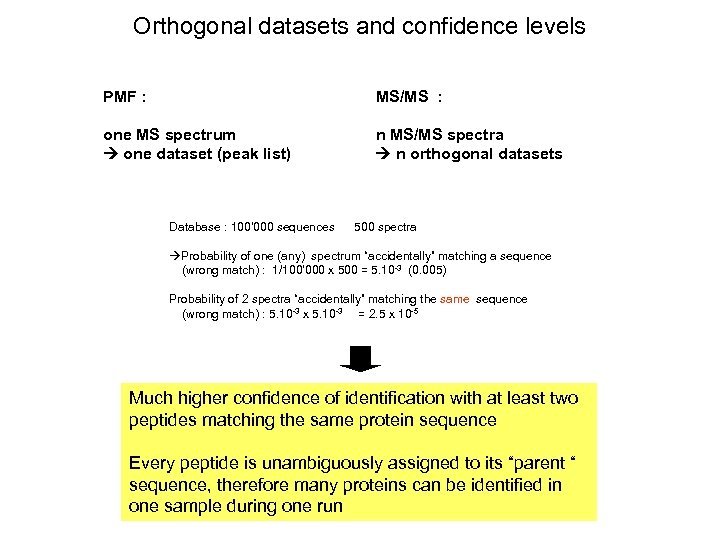 Orthogonal datasets and confidence levels PMF : MS/MS : one MS spectrum one dataset (peak list) n MS/MS spectra n orthogonal datasets Database : 100’ 000 sequences 500 spectra Probability of one (any) spectrum “accidentally” matching a sequence (wrong match) : 1/100’ 000 x 500 = 5. 10 -3 (0. 005) Probability of 2 spectra “accidentally” matching the same sequence (wrong match) : 5. 10 -3 x 5. 10 -3 = 2. 5 x 10 -5 Much higher confidence of identification with at least two peptides matching the same protein sequence Every peptide is unambiguously assigned to its “parent “ sequence, therefore many proteins can be identified in one sample during one run
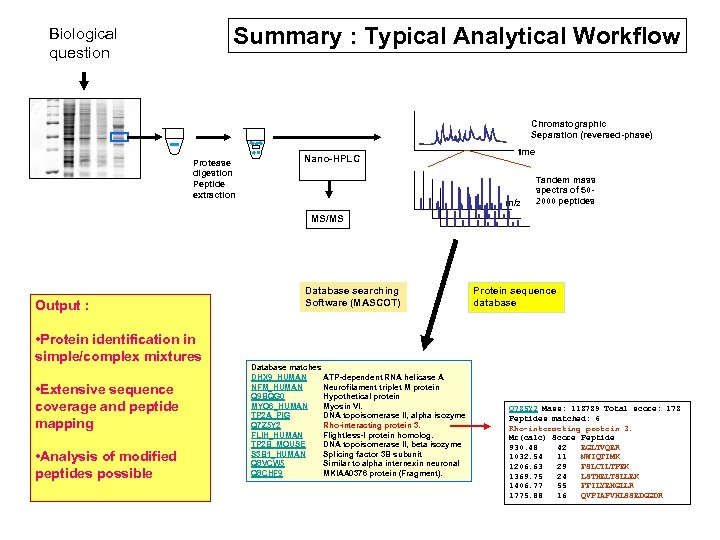 Summary : Typical Analytical Workflow Biological question Chromatographic Separation (reversed-phase) Protease digestion Peptide extraction Nano-HPLC time m/z Tandem mass spectra of 502000 peptides MS/MS Output : • Protein identification in simple/complex mixtures • Extensive sequence coverage and peptide mapping • Analysis of modified peptides possible Database searching Software (MASCOT) Database matches DHX 9_HUMAN ATP-dependent RNA helicase A NFM_HUMAN Neurofilament triplet M protein Q 9 BQG 0 Hypothetical protein MYO 6_HUMAN Myosin VI. TP 2 A_PIG DNA topoisomerase II, alpha isozyme Q 7 Z 5 Y 2 Rho-interacting protein 3. FLIH_HUMAN Flightless-I protein homolog. TP 2 B_MOUSE DNA topoisomerase II, beta isozyme S 3 B 1_HUMAN Splicing factor 3 B subunit Q 8 VCW 5 Similar to alpha internexin neuronal Q 8 CHF 9 MKIAA 0376 protein (Fragment). Protein sequence database Q 7 Z 5 Y 2 Mass: 118789 Total score: 178 Peptides matched: 6 Rho-interacting protein 3. Mr(calc) Score Peptide 930. 48 42 EGLTVQER 1032. 54 11 NWIQTIMK 1206. 63 29 FSLCILTPEK 1369. 75 24 LSTHELTSLLEK 1406. 77 55 FFILYEHGLLR 1775. 88 16 QVPIAPVHLSSEDGGDR
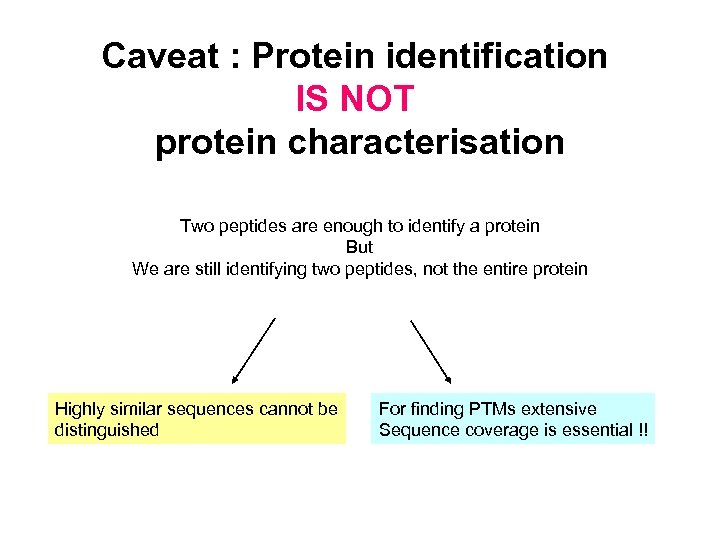 Caveat : Protein identification IS NOT protein characterisation Two peptides are enough to identify a protein But We are still identifying two peptides, not the entire protein Highly similar sequences cannot be distinguished For finding PTMs extensive Sequence coverage is essential !!
 2 Technology, workflows and applications : what is available
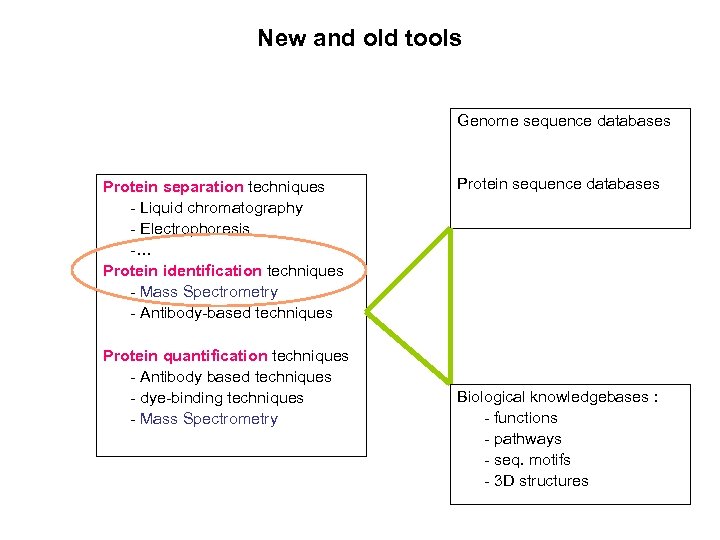 New and old tools Genome sequence databases Protein separation techniques - Liquid chromatography - Electrophoresis -… Protein identification techniques - Mass Spectrometry - Antibody-based techniques Protein quantification techniques - Antibody based techniques - dye-binding techniques - Mass Spectrometry Protein sequence databases Biological knowledgebases : - functions - pathways - seq. motifs - 3 D structures
 WORKFLOWS 1 : „classical“ 2 D-PAGE + MALDI TOF
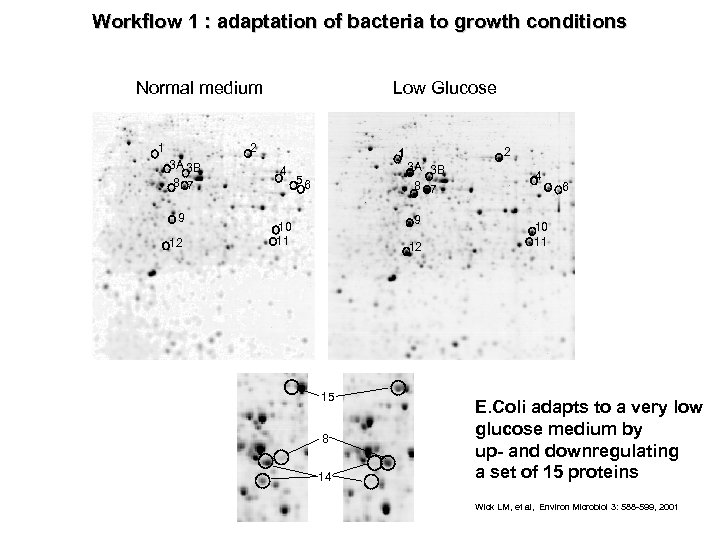 Workflow 1 : adaptation of bacteria to growth conditions Normal medium 1 Low Glucose 2 3 A 3 B 8 7 9 12 2 1 4 3 A 3 B 8 7 56 9 10 11 12 15 8 14 4 6 10 11 E. Coli adapts to a very low glucose medium by up- and downregulating a set of 15 proteins Wick LM, et al, Environ Microbiol 3: 588 -599, 2001
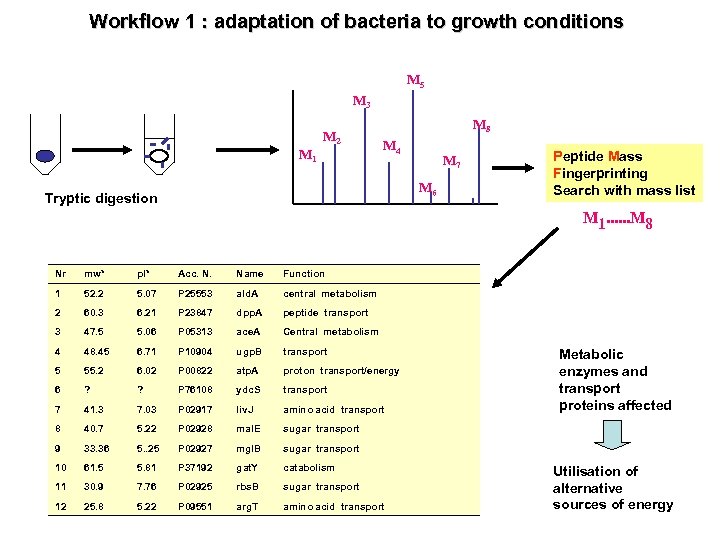 Workflow 1 : adaptation of bacteria to growth conditions M 5 M 3 M 2 M 1 M 8 M 4 M 7 M 6 Tryptic digestion Peptide Mass Fingerprinting Search with mass list M 1. . . M 8 Nr mw* p. I* Acc. N. Name Function 1 52. 2 5. 07 P 25553 ald. A central metabolism 2 60. 3 6. 21 P 23847 dpp. A peptide transport 3 47. 5 5. 06 P 05313 ace. A Central metabolism 4 48. 45 6. 71 P 10904 ugp. B transport 5 55. 2 6. 02 P 00822 atp. A proton transport/energy 6 ? ? P 76108 ydc. S transport 7 41. 3 7. 03 P 02917 liv. J amino acid transport 8 40. 7 5. 22 P 02928 mal. E sugar transport 9 33. 36 5. . 25 P 02927 mgl. B sugar transport 10 61. 5 5. 81 P 37192 gat. Y catabolism 11 30. 9 7. 76 P 02925 rbs. B sugar transport 12 25. 8 5. 22 P 09551 arg. T amino acid transport Metabolic enzymes and transport proteins affected Utilisation of alternative sources of energy
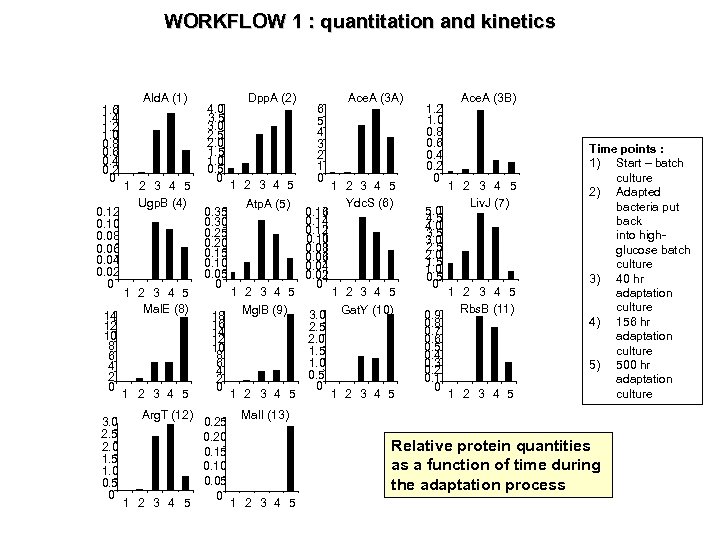 WORKFLOW 1 : quantitation and kinetics 1. 6 1. 4 1. 2 1. 0 0. 8 0. 6 0. 4 0. 2 0 0. 12 0. 10 0. 08 0. 06 0. 04 0. 02 0 14 12 10 8 6 4 2 0 3. 0 2. 5 2. 0 1. 5 1. 0 0. 5 0 Ald. A (1) 1 2 3 4 5 Ugp. B (4) 1 2 3 4 5 Mal. E (8) 1 2 3 4 5 Arg. T (12) 1 2 3 4 5 4. 0 3. 5 3. 0 2. 5 2. 0 1. 5 1. 0 0. 5 0 0. 35 0. 30 0. 25 0. 20 0. 15 0. 10 0. 05 0 18 16 14 12 10 8 6 4 2 0 0. 25 0. 20 0. 15 0. 10 0. 05 0 Dpp. A (2) 1 2 3 4 5 Atp. A (5) 1 2 3 4 5 Mgl. B (9) 1 2 3 4 5 6 5 4 3 2 1 0 0. 16 0. 14 0. 12 0. 10 0. 08 0. 06 0. 04 0. 02 0 Ace. A (3 A) 1 2 3 4 5 Ydc. S (6) 1 2 3 4 5 3. 0 Gat. Y (10) 2. 5 2. 0 1. 5 1. 0 0. 5 0 1 2 3 4 5 1. 2 1. 0 0. 8 0. 6 0. 4 0. 2 0 5. 0 4. 5 4. 0 3. 5 3. 0 2. 5 2. 0 1. 5 1. 0 0. 5 0 Ace. A (3 B) 1 2 3 4 5 Liv. J (7) 1 2 3 4 5 Rbs. B (11) 0. 9 0. 8 0. 7 0. 6 0. 5 0. 4 0. 3 0. 2 0. 1 0 1 2 3 4 5 Time points : 1) Start – batch culture 2) Adapted bacteria put back into highglucose batch culture 3) 40 hr adaptation culture 4) 156 hr adaptation culture 5) 500 hr adaptation culture Mal. I (13) Relative protein quantities as a function of time during the adaptation process 1 2 3 4 5
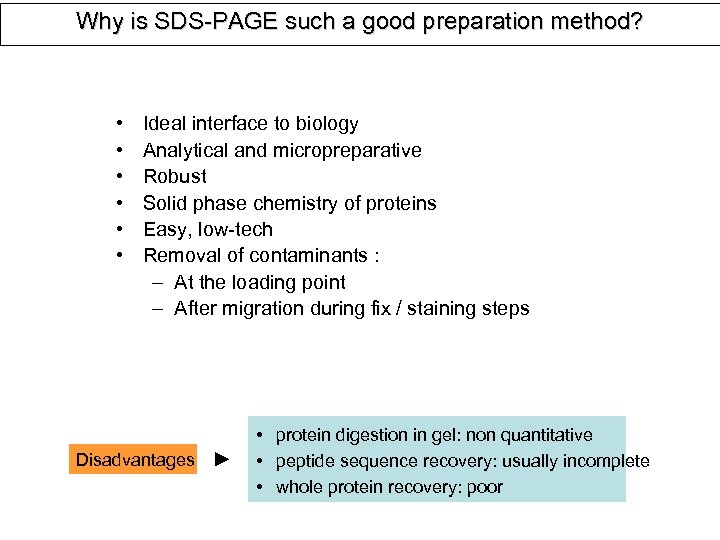 Why is SDS-PAGE such a good preparation method? • • • Ideal interface to biology Analytical and micropreparative Robust Solid phase chemistry of proteins Easy, low-tech Removal of contaminants : – At the loading point – After migration during fix / staining steps Disadvantages • protein digestion in gel: non quantitative • peptide sequence recovery: usually incomplete • whole protein recovery: poor
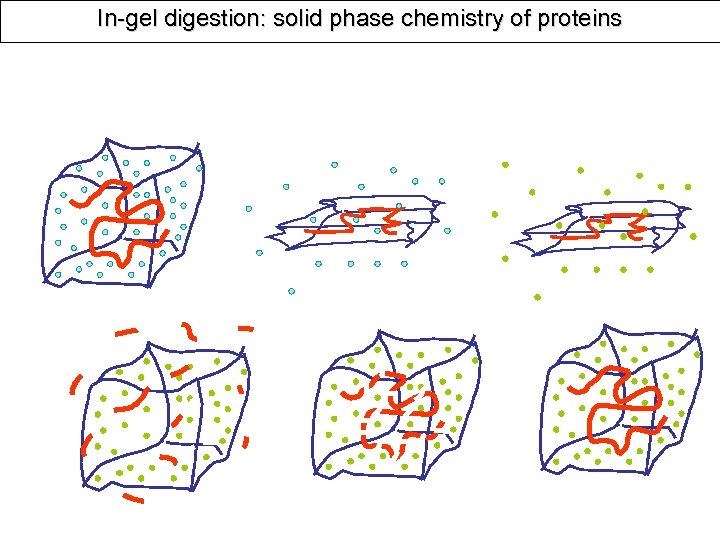 In-gel digestion: solid phase chemistry of proteins
 WORKFLOWS 2 : General shotgun protein identification techniques example : Affinity pull-down + 1 D-PAGE + LC-MS/MS
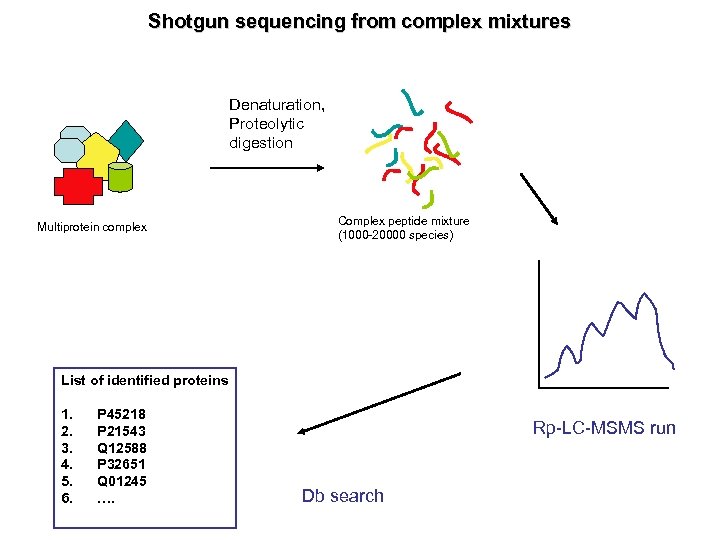 Shotgun sequencing from complex mixtures Denaturation, Proteolytic digestion Multiprotein complex Complex peptide mixture (1000 -20000 species) List of identified proteins 1. 2. 3. 4. 5. 6. P 45218 P 21543 Q 12588 P 32651 Q 01245 …. Rp-LC-MSMS run Db search
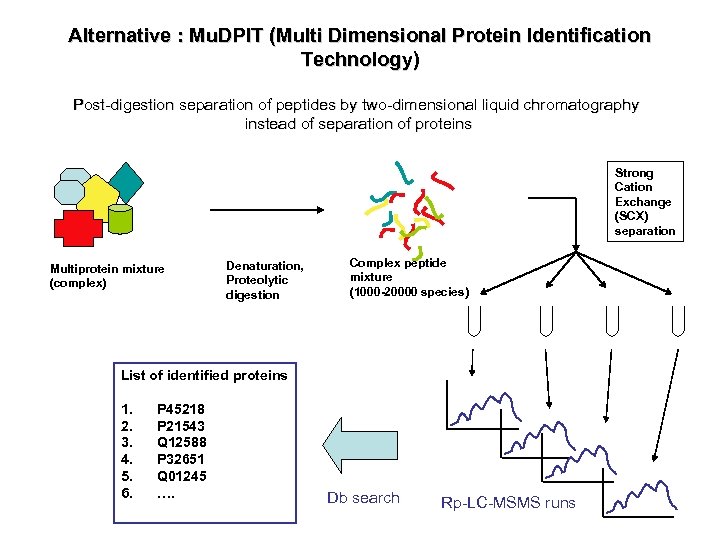 Alternative : Mu. DPIT (Multi Dimensional Protein Identification Technology) Post-digestion separation of peptides by two-dimensional liquid chromatography instead of separation of proteins Strong Cation Exchange (SCX) separation Multiprotein mixture (complex) Denaturation, Proteolytic digestion Complex peptide mixture (1000 -20000 species) List of identified proteins 1. 2. 3. 4. 5. 6. P 45218 P 21543 Q 12588 P 32651 Q 01245 …. Db search Rp-LC-MSMS runs
 A VERY complex mixture – direct analysis (no separation)
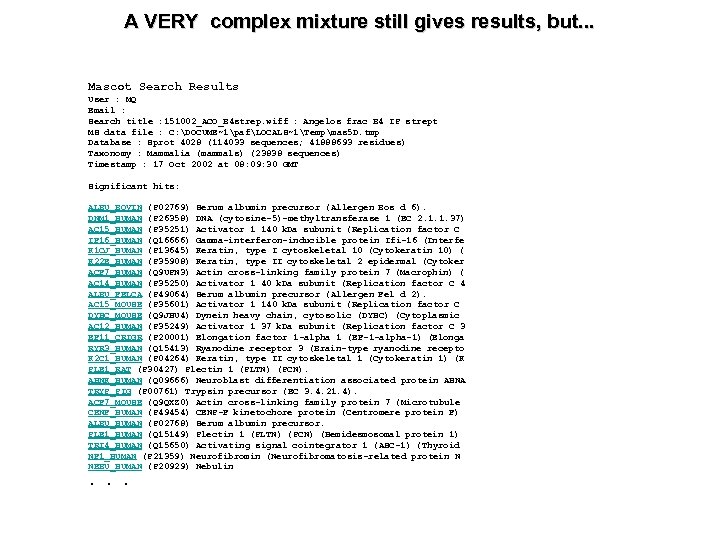 A VERY complex mixture still gives results, but. . . Mascot Search Results User : MQ Email : Search title : 151002_ACO_B 4 strep. wiff : Angelos frac B 4 IP strept MS data file : C: DOCUME~1pafLOCALS~1Tempmas 5 D. tmp Database : Sprot 4028 (114033 sequences; 41888693 residues) Taxonomy : Mammalia (mammals) (23838 sequences) Timestamp : 17 Oct 2002 at 08: 09: 30 GMT Significant hits: ALBU_BOVIN (P 02769) Serum albumin precursor (Allergen Bos d 6). DNM 1_HUMAN (P 26358) DNA (cytosine-5)-methyltransferase 1 (EC 2. 1. 1. 37) AC 15_HUMAN (P 35251) Activator 1 140 k. Da subunit (Replication factor C IF 16_HUMAN (Q 16666) Gamma-interferon-inducible protein Ifi-16 (Interfe K 1 CJ_HUMAN (P 13645) Keratin, type I cytoskeletal 10 (Cytokeratin 10) ( K 22 E_HUMAN (P 35908) Keratin, type II cytoskeletal 2 epidermal (Cytoker ACF 7_HUMAN (Q 9 UPN 3) Actin cross-linking family protein 7 (Macrophin) ( AC 14_HUMAN (P 35250) Activator 1 40 k. Da subunit (Replication factor C 4 ALBU_FELCA (P 49064) Serum albumin precursor (Allergen Fel d 2). AC 15_MOUSE (P 35601) Activator 1 140 k. Da subunit (Replication factor C DYHC_MOUSE (Q 9 JHU 4) Dynein heavy chain, cytosolic (DYHC) (Cytoplasmic AC 12_HUMAN (P 35249) Activator 1 37 k. Da subunit (Replication factor C 3 EF 11_CRIGR (P 20001) Elongation factor 1 -alpha 1 (EF-1 -alpha-1) (Elonga RYR 3_HUMAN (Q 15413) Ryanodine receptor 3 (Brain-type ryanodine recepto K 2 C 1_HUMAN (P 04264) Keratin, type II cytoskeletal 1 (Cytokeratin 1) (K PLE 1_RAT (P 30427) Plectin 1 (PLTN) (PCN). AHNK_HUMAN (Q 09666) Neuroblast differentiation associated protein AHNA TRYP_PIG (P 00761) Trypsin precursor (EC 3. 4. 21. 4). ACF 7_MOUSE (Q 9 QXZ 0) Actin cross-linking family protein 7 (Microtubule CENF_HUMAN (P 49454) CENP-F kinetochore protein (Centromere protein F) ALBU_HUMAN (P 02768) Serum albumin precursor. PLE 1_HUMAN (Q 15149) Plectin 1 (PLTN) (PCN) (Hemidesmosomal protein 1) TRI 4_HUMAN (Q 15650) Activating signal cointegrator 1 (ASC-1) (Thyroid NF 1_HUMAN (P 21359) Neurofibromin (Neurofibromatosis-related protein N NEBU_HUMAN (P 20929) Nebulin . . .
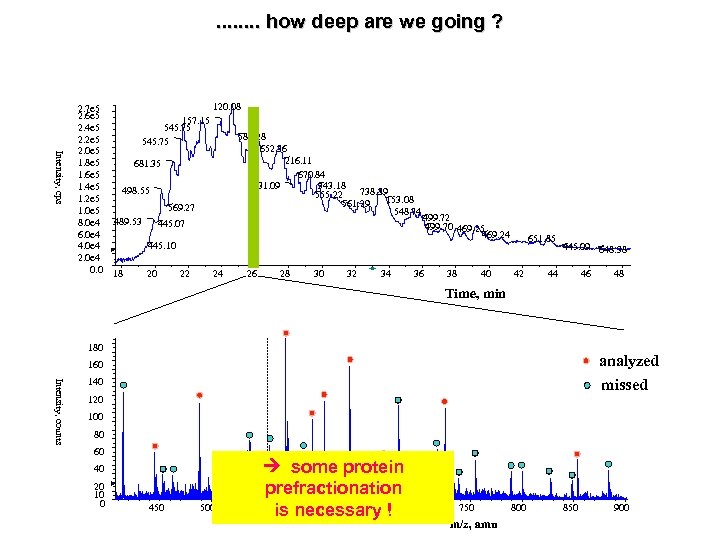 . . . . how deep are we going ? Intensity, cps 2. 7 e 5 2. 6 e 5 2. 4 e 5 2. 2 e 5 2. 0 e 5 1. 8 e 5 1. 6 e 5 1. 4 e 5 1. 2 e 5 1. 0 e 5 8. 0 e 4 6. 0 e 4 4. 0 e 4 2. 0 e 4 0. 0 120. 08 157. 15 545. 75 581. 28 652. 36 216. 11 670. 84 131. 09 343. 18 738. 39 555. 22 153. 08 561. 29 548. 74 681. 35 498. 55 569. 27 489. 53 445. 07 499. 72 499. 70 469. 25 469. 24 651. 85 445. 10 18 20 22 24 26 28 30 32 34 36 38 40 42 445. 09 648. 38 44 46 48 Time, min 180 analyzed missed 160 Intensity, counts 140 120 100 80 60 40 20 10 0 450 500 some protein prefractionation 550 600 650 is necessary ! 700 750 m/z, amu 800 850 900
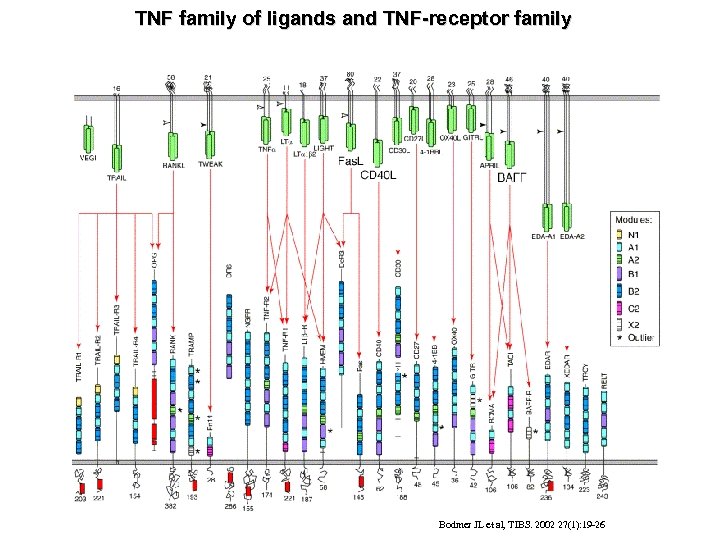 TNF family of ligands and TNF-receptor family Bodmer JL et al, TIBS. 2002 27(1): 19 -26
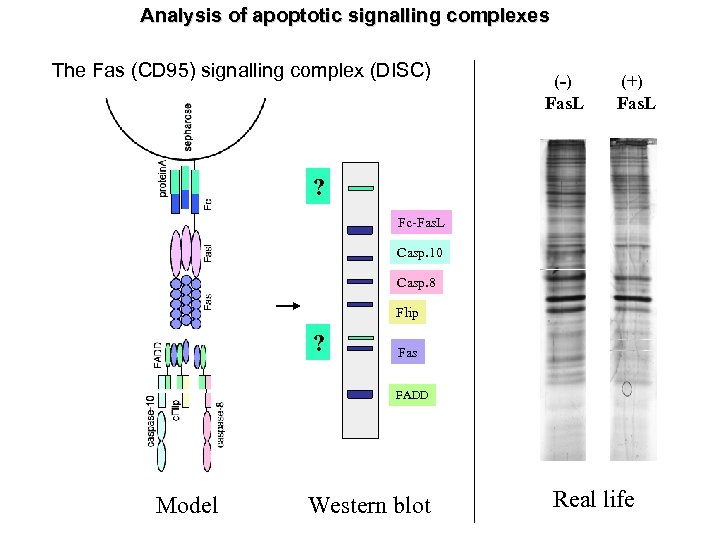 Analysis of apoptotic signalling complexes The Fas (CD 95) signalling complex (DISC) (-) Fas. L (+) Fas. L ? Fc-Fas. L Casp. 10 Casp. 8 Flip ? Fas FADD Model Western blot Real life
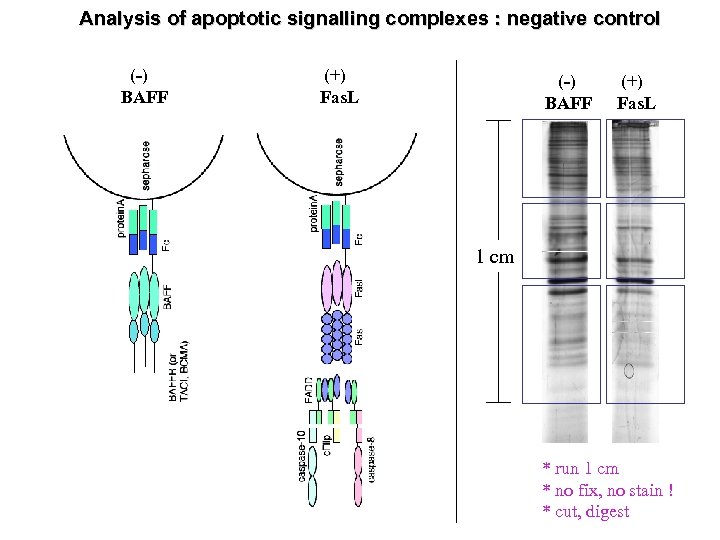 Analysis of apoptotic signalling complexes : negative control (-) BAFF (+) Fas. L 1 cm * run 1 cm * no fix, no stain ! * cut, digest
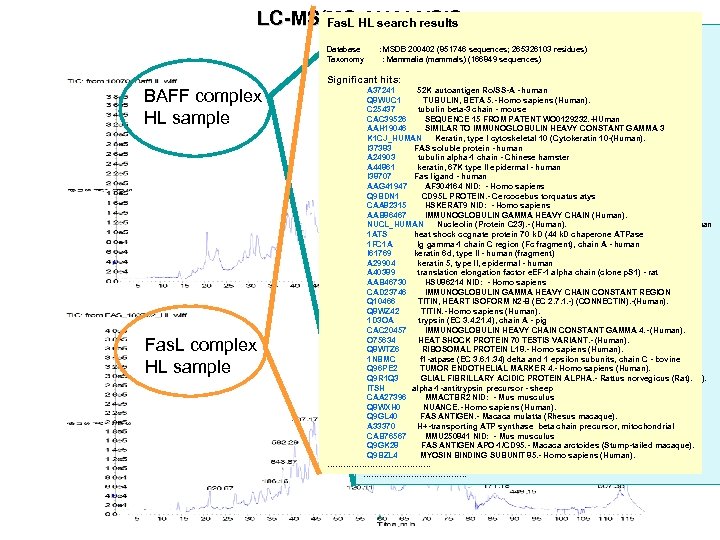 LC-MS/MS HL search results Fas. L ANALYSIS BAFF HL search results Database : MSDB 200402 (851746 sequences; 265326103 residues) : MSDB 200402 (851746 sequences; Taxonomy. Database : Mammalia (mammals) (166849 sequences) 265326103 residues) Taxonomy : Mammalia (mammals) (166849 sequences) BAFF complex HL sample Significant hits: A 37241 52 K autoantigen Ro/SS-A - human SSA 1. - 5. - Homo sapiens (Human). Q 8 WUC 1 Q 96 RF 8 TUBULIN, BETAHomo sapiens (Human). AK 010960 NID: C 25437 BAB 27292 beta-3 chain - mouse Mus musculus tubulin K 2 C 1_HUMAN CAC 39526 SEQUENCE Keratin, type II cytoskeletal 1 (Cytokeratin 1) 15 FROM PATENT WO 0129232. -HUman A 45935 dna. K-type molecular chaperone CONSTANT GAMMA 3 AAH 19046 SIMILAR TO IMMUNOGLOBULIN HEAVY hsc 70 - mouse KRHU 0 Keratin, type 10, type I, cytoskeletal - human keratin I cytoskeletal 10 (Cytokeratin 10 -(Human). K 1 CJ_HUMAN C 25437 soluble protein - human - mouse tubulin beta-3 chain I 37383 FAS ATP SYNTHASE, H+ TRANSPORTING MITOCHONDRIAL F 1 A 24903 Q 9 CWA 2 alpha-1 chain - Chinese hamster tubulin HSHA 44 G NID: - - human A 44861 CAA 30026 67 K type II epidermal. Homo sapiens keratin, CAB 59134 I 38707 Fas ligand - SEQUENCE 1 FROM PATENT WO 9818921 PRECURSOR human A 44861 keratin, - Homo sapiens AAG 41947 AF 304164 NID: 67 K type II epidermal - human HEAT SHOCK 70 KD torquatus atys Q 9 BDN 1 Q 9 BWB 7 PROTEIN. - Cercocebus. PROTEIN 9 B (MORTALIN-) (Human). CD 95 L A 26168 ribophorin I precursor - human CAA 82315 HSKERAT 9 NID: - Homo sapiens PT 0207 Ig gamma chain C region - chimpanzee AAB 86467 IMMUNOGLOBULIN GAMMA HEAVY CHAIN (Human). PWHUA Nucleolin (Protein C 23). - (Human). H+-transporting two-sector ATPase alpha chain precursor - human NUCL_HUMAN JC 1473 shock cognate protein 70 k. D (44 k. D chaperone ATPase chain - mouse H+-transporting ATP synthase (EC 3. 6. 1. 34) alpha 1 ATS heat tubulin alpha-1 chain human 1 FC 1 A I 77403 gamma-1 chain C region (Fc- fragment), chain A - human Ig AAA 572336 d, type II - human (fragment) MUSHP 7 A 2 NID: - Mus musculus I 61769 keratin HSKERAT 9 NID: - Homo A 29904 CAA 82315 5, type II, epidermal - human sapiens keratin 5, type II, epidermal - human A 40389 A 29904 translation elongation factor e. EF-1 alpha chain (clone p. S 1) - rat HHHU 84 heat shock protein 90 -beta [validated] - human AAB 46730 HSU 86214 NID: - Homo sapiens AAB 86467 IMMUNOGLOBULIN GAMMA HEAVY CHAIN. -(Human). CAD 23746 IMMUNOGLOBULIN GAMMA HEAVY CHAIN CONSTANT REGION ribophorin II precursor - 2. 7. 1. -) Q 10466 B 26168 HEART ISOFORM N 2 -B (EC human (CONNECTIN). -(Human). TITIN, HSEF 1 AC NID: - Homo Q 8 WZ 42 CAA 34756 Homo sapiens (Human). sapiens TITIN. alpha-1 -antitrypsin - pig 1 D 3 OA S 21097 trypsin (EC 3. 4. 21. 4), chain Aprecursor - bovine S 04652 Ca 2+-transporting ATPase CONSTANT 2, - pig CAC 20457 IMMUNOGLOBULIN HEAVY CHAIN(EC 3. 6. 1. 38) GAMMA 4. - (Human). BTBSA NID: - Bos taurus O 75634 CAA 41735 SHOCK PROTEIN 70 TESTIS VARIANT. - (Human). HEAT BIP Q 8 WTZ 6 Q 9 UK 02 RIBOSOMAL PROTEIN (FRAGMENT). - Homo sapiens (Human). L 18. - Homo sapiens (Human). keratin 6 a, type II and 1 epsilon subunits, chain C - bovine 1 NBMC KRHUEA f 1 -atpase (EC 3. 6. 1. 34) delta - human actin alpha, vascular smooth muscle - mouse Q 96 PE 2 A 22224 TUMOR ENDOTHELIAL MARKER 4. - Homo sapiens (Human). UNKNOWN (PROTEIN FOR ALPHA. - Rattus norvegicus (Human). Q 9 R 1 Q 3 Q 96 GA 6 GLIAL FIBRILLARY ACIDIC PROTEINMGC: 15420). - Homo sapiens (Rat). Q 8 WZ 42 TITIN. - precursor - sheep ITSH alpha-1 -antitrypsin Homo sapiens (Human). I 84741 RNA NID: - Mus musculus CAA 27396 MMACTBR 2 helicase - mouse 78 KDA sapiens (Human). Q 8 WXH 0 Q 9 TS 10 NUANCE. - Homo. APAMIN BINDING PROTEIN. - Bos taurus (Bovine). BC 002690 NID: - Homo sapiens Q 9 GL 40 AAH 02690 FAS ANTIGEN. - Macaca mulatta (Rhesus macaque). RNA helicase TNZ 2 - mouse A 33370 I 48385 H+-transporting ATP synthase beta chain precursor, mitochondrial Q 96 FZ 6 HEAT SHOCK 60 KD PROTEIN 1 (CHAPERONIN). (Human). CAB 76567 MMU 250841 NID: - Mus musculus HSU 15637 NID: - Macaca arctoides (Stump-tailed macaque). Q 9 GK 28 AAA 56753 FAS ANTIGEN APO-1/CD 95. -Homo sapiens Q 9 BZL 4 CAA 58470 BINDING SUBUNIT - Homo sapiens MYOSIN HSPXMP 11 NID: 85. - Homo sapiens (Human). JQ 0028 cytokeratin 19 – mouse ………………………………… 600 spectra LCMS runs Fas/Baff Fas. L complex HL sample 680 spectra
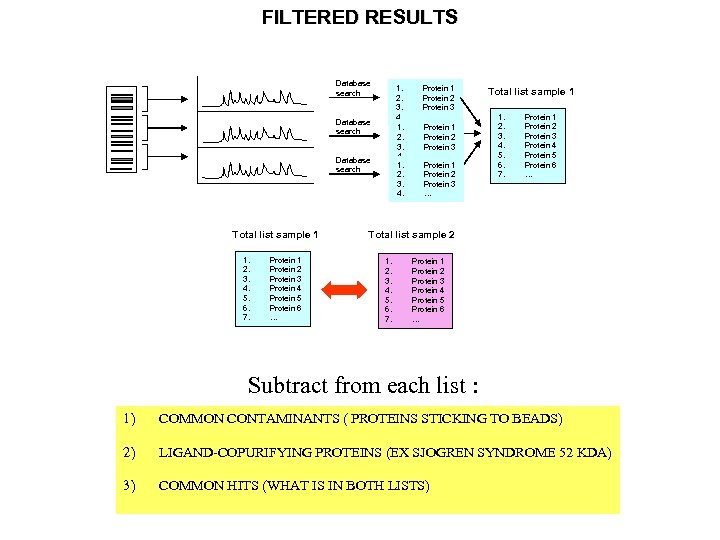 FILTERED RESULTS Database search 1. 2. 3. 4. Database search Total list sample 1 1. 2. 3. 4. 5. 6. 7. Protein 1 Protein 2 Protein 3 Protein 4 Protein 5 Protein 6 … Protein 1 Protein 2 Protein 3 … Total list sample 1 1. 2. 3. 4. 5. 6. 7. Protein 1 Protein 2 Protein 3 Protein 4 Protein 5 Protein 6 … Total list sample 2 1. 2. 3. 4. 5. 6. 7. Protein 1 Protein 2 Protein 3 Protein 4 Protein 5 Protein 6 … Subtract from each list : 1) COMMON CONTAMINANTS ( PROTEINS STICKING TO BEADS) 2) LIGAND-COPURIFYING PROTEINS (EX SJOGREN SYNDROME 52 KDA) 3) COMMON HITS (WHAT IS IN BOTH LISTS)
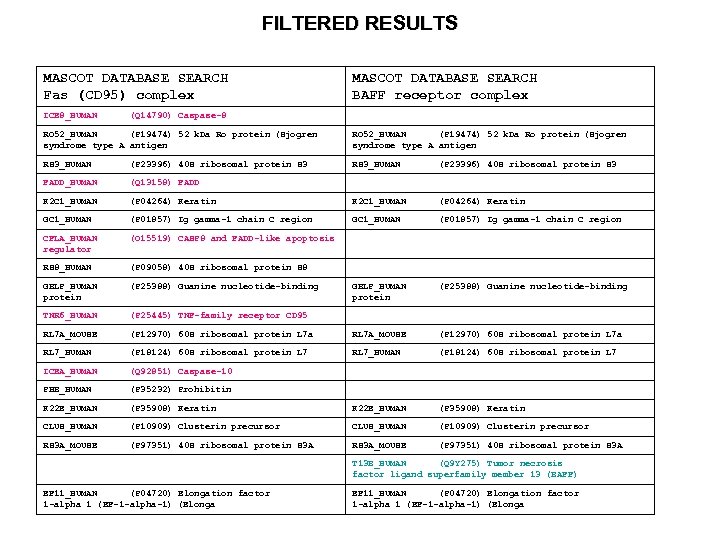 FILTERED RESULTS MASCOT DATABASE SEARCH Fas (CD 95) complex MASCOT DATABASE SEARCH BAFF receptor complex ICE 8_HUMAN (Q 14790) Caspase-8 RO 52_HUMAN (P 19474) 52 k. Da Ro protein (Sjogren syndrome type A antigen RS 3_HUMAN (P 23396) 40 S ribosomal protein S 3 FADD_HUMAN (Q 13158) FADD K 2 C 1_HUMAN (P 04264) Keratin GC 1_HUMAN (P 01857) Ig gamma-1 chain C region CFLA_HUMAN (O 15519) CASP 8 and FADD-like apoptosis regulator RS 8_HUMAN (P 09058) 40 S ribosomal protein S 8 GBLP_HUMAN (P 25388) Guanine nucleotide-binding protein TNR 6_HUMAN (P 25445) TNF-family receptor CD 95 RL 7 A_MOUSE (P 12970) 60 S ribosomal protein L 7 a RL 7_HUMAN (P 18124) 60 S ribosomal protein L 7 ICEA_HUMAN (Q 92851) Caspase-10 PHB_HUMAN (P 35232) Prohibitin K 22 E_HUMAN (P 35908) Keratin CLUS_HUMAN (P 10909) Clusterin precursor RS 3 A_MOUSE (P 97351) 40 S ribosomal protein S 3 A T 13 B_HUMAN (Q 9 Y 275) Tumor necrosis factor ligand superfamily member 13 (BAFF) EF 11_HUMAN (P 04720) Elongation factor 1 -alpha 1 (EF-1 -alpha-1) (Elonga
 • One major evolution of proteomics technologies in the last years has been the introduction of gel-free approaches for large scale protein identification and quantification • These methods combine isotope labelling, separation techniques and mass spectrometry
 WORKFLOWS 3: isotope labelling strategies
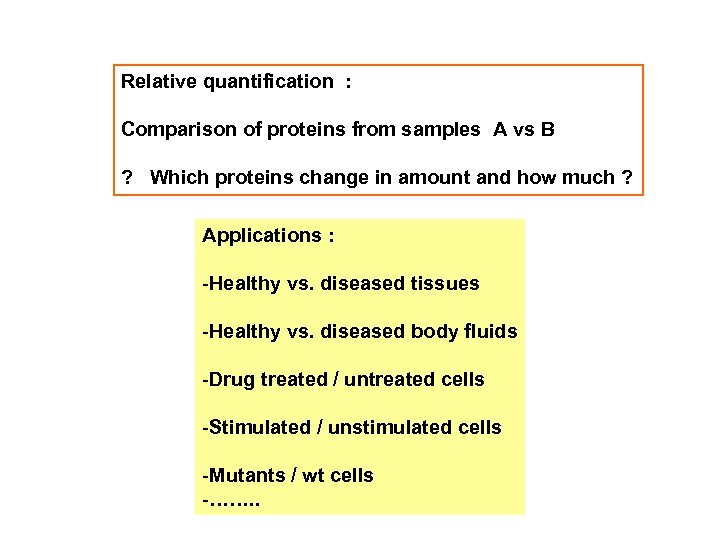 Relative quantification : Comparison of proteins from samples A vs B ? Which proteins change in amount and how much ? Applications : -Healthy vs. diseased tissues -Healthy vs. diseased body fluids -Drug treated / untreated cells -Stimulated / unstimulated cells -Mutants / wt cells -……. .
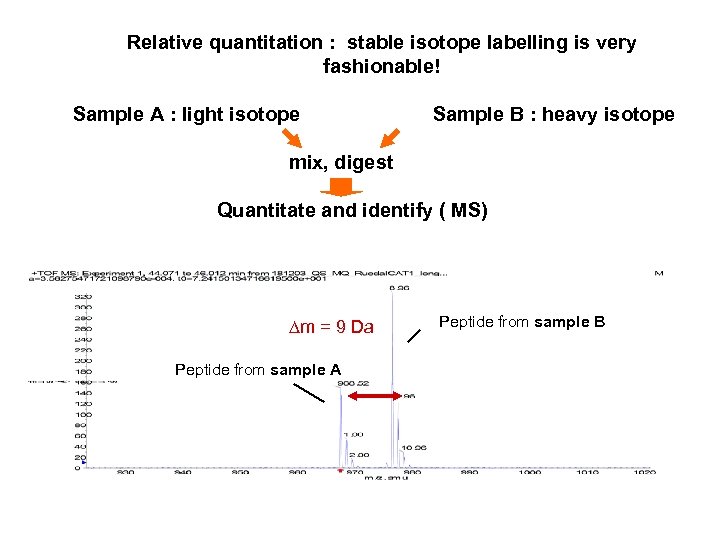 Relative quantitation : stable isotope labelling is very fashionable! Sample A : light isotope Sample B : heavy isotope mix, digest Quantitate and identify ( MS) Dm = 9 Da Peptide from sample A Peptide from sample B
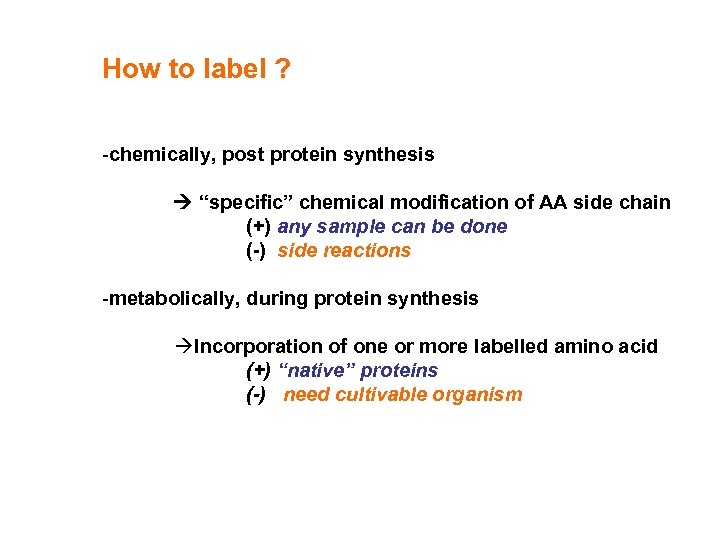 How to label ? -chemically, post protein synthesis “specific” chemical modification of AA side chain (+) any sample can be done (-) side reactions -metabolically, during protein synthesis Incorporation of one or more labelled amino acid (+) “native” proteins (-) need cultivable organism
![Isotope Coded Affinity Tag (ICAT) reagents Transition states State 1 [protein 1] [protein 2].](https://present5.com/presentation/0347acfc72cda07112470d1400b77d7d/image-71.jpg "Isotope Coded Affinity Tag (ICAT) reagents Transition states State 1 [protein 1] [protein 2].") Isotope Coded Affinity Tag (ICAT) reagents Transition states State 1 [protein 1] [protein 2]. . [proteinn] O N State 2 N XX O N S Biotin tag [protein 1] [protein 2]. . [proteinn] XX O O XX N Linker (heavy or light) I Thiol reactive d 0 - or d 8 -ICAT (X= H or D)
Isotope Coded Affinity Tag (ICAT) reagents Transition states State 1 [protein 1] [protein 2]. . [proteinn] O N State 2 N XX O N S Biotin tag [protein 1] [protein 2]. . [proteinn] XX O O XX N Linker (heavy or light) I Thiol reactive d 0 - or d 8 -ICAT (X= H or D)
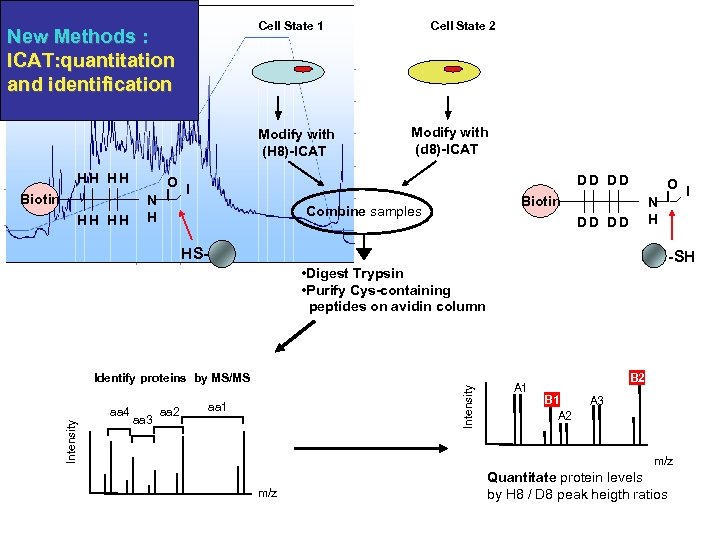 Cell State 1 New Methods : ICAT: quantitation and identification Modify with (H 8)-ICAT HH HH Biotin HH HH O N H Cell State 2 Modify with (d 8)-ICAT DD DD I O Biotin Combine samples N H DD DD HS- -SH • Digest Trypsin • Purify Cys-containing peptides on avidin column Intensity aa 4 aa 3 aa 2 Intensity Identify proteins by MS/MS aa 1 A 1 B 2 B 1 A 2 A 3 m/z I Quantitate protein levels by H 8 / D 8 peak heigth ratios
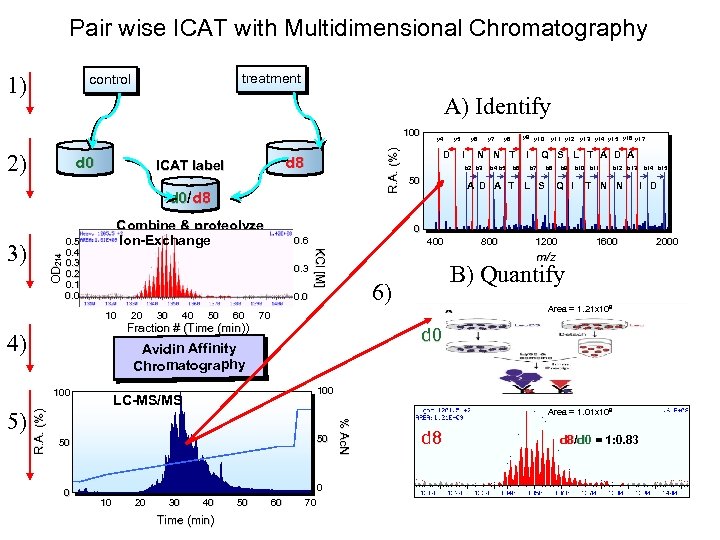 Pair wise ICAT with Multidimensional Chromatography 1) treatment control A) Identify 2) d 0 R. A. (%) 100 d 8 ICAT label d 0/d 8 d 0 OD 214 0. 5 0. 4 0. 3 0. 2 0. 1 0. 0 0. 3 4) 30 40 50 60 Fraction # (Time (min)) b 6 A D A T I Q S L T A D A b 7 L S b 8 b 9 Q I b 10 b 11 b 12 b 13 T N N b 14 b 15 I D 800 1200 1600 B) Quantify 6) 40 Time (min) 50 60 70 % Ac. N R. A. (%) b 4 b 5 y 13 y 14 y 15 y 16 y 17 Area = 1. 21 x 109 Area = 1. 01 x 109 0 30 N N T y 11 y 12 100 50 20 50 y 9 y 10 y 8 d 0 LC-MS/MS 10 I y 7 b 2 b 3 70 50 0 y 6 m/z Avidin Affinity Chromatography 100 5) 20 D 400 0. 0 10 y 5 0 0. 6 KCl [M] 3) Combine & proteolyze Ion-Exchange y 4 d 8/d 0 = 1: 0. 83 d 8/ 2000
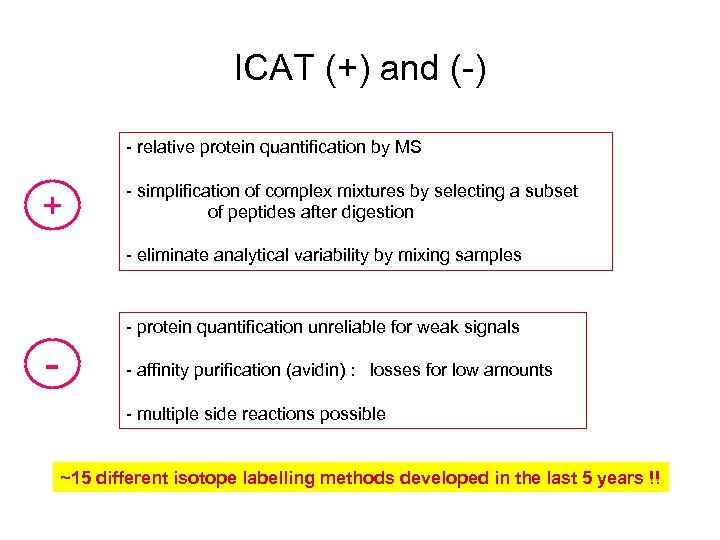 ICAT (+) and (-) - relative protein quantification by MS + - simplification of complex mixtures by selecting a subset of peptides after digestion - eliminate analytical variability by mixing samples - protein quantification unreliable for weak signals - - affinity purification (avidin) : losses for low amounts - multiple side reactions possible ~15 different isotope labelling methods developed in the last 5 years !!
 Recent ICAT studies (R. Aebersold’s group) Wollscheid B, von Haller PD, Yi E, Donohoe S, Vaughn K, Keller A, Nesvizhskii AI, Eng J, Li XJ, Goodlett DR, Aebersold R, Watts JD. Lipid raft proteins and their identification in T lymphocytes. Subcell Biochem. 2004; 37: 121 -52 Yan W, Lee H, Yi EC, Reiss D, Shannon P, Kwieciszewski BK, Coito C, Li XJ, Keller A, Eng J, Galitski T, Goodlett DR, Aebersold R, Katze MG. System-based proteomic analysis of the interferon response in human liver cells. Genome Biol. 2004; 5(8): R 54. Giglia-Mari G, Coin F, Ranish JA, Hoogstraten D, Theil A, Wijgers N, Jaspers NG, Raams A, Argentini M, van der Spek PJ, Botta E, Stefanini M, Egly JM, Aebersold R, Hoeijmakers JH, Vermeulen W. A new, tenth subunit of TFIIH is responsible for the DNA repair syndrome trichothiodystrophy group A. Nat Genet. 2004 Jul; 36(7): 714 -9. Ranish JA, Hahn S, Lu Y, Yi EC, Li XJ, Eng J, Aebersold R. Identification of TFB 5, a new component of general transcription and DNA repair factor IIH. Nat Genet. 2004 Jul; 36(7): 707 -13. Hardwidge PR, Rodriguez-Escudero I, Goode D, Donohoe S, Eng J, Goodlett DR, Aebersold R, Finlay BB Proteomic analysis of the intestinal epithelial cell response to enteropathogenic Escherichia coli. J Biol Chem. 2004 May 7; 279(19): 20127 -36. Zhang J, Goodlett DR, Peskind ER, Quinn JF, Zhou Y, Wang Q, Pan C, Yi E, Eng J, Aebersold RH, Montine TJ. Quantitative proteomic analysis of age-related changes in human cerebrospinal fluid. Neurobiol Aging. 2005 Feb; 26(2): 207 -27. Marelli M, Smith JJ, Jung S, Yi E, Nesvizhskii AI, Christmas RH, Saleem RA, Tam YY, Fagarasanu A, Goodlett DR, Aebersold R, Rachubinski RA, Aitchison JD. Quantitative mass spectrometry reveals a role for the GTPase Rho 1 p in actin organization on the peroxisome membrane. J Cell Biol. 2004 Dec 20; 167(6): 1099 -112. Epub 2004 Dec 13.
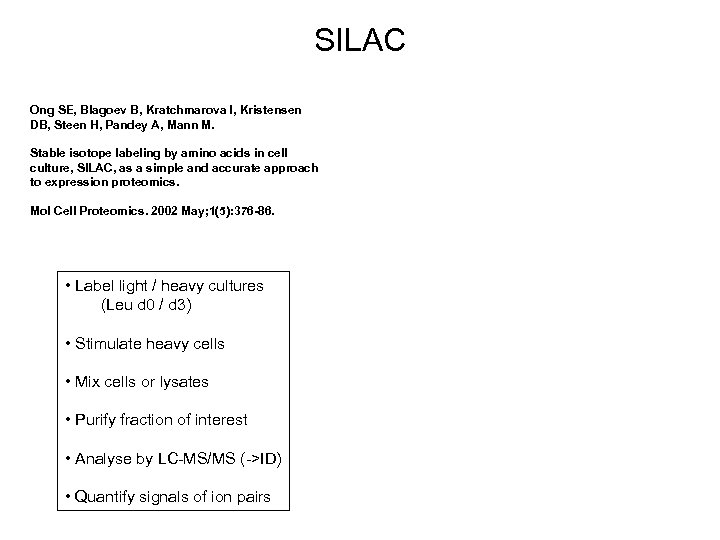 SILAC Ong SE, Blagoev B, Kratchmarova I, Kristensen DB, Steen H, Pandey A, Mann M. Stable isotope labeling by amino acids in cell culture, SILAC, as a simple and accurate approach to expression proteomics. Mol Cell Proteomics. 2002 May; 1(5): 376 -86. • Label light / heavy cultures (Leu d 0 / d 3) • Stimulate heavy cells • Mix cells or lysates • Purify fraction of interest • Analyse by LC-MS/MS (->ID) • Quantify signals of ion pairs
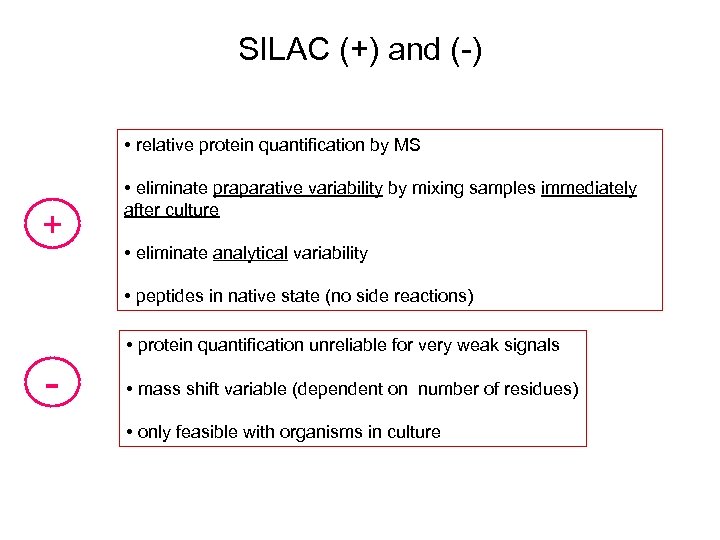 SILAC (+) and (-) • relative protein quantification by MS + • eliminate praparative variability by mixing samples immediately after culture • eliminate analytical variability • peptides in native state (no side reactions) • protein quantification unreliable for very weak signals - • mass shift variable (dependent on number of residues) • only feasible with organisms in culture
 Recent SILAC articles Ong SE, Blagoev B, Kratchmarova I, Kristensen DB, Steen H, Pandey A, Mann M. Stable isotope labeling by amino acids in cell culture, SILAC, as a simple and accurate approach to expression proteomics. Mol Cell Proteomics. 2002 May; 1(5): 376 -86. Blagoev B, Ong SE, Kratchmarova I, Mann M. Temporal analysis of phosphotyrosine-dependent signaling networks by quantitative proteomics. Nat Biotechnol. 2004 Sep; 22(9): 1139 -45. Epub 2004 Aug 15. Gruhler A, Olsen JV, Mohammed S, Mortensen P, Faergeman NJ, Mann M, Jensen ON. Quantitative Phosphoproteomics Applied to the Yeast Pheromone Signaling Pathway. Mol Cell Proteomics. 2005 Mar; 4(3): 310 -327. de Hoog CL, Foster LJ, Mann M. RNA and RNA binding proteins participate in early stages of cell spreading through spreading initiation centers. Cell. 2004 May 28; 117(5): 649 -62. Ong SE, Kratchmarova I, Mann M. Properties of 13 C-substituted arginine in stable isotope labeling by amino acids in cell culture (SILAC). J Proteome Res. 2003 Mar-Apr; 2(2): 173 -81. Blagoev B, Kratchmarova I, Ong SE, Nielsen M, Foster LJ, Mann M. A proteomics strategy to elucidate functional protein-protein interactions applied to EGF signaling. Nat Biotechnol. 2003 Mar; 21(3): 315 -8. Epub 2003 Feb 10. Foster LJ, De Hoog CL, Mann M. Unbiased quantitative proteomics of lipid rafts reveals high specificity for signaling factors. Proc Natl Acad Sci U S A. 2003 May 13; 100(10): 5813 -8. Epub 2003 Apr 30.
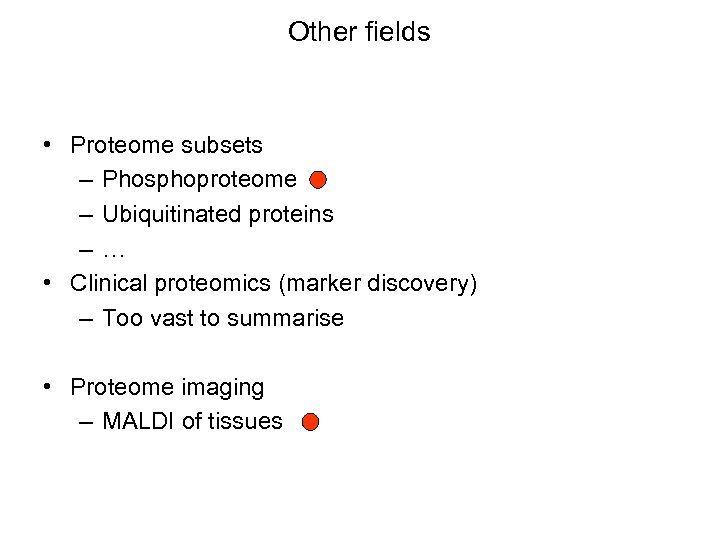 Other fields • Proteome subsets – Phosphoproteome – Ubiquitinated proteins –… • Clinical proteomics (marker discovery) – Too vast to summarise • Proteome imaging – MALDI of tissues