


 Скачать презентацию P S MURTY VICE PRESIDENT THE INSTITUTE OF
c452d53964c814c6f73e27246f11037b.ppt
- Количество слайдов: 44
 P. S. MURTY VICE PRESIDENT THE INSTITUTE OF MARINE ENGINEERS(INDIA) & CMD, PSM GROUP OF COMPANIES 1
 TOPICS • Phasing out of Single Hull Tankers • Condition Assessment Scheme • Changes to MARPOL 73/78, Annex I Regulation 13 G & 13 H (New Regulation 20) 2
 13 G and 13 H • Regulation 13 G as amended, accelerates the phasing out of Single Hull tankers. • Regulation 13 H restricts the carriage of Heavy Grade Oil by Single Hull Tankers. 3
 WHY PHASE OUT SINGLE HULL TANKERS • • WHAT PROMPTED THE CONCEPT HOW THIS WILL ASSIST THE MOTIVE DEBATES AT IMO CONCERN OF THE DEVELOPING NATIONS • PRESSURE ON SHIPYARDS/NEW BUILDINGS 4
 MARINE ACCIDENTS 5
 EXXON VALDEZ • Shortly after leaving the Port of Valdez, On March 24, 1989, the Exxon Valdez ran aground on Bligh Reef. • The Exxon Valdez grounded on Bligh Reef, and spilled nearly 11 million gallons of oil into the biologically rich waters of Prince William Sound, Alaska, USA. 6
 The Braer - The Grounding • At 05. 19 hrs on Tuesday the 5 th January 1993, Lerwick coastguard (Scotland) was advised that the tanker Braer, en route from Mongstad in Norway to Quebec in Canada, laden with 84, 700 tonnes of Norwegian Gulfaks crude oil, had lost engine power, has run aground off Shetland Islands, UK and oil is leaking, It is the 11 th largest oil spill recorded double then Exxon Valdez. 7
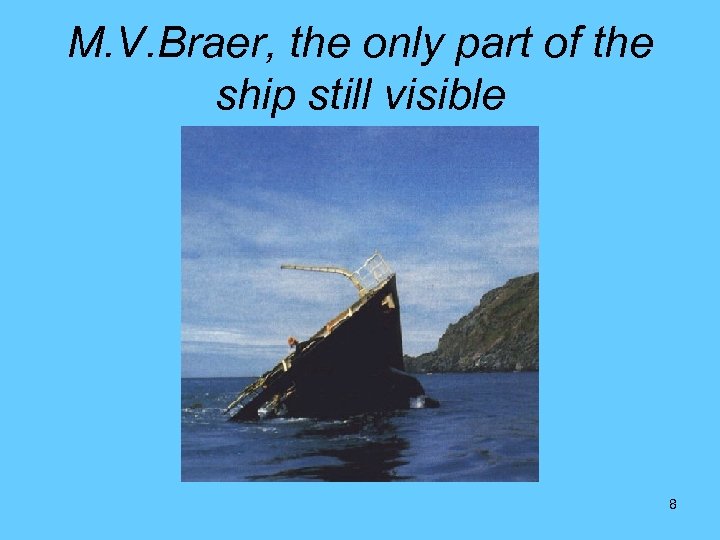 M. V. Braer, the only part of the ship still visible 8
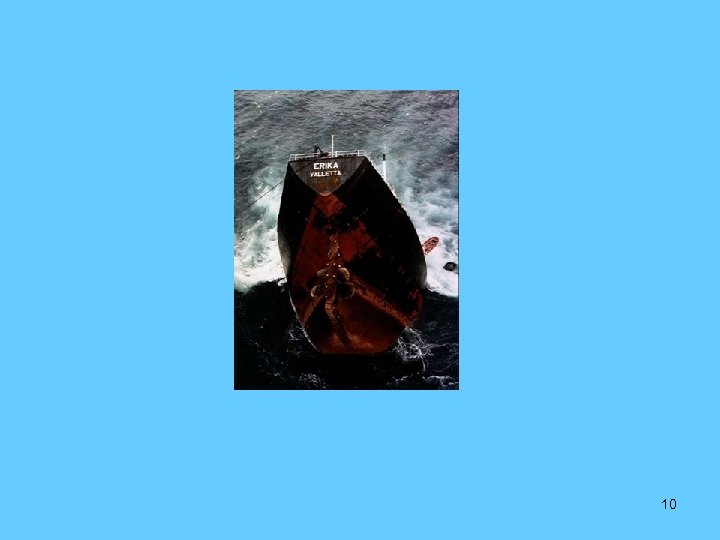
 Erika The Erika was a 24 year old, single hulled, badly maintained ship that sailed under the Maltese flag. On the 12 th of December 1999, this ship ran into trouble in a heavy storm 70 kilometers off the coast of Bretagne, France. The ship broke in half and sank to the bottom of the sea. Of the 30, 000 tons of heavy furnace oil it carried, 14, 000 tons spilled into the sea. The remaining oil in the wreck is steadily leaking out. Hundreds of thousands of birds died and the coast was smeared with oil over a length of 400 kilometers. 9
 10
10
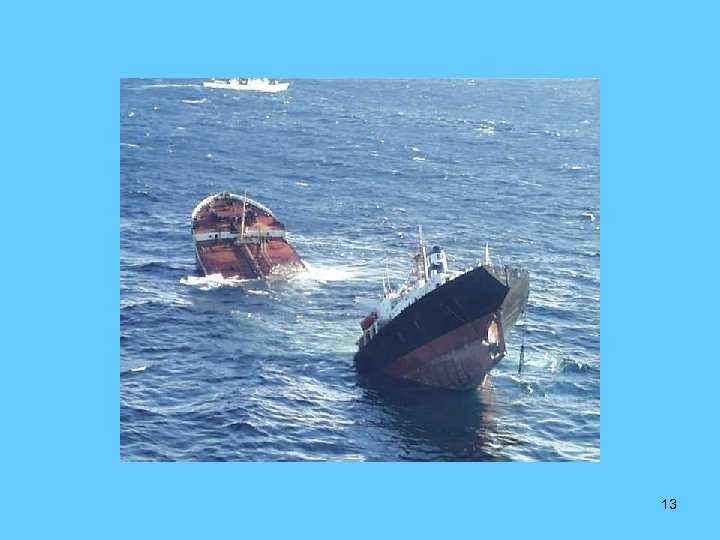
 Prestige disaster • During stormy weather on Wednesday 13 th November 2002 the Greek-owned Prestige suffered a 50 metre gash in the right side of the hull. • On the 19 th of November the tanker "Prestige" broke in two, after six agonizing days since Wednesday, the 13 th, when the ship sent the SOS signal at a few miles off the Galician coast, north western corner of the Iberian Peninsula. The tanker, carrying some 77, 000 tonnes of oil, sunk to the depth of 3, 600 meters some 250 km off the Spanish coast, with a large quantity of oil still on board. Vessel is said to have spilled oil in excess of 5, 000 tonnes. 11
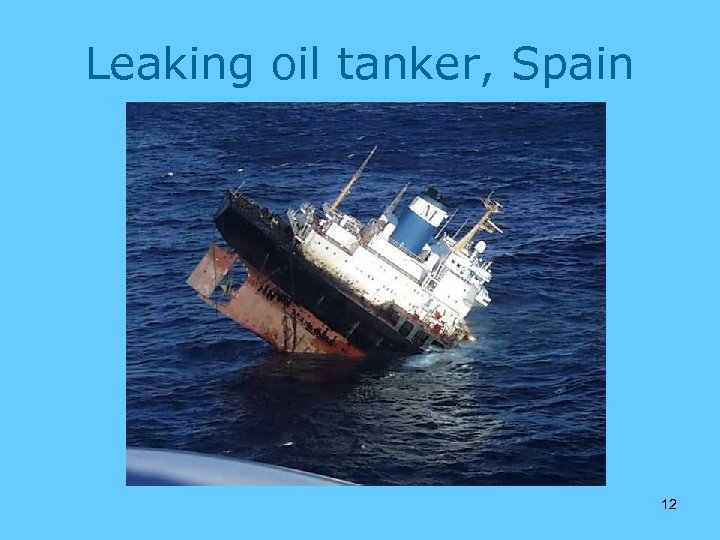 Leaking oil tanker, Spain 12
 13
13
 ATHOS I DELAWARE RIVER SPILLAGE • 26 TH November 2004 a major oil spill occurred on the Delaware River near Philadelphia. • ATHOS I, a 750 feet Greek tanker enroute to Citago, New Jersey while being moved for berthing at Pier, rode over a huge 15 foot curved piece of pipe damaging the hull. • Nearly 6000 tons of Heavy Crude Oil found way into the sea damaging marine life and the sea shores. 14 • Incident is still under investigation.
 MARPOL 73/78 • The International Convention for the Pollution from Ships 1973, was adopted by IMO in 1973. • This convention was subsequently modified by the protocol of 1978. • In short above are called “MARPOL 73/78” 15
 MARPOL ANNEX-I • Chapter I-General-Covers regulation 1 to 8 A • Chapter II-Requirement for control of operational pollution: Regulations 9 to 12, 13 A to 13 H and 14 to 21 • Chapter III- Requirement for minimizing oil pollution from oil tankers due to side and bottom damages. Regulation 22 to 25 A. • Chapter IV- Prevention of pollution arising from an oil pollution incident. -Regulation 26 –Shipboard pollution emergency plans. 16
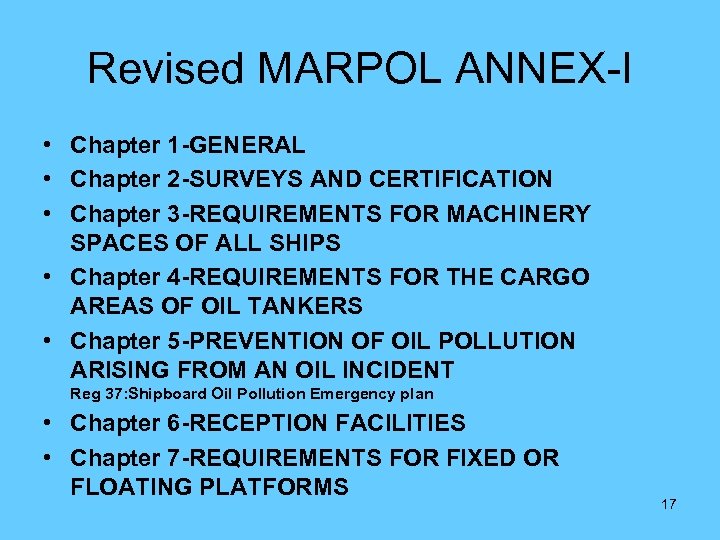 Revised MARPOL ANNEX-I • Chapter 1 -GENERAL • Chapter 2 -SURVEYS AND CERTIFICATION • Chapter 3 -REQUIREMENTS FOR MACHINERY SPACES OF ALL SHIPS • Chapter 4 -REQUIREMENTS FOR THE CARGO AREAS OF OIL TANKERS • Chapter 5 -PREVENTION OF OIL POLLUTION ARISING FROM AN OIL INCIDENT Reg 37: Shipboard Oil Pollution Emergency plan • Chapter 6 -RECEPTION FACILITIES • Chapter 7 -REQUIREMENTS FOR FIXED OR FLOATING PLATFORMS 17
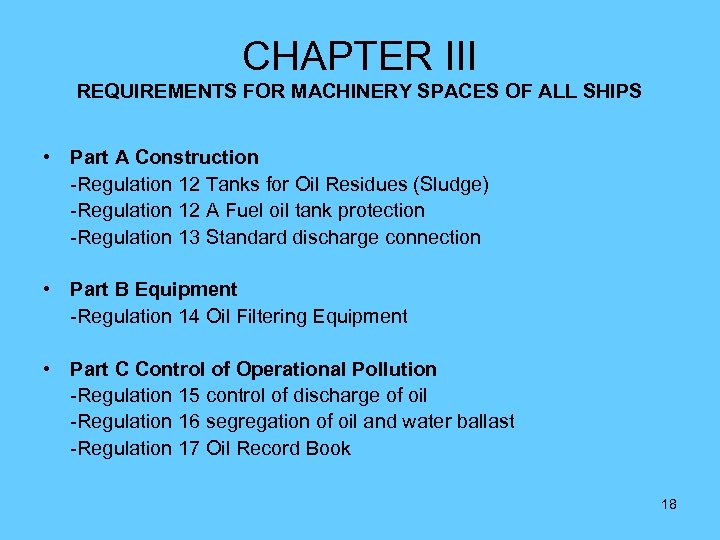 CHAPTER III REQUIREMENTS FOR MACHINERY SPACES OF ALL SHIPS • Part A Construction -Regulation 12 Tanks for Oil Residues (Sludge) -Regulation 12 A Fuel oil tank protection -Regulation 13 Standard discharge connection • Part B Equipment -Regulation 14 Oil Filtering Equipment • Part C Control of Operational Pollution -Regulation 15 control of discharge of oil -Regulation 16 segregation of oil and water ballast -Regulation 17 Oil Record Book 18
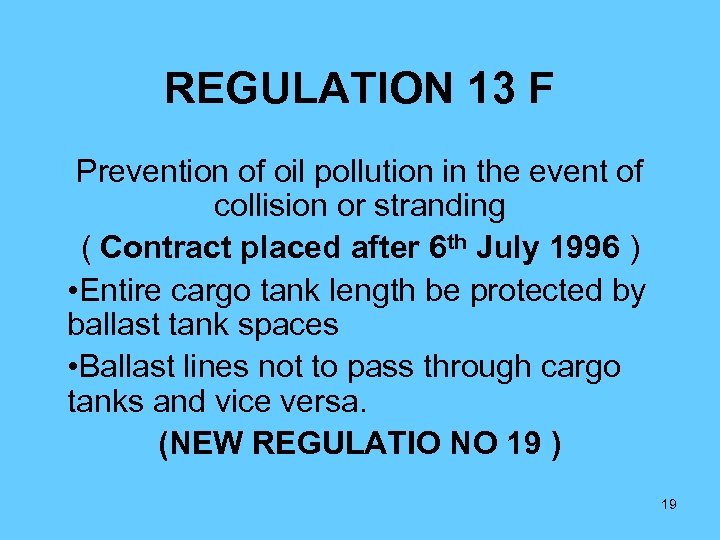 REGULATION 13 F Prevention of oil pollution in the event of collision or stranding ( Contract placed after 6 th July 1996 ) • Entire cargo tank length be protected by ballast tank spaces • Ballast lines not to pass through cargo tanks and vice versa. (NEW REGULATIO NO 19 ) 19
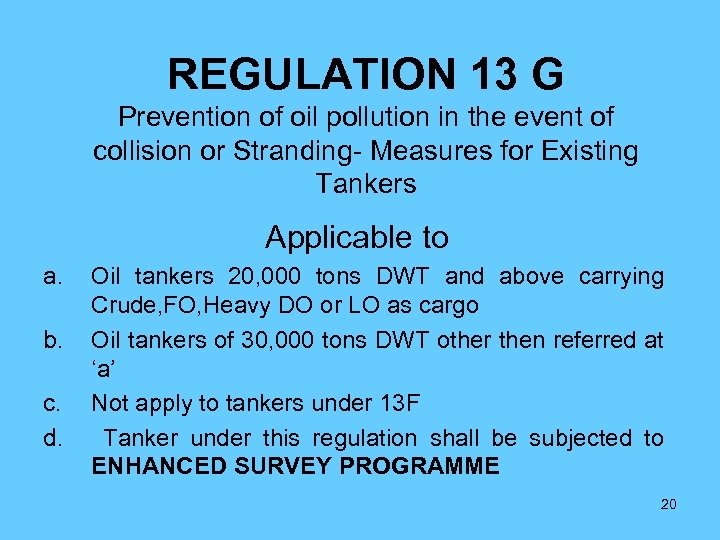 REGULATION 13 G Prevention of oil pollution in the event of collision or Stranding- Measures for Existing Tankers Applicable to a. b. c. d. Oil tankers 20, 000 tons DWT and above carrying Crude, FO, Heavy DO or LO as cargo Oil tankers of 30, 000 tons DWT other then referred at ‘a’ Not apply to tankers under 13 F Tanker under this regulation shall be subjected to ENHANCED SURVEY PROGRAMME 20
 First Proposal • Sinking of ERIKA in 1999 led to direct amendment of Reg I/13 G to phasing out of most single hull tankers of 5000 DWT and above by 2015. • Decision was governed by the fact that Double Hull tankers were made mandatory for all new buildings since 1996. 21
 Accelerated Phasing Out • Sinking of PRESTIGE in 2002 led to further amendment to Reg I/13 G to ensure accelerated phasing out of single hull tankers and introduction of a new Marpol Reg I/13 H. • Over 2200 single hull tankers of over 5000 DWT adding up to over 170 million DWT would be phased out between years 2003 -2010. 22
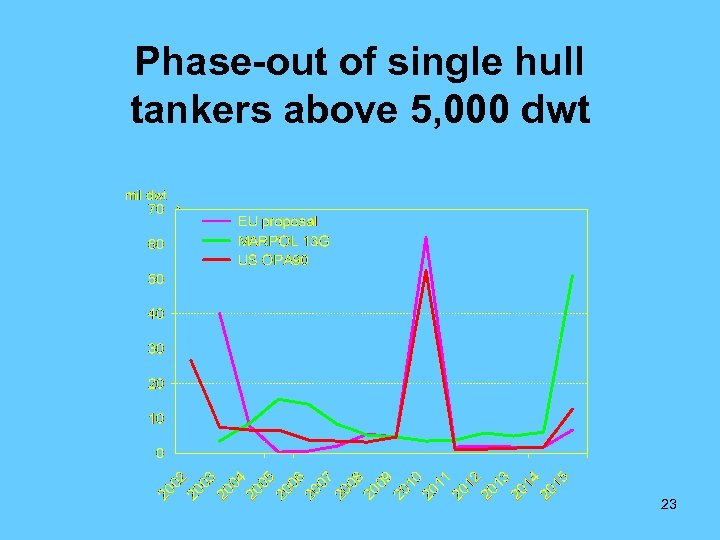 Phase-out of single hull tankers above 5, 000 dwt 23
 24
24
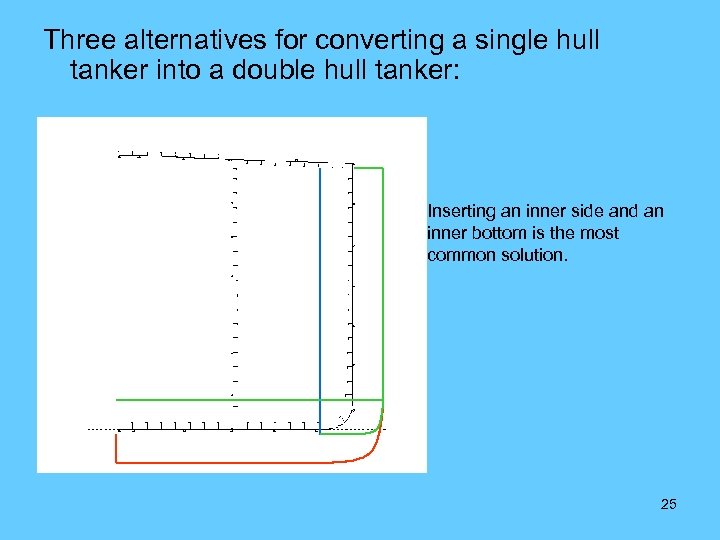 Three alternatives for converting a single hull tanker into a double hull tanker: Inserting an inner side and an inner bottom is the most common solution. 25
 PROTECTION OF FUEL TANKS MARPOL Revised Annex I Reg. 12 A • A maximum capacity limit of 2500 m 3 per fuel oil tank introduced in the regulation • Not applicable to fuel oil tanks below 30 m 3 • Excludes tanks which normally do not carry F. Oil • FOR NEW VESSELS these reg. enters into force: -1 st August 2007 -Contract date -If no contract date-Keel laid after 1 st Feb 2008 -Delivery after 1 st August 2010 • Applicable to new ships and major conversions with fuel capacity of 600 m 3 • Minimum h=0. 76 m. h=B/20 m or h=2. 0 m whichever is less 26
 TANKER CATEGORIES • Category I (Pre Marpol) Tankers: Are 20000 DWT and above carrying Crude, FO, Heavy DO or LO as cargo and 30000 DWT and above carrying other oil which do not comply with the requirement of SBT & PL. • Category II Oil Tankers: Means tankers of 20000 DWT and above carrying Crude, FO, Heavy DO or LO as cargo and 30000 DWT and above carrying other oil which DO comply with the requirement of SBT & PL. ( Marpol Tankers) • Category III Oil Tankers: Means an oil tanker of 5000 DWT and above but less than the tonnage specified for category I & II. 27
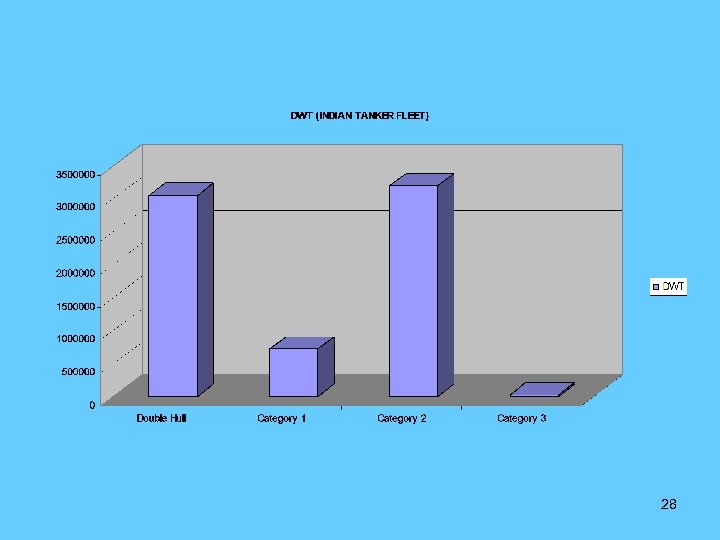 28
28
 MEPC The Marine Environment Protection Committee was formed in 1974 and reviews various provisions of MARPOL 73/78 29
 Marine Environment Protection Committee 49 th session: 14 -18 July 2003 Single-hull tankers proposals to amend MARPOL 73/78 30
 Marine Environment Protection Committee (MEPC), 50 th session: 1 and 4 December 2003 IMO meeting adopts accelerated single-hull tanker phase-out, new regulation on carriage of heavy fuel oil (TACIT APPROVAL) 31
 52 nd MEPC- Revised MARPOL Annex I • Revised MARPOL annex I adopted and to enter into force on 1 st January 2007. • Incorporates various amendments including amended 13 G to Reg 20, Reg 13 H to Reg 21. • It separates in different chapters, the construction & equipment provisions from operational requirement with clear distinction between requirement for New ships and those for Existing. • Revision is more USER FRIENDLY and is simplified 32
 CARRIAGE OF HEAVY GRADE OIL Regulation 13 H (New regulation 21) A new MARPOL regulation on the prevention of pollution from oil tankers when carrying Heavy Grade Oil (HGO) bans the carriage of HGO in single hull tankers of 5, 000 tons DWT and above after the entry of the regulation (5 th April 2005), and in single hull oil tankers of 600 DWT and above but less than 5, 000 DWT , not later than the anniversary of their delivery date in 2008. 33
 Carriage of heavy grade oil Under the new regulation, HGO means any of the following: a) crude oils having a density at 15ºC higher than 900 kg/m 3; b) fuel oils having either a density at 15ºC higher than 900 kg/ m 3 or a kinematic viscosity at 50ºC higher than 180 mm 2 /s; c) bitumen, tar and their emulsions. 34
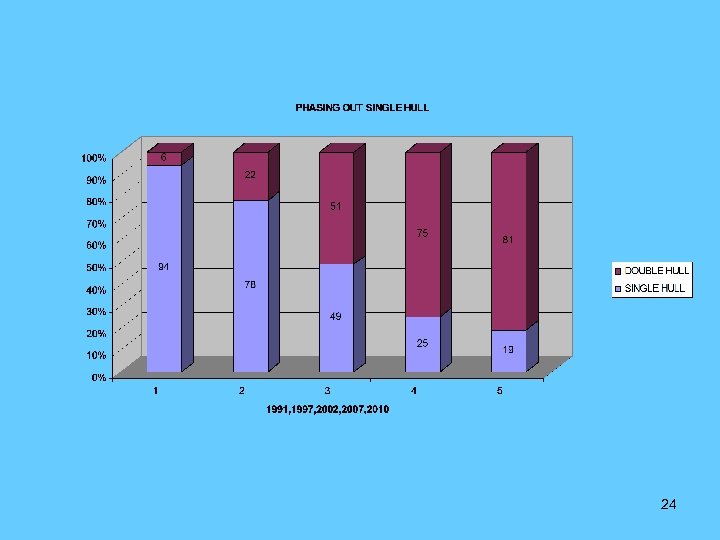
 Accelerated phase-out for singlehull tankers (5 oth. MEPC, December 2003) Under a revised regulation 13 G of Annex I of MARPOL, the final phasing-out date for Category 1 tankers (pre-MARPOL tankers) is brought forward to 2005, from 2007. The final phasing-out date for category 2 and 3 tankers (MARPOL tankers and smaller tankers) is brought forward to 2010, from 2015. Regulation 13 H introduced. 35
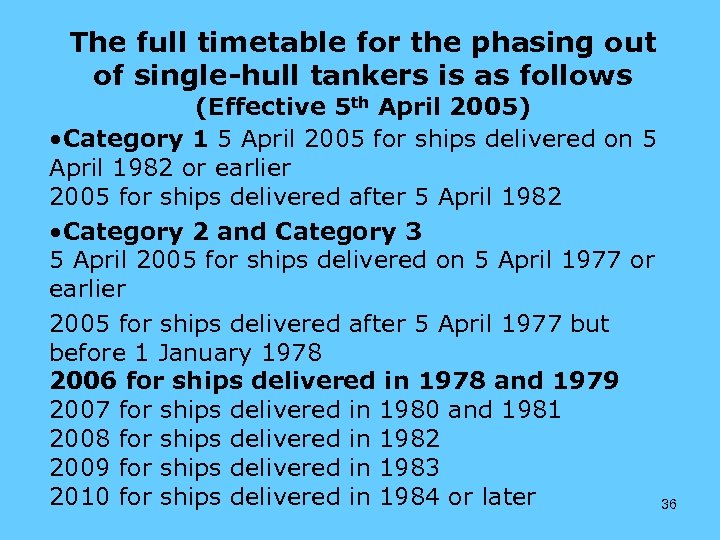 The full timetable for the phasing out of single-hull tankers is as follows (Effective 5 th April 2005) • Category 1 5 April 2005 for ships delivered on 5 April 1982 or earlier 2005 for ships delivered after 5 April 1982 • Category 2 and Category 3 5 April 2005 for ships delivered on 5 April 1977 or earlier 2005 for ships delivered after 5 April 1977 but before 1 January 1978 2006 for ships delivered in 1978 and 1979 2007 for ships delivered in 1980 and 1981 2008 for ships delivered in 1982 2009 for ships delivered in 1983 2010 for ships delivered in 1984 or later 36
 ANNIVERSARY DATE Consider the Phase out Table A tanker delivered i. e. in December 1978 will be phased out in December 2006, while a tanker delivered in January 1979 will be phased out in January 2006, ELEVEN months earlier than the relatively older tanker. 37
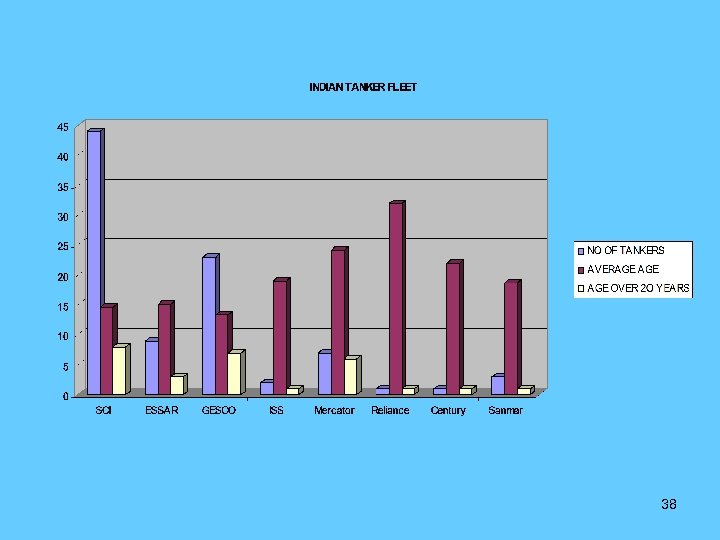 38
38
 PROTECTION OF FUEL TANKS MARPOL Revised Annex I Reg. 12 A • A maximum capacity limit of 2500 m 3 per fuel oil tank introduced in the regulation • Not applicable to fuel oil tanks below 30 m 3 • Excludes tanks which normally do not carry F. Oil • FOR NEW VESSELS these reg. enters into force: -1 st August 2007 -Contract date -If no contract date-Keel laid after 1 st Feb 2008 -Delivery after 1 st August 2010 • Applicable to new ships and major conversions with fuel capacity of 600 m 3 • Minimum h=0. 76 m. h=B/20 m or h=2. 0 m whichever is less 39
 Answers to typical questions • Conversion of single hull tankers to double hull is normally not regarded as a major conversion. The flag state is consulted from project to project. • Date of construction will not be changed after conversion • After conversion to double hull the phase out date of the vessel will not longer be relevant • The Stillwater bending moment and shear force limits are assumed unchanged. If the limits are increased the longitudinal strength must be reassessed 40
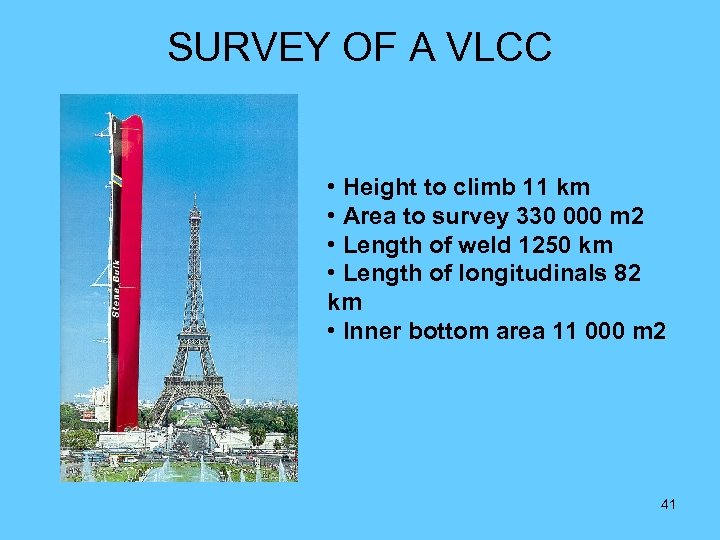 SURVEY OF A VLCC • • Height to climb 11 km • Area to survey 330 000 m 2 • Length of weld 1250 km • Length of longitudinals 82 km • Inner bottom area 11 000 m 2 41
 IS DOUBLE HULL THE ANSWER MAJOR CAUSES OF OIL SPILLS ARE * Machinery Failure * Human & Navigational Error * Fire and Explosion * Hull Damage 42
 DOUBLE HULL WILL REDUCE LIKELIHOOD OF OIL SPILLAGE ONLY IF • Double hull tankers are maintained to a higher standard than is apparent in some ships today. • Operated by personnel who are well trained and committed to their jobs. • Vessels are designed and built to high standards. 43
 THANKS 44