 Скачать презентацию P Bradshaw Skill Group Leader Airbus Future Projects
b59646f4f570bfc17f1c3976165d23ca.ppt
- Количество слайдов: 85



P Bradshaw Skill Group Leader Airbus Future Projects Low Fare Airline – Design Project 2006 -2007 University of Southampton 3 rd November 2006 EDXCW/PR/PB/20808 A
Design Project Aim Enable design teams: • To bring together knowledge of individual engineering disciplines into a complete aircraft project • To combine ‘conceptual design’ with some more focussed engineering. © AIRBUS S. All rights reserved. Confidential and proprietary document. • To work efficiently in teams – Compete with other teams, not each other • Develop process of working, managing and controlling the Project Design for an aircraft. EDXCW/PR/PB/20808 A
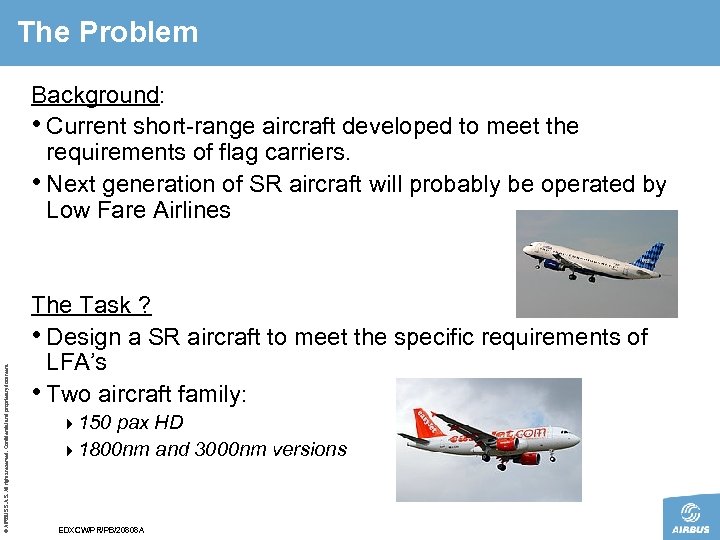
The Problem © AIRBUS S. All rights reserved. Confidential and proprietary document. Background: • Current short-range aircraft developed to meet the requirements of flag carriers. • Next generation of SR aircraft will probably be operated by Low Fare Airlines The Task ? • Design a SR aircraft to meet the specific requirements of LFA’s • Two aircraft family: 4150 pax HD 41800 nm and 3000 nm versions EDXCW/PR/PB/20808 A
Objective • Each team is to propose a short-range aircraft primarily designed for Low Fare Airlines. • EIS 2015 © AIRBUS S. All rights reserved. Confidential and proprietary document. • Generate initial technical specification to support a possible launch decision. Based on current and emerging technology and materials Novel configurations are not excluded Realistic approach to technology and risk EDXCW/PR/PB/20808 A
Design Targets • • Performance (P, R, Mcr, TOFL, TAT) Manufacturing and Assembly considerations ? Reliability and Maintenance Cost 4 To Manufacturer – Non-Recurring Cost – Recurring Cost 4 To - NRC - RC Customer – Operating Cost (direct and indirect) – Life Cycle Costs • Timescale and Development 4 Manufacturing Cycle Time – Build rate ? © AIRBUS S. All rights reserved. Confidential and proprietary document. 4 Design • Marketability: • 4 What appeals ? Business Case: 4 IRR vs Investment 4 Expected MSN to break even ? EDXCW/PR/PB/20808 A
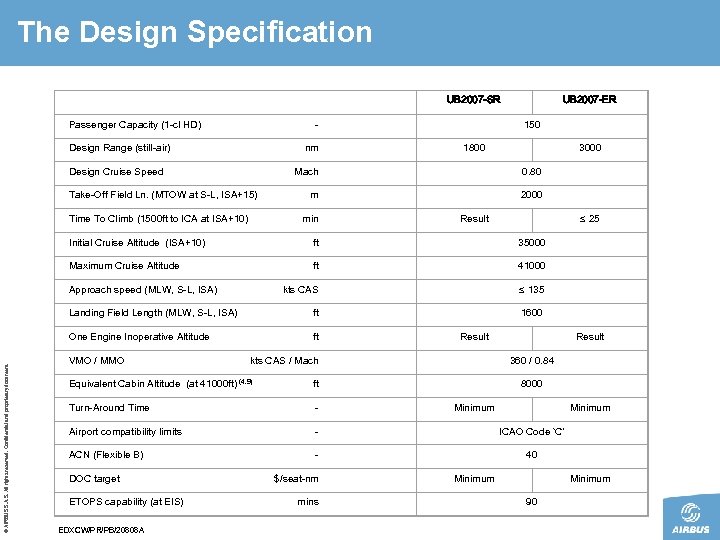
The Design Specification UB 2007 -SR Passenger Capacity (1 -cl HD) - Design Range (still-air) nm Design Cruise Speed UB 2007 -ER 150 1800 3000 Mach Take-Off Field Ln. (MTOW at S-L, ISA+15) Time To Climb (1500 ft to ICA at ISA+10) 0. 80 m 2000 min Result 25 Initial Cruise Altitude (ISA+10) ft 35000 Maximum Cruise Altitude ft 41000 kts CAS 135 Landing Field Length (MLW, S-L, ISA) ft 1600 One Engine Inoperative Altitude ft © AIRBUS S. All rights reserved. Confidential and proprietary document. Approach speed (MLW, S-L, ISA) VMO / MMO Result kts CAS / Mach Result 360 / 0. 84 Equivalent Cabin Altitude (at 41000 ft) (4. 9) ft Turn-Around Time - Airport compatibility limits - ICAO Code ‘C’ ACN (Flexible B) - 40 DOC target ETOPS capability (at EIS) EDXCW/PR/PB/20808 A $/seat-nm mins 8000 Minimum 90
What are Customers’ Needs ? • Future concept selection will be chosen to fulfill the requirements to be met………… 4 Range 4 Payload 4 Noise 4 Safety 4 Operating cost – (Profit for airlines !) 4 Manufacturing Cost (Profit for us !) © AIRBUS S. All rights reserved. Confidential and proprietary document. 4 Cheap to maintain (DMC) 4 Reliable etc etc (OI, MMEL) • That means understanding the options available to us, and the challenges ahead – does the latter infer that particular technologies have to be used, whether we like it or not ? ? EDXCW/PR/PB/20808 A
Method of Working • Initially you will be ‘swamped’ with information - don’t panic. • Things will get clearer as all topics are delivered and you will see how they fit together. THEN: 1. Organise yourselves: • Everyone cannot do everything, so allocate responsibilities • Ensure everyone knows their roles and tasks (and is fully aware of the roles and tasks of others) – focus on problems early – support eachother. © AIRBUS S. All rights reserved. Confidential and proprietary document. 2. Plan your project: • Identify major deliverables (internal / external), dates and owners • Identify activities with realistic timescales • Keep the plan current & feasible. • Ensure everone agrees & aims to adhere to it 3. Communicate • Share information early – decide what’s improtant/ what isn’t • Single failure=Collective failure EDXCW/PR/PB/20808 A
General Tips – Some Do’s and Don’ts • Understand the question: 4 Differentiate between the “hard” and “soft” requirements 4 Identify key drivers 4 Assess the ‘cost’ of each requirement 4 Challenge if appropriate - • Understand the importance of a design decision – Ensure © AIRBUS S. All rights reserved. Confidential and proprietary document. technical evidence justifies it. • Ensure design solutions are driven by the requirements • Be realistic in your assessment of risk – Wild arsed guesses may kill your product. EDXCW/PR/PB/20808 A
General Tips – Some Do’s and Don’ts • If you go for an unconventional design, always assess against an equivalent conventional design. • Only include technology if it buys it’s way onto your aircraft. • Focus on the engineering – The marketeers will do the © AIRBUS S. All rights reserved. Confidential and proprietary document. marketing (…. . and understand the difference between the two) • Always be aware of the regulations and ensure your design meets them (eg minimum ROC margin @ top of climb, Vapp rules in terms of Vst. . ). EDXCW/PR/PB/20808 A
General Tips – Some Do’s and Don’ts Always reference your design against a known solution 4 Sanity check 4 Calibration • Gain a feel for the configurational influences and exchange rates. © AIRBUS S. All rights reserved. Confidential and proprietary document. • Don’t squeeze the last drop from your design – you’ll regret it later on ! EDXCW/PR/PB/20808 A
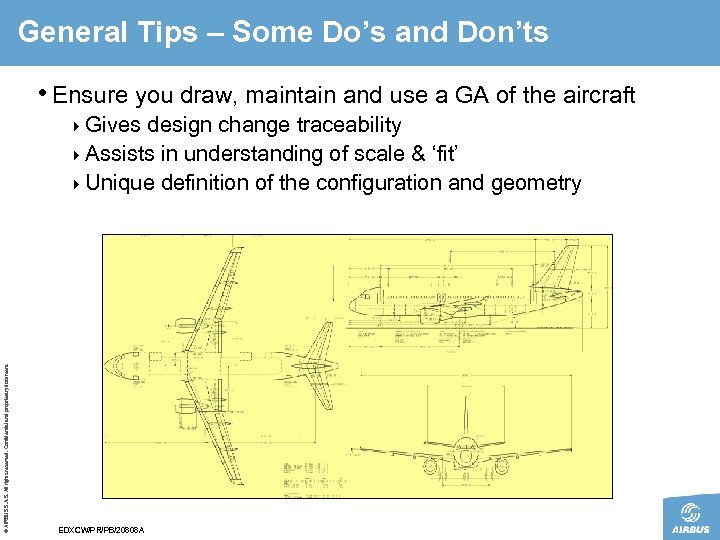
General Tips – Some Do’s and Don’ts • Ensure you draw, maintain and use a GA of the aircraft design change traceability 4 Assists in understanding of scale & ‘fit’ 4 Unique definition of the configuration and geometry © AIRBUS S. All rights reserved. Confidential and proprietary document. 4 Gives EDXCW/PR/PB/20808 A
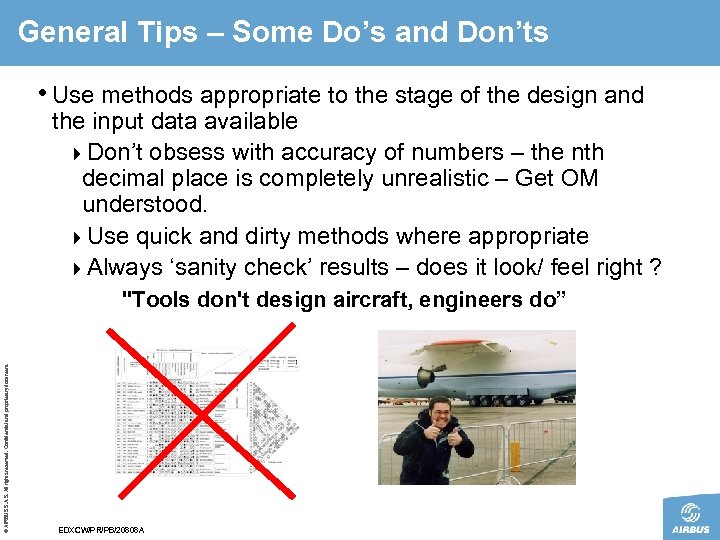
General Tips – Some Do’s and Don’ts • Use methods appropriate to the stage of the design and the input data available 4 Don’t obsess with accuracy of numbers – the nth decimal place is completely unrealistic – Get OM understood. 4 Use quick and dirty methods where appropriate 4 Always ‘sanity check’ results – does it look/ feel right ? © AIRBUS S. All rights reserved. Confidential and proprietary document. "Tools don't design aircraft, engineers do” EDXCW/PR/PB/20808 A
Presentation of Results • Ensure content, style and level of detail are appropriate. • Clearly describe the main features of the aircraft and its components. • Justify all design decisions made. • Demonstrate the multidisciplinary balance and integration of your design. • Describe the process by which you approached the design. • Demonstrate: © AIRBUS S. All rights reserved. Confidential and proprietary document. 4 Good team working 4 Good project management 4 Good control of the project design • Make your points as clearly as you can – peer review your chapters before submission. EDXCW/PR/PB/20808 A
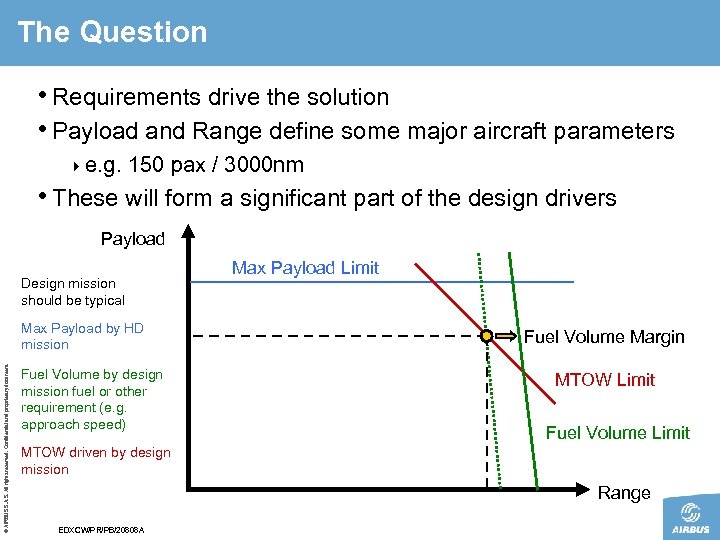
The Question • Requirements drive the solution • Payload and Range define some major aircraft parameters 4 e. g. 150 pax / 3000 nm • These will form a significant part of the design drivers Payload Design mission should be typical © AIRBUS S. All rights reserved. Confidential and proprietary document. Max Payload by HD mission Fuel Volume by design mission fuel or other requirement (e. g. approach speed) Max Payload Limit Fuel Volume Margin MTOW Limit Fuel Volume Limit MTOW driven by design mission Range EDXCW/PR/PB/20808 A
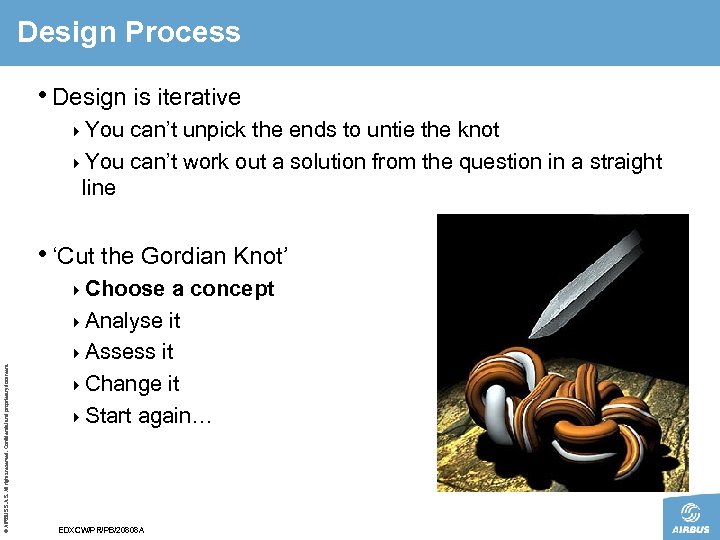
Design Process • Design is iterative 4 You can’t unpick the ends to untie the knot 4 You can’t work out a solution from the question in a straight line • ‘Cut the Gordian Knot’ © AIRBUS S. All rights reserved. Confidential and proprietary document. 4 Choose a concept 4 Analyse it 4 Assess it 4 Change it 4 Start again… EDXCW/PR/PB/20808 A
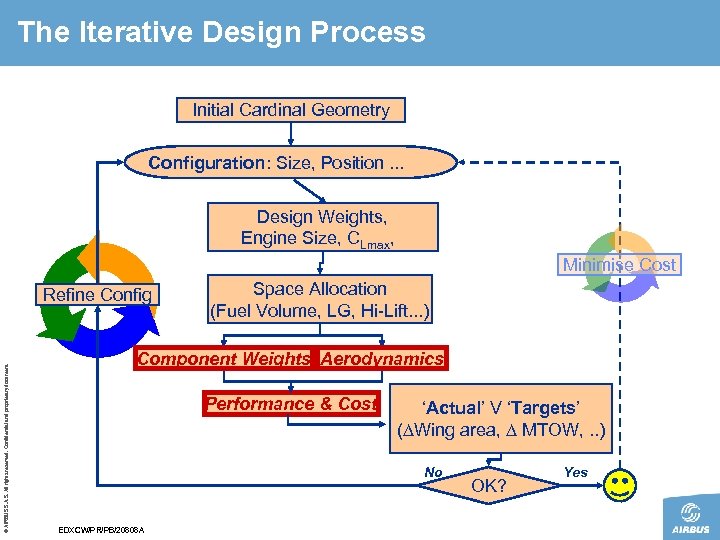
The Iterative Design Process Initial Cardinal Geometry Configuration: Size, Position. . . Design Weights, Engine Size, CLmax, Minimise Cost © AIRBUS S. All rights reserved. Confidential and proprietary document. Refine Config Space Allocation (Fuel Volume, LG, Hi-Lift. . . ) Component Weights Aerodynamics Performance & Cost ‘Actual’ V ‘Targets’ ( Wing area, MTOW, . . ) No EDXCW/PR/PB/20808 A OK? Yes
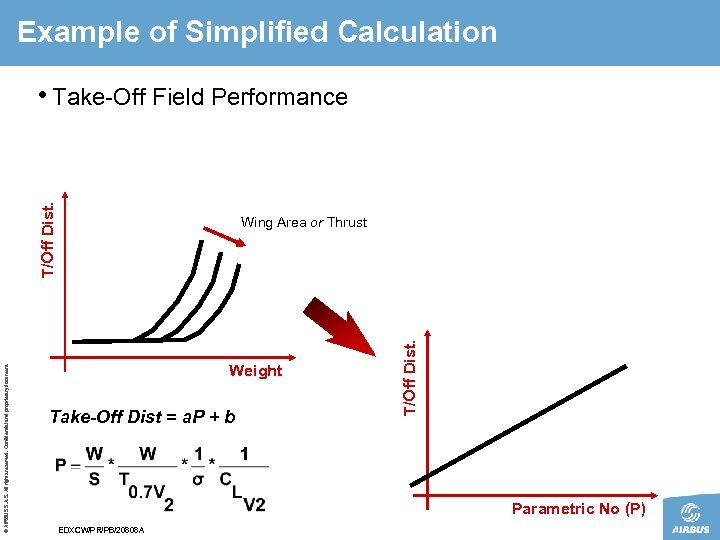
Example of Simplified Calculation Wing Area or Thrust Weight Take-Off Dist = a. P + b T/Off Dist. © AIRBUS S. All rights reserved. Confidential and proprietary document. T/Off Dist. • Take-Off Field Performance Parametric No (P) EDXCW/PR/PB/20808 A
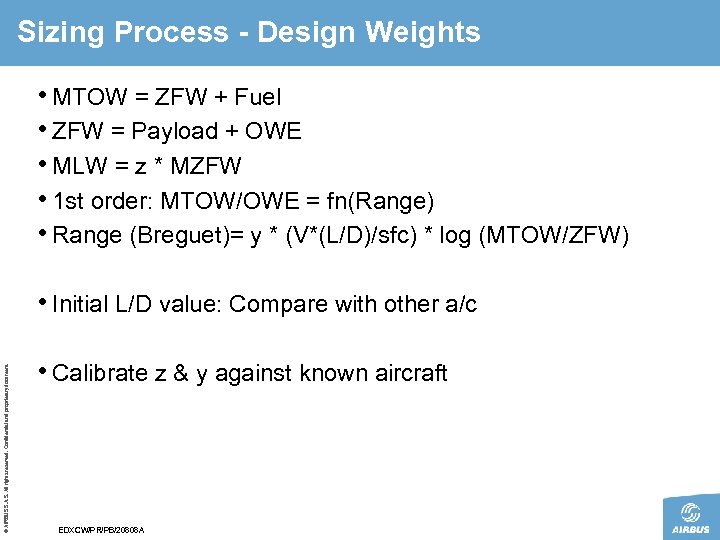
Sizing Process - Design Weights • MTOW = ZFW + Fuel • ZFW = Payload + OWE • MLW = z * MZFW • 1 st order: MTOW/OWE = fn(Range) • Range (Breguet)= y * (V*(L/D)/sfc) * log (MTOW/ZFW) © AIRBUS S. All rights reserved. Confidential and proprietary document. • Initial L/D value: Compare with other a/c • Calibrate z & y against known aircraft EDXCW/PR/PB/20808 A
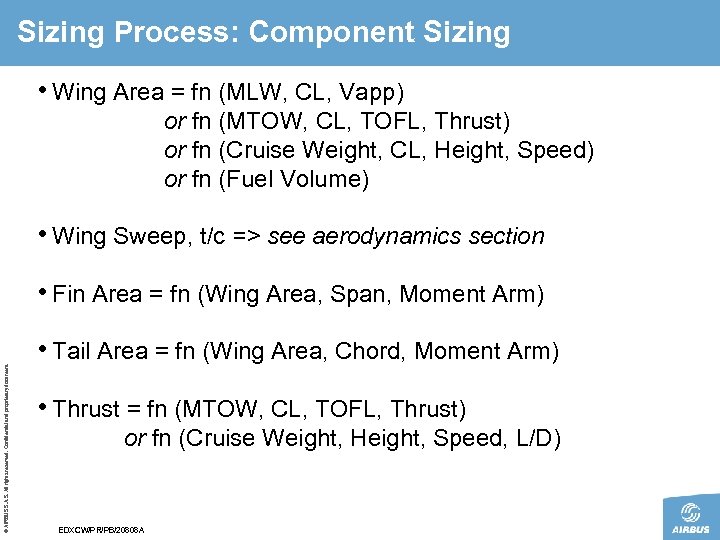
Sizing Process: Component Sizing • Wing Area = fn (MLW, CL, Vapp) or fn (MTOW, CL, TOFL, Thrust) or fn (Cruise Weight, CL, Height, Speed) or fn (Fuel Volume) • Wing Sweep, t/c => see aerodynamics section © AIRBUS S. All rights reserved. Confidential and proprietary document. • Fin Area = fn (Wing Area, Span, Moment Arm) • Tail Area = fn (Wing Area, Chord, Moment Arm) • Thrust = fn (MTOW, CL, TOFL, Thrust) or fn (Cruise Weight, Height, Speed, L/D) EDXCW/PR/PB/20808 A
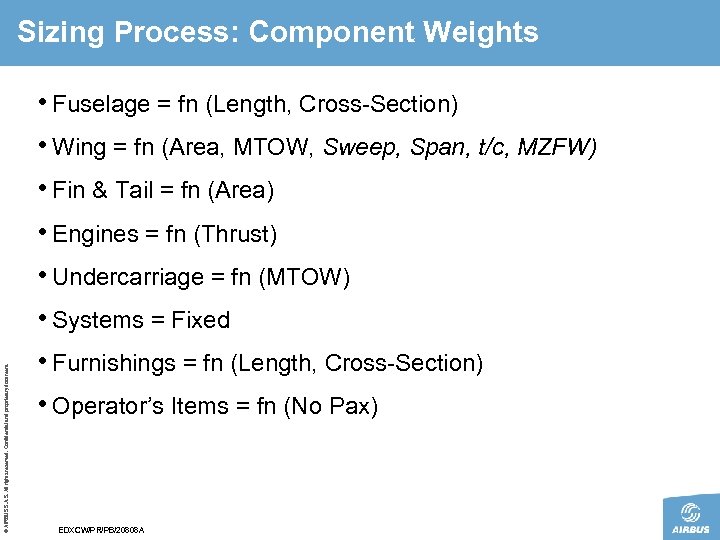
© AIRBUS S. All rights reserved. Confidential and proprietary document. Sizing Process: Component Weights • Fuselage = fn (Length, Cross-Section) • Wing = fn (Area, MTOW, Sweep, Span, t/c, MZFW) • Fin & Tail = fn (Area) • Engines = fn (Thrust) • Undercarriage = fn (MTOW) • Systems = Fixed • Furnishings = fn (Length, Cross-Section) • Operator’s Items = fn (No Pax) EDXCW/PR/PB/20808 A
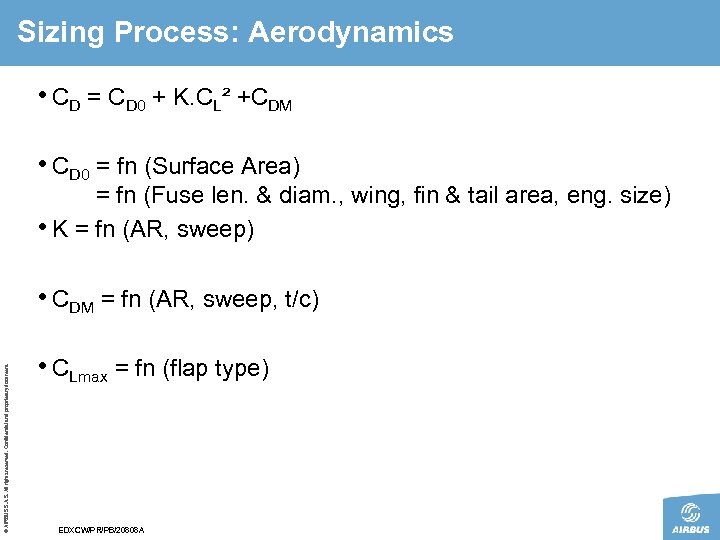
Sizing Process: Aerodynamics • CD = CD 0 + K. CL² +CDM • CD 0 = fn (Surface Area) = fn (Fuse len. & diam. , wing, fin & tail area, eng. size) • K = fn (AR, sweep) © AIRBUS S. All rights reserved. Confidential and proprietary document. • CDM = fn (AR, sweep, t/c) • CLmax = fn (flap type) EDXCW/PR/PB/20808 A
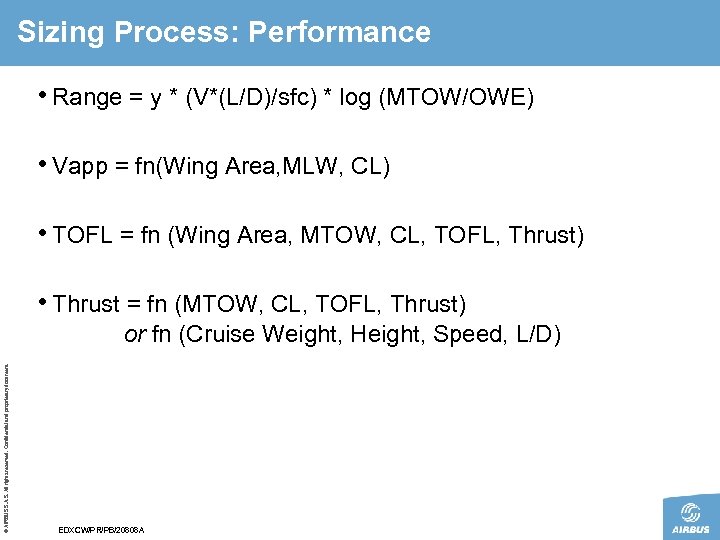
Sizing Process: Performance • Range = y * (V*(L/D)/sfc) * log (MTOW/OWE) • Vapp = fn(Wing Area, MLW, CL) • TOFL = fn (Wing Area, MTOW, CL, TOFL, Thrust) • Thrust = fn (MTOW, CL, TOFL, Thrust) © AIRBUS S. All rights reserved. Confidential and proprietary document. or fn (Cruise Weight, Height, Speed, L/D) EDXCW/PR/PB/20808 A
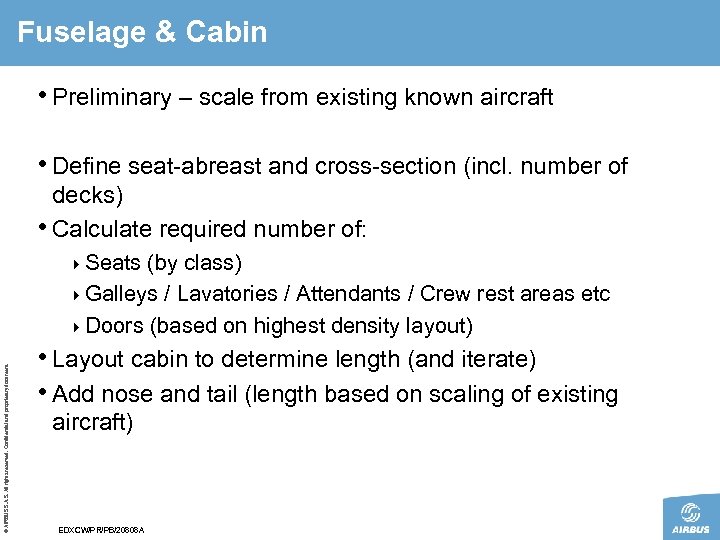
Fuselage & Cabin • Preliminary – scale from existing known aircraft • Define seat-abreast and cross-section (incl. number of decks) • Calculate required number of: (by class) 4 Galleys / Lavatories / Attendants / Crew rest areas etc 4 Doors (based on highest density layout) © AIRBUS S. All rights reserved. Confidential and proprietary document. 4 Seats • Layout cabin to determine length (and iterate) • Add nose and tail (length based on scaling of existing aircraft) EDXCW/PR/PB/20808 A
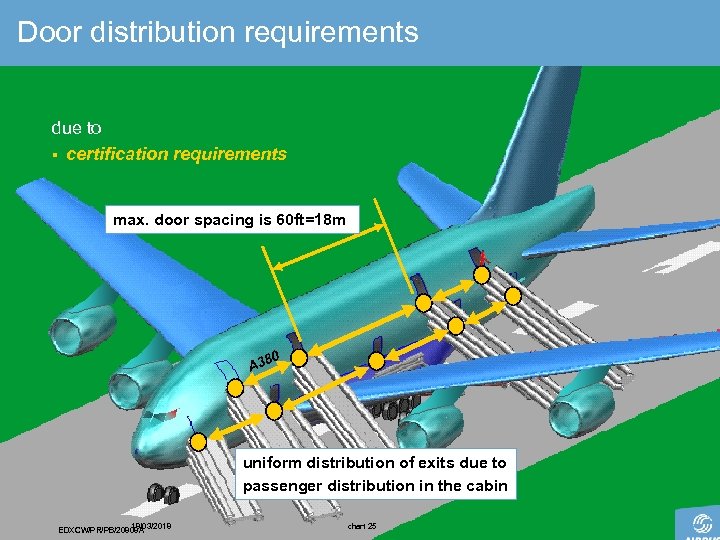
Door distribution requirements due to § certification requirements © AIRBUS S. All rights reserved. Confidential and proprietary document. max. door spacing is 60 ft=18 m 0 A 38 uniform distribution of exits due to passenger distribution in the cabin 18/03/2018 EDXCW/PR/PB/20808 A chart 25
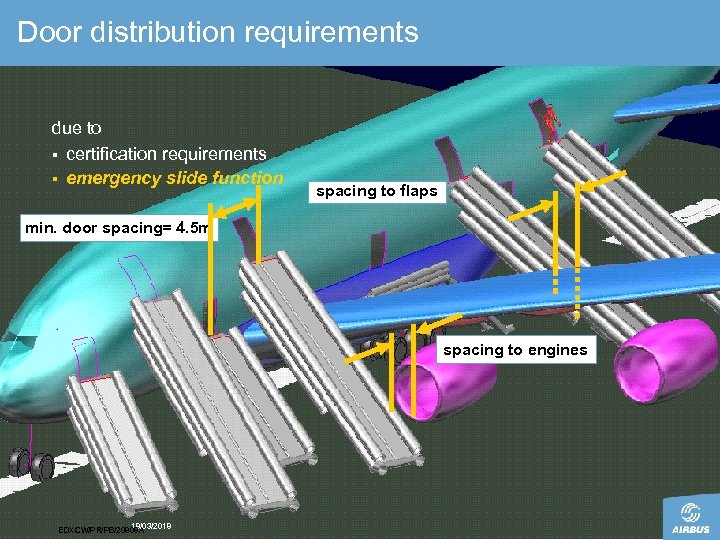
Door distribution requirements due to § certification requirements § emergency slide function spacing to flaps min. door spacing= 4. 5 m © AIRBUS S. All rights reserved. Confidential and proprietary document. spacing to engines 18/03/2018 EDXCW/PR/PB/20808 A
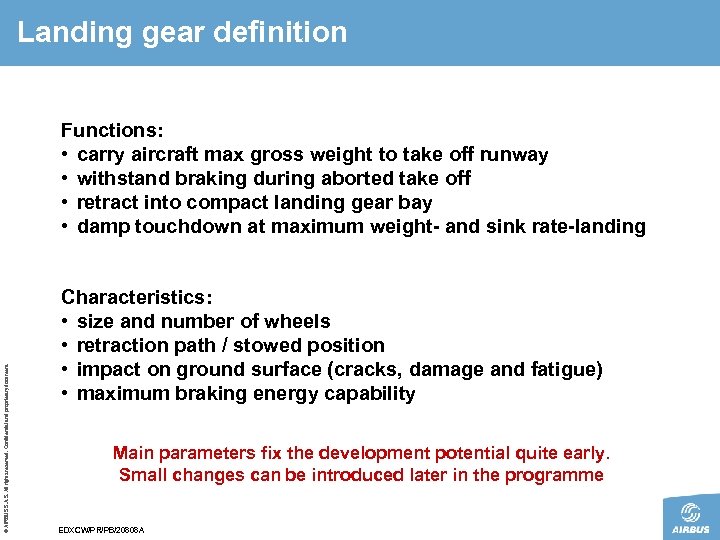
Landing gear definition © AIRBUS S. All rights reserved. Confidential and proprietary document. Functions: • carry aircraft max gross weight to take off runway • withstand braking during aborted take off • retract into compact landing gear bay • damp touchdown at maximum weight- and sink rate-landing Characteristics: • size and number of wheels • retraction path / stowed position • impact on ground surface (cracks, damage and fatigue) • maximum braking energy capability Main parameters fix the development potential quite early. Small changes can be introduced later in the programme EDXCW/PR/PB/20808 A
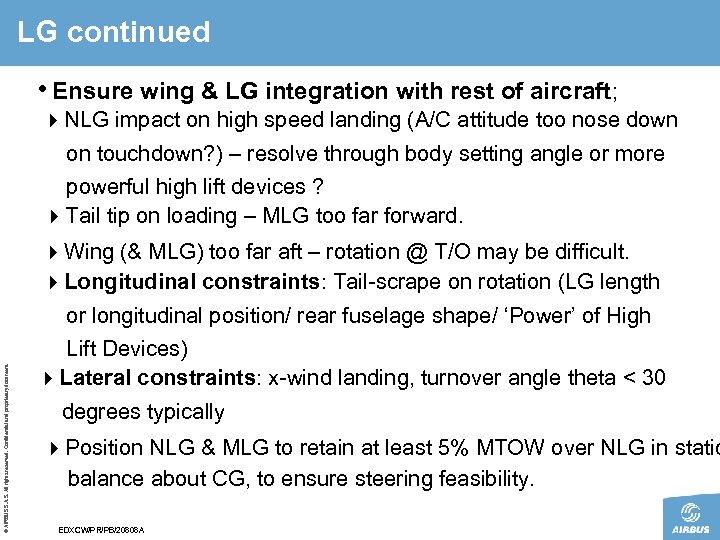
LG continued • Ensure wing & LG integration with rest of aircraft; 4 NLG impact on high speed landing (A/C attitude too nose down on touchdown? ) – resolve through body setting angle or more powerful high lift devices ? 4 Tail tip on loading – MLG too far forward. © AIRBUS S. All rights reserved. Confidential and proprietary document. 4 Wing (& MLG) too far aft – rotation @ T/O may be difficult. 4 Longitudinal constraints: Tail-scrape on rotation (LG length or longitudinal position/ rear fuselage shape/ ‘Power’ of High Lift Devices) 4 Lateral constraints: x-wind landing, turnover angle theta < 30 degrees typically 4 Position NLG & MLG to retain at least 5% MTOW over NLG in static balance about CG, to ensure steering feasibility. EDXCW/PR/PB/20808 A
LG 4 Ensure LG leg integration feasibility – NLG, BLG, MLG volume requirements for sensible leg positions & tyre quantity & size (family growth version ? ) – ACN – pavement loading – set by Airfield classification (requirement). –Greater root chord? –Inner TE kink? –Thicker section @ root? © AIRBUS S. All rights reserved. Confidential and proprietary document. –Re-twist at root? EDXCW/PR/PB/20808 A
Standard Clearances for LG Concept Studies • Weight: Total LG weight typically 3% of MTOW for commercial airliners • Tyre clearances: Spinning Tyre to airframe = 80 mm minimum for nominal static structure (50 mm after tolerances and deflections) Landing gear structure to airframe = 50 mm minimum for nominal static structure (25 mm after tolerances and deflections) © AIRBUS S. All rights reserved. Confidential and proprietary document. • Airframe skin thickness: Wing skin thickness = 50 mm Belly fairing thickness = 100 mm Nose bay skin thickness = 100 mm EDXCW/PR/PB/20808 A
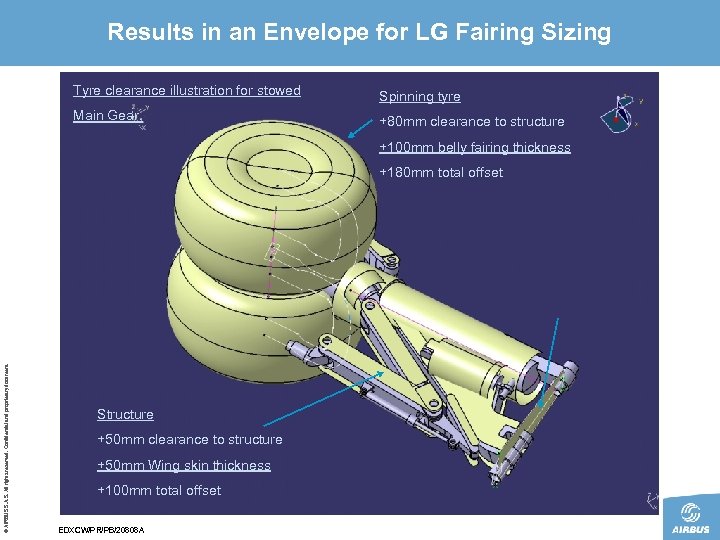
Results in an Envelope for LG Fairing Sizing Tyre clearance illustration for stowed Spinning tyre Main Gear. +80 mm clearance to structure +100 mm belly fairing thickness © AIRBUS S. All rights reserved. Confidential and proprietary document. +180 mm total offset Structure +50 mm clearance to structure +50 mm Wing skin thickness +100 mm total offset EDXCW/PR/PB/20808 A
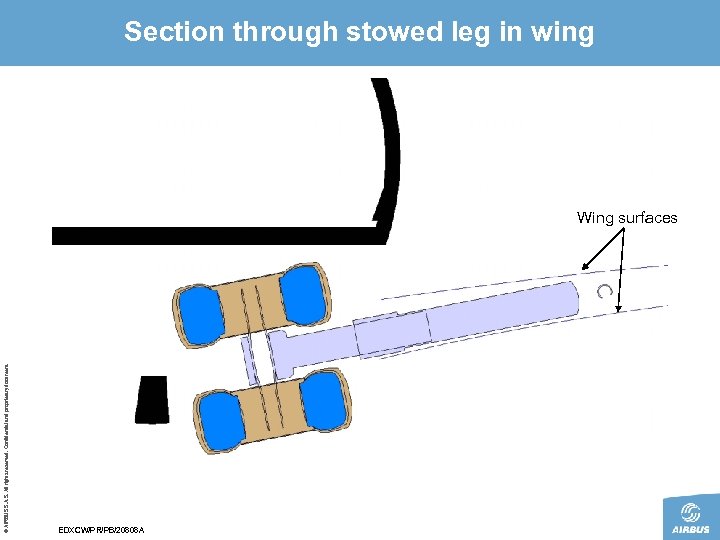
© AIRBUS S. All rights reserved. Confidential and proprietary document. Section through stowed leg in wing Wing surfaces EDXCW/PR/PB/20808 A
Landing Gear - Aerodrome reference code • The purpose of the Aerodrome reference code is to match aerodrome facilities to the A/C. It is a two part code. 4 The first part relates to the A/C reference field length 4 The second to the A/C wing span and L/G outer wheel span. • The details regarding the aerodrome reference code for L/G outer wheel span can be found in the ICAO aerodrome design manual Part 2 Chapter 1 (Taxiways). © AIRBUS S. All rights reserved. Confidential and proprietary document. • The code elements are reproduced as follows; EDXCW/PR/PB/20808 A
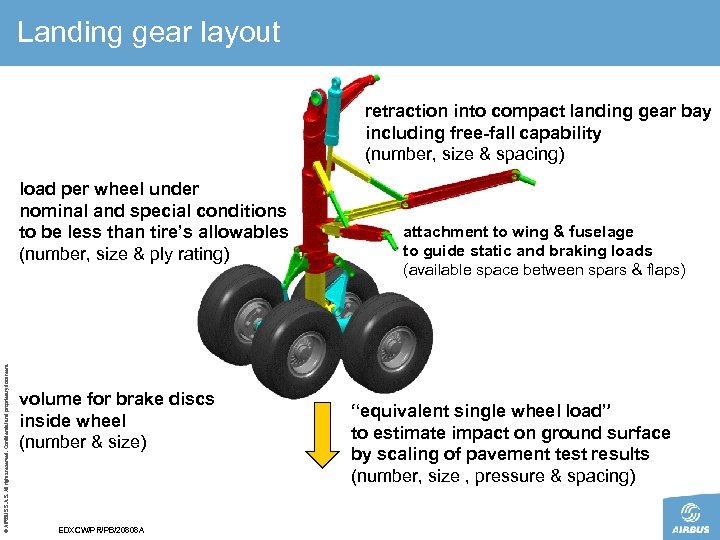
Landing gear layout retraction into compact landing gear bay including free-fall capability (number, size & spacing) © AIRBUS S. All rights reserved. Confidential and proprietary document. load per wheel under nominal and special conditions to be less than tire’s allowables (number, size & ply rating) volume for brake discs inside wheel (number & size) EDXCW/PR/PB/20808 A attachment to wing & fuselage to guide static and braking loads (available space between spars & flaps) “equivalent single wheel load” to estimate impact on ground surface by scaling of pavement test results (number, size , pressure & spacing)
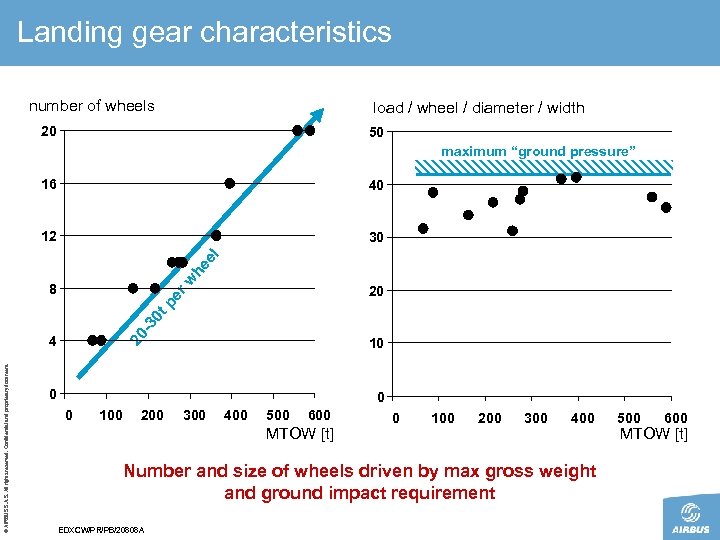
Landing gear characteristics number of wheels load / wheel / diameter / width 20 50 maximum “ground pressure” 40 12 30 er w he el 16 20 20 -3 0 tp 8 © AIRBUS S. All rights reserved. Confidential and proprietary document. 4 10 0 100 200 300 400 500 600 MTOW [t] 0 100 200 300 400 Number and size of wheels driven by max gross weight and ground impact requirement EDXCW/PR/PB/20808 A 500 600 MTOW [t]
Powerplant Positioning & Integration 4 Powerplant position: – Gulled wing ? (local increase in dihedral at root) –+/ - 5 degree disc burst cones for fuel tank boundaries and feeds to Engine. © AIRBUS S. All rights reserved. Confidential and proprietary document. –MLG longitudinal position on NLG collapse to ensure engine clearance. EDXCW/PR/PB/20808 A
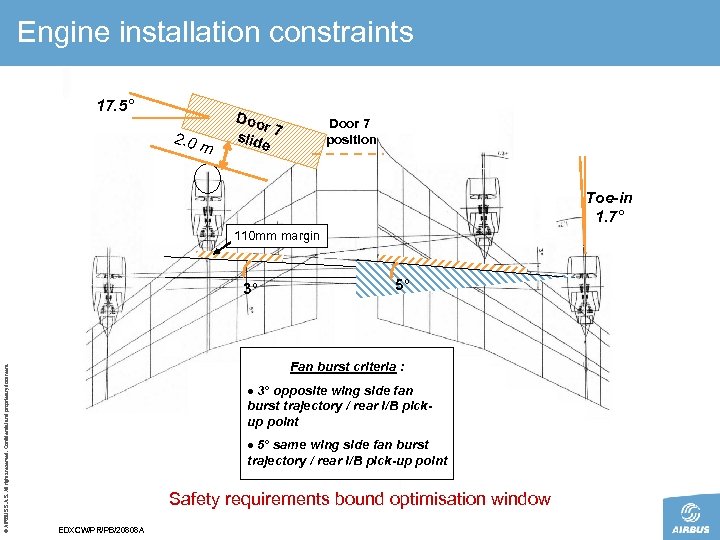
Engine installation constraints 17. 5° 2. 0 m Doo r 7 slid e Door 7 position Toe-in 1. 7° 110 mm margin © AIRBUS S. All rights reserved. Confidential and proprietary document. 3° 5° Fan burst criteria : · 3° opposite wing side fan burst trajectory / rear I/B pickup point · 5° same wing side fan burst trajectory / rear I/B pick-up point Safety requirements bound optimisation window EDXCW/PR/PB/20808 A
Wing planform definition • Wing aerodynamic performance depends on 4 Sectional shape 4 Wing area, span, sweep, thickness, taper 4 Spanwise lift distribution 4 Flap size and type • Wing weight depends on weights 4 Design speed 4 Wing area, span, sweep, t/c, taper 4 Spanwise lift distribution 4 Box size / flap size and type © AIRBUS S. All rights reserved. Confidential and proprietary document. 4 Design • Weight & drag require different planforms • The wing must also carry landing gear & engines, and integrate into the fuselage EDXCW/PR/PB/20808 A We must find the best balance for the overall aircraft
Wing Sizing • Develop understanding of component level sizing & links to OAD; • Wing planform versus drag & economics; 4 TR, Span, t/c, S – which gives the best multidisciplinary balance ? Span versus Area © AIRBUS S. All rights reserved. Confidential and proprietary document. Sweep versus t/c TR versus Co. P 4 Check fuel volume requirement is met in wing. 4 Value of Weight versus Drag for Economics terms – Which most influences ? 4 Is aero benefit of elliptical lift distribution more powerful than BM relief due to more inboard position of Co. P ? EDXCW/PR/PB/20808 A
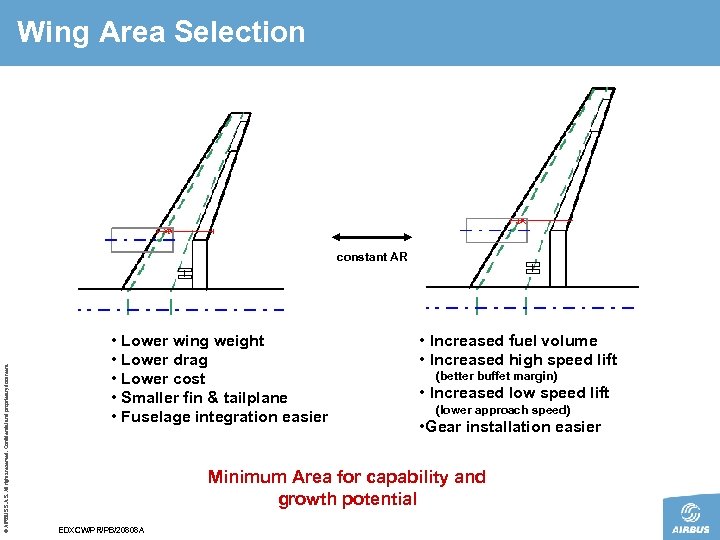
Wing Area Selection © AIRBUS S. All rights reserved. Confidential and proprietary document. constant AR • Lower wing weight • Lower drag • Lower cost • Smaller fin & tailplane • Fuselage integration easier • Increased fuel volume • Increased high speed lift (better buffet margin) • Increased low speed lift (lower approach speed) • Gear installation easier Minimum Area for capability and growth potential EDXCW/PR/PB/20808 A
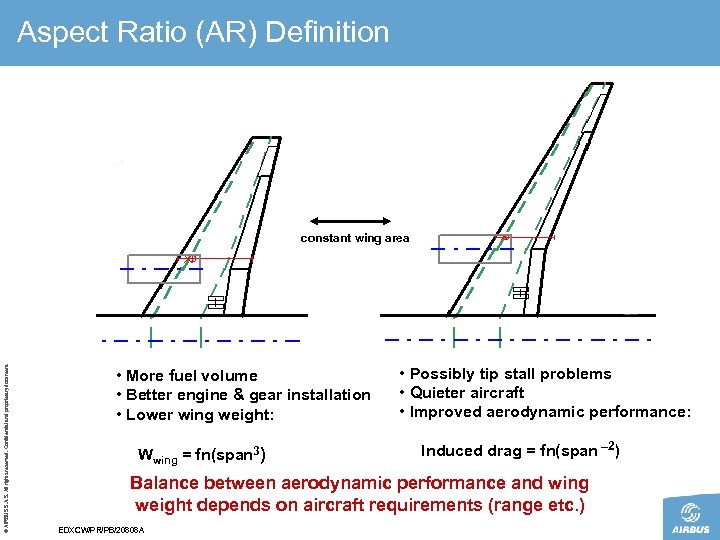
Aspect Ratio (AR) Definition © AIRBUS S. All rights reserved. Confidential and proprietary document. constant wing area • More fuel volume • Better engine & gear installation • Lower wing weight: Wwing = fn(span 3) • Possibly tip stall problems • Quieter aircraft • Improved aerodynamic performance: Induced drag = fn(span – 2) Balance between aerodynamic performance and wing weight depends on aircraft requirements (range etc. ) EDXCW/PR/PB/20808 A
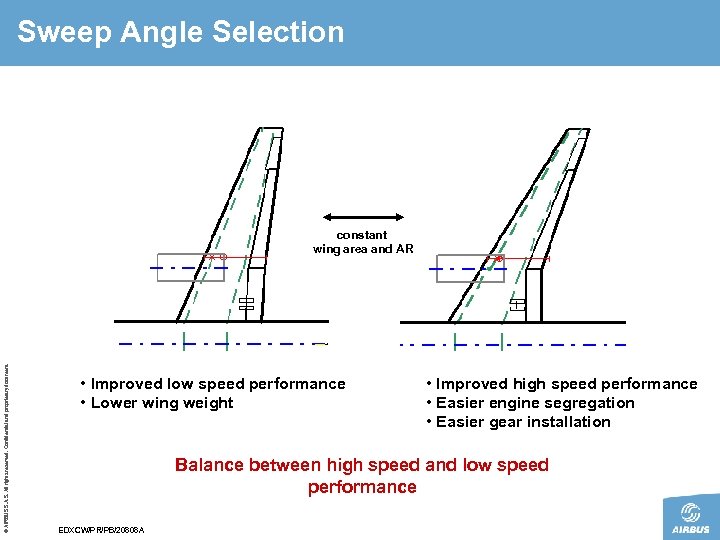
Sweep Angle Selection © AIRBUS S. All rights reserved. Confidential and proprietary document. constant wing area and AR • Improved low speed performance • Lower wing weight • Improved high speed performance • Easier engine segregation • Easier gear installation Balance between high speed and low speed performance EDXCW/PR/PB/20808 A
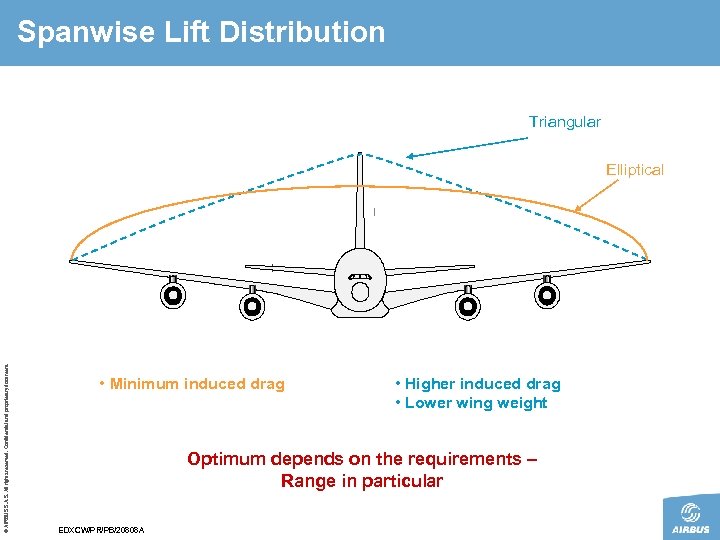
Spanwise Lift Distribution Triangular © AIRBUS S. All rights reserved. Confidential and proprietary document. Elliptical • Minimum induced drag • Higher induced drag • Lower wing weight Optimum depends on the requirements – Range in particular EDXCW/PR/PB/20808 A
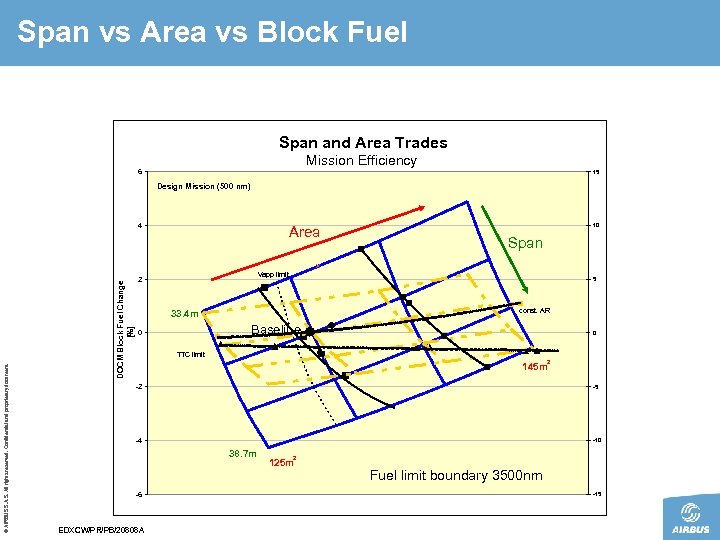
Span vs Area vs Block Fuel Span and Area Trades Mission Efficiency 6 15 Design Mission (500 nm) DOCM Block Fuel Change [%] © AIRBUS S. All rights reserved. Confidential and proprietary document. 4 Area 10 Span Vapp limit 2 5 const. AR 33. 4 m Baseline 0 0 TTC limit 2 145 m -2 -5 -4 -10 38. 7 m -6 EDXCW/PR/PB/20808 A 2 125 m Fuel limit boundary 3500 nm -15
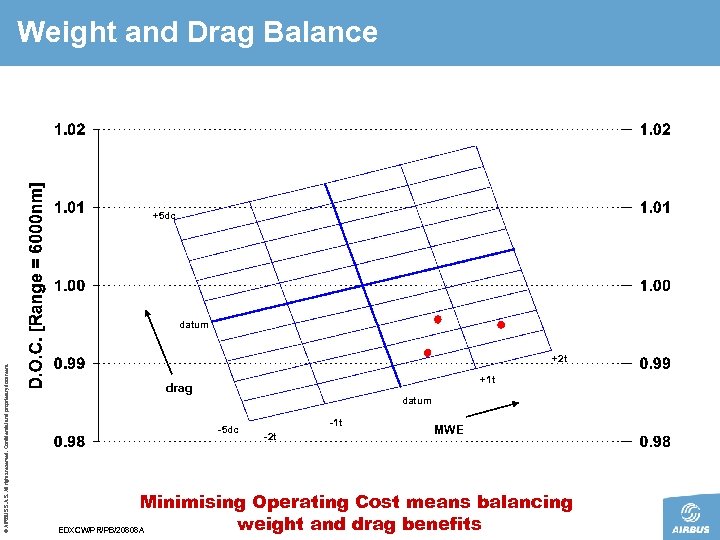
Weight and Drag Balance +5 dc © AIRBUS S. All rights reserved. Confidential and proprietary document. datum +2 t +1 t drag datum -5 dc -1 t -2 t MWE Minimising Operating Cost means balancing weight and drag benefits EDXCW/PR/PB/20808 A
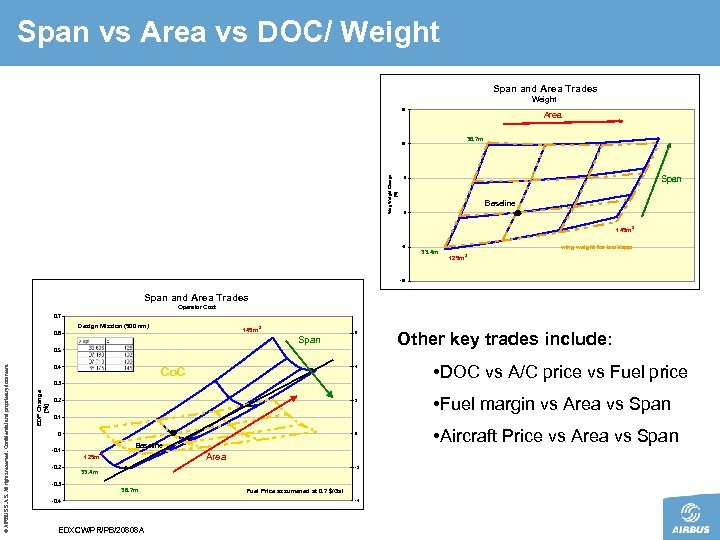
Span vs Area vs DOC/ Weight Span and Area Trades Weight 15 Area 38. 7 m Wing Weight Change [%] 10 Span 5 Baseline 0 145 m 2 wing weight for iso Vapp -5 33. 4 m 125 m 2 -10 Span and Area Trades Operator Cost 0. 7 Design Mission (500 nm) 145 m 0. 6 2 Span 6 0. 4 4 Co. C 0. 3 EDP Change [%] © AIRBUS S. All rights reserved. Confidential and proprietary document. 0. 5 0. 2 2 Other key trades include: • DOC vs A/C price vs Fuel price • Fuel margin vs Area vs Span 0. 1 0 0 Baseline -0. 1 125 m -0. 2 -0. 3 Area 2 -2 33. 4 m 38. 7 m -0. 4 EDXCW/PR/PB/20808 A Fuel Price assumened at 0. 7 $/Gal -4 • Aircraft Price vs Area vs Span
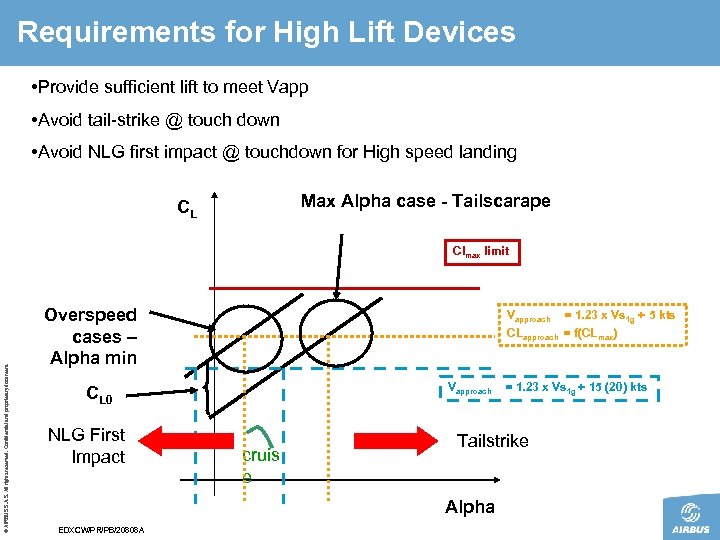
Requirements for High Lift Devices • Provide sufficient lift to meet Vapp • Avoid tail-strike @ touch down • Avoid NLG first impact @ touchdown for High speed landing Max Alpha case - Tailscarape CL © AIRBUS S. All rights reserved. Confidential and proprietary document. Clmax limit Overspeed cases – Alpha min Vapproach = 1. 23 x Vs 1 g + 5 kts CLapproach = f(CLmax) Vapproach CL 0 NLG First Impact cruis e Tailstrike Alpha EDXCW/PR/PB/20808 A = 1. 23 x Vs 1 g + 15 (20) kts
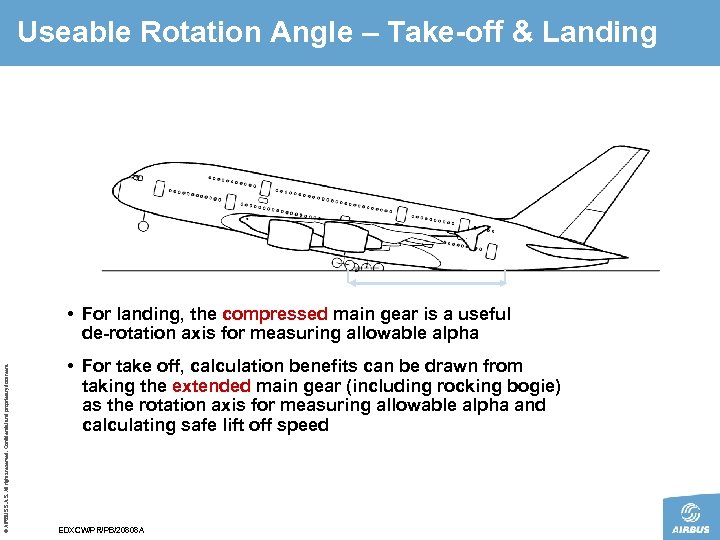
Useable Rotation Angle – Take-off & Landing © AIRBUS S. All rights reserved. Confidential and proprietary document. • For landing, the compressed main gear is a useful de-rotation axis for measuring allowable alpha • For take off, calculation benefits can be drawn from taking the extended main gear (including rocking bogie) as the rotation axis for measuring allowable alpha and calculating safe lift off speed EDXCW/PR/PB/20808 A
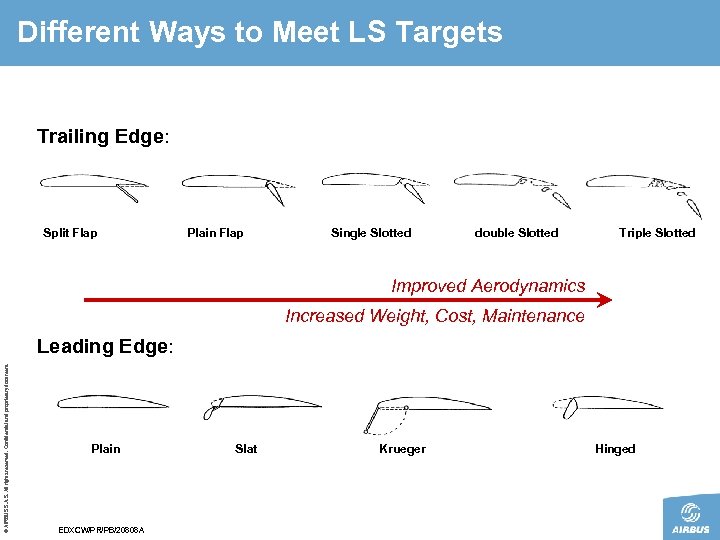
Different Ways to Meet LS Targets Trailing Edge: Split Flap Plain Flap Single Slotted double Slotted Triple Slotted Improved Aerodynamics Increased Weight, Cost, Maintenance © AIRBUS S. All rights reserved. Confidential and proprietary document. Leading Edge: Plain EDXCW/PR/PB/20808 A Slat Krueger Hinged
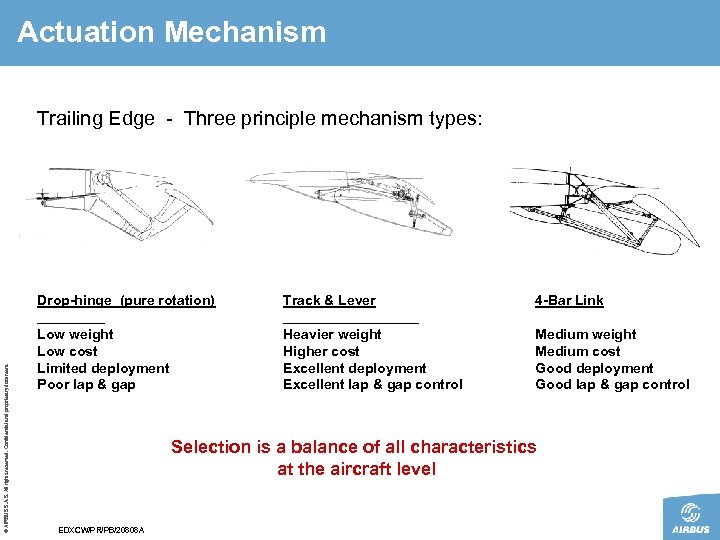
Actuation Mechanism Trailing Edge - Three principle mechanism types: © AIRBUS S. All rights reserved. Confidential and proprietary document. Drop-hinge (pure rotation) Track & Lever 4 -Bar Link Low weight Low cost Limited deployment Poor lap & gap Heavier weight Higher cost Excellent deployment Excellent lap & gap control Medium weight Medium cost Good deployment Good lap & gap control Selection is a balance of all characteristics at the aircraft level EDXCW/PR/PB/20808 A
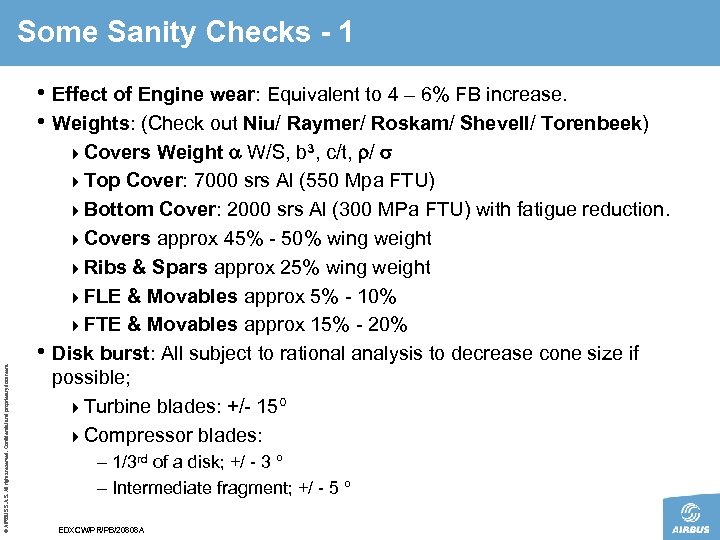
Some Sanity Checks - 1 • Effect of Engine wear: Equivalent to 4 – 6% FB increase. • Weights: (Check out Niu/ Raymer/ Roskam/ Shevell/ Torenbeek) Weight W/S, b 3, c/t, / 4 Top Cover: 7000 srs Al (550 Mpa FTU) 4 Bottom Cover: 2000 srs Al (300 MPa FTU) with fatigue reduction. 4 Covers approx 45% - 50% wing weight 4 Ribs & Spars approx 25% wing weight 4 FLE & Movables approx 5% - 10% 4 FTE & Movables approx 15% - 20% Disk burst: All subject to rational analysis to decrease cone size if possible; 4 Turbine blades: +/- 15º 4 Compressor blades: © AIRBUS S. All rights reserved. Confidential and proprietary document. 4 Covers • – 1/3 rd of a disk; +/ - 3 º – Intermediate fragment; +/ - 5 º EDXCW/PR/PB/20808 A
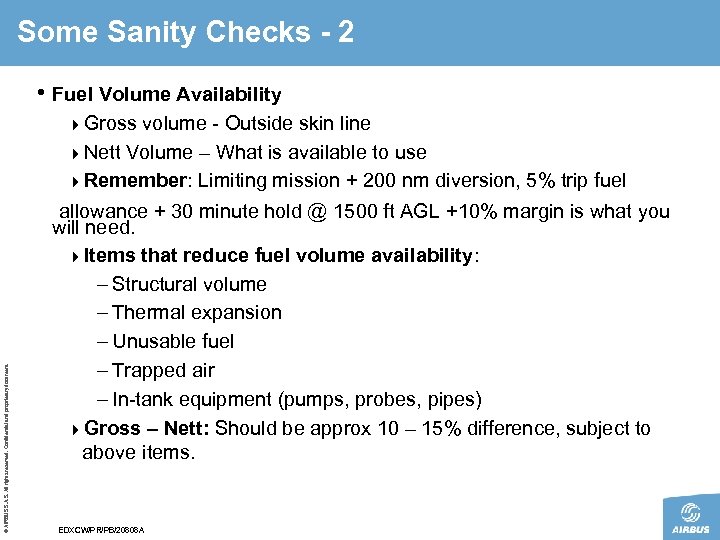
Some Sanity Checks - 2 • Fuel Volume Availability volume - Outside skin line 4 Nett Volume – What is available to use 4 Remember: Limiting mission + 200 nm diversion, 5% trip fuel © AIRBUS S. All rights reserved. Confidential and proprietary document. 4 Gross allowance + 30 minute hold @ 1500 ft AGL +10% margin is what you will need. 4 Items that reduce fuel volume availability: – Structural volume – Thermal expansion – Unusable fuel – Trapped air – In-tank equipment (pumps, probes, pipes) 4 Gross – Nett: Should be approx 10 – 15% difference, subject to above items. EDXCW/PR/PB/20808 A

© AIRBUS S. All rights reserved. Confidential and proprietary document. Economics EDXCW/PR/PB/20808 A
Why we’re Producing Aircraft ? © AIRBUS S. All rights reserved. Confidential and proprietary document. Making money is the reason why most companies are in the aerospace industry Operating Costs are an important criterion used by airlines when choosing new aircraft Operating Cost methods give engineers a useful multi-disciplinary assessment tool in the sizing process Consider economics throughout, not just as a result EDXCW/PR/PB/20808 A
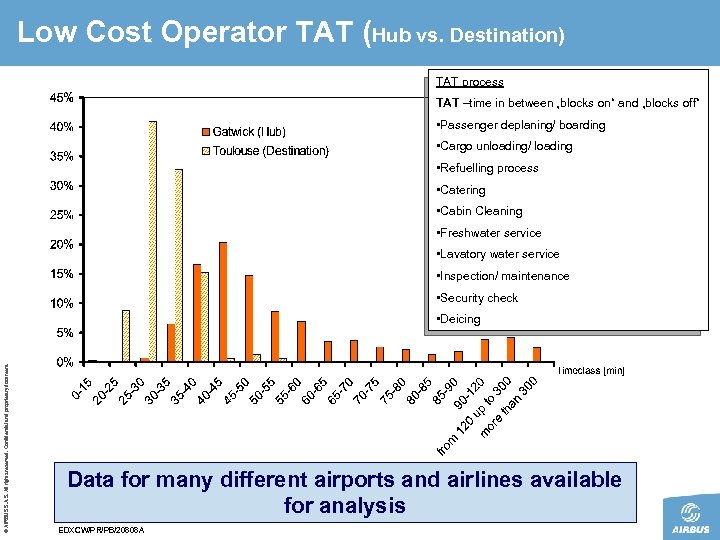
Low Cost Operator TAT (Hub vs. Destination) TAT process TAT –time in between „blocks on“ and „blocks off“ • Passenger deplaning/ boarding • Cargo unloading/ loading • Refuelling process • Catering • Cabin Cleaning • Freshwater service • Lavatory water service • Inspection/ maintenance • Security check © AIRBUS S. All rights reserved. Confidential and proprietary document. • Deicing Data for many different airports and airlines available for analysis EDXCW/PR/PB/20808 A
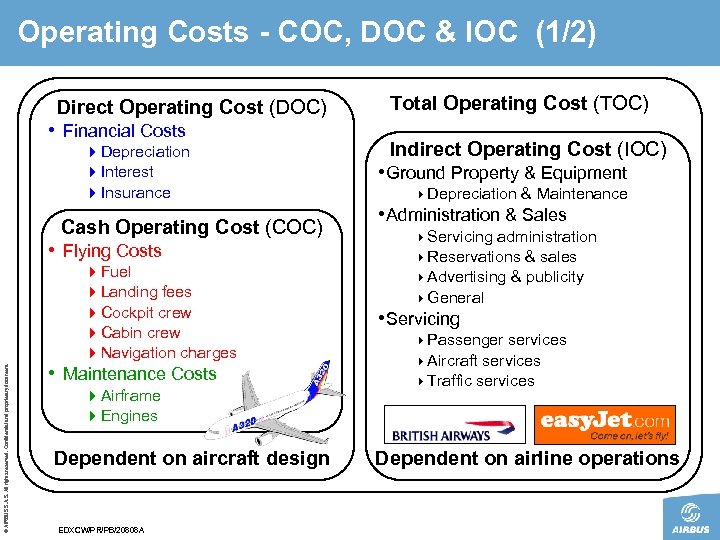
Operating Costs - COC, DOC & IOC (1/2) Direct Operating Cost (DOC) • Financial Costs 4 Depreciation 4 Interest 4 Insurance Cash Operating Cost (COC) • Flying Costs © AIRBUS S. All rights reserved. Confidential and proprietary document. 4 Fuel 4 Landing fees 4 Cockpit crew 4 Cabin crew 4 Navigation charges • Maintenance Costs 4 Airframe 4 Engines Dependent on aircraft design EDXCW/PR/PB/20808 A Total Operating Cost (TOC) Indirect Operating Cost (IOC) • Ground Property & Equipment 4 Depreciation & Maintenance • Administration & Sales 4 Servicing administration 4 Reservations & sales 4 Advertising & publicity 4 General • Servicing 4 Passenger services 4 Aircraft services 4 Traffic services Dependent on airline operations
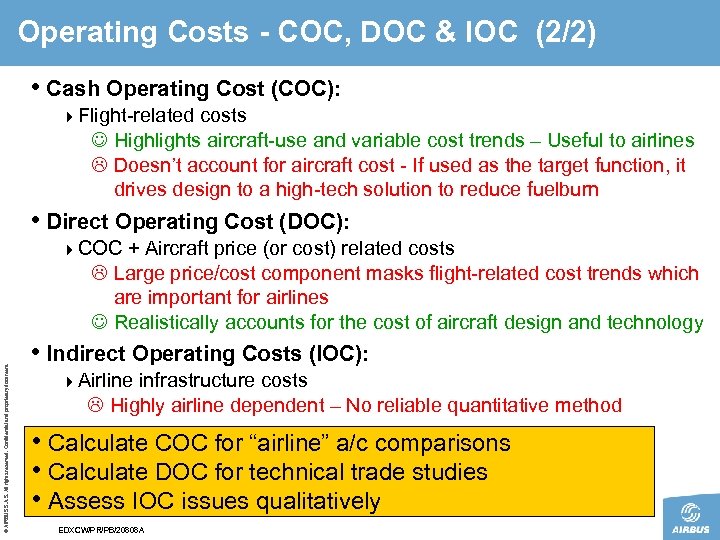
Operating Costs - COC, DOC & IOC (2/2) • Cash Operating Cost (COC): 4 Flight-related costs Highlights aircraft-use and variable cost trends – Useful to airlines Doesn’t account for aircraft cost - If used as the target function, it drives design to a high-tech solution to reduce fuelburn • Direct Operating Cost (DOC): + Aircraft price (or cost) related costs Large price/cost component masks flight-related cost trends which are important for airlines Realistically accounts for the cost of aircraft design and technology © AIRBUS S. All rights reserved. Confidential and proprietary document. 4 COC • Indirect Operating Costs (IOC): 4 Airline infrastructure costs Highly airline dependent – No reliable quantitative method • Calculate COC for “airline” a/c comparisons • Calculate DOC for technical trade studies • Assess IOC issues qualitatively EDXCW/PR/PB/20808 A
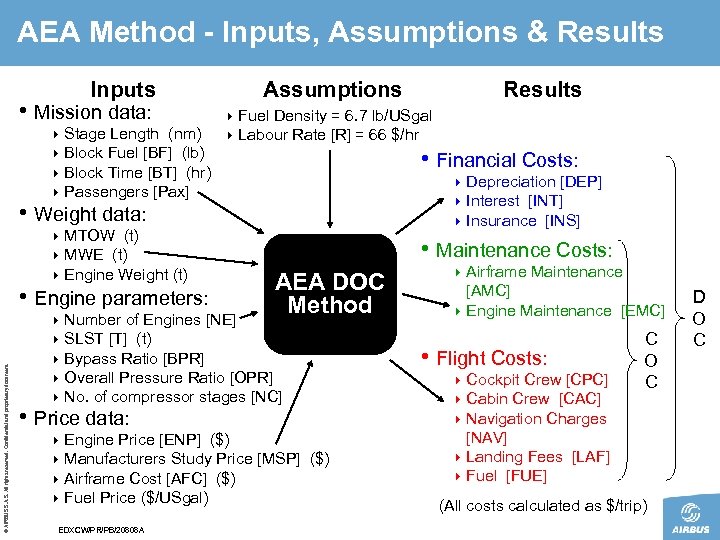
AEA Method - Inputs, Assumptions & Results Inputs Assumptions • Mission data: 4 Stage Length (nm) 4 Block Fuel [BF] (lb) 4 Block Time [BT] (hr) 4 Passengers [Pax] 4 Fuel Density = 6. 7 lb/USgal 4 Labour Rate [R] = 66 $/hr • Financial Costs: 4 Depreciation [DEP] 4 Interest [INT] 4 Insurance [INS] • Weight data: 4 MTOW (t) 4 MWE (t) 4 Engine Weight • Maintenance Costs: (t) © AIRBUS S. All rights reserved. Confidential and proprietary document. • Engine parameters: AEA DOC Method 4 Number of Engines [NE] 4 SLST [T] (t) 4 Bypass Ratio [BPR] 4 Overall Pressure Ratio [OPR] 4 No. of compressor stages [NC] • Price data: 4 Engine Price [ENP] ($) 4 Manufacturers Study Price 4 Airframe Cost [AFC] ($) 4 Fuel Price ($/USgal) EDXCW/PR/PB/20808 A Results [MSP] ($) 4 Airframe Maintenance [AMC] 4 Engine Maintenance [EMC] • Flight Costs: 4 Cockpit Crew [CPC] 4 Cabin Crew [CAC] 4 Navigation Charges C O C [NAV] 4 Landing Fees [LAF] 4 Fuel [FUE] (All costs calculated as $/trip) D O C
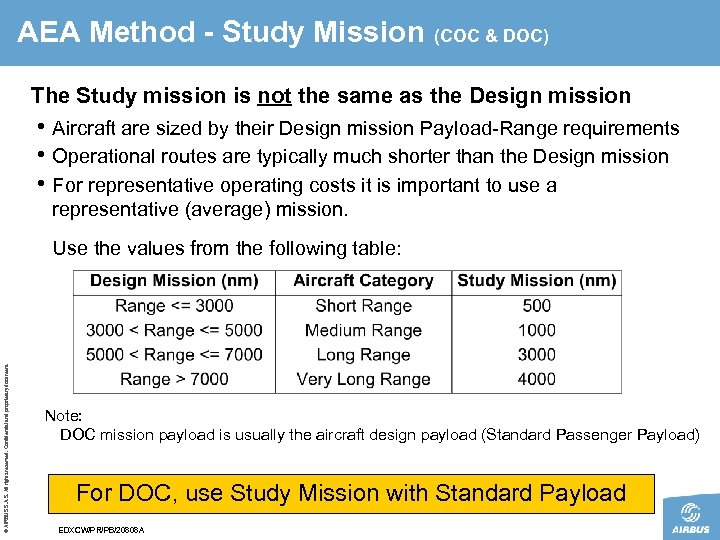
AEA Method - Study Mission (COC & DOC) The Study mission is not the same as the Design mission • Aircraft are sized by their Design mission Payload-Range requirements • Operational routes are typically much shorter than the Design mission • For representative operating costs it is important to use a representative (average) mission. © AIRBUS S. All rights reserved. Confidential and proprietary document. Use the values from the following table: Note: DOC mission payload is usually the aircraft design payload (Standard Passenger Payload) For DOC, use Study Mission with Standard Payload EDXCW/PR/PB/20808 A
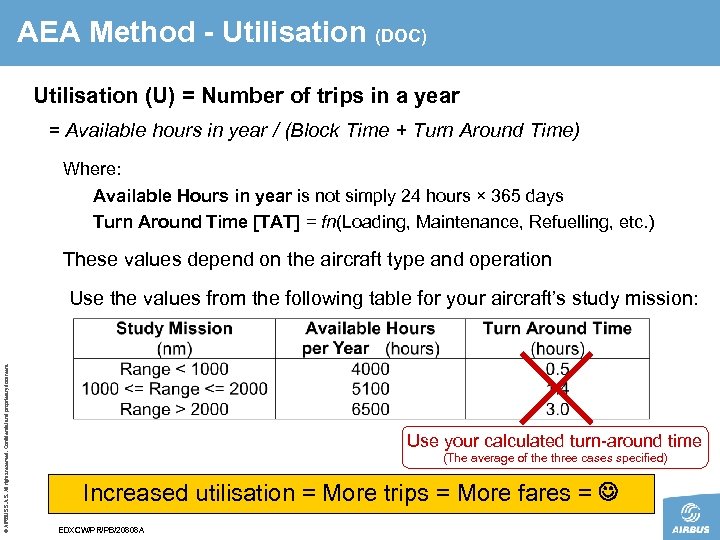
AEA Method - Utilisation (DOC) Utilisation (U) = Number of trips in a year = Available hours in year / (Block Time + Turn Around Time) Where: Available Hours in year is not simply 24 hours × 365 days Turn Around Time [TAT] = fn(Loading, Maintenance, Refuelling, etc. ) These values depend on the aircraft type and operation © AIRBUS S. All rights reserved. Confidential and proprietary document. Use the values from the following table for your aircraft’s study mission: Use your calculated turn-around time (The average of the three cases specified) Increased utilisation = More trips = More fares = EDXCW/PR/PB/20808 A
![AEA Method - Total Investment (DOC) Total Investment [TI] = Cost of aircraft and](https://present5.com/presentation/b59646f4f570bfc17f1c3976165d23ca/image-61.jpg "AEA Method - Total Investment (DOC) Total Investment [TI] = Cost of aircraft and")
AEA Method - Total Investment (DOC) Total Investment [TI] = Cost of aircraft and initial spares = Manufacturer’s Study Price [MSP] 4 Typically a study variable (see later) + Airframe spares = 10% of airframe price (or airframe cost) = 0. 10 × (MSP – (Engine Price [ENP] × No. of engines [NE])) © AIRBUS S. All rights reserved. Confidential and proprietary document. + Spare Propulsion Units = 30% of total engine price = 0. 30 × (Engine Price [ENP] × No. of engines [NE]) EDXCW/PR/PB/20808 A
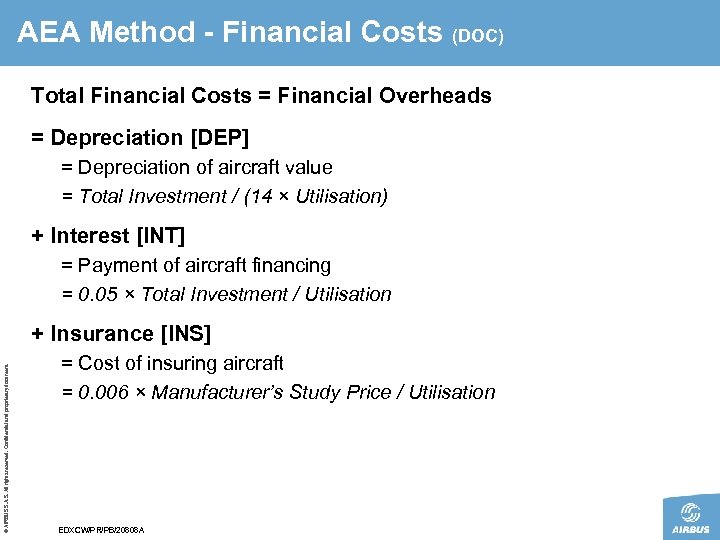
AEA Method - Financial Costs (DOC) Total Financial Costs = Financial Overheads = Depreciation [DEP] = Depreciation of aircraft value = Total Investment / (14 × Utilisation) + Interest [INT] = Payment of aircraft financing = 0. 05 × Total Investment / Utilisation © AIRBUS S. All rights reserved. Confidential and proprietary document. + Insurance [INS] = Cost of insuring aircraft = 0. 006 × Manufacturer’s Study Price / Utilisation EDXCW/PR/PB/20808 A
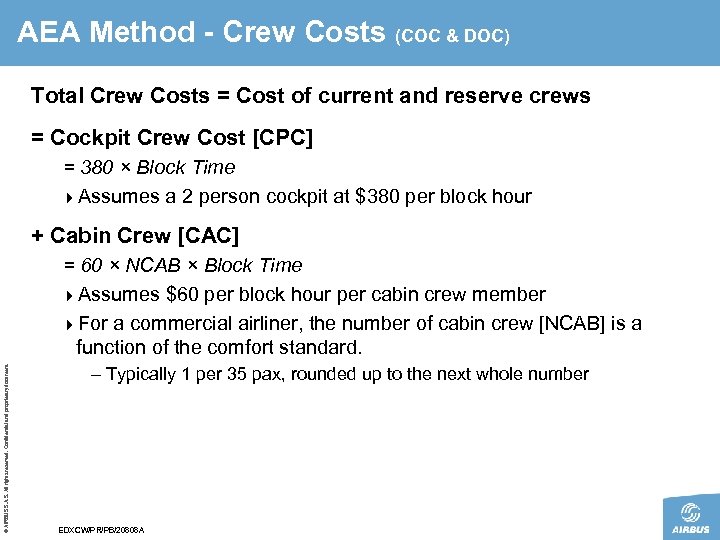
AEA Method - Crew Costs (COC & DOC) Total Crew Costs = Cost of current and reserve crews = Cockpit Crew Cost [CPC] = 380 × Block Time 4 Assumes a 2 person cockpit at $380 per block hour + Cabin Crew [CAC] © AIRBUS S. All rights reserved. Confidential and proprietary document. = 60 × NCAB × Block Time 4 Assumes $60 per block hour per cabin crew member 4 For a commercial airliner, the number of cabin crew [NCAB] is a function of the comfort standard. – Typically 1 per 35 pax, rounded up to the next whole number EDXCW/PR/PB/20808 A

© AIRBUS S. All rights reserved. Confidential and proprietary document. EDXCW/PR/PB/20808 A
![AEA Method - AF Maintenance Costs (COC & DOC) Airframe Maintenance Costs [AMC] =](https://present5.com/presentation/b59646f4f570bfc17f1c3976165d23ca/image-65.jpg "AEA Method - AF Maintenance Costs (COC & DOC) Airframe Maintenance Costs [AMC] =")
AEA Method - AF Maintenance Costs (COC & DOC) Airframe Maintenance Costs [AMC] = Airframe Labour = + Airframe Materials © AIRBUS S. All rights reserved. Confidential and proprietary document. = AFP × (4. 2 + 2. 2 × (t - 0. 25)) Where: AFW = Airframe Weight (tonnes) = MWE less Weight of the Engines R = Labour Rate = 66 $/hour MWE = Manufacturers Weight Empty (tonnes) t = Block time (hours) AFP = Airframe Price = MSP less Price of the Engines ($M) EDXCW/PR/PB/20808 A
![AEA Method - Eng Maintenance Costs (COC & DOC) Engine Maintenance Costs [EMC] 4](https://present5.com/presentation/b59646f4f570bfc17f1c3976165d23ca/image-66.jpg "AEA Method - Eng Maintenance Costs (COC & DOC) Engine Maintenance Costs [EMC] 4")
AEA Method - Eng Maintenance Costs (COC & DOC) Engine Maintenance Costs [EMC] 4 The method depends on the engine type: Turbojet or Turbofan Contra-Turboprop or Propfan Labour: LT = 0. 21 × C 3 × (1+T )0. 4 × R LT × 0. 152 × C 3 × (1+N)0. 4 × R [Core] LP = 0. 072 × B × (1+N/2)0. 4 × R Material: [Core] MT = 2. 56 × (1+T)0. 8 × C 1 (C 2+C 3) © AIRBUS S. All rights reserved. Confidential and proprietary document. MP = 0. 56 × (1+N/2)0. 8 × B [Props] MT = 1. 65 × (1+N)0. 8 × (C 2+C 3) [Props] Total: EMC = NE × (LT + MT) × (tƒ+1. 3) EMC = NE × (LT+MT) × (tƒ+1. 3) + NE × (LP+MP) × (tƒ+0. 5) Where: C 1 = 1. 27 - 0. 2 x BPR 0. 2 C 2 = 0. 4 × (OPR / 20)1. 3 + 0. 4 C 3 = 0. 032 × NC + 0. 57 A = 8. 5 × (N / 3 × P + 28)0. 5 + 0. 9 B = (0. 05 × P + 0. 6) × (0. 4 × (D / A) + 0. 6) T = Sea Level Static Thrust (tonnes) NC = No. of Compressor Stages tƒ = Flight time = Block time - 0. 25 (hrs) BPR = Bypass Ratio OPR = Overall Pressure Ratio P = No. of Propeller Blades EDXCW/PR/PB/20808 A N= Take Off SHP× 10 -3 D= Prop Diameter (m)
![AEA Method - Fuel Price (COC & DOC) Fuel cost [FUE] = Block Fuel](https://present5.com/presentation/b59646f4f570bfc17f1c3976165d23ca/image-67.jpg "AEA Method - Fuel Price (COC & DOC) Fuel cost [FUE] = Block Fuel")
AEA Method - Fuel Price (COC & DOC) Fuel cost [FUE] = Block Fuel (lb) / 6. 7 × Fuel Price ($/USGal) 4 Assumed fuel density = 6. 7 lb/USGal (~0. 803 kg/l) Current price >2 $/USgal © AIRBUS S. All rights reserved. Confidential and proprietary document. Historic price ~1 $/USgal • The price of fuel varies considerably • A tax on fuel is likely to be the method of taxing aircraft emissions in the future • Fuel price is typically considered a study variable (. . . see later) Source: IATA website, 03 October 2006 EDXCW/PR/PB/20808 A http: //www. iata. org/whatwedo/economics/fuel_monitor/price_development. htm
![Cost Estimation - Understanding Price & Cost • The Manufacturer’s Study Price [MSP] is](https://present5.com/presentation/b59646f4f570bfc17f1c3976165d23ca/image-68.jpg "Cost Estimation - Understanding Price & Cost • The Manufacturer’s Study Price [MSP] is")
Cost Estimation - Understanding Price & Cost • The Manufacturer’s Study Price [MSP] is a major DOC input = Airframe Price [AFP] + Engine Price [ENP] ( = Aircraft Cost + Manufacturer’s Profit) • The Price is what the airline is willing to pay for the aircraft 4 Market driven, big discounts • The Cost is what it costs the manufacturer to build the aircraft © AIRBUS S. All rights reserved. Confidential and proprietary document. = RC + (NRC / Number of a/c produced) Where: RC = Recurring Cost = Cost of building one aircraft. Includes materials, man-hours, transportation, bought items, energy, etc. NRC = Non Recurring Costs = Cost of design and set up for manufacture of a new aircraft. Includes design, jig & tools, testing, prototypes. Price is not the same as Cost EDXCW/PR/PB/20808 A
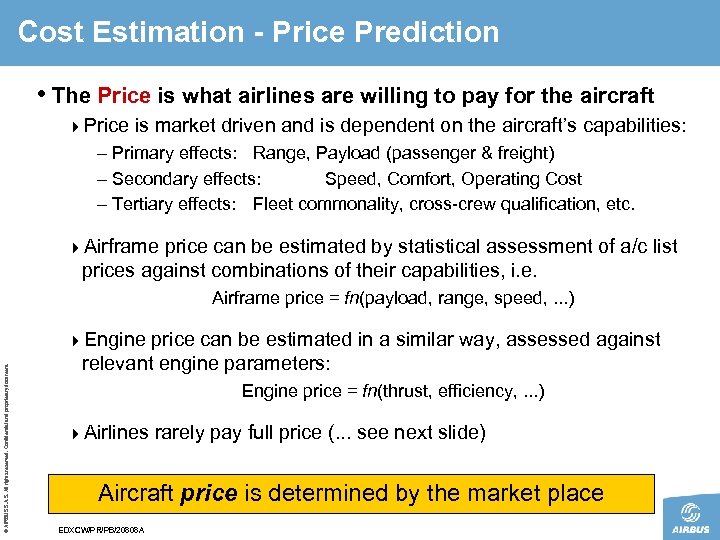
Cost Estimation - Price Prediction • The Price is what airlines are willing to pay for the aircraft 4 Price is market driven and is dependent on the aircraft’s capabilities: – Primary effects: Range, Payload (passenger & freight) – Secondary effects: Speed, Comfort, Operating Cost – Tertiary effects: Fleet commonality, cross-crew qualification, etc. 4 Airframe price can be estimated by statistical assessment of a/c list prices against combinations of their capabilities, i. e. Airframe price = fn(payload, range, speed, . . . ) © AIRBUS S. All rights reserved. Confidential and proprietary document. 4 Engine price can be estimated in a similar way, assessed against relevant engine parameters: Engine price = fn(thrust, efficiency, . . . ) 4 Airlines rarely pay full price (. . . see next slide) Aircraft price is determined by the market place EDXCW/PR/PB/20808 A
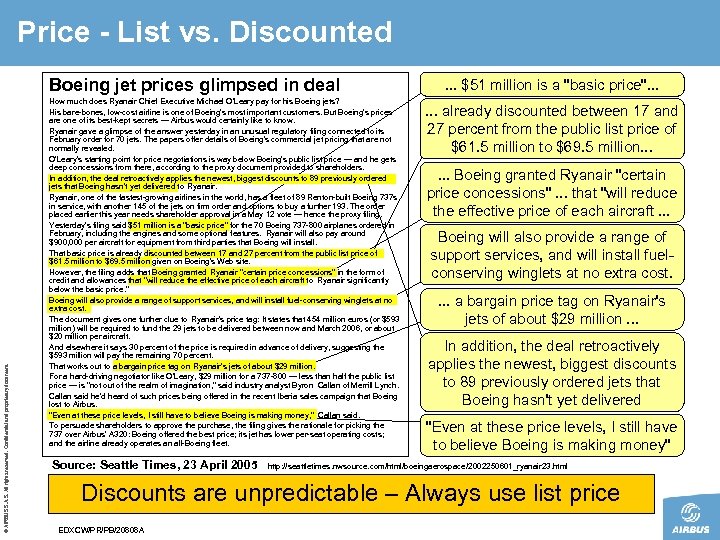
Price - List vs. Discounted © AIRBUS S. All rights reserved. Confidential and proprietary document. Boeing jet prices glimpsed in deal How much does Ryanair Chief Executive Michael O'Leary pay for his Boeing jets? His bare-bones, low-cost airline is one of Boeing's most important customers. But Boeing's prices are one of its best-kept secrets — Airbus would certainly like to know. Ryanair gave a glimpse of the answer yesterday in an unusual regulatory filing connected to its February order for 70 jets. The papers offer details of Boeing's commercial jet pricing that are not normally revealed. O'Leary's starting point for price negotiations is way below Boeing's public list price — and he gets deep concessions from there, according to the proxy document provided to shareholders. In addition, the deal retroactively applies the newest, biggest discounts to 89 previously ordered jets that Boeing hasn't yet delivered to Ryanair, one of the fastest-growing airlines in the world, has a fleet of 89 Renton-built Boeing 737 s in service, with another 145 of the jets on firm order and options to buy a further 193. The order placed earlier this year needs shareholder approval in a May 12 vote — hence the proxy filing. Yesterday's filing said $51 million is a "basic price" for the 70 Boeing 737 -800 airplanes ordered in February, including the engines and some optional features. Ryanair will also pay around $900, 000 per aircraft for equipment from third parties that Boeing will install. That basic price is already discounted between 17 and 27 percent from the public list price of $61. 5 million to $69. 5 million given on Boeing's Web site. However, the filing adds that Boeing granted Ryanair "certain price concessions" in the form of credit and allowances that "will reduce the effective price of each aircraft to Ryanair significantly below the basic price. " Boeing will also provide a range of support services, and will install fuel-conserving winglets at no extra cost. The document gives one further clue to Ryanair's price tag: It states that 454 million euros (or $593 million) will be required to fund the 29 jets to be delivered between now and March 2006, or about $20 million per aircraft. And elsewhere it says 30 percent of the price is required in advance of delivery, suggesting the $593 million will pay the remaining 70 percent. That works out to a bargain price tag on Ryanair's jets of about $29 million. For a hard-driving negotiator like O'Leary, $29 million for a 737 -800 — less than half the public list price — is "not out of the realm of imagination, " said industry analyst Byron Callan of Merrill Lynch. Callan said he'd heard of such prices being offered in the recent Iberia sales campaign that Boeing lost to Airbus. "Even at these price levels, I still have to believe Boeing is making money, " Callan said. To persuade shareholders to approve the purchase, the filing gives the rationale for picking the 737 over Airbus' A 320: Boeing offered the best price; its jet has lower per-seat operating costs; and the airline already operates an all-Boeing fleet. Source: Seattle Times, 23 April 2005 . . . $51 million is a "basic price". . . already discounted between 17 and 27 percent from the public list price of $61. 5 million to $69. 5 million. . . Boeing granted Ryanair "certain price concessions". . . that "will reduce the effective price of each aircraft. . . Boeing will also provide a range of support services, and will install fuelconserving winglets at no extra cost. . a bargain price tag on Ryanair's jets of about $29 million. . . In addition, the deal retroactively applies the newest, biggest discounts to 89 previously ordered jets that Boeing hasn't yet delivered "Even at these price levels, I still have to believe Boeing is making money" http: //seattletimes. nwsource. com/html/boeingaerospace/2002250601_ryanair 23. html Discounts are unpredictable – Always use list price EDXCW/PR/PB/20808 A
![Cost Estimation - RC Prediction • The Recurring Cost [RC] is the cost of](https://present5.com/presentation/b59646f4f570bfc17f1c3976165d23ca/image-71.jpg "Cost Estimation - RC Prediction • The Recurring Cost [RC] is the cost of")
Cost Estimation - RC Prediction • The Recurring Cost [RC] is the cost of making one aircraft 4 Materials, man-hours, transportation, bought items, energy, etc. 4 Cost prediction can be harder than price prediction. • There are two main methods: © AIRBUS S. All rights reserved. Confidential and proprietary document. 4 Top Down – Airframe cost = fn(Airframe Weight) – Method predicts light, high-tech structures are cheap (. . . rarely the case) – Fairly simple, good at OAD level, historical data driven - not particularly accurate – predicts yesterday’s cost tomorrow ? 4 Bottom up (Manufacturing process based) – Airframe cost = S(component costs) – Component cost = Material cost + Process Cost (Process cost includes man-hours, machining, energy, transportation) – Method correctly predicts heavy, simply machined components are cheap – More complicated, far more accurate, component & sub-component. . . See note on next page Aircraft cost is determined by the aircraft design EDXCW/PR/PB/20808 A
![Cost Estimation - NRC Prediction • Non-Recurring Cost [NRC] is the cost of design](https://present5.com/presentation/b59646f4f570bfc17f1c3976165d23ca/image-72.jpg "Cost Estimation - NRC Prediction • Non-Recurring Cost [NRC] is the cost of design")
Cost Estimation - NRC Prediction • Non-Recurring Cost [NRC] is the cost of design and set up for manufacture of a new aircraft • Consists of. . . Main stream engineering will typically take ~5 years 4 Tests: Wind tunnel test program, Materials & structures tests 4 Jig and tooling costs 4 Static & fatigue test airframes 4 Flight test aircraft - Typically costs about 30% more than a normal production aircraft © AIRBUS S. All rights reserved. Confidential and proprietary document. 4 Engineering: Note: RCs and NRCs, and hence aircraft cost, may already be a deliverable for the project Business Case chapter. – If so, use these values in the operating cost calculations – If not, a suggested NRC and RC estimation method can be found in: “Airplane Design, Part VIII: Airplane Cost Estimation” by Dr. J. Roskam. . . and maybe use the updated factors from the “AAA” method EDXCW/PR/PB/20808 A
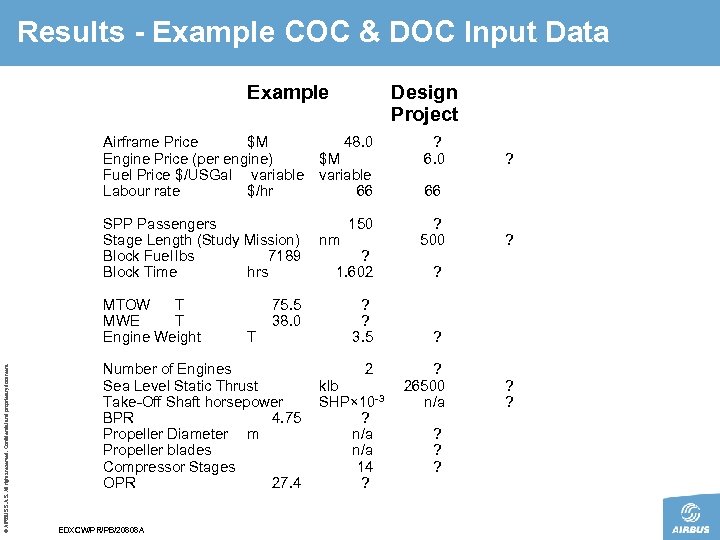
Results - Example COC & DOC Input Data Example Airframe Price $M Engine Price (per engine) Fuel Price $/USGal variable Labour rate $/hr SPP Passengers Stage Length (Study Mission) Block Fuel lbs 7189 Block Time hrs © AIRBUS S. All rights reserved. Confidential and proprietary document. MTOW T MWE T Engine Weight Design Project 48. 0 $M variable 66 nm 150 ? 1. 602 75. 5 38. 0 ? ? 3. 5 Number of Engines Sea Level Static Thrust Take-Off Shaft horsepower BPR 4. 75 Propeller Diameter m Propeller blades Compressor Stages OPR 27. 4 2 EDXCW/PR/PB/20808 A T klb SHP× 10 -3 ? n/a 14 ? ? 6. 0 ? 66 ? 500 ? ? ? ? 26500 n/a ? ? ?
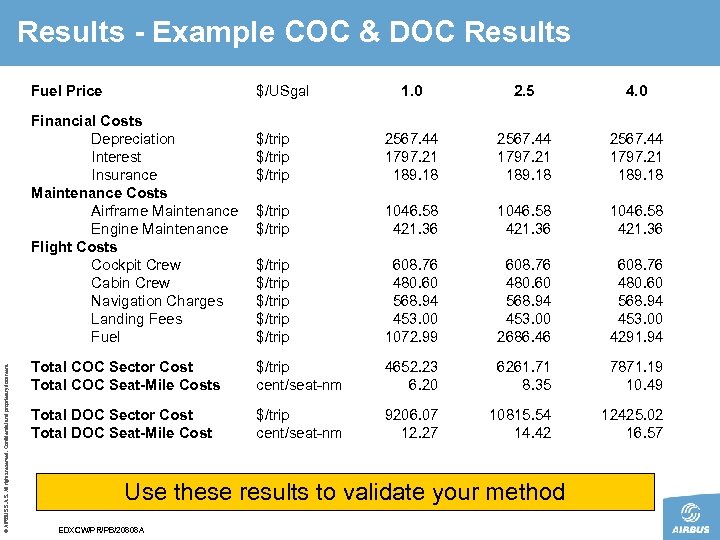
Results - Example COC & DOC Results Fuel Price $/USgal 1. 0 2. 5 4. 0 $/trip 2567. 44 1797. 21 189. 18 $/trip 1046. 58 421. 36 $/trip $/trip 608. 76 480. 60 568. 94 453. 00 1072. 99 608. 76 480. 60 568. 94 453. 00 2686. 46 608. 76 480. 60 568. 94 453. 00 4291. 94 Total COC Sector Cost Total COC Seat-Mile Costs $/trip cent/seat-nm 4652. 23 6. 20 6261. 71 8. 35 7871. 19 10. 49 Total DOC Sector Cost Total DOC Seat-Mile Cost $/trip cent/seat-nm 9206. 07 12. 27 10815. 54 14. 42 12425. 02 16. 57 © AIRBUS S. All rights reserved. Confidential and proprietary document. Financial Costs Depreciation Interest Insurance Maintenance Costs Airframe Maintenance Engine Maintenance Flight Costs Cockpit Crew Cabin Crew Navigation Charges Landing Fees Fuel Use these results to validate your method EDXCW/PR/PB/20808 A
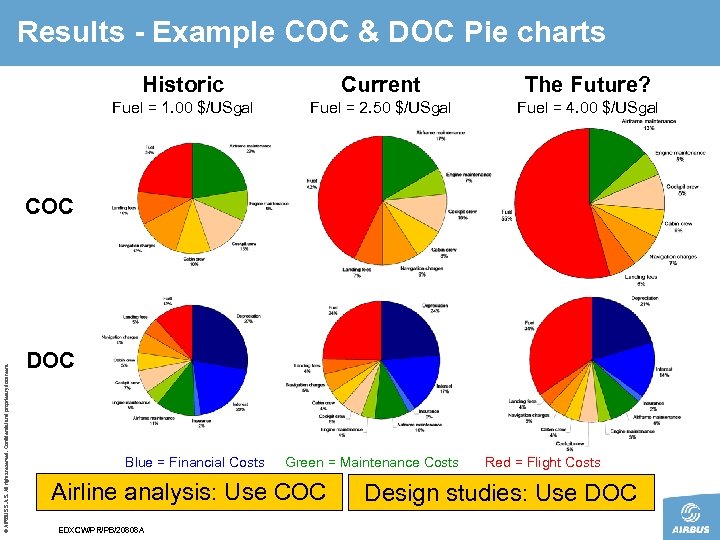
Results - Example COC & DOC Pie charts Historic Current The Future? Fuel = 1. 00 $/USgal Fuel = 2. 50 $/USgal Fuel = 4. 00 $/USgal © AIRBUS S. All rights reserved. Confidential and proprietary document. COC DOC Blue = Financial Costs Green = Maintenance Costs Airline analysis: Use COC EDXCW/PR/PB/20808 A Red = Flight Costs Design studies: Use DOC
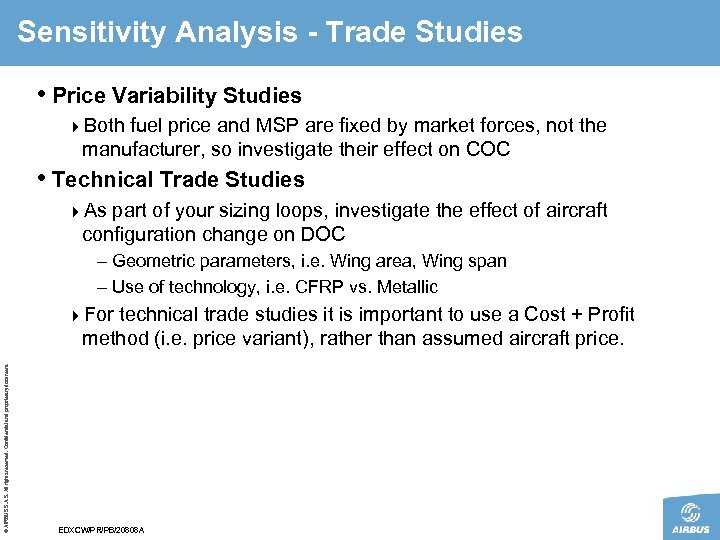
Sensitivity Analysis - Trade Studies • Price Variability Studies 4 Both fuel price and MSP are fixed by market forces, not the manufacturer, so investigate their effect on COC • Technical Trade Studies 4 As part of your sizing loops, investigate the effect of aircraft configuration change on DOC – Geometric parameters, i. e. Wing area, Wing span – Use of technology, i. e. CFRP vs. Metallic technical trade studies it is important to use a Cost + Profit method (i. e. price variant), rather than assumed aircraft price. © AIRBUS S. All rights reserved. Confidential and proprietary document. 4 For EDXCW/PR/PB/20808 A
This document and all information contained herein is the sole property of AIRBUS UK LTD. No intellectual property rights are granted by the delivery of this document or the disclosure of its content. This document shall not be reproduced or disclosed to a third party without the express written consent of AIRBUS UK LTD. This document and its content shall not be used for any purpose other than that for which it is supplied. © AIRBUS S. All rights reserved. Confidential and proprietary document. The statements made herein do not constitute an offer. They are based on the mentioned assumptions and are expressed in good faith. Where the supporting grounds for these statements are not shown, AIRBUS UK LTD will be pleased to explain the basis thereof. EDXCW/PR/PB/20808 A
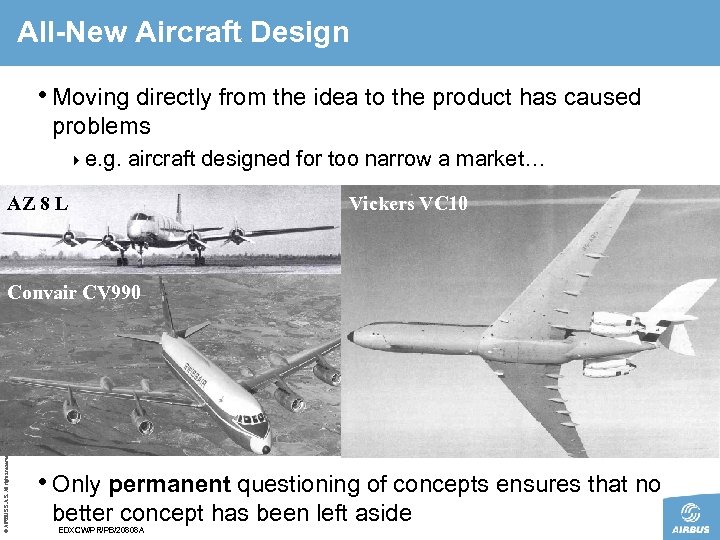
All-New Aircraft Design • Moving directly from the idea to the product has caused problems 4 e. g. aircraft designed for too narrow a market… AZ 8 L Vickers VC 10 © AIRBUS S. All rights reserved. Confidential and proprietary document. Convair CV 990 • Only permanent questioning of concepts ensures that no better concept has been left aside EDXCW/PR/PB/20808 A
© AIRBUS S. All rights reserved. Confidential and proprietary document. Carpet Plots EDXCW/PR/PB/20808 A
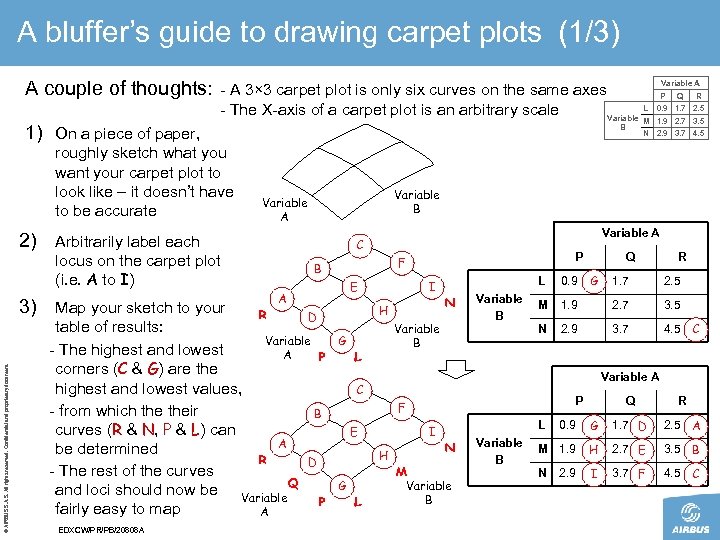
A bluffer’s guide to drawing carpet plots (1/3) A couple of thoughts: 1) On a piece of paper, - A 3× 3 carpet plot is only six curves on the same axes L - The X-axis of a carpet plot is an arbitrary scale Variable roughly sketch what you want your carpet plot to look like – it doesn’t have to be accurate © AIRBUS S. All rights reserved. Confidential and proprietary document. P F B E A I H D table of results: Variable - The highest and lowest A P corners (C & G) are the highest and lowest values, - from which their B curves (R & N, P & L) can A be determined R D - The rest of the curves Q and loci should now be Variable P fairly easy to map A EDXCW/PR/PB/20808 A N 2. 9 3. 7 4. 5 Variable A C R R Variable B Variable A 2) Arbitrarily label each 3) Map your sketch to your Q 0. 9 1. 7 2. 5 M 1. 9 2. 7 3. 5 B locus on the carpet plot (i. e. A to I) Variable A P G L Variable B M N N 0. 9 1. 7 2. 5 1. 9 2. 7 3. 5 2. 9 3. 7 4. 5 P F E I H L G R C Variable A C G Q M Variable B R 0. 9 G 1. 7 D 2. 5 A M 1. 9 H 2. 7 E 3. 5 B N I 3. 7 F 4. 5 C L N Q 2. 9
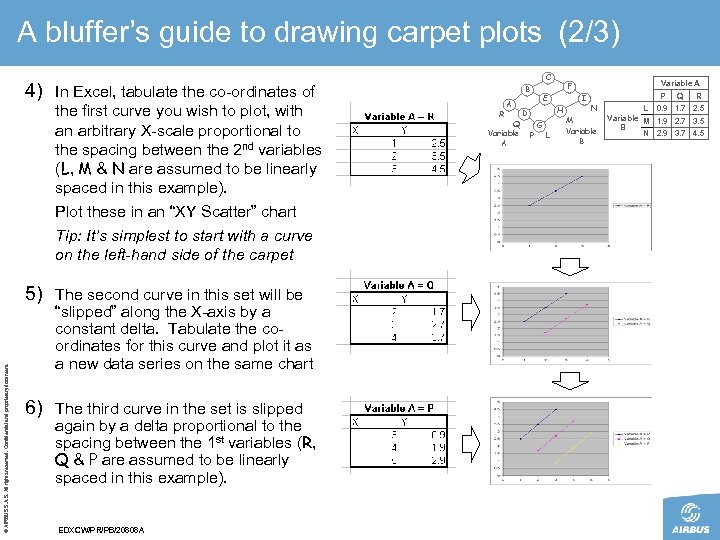
A bluffer’s guide to drawing carpet plots (2/3) C 4) In Excel, tabulate the co-ordinates of the first curve you wish to plot, with an arbitrary X-scale proportional to the spacing between the 2 nd variables (L, M & N are assumed to be linearly spaced in this example). Plot these in an “XY Scatter” chart Tip: It’s simplest to start with a curve on the left-hand side of the carpet © AIRBUS S. All rights reserved. Confidential and proprietary document. 5) The second curve in this set will be “slipped” along the X-axis by a constant delta. Tabulate the coordinates for this curve and plot it as a new data series on the same chart 6) The third curve in the set is slipped again by a delta proportional to the spacing between the 1 st variables (R, Q & P are assumed to be linearly spaced in this example). EDXCW/PR/PB/20808 A B R A Q Variable A E I H D P G L Variable A F P N M Variable B L Q R 0. 9 1. 7 2. 5 Variable M 1. 9 2. 7 3. 5 B N 2. 9 3. 7 4. 5
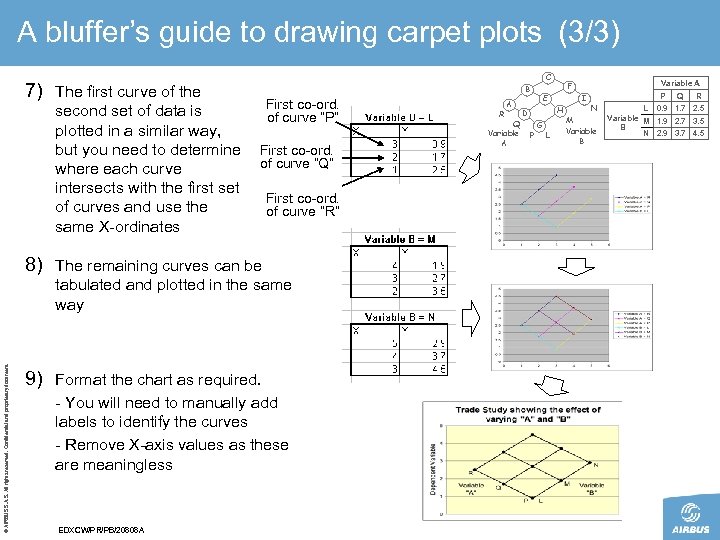
A bluffer’s guide to drawing carpet plots (3/3) C 7) The first curve of the second set of data is plotted in a similar way, but you need to determine where each curve intersects with the first set of curves and use the same X-ordinates B First co-ord. of curve “P” First co-ord. of curve “Q” First co-ord. of curve “R” 8) The remaining curves can be © AIRBUS S. All rights reserved. Confidential and proprietary document. tabulated and plotted in the same way 9) Format the chart as required. - You will need to manually add labels to identify the curves - Remove X-axis values as these are meaningless EDXCW/PR/PB/20808 A R A Q Variable A E I H D P G L Variable A F P N M Variable B L Q R 0. 9 1. 7 2. 5 Variable M 1. 9 2. 7 3. 5 B N 2. 9 3. 7 4. 5
Process & Performance • Use shared & common assumptions – discuss & agree. • Set up spreadsheets to facilitate quick turnaround of data – get the process right, otherwise you’ll waste time later in the multi iterations. • OAD Integration – Component level sizing loops are key: Excellent wing concept on a poor overall aircraft won’t work ! • Focus on generating data that assists decision making - sensitivities © AIRBUS S. All rights reserved. Confidential and proprietary document. 4 Initial ‘guesstimates’ on design weights (MTOW/ OWE/ Fuel/ PL). 4 Performance evaluation at key points in flight envelope to meet required P-R; –TOFL & BFL –First segment & second segment ROC requirements –ICA – Top of climb thrust available to give 300 fpm ROC margin –Fuel volume calcs for ‘assumed’ aero efficiency & weights • Don’t complicate the solution unless absolutely certain its needed. EDXCW/PR/PB/20808 A
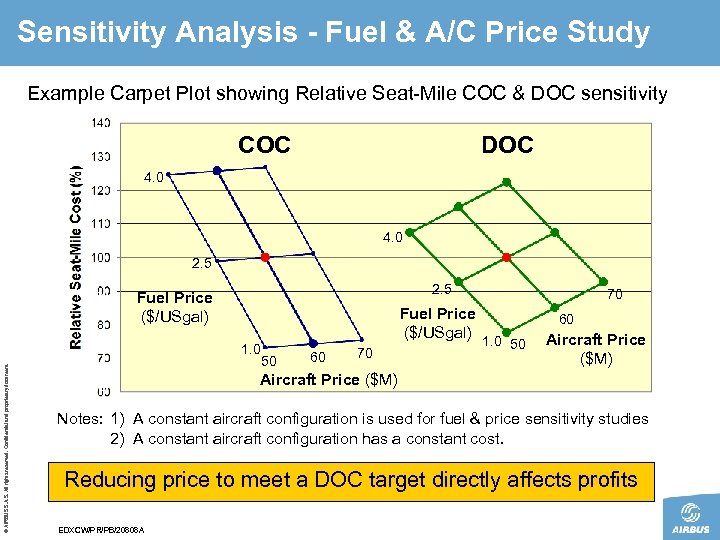
Sensitivity Analysis - Fuel & A/C Price Study Example Carpet Plot showing Relative Seat-Mile COC & DOC sensitivity COC DOC 4. 0 2. 5 Fuel Price ($/USgal) © AIRBUS S. All rights reserved. Confidential and proprietary document. 1. 0 50 60 70 Fuel Price ($/USgal) 1. 0 50 70 60 Aircraft Price ($M) Notes: 1) A constant aircraft configuration is used for fuel & price sensitivity studies 2) A constant aircraft configuration has a constant cost. Reducing price to meet a DOC target directly affects profits EDXCW/PR/PB/20808 A
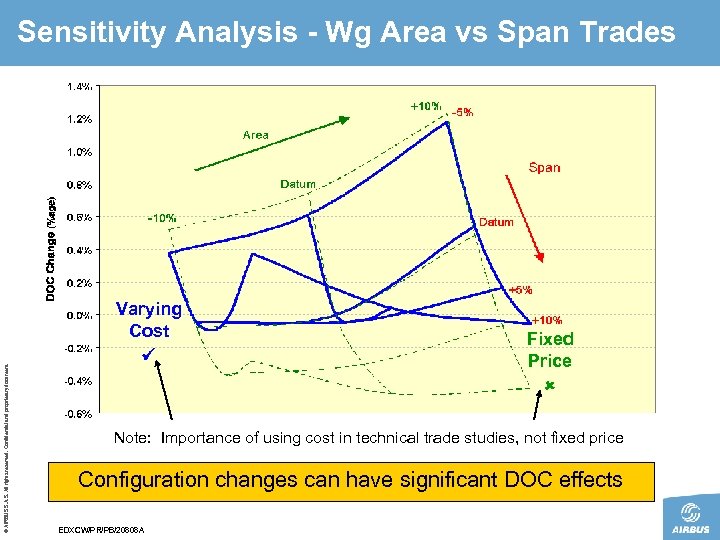
© AIRBUS S. All rights reserved. Confidential and proprietary document. Sensitivity Analysis - Wg Area vs Span Trades Varying Cost Fixed Price Note: Importance of using cost in technical trade studies, not fixed price Configuration changes can have significant DOC effects EDXCW/PR/PB/20808 A
Скачать презентацию P Bradshaw Skill Group Leader Airbus Future Projects
b59646f4f570bfc17f1c3976165d23ca.ppt