


 Скачать презентацию P A R T 3 Contracts Introduction to
a1e92db4d155cc30713016e53cef946f.ppt
- Количество слайдов: 17
 P A R T 3 Contracts Introduction to Contracts The Agreement: Offer The Agreement: Acceptance Consideration Reality of Consent Mc. Graw-Hill/Irwin Business Law, 13/e © 2007 The Mc. Graw-Hill Companies, Inc. All rights
 P A R T 3 Contracts Capacity to Contract Illegality Writing Rights of Third Parties Performance & Remedies Mc. Graw-Hill/Irwin Business Law, 13/e © 2007 The Mc. Graw-Hill Companies, Inc. All rights
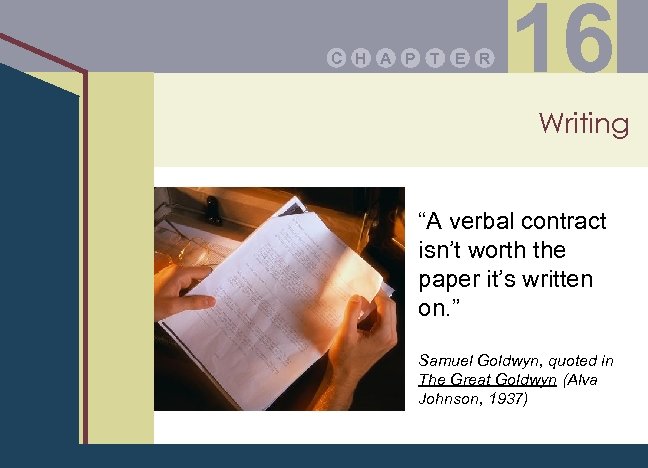 C H A P T E R 16 Writing “A verbal contract isn’t worth the paper it’s written on. ” Samuel Goldwyn, quoted in The Great Goldwyn (Alva Johnson, 1937)
 Learning Objectives v Significance of a writing in contract law v The Statute of Frauds v Contracts covered by the Statute of Frauds and the requirements v The UCC & the Statute of Frauds v The Parole Evidence Rule 16 - 5
 Basics v In general, a writing is not required to create a legally enforceable contract v Writing may be required by Statute of Frauds Enacted in 17 th century England to prevent fraud by requiring written evidence w American states adopted similar statutes w v. A contract is unenforceable if it does not satisfy the statute of frauds 16 - 6
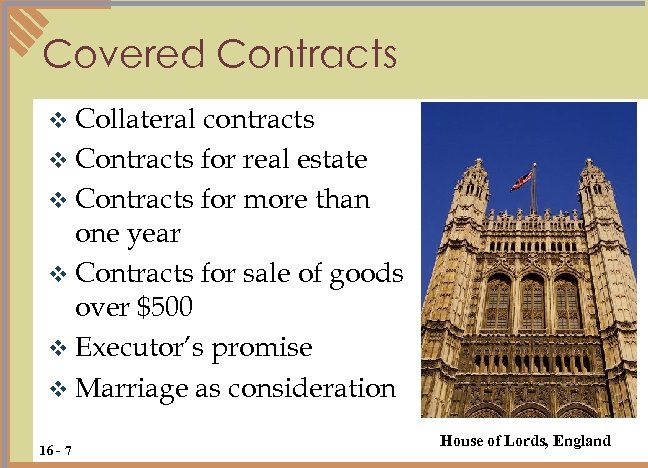 Covered Contracts v Collateral contracts v Contracts for real estate v Contracts for more than one year v Contracts for sale of goods over $500 v Executor’s promise v Marriage as consideration 16 - 7 House of Lords, England
 Collateral Contracts contracts in which a guarantor promises to perform an obligation of a principal debtor to a third person (obligee ) v Collateral Exception: under the main purpose or leading object rule, no writing required if guarantor makes a collateral promise for main purpose of obtaining personal economic advantage w See Wintersport Ltd. v. Millionaire. com , Inc. w 16 - 8
 Real Estate & Sale of Goods v. A writing is required for contracts for the transfer or sale of an interest in real estate w Some states require a writing for leases and certain easements on real property v UCC 2 -201 requires a writing for contracts for the sale of goods for a price of $500 or more 16 - 9
 The One Year Rule v. A writing is required for bilateral contracts that cannot be performed within a year from the date of their formation (one year rule ) w Likelihood of full performance is irrelevant v Test: w 16 - 10 is performance possible within year? Example: If Jack signs contract to consult with Company X on a 13 month project, the contract must be in writing to be enforceable
 Satisfying the Statute of Frauds v Most states require signed memorandum of parties’ agreement stating essential terms: (a) identity of parties, (b) subject matter identified with reasonable certainty, and (c) signed by the party to be charged w Need not be made at time contract is made w v Convention on International Sale of Goods does not require writing to enforce a contract 16 - 11
 The Parol Evidence Rule v Parol evidence rule provides that, when parties enter a written contract they intend as a complete integration (final statement of agreement), a court will not allow evidence of prior or contemporaneous statements to alter or contradict terms of written contract v Parol evidence is admissible to explain ambiguities or allegations of fraud 16 - 12
 Test Your Knowledge v True=A, False = B All contracts must be in writing to be enforceable. w A contract for the sale of a carpet for $499 must be in writing to be enforceable. w Jill orally promised the President of First Bank to pay Jack’s debt to First Bank if Jack defaulted on the note. Jack defaulted and Jill must pay Jack’s debt. w 16 - 13
 Test Your Knowledge v True=A, w 16 - 14 False = B Joey owes Chandler money, so Joey contracts with Loan. Co for a short-term loan. Chandler orally gave his personal guaranty to Loan. Co that Joey would repay the loan. Joey defaulted and Chandler must repay the loan for Joey.
 Test Your Knowledge v Multiple w Choice Parol evidence refers to: (a) The evidence required to prove a case w (b) Written or spoken statements not contained in the written contract w (c) The lack of evidence w 16 - 15
 Test Your Knowledge v Multiple w Choice Mamie agreed to sell Susan her Picasso painting. She wrote the name of the painting and $600 on a napkin. Both Mamie & Susan signed the napkin. Susan paid Mamie the money and Mamie: (a) May refuse to hand over the painting since contract was on a napkin and is unenforceable w (b) Must give Susan the painting since the contract satisfies the statute of frauds w 16 - 16
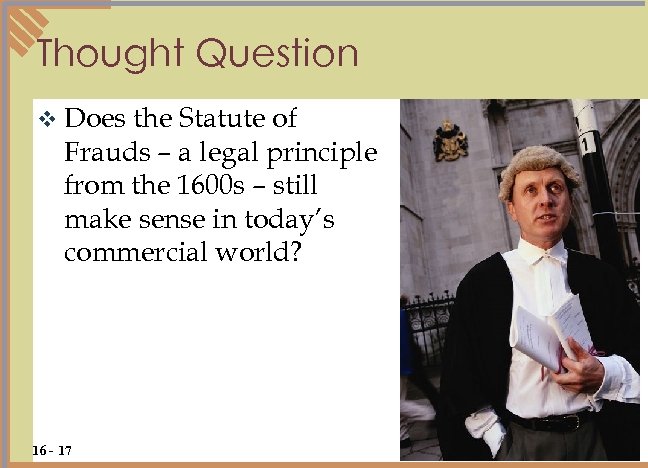 Thought Question v Does the Statute of Frauds – a legal principle from the 1600 s – still make sense in today’s commercial world? 16 - 17