


 Скачать презентацию P 2 Session 1 Demand Concepts Key
684fddfe0e3f78e04f02e99995f99622.ppt
- Количество слайдов: 13
 P 2 Session 1 Demand Concepts
 Key Concepts 1. A competitive market. 2. Relative price as an opportunity cost 3. Definition of demand. 4. Determinants of individual demand. 5. The demand function. 6. The law of demand. 7. The demand schedule. 8. The demand curve. 9. Substitution vs Income effects 10. The ceteris paribus assumption. 11. Demand marginal benefit 12. Value vs Price 13. Willingness to pay 14. Consumer surplus 15. Individual vs Market demand.
 Price and Opportunity Cost • A competitive market is a market that has many buyers and many sellers so no single buyer or seller can influence the price. • The money price of a good is the amount of money needed to buy it. • The relative price of a good—the ratio of its money price to the money price of the next best alternative good—is its opportunity cost.
 Demand • If you demand something, then you: Want it, can afford it, plan to buy it. • Wants are the unlimited desires or wishes people have for goods and services. • Demand reflects a decision about which wants to satisfy. • The quantity demanded of a good or service is the amount that consumers plan to buy during a particular time period, and at a particular price.
 Demand The Law of Demand The law of demand states: • Other things remaining the same (ceteris paribus the determinants of demand), the higher the price of a good, the smaller is the quantity demanded and vice-versa. • The law of demand results from the: – Substitution effect & Income effect
 Demand • Substitution effect – When the relative price (opportunity cost) of a good rises, people seek substitutes for it, so the quantity demanded of the original good decreases. • Income effect – When the price of a good rises relative to income, people cannot afford all the things they previously bought, so the
 Demand Curve and Demand Schedule • The term demand refers to the entire relationship between the price of the good and quantity demanded of the good. • A demand curve shows the relationship between the quantity demanded of a good and its price when all other influences on consumers’ planned purchases remain the same.
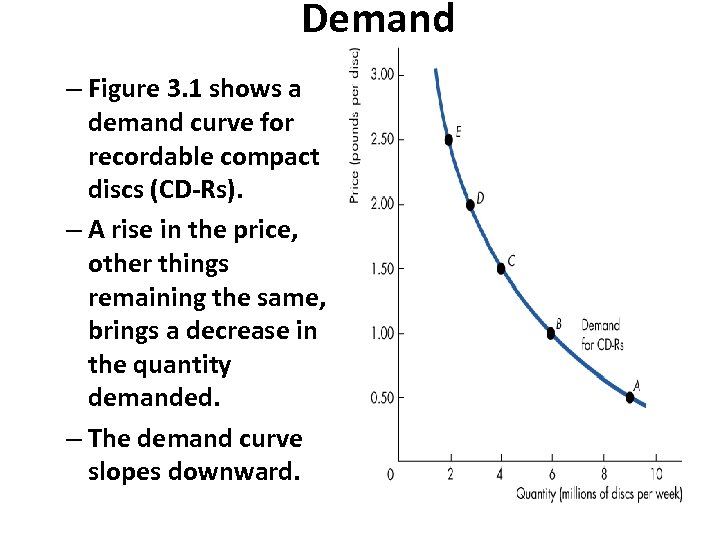 Demand – Figure 3. 1 shows a demand curve for recordable compact discs (CD-Rs). – A rise in the price, other things remaining the same, brings a decrease in the quantity demanded. – The demand curve slopes downward.
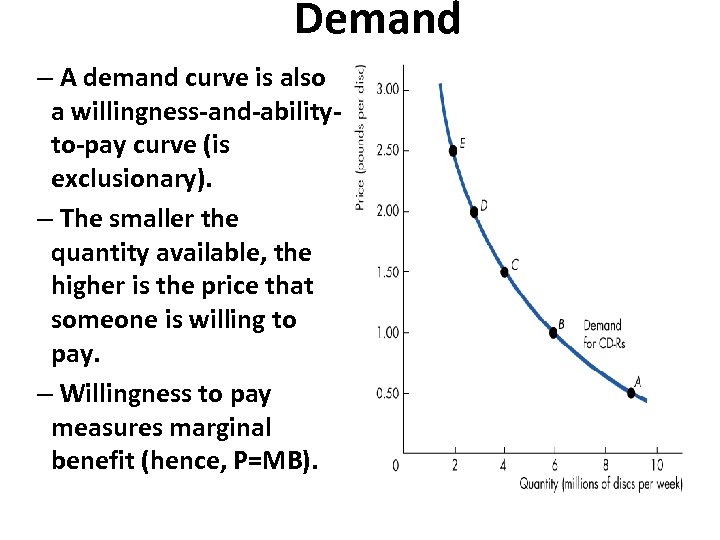 Demand – A demand curve is also a willingness-and-abilityto-pay curve (is exclusionary). – The smaller the quantity available, the higher is the price that someone is willing to pay. – Willingness to pay measures marginal benefit (hence, P=MB).
 Demand, Willingness to Pay, and Value The value of one more unit of a good or service is its marginal benefit. We measure marginal benefit by the maximum price that is willingly paid for another unit of the good or service. But willingness to pay determines demand. A demand curve is a marginal benefit curve.
 Individual Demand Market Demand – The individual demand for a good is the relationship between the price of the good and the quantity demanded by one person. – The market demand for a good is the relationship between the price of the good and total (market) quantity demanded of that good. – The Figure on the next slide shows how we sum (horizontally) the individual demand curves to obtain the market demand curve.
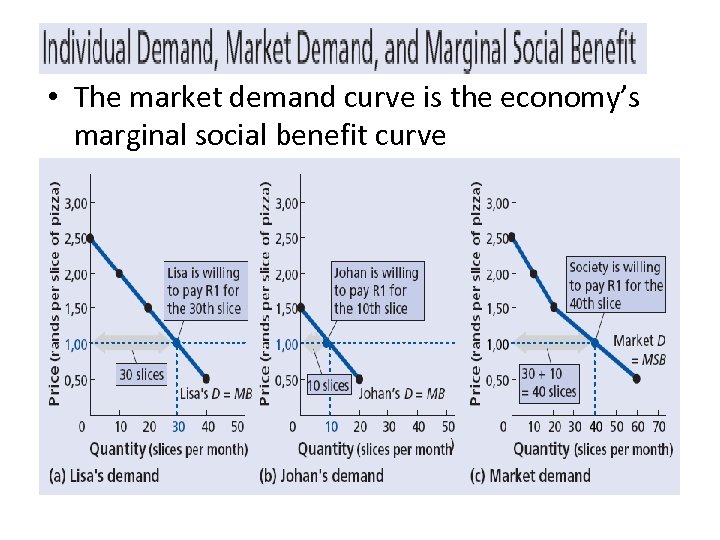 • The market demand curve is the economy’s marginal social benefit curve
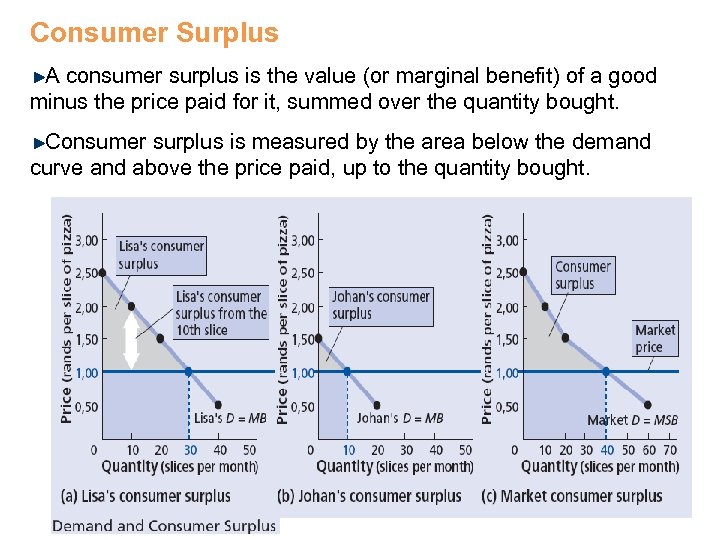 Consumer Surplus A consumer surplus is the value (or marginal benefit) of a good minus the price paid for it, summed over the quantity bought. Consumer surplus is measured by the area below the demand curve and above the price paid, up to the quantity bought.