


 Скачать презентацию P 2 Implementing Declarative Overlays Timothy Roscoe P
3f25c8fad4d3dc7993cc1070cc21c2cf.ppt
- Количество слайдов: 40
 P 2: Implementing Declarative Overlays Timothy Roscoe P 2 Intel Research Boon Thau Loo, Tyson Condie, David Gay, Joseph M. Hellerstein, Petros Maniatis, Ion Stoica Intel Research at Berkeley UC Berkeley Timothy Roscoe
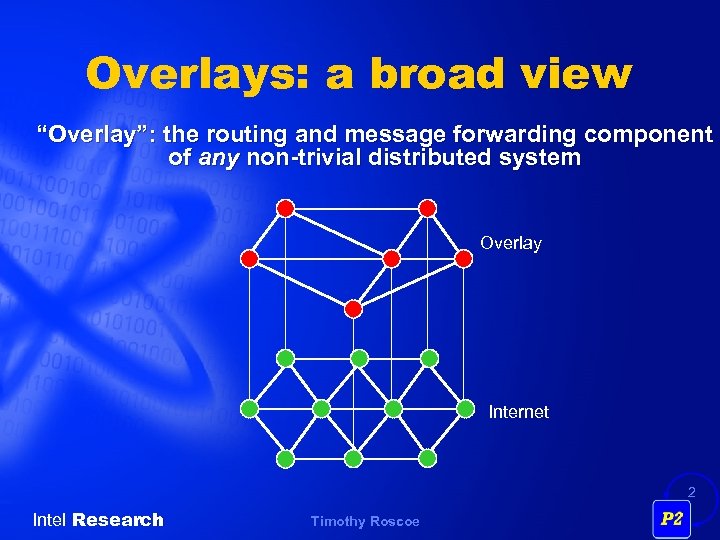 Overlays: a broad view “Overlay”: the routing and message forwarding component of any non-trivial distributed system Overlay Internet 2 Intel Research Timothy Roscoe
 Overlays Everywhere… Many examples: Internet Routing, multicast Content delivery, file sharing, DHTs, Google Microsoft Exchange Tibco (technology interoperation) Overlays are a fundamental tool for repurposing communication infrastructures Distributedfriends together and build your systems innovation needs overlays Get a bunch of own ISP (Internet evolvability) You don’t like Internet Routing? Make up your own rules (RON) Internet Paranoid? Run Freenet Intrusion detection with friends (DDI, Polygraph) Have your assets discover each other (i. AMT) 3 Intel Research Timothy Roscoe
 If only it weren’t so hard In theory But in practice Figure out right properties No global view Get the algorithms and protocols Wrong choice of algorithms Implement them Incorrect implementation Pathological timeouts It’s hard enough as it is Do Test them wheel every I also need to reinvent the Partial failures time? Tune them Debug them Impaired introspection Repeat Homicidal boredom Next to no debug support 4 Intel Research Timothy Roscoe
 Our Goal Make network development more accessible to developers of distributed applications Specify network at a high-level Automatically translate specification into executable Hide everything they don’t want to touch Enjoy performance that is good enough Do for networked systems what SQL and the relational model did for databases 5 Intel Research Timothy Roscoe
 The argument: The set of routing tables in a network represents a distributed data structure The data structure is characterized by a set of ideal properties which define the network Thinking in terms of structure, not protocol Routing is the process of maintaining these properties in the face of changing ground facts Failures, topology changes, load, policy… 6 Intel Research Timothy Roscoe
 Routing as Query Processing In database terms, the routing table is a view over changing network conditions and state Maintaining it is the domain of distributed continuous query processing Not merely an analogy: We have implemented a general routing protocol engine as a query processor. 7 Intel Research Timothy Roscoe
 Two directions 1. Declarative expression of Internet Routing protocols • Loo et. al. , ACM SIGCOMM 2005 2. Declarative implementation of overlay networks • Loo et. al. , ACM SOSP 2005 • The focus of this talk (and my work) 8 Intel Research Timothy Roscoe
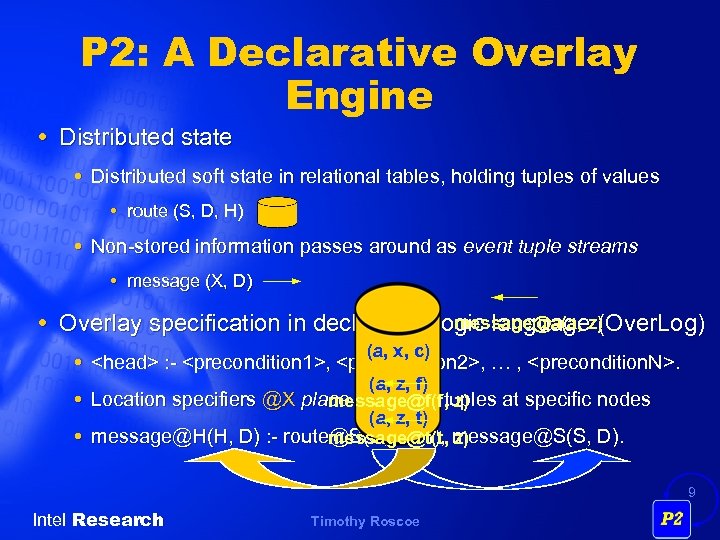 P 2: A Declarative Overlay Engine Distributed state Distributed soft state in relational tables, holding tuples of values route (S, D, H) Non-stored information passes around as event tuple streams message (X, D) message@a(a, ( Overlay specification in declarative logic languagez) Over. Log) (a, x, c)
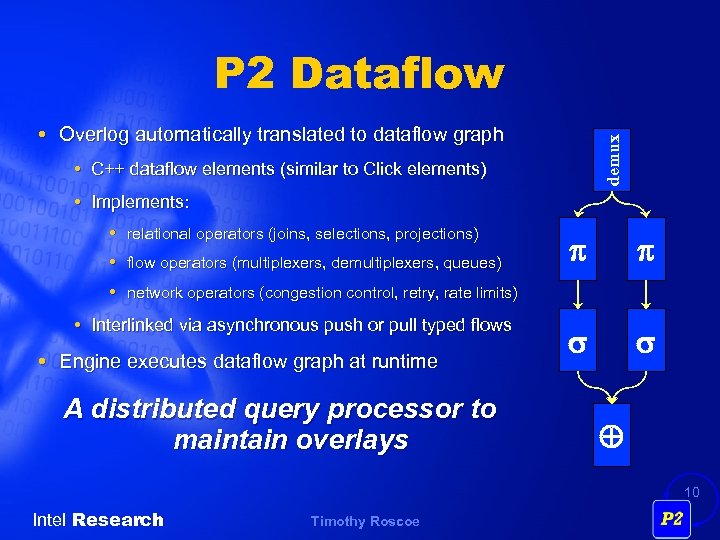 P 2 Dataflow demux Overlog automatically translated to dataflow graph C++ dataflow elements (similar to Click elements) Implements: relational operators (joins, selections, projections) flow operators (multiplexers, demultiplexers, queues) network operators (congestion control, retry, rate limits) Interlinked via asynchronous push or pull typed flows Engine executes dataflow graph at runtime A distributed query processor to maintain overlays 10 Intel Research Timothy Roscoe
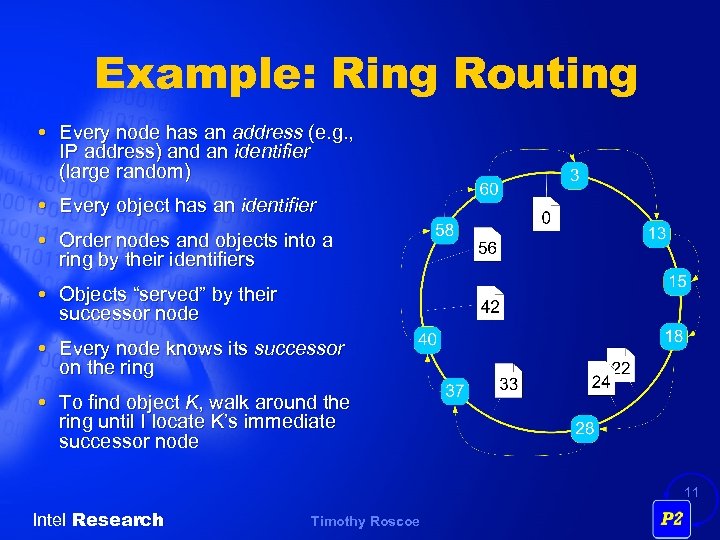 Example: Ring Routing Every node has an address (e. g. , IP address) and an identifier (large random) Every object has an identifier Order nodes and objects into a ring by their identifiers Objects “served” by their successor node Every node knows its successor on the ring To find object K, walk around the ring until I locate K’s immediate successor node 11 Intel Research Timothy Roscoe
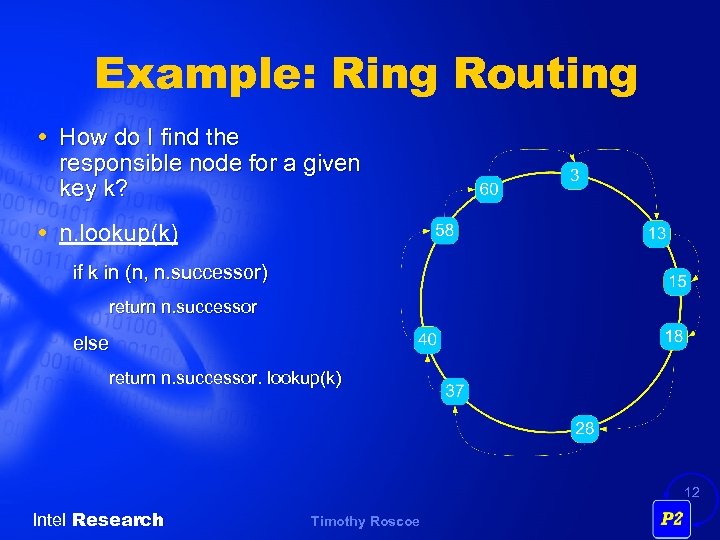 Example: Ring Routing How do I find the responsible node for a given key k? n. lookup(k) if k in (n, n. successor) return n. successor else return n. successor. lookup(k) 12 Intel Research Timothy Roscoe
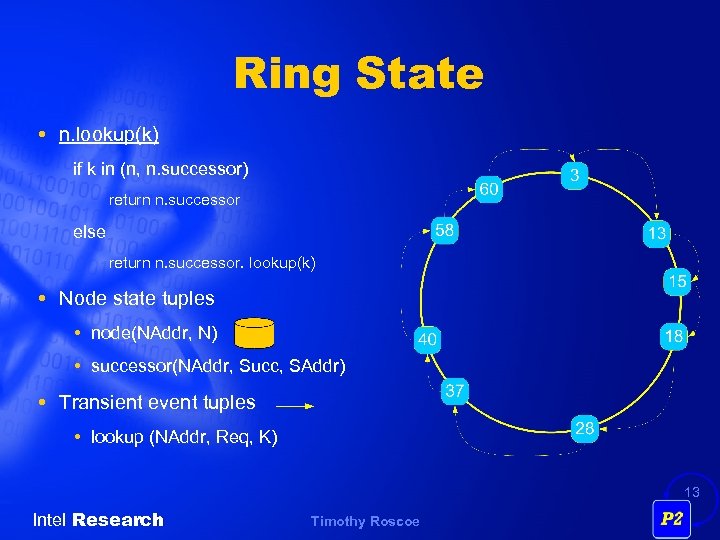 Ring State n. lookup(k) if k in (n, n. successor) return n. successor else return n. successor. lookup(k) Node state tuples node(NAddr, N) successor(NAddr, Succ, SAddr) Transient event tuples lookup (NAddr, Req, K) 13 Intel Research Timothy Roscoe
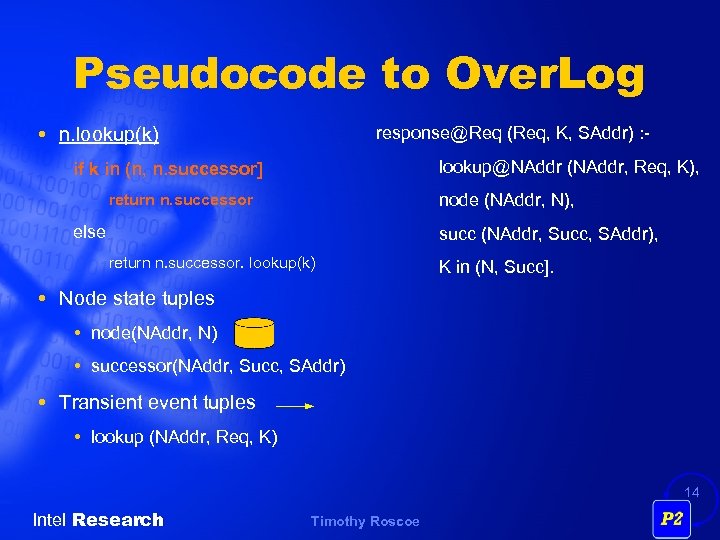 Pseudocode to Over. Log n. lookup(k) response@Req (Req, K, SAddr) : lookup@NAddr (NAddr, Req, K), if k in (n, n. successor] node (NAddr, N), return n. successor else succ (NAddr, Succ, SAddr), return n. successor. lookup(k) K in (N, Succ]. Node state tuples node(NAddr, N) successor(NAddr, Succ, SAddr) Transient event tuples lookup (NAddr, Req, K) 14 Intel Research Timothy Roscoe
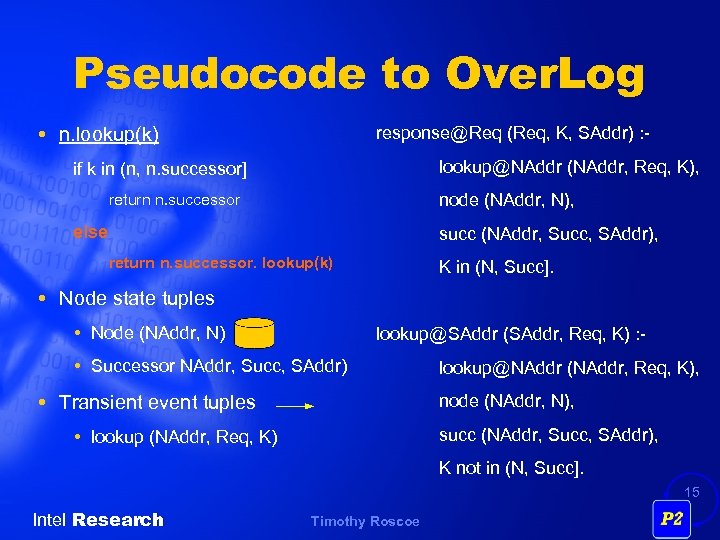 Pseudocode to Over. Log n. lookup(k) response@Req (Req, K, SAddr) : lookup@NAddr (NAddr, Req, K), if k in (n, n. successor] node (NAddr, N), return n. successor else succ (NAddr, Succ, SAddr), return n. successor. lookup(k) K in (N, Succ]. Node state tuples Node (NAddr, N) lookup@SAddr (SAddr, Req, K) : - Successor NAddr, Succ, SAddr) Transient event tuples lookup@NAddr (NAddr, Req, K), node (NAddr, N), succ (NAddr, Succ, SAddr), lookup (NAddr, Req, K) K not in (N, Succ]. 15 Intel Research Timothy Roscoe
 Implementation: From Over. Log to Dataflow Traditional problem in databases Turn logic into relational algebra Joins, projections, selections, aggregations, etc. 17 Intel Research Timothy Roscoe
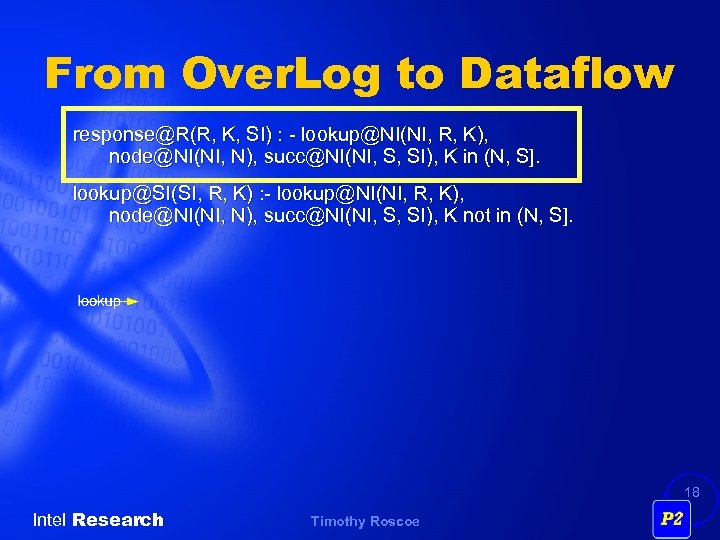 From Over. Log to Dataflow response@R(R, K, SI) : - lookup@NI(NI, R, K), node@NI(NI, N), succ@NI(NI, S, SI), K in (N, S]. lookup@SI(SI, R, K) : - lookup@NI(NI, R, K), node@NI(NI, N), succ@NI(NI, S, SI), K not in (N, S]. 18 Intel Research Timothy Roscoe
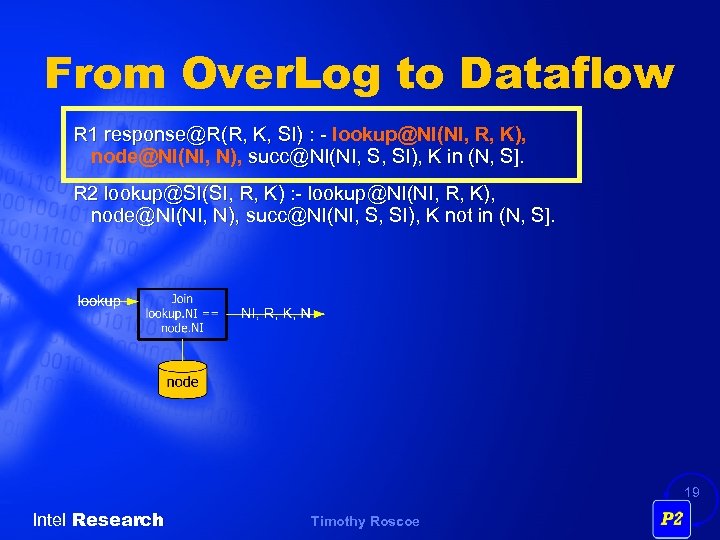 From Over. Log to Dataflow R 1 response@R(R, K, SI) : - lookup@NI(NI, R, K), node@NI(NI, N), succ@NI(NI, S, SI), K in (N, S]. R 2 lookup@SI(SI, R, K) : - lookup@NI(NI, R, K), node@NI(NI, N), succ@NI(NI, S, SI), K not in (N, S]. 19 Intel Research Timothy Roscoe
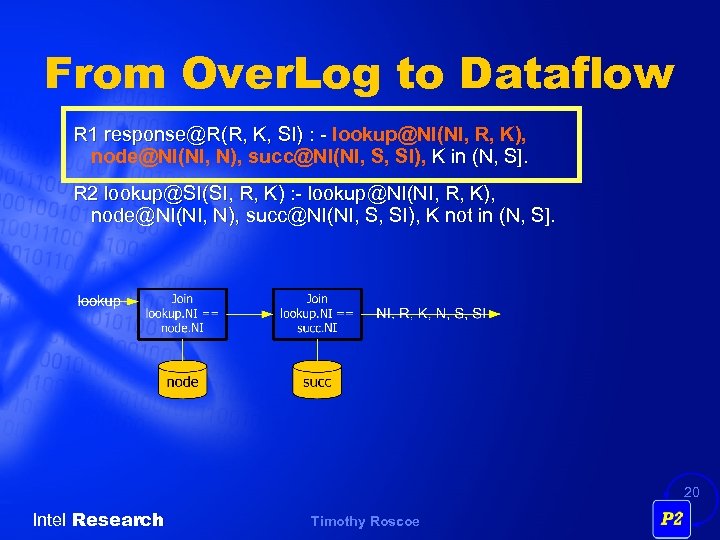 From Over. Log to Dataflow R 1 response@R(R, K, SI) : - lookup@NI(NI, R, K), node@NI(NI, N), succ@NI(NI, S, SI), K in (N, S]. R 2 lookup@SI(SI, R, K) : - lookup@NI(NI, R, K), node@NI(NI, N), succ@NI(NI, S, SI), K not in (N, S]. 20 Intel Research Timothy Roscoe
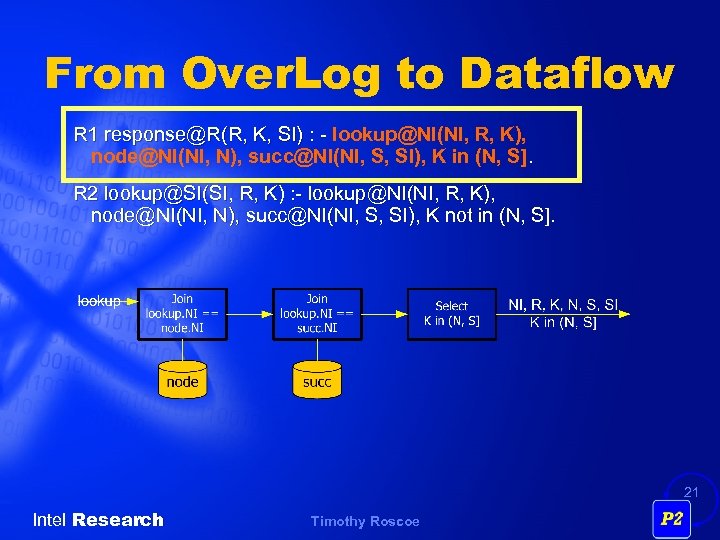 From Over. Log to Dataflow R 1 response@R(R, K, SI) : - lookup@NI(NI, R, K), node@NI(NI, N), succ@NI(NI, S, SI), K in (N, S]. R 2 lookup@SI(SI, R, K) : - lookup@NI(NI, R, K), node@NI(NI, N), succ@NI(NI, S, SI), K not in (N, S]. 21 Intel Research Timothy Roscoe
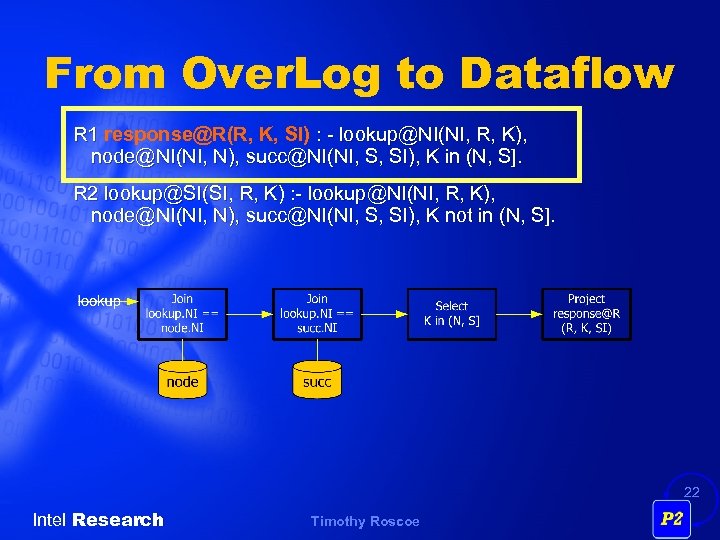 From Over. Log to Dataflow R 1 response@R(R, K, SI) : - lookup@NI(NI, R, K), node@NI(NI, N), succ@NI(NI, S, SI), K in (N, S]. R 2 lookup@SI(SI, R, K) : - lookup@NI(NI, R, K), node@NI(NI, N), succ@NI(NI, S, SI), K not in (N, S]. 22 Intel Research Timothy Roscoe
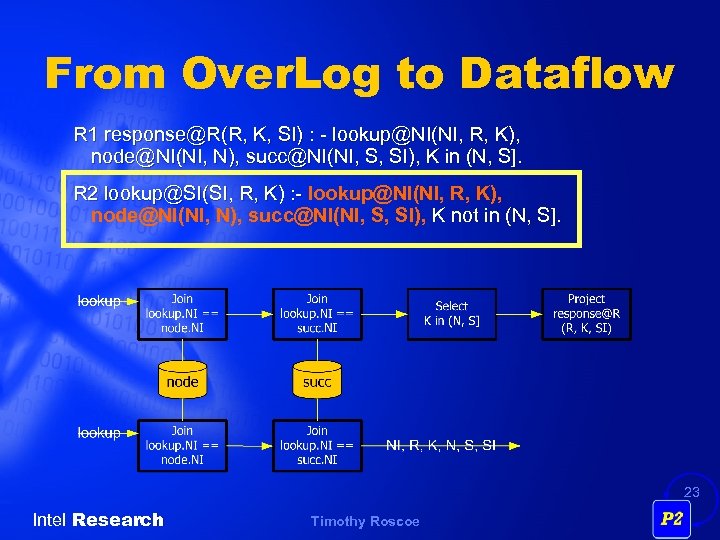 From Over. Log to Dataflow R 1 response@R(R, K, SI) : - lookup@NI(NI, R, K), node@NI(NI, N), succ@NI(NI, S, SI), K in (N, S]. R 2 lookup@SI(SI, R, K) : - lookup@NI(NI, R, K), node@NI(NI, N), succ@NI(NI, S, SI), K not in (N, S]. 23 Intel Research Timothy Roscoe
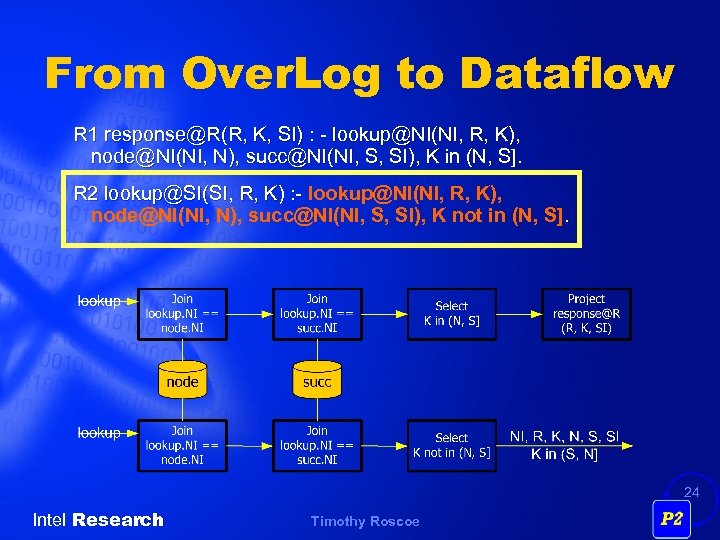 From Over. Log to Dataflow R 1 response@R(R, K, SI) : - lookup@NI(NI, R, K), node@NI(NI, N), succ@NI(NI, S, SI), K in (N, S]. R 2 lookup@SI(SI, R, K) : - lookup@NI(NI, R, K), node@NI(NI, N), succ@NI(NI, S, SI), K not in (N, S]. 24 Intel Research Timothy Roscoe
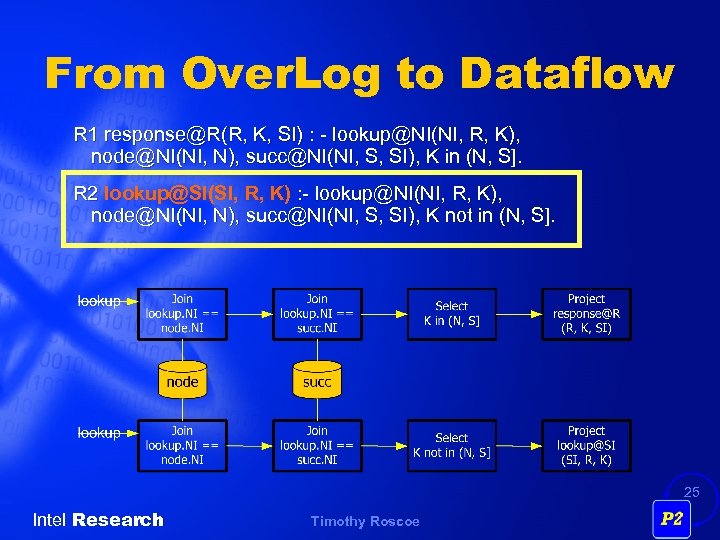 From Over. Log to Dataflow R 1 response@R(R, K, SI) : - lookup@NI(NI, R, K), node@NI(NI, N), succ@NI(NI, S, SI), K in (N, S]. R 2 lookup@SI(SI, R, K) : - lookup@NI(NI, R, K), node@NI(NI, N), succ@NI(NI, S, SI), K not in (N, S]. 25 Intel Research Timothy Roscoe
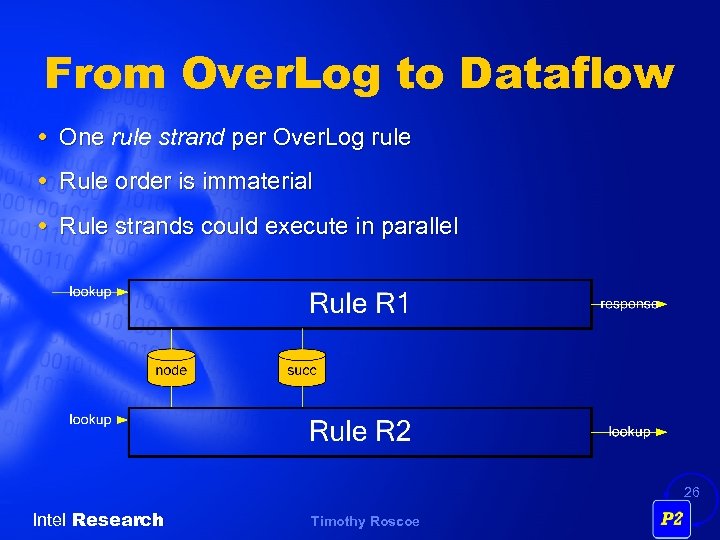 From Over. Log to Dataflow One rule strand per Over. Log rule Rule order is immaterial Rule strands could execute in parallel 26 Intel Research Timothy Roscoe
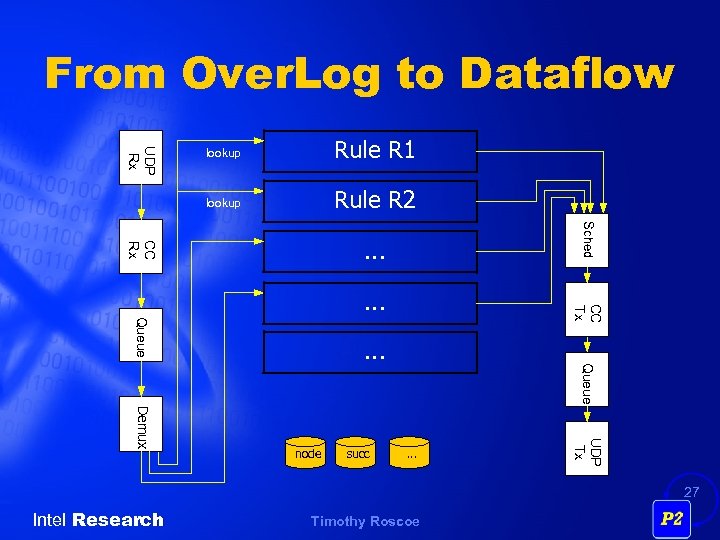 From Over. Log to Dataflow Rule R 1 lookup UDP Rx lookup Rule R 2 Sched CC Rx . . . Queue CC Tx . . . succ . . . UDP Tx Demux node Queue . . . 27 Intel Research Timothy Roscoe
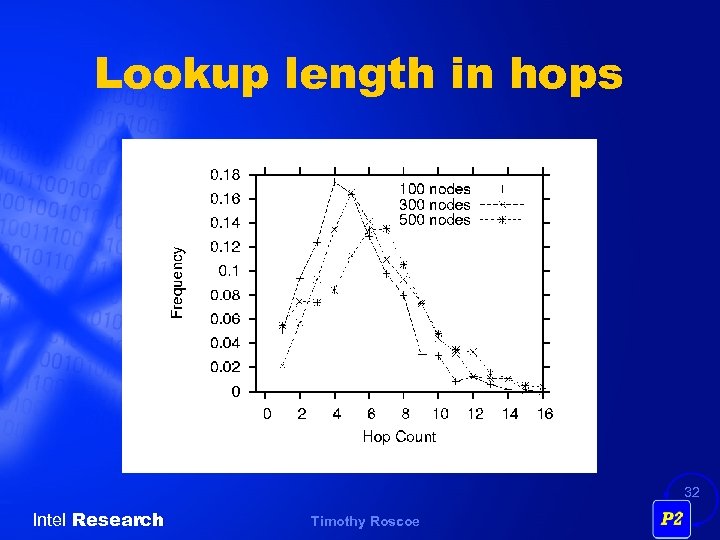
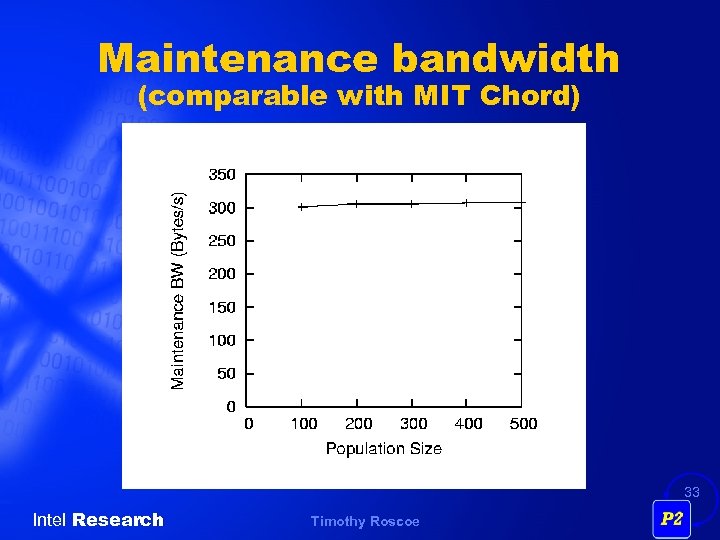
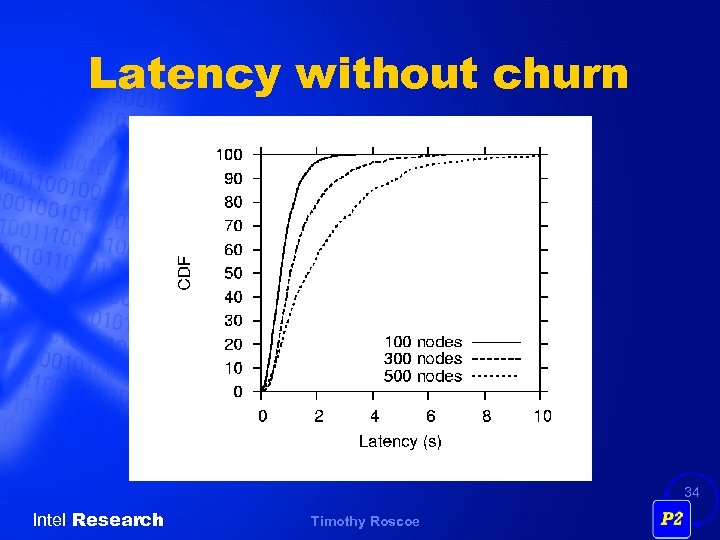
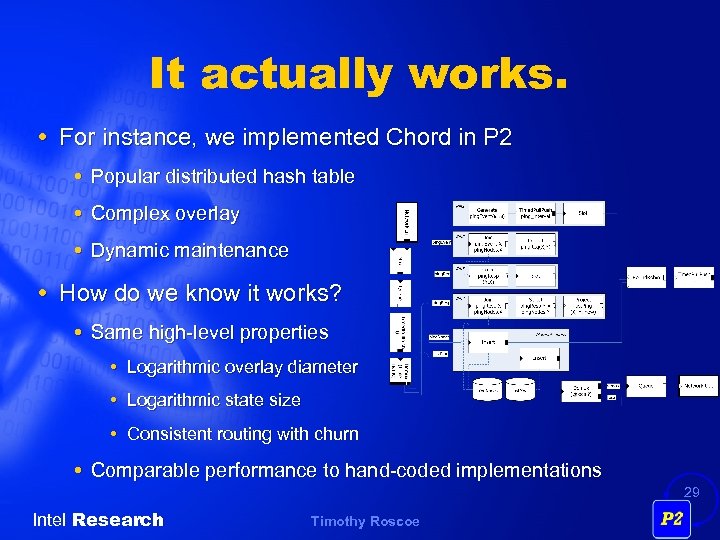 It actually works. For instance, we implemented Chord in P 2 Popular distributed hash table Complex overlay Dynamic maintenance How do we know it works? Same high-level properties Logarithmic overlay diameter Logarithmic state size Consistent routing with churn Comparable performance to hand-coded implementations 29 Intel Research Timothy Roscoe
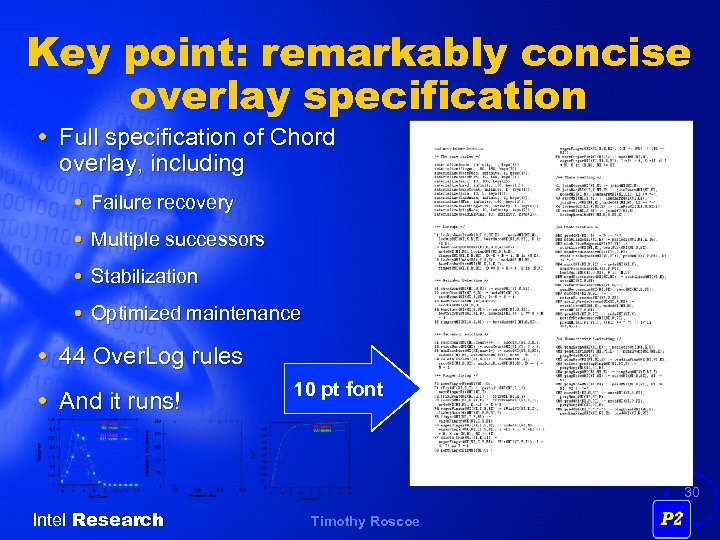 Key point: remarkably concise overlay specification Full specification of Chord overlay, including Failure recovery Multiple successors Stabilization Optimized maintenance 44 Over. Log rules And it runs! 10 pt font 30 Intel Research Timothy Roscoe
 Comparison: MIT Chord in C++ 31 Intel Research Timothy Roscoe
 Lookup length in hops 32 Intel Research Timothy Roscoe
 Maintenance bandwidth (comparable with MIT Chord) 33 Intel Research Timothy Roscoe
 Latency without churn 34 Intel Research Timothy Roscoe
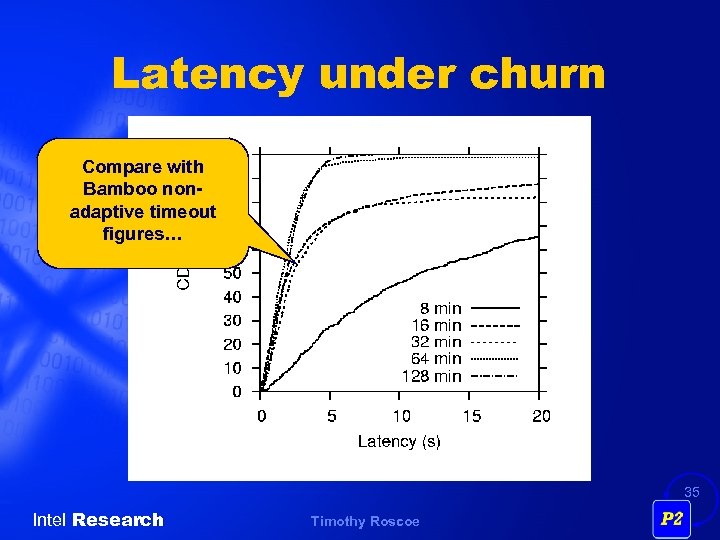 Latency under churn Compare with Bamboo nonadaptive timeout figures… 35 Intel Research Timothy Roscoe
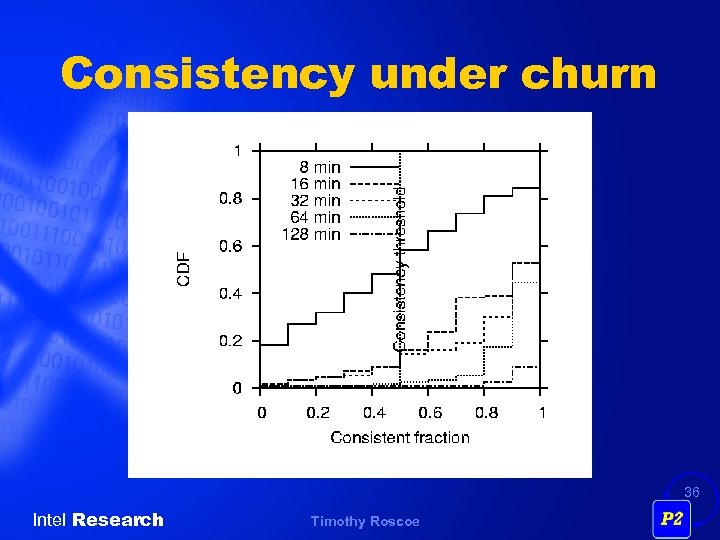 Consistency under churn 36 Intel Research Timothy Roscoe
 The story so far: Can specify overlays as continuous queries in a logic language Compile to a graph of dataflow elements Efficiently execute graph to perform routing and forwarding Overlays exhibit similar performance characteristics But … Once you have a distributed query processor, lots of things fall off the back of the truck… 37 Intel Research Timothy Roscoe
 What else does this buy you? Introspection (w/ Atul Singh, Rice) Overlay invariant monitoring: a distributed watchpoint “What’s the average path length? ” “Is routing consistent? ” Execution tracing at “pseudo-code” granularity: logical stepping Why did rule R 7 trigger? … and at dataflow granularity: intermediate representation stepping Why did that tuple expire? Great way to do distributed debugging and logging In fact, we use it and have found a number of bugs… 38 Intel Research Timothy Roscoe
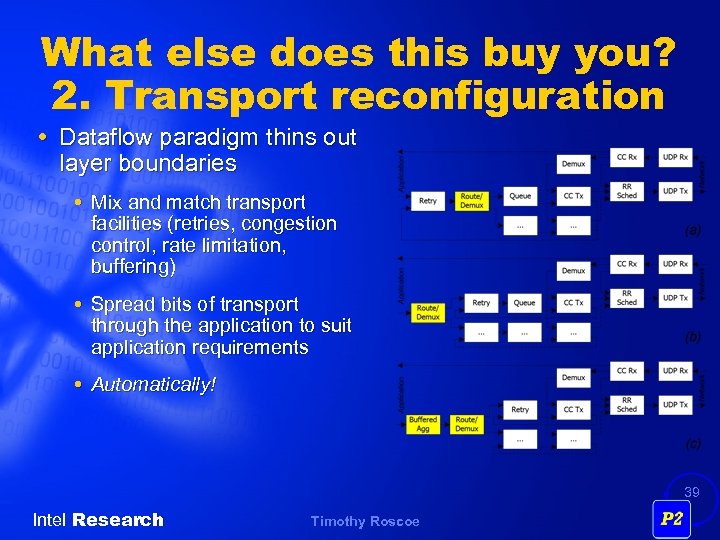 What else does this buy you? 2. Transport reconfiguration Dataflow paradigm thins out layer boundaries Mix and match transport facilities (retries, congestion control, rate limitation, buffering) Spread bits of transport through the application to suit application requirements Automatically! 39 Intel Research Timothy Roscoe
 In fact, a rich seam for future research… Reconfigurable transport protocols Debugging and logging support The “right” language – global invariants Use distributed joins as abstraction mechanism Optimization techniques Inc. multiquery optimization Monitoring other distributed systems and networks Evolve towards more general query processor? PIER heritage returns 40 Intel Research Timothy Roscoe
 Summary Overlays enable distributed system innovation We’d better make them easier to build, reuse, understand P 2 enables High-level overlay specification in Over. Log Automatic translation of specification into dataflow graph Execution of dataflow graph Explore and Embrace the trade-off between fine-tuning and ease of development Get the full immersion treatment in our paper in SOSP ’ 05, code release imminent 41 Intel Research Timothy Roscoe
 Thanks! Questions? A few to get you started: Who cares about overlays? Logic? You mean Prolog? Eeew! This language is really ugly. Discuss. But what about security? Is anyone ever going to use this? Is this as revolutionary and inspired as it looks? 42 Intel Research Timothy Roscoe