 Скачать презентацию P 08003 Portable Obstacle Course Any opinions findings
0b20acaf933dae581bc8b452874c8033.ppt
- Количество слайдов: 23



P 08003 Portable Obstacle Course Any opinions, findings, and conclusions or recommendations expressed in this material are those of the author and do not necessarily reflect the views of the National Science Foundation. Jared Berman (ME) Allison Hill (EE) Nicolette Mc. George (ISE) Samir Mian (CE) Shadle Stewart (ME)
Agenda • Project Description • High Level Customer Needs • Description of Design • Final Product • Verification of Specifications • Project Finalization • Project Evaluation • Future Recommendations
Project Description • Physical Therapy Clinic of Nazareth College: J. J. Mowder-Tinney • There is no commercial product readily available to recreate daily household movements. • Our objective is to create an obstacle course to simulate a more realistic experience for stroke patients re-learning how to walk.
Project Description • An ideal course would allow for various: – Terrain – Routes – Lengths – Difficulty – Obstacles • The course must track: – Obstacle location – Surface type and orientation
Customer Needs • Portable, easy-to-use obstacle course • Repeatable, reusable and reconfigurable • Should be able to keep track of obstacle and surface orientation • Safety
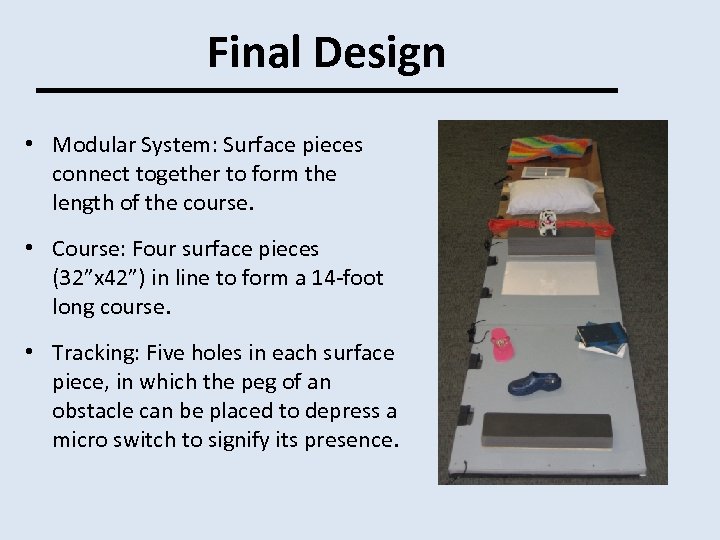
Final Design • Modular System: Surface pieces connect together to form the length of the course. • Course: Four surface pieces (32”x 42”) in line to form a 14 -foot long course. • Tracking: Five holes in each surface piece, in which the peg of an obstacle can be placed to depress a micro switch to signify its presence.
Surfaces and Obstacles Surfaces • • • Carpet (with padding) • High/Low Hardwood • Dark/Light Concrete Ice Gravel Rubber Mat Obstacles • • • Throw-rugs (4) Curb • 3 -inch/6 -inch Heater Vent Threshold Shoes (4) Pillows (2) Bundle of Cords (2) Stuffed animal (2) Stack of Books
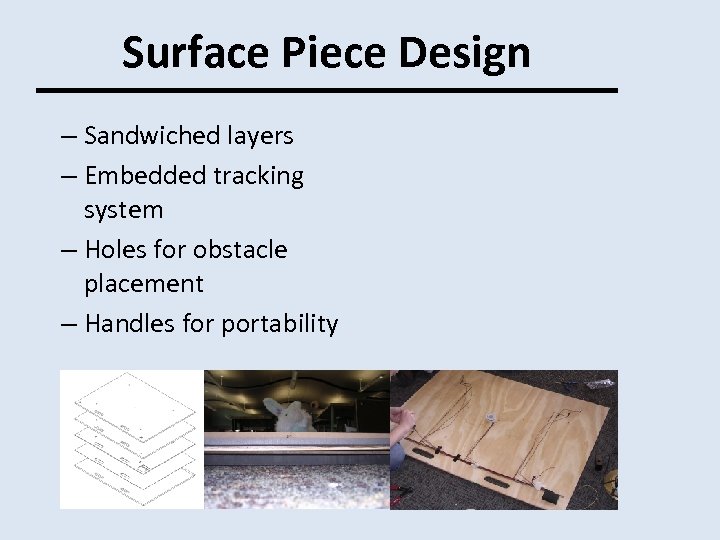
Surface Piece Design – Sandwiched layers – Embedded tracking system – Holes for obstacle placement – Handles for portability
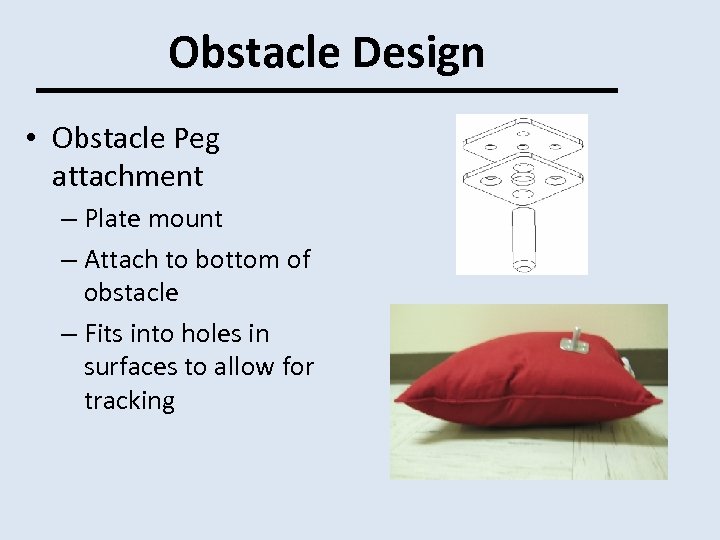
Obstacle Design • Obstacle Peg attachment – Plate mount – Attach to bottom of obstacle – Fits into holes in surfaces to allow for tracking
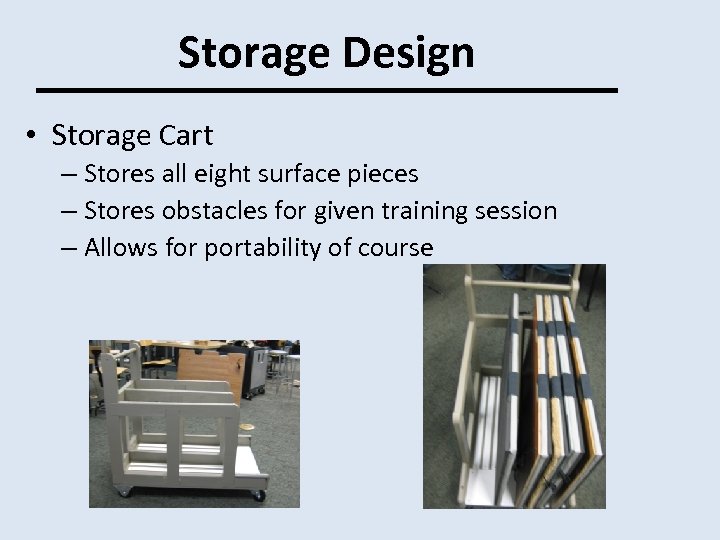
Storage Design • Storage Cart – Stores all eight surface pieces – Stores obstacles for given training session – Allows for portability of course
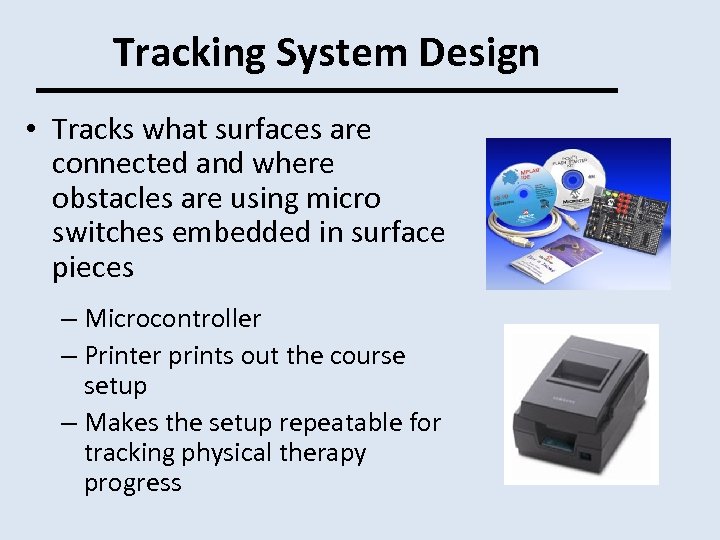
Tracking System Design • Tracks what surfaces are connected and where obstacles are using micro switches embedded in surface pieces – Microcontroller – Printer prints out the course setup – Makes the setup repeatable for tracking physical therapy progress
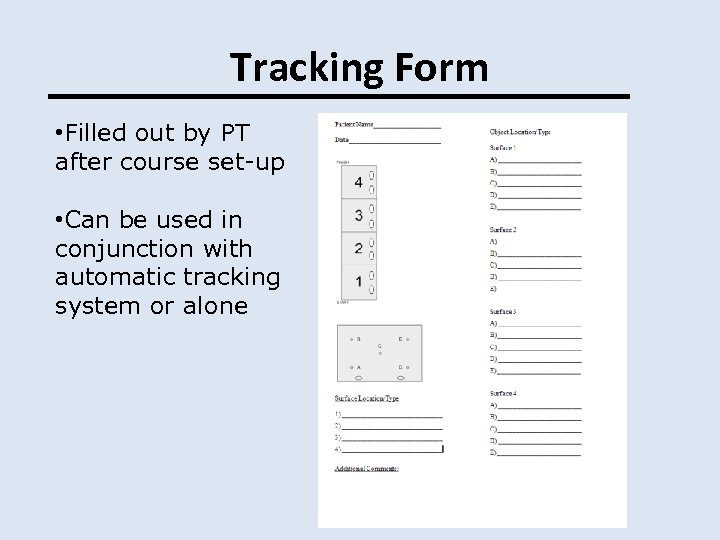
Tracking Form • Filled out by PT after course set-up • Can be used in conjunction with automatic tracking system or alone
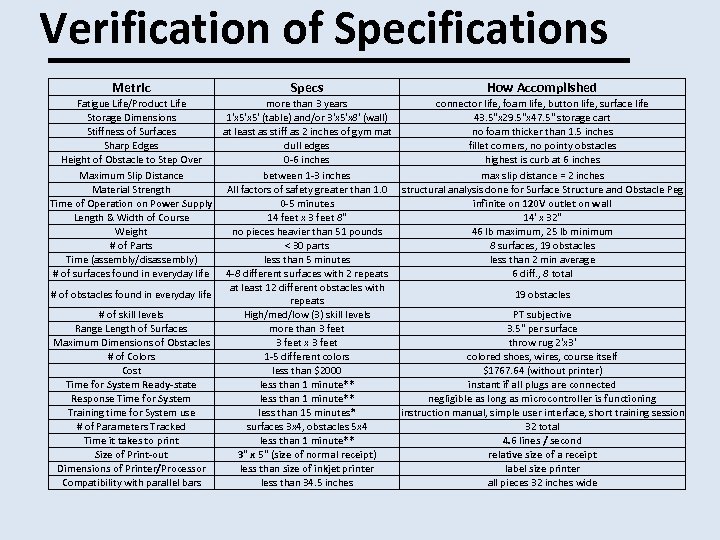
Verification of Specifications Metric Specs How Accomplished Fatigue Life/Product Life Storage Dimensions Stiffness of Surfaces Sharp Edges Height of Obstacle to Step Over more than 3 years 1'x 5' (table) and/or 3'x 5'x 8' (wall) at least as stiff as 2 inches of gym mat dull edges 0 -6 inches connector life, foam life, button life, surface life 43. 5"x 29. 5"x 47. 5" storage cart no foam thicker than 1. 5 inches fillet corners, no pointy obstacles highest is curb at 6 inches Maximum Slip Distance Material Strength Time of Operation on Power Supply Length & Width of Course Weight # of Parts Time (assembly/disassembly) # of surfaces found in everyday life between 1 -3 inches All factors of safety greater than 1. 0 0 -5 minutes 14 feet x 3 feet 8" no pieces heavier than 51 pounds < 30 parts less than 5 minutes 4 -8 different surfaces with 2 repeats at least 12 different obstacles with repeats High/med/low (3) skill levels more than 3 feet x 3 feet 1 -5 different colors less than $2000 less than 1 minute** less than 15 minutes* surfaces 3 x 4, obstacles 5 x 4 less than 1 minute** 3" x 5" (size of normal receipt) less than size of inkjet printer less than 34. 5 inches max slip distance = 2 inches structural analysis done for Surface Structure and Obstacle Peg infinite on 120 V outlet on wall 14' x 32" 46 lb maximum, 25 lb minimum 8 surfaces, 19 obstacles less than 2 min average 6 diff. , 8 total # of obstacles found in everyday life # of skill levels Range Length of Surfaces Maximum Dimensions of Obstacles # of Colors Cost Time for System Ready-state Response Time for System Training time for System use # of Parameters Tracked Time it takes to print Size of Print-out Dimensions of Printer/Processor Compatibility with parallel bars 19 obstacles PT subjective 3. 5" per surface throw rug 2'x 3' colored shoes, wires, course itself $1767. 64 (without printer) instant if all plugs are connected negligible as long as microcontroller is functioning instruction manual, simple user interface, short training session 32 total 4. 6 lines / second relative size of a receipt label size printer all pieces 32 inches wide
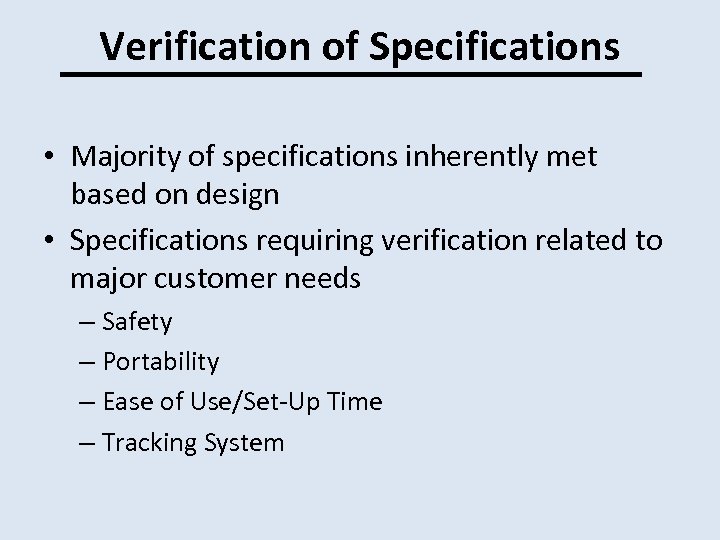
Verification of Specifications • Majority of specifications inherently met based on design • Specifications requiring verification related to major customer needs – Safety – Portability – Ease of Use/Set-Up Time – Tracking System
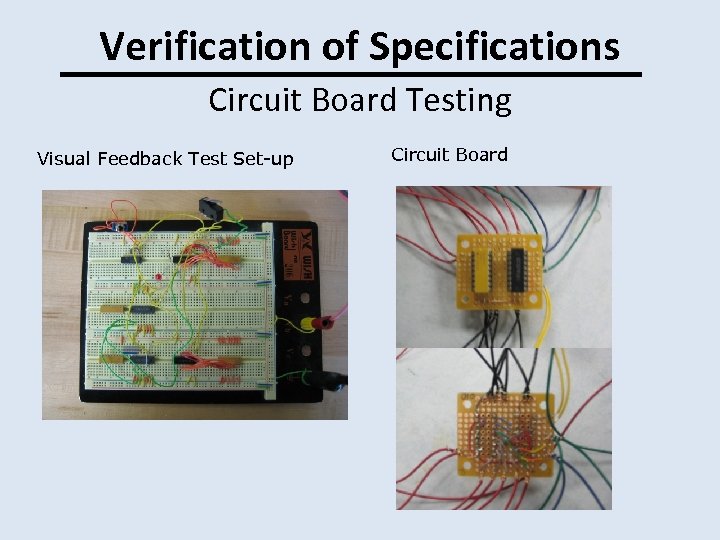
Verification of Specifications Circuit Board Testing Visual Feedback Test Set-up Circuit Board
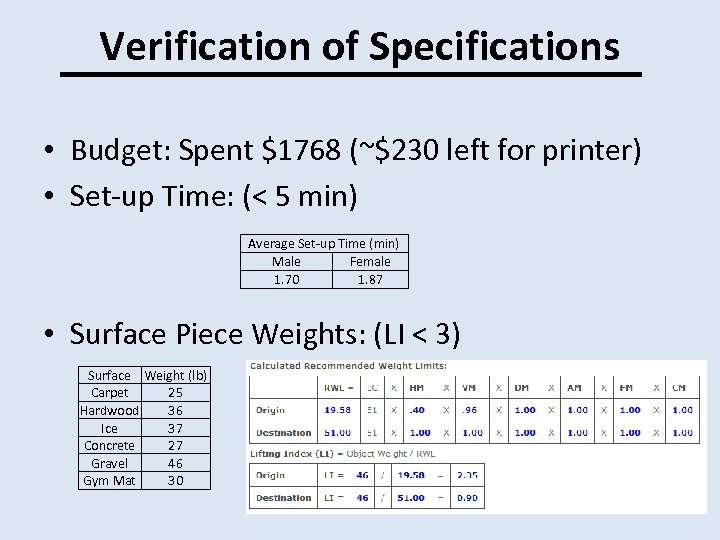
Verification of Specifications • Budget: Spent $1768 (~$230 left for printer) • Set-up Time: (< 5 min) Average Set-up Time (min) Male Female 1. 70 1. 87 • Surface Piece Weights: (LI < 3) Surface Weight (lb) Carpet 25 Hardwood 36 Ice 37 Concrete 27 Gravel 46 Gym Mat 30
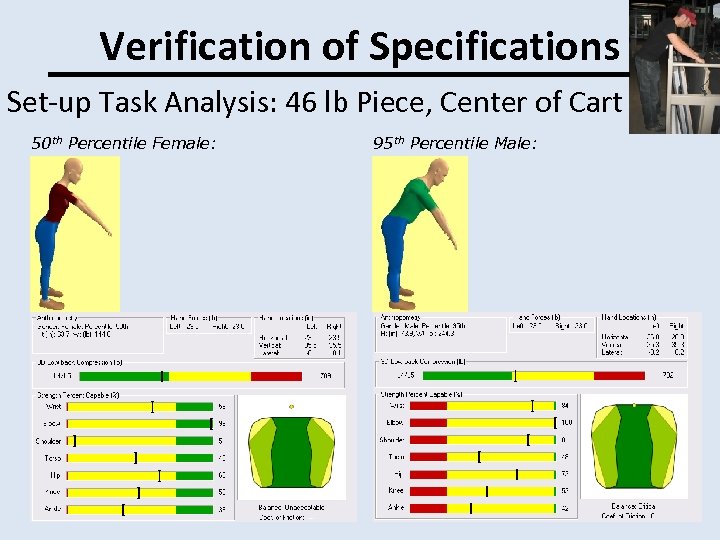
Verification of Specifications Set-up Task Analysis: 46 lb Piece, Center of Cart 50 th Percentile Female: 95 th Percentile Male:
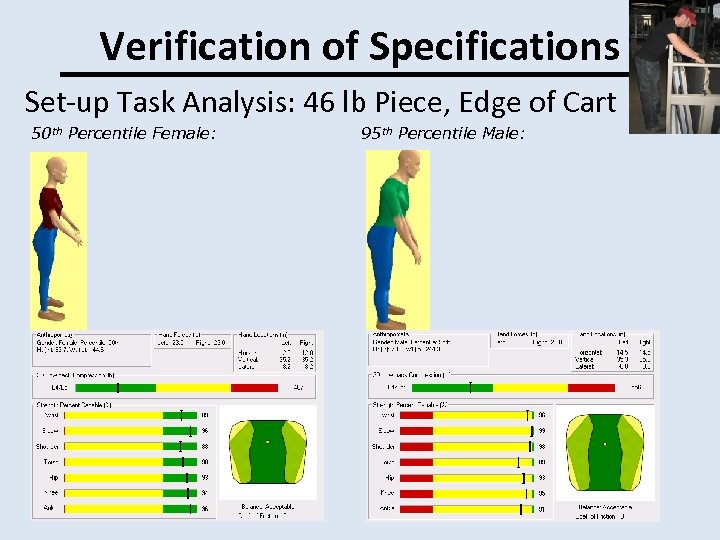
Verification of Specifications Set-up Task Analysis: 46 lb Piece, Edge of Cart 50 th Percentile Female: 95 th Percentile Male:
Project Finalization Due to constraints on manufacturing, there is still some construction remaining Plan for Next Week: • Finish Remaining Surface Pieces & Obstacles • Test Functionality of Embedded Circuitry • Deliver Course to Nazareth - minus components needed for independent study
Project Evaluation Weaknesses • Course is not automated for tracking • No printout is provided for PT • Certain pieces are heavier than optimal weight • Underestimation of manufacturing and programming necessary for design
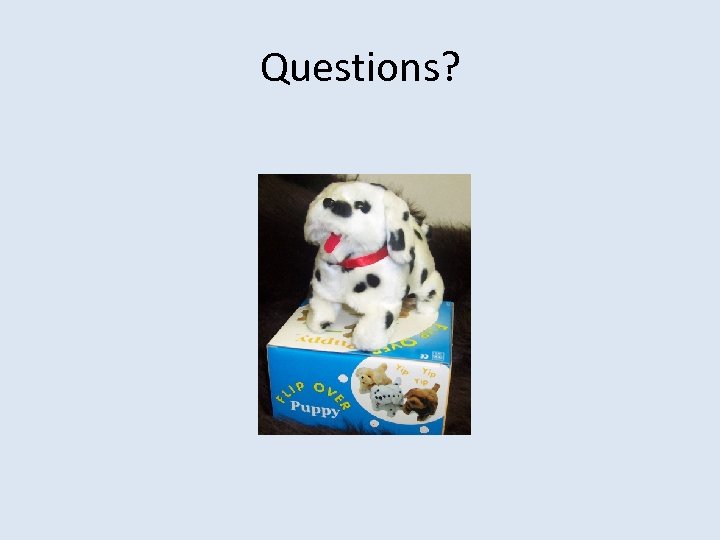
Project Evaluation Strengths • Course is repeatable, reconfigurable, and manually trackable • Various difficulties, terrains, and obstacles are present • Course is portable and storable • Challenging for patients yet safe for all involved • WE HAVE THE DOG
Future Improvements • • More durable micro switches Lighter surface pieces Use Printed Circuit Boards Independent study to finalize micro controller & implement printer – Embedded circuitry already present
Questions?
Скачать презентацию P 08003 Portable Obstacle Course Any opinions findings
0b20acaf933dae581bc8b452874c8033.ppt