 Скачать презентацию Overweight Obesity Physical Inactivity Healthy Kansans 2010 Steering
786032b1babc4853722015a4eead3b2e.ppt
- Количество слайдов: 41



Overweight/Obesity & Physical Inactivity Healthy Kansans 2010 Steering Committee Meeting April 22, 2005
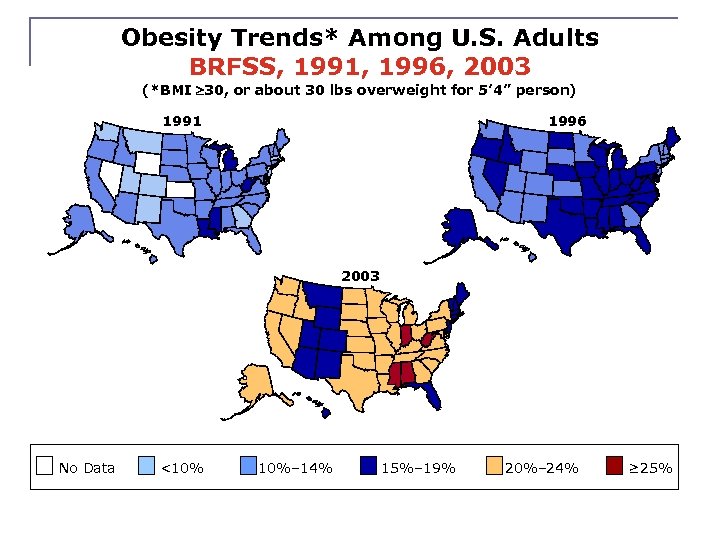
Obesity Trends* Among U. S. Adults BRFSS, 1991, 1996, 2003 (*BMI 30, or about 30 lbs overweight for 5’ 4” person) 1991 1996 2003 No Data <10% 10%– 14% 15%– 19% 20%– 24% ≥ 25%
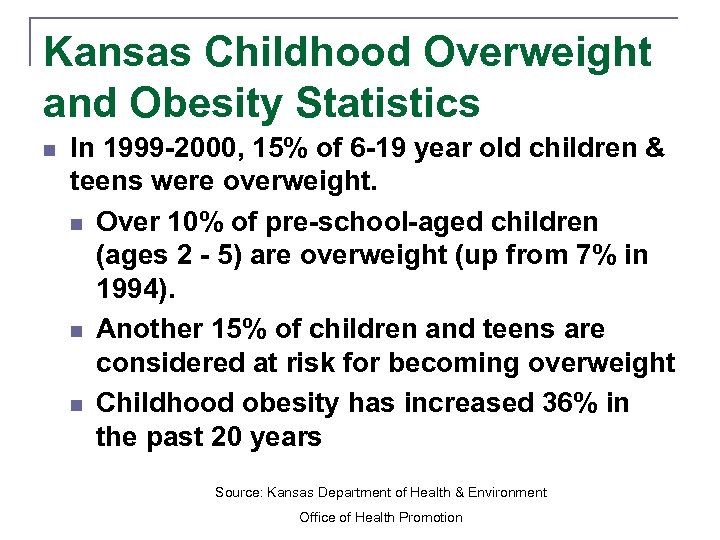
Kansas Childhood Overweight and Obesity Statistics n In 1999 -2000, 15% of 6 -19 year old children & teens were overweight. n Over 10% of pre-school-aged children (ages 2 - 5) are overweight (up from 7% in 1994). n Another 15% of children and teens are considered at risk for becoming overweight n Childhood obesity has increased 36% in the past 20 years Source: Kansas Department of Health & Environment Office of Health Promotion
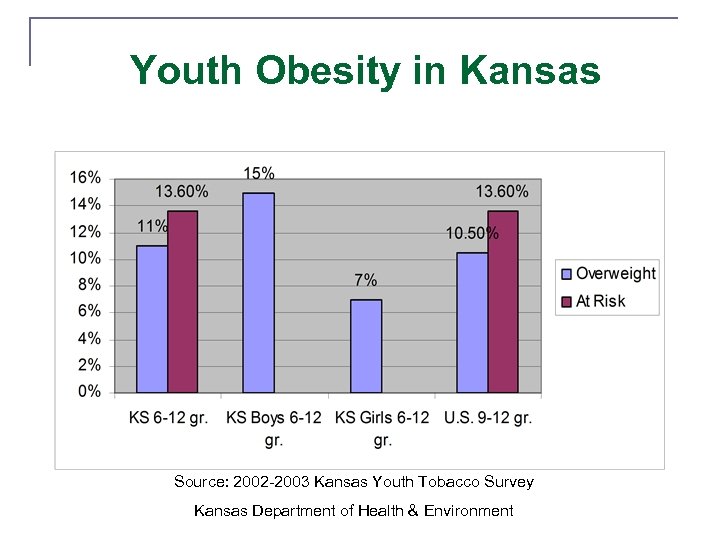
Youth Obesity in Kansas Source: 2002 -2003 Kansas Youth Tobacco Survey Kansas Department of Health & Environment
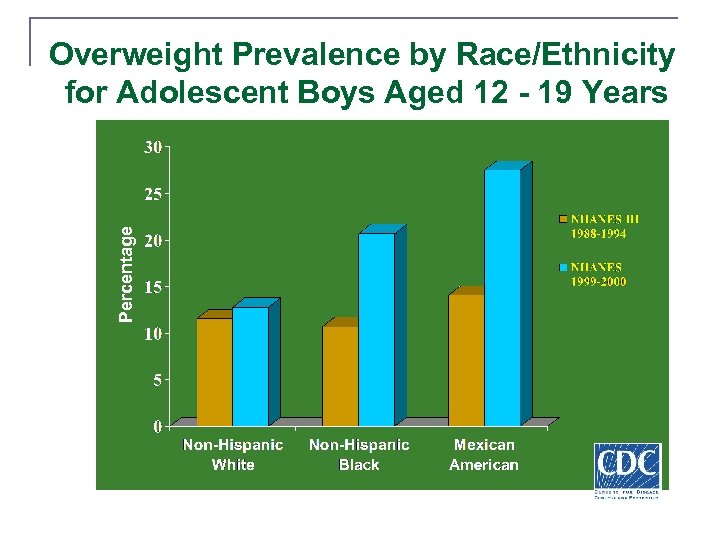
Percentage Overweight Prevalence by Race/Ethnicity for Adolescent Boys Aged 12 - 19 Years Source: JAMA, Oct. 9, 2002, Vol. 288, No. 14: 1731
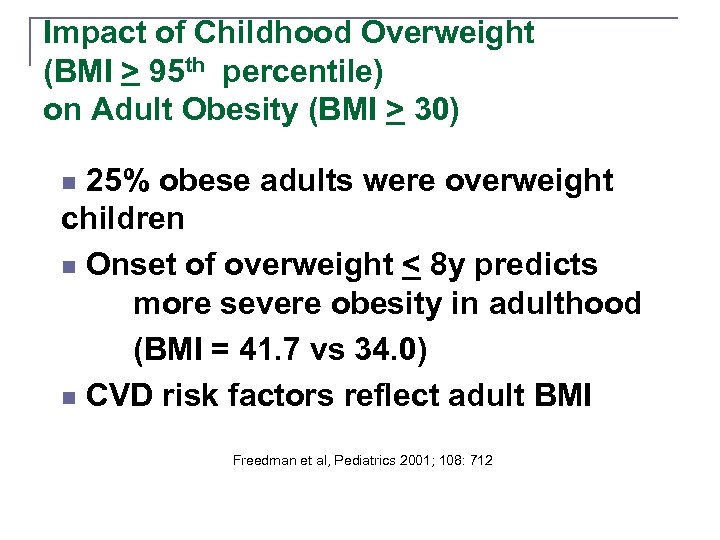
Impact of Childhood Overweight (BMI > 95 th percentile) on Adult Obesity (BMI > 30) n 25% obese adults were overweight children n Onset of overweight < 8 y predicts more severe obesity in adulthood (BMI = 41. 7 vs 34. 0) n CVD risk factors reflect adult BMI Freedman et al, Pediatrics 2001; 108: 712
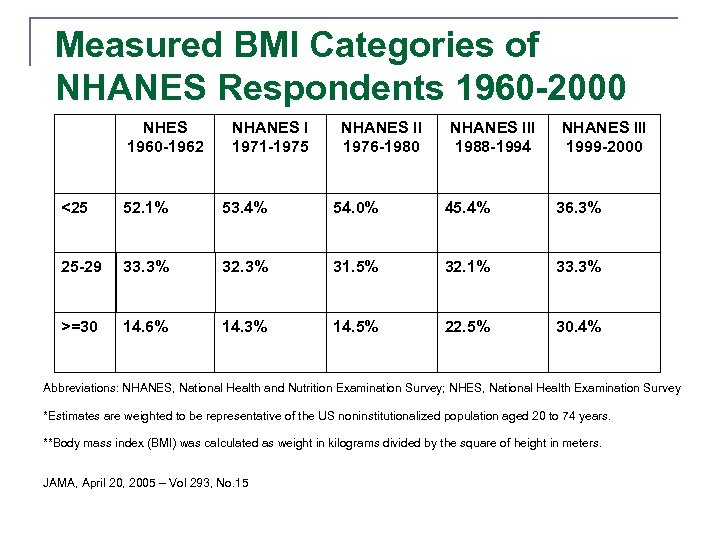
Measured BMI Categories of NHANES Respondents 1960 -2000 NHES 1960 -1962 NHANES I 1971 -1975 NHANES II 1976 -1980 NHANES III 1988 -1994 NHANES III 1999 -2000 <25 52. 1% 53. 4% 54. 0% 45. 4% 36. 3% 25 -29 33. 3% 32. 3% 31. 5% 32. 1% 33. 3% >=30 14. 6% 14. 3% 14. 5% 22. 5% 30. 4% Abbreviations: NHANES, National Health and Nutrition Examination Survey; NHES, National Health Examination Survey *Estimates are weighted to be representative of the US noninstitutionalized population aged 20 to 74 years. **Body mass index (BMI) was calculated as weight in kilograms divided by the square of height in meters. JAMA, April 20, 2005 – Vol 293, No. 15
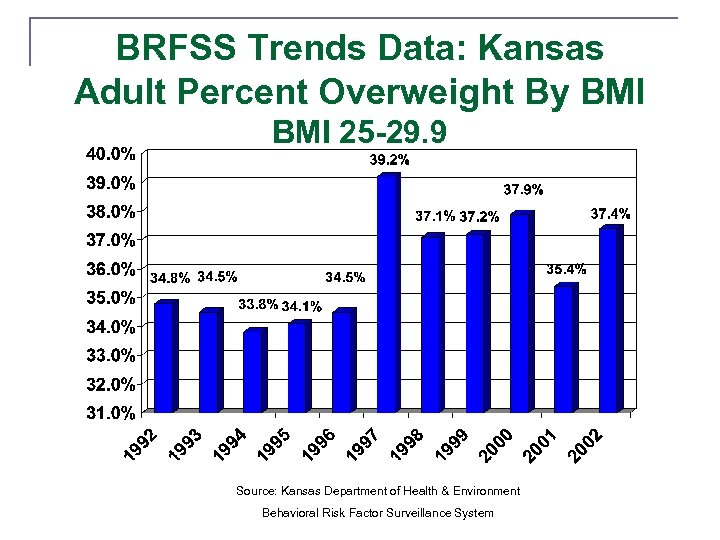
BRFSS Trends Data: Kansas Adult Percent Overweight By BMI 25 -29. 9 Source: Kansas Department of Health & Environment Behavioral Risk Factor Surveillance System
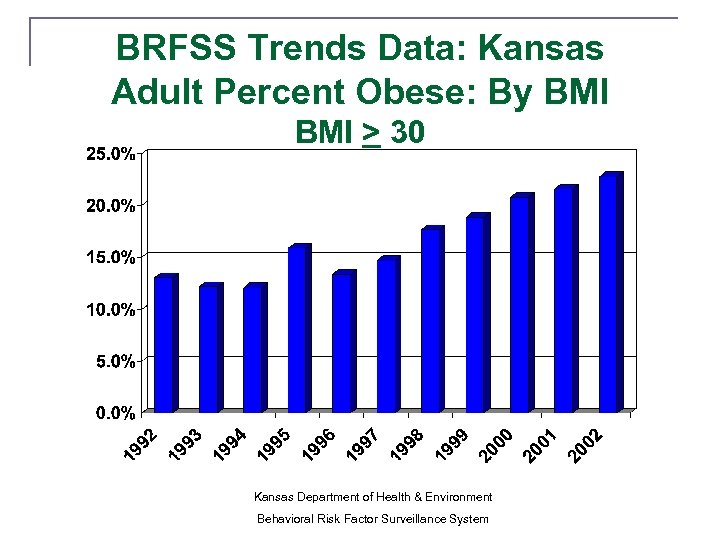
BRFSS Trends Data: Kansas Adult Percent Obese: By BMI > 30 Kansas Department of Health & Environment Behavioral Risk Factor Surveillance System
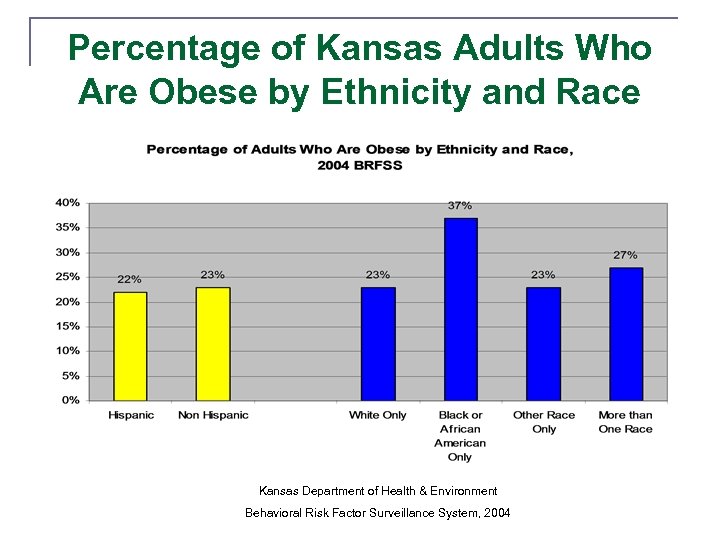
Percentage of Kansas Adults Who Are Obese by Ethnicity and Race Kansas Department of Health & Environment Behavioral Risk Factor Surveillance System, 2004
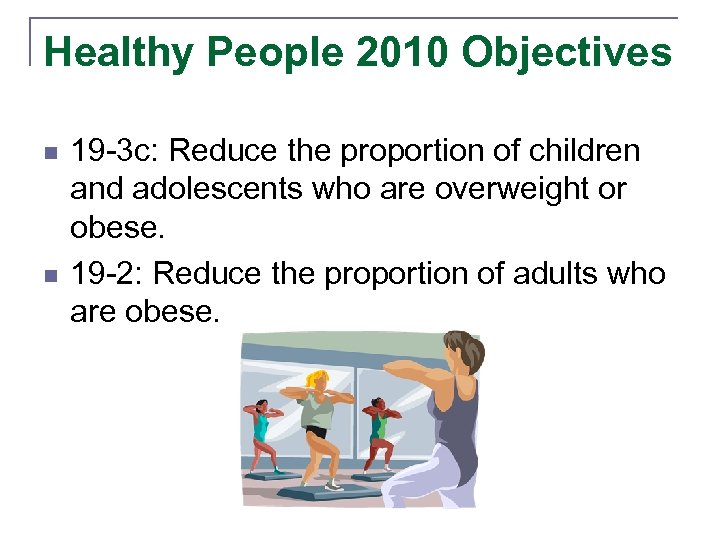
Healthy People 2010 Objectives n n 19 -3 c: Reduce the proportion of children and adolescents who are overweight or obese. 19 -2: Reduce the proportion of adults who are obese.
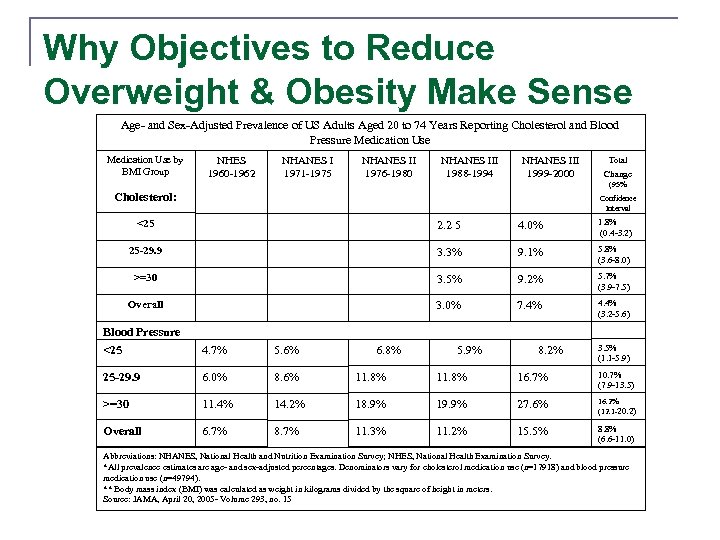
Why Objectives to Reduce Overweight & Obesity Make Sense Age- and Sex-Adjusted Prevalence of US Adults Aged 20 to 74 Years Reporting Cholesterol and Blood Pressure Medication Use by BMI Group NHES 1960 -1962 NHANES I 1971 -1975 NHANES II 1976 -1980 NHANES III 1988 -1994 NHANES III 1999 -2000 Total Change (95% Cholesterol: Confidence Interval <25 2. 2 5 4. 0% 1. 8% (0. 4 -3. 2) 25 -29. 9 3. 3% 9. 1% 5. 8% (3. 6 -8. 0) >=30 3. 5% 9. 2% 5. 7% (3. 9 -7. 5) Overall 3. 0% 7. 4% 4. 4% (3. 2 -5. 6) Blood Pressure <25 4. 7% 5. 6% 25 -29. 9 6. 0% 8. 6% 11. 8% 16. 7% 10. 7% (7. 9 -13. 5) >=30 11. 4% 14. 2% 18. 9% 19. 9% 27. 6% 16. 2% (12. 1 -20. 2) Overall 6. 7% 8. 7% 11. 3% 11. 2% 15. 5% 8. 8% (6. 6 -11. 0) 6. 8% 5. 9% 8. 2% 3. 5% (1. 1 -5. 9) Abbreviations: NHANES, National Health and Nutrition Examination Survey; NHES, National Health Examination Survey. *All prevalence estimates are age- and sex-adjusted percentages. Denominators vary for cholesterol medication use (n=17918) and blood pressure medication use (n=49794). ** Body mass index (BMI) was calculated as weight in kilograms divided by the square of height in meters. Source: JAMA, April 20, 2005 - Volume 293, no. 15
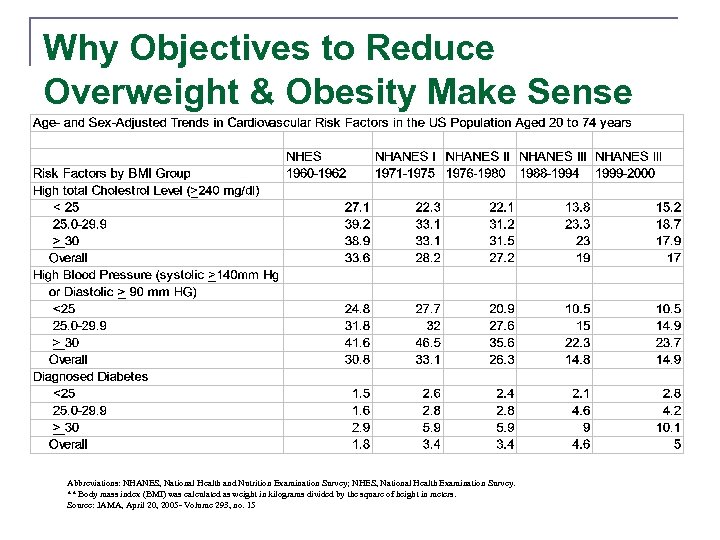
Why Objectives to Reduce Overweight & Obesity Make Sense Abbreviations: NHANES, National Health and Nutrition Examination Survey; NHES, National Health Examination Survey. ** Body mass index (BMI) was calculated as weight in kilograms divided by the square of height in meters. Source: JAMA, April 20, 2005 - Volume 293, no. 15
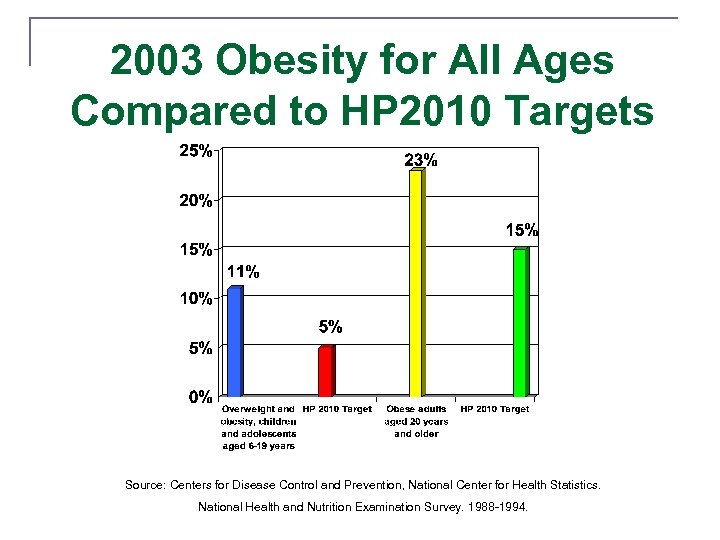
2003 Obesity for All Ages Compared to HP 2010 Targets Source: Centers for Disease Control and Prevention, National Center for Health Statistics. National Health and Nutrition Examination Survey. 1988 -1994.
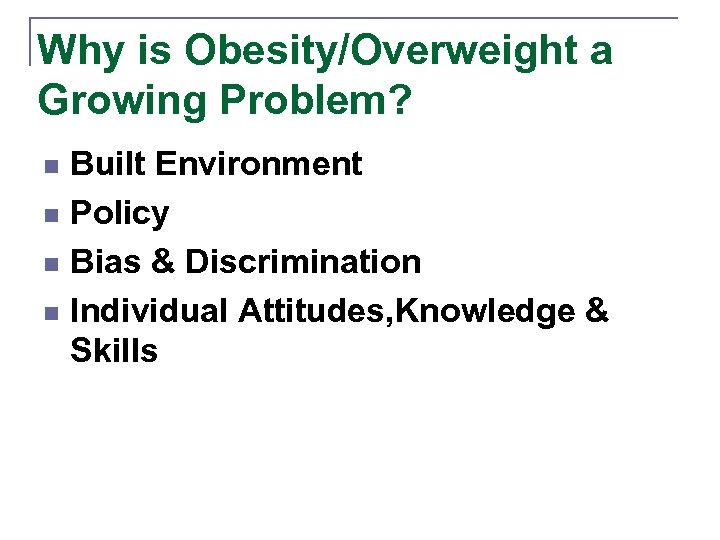
Why is Obesity/Overweight a Growing Problem? Built Environment n Policy n Bias & Discrimination n Individual Attitudes, Knowledge & Skills n
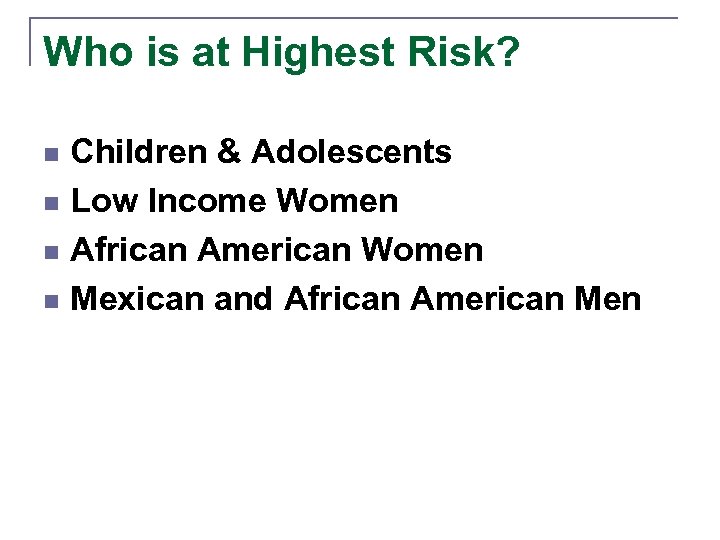
Who is at Highest Risk? Children & Adolescents n Low Income Women n African American Women n Mexican and African American Men n
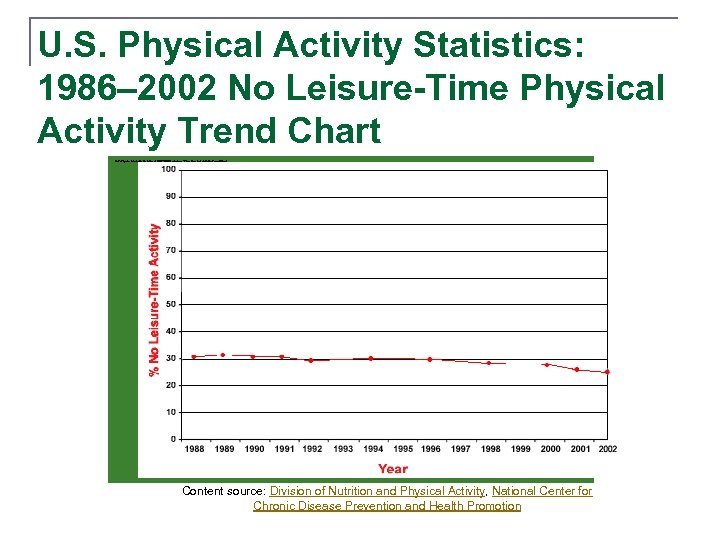
U. S. Physical Activity Statistics: 1986– 2002 No Leisure-Time Physical Activity Trend Chart U. S. Physical Activity Statistics: 1986– 2002 No Leisure-Time Physical Activity Trend Chart Content source: Division of Nutrition and Physical Activity, National Center for Chronic Disease Prevention and Health Promotion
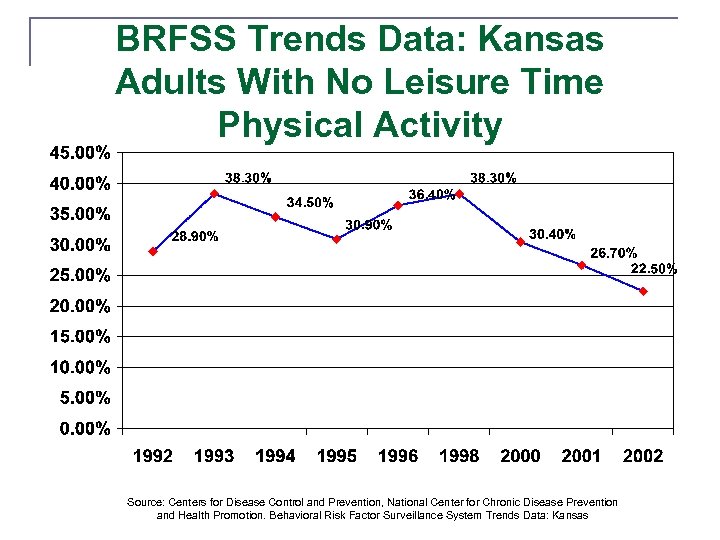
BRFSS Trends Data: Kansas Adults With No Leisure Time Physical Activity Source: Centers for Disease Control and Prevention, National Center for Chronic Disease Prevention and Health Promotion. Behavioral Risk Factor Surveillance System Trends Data: Kansas
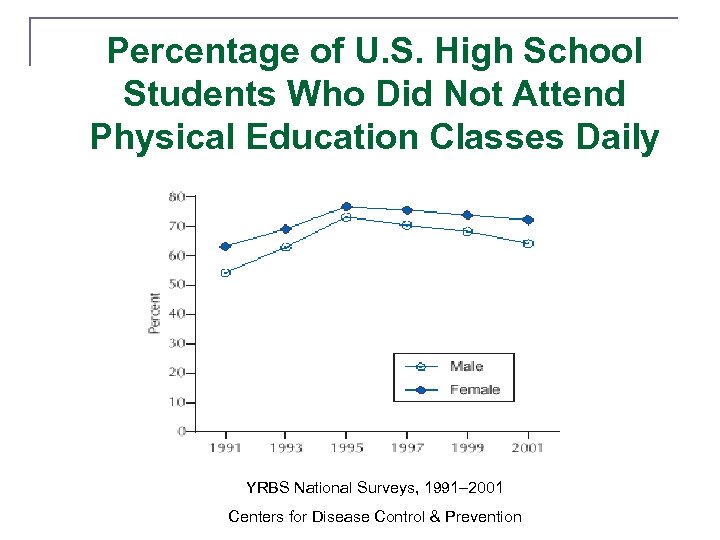
Percentage of U. S. High School Students Who Did Not Attend Physical Education Classes Daily YRBS National Surveys, 1991– 2001 Centers for Disease Control & Prevention
Healthy People 2010 Goals n n 22 -7: Increase the proportion of adolescents who engage in vigorous physical activity that promotes cardiorespiratory fitness 3 or more days per week for 20 or more minutes per occasion. 22 -2: Increase the proportion of adults who engage regularly, preferably daily, in moderate physical activity for at least 30 minutes per day.
Why is Increase Physical Activity for Children & Youth? n Study of school-age youth in 34 countries: q q Significant (P<0. 05) negative relationship between physical activity patterns and BMI classification in 29 of 33 countries (88%) Significant (P<0. 05) positive relationship between television viewing time and BMI classification in 22 of 34 countries (65%) 2005 The International Association for the Study of Obesity Reviews 6, 123 -132
Why Increase Physical Activity for Children & Youth? n Study of school-age youth in 34 countries: q Likelihood of being overweight was significantly lower in dose-response manner with higher physical activity participation in 29 or 33 countries (88%) 2005 The International Association for the Study of Obesity Reviews 6, 123 -132
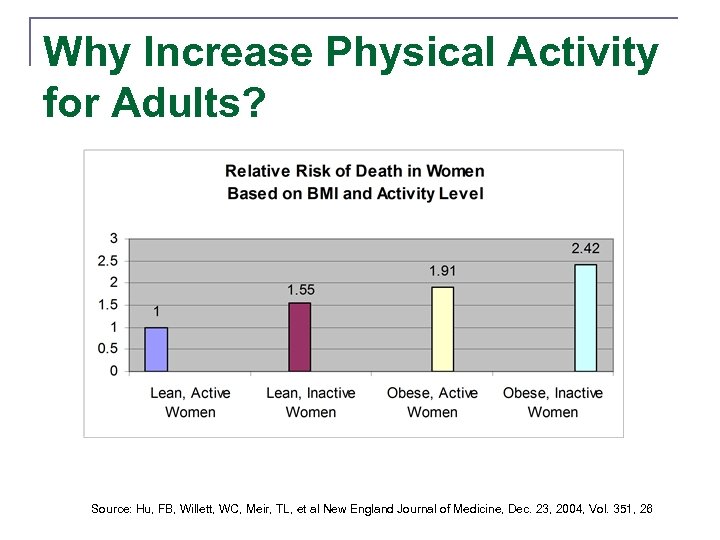
Why Increase Physical Activity for Adults? Source: Hu, FB, Willett, WC, Meir, TL, et al New England Journal of Medicine, Dec. 23, 2004, Vol. 351, 26
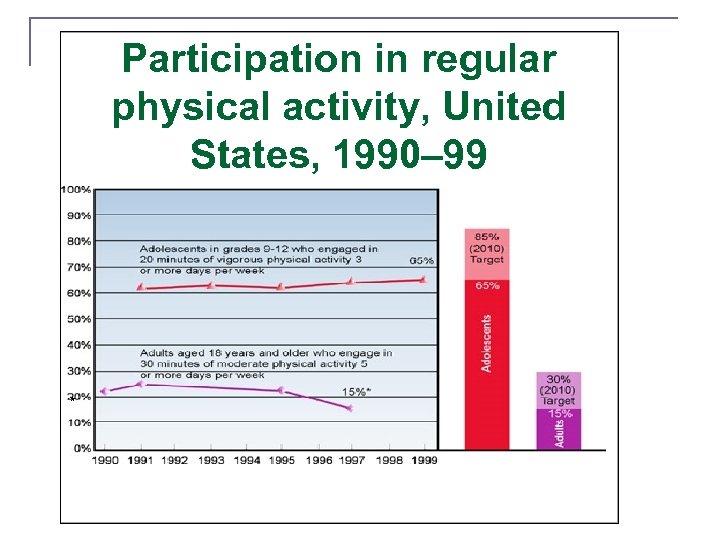
Participation in regular physical activity, United States, 1990– 99 *
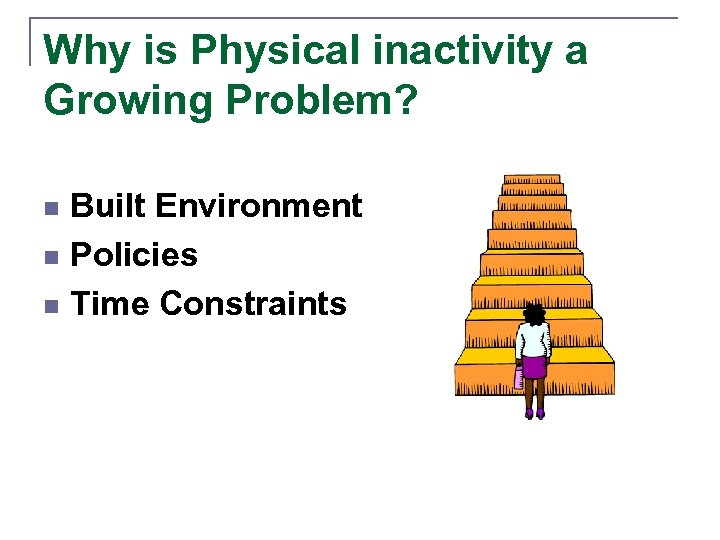
Why is Physical inactivity a Growing Problem? Built Environment n Policies n Time Constraints n
Who is at Greatest Risk? Women n Low income/low education n African Americans & Hispanics n People with disabilities n Elderly n
Recommendations for Addressing Physical Inactivity in Kansas Now? n The Community Guide to Preventive Services recommends community-wide campaigns using multiple media outlets to promote physical activity, conducted in collaboration with strategies of: q q q Social support networks, Individual behavior change through knowledge & skill development, & Environmental & policy change
Recommendations for Addressing Physical Inactivity in Kansas Now? n The Community Guide to Preventive Services recommends enhanced Physical Education Classes in schools to increase physical activity among youth, including: q q q Mandatory daily Physical Education Making PE classes longer in length Increasing duration & intensity of students’ activity during PE classes
Recommendations for Addressing Physical Inactivity in Kansas Now? n The Community Guide to Preventive Services recommends creating or improving access to places for physical activity, including: q q q Creating walking trails Building exercise facilities Providing increased access to existing facilities
Current Statewide Efforts to Address Obesity and Physical Inactivity in Kansas n n Kansas LEAN Coordinated School Health Initiative Healthy Congregations in Action Health foundations’ initiatives to evaluate obesity &/or nutrition/physical activity KANSAS

What Are Kansas’ Assets for Improving These Health Issues? Collaborative partnerships: Kansas LEAN, Kansas Nutrition Network, Wichita Wellness Coalition, etc. n Academic Expertise & Resources: University of Kansas School of Medicine, University of Kansas, Kansas State University Community Health Institute, etc. n
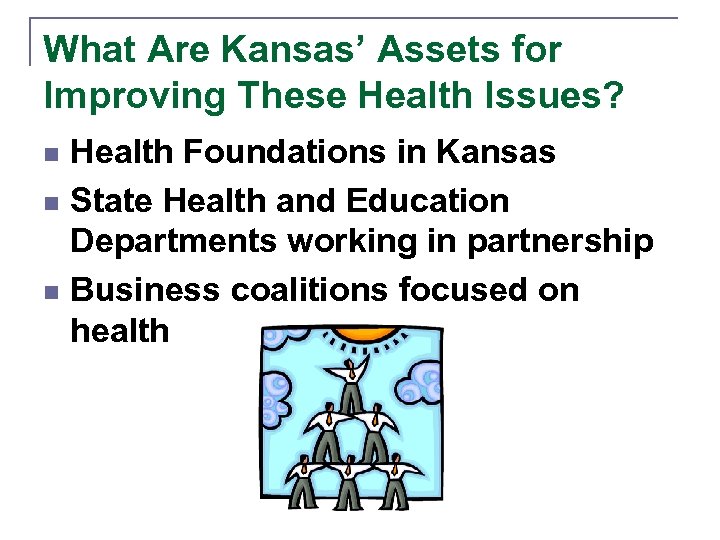
What Are Kansas’ Assets for Improving These Health Issues? Health Foundations in Kansas n State Health and Education Departments working in partnership n Business coalitions focused on health n
What Are Barriers or Liabilities That Are Limiting Progress in Kansas? n n Lack of YRBS or comparable youth data Lack of consistently reported data for ease of comparison Lack of health & physical education policy in schools Lack of skills among primary care practitioners in preventing &/or managing obesity
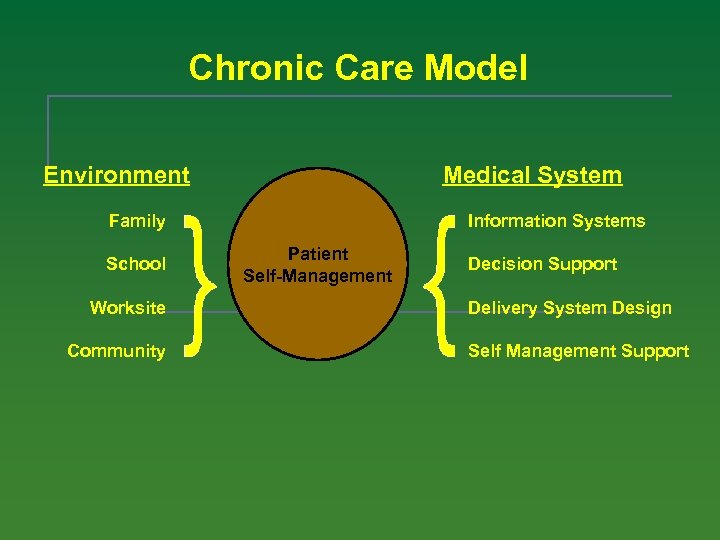
Chronic Care Model Environment Medical System Family School Worksite Community Information Systems Patient Self-Management Decision Support Delivery System Design Self Management Support
What Are Barriers or Liabilities That Are Limiting Progress in Kansas? Lack of third party reimbursement for lifestyle management (prevention) n Lack of third party reimbursement for weight loss management n Health care system that limits time for prevention activities by practitioners n
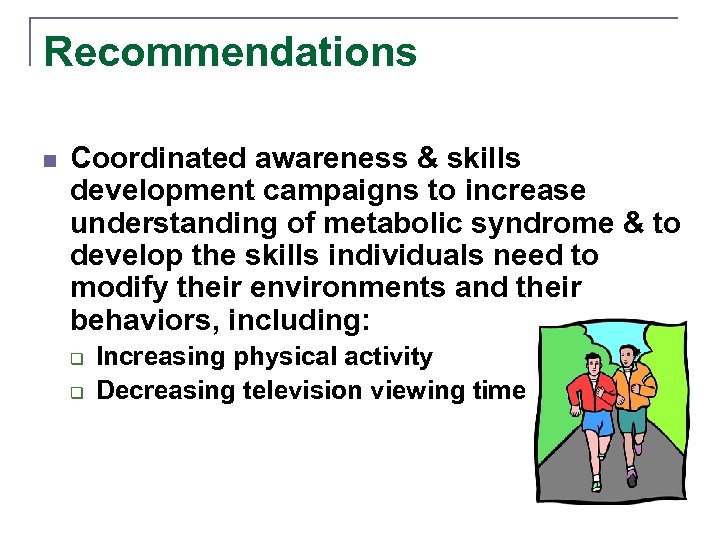
Recommendations n Coordinated awareness & skills development campaigns to increase understanding of metabolic syndrome & to develop the skills individuals need to modify their environments and their behaviors, including: q q Increasing physical activity Decreasing television viewing time
Recommendations Policy changes to require > 30 minutes daily Physical Education in schools at all levels n Policy changes to limit competitive foods in schools, provide universal school meals & close campuses at mealtimes in all schools n
Recommendations Incentive programs to encourage communities, work sites & schools to increase access to physical activity venues n Incentive programs to encourage communities, work sites & schools to create and/or improve venues that encourage and support leisure time & transportation physical activity n
Recommendations n Medical school curriculum modifications to include skills in motivational interviewing & standardized patients with metabolic syndrome

James Early, M. D. Clinical Associate Professor jearly@kumc. edu Judy Johnston, M. S. , R. D. , L. D. Research Instructor jjohnsto@kumc. edu Department of Preventive Medicine & Public Health University of Kansas School of Medicine – Wichita 316 -293 -2627
Скачать презентацию Overweight Obesity Physical Inactivity Healthy Kansans 2010 Steering
786032b1babc4853722015a4eead3b2e.ppt