 Скачать презентацию Overview Smarter Balanced Assessment Consortium New Hampshire Department
5ebbd31e169ebde1992acbddfb907381.ppt
- Количество слайдов: 30



Overview: Smarter Balanced Assessment Consortium New Hampshire Department of Education
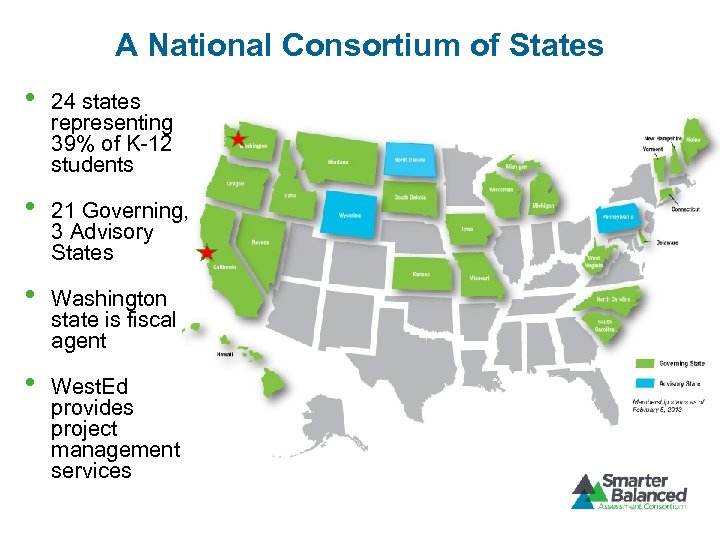
A National Consortium of States • 24 states representing 39% of K-12 students • 21 Governing, 3 Advisory States • Washington state is fiscal agent • West. Ed provides project management services
Next-Generation Assessments • Rigorous assessments of progress toward • • “college and career readiness” Common cut scores across all Consortium states Information about grade-level achievement and growth Valid, reliable, and fair for all students (except • those with “significant cognitive disabilities”) • Administered online, using multiple measures (paper/pencil option for 3 years) • Fully operational in 2014 -15 school year
What are the NH’s College & Career Readiness? …working with but not only with the “Common Core State Standards” is a… ▪ State-led initiative made up of the nation’s governors and education commissioners; states voluntarily adopt the Standards - 46 states have adopted so far ▪ Single set of clear educational standards for Kindergarten through 12 th grade in English Language Arts and Math that measure both content and application of knowledge ▪ More rigorous set of standards designed to ensure all students are prepared for college and career success and to collaborate and compete with their peers in the United states and abroad 4
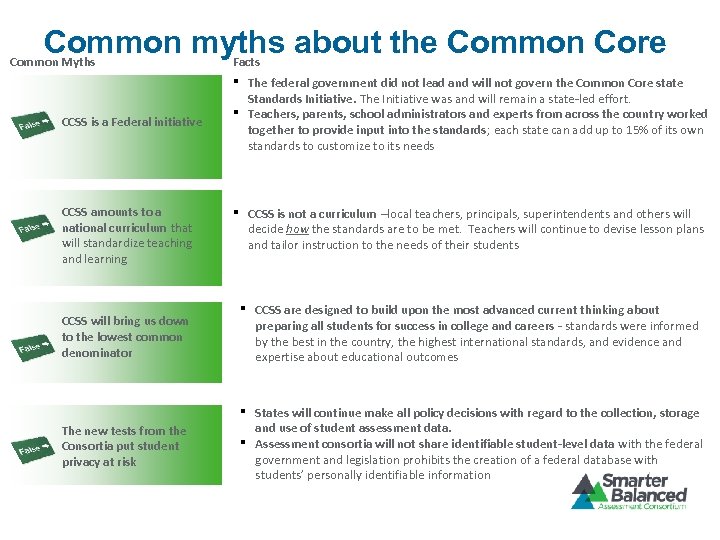
Common myths about the Common Core Facts Common Myths ▪ CCSS is a Federal initiative CCSS amounts to a national curriculum that will standardize teaching and learning The federal government did not lead and will not govern the Common Core state Standards Initiative. The Initiative was and will remain a state-led effort. Teachers, parents, school administrators and experts from across the country worked together to provide input into the standards; each state can add up to 15% of its own standards to customize to its needs ▪ ▪ CCSS is not a curriculum –local teachers, principals, superintendents and others will decide how the standards are to be met. Teachers will continue to devise lesson plans and tailor instruction to the needs of their students The new tests from the Consortia put student privacy at risk ▪ CCSS are designed to build upon the most advanced current thinking about preparing all students for success in college and careers - standards were informed by the best in the country, the highest international standards, and evidence and expertise about educational outcomes ▪ CCSS will bring us down to the lowest common denominator States will continue make all policy decisions with regard to the collection, storage and use of student assessment data. Assessment consortia will not share identifiable student-level data with the federal government and legislation prohibits the creation of a federal database with students’ personally identifiable information ▪ 5
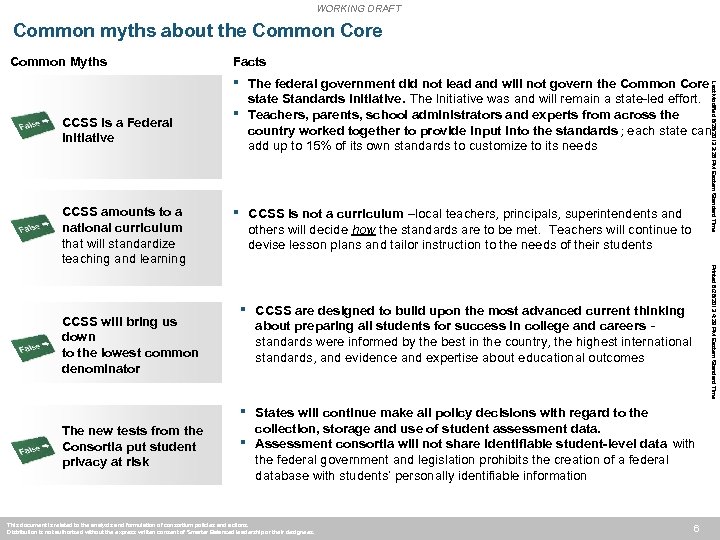
WORKING DRAFT Common myths about the Common Core Common Myths Facts ▪ ▪ CCSS is not a curriculum –local teachers, principals, superintendents and others will decide how the standards are to be met. Teachers will continue to devise lesson plans and tailor instruction to the needs of their students The new tests from the Consortia put student privacy at risk ▪ CCSS are designed to build upon the most advanced current thinking about preparing all students for success in college and careers - standards were informed by the best in the country, the highest international standards, and evidence and expertise about educational outcomes ▪ CCSS will bring us down to the lowest common denominator States will continue make all policy decisions with regard to the collection, storage and use of student assessment data. Assessment consortia will not share identifiable student-level data with the federal government and legislation prohibits the creation of a federal database with students’ personally identifiable information ▪ This document is related to the analysis and formulation of consortium policies and actions. Distribution is not authorized without the express written consent of Smarter Balanced leadership or their designees. 6 Printed 6/26/2013 4: 29 PM Eastern Standard Time CCSS amounts to a national curriculum that will standardize teaching and learning ▪ Last Modified 6/28/2013 3: 28 PM Eastern Standard Time CCSS is a Federal initiative The federal government did not lead and will not govern the Common Core state Standards Initiative. The Initiative was and will remain a state-led effort. Teachers, parents, school administrators and experts from across the country worked together to provide input into the standards ; each state can add up to 15% of its own standards to customize to its needs
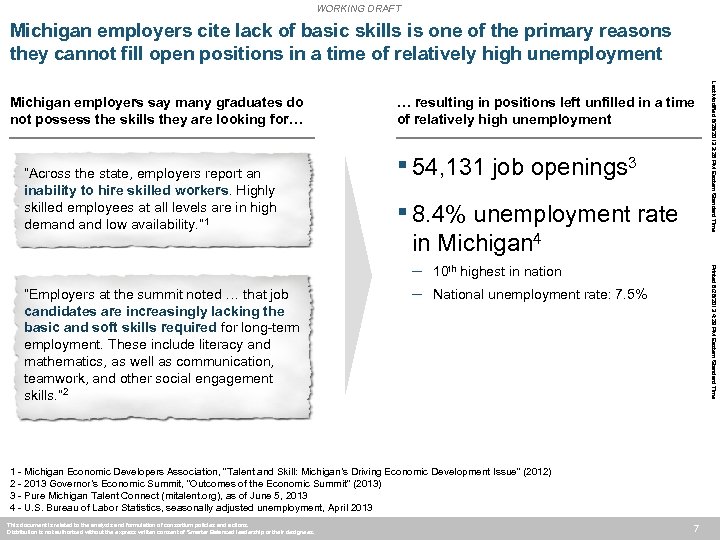
WORKING DRAFT Michigan employers cite lack of basic skills is one of the primary reasons they cannot fill open positions in a time of relatively high unemployment “Across the state, employers report an inability to hire skilled workers. Highly skilled employees at all levels are in high demand low availability. ” 1 ▪ 54, 131 job openings 3 ▪ 8. 4% unemployment rate in Michigan 4 – 10 th highest in nation – National unemployment rate: 7. 5% Printed 6/26/2013 4: 29 PM Eastern Standard Time “Employers at the summit noted … that job candidates are increasingly lacking the basic and soft skills required for long-term employment. These include literacy and mathematics, as well as communication, teamwork, and other social engagement skills. ” 2 … resulting in positions left unfilled in a time of relatively high unemployment 1 - Michigan Economic Developers Association, “Talent and Skill: Michigan’s Driving Economic Development Issue” (2012) 2 - 2013 Governor’s Economic Summit, “Outcomes of the Economic Summit” (2013) 3 - Pure Michigan Talent Connect (mitalent. org), as of June 5, 2013 4 - U. S. Bureau of Labor Statistics, seasonally adjusted unemployment, April 2013 This document is related to the analysis and formulation of consortium policies and actions. Distribution is not authorized without the express written consent of Smarter Balanced leadership or their designees. Last Modified 6/28/2013 3: 28 PM Eastern Standard Time Michigan employers say many graduates do not possess the skills they are looking for… 7
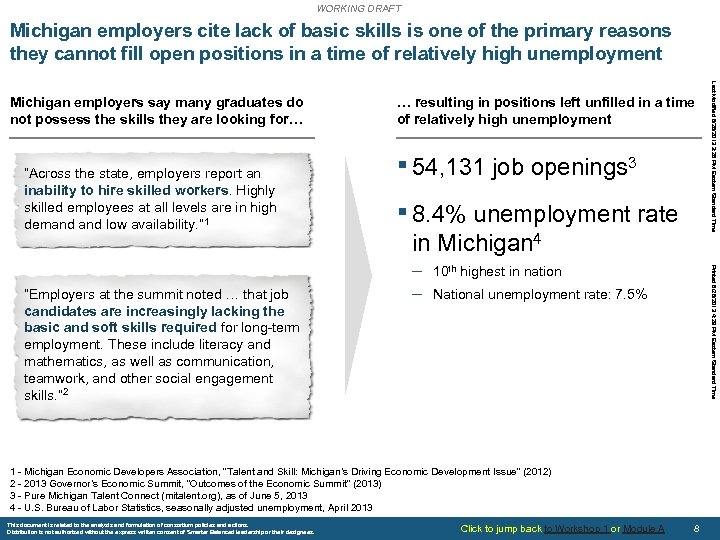
WORKING DRAFT Michigan employers cite lack of basic skills is one of the primary reasons they cannot fill open positions in a time of relatively high unemployment “Across the state, employers report an inability to hire skilled workers. Highly skilled employees at all levels are in high demand low availability. ” 1 ▪ 54, 131 job openings 3 ▪ 8. 4% unemployment rate in Michigan 4 – 10 th highest in nation – National unemployment rate: 7. 5% Printed 6/26/2013 4: 29 PM Eastern Standard Time “Employers at the summit noted … that job candidates are increasingly lacking the basic and soft skills required for long-term employment. These include literacy and mathematics, as well as communication, teamwork, and other social engagement skills. ” 2 … resulting in positions left unfilled in a time of relatively high unemployment 1 - Michigan Economic Developers Association, “Talent and Skill: Michigan’s Driving Economic Development Issue” (2012) 2 - 2013 Governor’s Economic Summit, “Outcomes of the Economic Summit” (2013) 3 - Pure Michigan Talent Connect (mitalent. org), as of June 5, 2013 4 - U. S. Bureau of Labor Statistics, seasonally adjusted unemployment, April 2013 This document is related to the analysis and formulation of consortium policies and actions. Distribution is not authorized without the express written consent of Smarter Balanced leadership or their designees. Click to jump back to Workshop 1 or Module A Last Modified 6/28/2013 3: 28 PM Eastern Standard Time Michigan employers say many graduates do not possess the skills they are looking for… 8
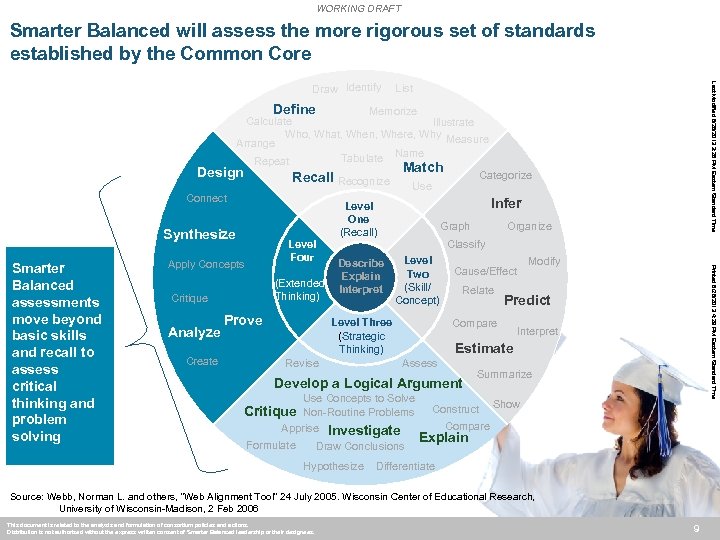
WORKING DRAFT Smarter Balanced will assess the more rigorous set of standards established by the Common Core Last Modified 6/28/2013 3: 28 PM Eastern Standard Time Draw Identify List Define Memorize Calculate Illustrate Who, What, When, Where, Why Measure Arrange Tabulate Name Repeat Design Recall Recognize Connect Synthesize Critique Analyze Create Prove Infer Level One (Recall) Describe Explain (Extended Interpret Thinking) Apply Concepts Graph Level Two (Skill/ Concept) Cause/Effect Relate Interpret Estimate Assess Use Concepts to Solve Non-Routine Problems Apprise Investigate Critique Draw Conclusions Hypothesize Modify Predict Compare Develop a Logical Argument Formulate Organize Classify Level Three (Strategic Thinking) Revise Categorize Use Printed 6/26/2013 4: 29 PM Eastern Standard Time Smarter Balanced assessments move beyond basic skills and recall to assess critical thinking and problem solving Level Four Match Summarize Construct Show Compare Explain Differentiate Source: Webb, Norman L. and others, “Web Alignment Tool” 24 July 2005. Wisconsin Center of Educational Research, University of Wisconsin-Madison, 2 Feb 2006 This document is related to the analysis and formulation of consortium policies and actions. Distribution is not authorized without the express written consent of Smarter Balanced leadership or their designees. 9
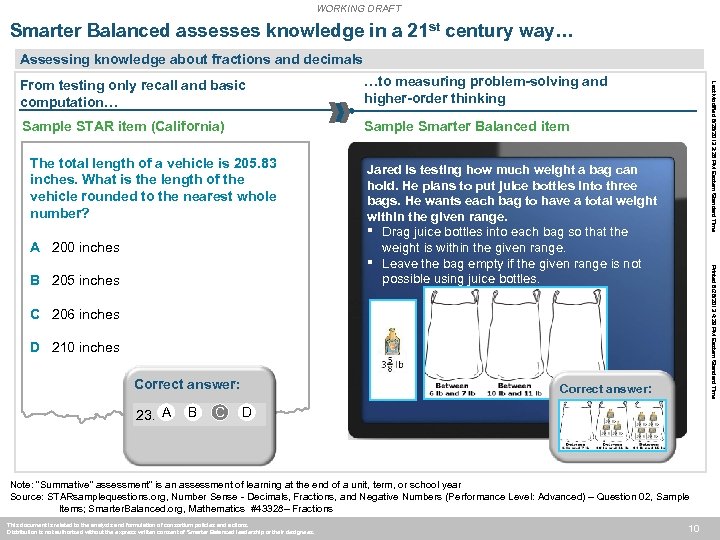
WORKING DRAFT Smarter Balanced assesses knowledge in a 21 st century way… Assessing knowledge about fractions and decimals …to measuring problem-solving and higher-order thinking Sample STAR item (California) Sample Smarter Balanced item The total length of a vehicle is 205. 83 inches. What is the length of the vehicle rounded to the nearest whole number? A 200 inches Jared is testing how much weight a bag can hold. He plans to put juice bottles into three bags. He wants each bag to have a total weight within the given range. ▪ Drag juice bottles into each bag so that the weight is within the given range. ▪ Leave the bag empty if the given range is not possible using juice bottles. Printed 6/26/2013 4: 29 PM Eastern Standard Time B 205 inches Last Modified 6/28/2013 3: 28 PM Eastern Standard Time From testing only recall and basic computation… C 206 inches D 210 inches Correct answer: 23. A B C Correct answer: D Note: “Summative” assessment” is an assessment of learning at the end of a unit, term, or school year Source: STARsamplequestions. org, Number Sense - Decimals, Fractions, and Negative Numbers (Performance Level: Advanced) – Question 02, Sample Items; Smarter. Balanced. org, Mathematics #43328– Fractions This document is related to the analysis and formulation of consortium policies and actions. Distribution is not authorized without the express written consent of Smarter Balanced leadership or their designees. 10
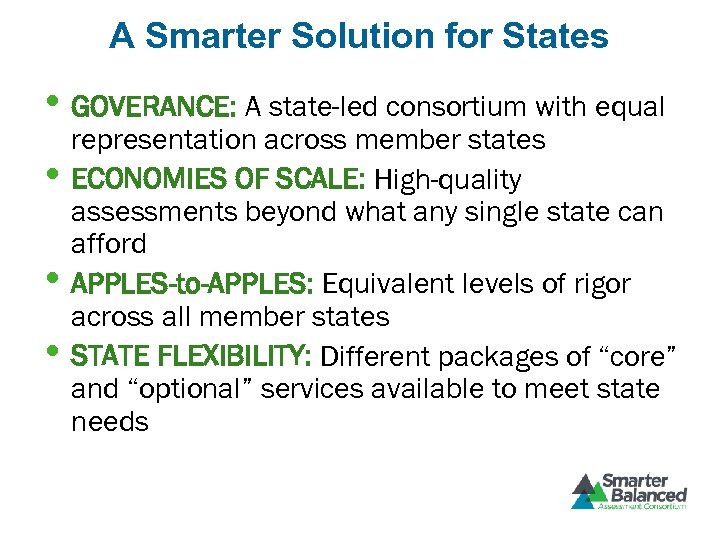
A Smarter Solution for States • GOVERANCE: A state-led consortium with equal • • • representation across member states ECONOMIES OF SCALE: High-quality assessments beyond what any single state can afford APPLES-to-APPLES: Equivalent levels of rigor across all member states STATE FLEXIBILITY: Different packages of “core” and “optional” services available to meet state needs
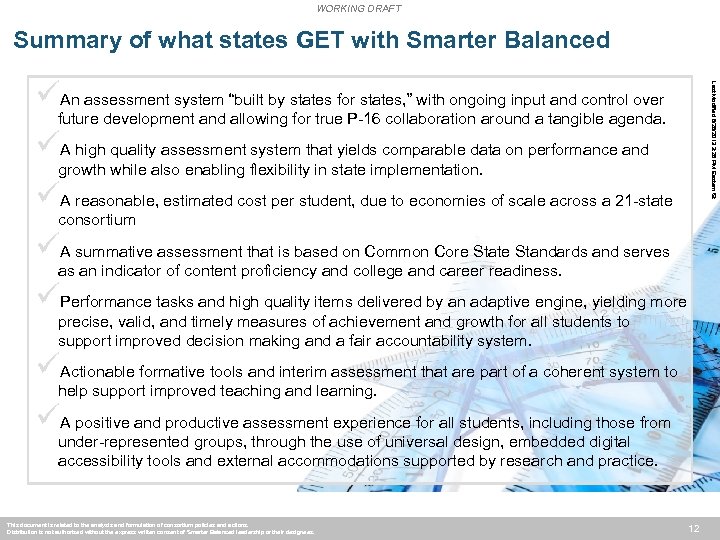
WORKING DRAFT Summary of what states GET with Smarter Balanced Last Modified 6/28/2013 3: 28 PM Eastern Standard Time üAn assessment system “built by states for states, ” with ongoing input and control over future development and allowing for true P-16 collaboration around a tangible agenda. üA high quality assessment system that yields comparable data on performance and growth while also enabling flexibility in state implementation. üA reasonable, estimated cost per student, due to economies of scale across a 21 -state consortium üA summative assessment that is based on Common Core State Standards and serves üPerformance tasks and high quality items delivered by an adaptive engine, yielding more precise, valid, and timely measures of achievement and growth for all students to support improved decision making and a fair accountability system. üActionable formative tools and interim assessment that are part of a coherent system to help support improved teaching and learning. üA positive and productive assessment experience for all students, including those from under-represented groups, through the use of universal design, embedded digital accessibility tools and external accommodations supported by research and practice. This document is related to the analysis and formulation of consortium policies and actions. Distribution is not authorized without the express written consent of Smarter Balanced leadership or their designees. 12 Printed 6/26/2013 4: 29 PM Eastern Standard Time as an indicator of content proficiency and college and career readiness.
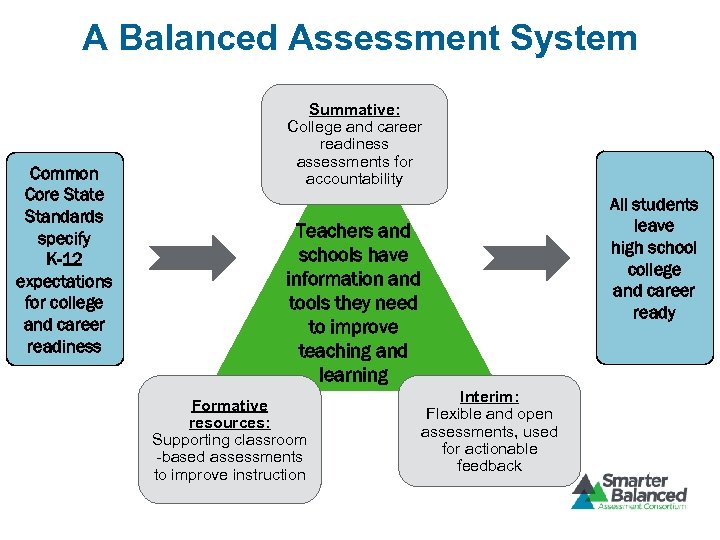
A Balanced Assessment System Common Core State Standards specify K-12 expectations for college and career readiness Summative: College and career readiness assessments for accountability All students leave high school college and career ready Teachers and schools have information and tools they need to improve teaching and learning Formative resources: Supporting classroom -based assessments to improve instruction Interim: Flexible and open assessments, used for actionable feedback
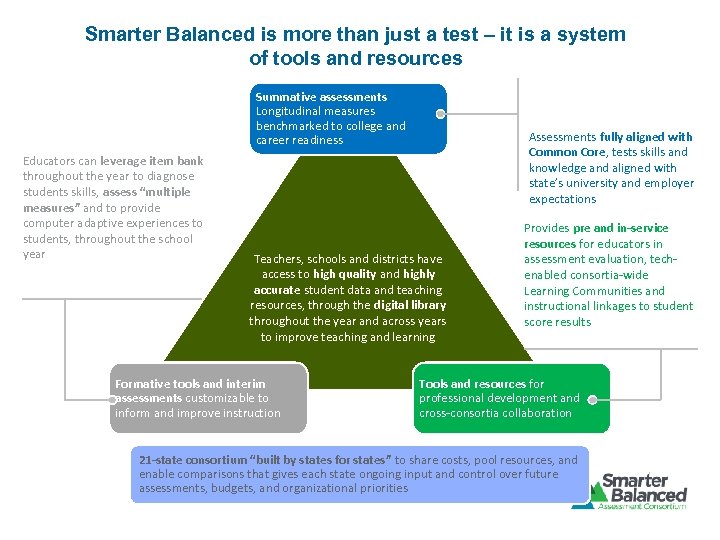
Smarter Balanced is more than just a test – it is a system of tools and resources Summative assessments Longitudinal measures benchmarked to college and career readiness Educators can leverage item bank throughout the year to diagnose students skills, assess “multiple measures” and to provide computer adaptive experiences to students, throughout the school year Assessments fully aligned with Common Core, tests skills and knowledge and aligned with state’s university and employer expectations Teachers, schools and districts have access to high quality and highly accurate student data and teaching resources, through the digital library throughout the year and across years to improve teaching and learning Formative tools and interim assessments customizable to inform and improve instruction Provides pre and in-service resources for educators in assessment evaluation, techenabled consortia-wide Learning Communities and instructional linkages to student score results Tools and resources for professional development and cross-consortia collaboration 21 -state consortium “built by states for states” to share costs, pool resources, and enable comparisons that gives each state ongoing input and control over future assessments, budgets, and organizational priorities 14
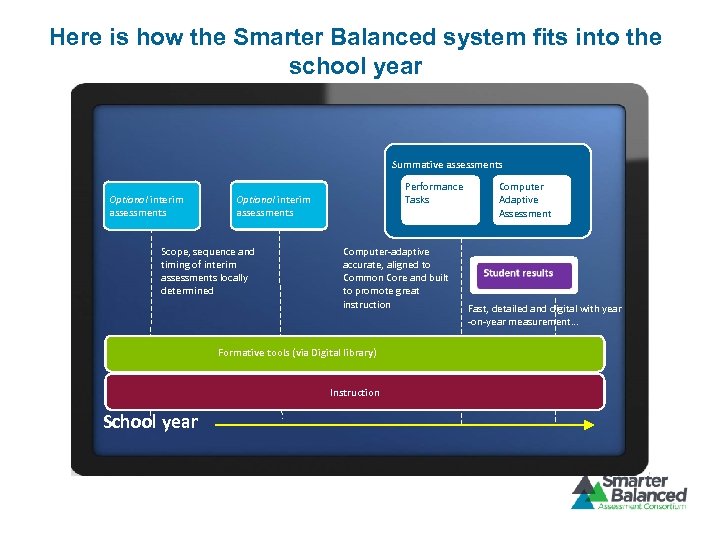
Here is how the Smarter Balanced system fits into the school year Summative assessments Optional interim assessments Performance Tasks Optional interim assessments Scope, sequence and timing of interim assessments locally determined Computer-adaptive accurate, aligned to Common Core and built to promote great instruction Computer Adaptive Assessment Fast, detailed and digital with year -on-year measurement… Formative tools (via Digital library) Instruction School year 15
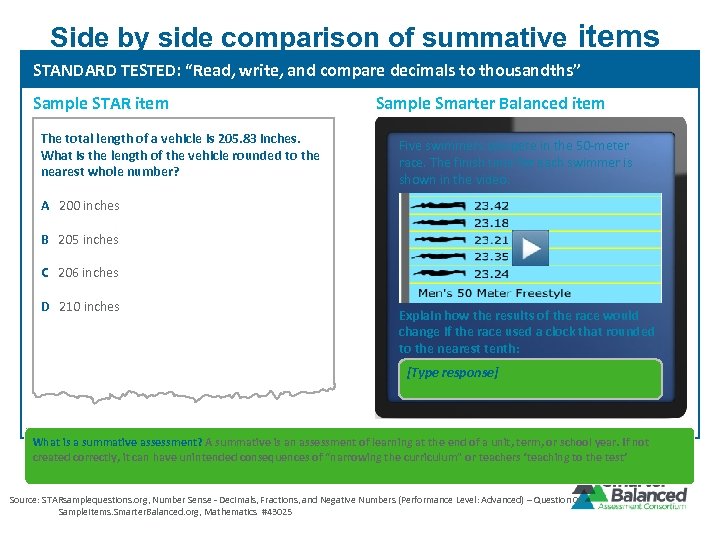
Side by side comparison of summative items STANDARD TESTED: “Read, write, and compare decimals to thousandths” Sample STAR item The total length of a vehicle is 205. 83 inches. What is the length of the vehicle rounded to the nearest whole number? Sample Smarter Balanced item Five swimmers compete in the 50 -meter race. The finish time for each swimmer is shown in the video. A 200 inches B 205 inches C 206 inches D 210 inches Explain how the results of the race would change if the race used a clock that rounded to the nearest tenth: [Type response] What is a summative assessment? A summative is an assessment of learning at the end of a unit, term, or school year. If not created correctly, it can have unintended consequences of “narrowing the curriculum” or teachers ‘teaching to the test’ Source: STARsamplequestions. org, Number Sense - Decimals, Fractions, and Negative Numbers (Performance Level: Advanced) – Question 02, Sample. Items. Smarter. Balanced. org, Mathematics #43025 16
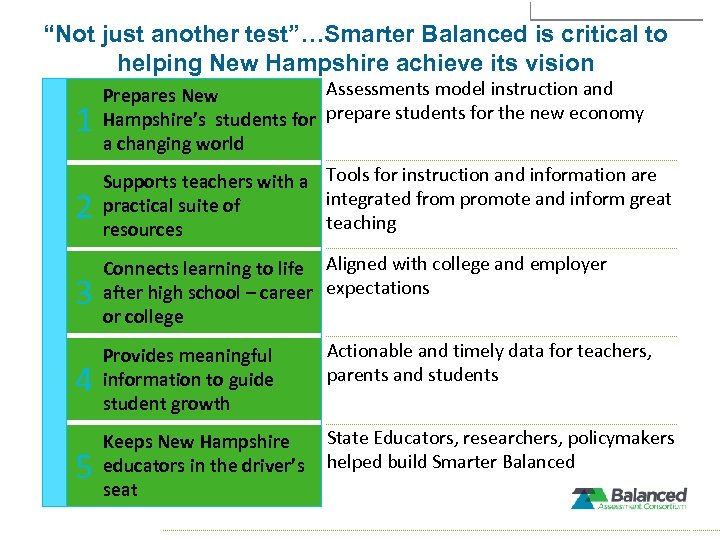
“Not just another test”…Smarter Balanced is critical to helping New Hampshire achieve its vision 1 Assessments model instruction and Prepares New Hampshire’s students for prepare students for the new economy a changing world 2 Supports teachers with a Tools for instruction and information are integrated from promote and inform great practical suite of teaching resources 3 Connects learning to life Aligned with college and employer after high school – career expectations or college 4 Provides meaningful information to guide student growth Actionable and timely data for teachers, parents and students 5 Keeps New Hampshire educators in the driver’s seat State Educators, researchers, policymakers helped build Smarter Balanced 17
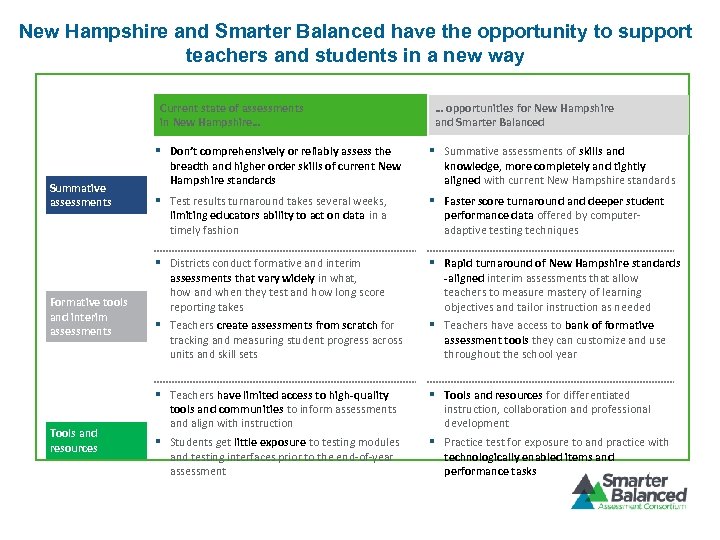
New Hampshire and Smarter Balanced have the opportunity to support teachers and students in a new way … opportunities for New Hampshire and Smarter Balanced Current state of assessments in New Hampshire… ▪ Tools and resources Summative assessments of skills and knowledge, more completely and tightly aligned with current New Hampshire standards ▪ Test results turnaround takes several weeks, limiting educators ability to act on data in a timely fashion ▪ Faster score turnaround and deeper student performance data offered by computeradaptive testing techniques Districts conduct formative and interim assessments that vary widely in what, how and when they test and how long score reporting takes ▪ Rapid turnaround of New Hampshire standards -aligned interim assessments that allow teachers to measure mastery of learning objectives and tailor instruction as needed ▪ Teachers create assessments from scratch for tracking and measuring student progress across units and skill sets ▪ Teachers have access to bank of formative assessment tools they can customize and use throughout the school year ▪ Formative tools and interim assessments ▪ ▪ Summative assessments Don’t comprehensively or reliably assess the breadth and higher order skills of current New Hampshire standards Teachers have limited access to high-quality tools and communities to inform assessments and align with instruction ▪ Tools and resources for differentiated instruction, collaboration and professional development ▪ Students get little exposure to testing modules and testing interfaces prior to the end-of-year assessment ▪ Practice test for exposure to and practice with technologically enabled items and performance tasks 18
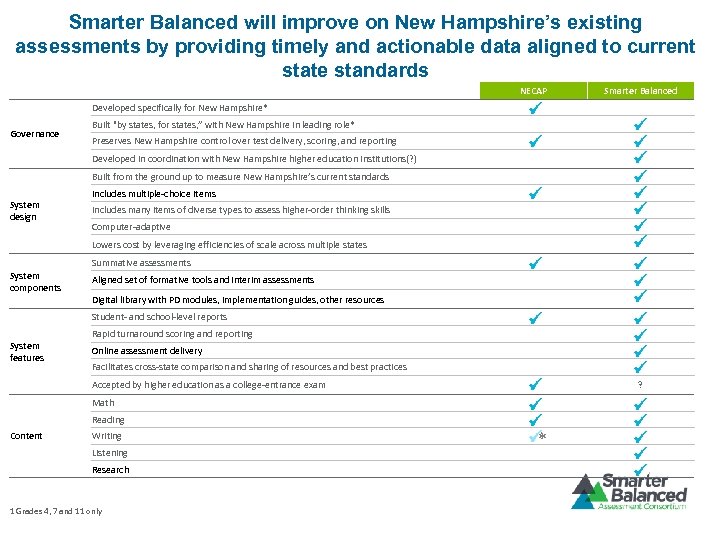
Smarter Balanced will improve on New Hampshire’s existing assessments by providing timely and actionable data aligned to current state standards NECAP Developed specifically for New Hampshire* Governance Built "by states, for states, ” with New Hampshire in leading role* Preserves New Hampshire control over test delivery, scoring, and reporting Developed in coordination with New Hampshire higher education institutions(? ) ü ü Built from the ground up to measure New Hampshire’s current standards System design Includes multiple-choice items Includes many items of diverse types to assess higher-order thinking skills ü Computer-adaptive Lowers cost by leveraging efficiencies of scale across multiple states Summative assessments System components Aligned set of formative tools and interim assessments Digital library with PD modules, implementation guides, other resources Student- and school-level reports System features Rapid turnaround scoring and reporting ü Online assessment delivery Facilitates cross-state comparison and sharing of resources and best practices Accepted by higher education as a college-entrance exam Math Reading Content ü Writing Listening Research ü ü * Smarter Balanced ü ü ü ü ? ü ü ü 1 Grades 4, 7 and 11 only 19
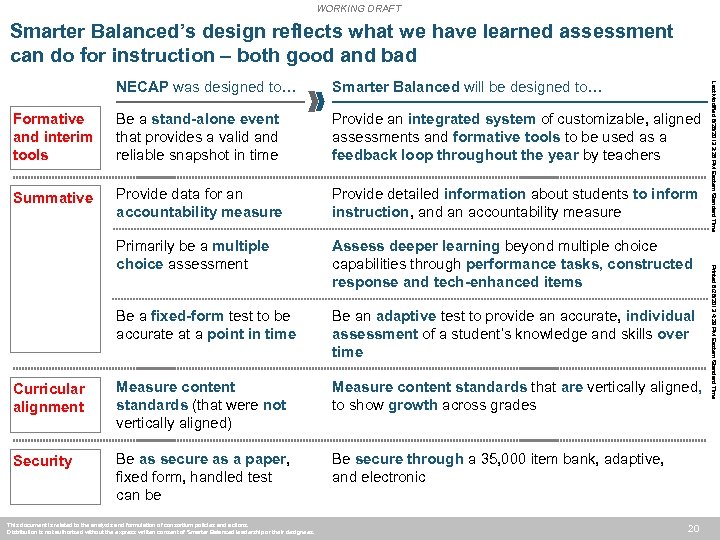
WORKING DRAFT Smarter Balanced’s design reflects what we have learned assessment can do for instruction – both good and bad Formative and interim tools Be a stand-alone event that provides a valid and reliable snapshot in time Provide an integrated system of customizable, aligned assessments and formative tools to be used as a feedback loop throughout the year by teachers Summative Provide data for an accountability measure Provide detailed information about students to inform instruction, and an accountability measure Primarily be a multiple choice assessment Assess deeper learning beyond multiple choice capabilities through performance tasks, constructed response and tech-enhanced items Be a fixed-form test to be accurate at a point in time Be an adaptive test to provide an accurate, individual assessment of a student’s knowledge and skills over time Curricular alignment Measure content standards (that were not vertically aligned) Measure content standards that are vertically aligned, to show growth across grades Security Be as secure as a paper, fixed form, handled test can be Be secure through a 35, 000 item bank, adaptive, and electronic This document is related to the analysis and formulation of consortium policies and actions. Distribution is not authorized without the express written consent of Smarter Balanced leadership or their designees. 20 Printed 6/26/2013 4: 29 PM Eastern Standard Time Smarter Balanced will be designed to… Last Modified 6/28/2013 3: 28 PM Eastern Standard Time NECAP was designed to…
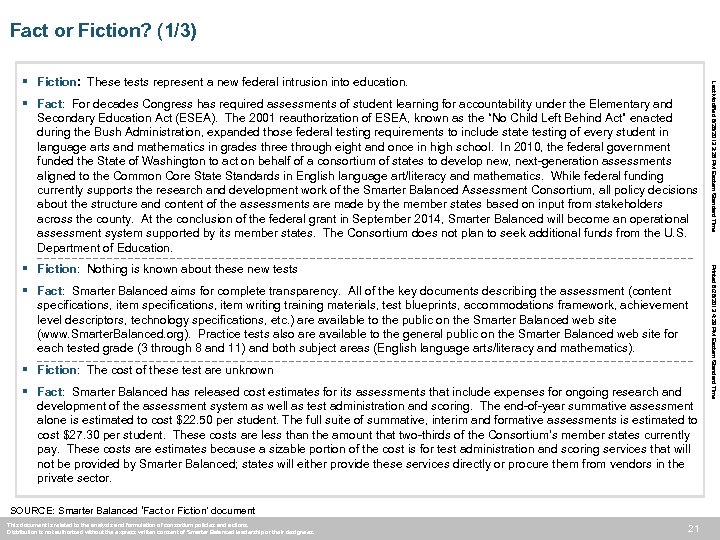
WORKING DRAFT Fact or Fiction? (1/3) ▪ ▪ Fiction: Nothing is known about these new tests ▪ ▪ Fiction: The cost of these test are unknown Fact: For decades Congress has required assessments of student learning for accountability under the Elementary and Secondary Education Act (ESEA). The 2001 reauthorization of ESEA, known as the “No Child Left Behind Act” enacted during the Bush Administration, expanded those federal testing requirements to include state testing of every student in language arts and mathematics in grades three through eight and once in high school. In 2010, the federal government funded the State of Washington to act on behalf of a consortium of states to develop new, next-generation assessments aligned to the Common Core State Standards in English language art/literacy and mathematics. While federal funding currently supports the research and development work of the Smarter Balanced Assessment Consortium, all policy decisions about the structure and content of the assessments are made by the member states based on input from stakeholders across the county. At the conclusion of the federal grant in September 2014, Smarter Balanced will become an operational assessment system supported by its member states. The Consortium does not plan to seek additional funds from the U. S. Department of Education. Fact: Smarter Balanced aims for complete transparency. All of the key documents describing the assessment (content specifications, item writing training materials, test blueprints, accommodations framework, achievement level descriptors, technology specifications, etc. ) are available to the public on the Smarter Balanced web site (www. Smarter. Balanced. org). Practice tests also are available to the general public on the Smarter Balanced web site for each tested grade (3 through 8 and 11) and both subject areas (English language arts/literacy and mathematics). Fact: Smarter Balanced has released cost estimates for its assessments that include expenses for ongoing research and development of the assessment system as well as test administration and scoring. The end-of-year summative assessment alone is estimated to cost $22. 50 per student. The full suite of summative, interim and formative assessments is estimated to cost $27. 30 per student. These costs are less than the amount that two-thirds of the Consortium’s member states currently pay. These costs are estimates because a sizable portion of the cost is for test administration and scoring services that will not be provided by Smarter Balanced; states will either provide these services directly or procure them from vendors in the private sector. SOURCE: Smarter Balanced ‘Fact or Fiction’ document This document is related to the analysis and formulation of consortium policies and actions. Distribution is not authorized without the express written consent of Smarter Balanced leadership or their designees. 21 Printed 6/26/2013 4: 29 PM Eastern Standard Time Fiction: These tests represent a new federal intrusion into education. Last Modified 6/28/2013 3: 28 PM Eastern Standard Time ▪ ▪
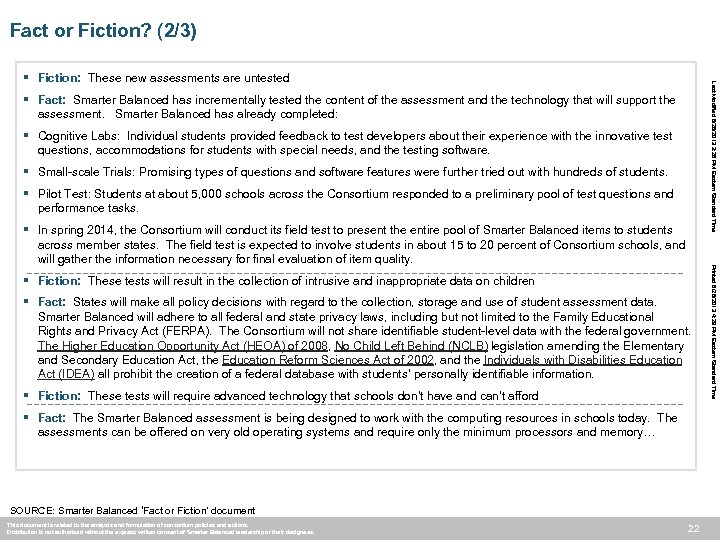
WORKING DRAFT Fact or Fiction? (2/3) ▪ Cognitive Labs: Individual students provided feedback to test developers about their experience with the innovative test questions, accommodations for students with special needs, and the testing software. ▪ ▪ Small-scale Trials: Promising types of questions and software features were further tried out with hundreds of students. ▪ In spring 2014, the Consortium will conduct its field test to present the entire pool of Smarter Balanced items to students across member states. The field test is expected to involve students in about 15 to 20 percent of Consortium schools, and will gather the information necessary for final evaluation of item quality. ▪ ▪ Fiction: These tests will result in the collection of intrusive and inappropriate data on children ▪ ▪ Fiction: These tests will require advanced technology that schools don’t have and can’t afford Fact: Smarter Balanced has incrementally tested the content of the assessment and the technology that will support the assessment. Smarter Balanced has already completed: Pilot Test: Students at about 5, 000 schools across the Consortium responded to a preliminary pool of test questions and performance tasks. Fact: States will make all policy decisions with regard to the collection, storage and use of student assessment data. Smarter Balanced will adhere to all federal and state privacy laws, including but not limited to the Family Educational Rights and Privacy Act (FERPA). The Consortium will not share identifiable student-level data with the federal government. The Higher Education Opportunity Act (HEOA) of 2008, No Child Left Behind (NCLB) legislation amending the Elementary and Secondary Education Act, the Education Reform Sciences Act of 2002, and the Individuals with Disabilities Education Act (IDEA) all prohibit the creation of a federal database with students’ personally identifiable information. Fact: The Smarter Balanced assessment is being designed to work with the computing resources in schools today. The assessments can be offered on very old operating systems and require only the minimum processors and memory… SOURCE: Smarter Balanced ‘Fact or Fiction’ document This document is related to the analysis and formulation of consortium policies and actions. Distribution is not authorized without the express written consent of Smarter Balanced leadership or their designees. 22 Printed 6/26/2013 4: 29 PM Eastern Standard Time Fiction: These new assessments are untested Last Modified 6/28/2013 3: 28 PM Eastern Standard Time ▪ ▪
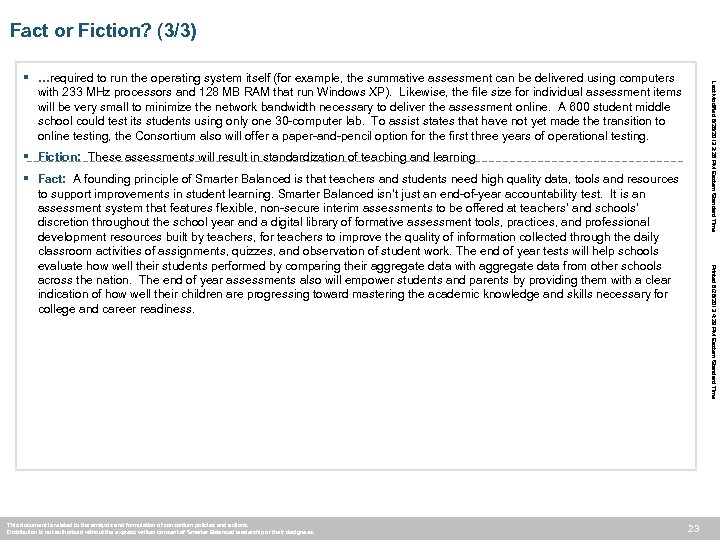
WORKING DRAFT Fact or Fiction? (3/3) …required to run the operating system itself (for example, the summative assessment can be delivered using computers with 233 MHz processors and 128 MB RAM that run Windows XP). Likewise, the file size for individual assessment items will be very small to minimize the network bandwidth necessary to deliver the assessment online. A 600 student middle school could test its students using only one 30 -computer lab. To assist states that have not yet made the transition to online testing, the Consortium also will offer a paper-and-pencil option for the first three years of operational testing. ▪ ▪ Fiction: These assessments will result in standardization of teaching and learning Last Modified 6/28/2013 3: 28 PM Eastern Standard Time ▪ This document is related to the analysis and formulation of consortium policies and actions. Distribution is not authorized without the express written consent of Smarter Balanced leadership or their designees. Printed 6/26/2013 4: 29 PM Eastern Standard Time Fact: A founding principle of Smarter Balanced is that teachers and students need high quality data, tools and resources to support improvements in student learning. Smarter Balanced isn’t just an end-of-year accountability test. It is an assessment system that features flexible, non-secure interim assessments to be offered at teachers’ and schools’ discretion throughout the school year and a digital library of formative assessment tools, practices, and professional development resources built by teachers, for teachers to improve the quality of information collected through the daily classroom activities of assignments, quizzes, and observation of student work. The end of year tests will help schools evaluate how well their students performed by comparing their aggregate data with aggregate data from other schools across the nation. The end of year assessments also will empower students and parents by providing them with a clear indication of how well their children are progressing toward mastering the academic knowledge and skills necessary for college and career readiness. 23
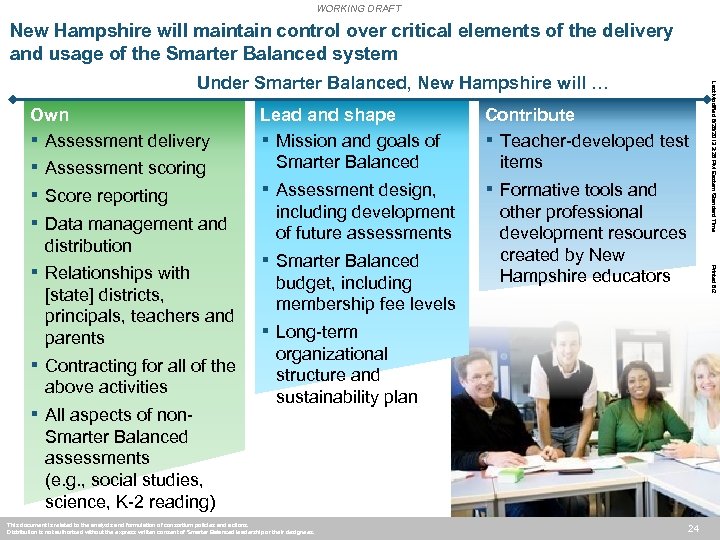
WORKING DRAFT New Hampshire will maintain control over critical elements of the delivery and usage of the Smarter Balanced system Own ▪ Assessment delivery Assessment scoring ▪ Relationships with [state] districts, principals, teachers and parents Score reporting Data management and distribution ▪ Contracting for all of the above activities ▪ All aspects of non. Smarter Balanced assessments (e. g. , social studies, science, K-2 reading) Contribute ▪ Teacher-developed test items ▪ Assessment design, including development of future assessments ▪ ▪ Smarter Balanced budget, including membership fee levels ▪ Long-term organizational structure and sustainability plan This document is related to the analysis and formulation of consortium policies and actions. Distribution is not authorized without the express written consent of Smarter Balanced leadership or their designees. Formative tools and other professional development resources created by New Hampshire educators 24 Printed 6/26/2013 4: 29 PM Eastern Standard Time ▪ ▪ ▪ Lead and shape ▪ Mission and goals of Smarter Balanced Last Modified 6/28/2013 3: 28 PM Eastern Standard Time Under Smarter Balanced, New Hampshire will …
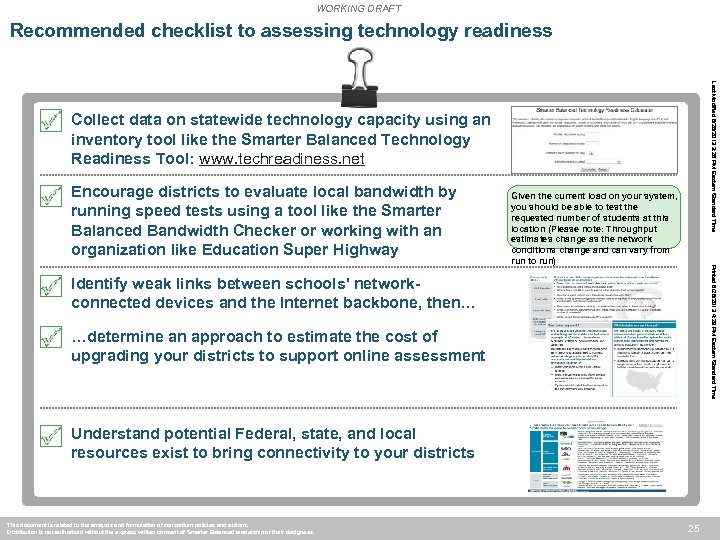
WORKING DRAFT Recommended checklist to assessing technology readiness Last Modified 6/28/2013 3: 28 PM Eastern Standard Time Collect data on statewide technology capacity using an inventory tool like the Smarter Balanced Technology Readiness Tool: www. techreadiness. net Encourage districts to evaluate local bandwidth by running speed tests using a tool like the Smarter Balanced Bandwidth Checker or working with an organization like Education Super Highway Printed 6/26/2013 4: 29 PM Eastern Standard Time Given the current load on your system, you should be able to test the requested number of students at this location (Please note: Throughput estimates change as the network conditions change and can vary from run to run) Identify weak links between schools' networkconnected devices and the Internet backbone, then… …determine an approach to estimate the cost of upgrading your districts to support online assessment Understand potential Federal, state, and local resources exist to bring connectivity to your districts This document is related to the analysis and formulation of consortium policies and actions. Distribution is not authorized without the express written consent of Smarter Balanced leadership or their designees. 25
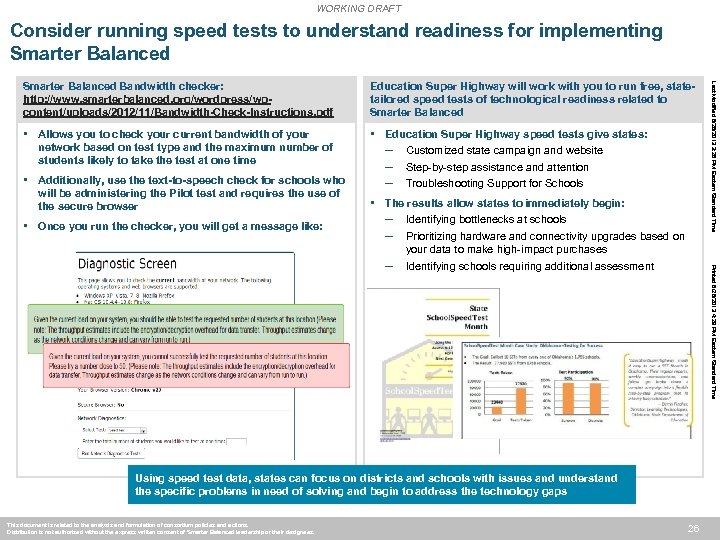
WORKING DRAFT Consider running speed tests to understand readiness for implementing Smarter Balanced Education Super Highway will work with you to run free, statetailored speed tests of technological readiness related to Smarter Balanced ▪ Allows you to check your current bandwidth of your network based on test type and the maximum number of students likely to take the test at one time ▪ ▪ Additionally, use the text-to-speech check for schools who will be administering the Pilot test and requires the use of the secure browser Education Super Highway speed tests give states: – Customized state campaign and website – Step-by-step assistance and attention – Troubleshooting Support for Schools ▪ The results allow states to immediately begin: – Identifying bottlenecks at schools – Prioritizing hardware and connectivity upgrades based on your data to make high-impact purchases ▪ Once you run the checker, you will get a message like: Printed 6/26/2013 4: 29 PM Eastern Standard Time – Identifying schools requiring additional assessment Using speed test data, states can focus on districts and schools with issues and understand the specific problems in need of solving and begin to address the technology gaps This document is related to the analysis and formulation of consortium policies and actions. Distribution is not authorized without the express written consent of Smarter Balanced leadership or their designees. Last Modified 6/28/2013 3: 28 PM Eastern Standard Time Smarter Balanced Bandwidth checker: http: //www. smarterbalanced. org/wordpress/wpcontent/uploads/2012/11/Bandwidth-Check-Instructions. pdf 26
WORKING DRAFT Evaluating The Smarter Balanced Assessment Last Modified 6/28/2013 3: 28 PM Eastern Standard Time We will spend some time evaluating the SBAC Practice Test Location: http: //sbac. portal. airast. org/Practice_Test/default. html Printed 6/26/2013 4: 29 PM Eastern Standard Time Limitations: Practice test is not full range of content so should not be used as an instructional guide. Has no reports or scores and is fixedform not computer adaptive. Please log into the SBAC Practice Test Location provided above This document is related to the analysis and formulation of consortium policies and actions. Distribution is not authorized without the express written consent of Smarter Balanced leadership or their designees. 27
WORKING DRAFT Evaluating The Smarter Balanced Assessment Last Modified 6/28/2013 3: 28 PM Eastern Standard Time Process: 1. With at least one computer able to connect to the Wi. Fi and using either Mozilla Firefox, Google Chrome, Apple Safari or with the SBAC Secure Browser, break into groups. If you need the SBAC Secure Browser (Explorer/Windows): http: //sbac. portal. airast. org/browsers/default. html Printed 6/26/2013 4: 29 PM Eastern Standard Time 2. Log into SBAC Practice Test Portal: (http: //sbac. portal. airast. org/Practice_Test/default. html) or initiate the SBAC Secure Browser. 3. Please review the materials on the “Welcome to the Smarter Balanced Test” page. 4. Click on the green icon “Student interface Practice Test” if you are not using the SBAC Secure Browser. This document is related to the analysis and formulation of consortium policies and actions. Distribution is not authorized without the express written consent of Smarter Balanced leadership or their designees. 28
WORKING DRAFT Evaluating The Smarter Balanced Assessment Last Modified 6/28/2013 3: 28 PM Eastern Standard Time Exercise: 1. Choose a grade and subject to examine as a group. 2. Work through the questions and consider the following: 1. Printed 6/26/2013 4: 29 PM Eastern Standard Time 1. What are the pros/cons of this format? 2. What adjustments will be required at the classroom level? 3. What problems or issues have you observed? What are some possible solutions to ameliorate problems or issues? 4. What implications are there using SBAC at the school and district levels? 5. What recommendations can you make to facilitate school, district or NHDOE’s transition to using SBAC? This document is related to the analysis and formulation of consortium policies and actions. Distribution is not authorized without the express written consent of Smarter Balanced leadership or their designees. 29
Visit us at: Smarter. Balanced. org
Скачать презентацию Overview Smarter Balanced Assessment Consortium New Hampshire Department
5ebbd31e169ebde1992acbddfb907381.ppt