 Скачать презентацию Overview Shareholder s right to vote Right to obtain
Shareholder's rights.pptx
- Количество слайдов: 27



Overview Shareholder’s right to vote Right to obtain information at the annual meeting Dividend rights Preemptive rights Protection of minority shareholders Shareholder’s right to claims
THE SHAREHOLDER'S RIGHT TO VOTE
What is the right to vote Ø The right to vote is an “inherent part of membership” Ø The right of a shareholder to vote on matters of corporate policy and who will make up the board of directors. Ø Voting often involves decisions on issuing securities, initiating corporate actions and making substantial changes in the corporation's operations.
Distinctive features Ø Each share shall confer voting rights. Ø The voting rights are proportionate to the par value of the shares (§ 134 (1) Aktiengesetz). Ø Preferred shares that confer no voting rights may be issued in accordance with the provisions of Akt. G. Ø Multiple voting rights shall be prohibited. Ø Decisions of the General meeting are taken by a majority of the votes. Ø The right to vote cannot be withdrawn. Ø Shareholder can transfer his power to vote to his custodian or a third party.
Exercise of Voting Rights Through Agents A shareholder has a right: Ø To give to another person a power of attorney (Vollinacht) to vote his shares at the meeting. Ø To give the bank authorization (Ermichtigung) to vote the shares.
On what do shareholders vote? Ø Basic decisions: amendments of the articles of association (§ 179 Aktiengesetz); measures to increase and to decrease the stated capital (§§ 182, 237 Aktiengesetz); consent to group contracts (§§ 291 et seq. Aktiengesetz); change of the corporate form (§ 13 Umwandlungsgesetz) or dissolution of the association (§ 262 Aktiengesetz). Ø The decisions that must be taken regularly. The appointment of the members of the supervisory board (§ 101 Aktiengesetz); the appropriation of retained earnings (§ 119 Aktiengesetz); the discharge from responsibility of the members of the board of management and the supervisory board (§ 120 Aktiengesetz) or the appointment of auditors (§ 163 Aktiengesetz). Ø Decisions in special cases. The appointment of special auditors (§ 142 Aktiengesetz), the removal of members of the supervisory board (§ 103 Aktiengesetz), taking decisions on managerial matters if the management board requests (§ 119 (2) Aktiengesetz).
Prohibition on the exercise of voting right. No one can exercise the right to vote for themselves or for another person: Ø in case of the decision on the approval of his work; Ø in case of the decision of the release this person from obligations; Ø in case of the decision whether the company should make claim to this person.

THE RIGHT TO OBTAIN INFORMATION AT THE ANNUAL MEETING
Shareholder’s right to obtain information at the annual meeting Ø The duty of the Board to provide information about the affairs of the joint stock company Ø The right of the Board to refuse to provide information Ø Judgment on the right to obtain information

DIVIDEND RIGHT OF SHAREHOLDERS
Dividend right A shareholder's rights to receive per-share dividends identical to those other shareholders receive.
Classification of Shares Ø Common (St or St. A) – right to vote, dividends depend on board of managements’ decision Ø Preferred (V, VA or Vz) – no right to vote, fixed dividends
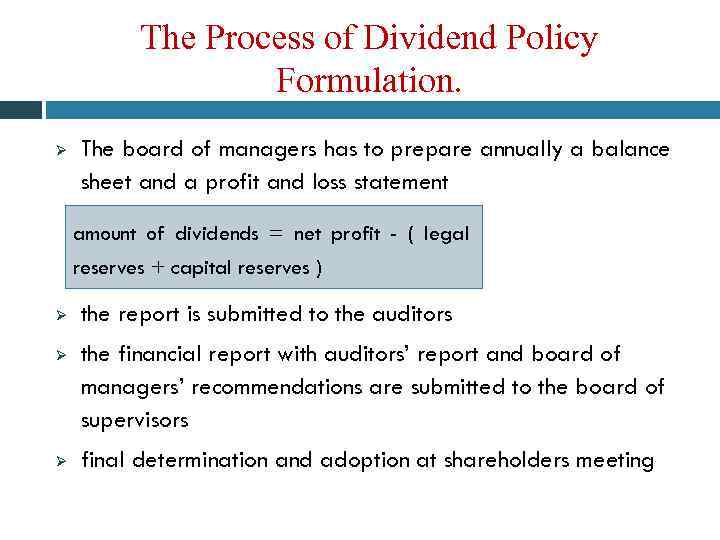
The Process of Dividend Policy Formulation. Ø The board of managers has to prepare annually a balance sheet and a profit and loss statement amount of dividends = net profit - ( legal reserves + capital reserves ) Ø the report is submitted to the auditors Ø the financial report with auditors’ report and board of managers’ recommendations are submitted to the board of supervisors Ø final determination and adoption at shareholders meeting

PREEMPTIVE RIGHT OF SHAREHOLDERS
Preemptive right Privilege prescribed by Commercial Code. Must be stated in articles of association or bylaws of a firm. Under this privilege the current stockholders (shareholders) are given the first option to buy a new issue of common stock (ordinary shares). Ø Ø Ø Enables to maintain shareholders their percentage of the total ownership of the firm Usually exercised on the basis of current stockholding. Also called subscription privilege or subscription right.

PROTECTION OF MINORITY SHAREHOLDERS
Minority shareholders are individuals, or legal entities, who have minority stakes in a company that is controlled by majority shareholders.
Protection of minority shareholders Legal Concepts and Relevant Statutory Rules in Germany: Ø Ø Ø The Right to Information, Independent Auditing and Special Right to Control by Minority Shareholders; Influence on Decision-Making Process by Minority Shareholders; Voting Rights of Minority Shareholders.
The Right to Information, Independent Auditing and Special Right to Control by Minority Shareholders Right to request and receive information from the management: Ø Ø Ø At the general meeting; information should be essential for a shareholder; Concerning to the item of agenda.
Influence on Decision-Making Process by Minority Shareholders Ø Participation in general meeting of shareholders Ø Right to call the external shareholder meeting Ø Right to publish additional items on agenda
Voting Rights of Minority Shareholders Ø Blocking power Ø “Lowering information and transaction costs for shareholders to cast their votes. ” Ø One-share, one-vote rule.
Squeeze-Out Rule in Germany Request of a principal shareholder (holding 95% of the share capital) to transfer shares of minority shareholders against the adequate compensation. Ø Ø This request is resolved by shareholders meeting If the compensation is not adequate (or it is not offered), the court shall set adequate cash compensation
SHAREHOLDER`S RIGHT TO CLAIMS
Annulment of Resolution of the Shareholders’ Meeting. Grounds for Invalidity (according to § 241 (Akt. G): Ø Ø Ø was adopted in a shareholders’ meeting which was not called pursuant to § 121 (Akt. G) has not been recorded pursuant to § 130 (Akt. G) is not compatible with the nature of the company or violates provisions which exist for the protection of the company’s creditors by its terms is unethical has been declared null and void by a judgment upon a contesting action which is final
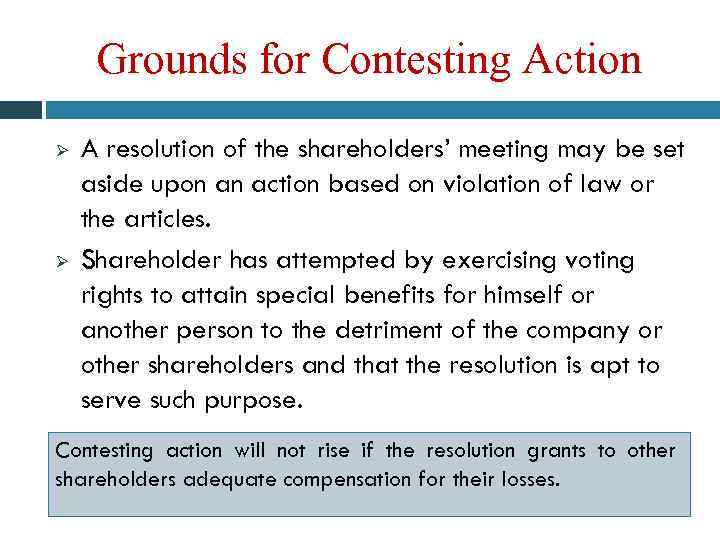
Grounds for Contesting Action Ø Ø A resolution of the shareholders’ meeting may be set aside upon an action based on violation of law or the articles. Shareholder has attempted by exercising voting rights to attain special benefits for himself or another person to the detriment of the company or other shareholders and that the resolution is apt to serve such purpose. Contesting action will not rise if the resolution grants to other shareholders adequate compensation for their losses.
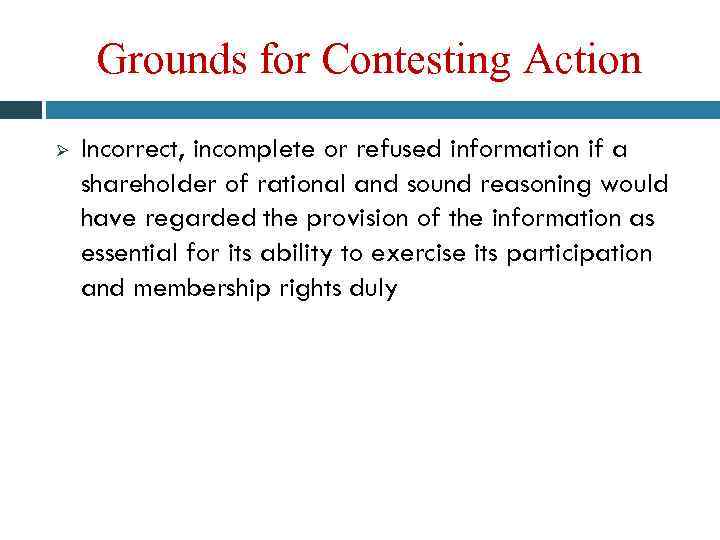
Grounds for Contesting Action Ø Incorrect, incomplete or refused information if a shareholder of rational and sound reasoning would have regarded the provision of the information as essential for its ability to exercise its participation and membership rights duly
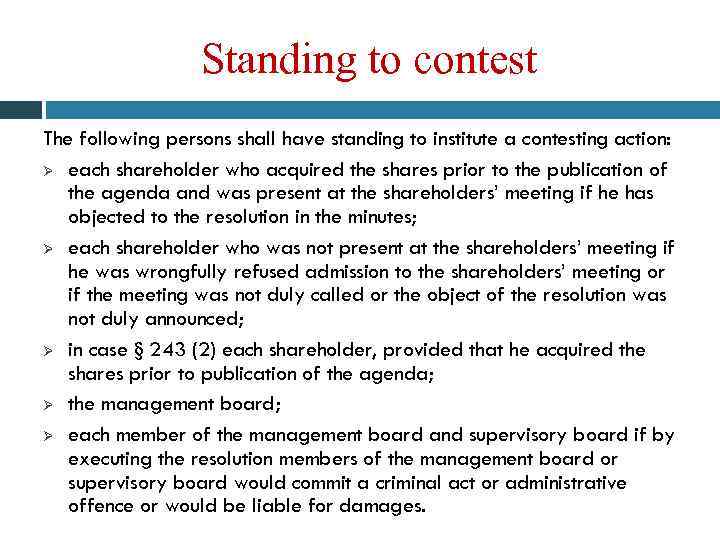
Standing to contest The following persons shall have standing to institute a contesting action: Ø each shareholder who acquired the shares prior to the publication of the agenda and was present at the shareholders’ meeting if he has objected to the resolution in the minutes; Ø each shareholder who was not present at the shareholders’ meeting if he was wrongfully refused admission to the shareholders’ meeting or if the meeting was not duly called or the object of the resolution was not duly announced; Ø in case § 243 (2) each shareholder, provided that he acquired the shares prior to publication of the agenda; Ø the management board; Ø each member of the management board and supervisory board if by executing the resolution members of the management board or supervisory board would commit a criminal act or administrative offence or would be liable for damages.
Скачать презентацию Overview Shareholder s right to vote Right to obtain
Shareholder's rights.pptx