 Скачать презентацию Overview on Metabolomics Josephine Linke Yibeltal Science is
cf1aa8b85203998b3489d57eebd73631.ppt
- Количество слайдов: 36




Overview on Metabolomics Josephine Linke Yibeltal “Science is built up with facts, as a house is with stones. But a collection of f acts is no more a science than a heap of stones is a house. ” - Jules Henri Poincaré
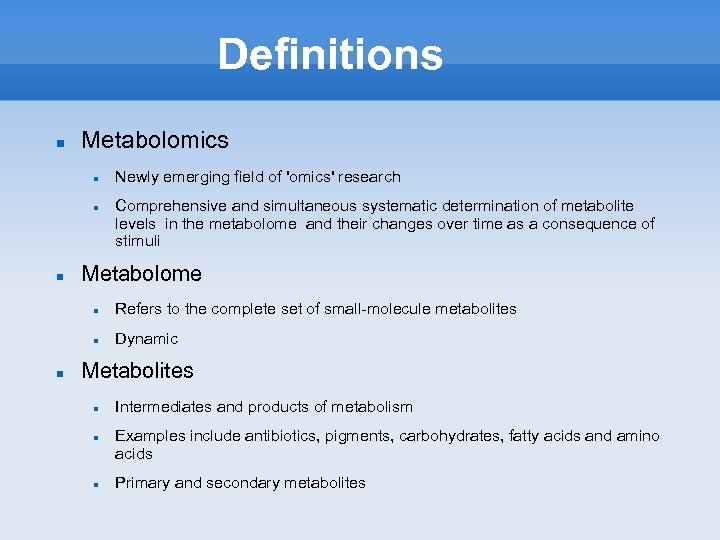
Definitions Metabolomics Newly emerging field of 'omics' research Comprehensive and simultaneous systematic determination of metabolite levels in the metabolome and their changes over time as a consequence of stimuli Metabolome Refers to the complete set of small-molecule metabolites Dynamic Metabolites Intermediates and products of metabolism Examples include antibiotics, pigments, carbohydrates, fatty acids and amino acids Primary and secondary metabolites
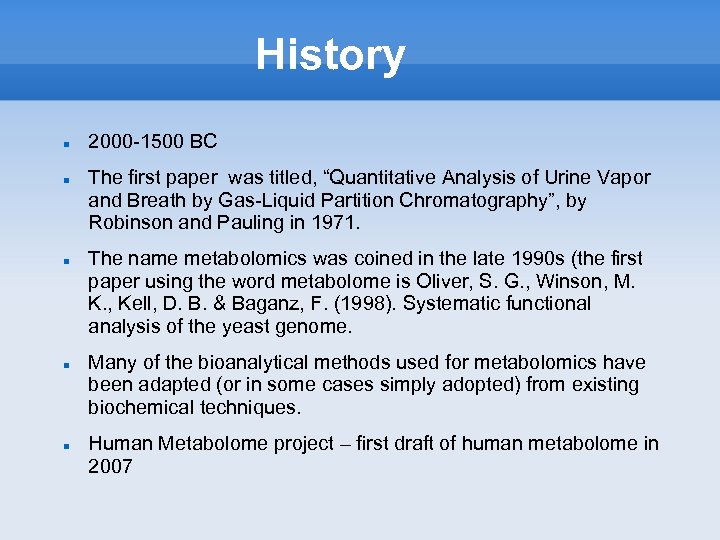
History 2000 -1500 BC The first paper was titled, “Quantitative Analysis of Urine Vapor and Breath by Gas-Liquid Partition Chromatography”, by Robinson and Pauling in 1971. The name metabolomics was coined in the late 1990 s (the first paper using the word metabolome is Oliver, S. G. , Winson, M. K. , Kell, D. B. & Baganz, F. (1998). Systematic functional analysis of the yeast genome. Many of the bioanalytical methods used for metabolomics have been adapted (or in some cases simply adopted) from existing biochemical techniques. Human Metabolome project – first draft of human metabolome in 2007
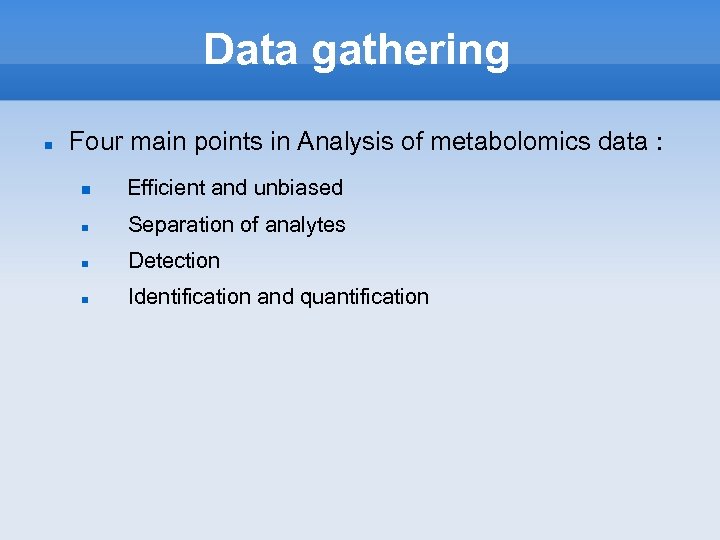
Data gathering Four main points in Analysis of metabolomics data : Efficient and unbiased Separation of analytes Detection Identification and quantification
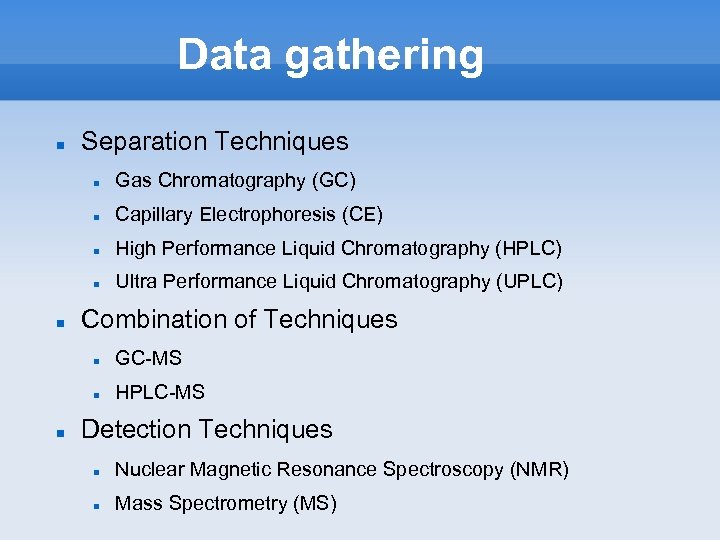
Data gathering Separation Techniques Capillary Electrophoresis (CE) High Performance Liquid Chromatography (HPLC) Gas Chromatography (GC) Ultra Performance Liquid Chromatography (UPLC) Combination of Techniques GC-MS HPLC-MS Detection Techniques Nuclear Magnetic Resonance Spectroscopy (NMR) Mass Spectrometry (MS)
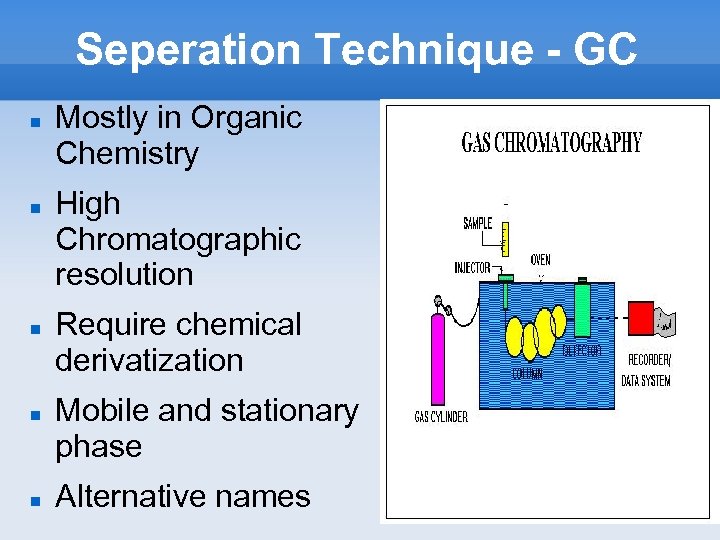
Seperation Technique - GC Mostly in Organic Chemistry High Chromatographic resolution Require chemical derivatization Mobile and stationary phase Alternative names
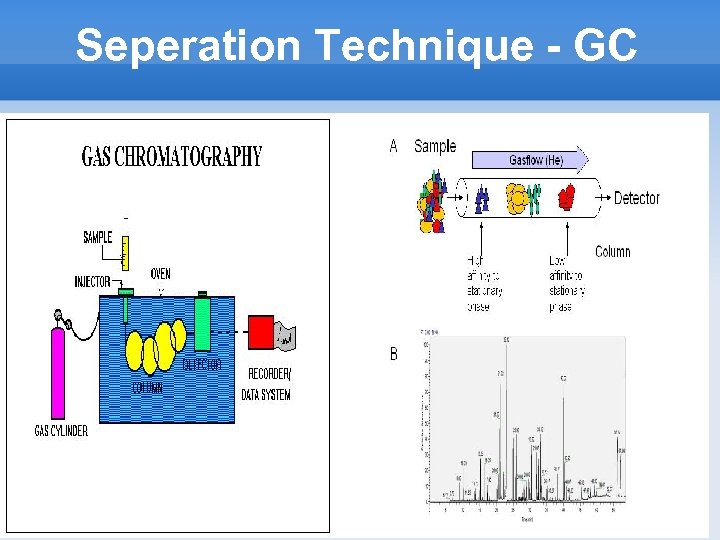
Seperation Technique - GC
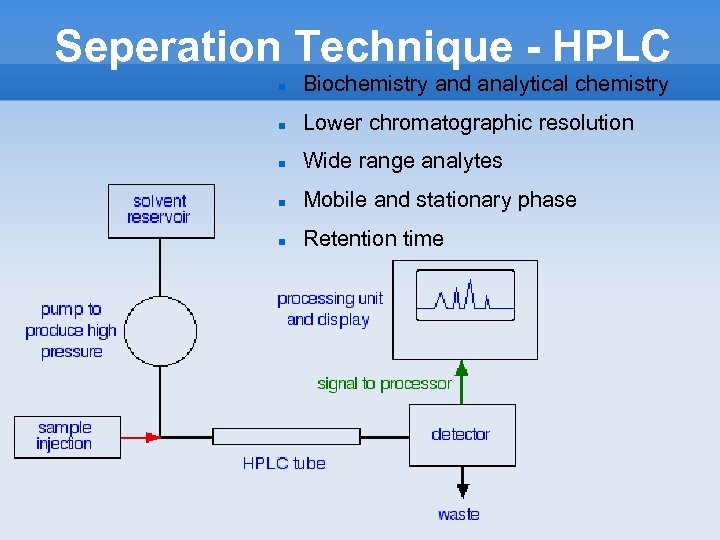
Seperation Technique - HPLC Biochemistry and analytical chemistry Lower chromatographic resolution Wide range analytes Mobile and stationary phase Retention time
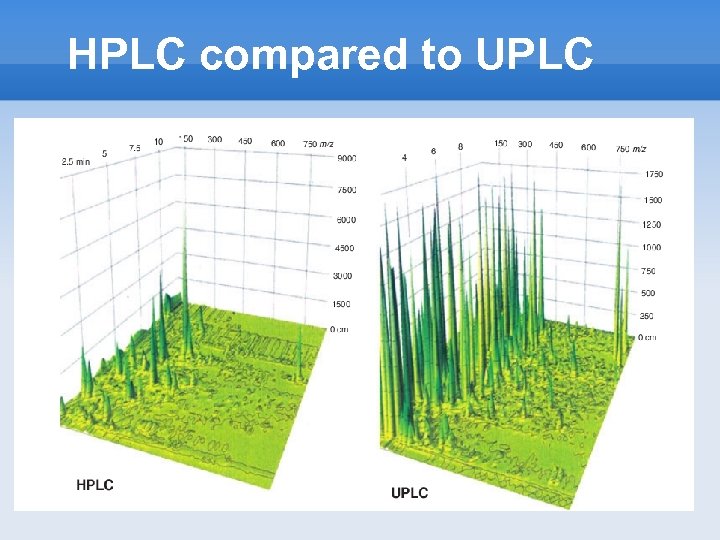
HPLC compared to UPLC
Seperation Technique - CE Introduced in 1960 s Higher separation efficiency than HPLC Wide range of metabolites than GC Charged analytes
Detection Technique - NMRS Doesn't depend on separation Relatively insensitive NMR spectra difficult for interpretation Applicable in MRI
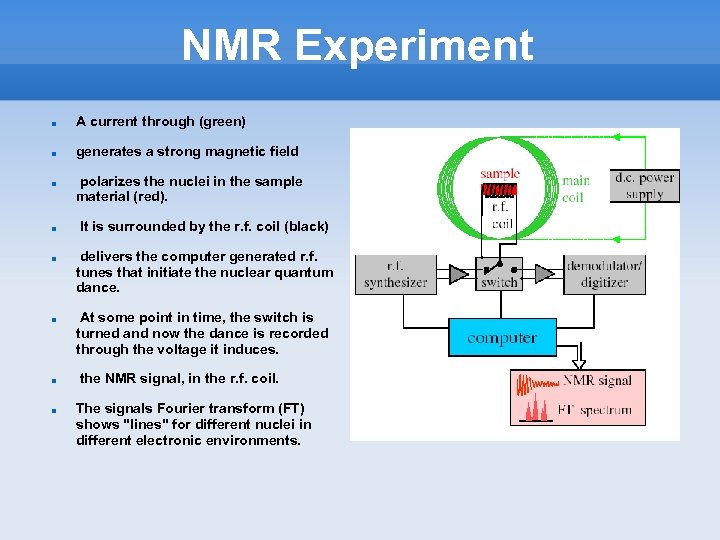
NMR Experiment A current through (green) generates a strong magnetic field polarizes the nuclei in the sample material (red). It is surrounded by the r. f. coil (black) delivers the computer generated r. f. tunes that initiate the nuclear quantum dance. At some point in time, the switch is turned and now the dance is recorded through the voltage it induces. the NMR signal, in the r. f. coil. The signals Fourier transform (FT) shows "lines" for different nuclei in different electronic environments.
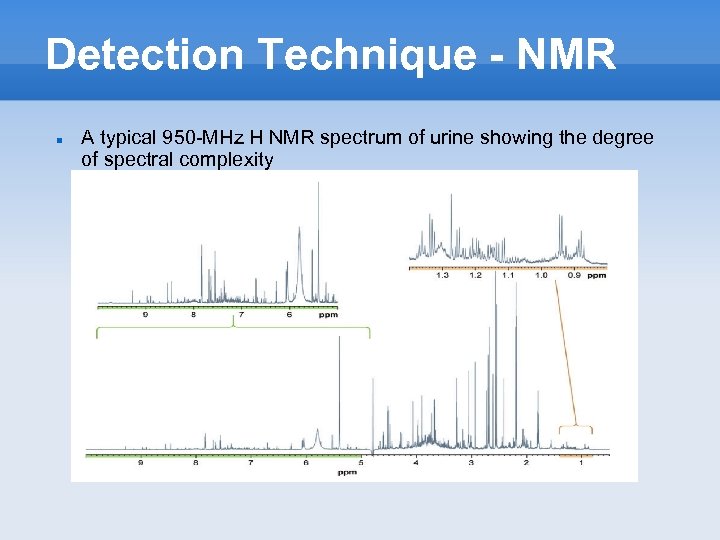
Detection Technique - NMR A typical 950 -MHz H NMR spectrum of urine showing the degree of spectral complexity
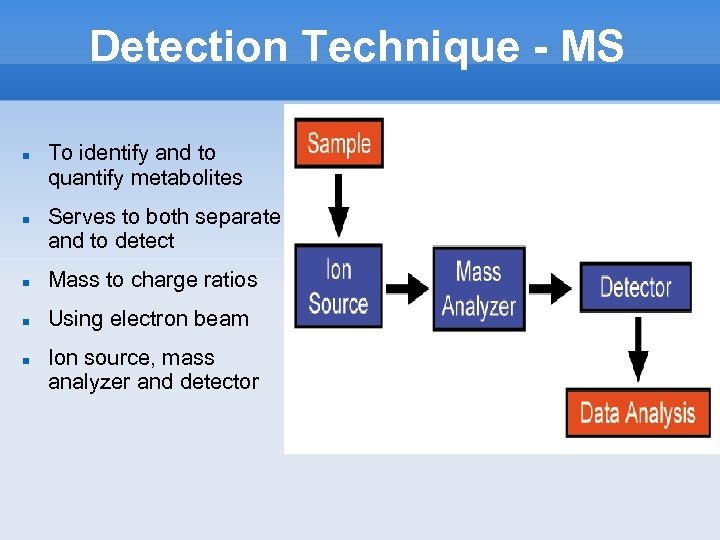
Detection Technique - MS To identify and to quantify metabolites Serves to both separate and to detect Mass to charge ratios Using electron beam Ion source, mass analyzer and detector
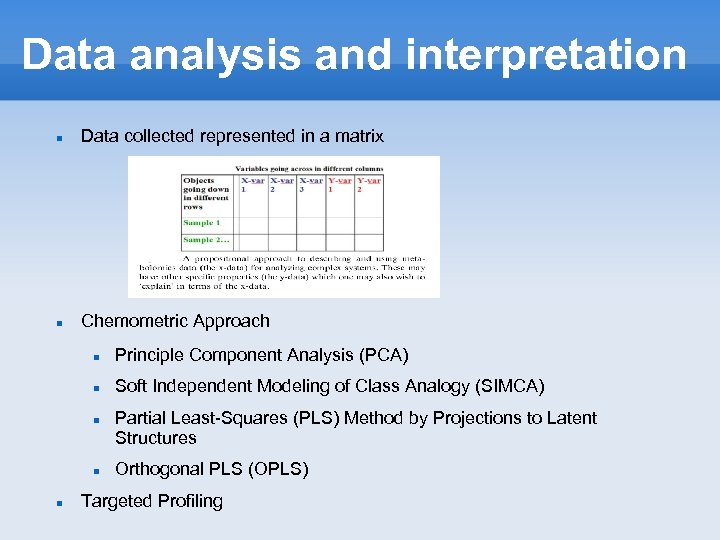
Data analysis and interpretation Data collected represented in a matrix Chemometric Approach Principle Component Analysis (PCA) Soft Independent Modeling of Class Analogy (SIMCA) Partial Least-Squares (PLS) Method by Projections to Latent Structures Orthogonal PLS (OPLS) Targeted Profiling
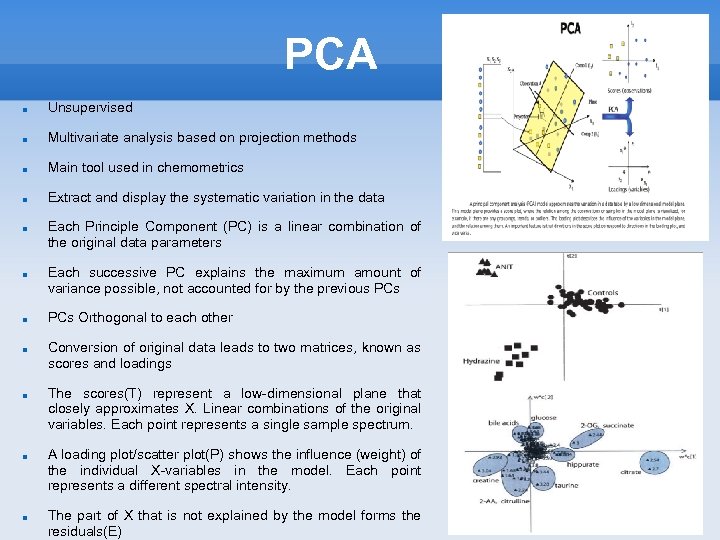
PCA Unsupervised Multivariate analysis based on projection methods Main tool used in chemometrics Extract and display the systematic variation in the data Each Principle Component (PC) is a linear combination of the original data parameters Each successive PC explains the maximum amount of variance possible, not accounted for by the previous PCs Orthogonal to each other Conversion of original data leads to two matrices, known as scores and loadings The scores(T) represent a low-dimensional plane that closely approximates X. Linear combinations of the original variables. Each point represents a single sample spectrum. A loading plot/scatter plot(P) shows the influence (weight) of the individual X-variables in the model. Each point represents a different spectral intensity. The part of X that is not explained by the model forms the residuals(E)
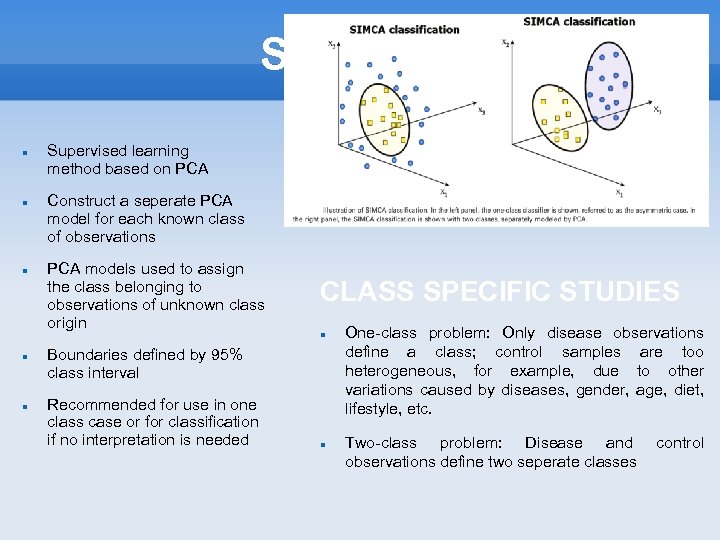
SIMCA Supervised learning method based on PCA Construct a seperate PCA model for each known class of observations PCA models used to assign the class belonging to observations of unknown class origin CLASS SPECIFIC STUDIES Boundaries defined by 95% class interval Recommended for use in one class case or for classification if no interpretation is needed One-class problem: Only disease observations define a class; control samples are too heterogeneous, for example, due to other variations caused by diseases, gender, age, diet, lifestyle, etc. Two-class problem: Disease and observations define two seperate classes control
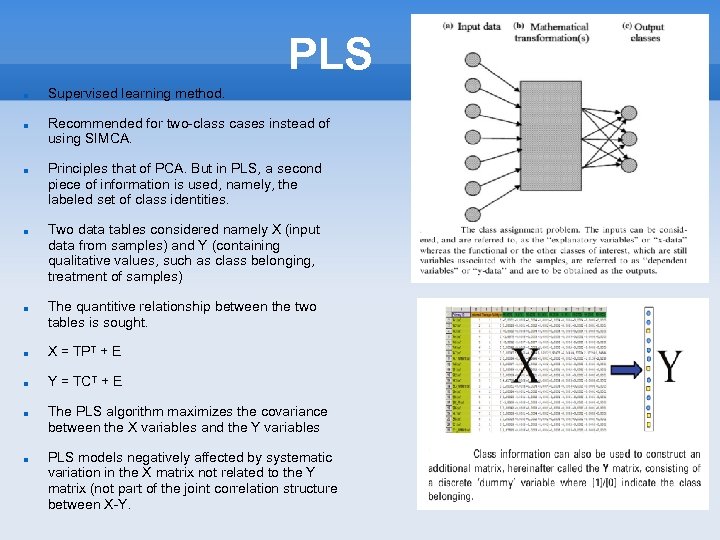
PLS Supervised learning method. Recommended for two-class cases instead of using SIMCA. Principles that of PCA. But in PLS, a second piece of information is used, namely, the labeled set of class identities. Two data tables considered namely X (input data from samples) and Y (containing qualitative values, such as class belonging, treatment of samples) The quantitive relationship between the two tables is sought. X = TPT + E Y = TCT + E The PLS algorithm maximizes the covariance between the X variables and the Y variables PLS models negatively affected by systematic variation in the X matrix not related to the Y matrix (not part of the joint correlation structure between X-Y.
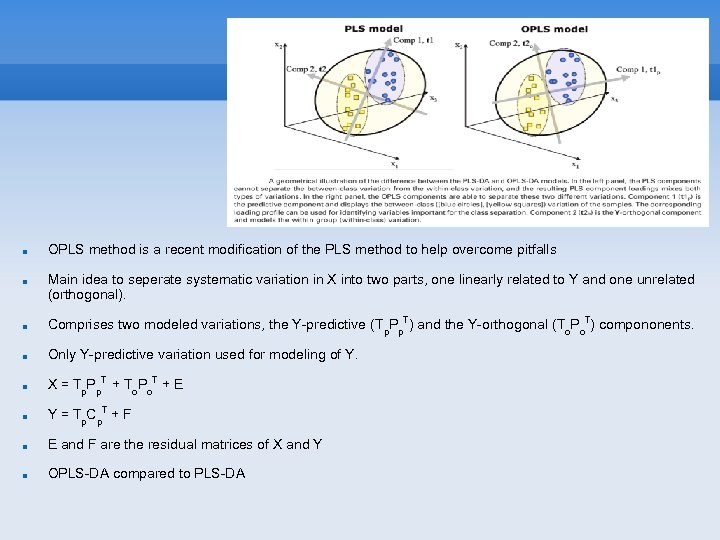
OPLS method is a recent modification of the PLS method to help overcome pitfalls Main idea to seperate systematic variation in X into two parts, one linearly related to Y and one unrelated (orthogonal). Comprises two modeled variations, the Y-predictive (Tp. Pp. T) and the Y-orthogonal (To. Po. T) compononents. Only Y-predictive variation used for modeling of Y. X = Tp. Pp. T + To. Po. T + E Y = Tp. Cp. T + F E and F are the residual matrices of X and Y OPLS-DA compared to PLS-DA
Remarks on pattern classification Intent in using these classification techniques not to identify specific compound Classify in specific categories, conditions or disease status Traditional clinical chemistry depended on identifying and quantifying specific compounds Chemometric profiling interested in looking at all metabolites at once and making a phenotypic classification of diagnosis
Targeted profiling Targeted metabolomic profiling is fundamentally different than most chemometric approaches. In targeted metabolomic profiling the compounds in a given biofluid or tissue extract identified and quantified by comparing the spectrum of interest to a library of reference spectra of pure compounds. Key advantage: Does not require collection of identical sets = More amenable to human studies or studies that require less day-to-day monitoring. Disadvantage: Relatively limited size of most current spectral libraries = bias metabolite identification and interpretation. A growing trend towards combining the best features of both chemometric and targeted methods.
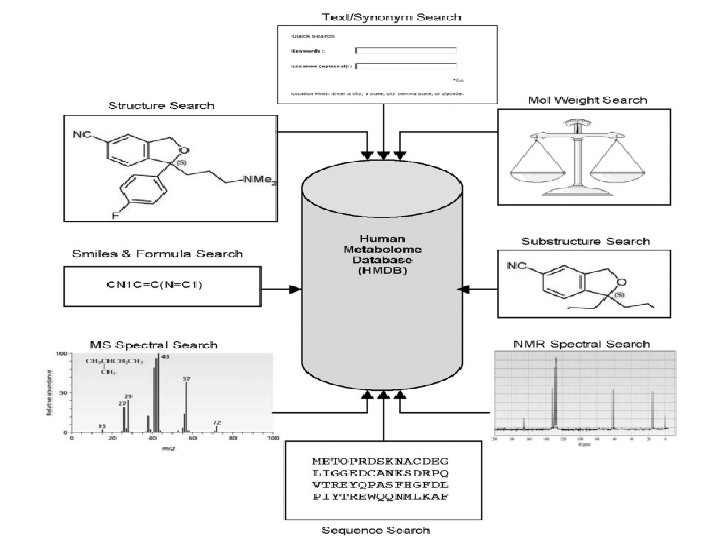
Databases Large amount of data Need for databases that can be easily searched Better databases will help in combining chemometric and targeted profiling methods Newly emerging databases HMDB good model for other databases Challenge of standardisation
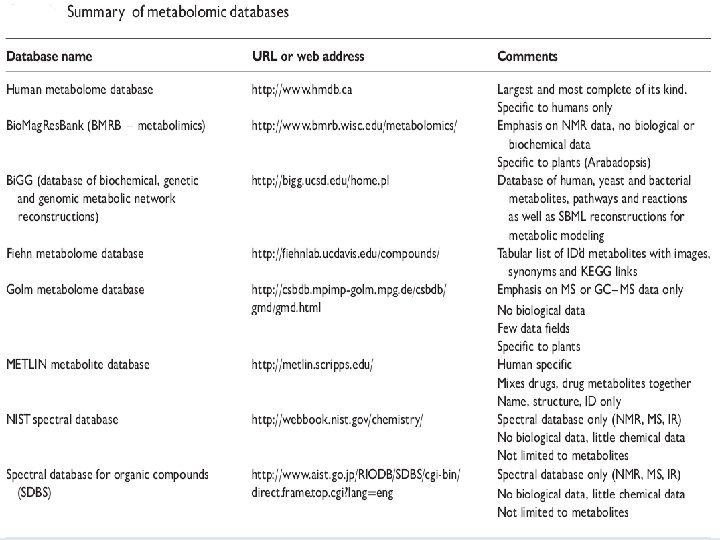
Databases
Integration of metabolomics with other ‘omics’ fields Integrating genomics and metabolomics for engineering plant metabolic pathways - Kirsi-Marja Oksman-Caldentey and Kazuki Saito (2005) Proteomic and metabolomic analysis of cardioprotection: Interplay between protein kinase C epsilon and delta in regulating glucose metabolism of murine hearts Recent studies (2005) to integrate transcriptomics, proteomics and metabolomics in an effort to enhance production efficiency under stressful conditions of grapes. Nutrigenomics is a generalised term which links genomics, transcriptomics, proteomics and metabolomics to human nutrition.
Main Applications Drug assessment Clinical toxicology Nutrigenomics Functional genomics
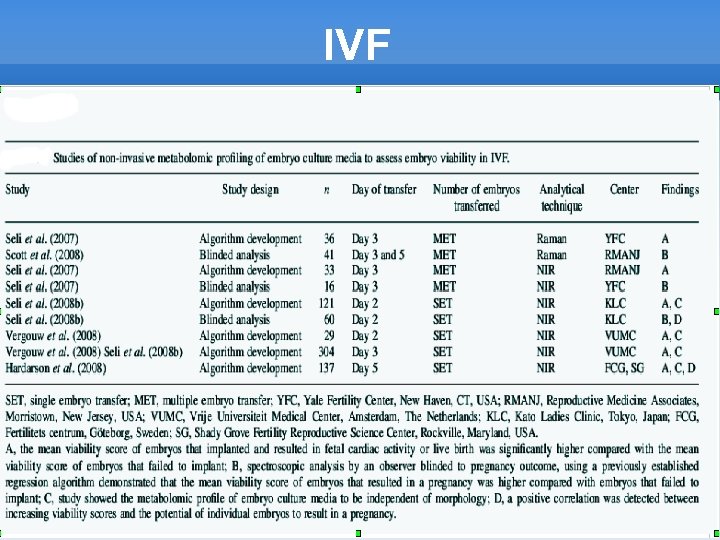
Examples of interesting research projects Metabolomics and its Application for non-invasive embryo assessment in IVF Nonivasive metabolomic profiling of embryo culture media using proton nuclear magnetic resonance correlates with reproductive potential of embryos in women undergoing in vitro fertilization Nonivasive metabolomic profiling of human embryo culture media using Raman spectroscopy predicts embryonic reproductive potential: a prospective blinded pilot study Metabolomic profiles delineate potential role for sarcosine in prostate cancer progression A Multivariate Screening Strategy for Investigating Metabolic Effects of Strenuous Physical Exercise in Human Serum
IVF Statistics Grading system based on embryo morphology and cleavage rates the mainstay of embryo assessment worldwide Not sufficiently precise Investigations to demonstrate underlying metabolic difference between embryos resulting in pregnancy and those that do not.
IVF Aim of the method: To increase pregnancy rates and reduce number of embryos implanted To enhance treatment outcomes and a reduction in multiple birth rate To reduce time and cost of achieving a successful pregnancy To expand the IVF market
IVF
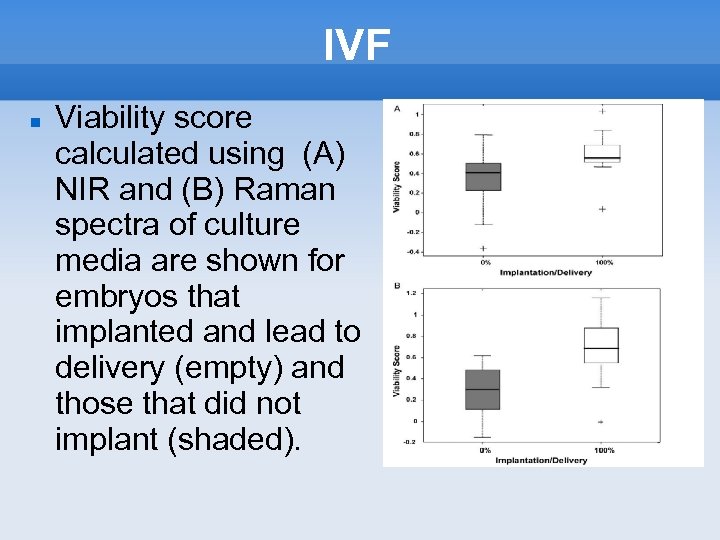
IVF Viability score calculated using (A) NIR and (B) Raman spectra of culture media are shown for embryos that implanted and lead to delivery (empty) and those that did not implant (shaded).
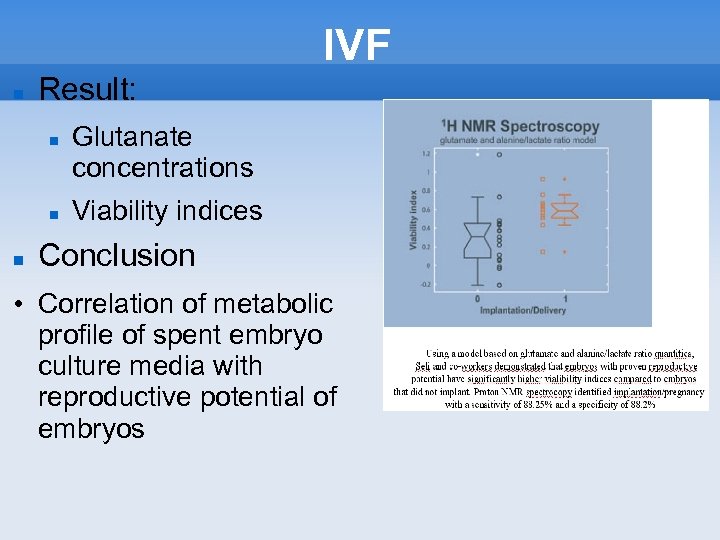
IVF Result: Glutanate concentrations Viability indices Conclusion • Correlation of metabolic profile of spent embryo culture media with reproductive potential of embryos
Future challenges and development Database Standardisation Diversity/variation of metabolomic data More efficient ways of identification Better models for interpretation of data Integration with other 'OMICS'

Bibliography Current Progress in computational metabolomics – David S. Wishart, 2007 Metabonomics in pharmaceutical R & D – John C. Lindon, Elaine Holmes and Jeremy K. Nicholson Wikipedia – search on “Metabolomics” Metabolomics Basics : What is Metabolomics? - Thermo Scientific, www. thermo. com A metabolome pipeline : from concept to data to knowledge – Marie Brown, Warwick B. Dunn, David I. Ellis, Roystone Goodacre, Julia Handl, Joshua D. Knowles, Steve O'Hagan, Irena Spasic and Douglas B. Kell, 2004 Integrative Genomics and Functional Explanation – Jo Davies, Thorunn Rafner, Garrett Hellenthal and Jotun Hein, 2009 Chemometrics in Metabonomics – Johan Trygg, Elaine Holmes and Torbjorn Lundstedt Wikipedia – search on “Chromatography” Spectroscopic and Statistical Techniques for Information Recovery in Metabonomics and Metabolomics – John C. Lindon and Jeremy K. Nicholson Wikipedia – search on “NMR” Wikipedia – search on “Spectroscopy” Setup. X: A public study design database for metabolomic projects – Scholz M, Fiehn O, 2007 New bioinformatics resources for metabolomics – Markley JL, Anderson ME, Cui Q Non-Invasive Metabolic profiling of embryo culture media using proton nuclear magnetic resonance correlates with reproductive potential of embryos in women undergoing in vitro fertilization. - E. Seli, L. Botros, D. Sakkas, D. Burns Non-Invasive Metabolomic profiling of human embryo culture media using Raman spectroscopy predicts embryonic reproductive potential: a proospective blinded pilot study. - Scott R. , et al. 2008

The End
Скачать презентацию Overview on Metabolomics Josephine Linke Yibeltal Science is
cf1aa8b85203998b3489d57eebd73631.ppt