 Скачать презентацию Overview of Verizon Global Public Policy Issues
7545328bea6fba1d5c3f60b0db9726f1.ppt
- Количество слайдов: 12



Overview of Verizon & Global Public Policy Issues for the Internet Ecosystem Chris Boam Director, International Public Policy and Regulatory Affairs 7 October 2011 © 2007 Verizon. All Rights Reserved. PTE 12065 03/07 Washington, D. C.
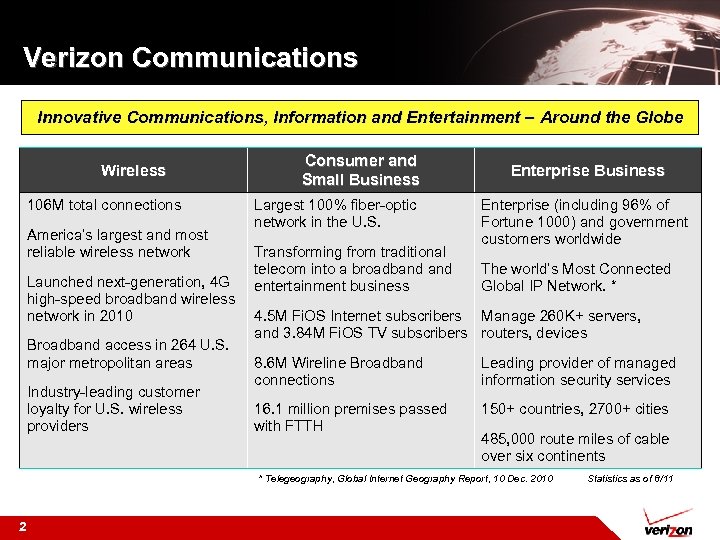
Verizon Communications Innovative Communications, Information and Entertainment – Around the Globe Wireless 106 M total connections America’s largest and most reliable wireless network Launched next-generation, 4 G high-speed broadband wireless network in 2010 Broadband access in 264 U. S. major metropolitan areas Industry-leading customer loyalty for U. S. wireless providers Consumer and Small Business Largest 100% fiber-optic network in the U. S. Transforming from traditional telecom into a broadband entertainment business Enterprise Business Enterprise (including 96% of Fortune 1000) and government customers worldwide The world’s Most Connected Global IP Network. * 4. 5 M Fi. OS Internet subscribers Manage 260 K+ servers, and 3. 84 M Fi. OS TV subscribers routers, devices 8. 6 M Wireline Broadband connections Leading provider of managed information security services 16. 1 million premises passed with FTTH 150+ countries, 2700+ cities 485, 000 route miles of cable over six continents * Telegeography, Global Internet Geography Report, 10 Dec. 2010 2 Statistics as of 8/11
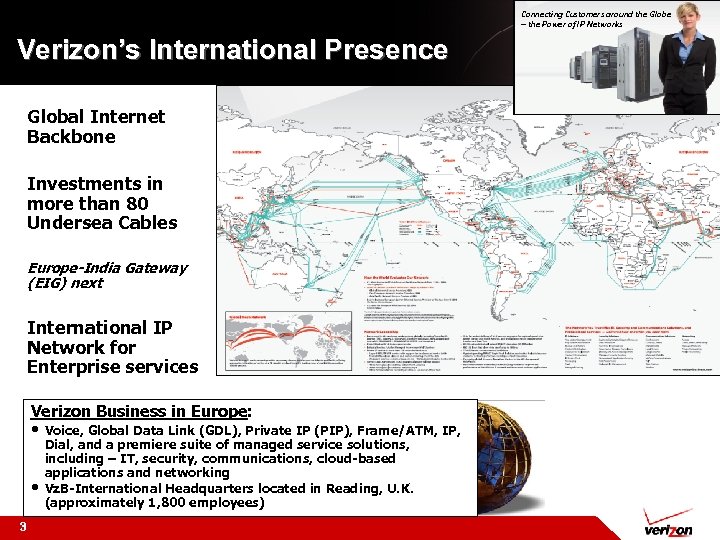
Connecting Customers around the Globe – the Power of IP Networks Verizon’s International Presence Global Internet Backbone Investments in more than 80 Undersea Cables Europe-India Gateway (EIG) next International IP Network for Enterprise services Verizon Business in Europe: • Voice, Global Data Link (GDL), Private IP (PIP), Frame/ATM, IP, • 3 Dial, and a premiere suite of managed service solutions, including – IT, security, communications, cloud-based applications and networking Vz. B-International Headquarters located in Reading, U. K. (approximately 1, 800 employees)
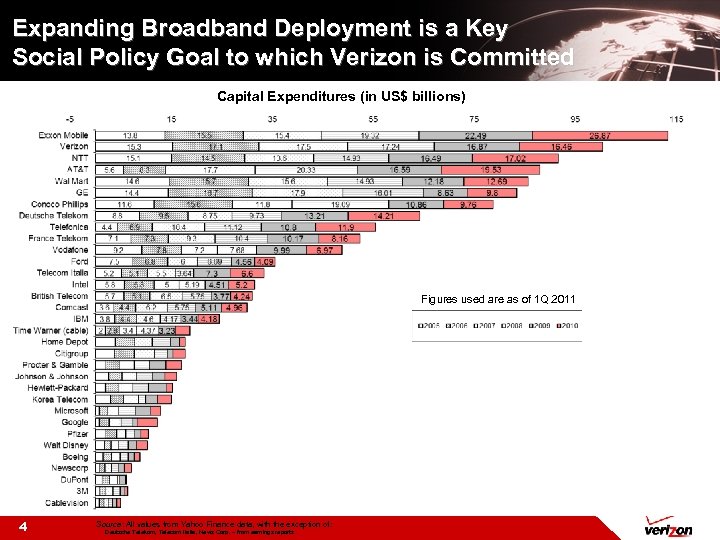
Expanding Broadband Deployment is a Key Social Policy Goal to which Verizon is Committed Capital Expenditures (in US$ billions) Figures used are as of 1 Q 2011 4 Source: All values from Yahoo Finance data, with the exception of: Deutsche Telekom, Telecom Italia, News Corp. – from earnings reports
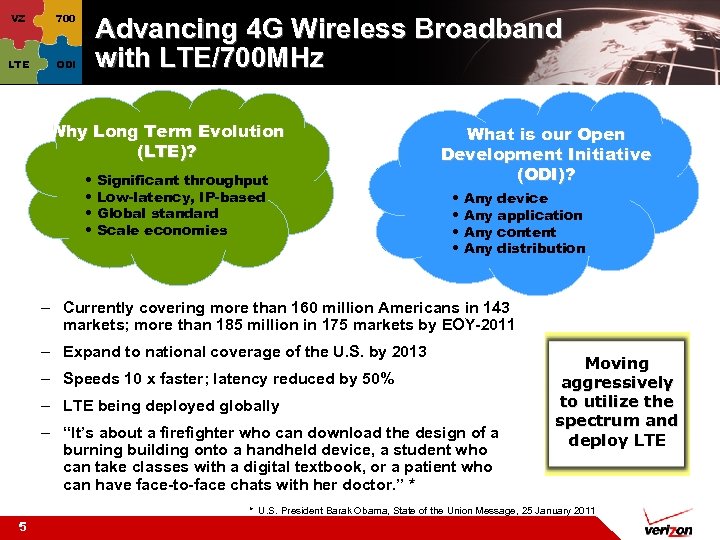
VZ 700 LTE ODI Advancing 4 G Wireless Broadband with LTE/700 MHz Why Long Term Evolution (LTE)? • • Significant throughput Low-latency, IP-based Global standard Scale economies What is our Open Development Initiative (ODI)? • • Any Any device application content distribution – Currently covering more than 160 million Americans in 143 markets; more than 185 million in 175 markets by EOY-2011 – Expand to national coverage of the U. S. by 2013 – Speeds 10 x faster; latency reduced by 50% – LTE being deployed globally – “It’s about a firefighter who can download the design of a burning building onto a handheld device, a student who can take classes with a digital textbook, or a patient who can have face-to-face chats with her doctor. ” * Moving aggressively to utilize the spectrum and deploy LTE * U. S. President Barak Obama, State of the Union Message, 25 January 2011 5
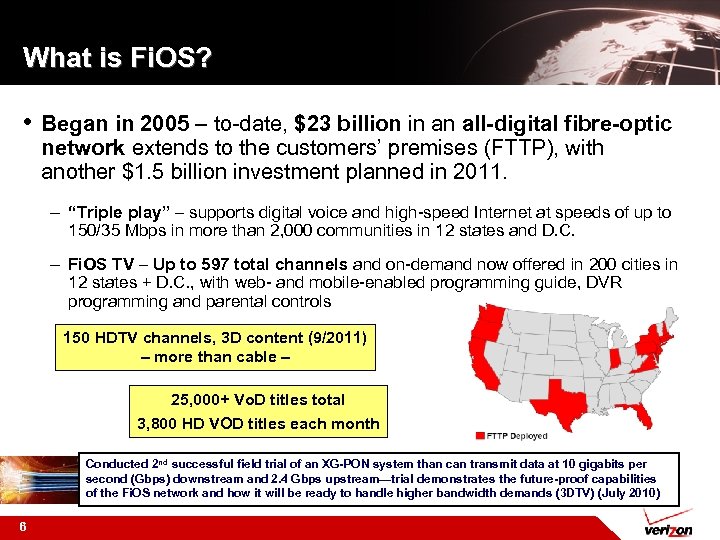
What is Fi. OS? • Began in 2005 – to-date, $23 billion in an all-digital fibre-optic network extends to the customers’ premises (FTTP), with another $1. 5 billion investment planned in 2011. – “Triple play” – supports digital voice and high-speed Internet at speeds of up to 150/35 Mbps in more than 2, 000 communities in 12 states and D. C. – Fi. OS TV – Up to 597 total channels and on-demand now offered in 200 cities in 12 states + D. C. , with web- and mobile-enabled programming guide, DVR programming and parental controls 150 HDTV channels, 3 D content (9/2011) – more than cable – 25, 000+ Vo. D titles total 3, 800 HD VOD titles each month Conducted 2 nd successful field trial of an XG-PON system than can transmit data at 10 gigabits per second (Gbps) downstream and 2. 4 Gbps upstream—trial demonstrates the future-proof capabilities of the Fi. OS network and how it will be ready to handle higher bandwidth demands (3 DTV) (July 2010) 6
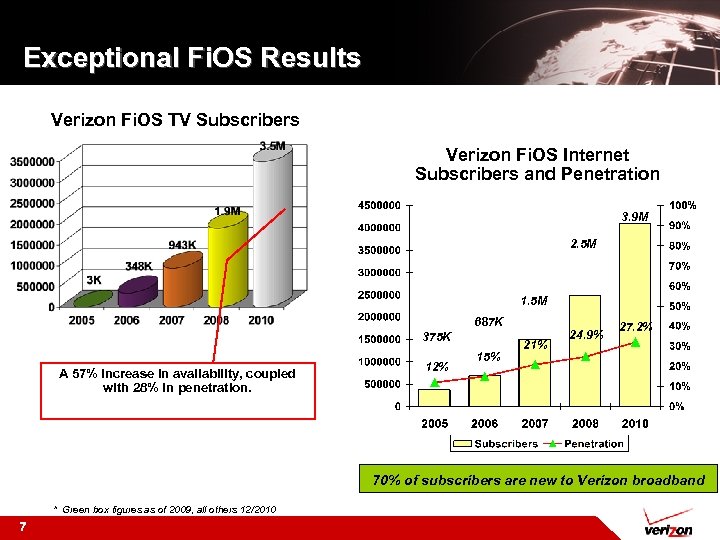
Exceptional Fi. OS Results Verizon Fi. OS TV Subscribers Verizon Fi. OS Internet Subscribers and Penetration 3. 9 M 2. 5 M 1. 5 M 687 K 375 K A 57% increase in availability, coupled with 28% in penetration. 12% 15% 21% 24. 9% 27. 2% 70% of subscribers are new to Verizon broadband * Green box figures as of 2009, all others 12/2010 7
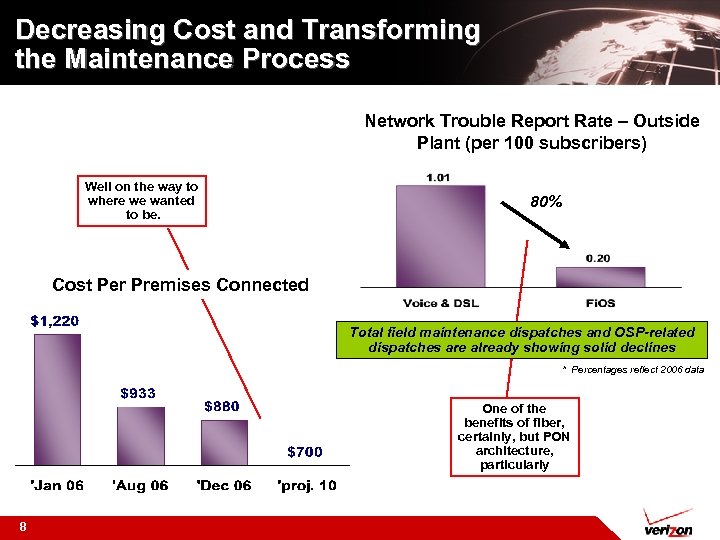
Decreasing Cost and Transforming the Maintenance Process Network Trouble Report Rate – Outside Plant (per 100 subscribers) Well on the way to where we wanted to be. 80% Cost Per Premises Connected Total field maintenance dispatches and OSP-related dispatches are already showing solid declines * Percentages reflect 2006 data One of the benefits of fiber, certainly, but PON architecture, particularly 8
Verizon’s Network: an Integral Part of the Internet • Every day, more than 100 million people connect using a Verizon network: – – – • 1. 7 billion text messages are exchanged (> 190 billion in the 2 nd quarter of 2011 alone) 50 million video/pictures exchanged 400 million emails received 8. 7 petabytes of video streamed – the equivalent of 4 million full-length movies 5 billion potential threats monitored and acted upon 1 billion phone calls are connected Network management – constant technical innovation, enabling services for businesses (for example): – Blocking a distributed denial of service attack – Facilitating seamless video and interactive conferencing solutions – Providing virtual private networks (VPNs) For consumers (for example): – Blocking spam or phishing emails – Enabling real-time home medical monitoring – Delivering the highest quality IP television experience 9
Verizon’s Position on Net Neutrality • Verizon continues to champion the consumer-driven open Internet. – Verizon agrees that the Internet must remain an unrestricted and open platform to access lawful content, services and applications, a principle we affirmed with our wireless Open Development Initiative and the proposed framework we announced with Google in August 2010. • Verizon believes that Europe adopted a sound policy around these issues in the course of its Electronic Communications Framework Review, with: – An emphasis on transparency – Recognition of the importance of network management – Reliance on ex post competition law to address alleged problems, use of case-by-case approach, possibility of minimum Qo. S obligations • In December, the FCC issued an order on network neutrality that also emphasizes transparency – we support the notion of appropriate transparency, though we note that too much disclosure can be problematic in some areas (e. g. , security practices). • Importantly, the FCC adopted a case-by-case approach to addressing issues that might arise. The FCC also exempted enterprise services from these obligations. • These points notwithstanding, Verizon is concerned that the FCC has acted outside of the authority available to it by law. That concern about legal jurisdiction is the focus of our judicial appeal. 10
Next Steps for U. S. Broadband • There is no doubt that U. S. policies have produced results: – Approximately 98% of the U. S. has access to at least one platform (cable) for broadband service (85% have access to at least two, including cable and DSL) – Only 37% of U. S. broadband subscribers rely on DSL for their broadband, a strength in platform competition that is rare globally. – Over 68% of American households take-up broadband. – The ITU ranks the U. S. 4 th in average broadband price, behind Macao, Israel and H. K. – The take-up of mobile Internet by users is roughly 30% of all U. S. subscribers (highest globally), whereas it’s 19% in Japan, 16% in the U. K. , 7% in France. • But as highlighted in the FCC’s National Broadband Plan: – We need to reach those who don’t have broadband, but to do so, we need to take a hard look at our subsidies – how we support efforts to build out to underserved areas – Mobile broadband rollout in the U. S. has been rapid and a global leader, but for it to continue, we need more spectrum and an open and orderly process to access it – Addressing demand will be critical, to emphasize to the remaining 32% of U. S. households, who don’t take-up broadband, the relevance of it to daily life 11
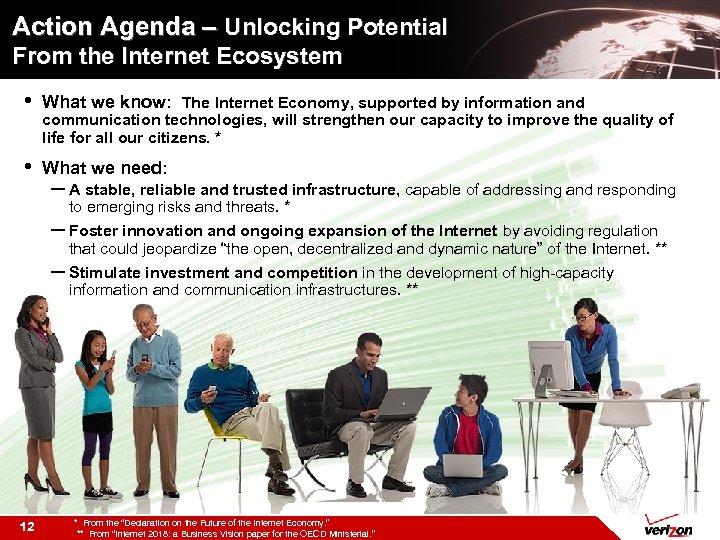
Action Agenda – Unlocking Potential From the Internet Ecosystem • What we know: The Internet Economy, supported by information and • What we need: communication technologies, will strengthen our capacity to improve the quality of life for all our citizens. * – A stable, reliable and trusted infrastructure, capable of addressing and responding to emerging risks and threats. * – Foster innovation and ongoing expansion of the Internet by avoiding regulation that could jeopardize “the open, decentralized and dynamic nature” of the Internet. ** – Stimulate investment and competition in the development of high-capacity information and communication infrastructures. ** 12 * From the “Declaration on the Future of the Internet Economy. ” ** From “Internet 2018: a Business Vision paper for the OECD Ministerial. ”
Скачать презентацию Overview of Verizon Global Public Policy Issues
7545328bea6fba1d5c3f60b0db9726f1.ppt