


 Скачать презентацию OVERVIEW OF THE STATUS OF INDIGENOUS KNOWLEDGE IK
78f6f866c291f4818b140bb05441c48d.ppt
- Количество слайдов: 15
 OVERVIEW OF THE STATUS OF INDIGENOUS KNOWLEDGE (IK) APPLICATION BY COMMUNITIES (Experience Sharing, Uganda) Augustine Bazaale Uganda Indigenous Knowledge Information Society (UGIKIS) March 28 – April 1, 2005
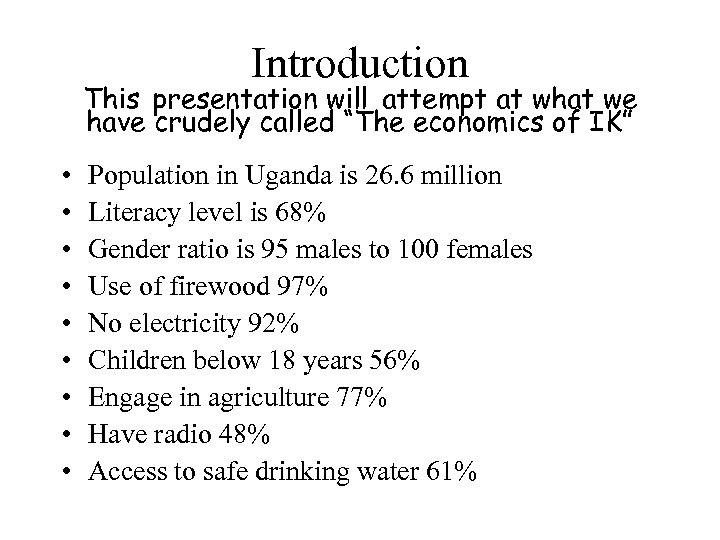 Introduction This presentation will attempt at what we have crudely called “The economics of IK” • • • Population in Uganda is 26. 6 million Literacy level is 68% Gender ratio is 95 males to 100 females Use of firewood 97% No electricity 92% Children below 18 years 56% Engage in agriculture 77% Have radio 48% Access to safe drinking water 61%
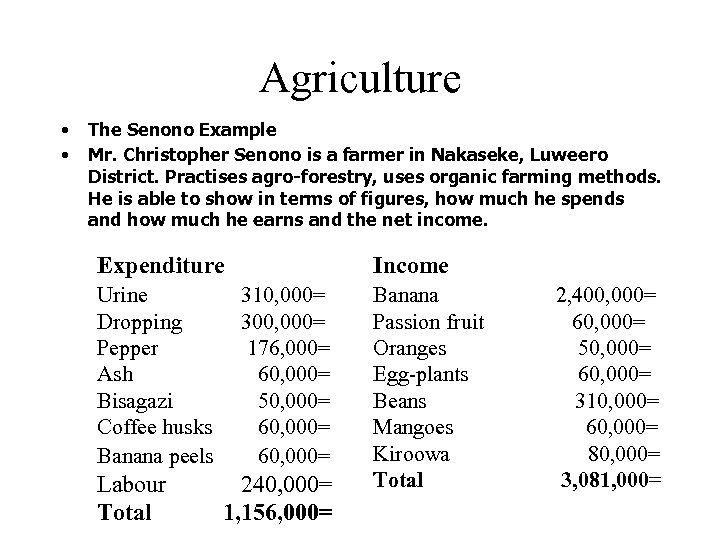 Agriculture • • The Senono Example Mr. Christopher Senono is a farmer in Nakaseke, Luweero District. Practises agro-forestry, uses organic farming methods. He is able to show in terms of figures, how much he spends and how much he earns and the net income. Expenditure Urine Dropping Pepper Ash Bisagazi Coffee husks Banana peels Labour Total Income 310, 000= 300, 000= 176, 000= 60, 000= 50, 000= 60, 000= 240, 000= 1, 156, 000= Banana Passion fruit Oranges Egg-plants Beans Mangoes Kiroowa Total 2, 400, 000= 60, 000= 50, 000= 60, 000= 310, 000= 60, 000= 80, 000= 3, 081, 000=
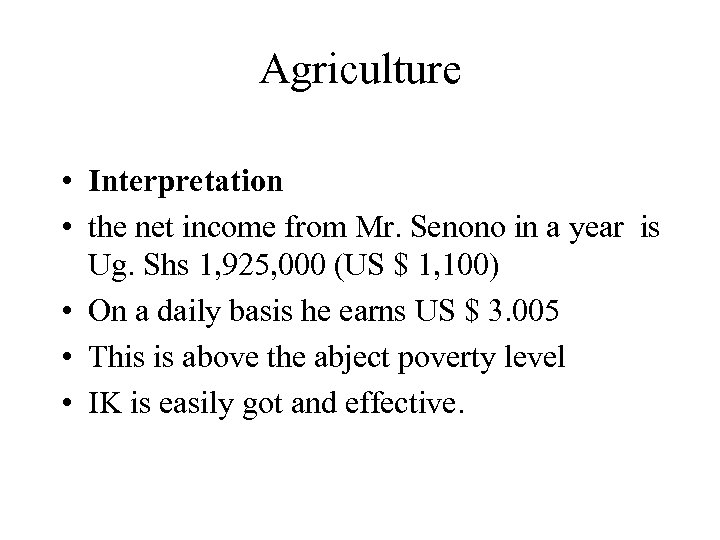 Agriculture • Interpretation • the net income from Mr. Senono in a year is Ug. Shs 1, 925, 000 (US $ 1, 100) • On a daily basis he earns US $ 3. 005 • This is above the abject poverty level • IK is easily got and effective.
 Agriculture Katumba Example Mr. Israel Katumba is a farmer in Nakaseke, Luweero District. He has been able to convert saline and rocky soils into arable soils and presently he makes rich harvest of banana, which he sells to add to his income.
 Agriculture Katumba Example Mr. Israel Katumba rears both cattle and pigs and also does banana farming. He made a trunk that channels the animal urine into a tank; they get the urine from this tank to go and apply it to the plantation. The droppings of the animals are also collected and applied to the plantation The banana peels are given to feed the cattle and cassave to feed the pigs He earns over 300, 000= per month, that is 3, 600, 000= p. a.
 Health • Traditional Birth Attendants (TBA) • TBAs work in partnership with Bio-medical Doctors. TBA is provided with communication equipment, so that if the intervention of the TBA proves hard, quickly communicates to the Hospital for an ambulance of for professional medical workers to come. This has reduced the Maternal mortality rate
 Health • Dr Jjuuko Ndawula Example • Packaging and processing of Herbal therapies to treat all kinds of diseases. These include HIV/AIDS opportunistic diseases, TB, malaria, Cancer • Herbal Farming to meet the market demand
 Natural Resource Mangement • Dr. Sekagya Example • Dr. Sekagya is a dental surgion by training. He is works for PROMETRA (Uganda) who practices traditional medicine, and he has set up a training centre for herbalists and traditional healers in the forest itself. • This centre promotes sustainable tree harvesting • He has also been able to domesticate some wild medicinal species and are being multiplied and preserved
 Natural Resource Management • Nakayima Tree • Beliefs have sustained the life of a tree believed to have mysterious powers of a deity.
 Challenges • Demand market versus the supply market • Demand market: 85% of Ugandans use herbal medicine over 70% of the farmers apply organic manure : Nakavundira” to the farms 97% use firewood, therefore tree cutting is eminent Researchers are getting more interested in the local approaches to addressing development concerns
 Challenges • The Supply market • There is need for standardisation of IK Practices so as to fit on the local and international market • There is need for critical mass of producers/ practitioners who, as of now are very few • Sclae up production and have specialised herbal farming on large scale • Establish and encourage investment in the areas of herbal cottage industries, agro-processing industry, and herbal farming • This will add to the GDP and will create employment opportunities
 Challenges • Labour market • There is need for “professionalising” IK practice, this means that the question of legitimacy for IK is crucial for each country to consider. • There need for full time workers who earn their living by and through IK practicing.
 Challenges • Ownership market • The Intellectual Property Rights legislations should be concluded and • Our countries accede to TRIPS Agreement • There is economic benefit in protecting local knowledge • Partneship with modern mode of knowledge sysems should be encouraged.
 THE END Thanks for your Attention