


 Скачать презентацию Overview of the SSR -SSR Coordinator MRM Campus
d0b91ba3a97268de96a4cf4cde362835.ppt
- Количество слайдов: 22
 Overview of the SSR -SSR Coordinator MRM Campus Ilam
 Background : Received the Letter of Intention (LOI) on 27 th Nov. 2011 Submission of the Self Study Report (SSR) on 23 rd Dec. 2012 Submission of Added Documents on 13 th Mar. 2013 Preparatory visit 2 nd Apr. 2013 Suggestions from pre review team meeting on 15 th Apr. 2013 Submission of Additional Documents on 27 th Sept. 2013 Peer Review Team Visit
 VISION To establish the Campus as Ilam University by 2014 AD as the point of departure by enhancing its social, economic and cultural specialties and promoting it as an academic centre for teaching and research activities.
 MISSION The mission of the Campus will be to provide qualitative, scientific and job-oriented education by achieving academic excellence to meet its vision.
 GOALS The goal of the Campus will be to upgrade its teaching and research activities strengthening its physical infrastructure so as to establish it as an academic institution.
 Objectives ØTo improve the educational status by systematically managing its physical infrastructure such as faculty wise class rooms, library, labs and equipments. Ø To improve the examination results of the students by reforming, extending and better managing the existing academic programs, and to promote the Campus as the centre of academic excellence through competition and timely reformation of the curricula. Ø To establish the Campus as an institution having subject wise professionally proficient and skilled human resources. Ø To establish the Campus as a well managed academic centre for research. Ø To establish the Campus economically and financially sound with a due mobilization of internal and external resources. Ø To develop, extend and upgrade the internal activities and student welfare programs.
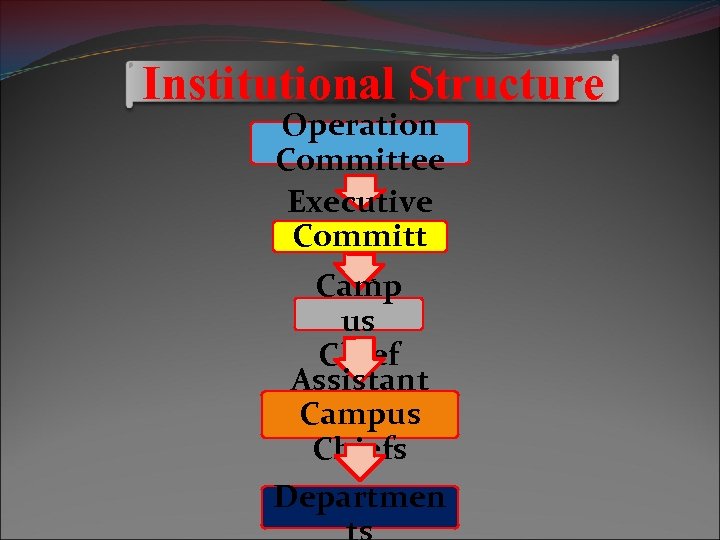 Institutional Structure Operation Committee Executive Committ ee Camp us Chief Assistant Campus Chiefs Departmen
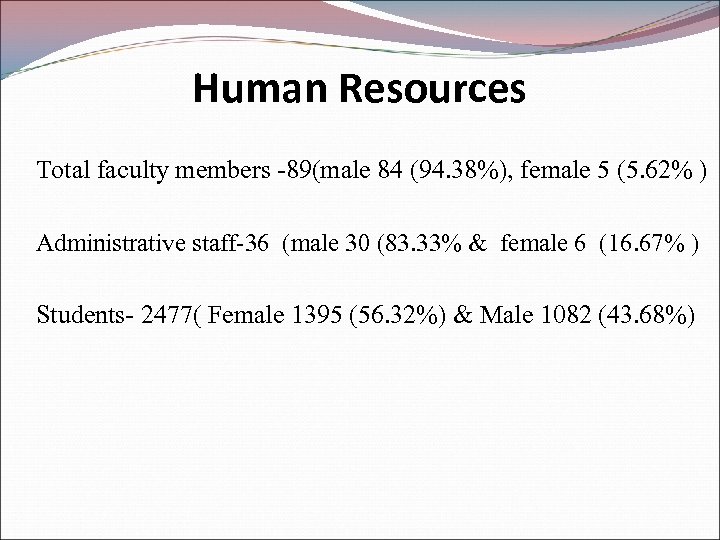 Human Resources Total faculty members -89(male 84 (94. 38%), female 5 (5. 62% ) Administrative staff-36 (male 30 (83. 33% & female 6 (16. 67% ) Students- 2477( Female 1395 (56. 32%) & Male 1082 (43. 68%)
 Academic Development Different incentives like bearing cost of stationery, tea, photocopy etc. are given to the students for project work, paper presentation, group and individual work based on curriculum. Teachers are also encouraged to use student-centered teaching methods in their classroom teaching activities. The Campus has given opportunities for teachers to participate in different seminars, workshops and training in and outside the Campus for their academic and professional advancement. The Campus has given opportunities for research methodology training and in the future, the Campus will also provide the opportunity for mini research through Research Unit of MRMC and also encourage and promote research articles publication through journal publication.
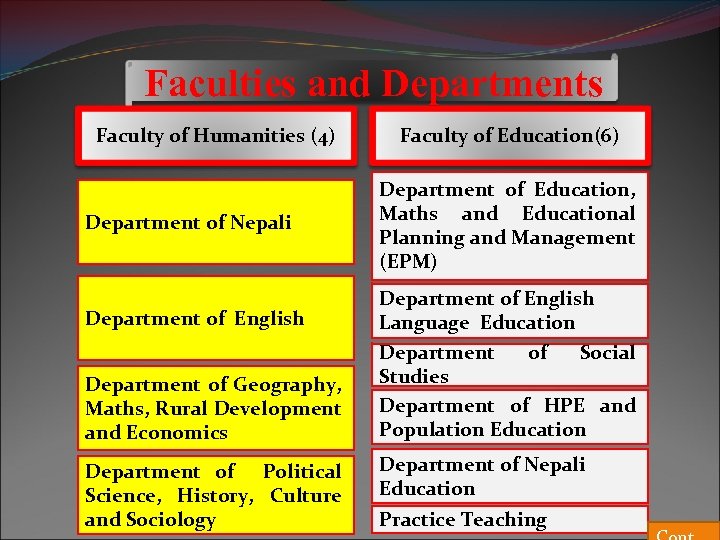 Faculties and Departments Faculty of Humanities (4) Department of Nepali Department of English Department of Geography, Maths, Rural Development and Economics Department of Political Science, History, Culture and Sociology Faculty of Education(6) Department of Education, Maths and Educational Planning and Management (EPM) Department of English Language Education Department of Social Studies Department of HPE and Population Education Department of Nepali Education Practice Teaching
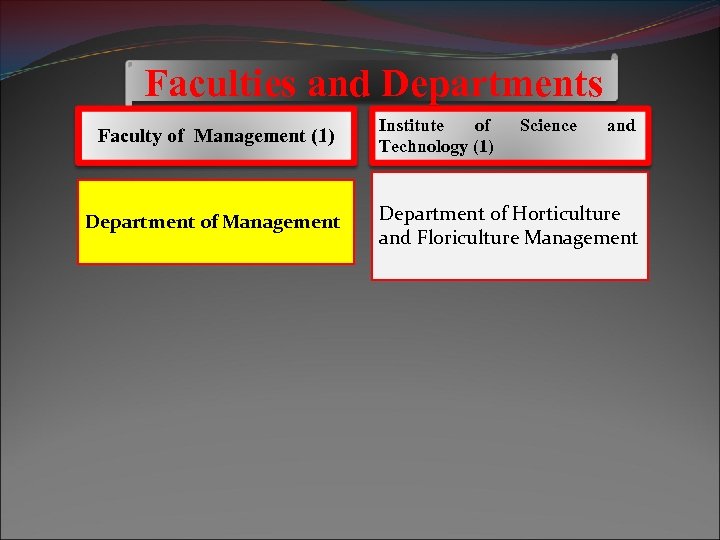 Faculties and Departments Faculty of Management (1) Department of Management Institute of Technology (1) Science and Department of Horticulture and Floriculture Management
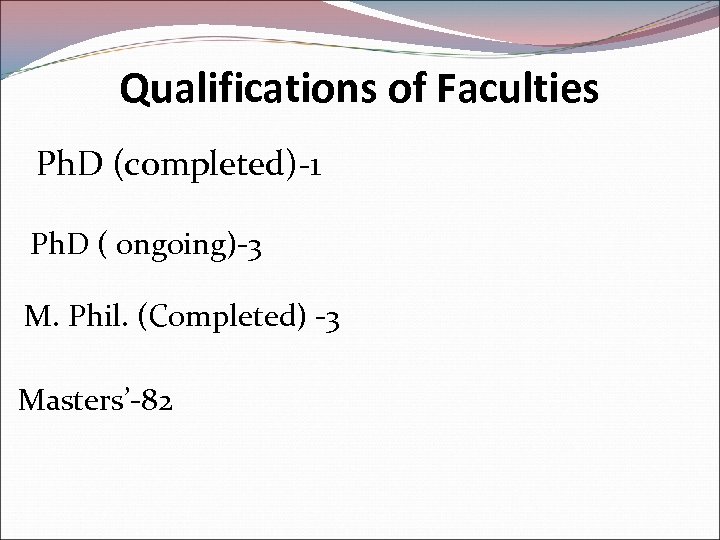 Qualifications of Faculties Ph. D (completed)-1 Ph. D ( ongoing)-3 M. Phil. (Completed) -3 Masters’-82
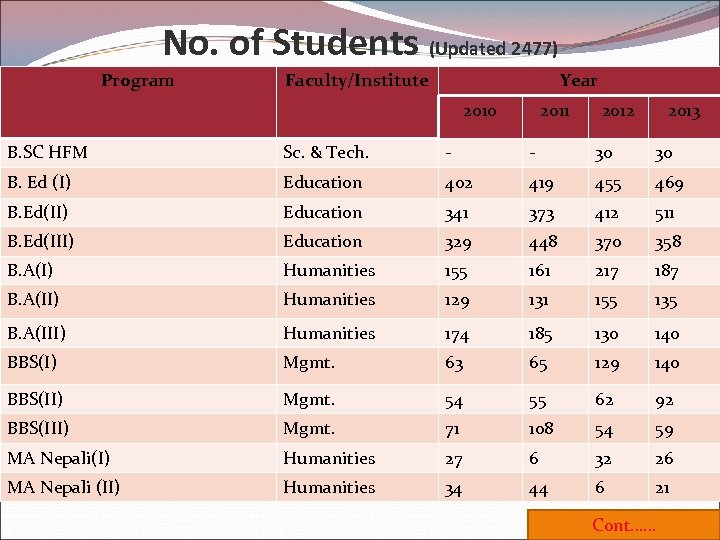 No. of Students (Updated 2477) Program Faculty/Institute Year 2010 2011 2012 2013 B. SC HFM Sc. & Tech. - - 30 30 B. Ed (I) Education 402 419 455 469 B. Ed(II) Education 341 373 412 511 B. Ed(III) Education 329 448 370 358 B. A(I) Humanities 155 161 217 187 B. A(II) Humanities 129 131 155 135 B. A(III) Humanities 174 185 130 140 BBS(I) Mgmt. 63 65 129 140 BBS(II) Mgmt. 54 55 62 92 BBS(III) Mgmt. 71 108 54 59 MA Nepali(I) Humanities 27 6 32 26 MA Nepali (II) Humanities 34 44 6 21 Cont……
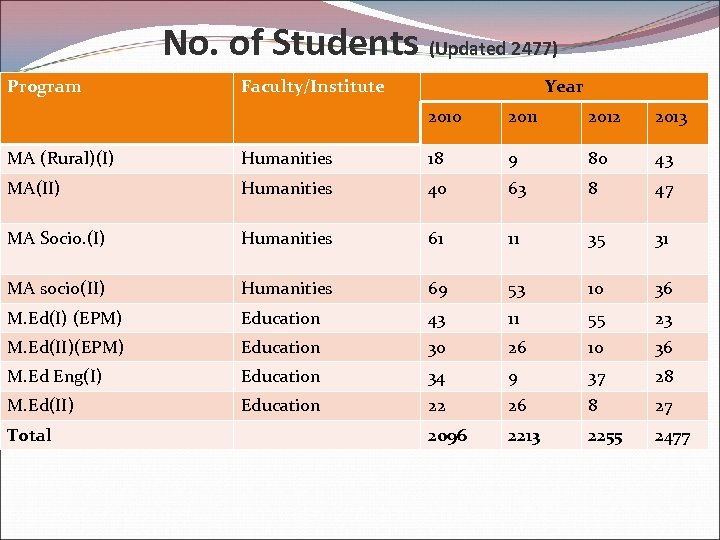 No. of Students (Updated 2477) Program Faculty/Institute Year 2010 2011 2012 2013 MA (Rural)(I) Humanities 18 9 80 43 MA(II) Humanities 40 63 8 47 MA Socio. (I) Humanities 61 11 35 31 MA socio(II) Humanities 69 53 10 36 M. Ed(I) (EPM) Education 43 11 55 23 M. Ed(II)(EPM) Education 30 26 10 36 M. Ed Eng(I) Education 34 9 37 28 M. Ed(II) Education 22 26 8 27 2096 2213 2255 2477 Total
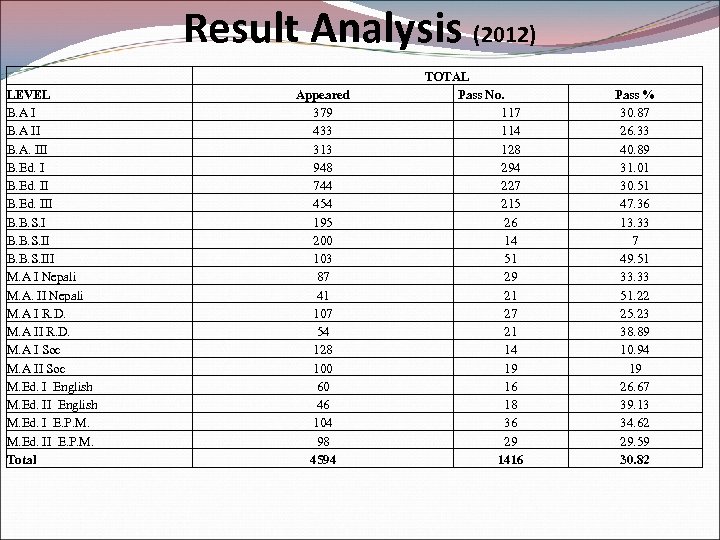 Result Analysis (2012) LEVEL B. A II B. A. III B. Ed. III B. B. S. III M. A I Nepali M. A. II Nepali M. A I R. D. M. A I Soc M. A II Soc M. Ed. I English M. Ed. I E. P. M. M. Ed. II E. P. M. Total Appeared 379 433 313 948 744 454 195 200 103 87 41 107 54 128 100 60 46 104 98 4594 TOTAL Pass No. 117 114 128 294 227 215 26 14 51 29 21 27 21 14 19 16 18 36 29 1416 Pass % 30. 87 26. 33 40. 89 31. 01 30. 51 47. 36 13. 33 7 49. 51 33. 33 51. 22 25. 23 38. 89 10. 94 19 26. 67 39. 13 34. 62 29. 59 30. 82
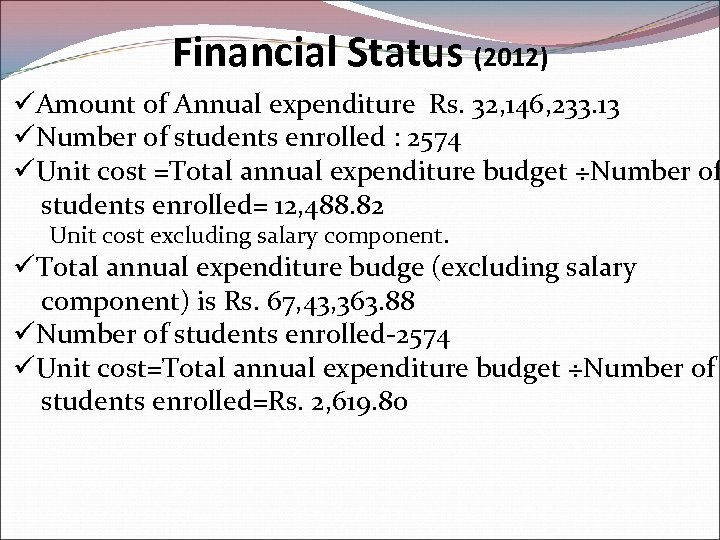 Financial Status (2012) üAmount of Annual expenditure Rs. 32, 146, 233. 13 üNumber of students enrolled : 2574 üUnit cost =Total annual expenditure budget ÷Number of students enrolled= 12, 488. 82 Unit cost excluding salary component. üTotal annual expenditure budge (excluding salary component) is Rs. 67, 43, 363. 88 üNumber of students enrolled-2574 üUnit cost=Total annual expenditure budget ÷Number of students enrolled=Rs. 2, 619. 80
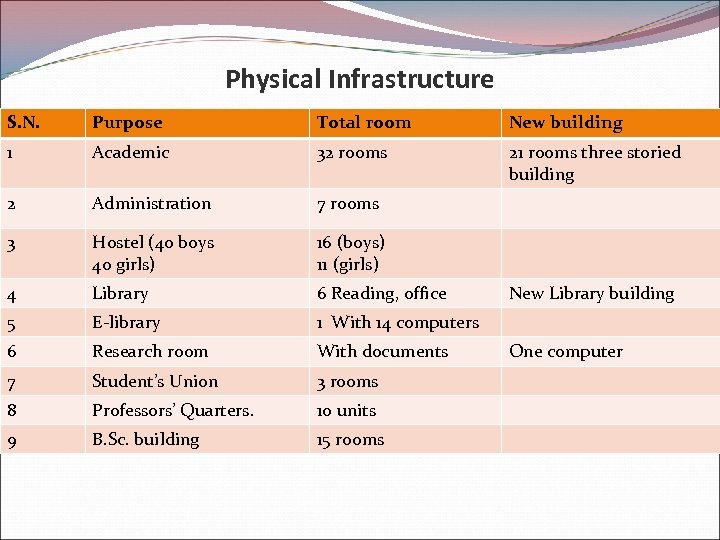 Physical Infrastructure S. N. Purpose Total room New building 1 Academic 32 rooms 21 rooms three storied building 2 Administration 7 rooms 3 Hostel (40 boys 40 girls) 16 (boys) 11 (girls) 4 Library 6 Reading, office 5 E-library 1 With 14 computers 6 Research room With documents 7 Student’s Union 3 rooms 8 Professors’ Quarters. 10 units 9 B. Sc. building 15 rooms New Library building One computer
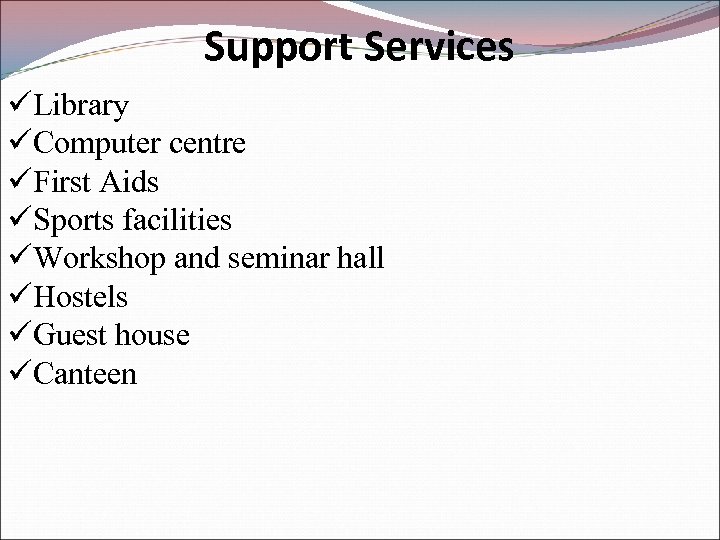 Support Services üLibrary üComputer centre üFirst Aids üSports facilities üWorkshop and seminar hall üHostels üGuest house üCanteen
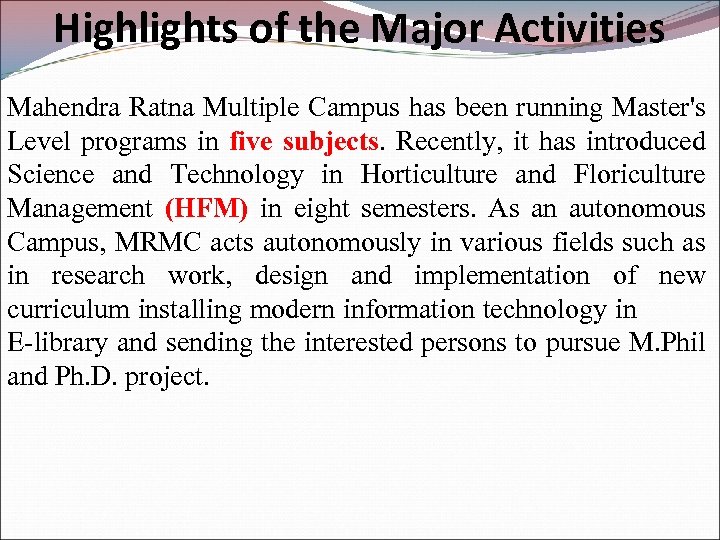 Highlights of the Major Activities Mahendra Ratna Multiple Campus has been running Master's Level programs in five subjects. Recently, it has introduced Science and Technology in Horticulture and Floriculture Management (HFM) in eight semesters. As an autonomous Campus, MRMC acts autonomously in various fields such as in research work, design and implementation of new curriculum installing modern information technology in E-library and sending the interested persons to pursue M. Phil and Ph. D. project.
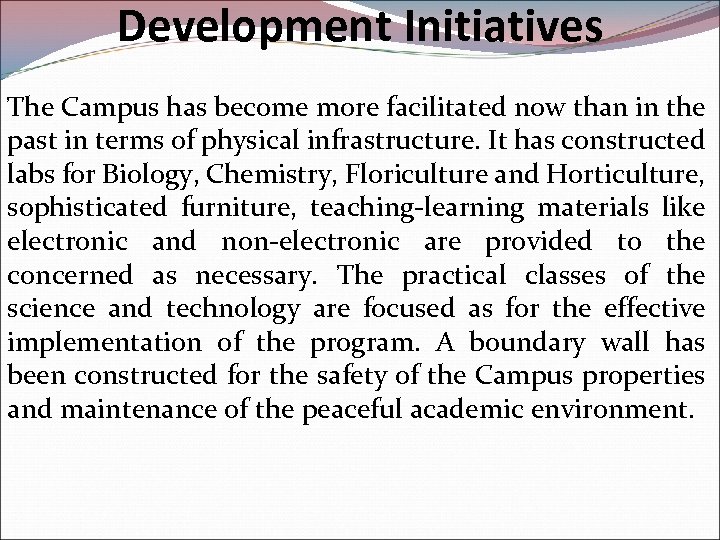 Development Initiatives The Campus has become more facilitated now than in the past in terms of physical infrastructure. It has constructed labs for Biology, Chemistry, Floriculture and Horticulture, sophisticated furniture, teaching-learning materials like electronic and non-electronic are provided to the concerned as necessary. The practical classes of the science and technology are focused as for the effective implementation of the program. A boundary wall has been constructed for the safety of the Campus properties and maintenance of the peaceful academic environment.
 Improvements As per the suggestions of pre visit team (15 th Apr. 2013) v Proper management of departments and sections, v Well-managed class rooms each with white board and podium, v Maintenance and coloring of administrative building, hostels, quarter, canteen and students’ union building, v Classes effective on time, v One storey of library and girls hostel under construction , v Program stage and parking zone on the process of construction. v Furnished and equipped Research Unit, v Formulation of by laws for Research Unit, v Result analysis, v Discussion on students’ welfare among the students of different faculties, v Paving and internal paths in Campus premises completed, v Terms of References (TOR) distributed to different Cells/Departments/Sections.
 Thank You !