


 Скачать презентацию Overview of the National Cultural Policy Legislative
86224c94f8e0cc3818cdd55e8fd0e418.ppt
- Количество слайдов: 24
 Overview of the National Cultural Policy & Legislative Framework, including Support to Culture Enterprises in Sierra Leone
 1. 0 INTRODUCTION Sierra Leone is located on the south-western curve of the West African bulge and occupies a total area of 71, 740 sq km (27, 699 sq miles) rising from the beaches of the southwest to the broad plateau of the Atlantic watershed at the north-eastern frontier. Elsewhere in the countryside, isolated hills provide mineral deposits including iron ore, gold, diamonds, retiles and bauxite.
 The climate is tropical. Prolonged rains (May to October) are bracketed by showery weather with many thunderstorms, and a dry season from December to April. The natural vegetation of the south-east is tropical evergreen forest making the cultivation of cash crops such as cocoa, coffee, kola and oil palm successful in this area. The Savannah woodlands to the north-east have less rain, a shorter period of plant growth and a dry season made harsh by harmattan winds, with cattle rearing, groundnuts and tobacco as potential commercial resources. Permanent rice lands have been created some mangrove swamps in the north-west, with cassava and millet in the north.
 Sierra Leone is home to about sixteen ethno-linguistic groupings, including the: Mende, Temne, Limba, Sherbro, Krim, Vai, Gola, Kono, Kissi, Loko, Koranko, Yalunka, Susu, Mandingo and Fullah. The local population has been enriched in the late eighteenth century by the descendants of former slaves who were freed and settled on the Sierra Leone peninsula, in villages around Freetown. Coming from diverse places with different cultural backgrounds, the settlers had to evolve a new language and culture and engage in different professions; By the late nineteenth century, they came to be referred to by the generic term ‘Krios’ (or Creole). For several decades since the attainment of independence, the country was subject to a variety of internal upheavals and political instability resulting in the breakdown of the social, economic and political structures with even more devastating effects on the nation’s economy, infrastructure and human resources. In addition to the destruction of the country’s social and economic infrastructure, the decade-long (1991 -2002) civil conflict lead to the flight of many businesses. Sierra Leoneans were also internally and externally displaced.
 Many of the displaced people returned to their homes and stability improved remarkably. Traditional mores still dominate, in spite of the westernizing influences in employment, education and urbanization. A large proportion of the population still observe traditional religion, beliefs, cultural practices and value systems, although there are significant Islamic and Christian communities. The extended family system and paramount chieftaincies form a social nexus and closely mirrored by a hierarchy of hamlet, village and rural centres. The official language of the country is English, while Mende, Temne, Limba and Krio are also widely spoken, with the latter being the lingua franca.
 In recognition of the significance of culture in national development, the government created a Ministry of Tourism and Cultural affairs in 1973. in 1978, through UNESCO assistance, it prepared its first Cultural Policy. In 1999, attempts were made to prepare a revised cultural policy, but that effort never reached logical conclusions. Considering the fact that almost twenty six years has elapsed since the preparation of the first policy on culture, together with the series of emerging events, trends and processes spinning within and around the Sierra Leonean cultural space during that intervening period, it is timely to come up with a new cultural policy that responds to the realities of Sierra Leone’s current situation and other global processes and opportunities.
 1. 1 The Mission of the Policy To preserve, protect and promote cultural diversity, with a view to reviving and strengthening national consciousness, understanding and appreciation of the cultural heritage and artistic creativity, and enhance its contribution to poverty reduction and overall national development. 1. 2 The Goal The broad goals of the national policy on culture will be: To provide leadership and drive in national development. To establish national identity, strengthen cultural understanding and inculcate consciousness and appreciation of the arts among the people; To incorporate essential elements of our culture into national development frameworks and Processes with a view to contributing to the alleviation of persistent poverty and to stimulate and foster creativity in all aspects of national life with a view to improving the quality of life of Sierra Leoneans, while contributing their quota to the global processes of cultural development. 1. 3 The Guiding Principles The following principles shall guide the delivery of this policy: Preservation, Protection and Promotion of Culture Linking Cultural Policies to Development Policies Consultation, Involvement and Participation Employment Creation, Income Generation and Poverty Alleviation Partnership with Private Sector and Civil Society Cultural Rights Cultural Impact Assessment
 1. 4 The Rational for a Policy on Culture Sierra Leone comprises about sixteen ethno-linguistic groupings which together represent a rich and diverse cultural heritage. Despite this heterogeneity, there is nevertheless a remarkable degree of similarity in the socio-cultural institutions and values which gives Sierra Leone a distinctive character that enables it to uphold its unity in diversity. This valuable heritage must be nurtured, preserved, protected and promoted vigorously to foster a stronger sense of national identity, pride and unity and to become a catalytic force for the attainment of Sierra Leone’s development goals and aspirations. Sierra Leone’s multicultural values, traditions and belief systems as manifested through the diverse languages and literary art forms, festivals, rituals, ceremonies, performing and fine arts, media arts, traditional knowledge, religious beliefs and practices, traditional cultural institutions and historic sites, monuments and antiquities, all constitute elements of a broader national culture. Encouragement needs to be given to the pursuit of cultural and historical research, documentation and publication of these aspects of our culture in order to enhance awareness raising, knowledge, understanding, appreciation and respect for this valuable heritage.
 The availability of required cultural infrastructure, facilities and resources and the provision of sound policy, legal frameworks and regulatory mechanisms all constitute elements of an enabling cultural environment for the attainment of a vibrant cultural life and artistic creativity. This policy seeks to ensure the provision of that enabling environment as a way of stimulating and harnessing the creative energies of Sierra Leoneans for their cultural self-expression in fulfillment of their leisure time needs and for job creation and income generation. Sierra Leone has become a melting pot of diverse cultures; local, settler, neighboring countries, European, American, Arab and Asian. Sierra Leonean cultures in themselves are continuously evolving, adopting and adapting because of local and foreign influences, through inter-marriage, rural-urban migration, international migration, tourism, globalization and the growing impact of the new information and communication technologies, such as the internet, on the minds and behaviour of our people. Sierra Leone being part of the “global village”, its citizenry cannot therefore escape the impact of these foreign cultural elements upon their ways of life, which in the process may enrich or weaken the traditional cultural values and social norms. While it is important to respond to new situations, trends and global processes spinning around the Sierra Leonean cultural space, in the development and stimulation of the national culture, it is important to uphold and maintain the good in our cultures and to guard against negative influences of other cultures.
 It is generally recognized that governments are now gradually getting out of the business of direct involvement in cultural activities and productions. While their responsibility is to provide the enabling cultural environment, the private sector and civil society must become the principal actors and engines for cultural action. To facilitate this, the policy will seek to work closely with the private sector agencies, civil society organizations, local governments and traditional authorities in addressing operational and structural constraints facing the sector such as the problems of resources, facilities, training and the establishment of national organizational frameworks to pull the cultural groups and associations together for the effective coordination and collaboration of their activities. As every culture has an in-built mechanism for renovation and adjustment, there is the need for a continuous reappraisal of certain cultural assumptions which may be at variance with the universal and indivisible notions of human rights, particularly as it affects women, the youth, children and other vulnerable groups of our society.
 As part of the international community Sierra Leone will seek to expand strengthen its international relations and cooperation in the field of cultural affairs as a way of projecting its identity, image and values abroad, developing and exposing cultural talents and productions and exploring avenues for enhancing the participation of the international community in the preservation, protection and promotion of its cultural heritage and artistic creativity. The aforesaid issues provide reasonable justification for an up-dated national policy on culture for Sierra Leone which should serve the following purposes: 1. To provide the framework within which culture in Sierra Leone should be conceptualized and operationalzed. 2. To provide the enabling cultural environment for participation, collaboration and partnership between the different interest groups and actors in the planning, implementation, monitoring and evaluation of the policy; and 3. To identify and elaborate strategies and establish structures and organs for the effective and efficient preservation, protection and promotion of the cultural heritage and artistic creativity.
 2. 0 CULTURAL LEGISLATION 2. 1 Culture and the Constitution The Constitution of Sierra Leone (1991) commits itself to the preservation, protection and promotion of the country’s cultures and heritage. In accordance with section 12 (enhancement of national culture), the cultural objectives of the Constitution, stipulate for the state to: Promote Sierra Leonean culture such as music, art, dance, science, philosophy, education and traditional medicine, which is compatible with national development; Recognize traditional Sierra Leonean institutions compatible with national development. Protect and enhance the cultures of Sierra Leone; and Facilitate the provision of funds for the development of culture in Sierra Leone. Among other things, in outlining its educational objectives, section 9 (3) of the Constitution calls on the State to “promote the learning of indigenous languages”, as a way of “ensuring that there are equal rights and adequate educational opportunities for all citizens at all levels”.
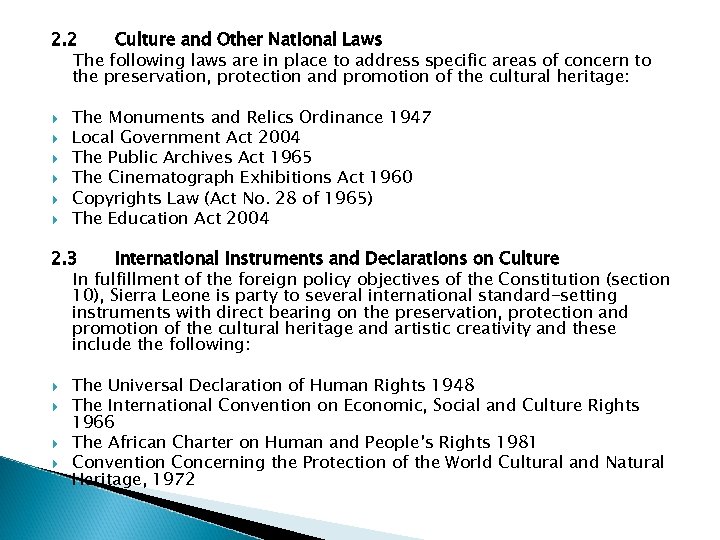 2. 2 Culture and Other National Laws The following laws are in place to address specific areas of concern to the preservation, protection and promotion of the cultural heritage: The Monuments and Relics Ordinance 1947 Local Government Act 2004 The Public Archives Act 1965 The Cinematograph Exhibitions Act 1960 Copyrights Law (Act No. 28 of 1965) The Education Act 2004 2. 3 International Instruments and Declarations on Culture In fulfillment of the foreign policy objectives of the Constitution (section 10), Sierra Leone is party to several international standard-setting instruments with direct bearing on the preservation, protection and promotion of the cultural heritage and artistic creativity and these include the following: The Universal Declaration of Human Rights 1948 The International Convention on Economic, Social and Culture Rights 1966 The African Charter on Human and People’s Rights 1981 Convention Concerning the Protection of the World Cultural and Natural Heritage, 1972
 Sierra Leone ratified this convention in February 2004. However, to date, Sierra Leone has still not been able to include Bunce Island on the World Heritage list. Sierra Leone is also yet to ratify other relevant international conventions on culture such as: Convention on the Intangible Cultural Heritage, 2003; Convention on the Means of Prohibiting and Preventing the Illicit Import, export and Transfer of Ownership of Cultural Property, 1970; and Convention for the Protection of Cultural Property in the Event of an Armed Conflict (the Hague convention, 1954) and its two protocols of 1954 and 1999.
 2. 4 Culture and Development Policies When development builds from traditional institutions, it exacts lower social costs and imposes less human suffering and cultural destruction than when it copies outside models. Culture should therefore be a central component of Sierra Leone’s development strategies in a double sense. On the one hand, the strategies must be sensitive to the cultural roots of the society, to the basic shared values, attitudes, beliefs and customs; on the other, they must include as a goal to the development of culture itself, the stimulation, development and expansion of creativity and cultural preservation and promotion. If vigorously pursued, a culture-sensitive process of development will be able to draw on the large reserves of creativity and traditional knowledge and skills that are found throughout Sierra Leone.
 In Sierra Leone, culture has been mainstreamed into the following government development policies and strategic documents as a way of ensuring the active participation of the population: The Poverty Reduction Strategy Paper (PRSP) 2004; Extended Programme on Immunization (EPI); National Commission for Democracy & Human Rights – Translated the Universal Declaration of Human Rights 1948 into the local languages; National Tourism Strategy – to promote cultural and ecotourism; National Environmental Action Plan – to tap local knowledge, wisdom and skills in environmental and natural resources management; and National Science and Technology Policy 2003 – Integrated traditional medicine and agricultural knowledge into science and technology policy.
 INSTITUTIONAL FRAMEWORK FOR THE IMPLEMENTATION OF THE POLICY The implementation of this policy shall involve the collaboration and participation of different levels and categories of stakeholders. The functions and responsibilities of these stakeholders shall be broadly defined as follows; 3. 0 3. 1 Central Government The Central Government Ministries, Departments and Agencies have overall responsibility for coordinating the administration and implementation of this policy. The functions of the various public sector agencies shall inter-alia be; Ministry Ministry Ministry responsible for Tourism and Culture responsible for Information and Broadcasting responsible for Education, Science and Technology responsible for Youth and Sport responsible for Finance, Development and Economic Planning responsible for Health and Sanitation responsible for Trade and Industry responsible for Lands, Country Planning and Environment responsible for Social Welfare, Gender and Children’s Affairs responsible for Justice responsible for Agriculture and Food Security of Foreign Affairs and International Cooperation
 3. 2 The National Council for Arts and Culture To effectively coordinate the implementation of this policy, there shall be established a National Council for Arts and Culture (NCAC). The Council’s responsibilities shall be executed through functional departments in charge of Museums and Monuments; Research and Documentation (including Library and Archives); Creative and Performing Arts; Cultural Industries and Enterprises; and Administration, Marketing and Finance. Its main functions shall be to: Serve as the supreme advisory body on all policies and programmes by cultural institutions, associations and groups in Sierra Leone; Coordinate the activities of the different actors in the cultural sector; Advise government on the formulation, evaluation and review of the National Policy on Culture; Manage the distribution of subsidies and other support services to the cultural sector; Elaborate strategies for the participation of different stakeholders in the implementation of the policy; Administer the activities of the cultural cooperation programmes; Reward traditional medicine practices and encourage and develop herbalists; Provide guidelines for the recognition and accreditation of cultural groups; and Provide awards and recognition in all fields of artistic endeavour.
 3. 3 Local Government Authorities According to the local Government Act (2004) the local councils shall have responsibility for cultural development at their respective communities. They should therefore ensure: 3. 4 Private Sector Agencies The Private Sector, as a major partner in the implementation of this policy is expected to contribute in the following ways: 3. 5 Civil Society Organisations The Civil Society includes cultural groups, associations and societies directly dealing with culture well as other nongovernmental organisations not directly dealing with culture. 3. 6 Faith-Based Organisations Faith based organisations are organisations that are based on religious beliefs. 3. 7 Traditional Authorities include the traditional chiefs, religious leaders and other community opinion leaders.
 Cultural Enterprises and Creative Industries Cultural goods and services are considered to be the vectors of people’s creativity, identity and values. Cultural industries allow for the manufacture and distribution of these creative goods and services. They contribute to cultural development by preserving and enriching cultural values and traditions, promoting creativity and the development and communication of culture-sensitive messages that foster peace, understanding and national development. 4. 0 Cultural industries include; the production and sale of audiovisual items of music, dance and drama; handicrafts, publishing and the sale of books with local literature, production and sale of traditional medicine, food and beverage items. As the trend of globalization is progressing, even advanced countries are gradually losing their manufacturing base and entering into the stage of the new knowledge and informational economies. The key driver of the new knowledge economies is creativity especially at artistic, cultural and technological creativity. With the emerging knowledge economy, a renewed emphasis has been placed on creative industries, as remarkable economic engines of urban and regional development.
 Sectors targeted for the creative industries include multi-media and advertising; architecture; literature and publishing; music; cinema and film; craft; designer and designer fashion; software; fine arts and antiques; performing arts; libraries and archives; museums; monuments and art galleries; radio and television; traditional medicine, food and beverage and resource centres. Creative industries today represent one of the most dynamic sectors in the global trading system, with high skill and value added content and strong employment linkages, particularly in smaller and medium-sized enterprises. Creative expressions by drawing on a wealth of historical and contemporary values and symbols, allow countries to tell their own stories, protect their image and values, and share their own challenges and aspirations, both among their own citizens and with those from other counties. In this respect, support for domestic creative industries should be seen as an integral part of the promotion and protection of cultural diversity. However, there are several barriers to the development of domestic creative industries, principal among them are; the problems of market access, creation of new and innovative sources of finance and mechanisms aimed at facilitating more equitable access for, and remuneration from the creative industries, the need to support innovative art forms, and the contributions of the digital environment for creative industries.
 4. 1 Strategies Undertake a nation-wide research into Sierra Leone’s traditional crafts industry, traditional skills and knowledge, folklore, music and dance with a view to preserving their original and authentic forms; Establish databanks on the traditional industries and performing arts at the National Archives; Promote the teaching of the traditional industries and performing arts at all levels of the educational system; Encourage the development of the local film industry through the establishment of a Film Institute, National Film Production Studio and Film Distribution Centre to enhance the marketing of locally-produced films. A film classification board is to be established; Encourage the establishment of Music Academies for study and research into music including instrument-making to enhance the manufacturing techniques of traditional Sierra Leonean musical instruments; Encourage the establishment of various arts and cultural unions and associations; Ensure the provision of the appropriate cultural infrastructure, facilities and resources to enhance the promotion of the traditional industries and performing arts, such as National and Regional theatres, Cultural Centres, Crafts Villages, Craft Shops, National Art Galleries;
 Protect all Artists by enforcing their intellectual property rights and copyrights; Encourage all public buildings to use Sierra Leonean art works in their décor; Require by regulation that television and radio stations provide more air-time to Sierra Leonean music, dance, drama and films and the promotion of Sierra Leonean art forms; Support the development of innovative art forms; Recognise and reward excellence in creative works; Make not only environmental impact assessment by active enterprises, but also impact assessment on culture; Work towards establishing an independent entity to coordinate the intervention strategies and programmes on creative industries with the following responsibilities:
 Presented by: Ernest S. T. F. MANNAH Co-Founder & General Secretary- SLFILM GUILD National Project Director- SLFILM FOUNDATION Chairman & Country Rep- ARTERIAL NETWORK National Film Rep–COALITION OF CULTURAL ORGANISATION