


 Скачать презентацию Overview of the LHC Triggers and Plans for
a32776fc04e578be2292dc20f89dbd4c.ppt
- Количество слайдов: 52
 Overview of the LHC Triggers and Plans for LHC Start-up Overview of the talk: • • Triggering Challenges at LHC Trigger Systems at LHC Pilot run Triggers (2007) Physics Triggers (2008) 1 LHC Forum, Coseners House, 13. 4. 07 Costas Foudas, Imperial College London
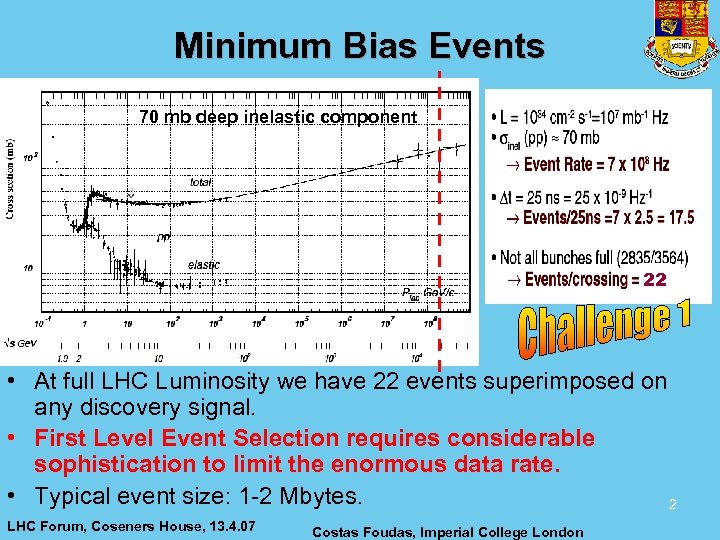 Minimum Bias Events 70 mb deep inelastic component 22 • At full LHC Luminosity we have 22 events superimposed on any discovery signal. • First Level Event Selection requires considerable sophistication to limit the enormous data rate. • Typical event size: 1 -2 Mbytes. 2 LHC Forum, Coseners House, 13. 4. 07 Costas Foudas, Imperial College London
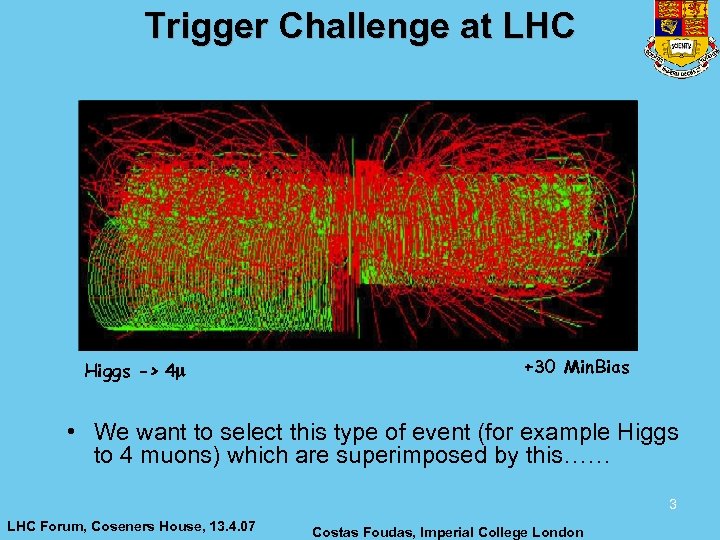 Trigger Challenge at LHC Higgs -> 4 +30 Min. Bias • We want to select this type of event (for example Higgs to 4 muons) which are superimposed by this…… 3 LHC Forum, Coseners House, 13. 4. 07 Costas Foudas, Imperial College London
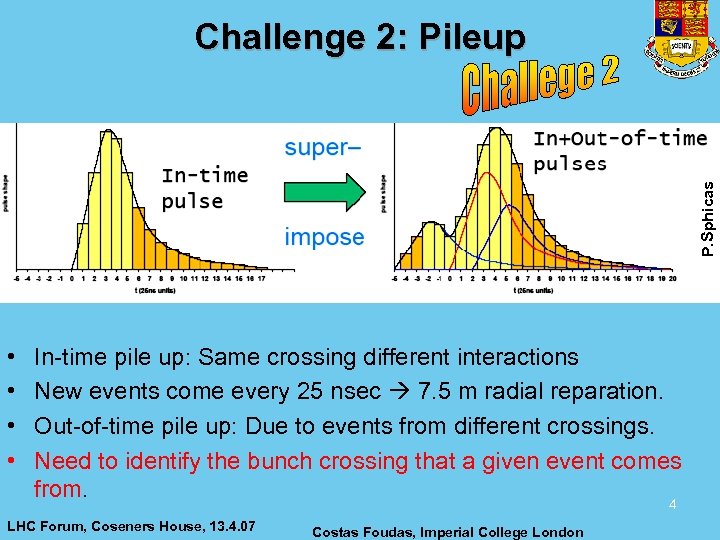 P. Sphicas Challenge 2: Pileup • • In-time pile up: Same crossing different interactions New events come every 25 nsec 7. 5 m radial reparation. Out-of-time pile up: Due to events from different crossings. Need to identify the bunch crossing that a given event comes from. 4 LHC Forum, Coseners House, 13. 4. 07 Costas Foudas, Imperial College London
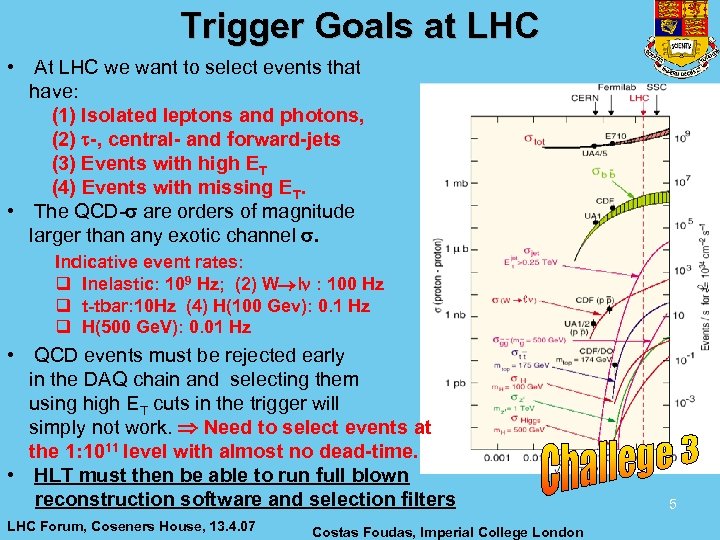 Trigger Goals at LHC • At LHC we want to select events that have: (1) Isolated leptons and photons, (2) -, central- and forward-jets (3) Events with high ET (4) Events with missing ET. • The QCD- are orders of magnitude larger than any exotic channel . Indicative event rates: q Inelastic: 109 Hz; (2) W l : 100 Hz q t-tbar: 10 Hz (4) H(100 Gev): 0. 1 Hz q H(500 Ge. V): 0. 01 Hz • QCD events must be rejected early in the DAQ chain and selecting them using high ET cuts in the trigger will simply not work. Need to select events at the 1: 1011 level with almost no dead-time. • HLT must then be able to run full blown reconstruction software and selection filters LHC Forum, Coseners House, 13. 4. 07 Costas Foudas, Imperial College London 5
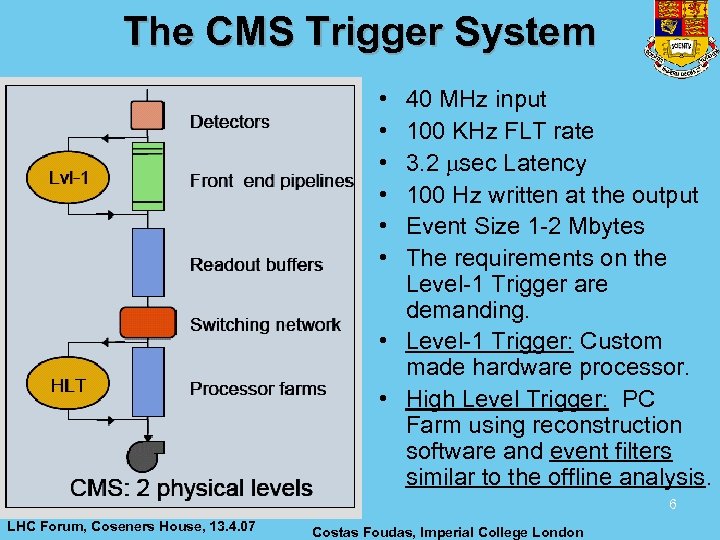 The CMS Trigger System • • • 40 MHz input 100 KHz FLT rate 3. 2 sec Latency 100 Hz written at the output Event Size 1 -2 Mbytes The requirements on the Level-1 Trigger are demanding. • Level-1 Trigger: Custom made hardware processor. • High Level Trigger: PC Farm using reconstruction software and event filters similar to the offline analysis. 6 LHC Forum, Coseners House, 13. 4. 07 Costas Foudas, Imperial College London
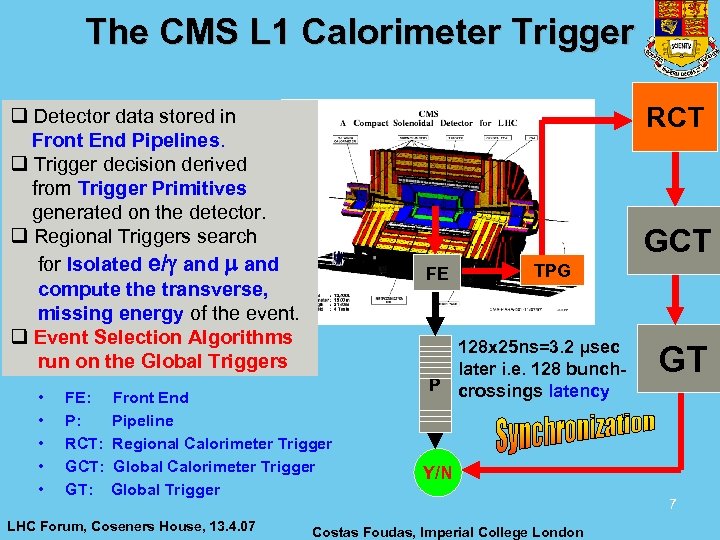 The CMS L 1 Calorimeter Trigger RCT q Detector data stored in Front End Pipelines. q Trigger decision derived from Trigger Primitives generated on the detector. q Regional Triggers search for Isolated e/ and compute the transverse, missing energy of the event. q Event Selection Algorithms run on the Global Triggers • • • FE: P: RCT: GT: GCT FE Front End Pipeline Regional Calorimeter Trigger Global Trigger LHC Forum, Coseners House, 13. 4. 07 TPG 128 x 25 ns=3. 2 µsec later i. e. 128 bunch. P crossings latency GT Y/N Costas Foudas, Imperial College London 7
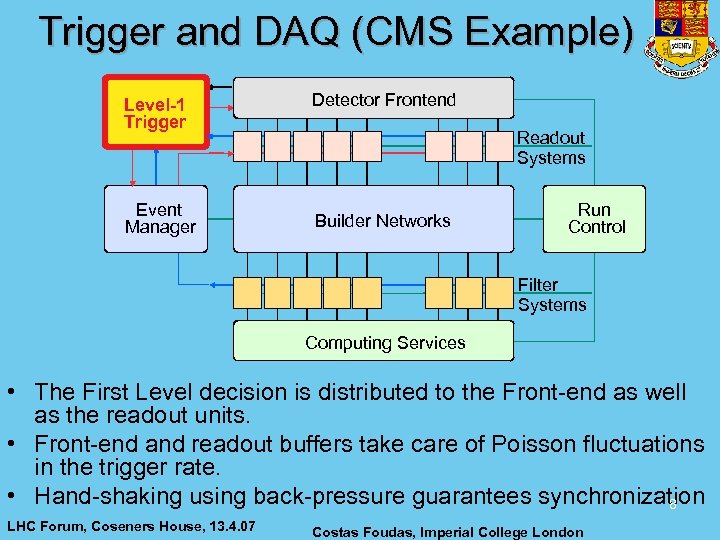 Trigger and DAQ (CMS Example) Level-1 Trigger Event Manager Detector Frontend Readout Systems Builder Networks Run Control Filter Systems Computing Services • The First Level decision is distributed to the Front-end as well as the readout units. • Front-end and readout buffers take care of Poisson fluctuations in the trigger rate. • Hand-shaking using back-pressure guarantees synchronization 8 LHC Forum, Coseners House, 13. 4. 07 Costas Foudas, Imperial College London
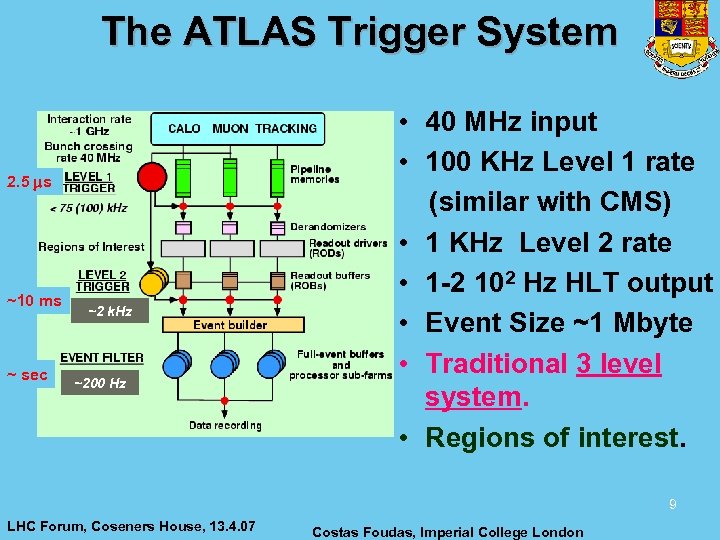 The ATLAS Trigger System 2. 5 s ~10 ms ~ sec ~2 k. Hz ~200 Hz • 40 MHz input • 100 KHz Level 1 rate (similar with CMS) • 1 KHz Level 2 rate • 1 -2 102 Hz HLT output • Event Size ~1 Mbyte • Traditional 3 level system. • Regions of interest. 9 LHC Forum, Coseners House, 13. 4. 07 Costas Foudas, Imperial College London
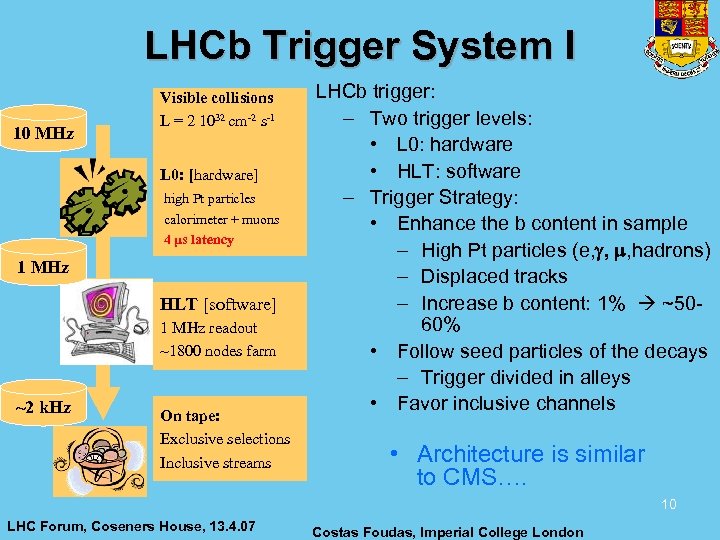 LHCb Trigger System I 10 MHz Visible collisions L = 2 1032 cm-2 s-1 L 0: [hardware] high Pt particles calorimeter + muons 4 μs latency 1 MHz HLT [software] 1 MHz readout ~1800 nodes farm ~2 k. Hz On tape: Exclusive selections Inclusive streams LHCb trigger: – Two trigger levels: • L 0: hardware • HLT: software – Trigger Strategy: • Enhance the b content in sample – High Pt particles (e, , , hadrons) – Displaced tracks – Increase b content: 1% ~5060% • Follow seed particles of the decays – Trigger divided in alleys • Favor inclusive channels • Architecture is similar to CMS…. 10 LHC Forum, Coseners House, 13. 4. 07 Costas Foudas, Imperial College London
 Level-1 Strategy • Selecting events using physics filters at the High Level Trigger level (HLT CPU farms) will not do. The rate must be cut earlier before the HLT is overwhelmed by MHz of background QCD jet events. • It follows that the first level of selection, the First Level Trigger, should include algorithms of considerable sophistication which can find Isolated Electrons, Jets and detect specific event topologies. • This is a challenging task because we only have 15 x 25 ns = 375 ns to accomplish it for all sub-triggers. Jets take longer: 24 x 25 nsec = 600 nsec; which is many orders of magnitude faster than offline. 11 LHC Forum, Coseners House, 13. 4. 07 Costas Foudas, Imperial College London
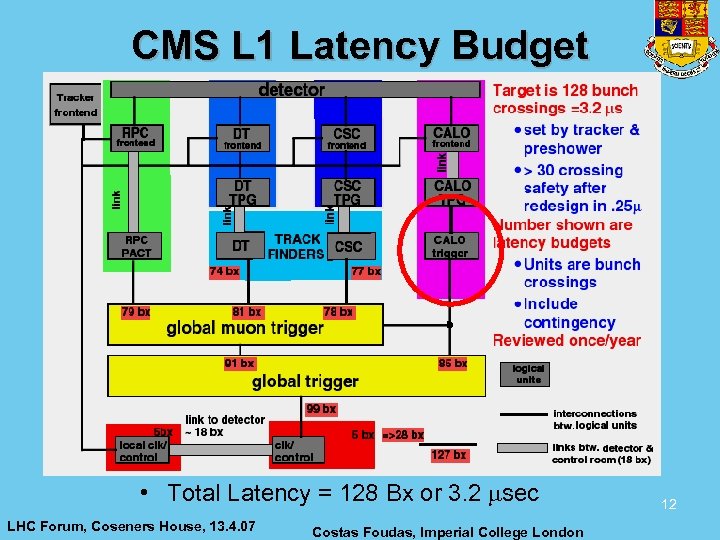 CMS L 1 Latency Budget • Total Latency = 128 Bx or 3. 2 sec LHC Forum, Coseners House, 13. 4. 07 Costas Foudas, Imperial College London 12
 The Calorimeter Trigger Task • Jet Triggers: Central, Tau and Forward jet finding and sorting. • Jet Counters: Count Jets in 12 different regions of the detector or 12 different thresholds within the detector. • Electron/ triggers: Select and Sort the e/ candidates from Regional Calorimeter Trigger. • Total Transverse, Total Missing Transverse and Total Jet Transverse Energy calculation. • Receive the Muon data and send them to the Global Muon Trigger. • Luminosity Monitoring and readout all the RCT and GCT data for every L 1 A. 13 LHC Forum, Coseners House, 13. 4. 07 Costas Foudas, Imperial College London
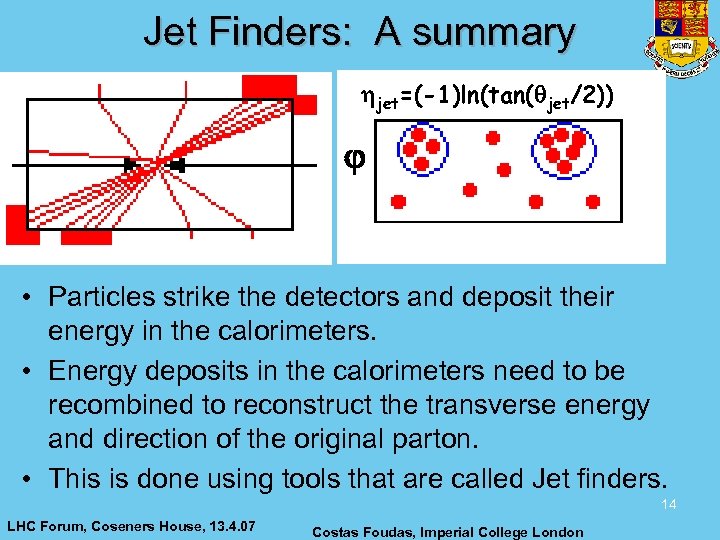 Jet Finders: A summary jet=(-1)ln(tan( jet/2)) • Particles strike the detectors and deposit their energy in the calorimeters. • Energy deposits in the calorimeters need to be recombined to reconstruct the transverse energy and direction of the original parton. • This is done using tools that are called Jet finders. 14 LHC Forum, Coseners House, 13. 4. 07 Costas Foudas, Imperial College London
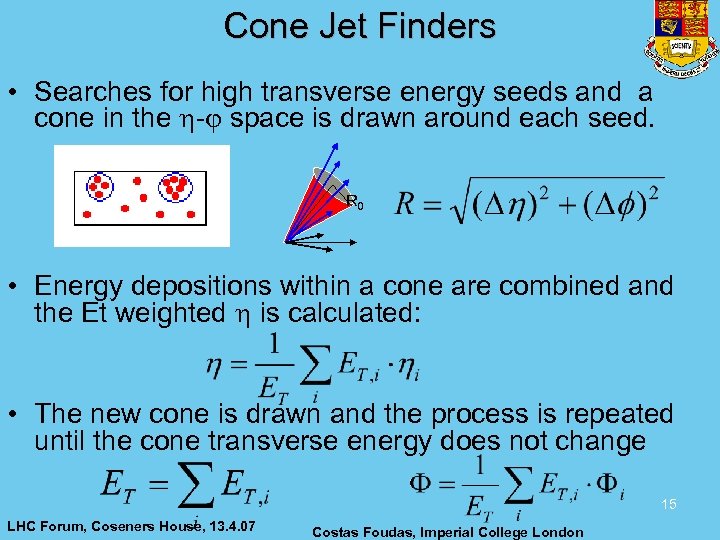 Cone Jet Finders • Searches for high transverse energy seeds and a cone in the - space is drawn around each seed. R 0 • Energy depositions within a cone are combined and the Et weighted is calculated: • The new cone is drawn and the process is repeated until the cone transverse energy does not change 15 LHC Forum, Coseners House, 13. 4. 07 Costas Foudas, Imperial College London
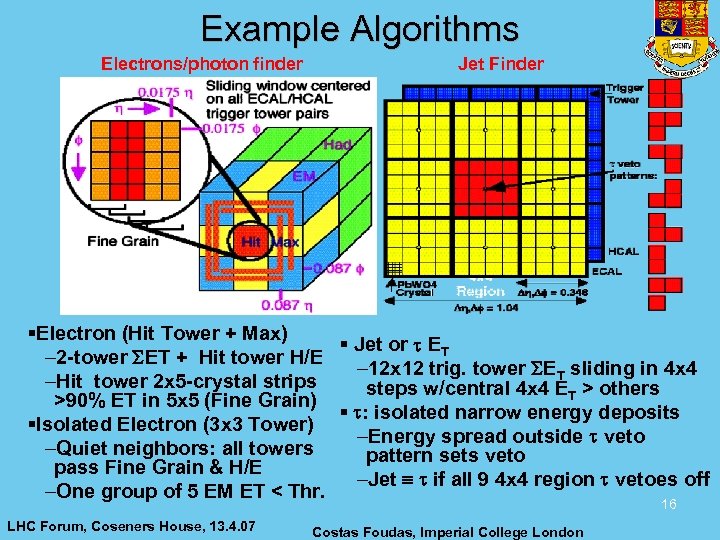 Example Algorithms Electrons/photon finder Jet Finder §Electron (Hit Tower + Max) § Jet or ET – 2 -tower ET + Hit tower H/E – 12 x 12 trig. tower ET sliding in 4 x 4 –Hit tower 2 x 5 -crystal strips steps w/central 4 x 4 ET > others >90% ET in 5 x 5 (Fine Grain) § : isolated narrow energy deposits §Isolated Electron (3 x 3 Tower) –Energy spread outside veto –Quiet neighbors: all towers pattern sets veto pass Fine Grain & H/E –Jet if all 9 4 x 4 region vetoes off –One group of 5 EM ET < Thr. 16 LHC Forum, Coseners House, 13. 4. 07 Costas Foudas, Imperial College London
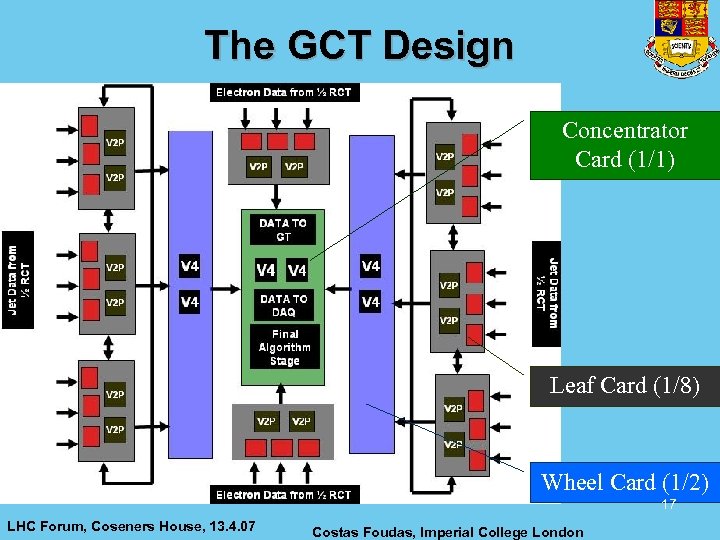 The GCT Design Concentrator Card (1/1) Leaf Card (1/8) Wheel Card (1/2) 17 LHC Forum, Coseners House, 13. 4. 07 Costas Foudas, Imperial College London
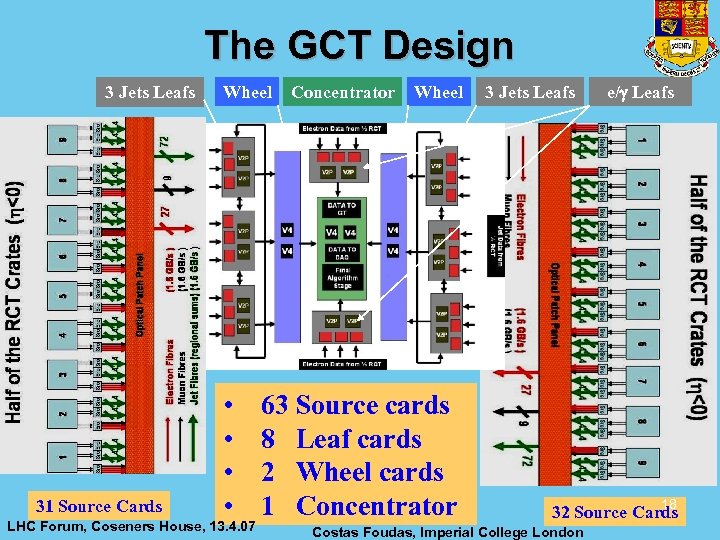 The GCT Design 3 Jets Leafs 31 Source Cards Wheel Concentrator Wheel • 63 Source cards • 8 Leaf cards • 2 Wheel cards • 1 Concentrator LHC Forum, Coseners House, 13. 4. 07 3 Jets Leafs e/ Leafs 18 32 Source Cards Costas Foudas, Imperial College London
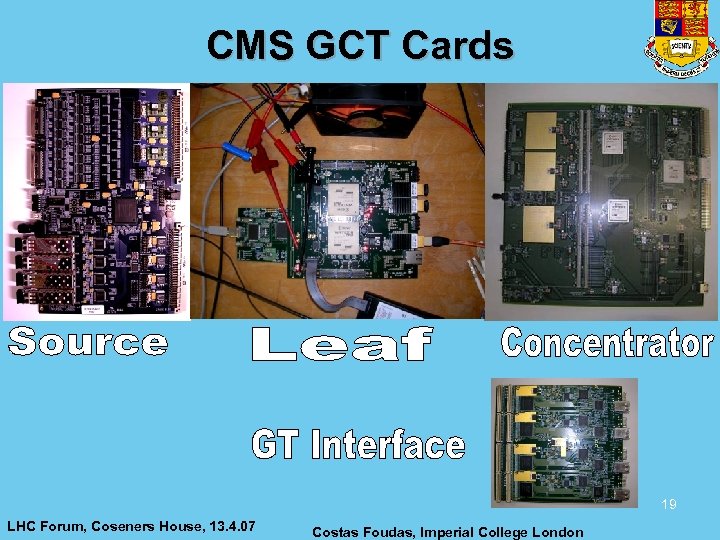 CMS GCT Cards 19 LHC Forum, Coseners House, 13. 4. 07 Costas Foudas, Imperial College London
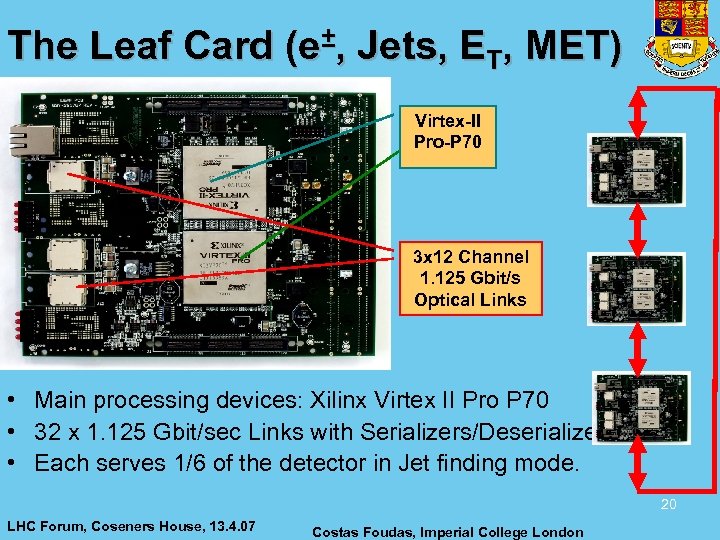 The Leaf Card (e±, Jets, ET, MET) Virtex-II Pro-P 70 3 x 12 Channel 1. 125 Gbit/s Optical Links • Main processing devices: Xilinx Virtex II Pro P 70 • 32 x 1. 125 Gbit/sec Links with Serializers/Deserializers • Each serves 1/6 of the detector in Jet finding mode. 20 LHC Forum, Coseners House, 13. 4. 07 Costas Foudas, Imperial College London
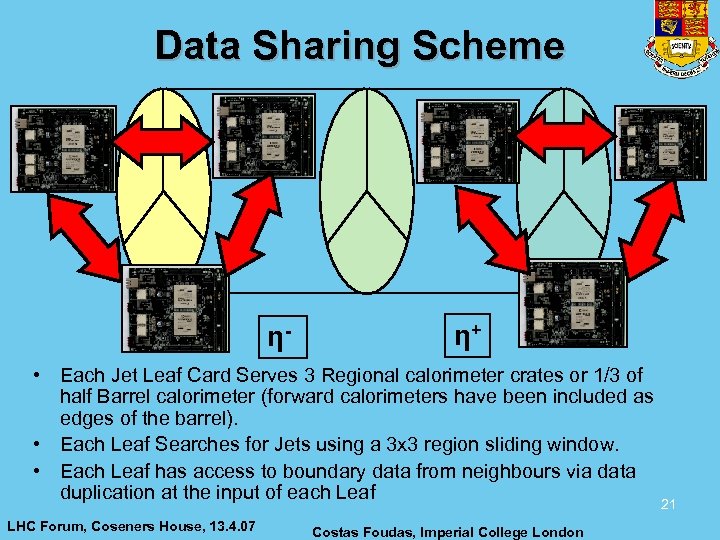 Data Sharing Scheme η- η+ • Each Jet Leaf Card Serves 3 Regional calorimeter crates or 1/3 of half Barrel calorimeter (forward calorimeters have been included as edges of the barrel). • Each Leaf Searches for Jets using a 3 x 3 region sliding window. • Each Leaf has access to boundary data from neighbours via data duplication at the input of each Leaf LHC Forum, Coseners House, 13. 4. 07 Costas Foudas, Imperial College London 21
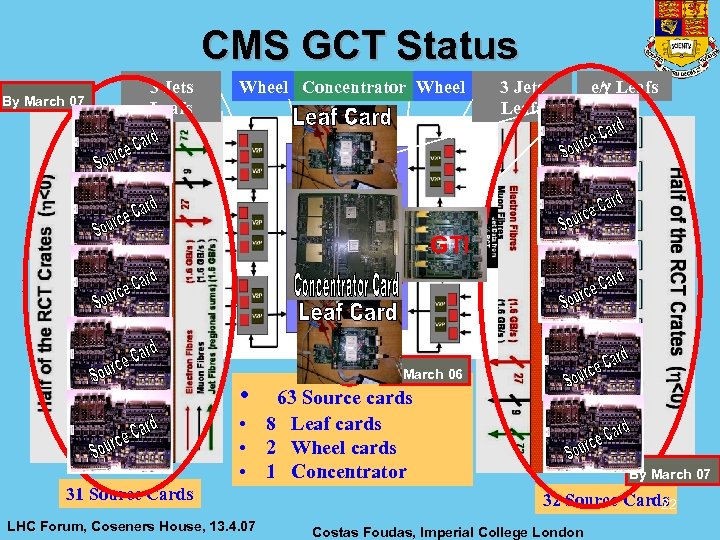 CMS GCT Status By March 07 3 Jets Leafs Wheel Concentrator Wheel 3 Jets Leafs e/ Leafs GTI By March 06 • 63 Source cards • 8 Leaf cards • 2 Wheel cards • 1 Concentrator 31 Source Cards LHC Forum, Coseners House, 13. 4. 07 By March 07 32 Source Cards 22 Costas Foudas, Imperial College London
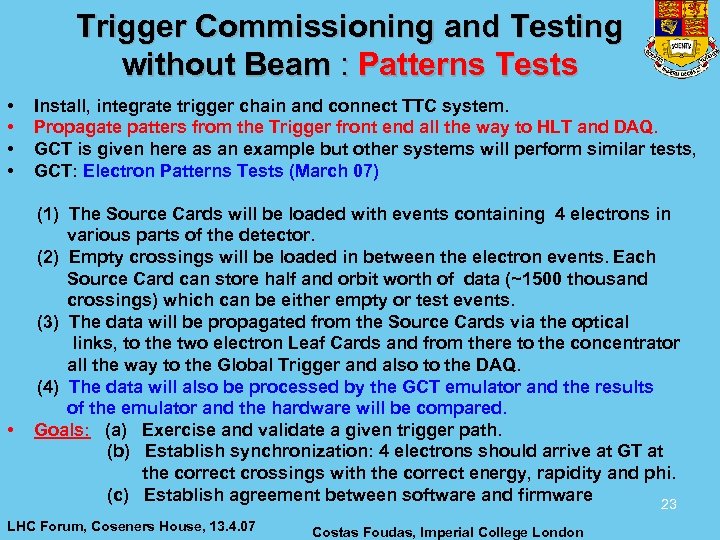 Trigger Commissioning and Testing without Beam : Patterns Tests • • • Install, integrate trigger chain and connect TTC system. Propagate patters from the Trigger front end all the way to HLT and DAQ. GCT is given here as an example but other systems will perform similar tests, GCT: Electron Patterns Tests (March 07) (1) The Source Cards will be loaded with events containing 4 electrons in various parts of the detector. (2) Empty crossings will be loaded in between the electron events. Each Source Card can store half and orbit worth of data (~1500 thousand crossings) which can be either empty or test events. (3) The data will be propagated from the Source Cards via the optical links, to the two electron Leaf Cards and from there to the concentrator all the way to the Global Trigger and also to the DAQ. (4) The data will also be processed by the GCT emulator and the results of the emulator and the hardware will be compared. Goals: (a) Exercise and validate a given trigger path. (b) Establish synchronization: 4 electrons should arrive at GT at the correct crossings with the correct energy, rapidity and phi. (c) Establish agreement between software and firmware 23 LHC Forum, Coseners House, 13. 4. 07 Costas Foudas, Imperial College London
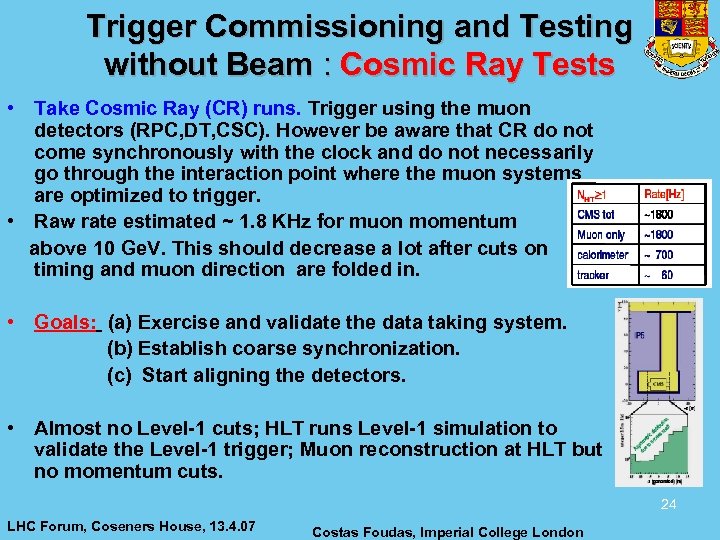 Trigger Commissioning and Testing without Beam : Cosmic Ray Tests • Take Cosmic Ray (CR) runs. Trigger using the muon detectors (RPC, DT, CSC). However be aware that CR do not come synchronously with the clock and do not necessarily go through the interaction point where the muon systems are optimized to trigger. • Raw rate estimated ~ 1. 8 KHz for muon momentum above 10 Ge. V. This should decrease a lot after cuts on timing and muon direction are folded in. • Goals: (a) Exercise and validate the data taking system. (b) Establish coarse synchronization. (c) Start aligning the detectors. • Almost no Level-1 cuts; HLT runs Level-1 simulation to validate the Level-1 trigger; Muon reconstruction at HLT but no momentum cuts. 24 LHC Forum, Coseners House, 13. 4. 07 Costas Foudas, Imperial College London
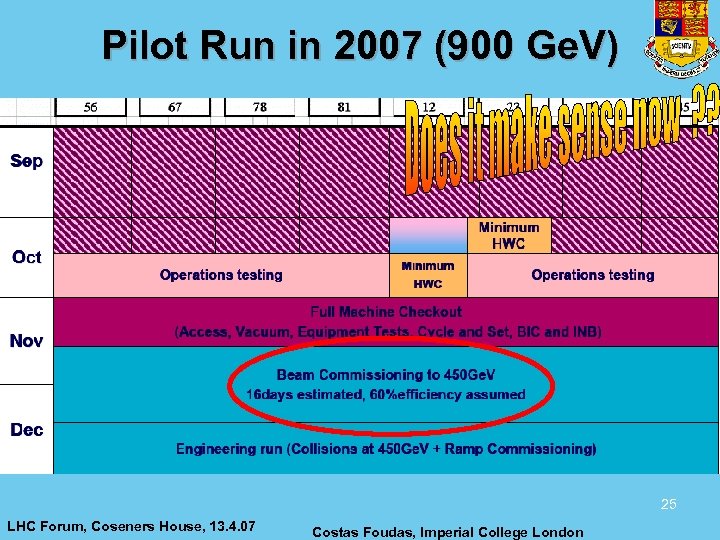 Pilot Run in 2007 (900 Ge. V) 25 LHC Forum, Coseners House, 13. 4. 07 Costas Foudas, Imperial College London
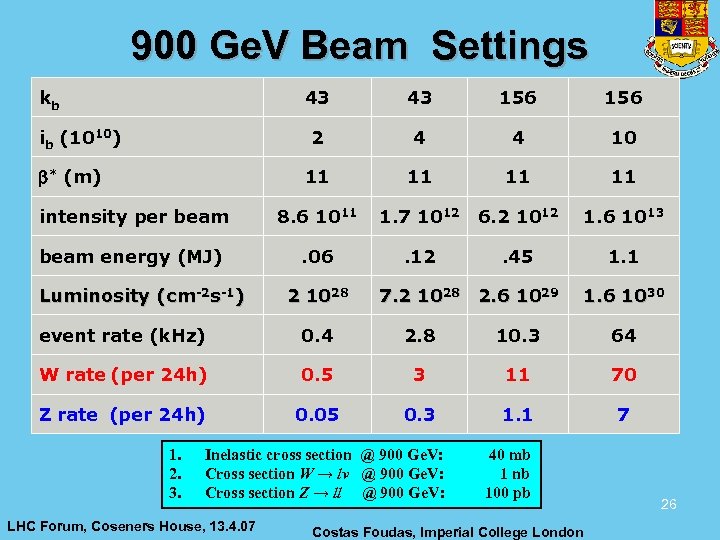 900 Ge. V Beam Settings kb 43 156 4 4 10 11 * (m) 156 2 ib (1010) 43 11 11 11 intensity per beam 8. 6 1011 beam energy (MJ) . 06 Luminosity (cm-2 s-1) 2 1028 1. 7 1012 6. 2 1012. 12 1. 6 1013 . 45 7. 2 1028 2. 6 1029 1. 1 1. 6 1030 event rate (k. Hz) 0. 4 2. 8 10. 3 64 W rate (per 24 h) 0. 5 3 11 70 Z rate (per 24 h) 0. 05 0. 3 1. 1 7 1. 2. 3. Inelastic cross section @ 900 Ge. V: 40 mb Cross section W → lν @ 900 Ge. V: 1 nb Cross section Z → ll @ 900 Ge. V: 100 pb LHC Forum, Coseners House, 13. 4. 07 Costas Foudas, Imperial College London 26
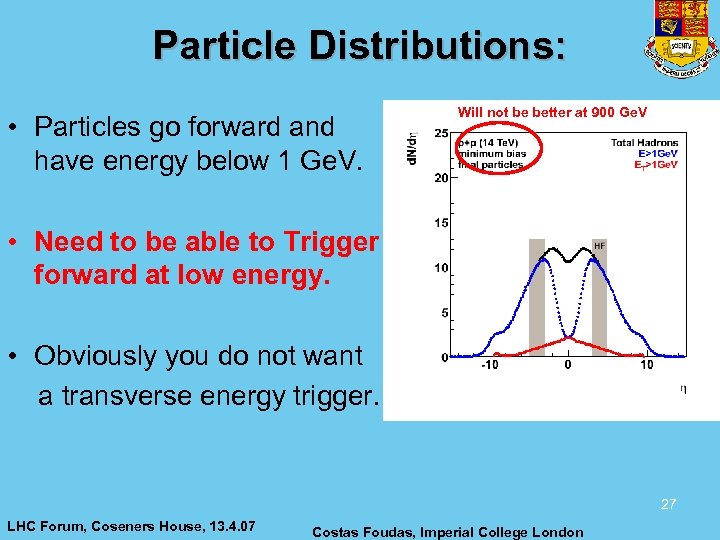 Particle Distributions: • Particles go forward and have energy below 1 Ge. V. Will not be better at 900 Ge. V • Need to be able to Trigger forward at low energy. • Obviously you do not want a transverse energy trigger. 27 LHC Forum, Coseners House, 13. 4. 07 Costas Foudas, Imperial College London
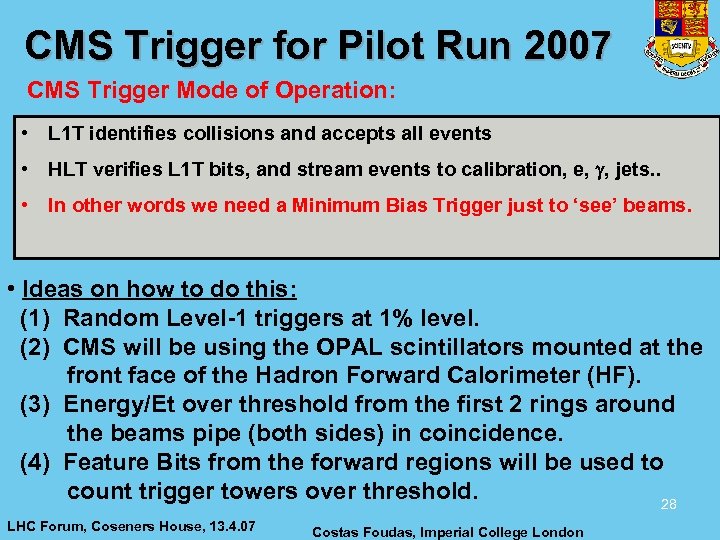 CMS Trigger for Pilot Run 2007 CMS Trigger Mode of Operation: • L 1 T identifies collisions and accepts all events • HLT verifies L 1 T bits, and stream events to calibration, e, , jets. . • In other words we need a Minimum Bias Trigger just to ‘see’ beams. • Ideas on how to do this: (1) Random Level-1 triggers at 1% level. (2) CMS will be using the OPAL scintillators mounted at the front face of the Hadron Forward Calorimeter (HF). (3) Energy/Et over threshold from the first 2 rings around the beams pipe (both sides) in coincidence. (4) Feature Bits from the forward regions will be used to count trigger towers over threshold. 28 LHC Forum, Coseners House, 13. 4. 07 Costas Foudas, Imperial College London
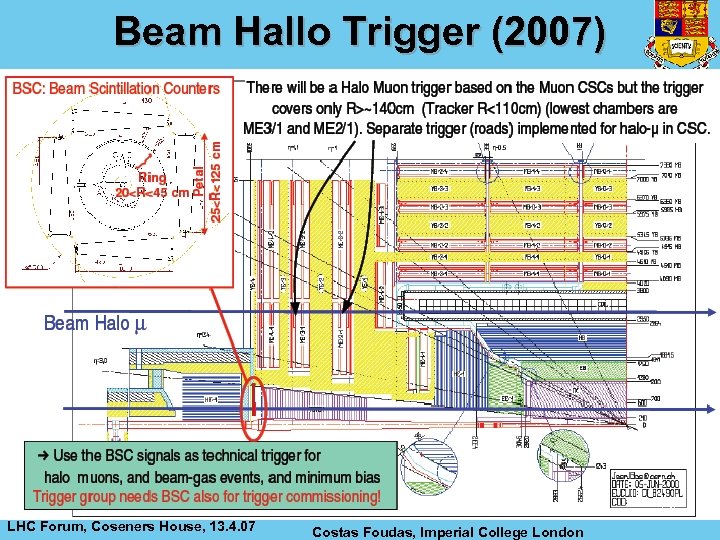 Beam Hallo Trigger (2007) 29 LHC Forum, Coseners House, 13. 4. 07 Costas Foudas, Imperial College London
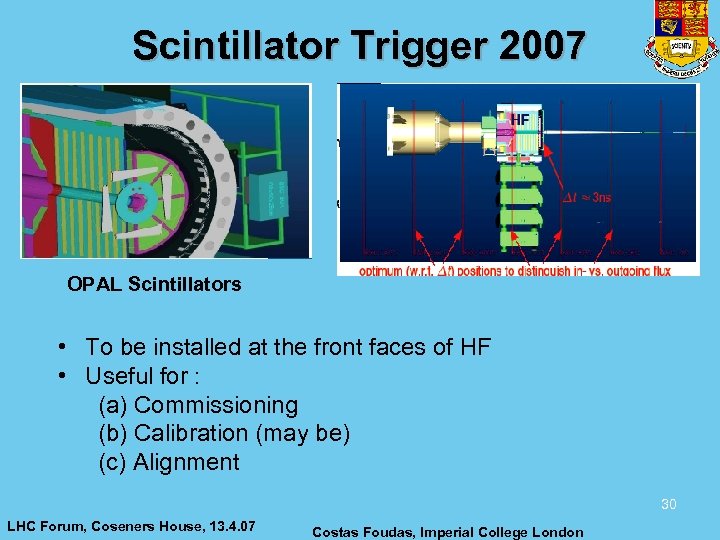 Scintillator Trigger 2007 OPAL Scintillators • To be installed at the front faces of HF • Useful for : (a) Commissioning (b) Calibration (may be) (c) Alignment 30 LHC Forum, Coseners House, 13. 4. 07 Costas Foudas, Imperial College London
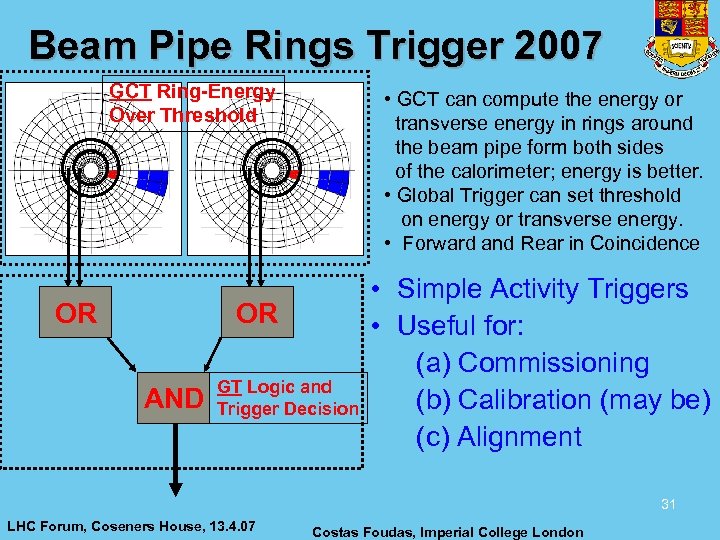 Beam Pipe Rings Trigger 2007 GCT Ring-Energy Over Threshold OR • GCT can compute the energy or transverse energy in rings around the beam pipe form both sides of the calorimeter; energy is better. • Global Trigger can set threshold on energy or transverse energy. • Forward and Rear in Coincidence OR AND GT Logic and Trigger Decision • Simple Activity Triggers • Useful for: (a) Commissioning (b) Calibration (may be) (c) Alignment 31 LHC Forum, Coseners House, 13. 4. 07 Costas Foudas, Imperial College London
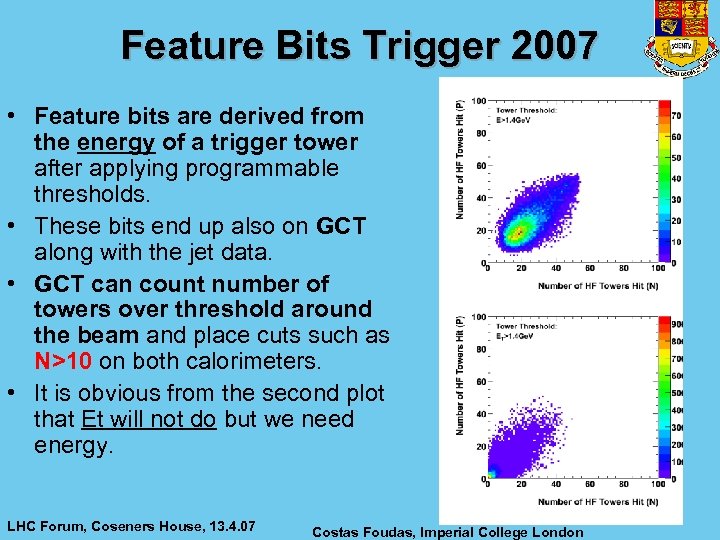 Feature Bits Trigger 2007 • Feature bits are derived from the energy of a trigger tower after applying programmable thresholds. • These bits end up also on GCT along with the jet data. • GCT can count number of towers over threshold around the beam and place cuts such as N>10 on both calorimeters. • It is obvious from the second plot that Et will not do but we need energy. 32 LHC Forum, Coseners House, 13. 4. 07 Costas Foudas, Imperial College London
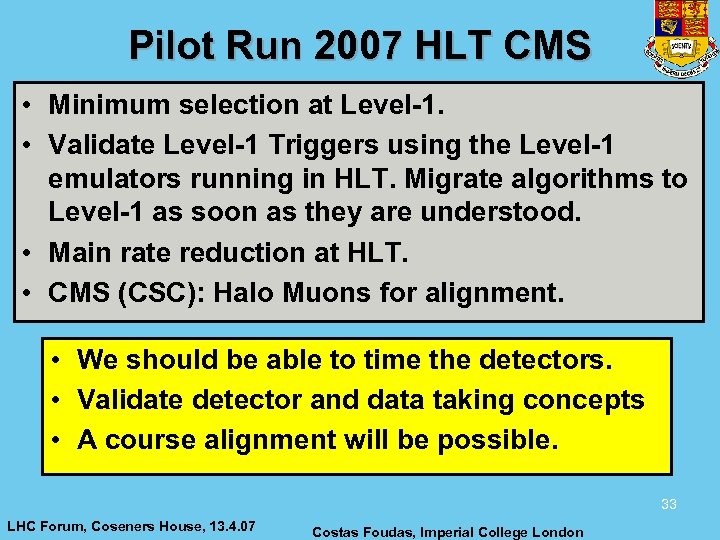 Pilot Run 2007 HLT CMS • Minimum selection at Level-1. • Validate Level-1 Triggers using the Level-1 emulators running in HLT. Migrate algorithms to Level-1 as soon as they are understood. • Main rate reduction at HLT. • CMS (CSC): Halo Muons for alignment. • We should be able to time the detectors. • Validate detector and data taking concepts • A course alignment will be possible. 33 LHC Forum, Coseners House, 13. 4. 07 Costas Foudas, Imperial College London
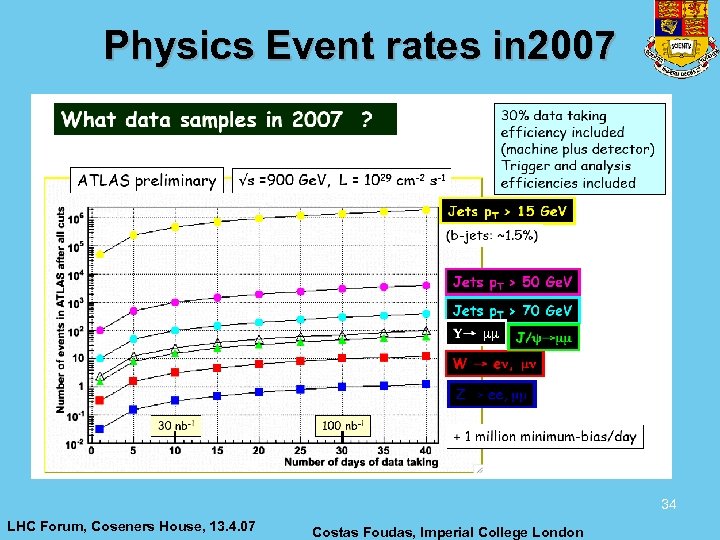 Physics Event rates in 2007 34 LHC Forum, Coseners House, 13. 4. 07 Costas Foudas, Imperial College London
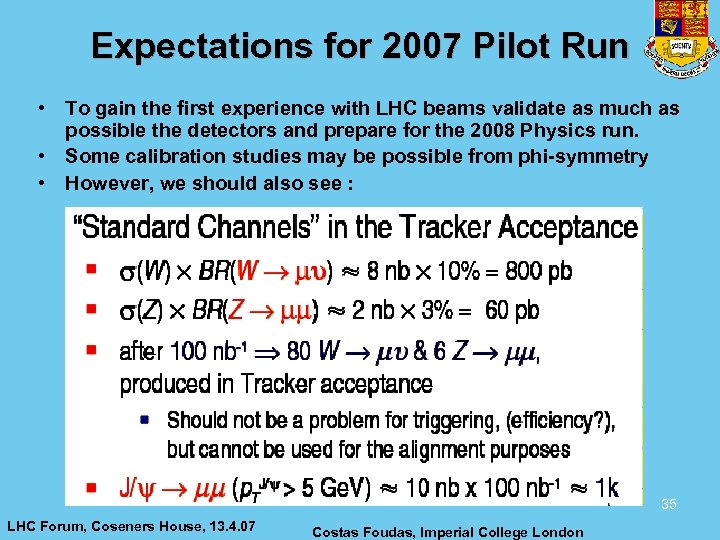 Expectations for 2007 Pilot Run • To gain the first experience with LHC beams validate as much as possible the detectors and prepare for the 2008 Physics run. • Some calibration studies may be possible from phi-symmetry • However, we should also see : 35 LHC Forum, Coseners House, 13. 4. 07 Costas Foudas, Imperial College London
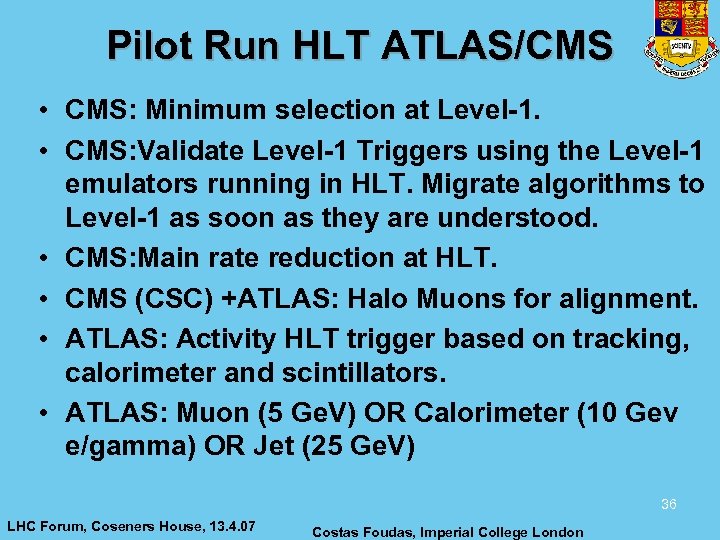 Pilot Run HLT ATLAS/CMS • CMS: Minimum selection at Level-1. • CMS: Validate Level-1 Triggers using the Level-1 emulators running in HLT. Migrate algorithms to Level-1 as soon as they are understood. • CMS: Main rate reduction at HLT. • CMS (CSC) +ATLAS: Halo Muons for alignment. • ATLAS: Activity HLT trigger based on tracking, calorimeter and scintillators. • ATLAS: Muon (5 Ge. V) OR Calorimeter (10 Gev e/gamma) OR Jet (25 Ge. V) 36 LHC Forum, Coseners House, 13. 4. 07 Costas Foudas, Imperial College London
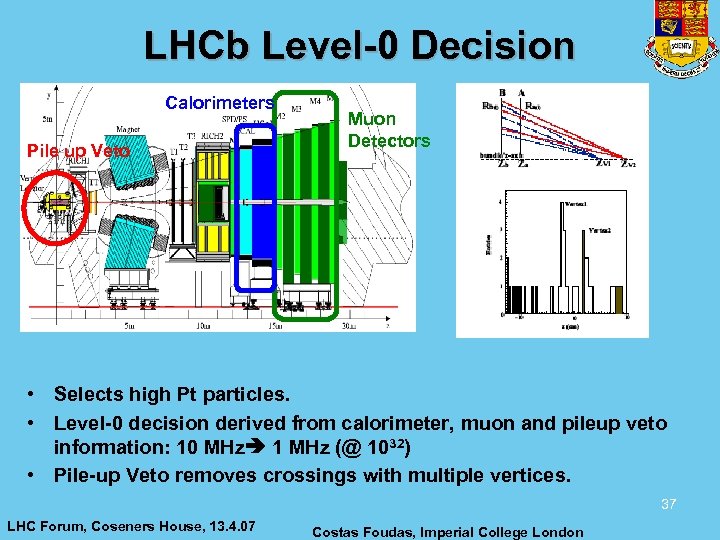 LHCb Level-0 Decision Calorimeters Pile up Veto Muon Detectors • Selects high Pt particles. • Level-0 decision derived from calorimeter, muon and pileup veto information: 10 MHz 1 MHz (@ 1032) • Pile-up Veto removes crossings with multiple vertices. 37 LHC Forum, Coseners House, 13. 4. 07 Costas Foudas, Imperial College London
 LHCb plans: Pilot run 2007 • Goal: Select single High-Pt particles. • Start selection using the hadronic calorimeter to select clusters with High-Pt. • Trigger rate = 50 – 100 Hz • The data will be used for: (a) Timing alignment (b) Detector main alignment with B-field= off (c) Turn on Magnetic Field and test E/p (RICH) (d) Test Velo with Magnetic Field off and validate impact parameter algorithms 38 LHC Forum, Coseners House, 13. 4. 07 Costas Foudas, Imperial College London
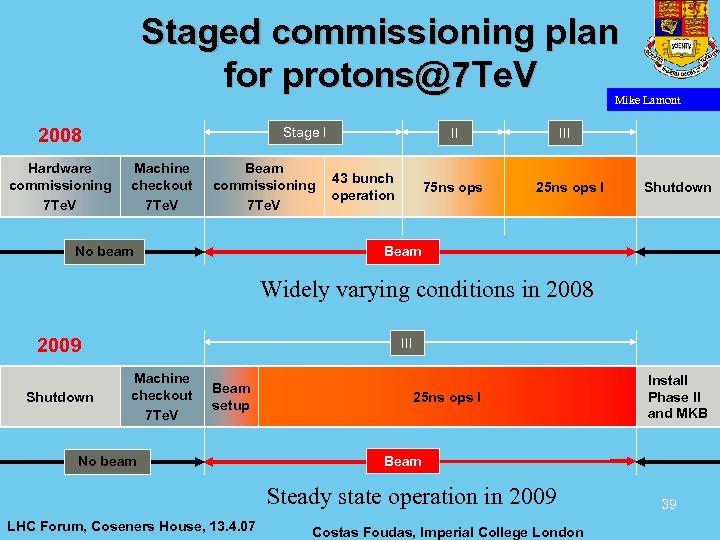 Staged commissioning plan for protons@7 Te. V Mike Lamont 2008 Hardware commissioning 7 Te. V Stage I Machine checkout 7 Te. V Beam commissioning 7 Te. V No beam II 43 bunch operation 75 ns ops III 25 ns ops I Shutdown Beam Widely varying conditions in 2008 2009 Shutdown III Machine checkout 7 Te. V Beam setup No beam 25 ns ops I Beam Steady state operation in 2009 LHC Forum, Coseners House, 13. 4. 07 Install Phase II and MKB Costas Foudas, Imperial College London 39
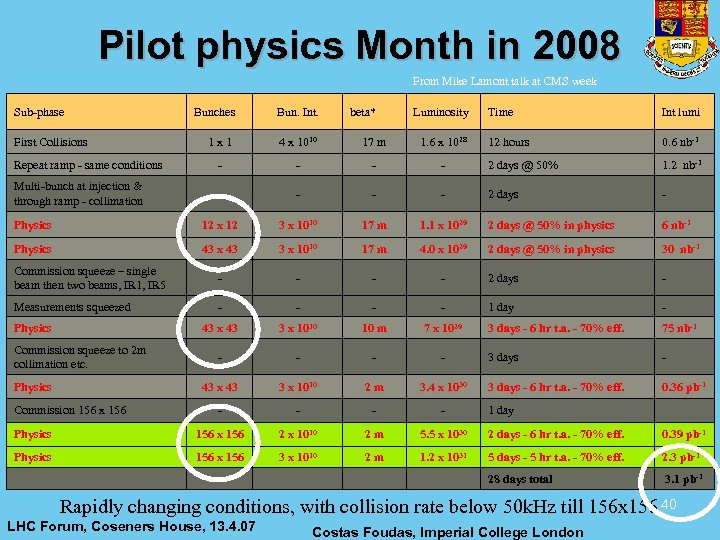 Pilot physics Month in 2008 From Mike Lamont talk at CMS week Sub-phase Bunches Bun. Int. Time Int lumi 1 x 1 4 x 10¹⁰ 17 m 1. 6 x 1028 12 hours 0. 6 nb-1 Repeat ramp - same conditions - - 2 days @ 50% 1. 2 nb-1 Multi-bunch at injection & through ramp - collimation - - 2 days - Physics 12 x 12 3 x 10¹⁰ 17 m 1. 1 x 1029 2 days @ 50% in physics 6 nb-1 Physics 43 x 43 3 x 10¹⁰ 17 m 4. 0 x 1029 2 days @ 50% in physics 30 nb-1 Commission squeeze – single beam then two beams, IR 1, IR 5 - - 2 days - Measurements squeezed - - 1 day - 43 x 43 3 x 10¹⁰ 10 m 7 x 1029 3 days - 6 hr t. a. - 70% eff. 75 nb-1 - - 3 days - 43 x 43 3 x 10¹⁰ 2 m 3. 4 x 1030 3 days - 6 hr t. a. - 70% eff. 0. 36 pb-1 - - 1 day Physics 156 x 156 2 x 10¹⁰ 2 m 5. 5 x 1030 2 days - 6 hr t. a. - 70% eff. 0. 39 pb-1 Physics 156 x 156 3 x 10¹⁰ 2 m 1. 2 x 1031 5 days - 5 hr t. a. - 70% eff. 2. 3 pb-1 28 days total 3. 1 pb-1 First Collisions Physics Commission squeeze to 2 m collimation etc. Physics Commission 156 x 156 beta* Luminosity Rapidly changing conditions, with collision rate below 50 k. Hz till 156 x 156 40 LHC Forum, Coseners House, 13. 4. 07 Costas Foudas, Imperial College London
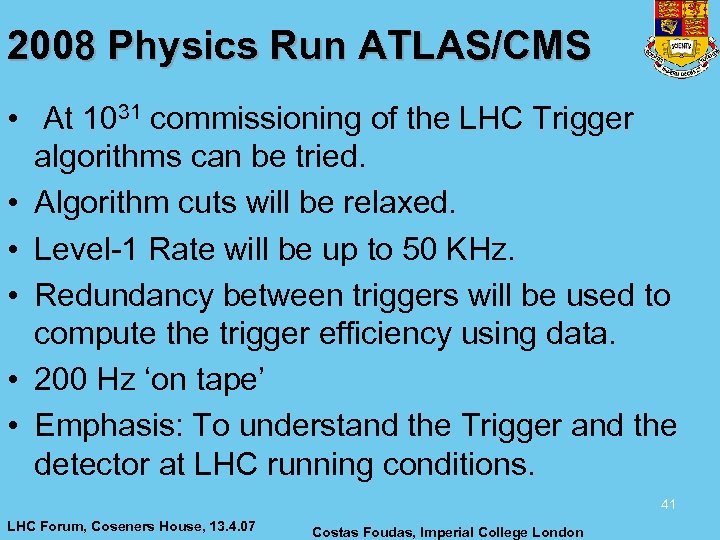 2008 Physics Run ATLAS/CMS • At 1031 commissioning of the LHC Trigger algorithms can be tried. • Algorithm cuts will be relaxed. • Level-1 Rate will be up to 50 KHz. • Redundancy between triggers will be used to compute the trigger efficiency using data. • 200 Hz ‘on tape’ • Emphasis: To understand the Trigger and the detector at LHC running conditions. 41 LHC Forum, Coseners House, 13. 4. 07 Costas Foudas, Imperial College London
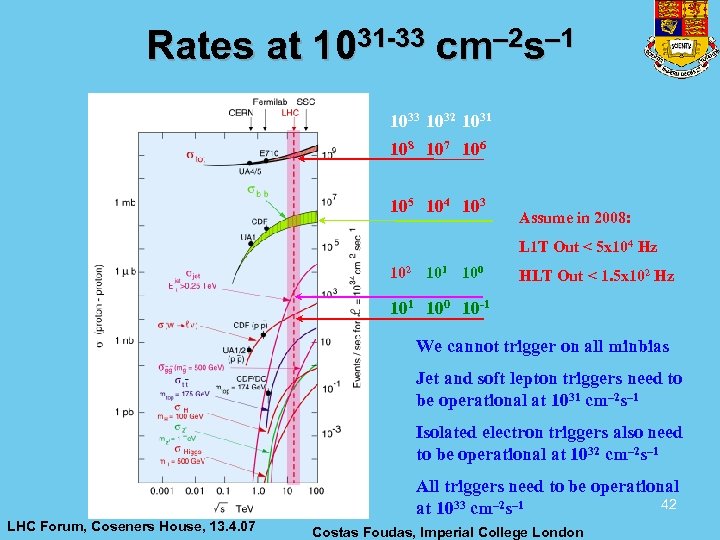 Rates at 1031 -33 cm– 2 s– 1 1033 1032 1031 108 107 106 105 104 103 Assume in 2008: L 1 T Out < 5 x 10⁴ Hz 102 101 100 HLT Out < 1. 5 x 10² Hz 101 100 10 -1 We cannot trigger on all minbias Jet and soft lepton triggers need to be operational at 1031 cm– 2 s– 1 Isolated electron triggers also need to be operational at 1032 cm– 2 s– 1 All triggers need to be operational 42 at 1033 cm– 2 s– 1 LHC Forum, Coseners House, 13. 4. 07 Costas Foudas, Imperial College London
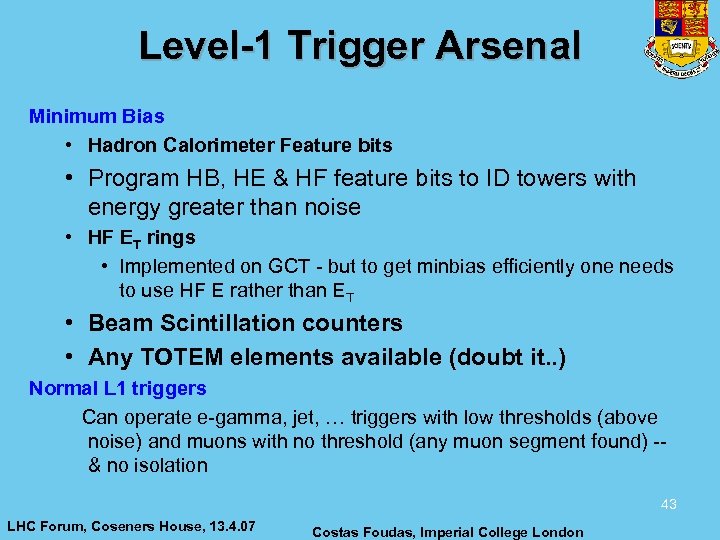 Level-1 Trigger Arsenal Minimum Bias • Hadron Calorimeter Feature bits • Program HB, HE & HF feature bits to ID towers with energy greater than noise • HF ET rings • Implemented on GCT - but to get minbias efficiently one needs to use HF E rather than ET • Beam Scintillation counters • Any TOTEM elements available (doubt it. . ) Normal L 1 triggers Can operate e-gamma, jet, … triggers with low thresholds (above noise) and muons with no threshold (any muon segment found) -& no isolation 43 LHC Forum, Coseners House, 13. 4. 07 Costas Foudas, Imperial College London
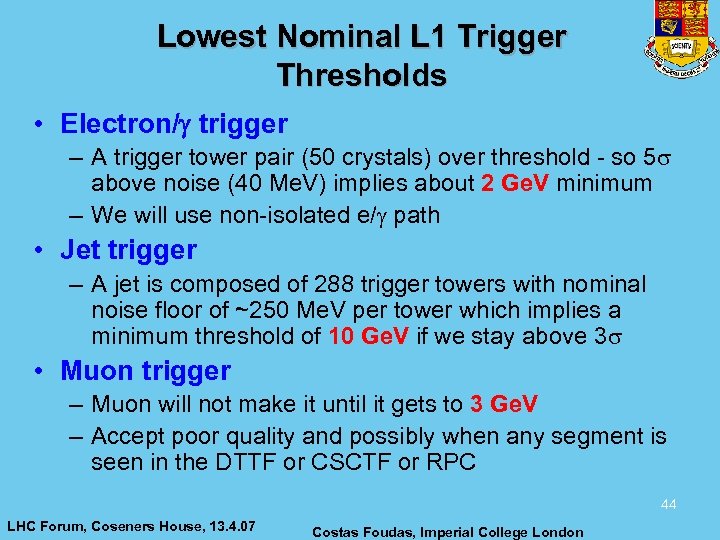 Lowest Nominal L 1 Trigger Thresholds • Electron/ trigger – A trigger tower pair (50 crystals) over threshold - so 5 above noise (40 Me. V) implies about 2 Ge. V minimum – We will use non-isolated e/ path • Jet trigger – A jet is composed of 288 trigger towers with nominal noise floor of ~250 Me. V per tower which implies a minimum threshold of 10 Ge. V if we stay above 3 • Muon trigger – Muon will not make it until it gets to 3 Ge. V – Accept poor quality and possibly when any segment is seen in the DTTF or CSCTF or RPC 44 LHC Forum, Coseners House, 13. 4. 07 Costas Foudas, Imperial College London
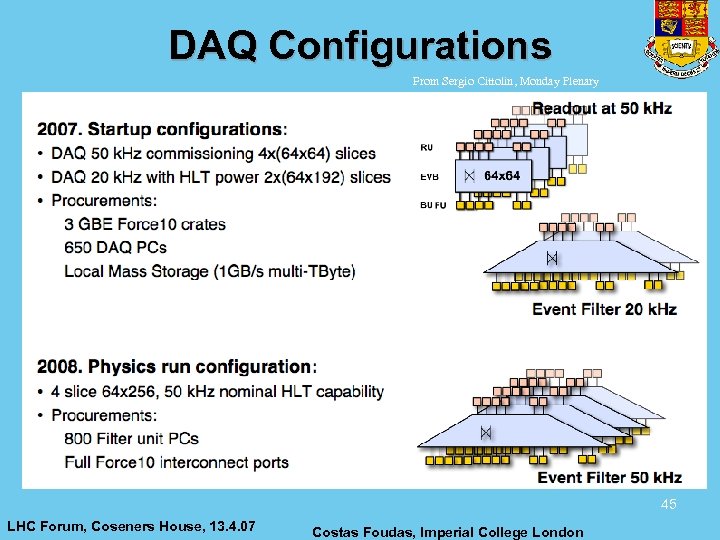 DAQ Configurations From Sergio Cittolin, Monday Plenary 45 LHC Forum, Coseners House, 13. 4. 07 Costas Foudas, Imperial College London
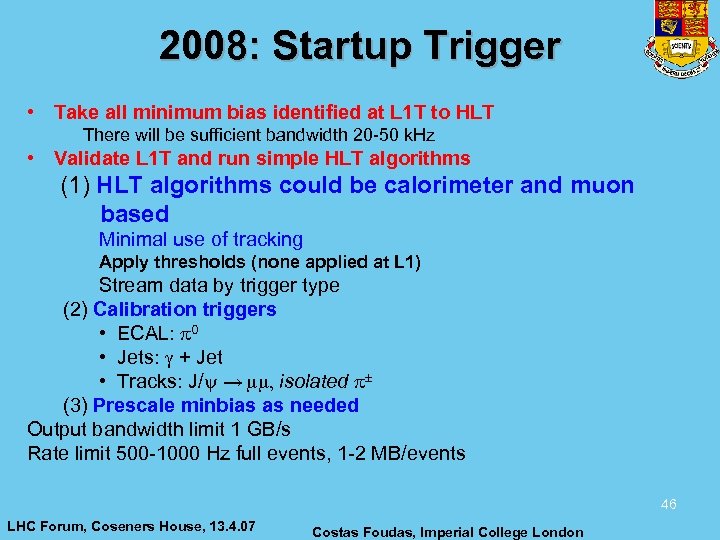 2008: Startup Trigger • Take all minimum bias identified at L 1 T to HLT There will be sufficient bandwidth 20 -50 k. Hz • Validate L 1 T and run simple HLT algorithms (1) HLT algorithms could be calorimeter and muon based Minimal use of tracking Apply thresholds (none applied at L 1) Stream data by trigger type (2) Calibration triggers • ECAL: 0 • Jets: + Jet • Tracks: J/y → isolated (3) Prescale minbias as needed Output bandwidth limit 1 GB/s Rate limit 500 -1000 Hz full events, 1 -2 MB/events 46 LHC Forum, Coseners House, 13. 4. 07 Costas Foudas, Imperial College London
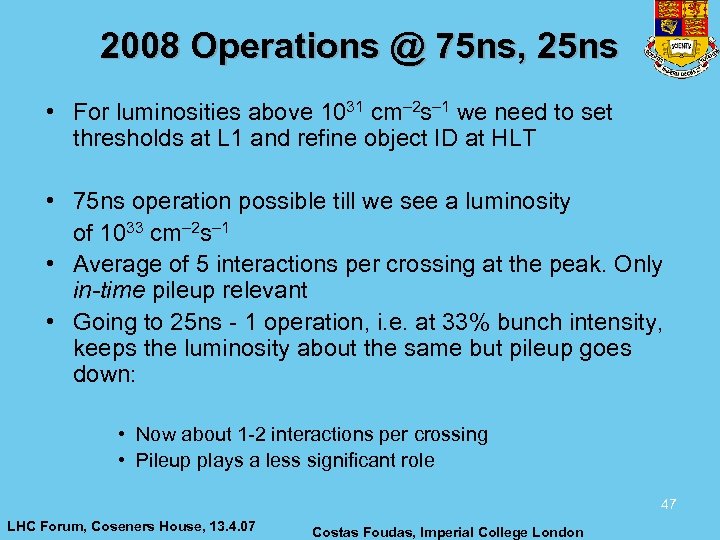 2008 Operations @ 75 ns, 25 ns • For luminosities above 1031 cm– 2 s– 1 we need to set thresholds at L 1 and refine object ID at HLT • 75 ns operation possible till we see a luminosity of 1033 cm– 2 s– 1 • Average of 5 interactions per crossing at the peak. Only in-time pileup relevant • Going to 25 ns - 1 operation, i. e. at 33% bunch intensity, keeps the luminosity about the same but pileup goes down: • Now about 1 -2 interactions per crossing • Pileup plays a less significant role 47 LHC Forum, Coseners House, 13. 4. 07 Costas Foudas, Imperial College London
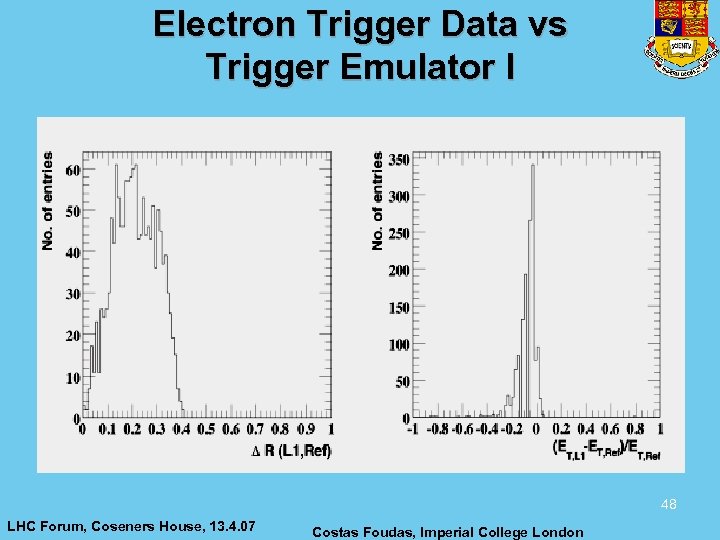 Electron Trigger Data vs Trigger Emulator I 48 LHC Forum, Coseners House, 13. 4. 07 Costas Foudas, Imperial College London
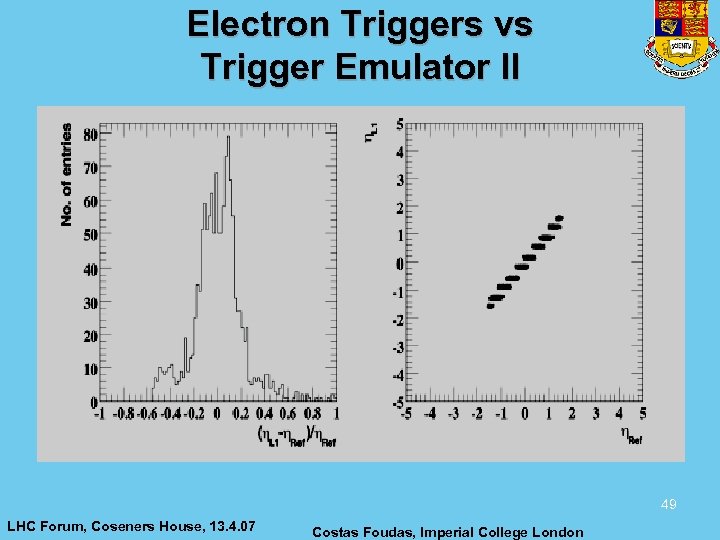 Electron Triggers vs Trigger Emulator II 49 LHC Forum, Coseners House, 13. 4. 07 Costas Foudas, Imperial College London
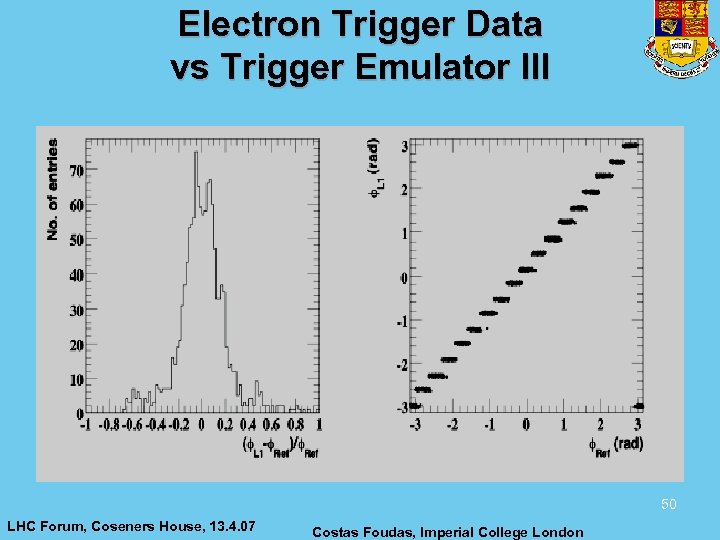 Electron Trigger Data vs Trigger Emulator III 50 LHC Forum, Coseners House, 13. 4. 07 Costas Foudas, Imperial College London
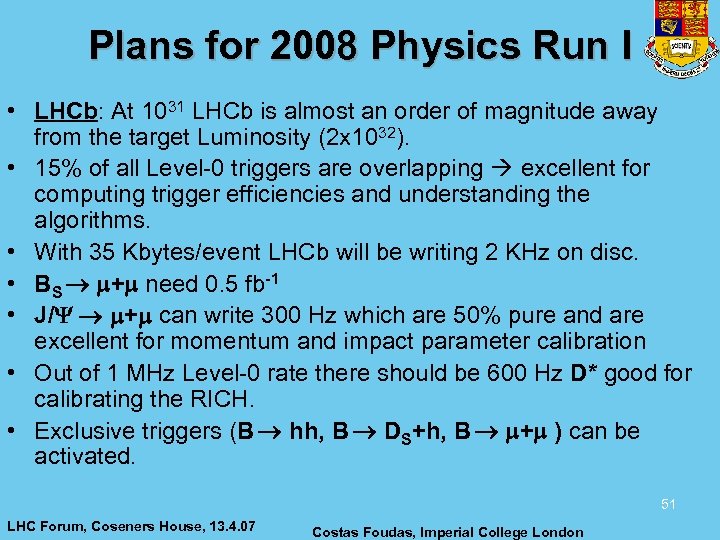 Plans for 2008 Physics Run I • LHCb: At 1031 LHCb is almost an order of magnitude away from the target Luminosity (2 x 1032). • 15% of all Level-0 triggers are overlapping excellent for computing trigger efficiencies and understanding the algorithms. • With 35 Kbytes/event LHCb will be writing 2 KHz on disc. • BS + need 0. 5 fb-1 • J/ + can write 300 Hz which are 50% pure and are excellent for momentum and impact parameter calibration • Out of 1 MHz Level-0 rate there should be 600 Hz D* good for calibrating the RICH. • Exclusive triggers (B hh, B DS+h, B + ) can be activated. 51 LHC Forum, Coseners House, 13. 4. 07 Costas Foudas, Imperial College London
 LHC Trigger Overview • The LHC experiments are gearing up for the first data. Preparations of almost two decades come to a conclusion and I am sure it will be a very exciting time. • However, the trigger and DAQ systems at LHC are orders of magnitude more complicated than before but also more sophisticated producing samples of purity not seen before. • Understanding the first samples will not be easy, it will take time and requires a methodical and systematic approach. • But you can be sure that he who understands his detector first will be closer to discovery using the data after 2008. 52 LHC Forum, Coseners House, 13. 4. 07 Costas Foudas, Imperial College London