


 Скачать презентацию Overview of the Interactive Entertainment Industry Ernest W
7e20c27f769fded6c2eb31d9c8114848.ppt
- Количество слайдов: 35
 Overview of the Interactive Entertainment Industry Ernest W. Adams ewadams@designersnotebook. com http: //www. designersnotebook. com +44 -1483 -237599 1
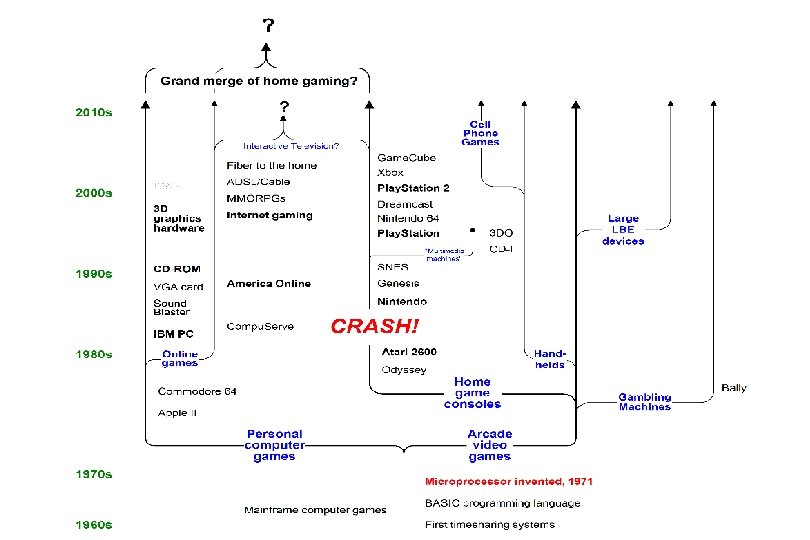
 First, A Little History n The game industry grew out of two branches n Personal computer games n Arcade games n Other branches arrived later n Home consoles n Online games n Gambling machines n Location-based entertainment 2
 Segments of the Game Industry n Arcade (coin-operated) games n Home console video games (Nintendo, etc. ) n Personal computer games n (And n on-line games) Smaller segments: n Gambling machines, handheld games, cellphone games, ride simulators (LBE) 4
 Arcade (Coin-op) Machines Entirely closed systems n Game designs limited by time n Possible to have specialized hardware n Expense of manufacture limits entry to market n Not exactly a retail product n 5
 The Home Console System n Advantages n Enables hardware to be sold very cheaply n No matter who builds the software, the hardware manufacturer gets a royalty n Guarantees product quality n Disadvantages n Limits creativity n Limits entrepreneurship and competition n Potential conflict of interest when hardware manufacturer also sells software 6
 The Personal Computer Powerful processors for better games n Excellent video resolution & color depth n Excellent sound reproduction n Keyboard permits complex games n Multipurpose device n n Education; home office; reference; on-line Still an open system! n (But also much more expensive) n 7
 On-Line Games n Many early problems n Complexity of setting up a modem n Low transmission speeds n High hourly charges n Large growth potential n Most problems above addressed n Internet standardizes transmission protocols n Multi-player play offers a richer experience n Customer service is still a problem 8
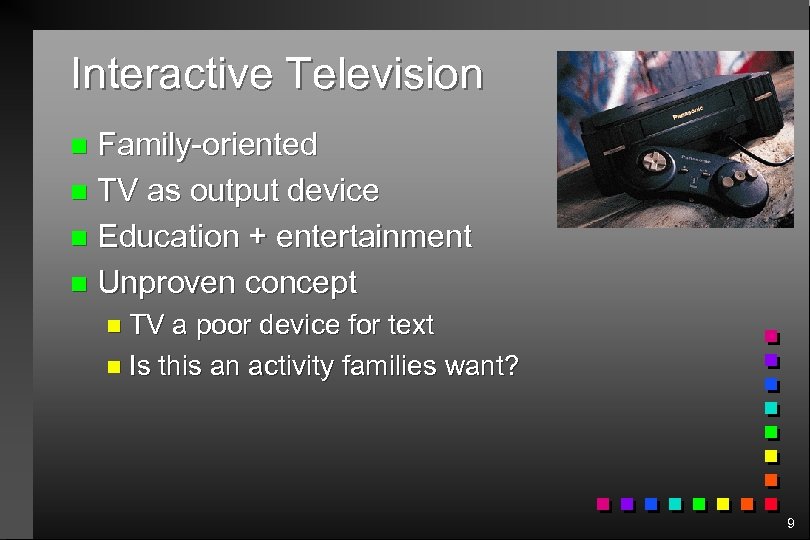 Interactive Television Family-oriented n TV as output device n Education + entertainment n Unproven concept n n TV a poor device for text n Is this an activity families want? 9
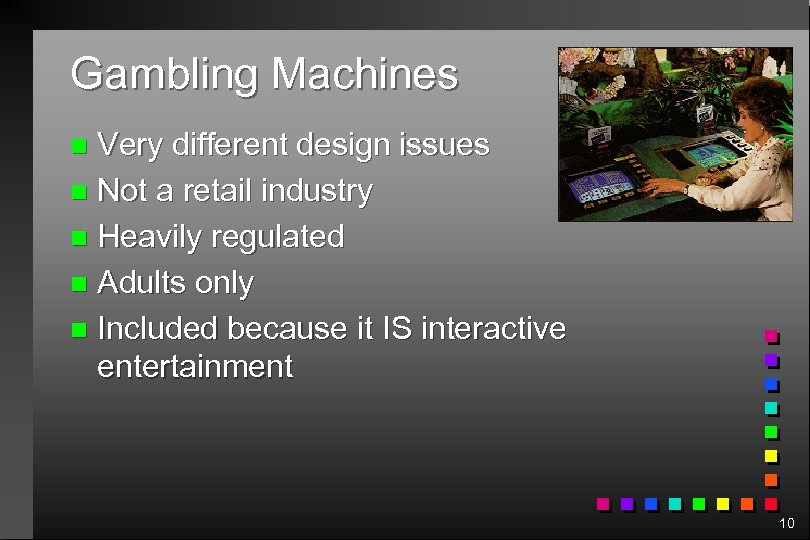 Gambling Machines Very different design issues n Not a retail industry n Heavily regulated n Adults only n Included because it IS interactive entertainment n 10
 Culture - Video Game Development n Founded by business people n Expensive development systems n Expensive manufacturing: cartridges or special CDs Risk-averse; little design experimentation n Difficult for newcomers to enter n n Hard to learn the tools n Secretive n Much larger market 11
 Culture - Computer Game Development Grew out of homebrew clubs and user groups n Anyone can do it without a license n n Shareware! No expensive development stations needed n More experimentation, unusual games n Friendly, open, many resources to help n 12
 The Marketing Issues What makes people want to buy interactive entertainment? What determines if they will or not? Risk Analysis n Comparable Prices of Other Equipment n “Household Use” Theory n 13
 Risk Analysis The purchase decision is based on the amount of money lost if the consumer does not like the product. This amount of money consists of: Initial (equipment) costs Price per hour of play 14
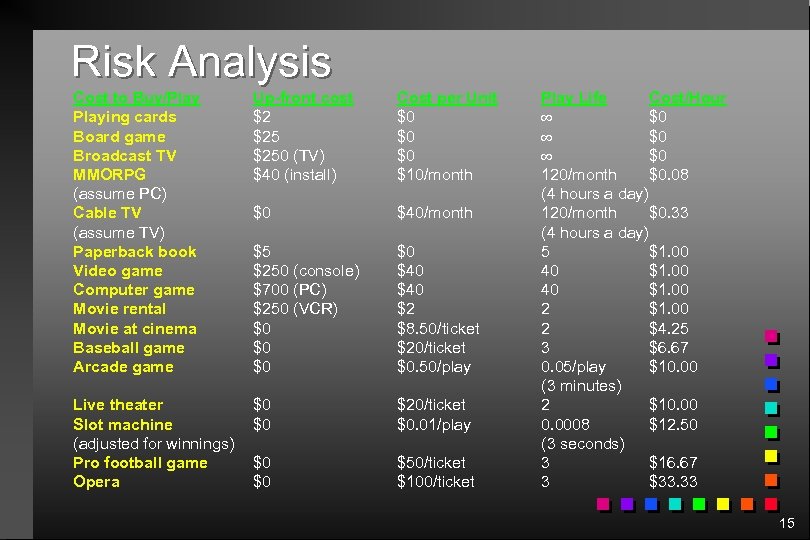 Risk Analysis Cost to Buy/Playing cards Board game Broadcast TV MMORPG (assume PC) Cable TV (assume TV) Paperback book Video game Computer game Movie rental Movie at cinema Baseball game Arcade game Up-front cost $2 $250 (TV) $40 (install) Cost per Unit $0 $0 $0 $10/month $0 $40/month $5 $250 (console) $700 (PC) $250 (VCR) $0 $0 $40 $2 $8. 50/ticket $20/ticket $0. 50/play Live theater Slot machine (adjusted for winnings) Pro football game Opera $0 $0 $20/ticket $0. 01/play $0 $0 $50/ticket $100/ticket Play Life Cost/Hour $0 $0 120/month $0. 08 (4 hours a day) 120/month $0. 33 (4 hours a day) 5 $1. 00 40 $1. 00 2 $4. 25 3 $6. 67 0. 05/play $10. 00 (3 minutes) 2 $10. 0008 $12. 50 (3 seconds) 3 $16. 67 3 $33. 33 15
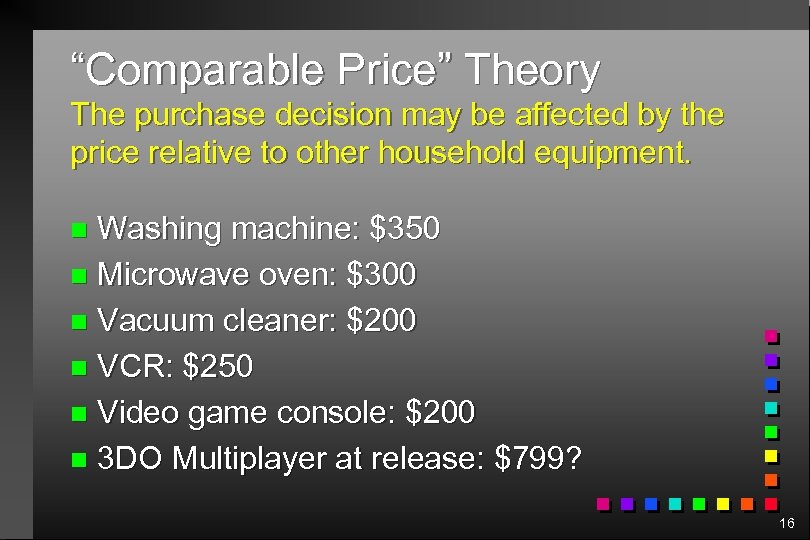 “Comparable Price” Theory The purchase decision may be affected by the price relative to other household equipment. Washing machine: $350 n Microwave oven: $300 n Vacuum cleaner: $200 n VCR: $250 n Video game console: $200 n 3 DO Multiplayer at release: $799? n 16
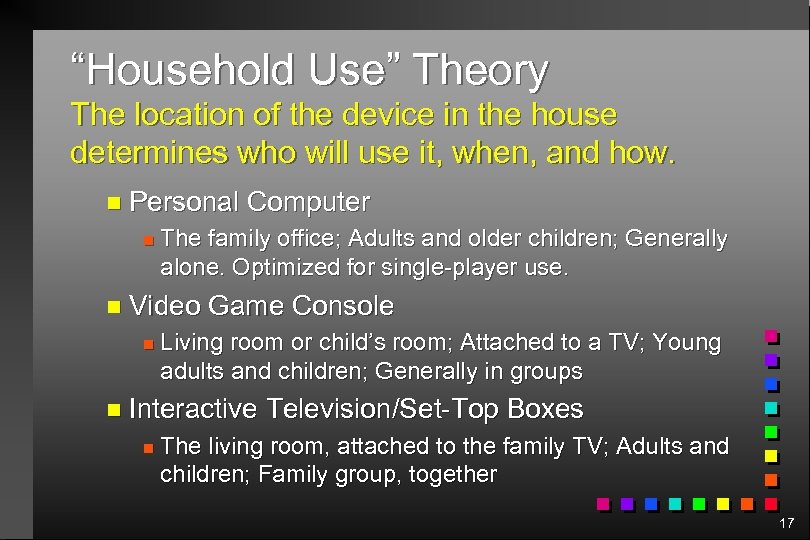 “Household Use” Theory The location of the device in the house determines who will use it, when, and how. n Personal n The family office; Adults and older children; Generally alone. Optimized for single-player use. n Video n Computer Game Console Living room or child’s room; Attached to a TV; Young adults and children; Generally in groups n Interactive n Television/Set-Top Boxes The living room, attached to the family TV; Adults and children; Family group, together 17
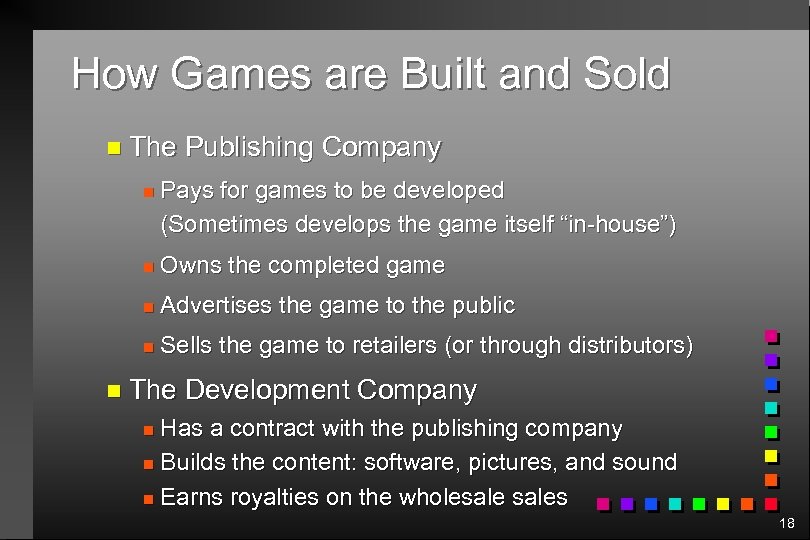 How Games are Built and Sold n The Publishing Company n Pays for games to be developed (Sometimes develops the game itself “in-house”) n Owns the completed game n Advertises the game to the public n Sells the game to retailers (or through distributors) n The Development Company Has a contract with the publishing company n Builds the content: software, pictures, and sound n Earns royalties on the wholesales n 18
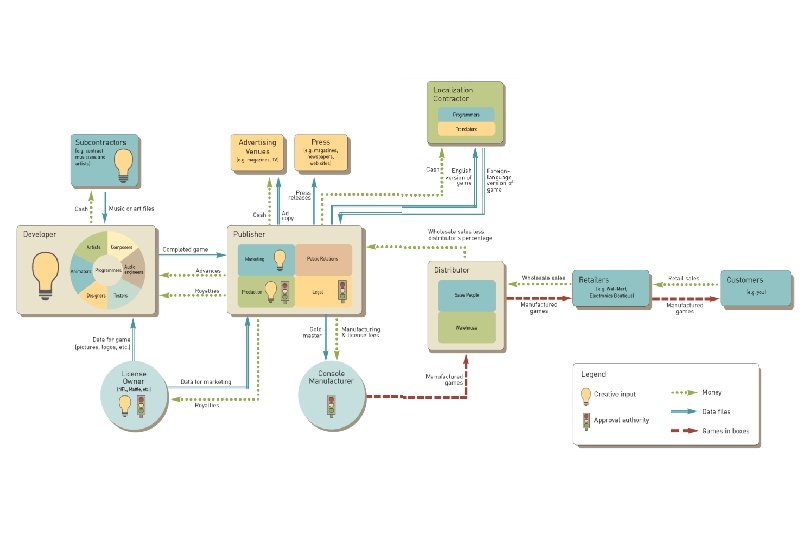
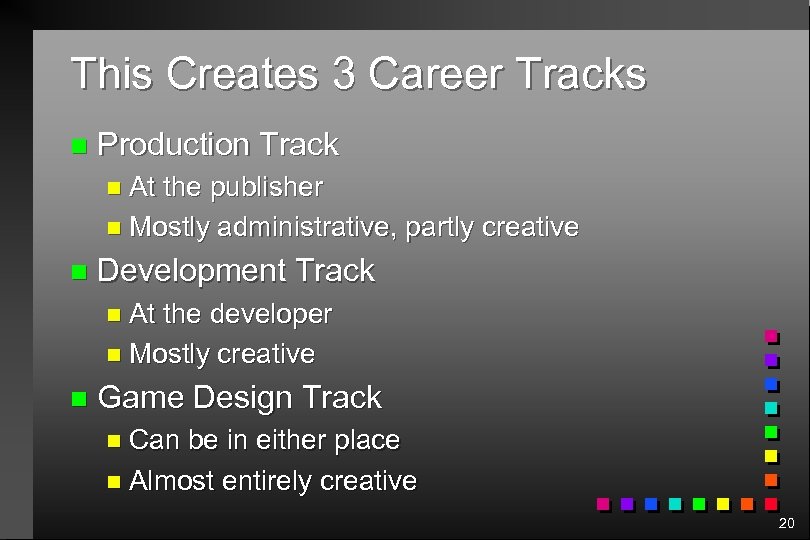 This Creates 3 Career Tracks n Production Track n At the publisher n Mostly administrative, partly creative n Development Track n At the developer n Mostly creative n Game Design Track n Can be in either place n Almost entirely creative 20
 The Production Track Function is to assist and oversee the development process for the publisher n Primary talent required is “product sense” n n Ability to know when a game is good (and how to fix it when it is not good!) Don’t have to be a programmer, artist, etc. n Can start at the very bottom n Can go to the very top! n 21
 The Development Track Function is to build the game n Divided into specialties based on skills n Programming – the software n n Graphics, n Art and animation – the pictures n 2 D n artificial intelligence, physics, etc. art & animation, 3 D modelling and animation Audio engineering & music – the sound n Recording, editing, music composition 22
 More on the Development Track Can learn skills at university n Can start at a good salary n Promotion is limited unless you change track n If you are a great programmer. . . n The company will only want you to program! n 23
 The Game Design Track Game design can be at publisher OR developer n Three levels of design n n Lead n game designer (only 1 per game) Defines the general nature of the game, player’s role n Game n Fills in the details about the game n Level n designer Creates scenarios (“levels”) that the player will play 24
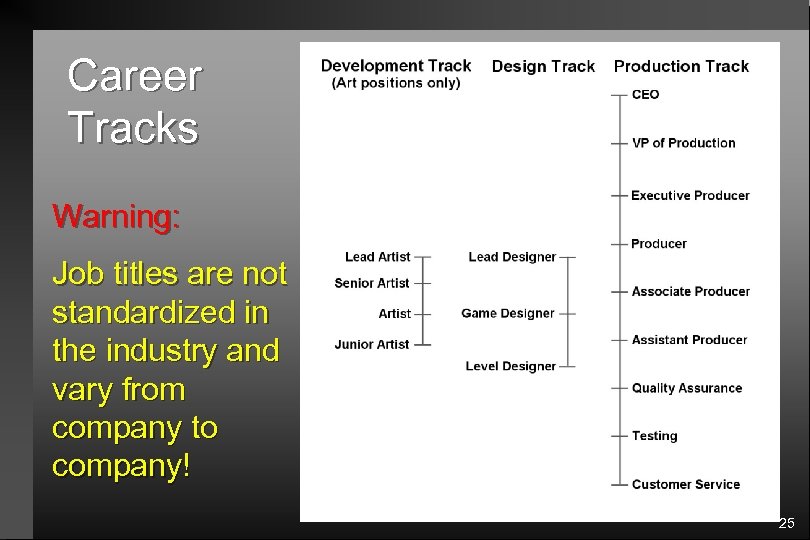 Career Tracks Warning: Job titles are not standardized in the industry and vary from company to company! 25
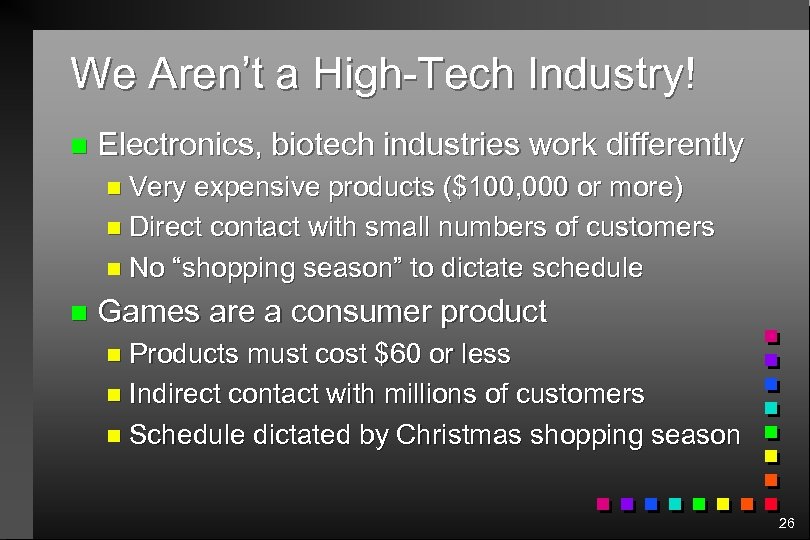 We Aren’t a High-Tech Industry! n Electronics, biotech industries work differently n Very expensive products ($100, 000 or more) n Direct contact with small numbers of customers n No “shopping season” to dictate schedule n Games are a consumer product n Products must cost $60 or less n Indirect contact with millions of customers n Schedule dictated by Christmas shopping season 26
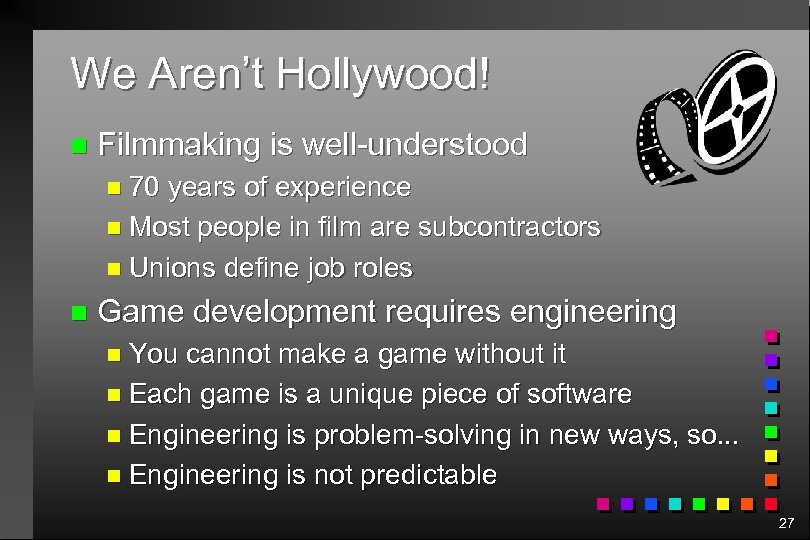 We Aren’t Hollywood! n Filmmaking is well-understood n 70 years of experience n Most people in film are subcontractors n Unions define job roles n Game development requires engineering n You cannot make a game without it n Each game is a unique piece of software n Engineering is problem-solving in new ways, so. . . n Engineering is not predictable 27
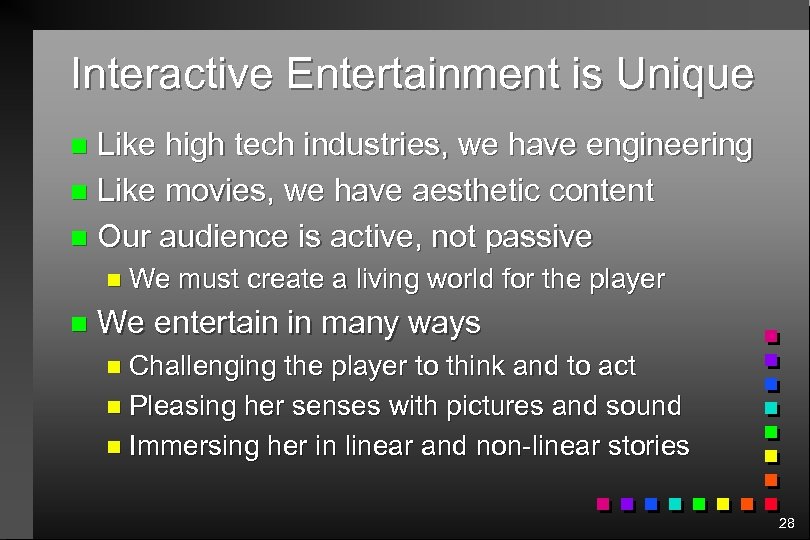 Interactive Entertainment is Unique Like high tech industries, we have engineering n Like movies, we have aesthetic content n Our audience is active, not passive n n We n must create a living world for the player We entertain in many ways n Challenging the player to think and to act n Pleasing her senses with pictures and sound n Immersing her in linear and non-linear stories 28
 Some Bad News n Game companies don’t buy ideas n Everyone in the industry already has many ideas n You cannot patent an idea alone n Don’t get into the industry for the money! n Game n You may not get a chance to make your game n It n programming pays 25% less than others is your job to make the game the company needs The work can be very long and very hard! n Schedules are always unpredictable 29
 Some Game Industry Trends n New hardware is always coming n Game richness and detail is improving n Development costs are rising n n 20 -50 times what they were 15 years ago Much competition for space in retail shops n Forces prices down n Games only stay on shelves a short time n Must sell hundreds of thousands to succeed n All this produces publisher conservatism! 30
 Limitations of Retail Distribution n Retail distribution is like TV before cable n Before cable, 3 big TV networks dominated the USA n Amount of content limited by transmission bandwidth n No concept of market niches n All shows had to appeal to all people (all equally stupid!) n After n n cable, many channels, many interests History, sport, drama, music, news, etc. Retail game distribution forces all games through the narrow bandwidth of store shelves! 31
 Benefits of Electronic Distribution n No goods to manufacture n No n shipping, no warehouses, no retailers Shelf space on the Internet is infinite! n Small n Piracy is less of a problem n Game n publishers can distribute as easily as big ones can be verified by a secure server each time Can sell using many different payment models n Flat fee, monthly subscription, per-hour charges 32
 Problems of Electronic Distribution n Don’t yet have enough speed n Must be able to download 650 MB in 10 min Not enough people have broadband yet n We don’t understand the psychology of the game buyer n n How important is the “shopping experience”? n Do retail stores offer something valuable? n People like to see boxes under the Christmas tree, not just a URL! 33
 A View of the Future n Electronic distribution is inevitable n n n Graphics are no longer our primary selling point n n We need to concentrate on new genres and worlds. “Interactive Entertainment” won’t only mean games. n n The cost-reduction benefits will be unanswerable. The bandwidth will permit us to serve niche markets. Microsoft is already researching non-competitive play. Academic research holds great promise. n n n Will help the interactivity/narrative problem. Will help the artificial intelligence problem. Doesn’t have to be commercially viable. 34
 Overview of the Interactive Entertainment Industry Ernest W. Adams ewadams@designersnotebook. com http: //www. designersnotebook. com +44 -1483 -237599 35