 Скачать презентацию Overview of the Daya Bay experiment Yifang Wang
4132f181ddc9172dd243a932807c623f.ppt
- Количество слайдов: 46



Overview of the Daya Bay experiment Yifang Wang Institute of High Energy Physics
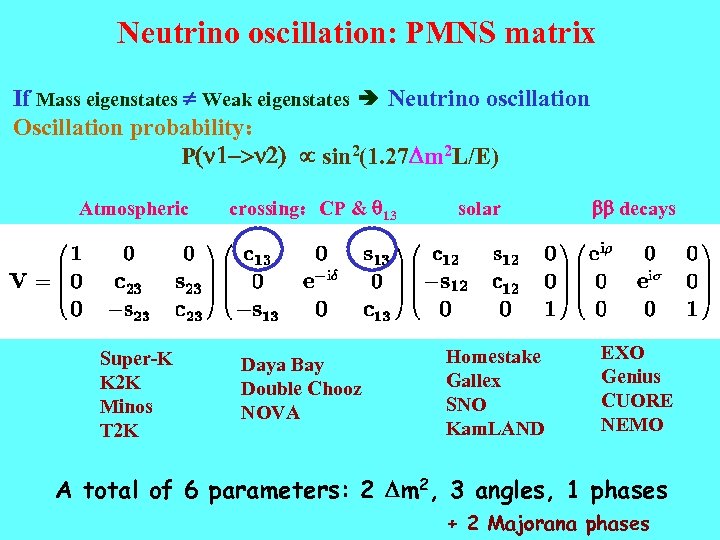
Neutrino oscillation: PMNS matrix If Mass eigenstates Weak eigenstates Neutrino oscillation Oscillation probability: P(n 1 >n 2) sin 2(1. 27 Dm 2 L/E) Atmospheric Super-K K 2 K Minos T 2 K crossing:CP & 13 Daya Bay Double Chooz NOVA solar Homestake Gallex SNO Kam. LAND bb decays EXO Genius CUORE NEMO A total of 6 parameters: 2 Dm 2, 3 angles, 1 phases + 2 Majorana phases
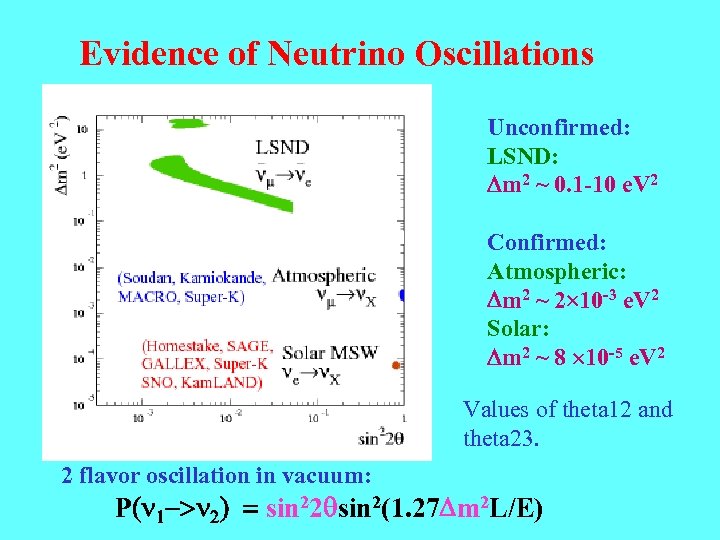
Evidence of Neutrino Oscillations Unconfirmed: LSND: Dm 2 ~ 0. 1 -10 e. V 2 Confirmed: Atmospheric: Dm 2 ~ 2 10 -3 e. V 2 Solar: Dm 2 ~ 8 10 -5 e. V 2 Values of theta 12 and theta 23. 2 flavor oscillation in vacuum: P(n 1 >n 2) = sin 22 sin 2(1. 27 Dm 2 L/E)
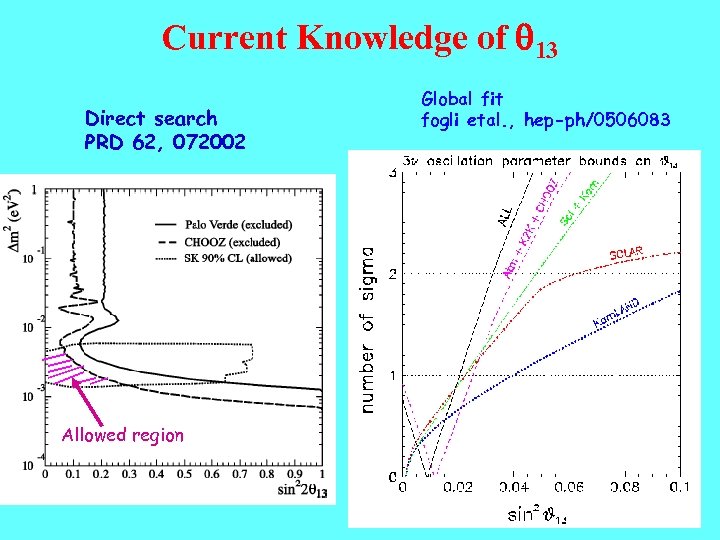
Current Knowledge of 13 Direct search PRD 62, 072002 Global fit fogli etal. , hep-ph/0506083 Sin 2(2 13) < 0. 18 Sin 2(2 13) < 0. 09 Allowed region
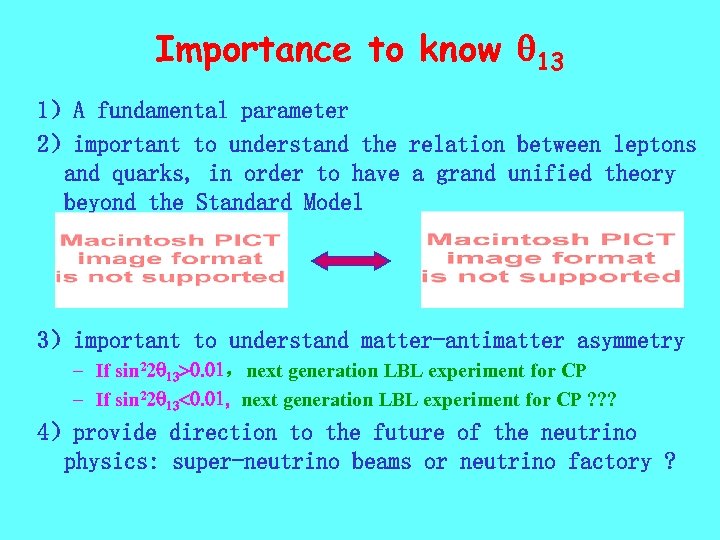
Importance to know 13 1)A fundamental parameter 2)important to understand the relation between leptons and quarks, in order to have a grand unified theory beyond the Standard Model 3)important to understand matter-antimatter asymmetry – If sin 22 13>0. 01,next generation LBL experiment for CP – If sin 22 13<0. 01, next generation LBL experiment for CP ? ? ? 4)provide direction to the future of the neutrino physics: super-neutrino beams or neutrino factory ?
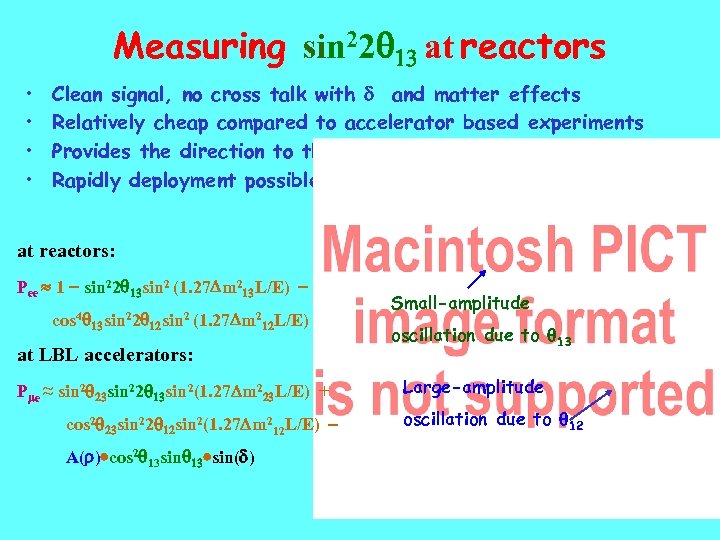
Measuring sin 22 13 at reactors • • Clean signal, no cross talk with d and matter effects Relatively cheap compared to accelerator based experiments Provides the direction to the future of neutrino physics Rapidly deployment possible at reactors: Pee 1 sin 22 13 sin 2 (1. 27 Dm 213 L/E) cos 4 13 sin 22 12 sin 2 (1. 27 Dm 2 12 L/E) at LBL accelerators: Pme ≈ sin 2 23 sin 22 13 sin 2(1. 27 Dm 223 L/E) + cos 2 23 sin 22 12 sin 2(1. 27 Dm 212 L/E) A(r) cos 2 13 sin 13 sin(d) Small-amplitude oscillation due to 13 Large-amplitude oscillation due to 12
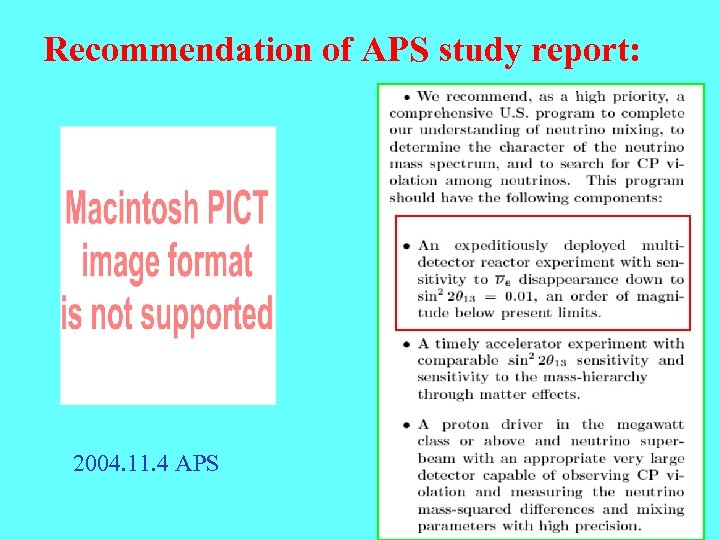
Recommendation of APS study report: 2004. 11. 4 APS
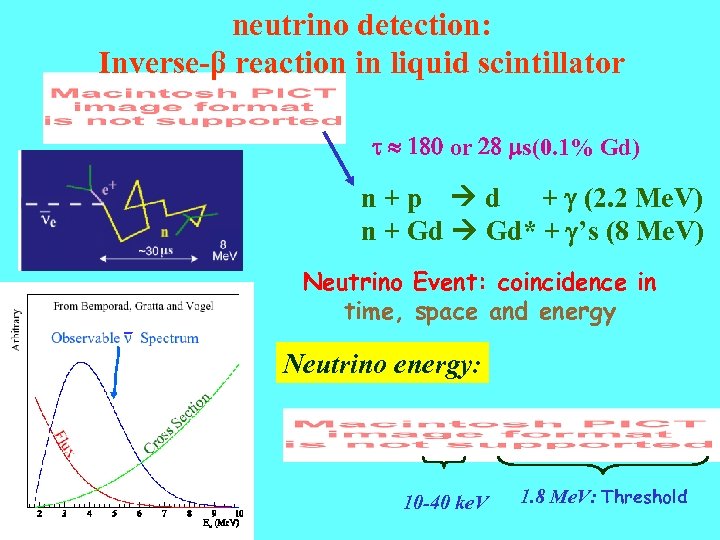
neutrino detection: Inverse-β reaction in liquid scintillator t 180 or 28 ms(0. 1% Gd) n+p d + g (2. 2 Me. V) n + Gd Gd* + g’s (8 Me. V) Neutrino Event: coincidence in time, space and energy Neutrino energy: 10 -40 ke. V 1. 8 Me. V: Threshold
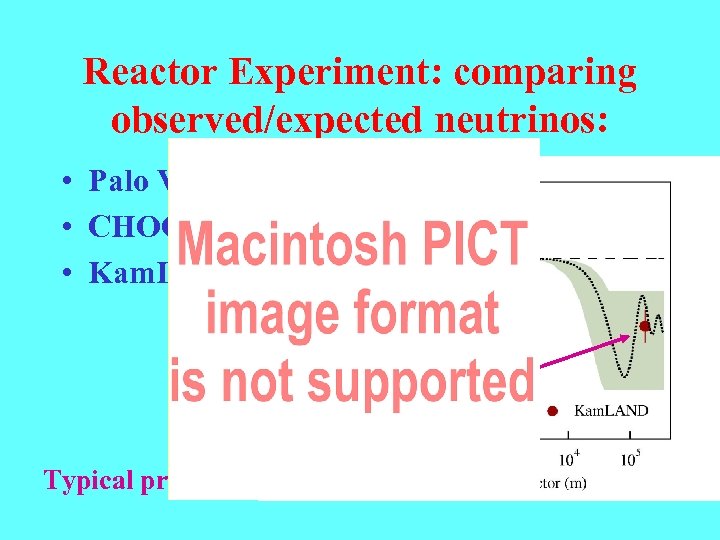
Reactor Experiment: comparing observed/expected neutrinos: • Palo Verde • CHOOZ • Kam. LAND Typical precision: 3 -6%
How to reach 1% precision ? • Increase statistics: – Use more powerful nuclear reactors – Utilize larger target mass, hence larger detectors • Reduce systematic uncertainties: – Reactor-related: • Optimize baseline for best sensitivity and smaller residual errors • Near and far detectors to minimize reactor-related errors – Detector-related: • Use “Identical” pairs of detectors to do relative measurement • Comprehensive program in calibration/monitoring of detectors • Interchange near and far detectors (optional) – Background-related • Go deeper to reduce cosmic-induced backgrounds • Enough active and passive shielding
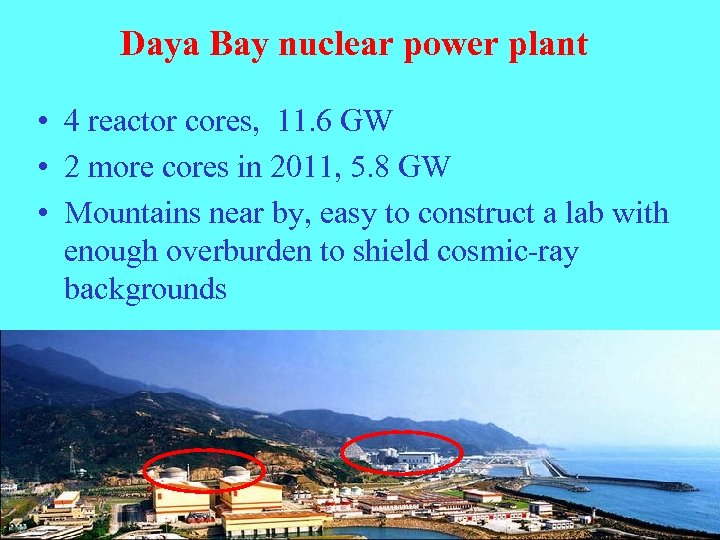
Daya Bay nuclear power plant • 4 reactor cores, 11. 6 GW • 2 more cores in 2011, 5. 8 GW • Mountains near by, easy to construct a lab with enough overburden to shield cosmic-ray backgrounds
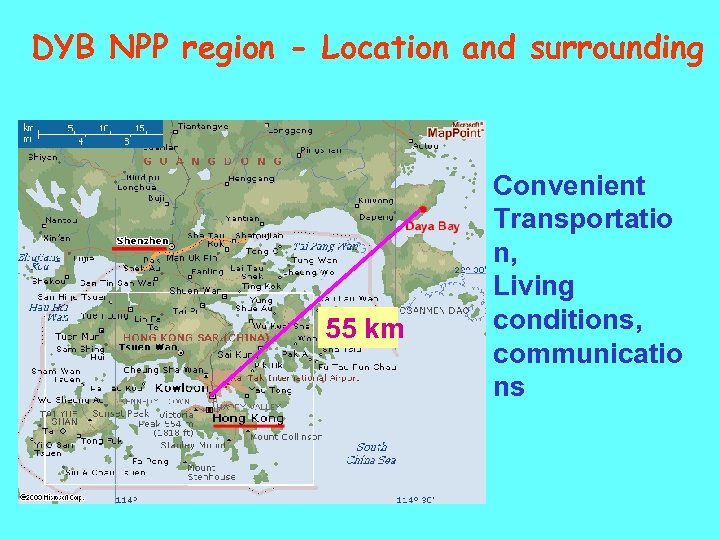
DYB NPP region - Location and surrounding 55 km Convenient Transportatio n, Living conditions, communicatio ns
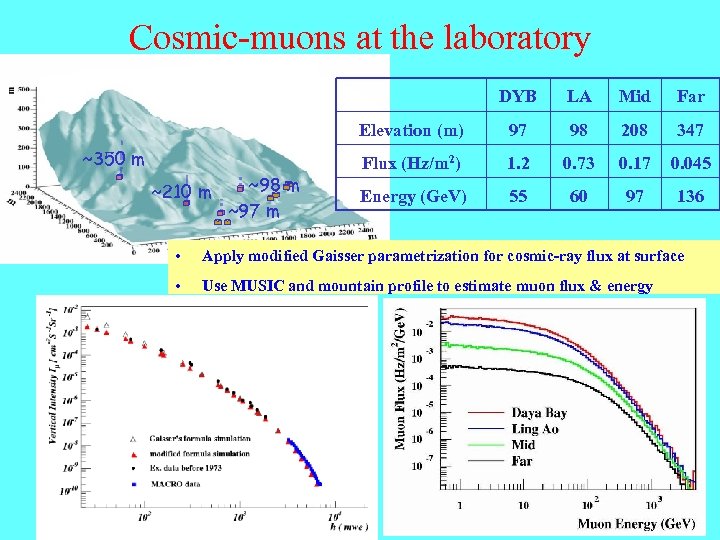
Cosmic-muons at the laboratory DYB ~210 m ~98 m ~97 m Mid Far Elevation (m) ~350 m LA 97 98 208 347 Flux (Hz/m 2) 1. 2 0. 73 0. 17 0. 045 Energy (Ge. V) 55 60 97 136 • Apply modified Gaisser parametrization for cosmic-ray flux at surface • Use MUSIC and mountain profile to estimate muon flux & energy
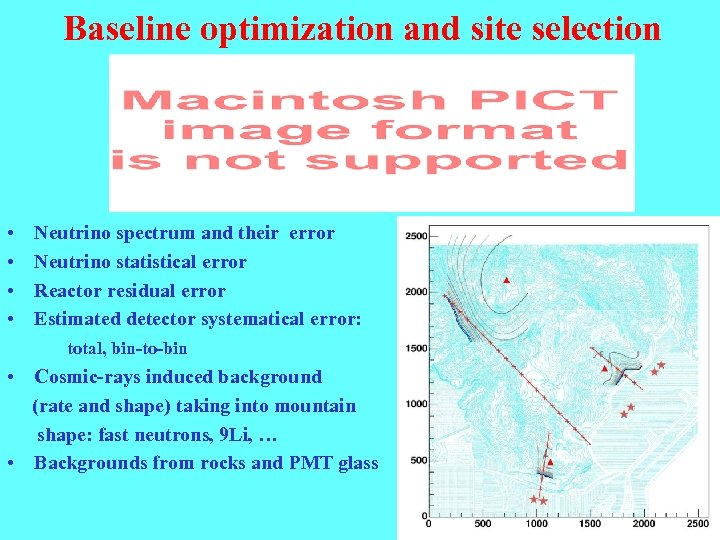
Baseline optimization and site selection • • Neutrino spectrum and their error Neutrino statistical error Reactor residual error Estimated detector systematical error: total, bin-to-bin • Cosmic-rays induced background (rate and shape) taking into mountain shape: fast neutrons, 9 Li, … • Backgrounds from rocks and PMT glass
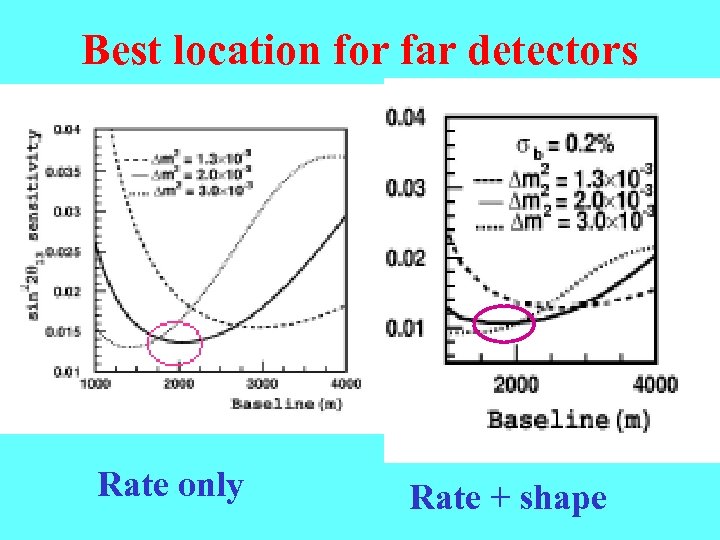
Best location for far detectors Rate only Rate + shape
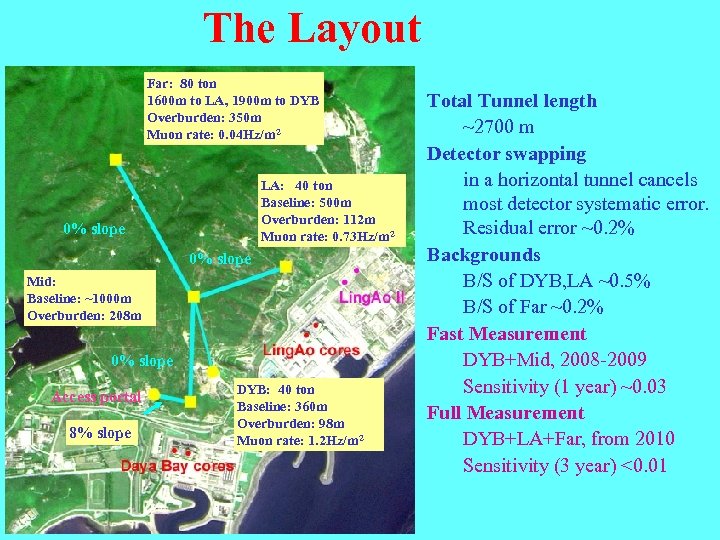
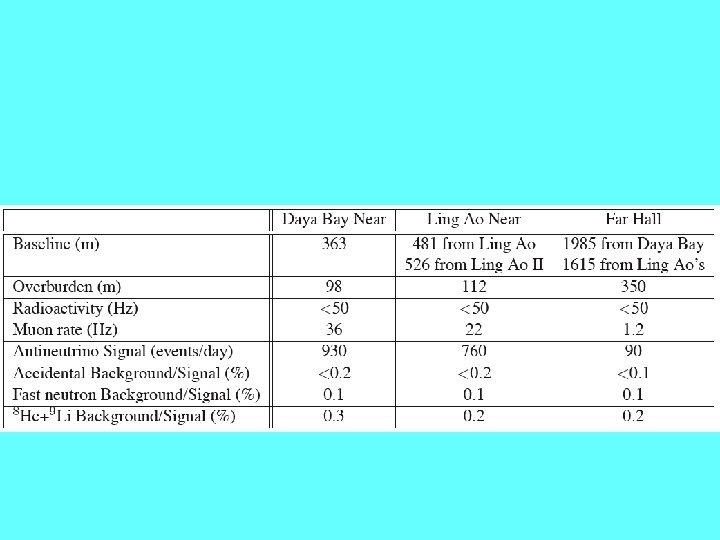
The Layout Far: 80 ton 1600 m to LA, 1900 m to DYB Overburden: 350 m Muon rate: 0. 04 Hz/m 2 LA: 40 ton Baseline: 500 m Overburden: 112 m Muon rate: 0. 73 Hz/m 2 0% slope Mid: Baseline: ~1000 m Overburden: 208 m 0% slope Access portal 8% slope DYB: 40 ton Baseline: 360 m Overburden: 98 m Muon rate: 1. 2 Hz/m 2 Total Tunnel length ~2700 m Detector swapping in a horizontal tunnel cancels most detector systematic error. Residual error ~0. 2% Backgrounds B/S of DYB, LA ~0. 5% B/S of Far ~0. 2% Fast Measurement DYB+Mid, 2008 -2009 Sensitivity (1 year) ~0. 03 Full Measurement DYB+LA+Far, from 2010 Sensitivity (3 year) <0. 01
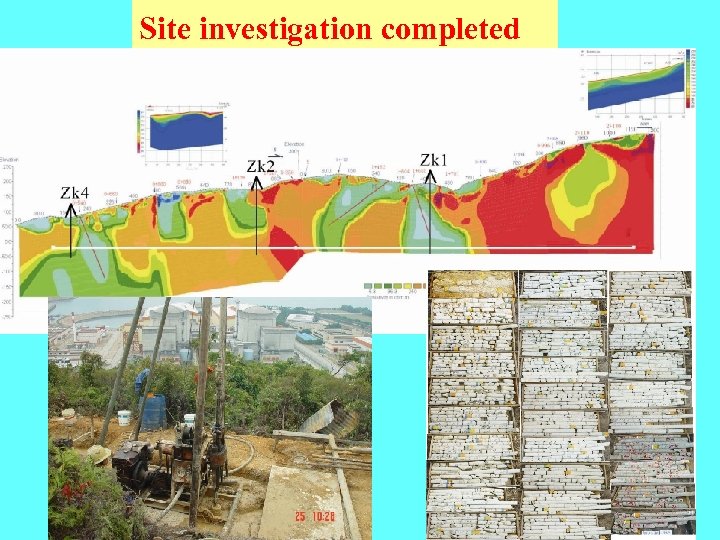
Site investigation completed
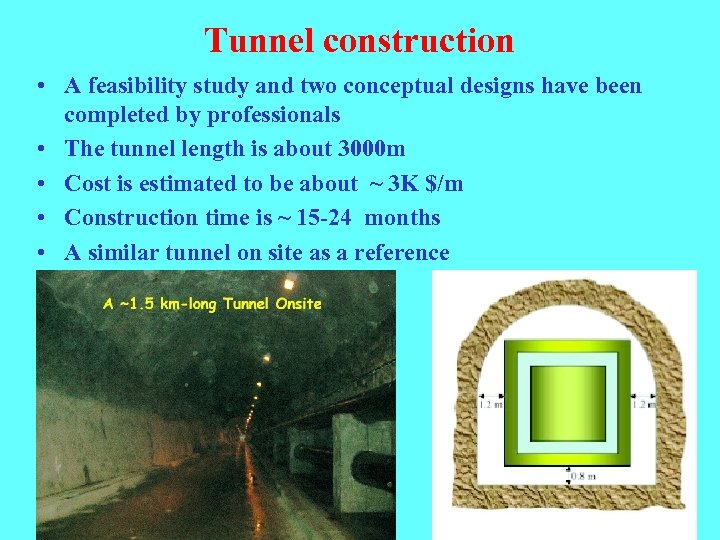
Tunnel construction • A feasibility study and two conceptual designs have been completed by professionals • The tunnel length is about 3000 m • Cost is estimated to be about ~ 3 K $/m • Construction time is ~ 15 -24 months • A similar tunnel on site as a reference
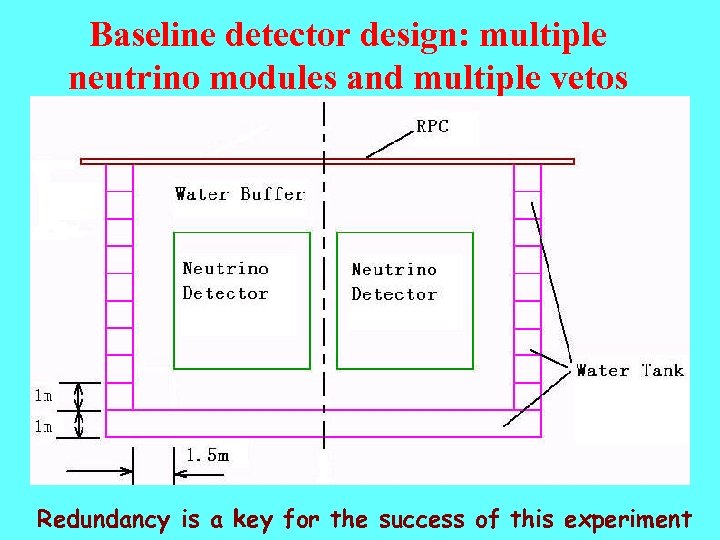
Baseline detector design: multiple neutrino modules and multiple vetos Redundancy is a key for the success of this experiment
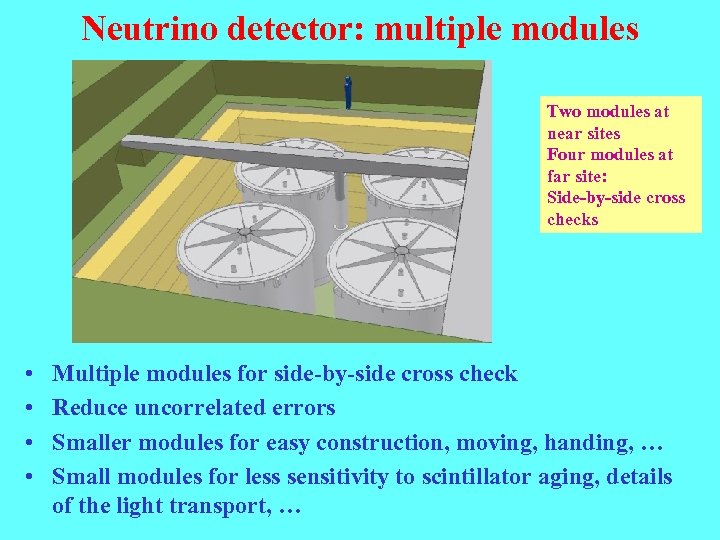
Neutrino detector: multiple modules Two modules at near sites Four modules at far site: Side-by-side cross checks • • Multiple modules for side-by-side cross check Reduce uncorrelated errors Smaller modules for easy construction, moving, handing, … Small modules for less sensitivity to scintillator aging, details of the light transport, …
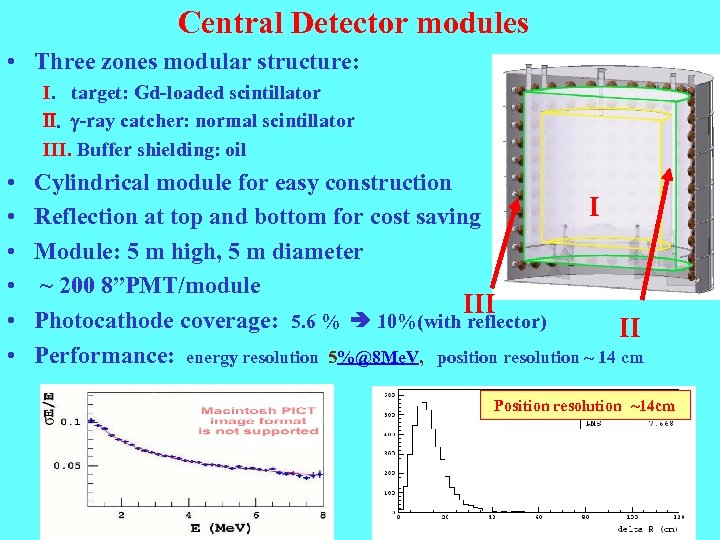
Central Detector modules • Three zones modular structure: I. target: Gd-loaded scintillator II. g-ray catcher: normal scintillator III. Buffer shielding: oil • • • Cylindrical module for easy construction I Reflection at top and bottom for cost saving Module: 5 m high, 5 m diameter ~ 200 8”PMT/module III Photocathode coverage: 5. 6 % 10%(with reflector) II Performance: energy resolution 5%@8 Me. V, position resolution ~ 14 cm Position resolution ~14 cm
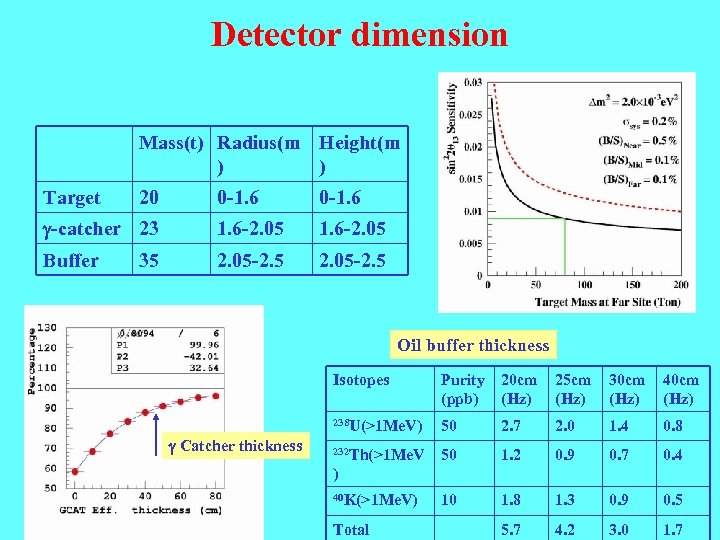
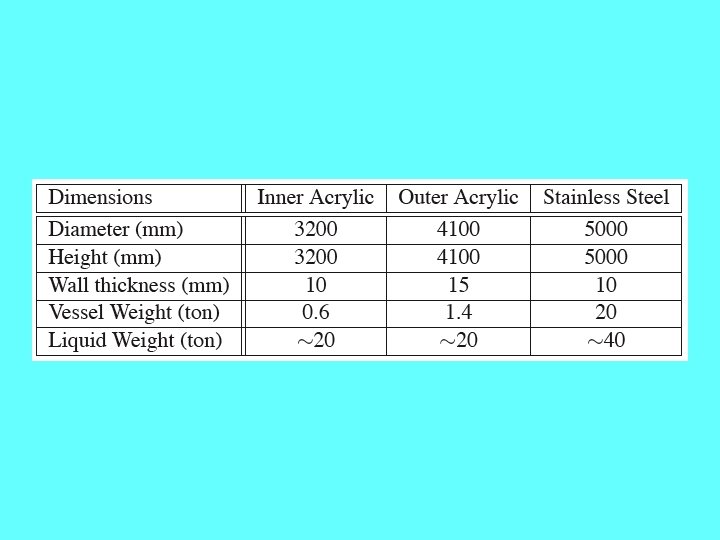
Detector dimension Mass(t) Radius(m Height(m ) ) Target 20 0 -1. 6 g-catcher 23 1. 6 -2. 05 Buffer 2. 05 -2. 5 35 Oil buffer thickness Isotopes 20 cm (Hz) 25 cm (Hz) 30 cm (Hz) 40 cm (Hz) 238 U(>1 Me. V) g Catcher thickness Purity (ppb) 50 2. 7 2. 0 1. 4 0. 8 232 Th(>1 Me. V 50 1. 2 0. 9 0. 7 0. 4 10 1. 8 1. 3 0. 9 0. 5 5. 7 4. 2 3. 0 1. 7 ) 40 K(>1 Me. V) Total
Calibration and Monitoring • Source calibration: energy scale, resolutions, … – Deployment system • Automatic: quick but limited space points • Manual: slow but everywhere – Choices of sources: energy(0. 5 -8 Me. V), activity(<1 KHz), g/n, … – Cleanness • Calibration with physics events: – Neutron capture – Cosmic-rays • • LED calibration: PMT gain, liquid transparency, … Environmental monitoring: temp. , voltage, radon, … Mass calibration and high precision flow meters Material certification
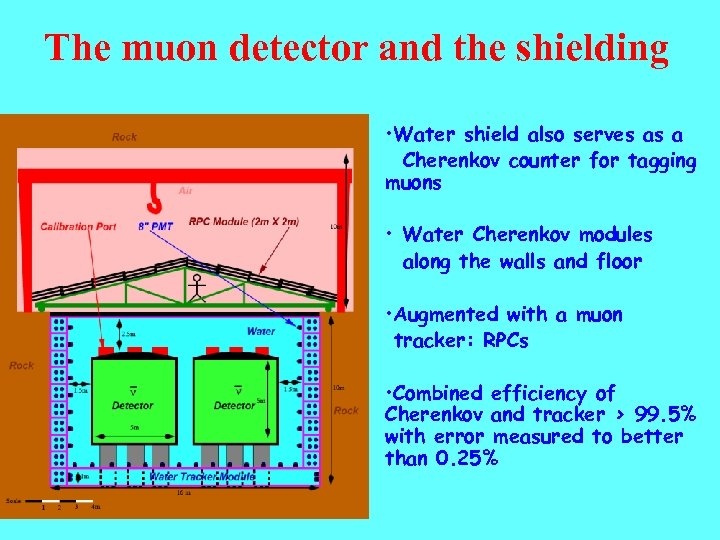
The muon detector and the shielding • Water shield also serves as a Cherenkov counter for tagging muons • Water Cherenkov modules along the walls and floor • Augmented with a muon tracker: RPCs • Combined efficiency of Cherenkov and tracker > 99. 5% with error measured to better than 0. 25%
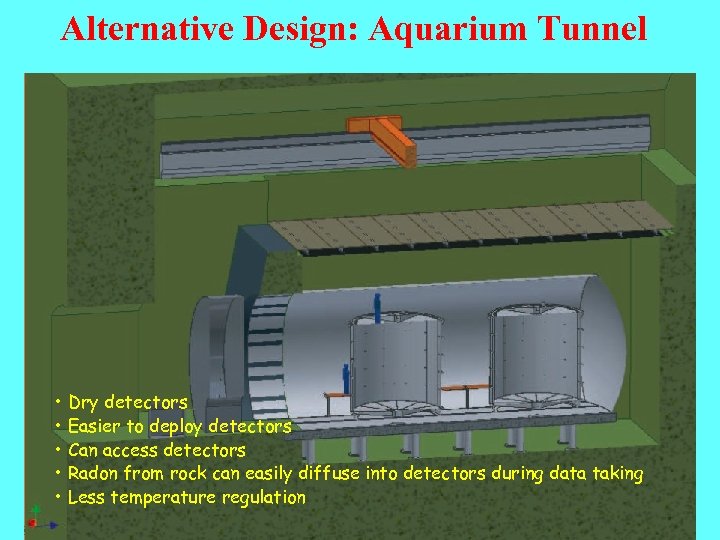
Alternative Design: Aquarium Tunnel • Dry detectors • Easier to deploy detectors • Can access detectors • Radon from rock can easily diffuse into detectors during data taking • Less temperature regulation
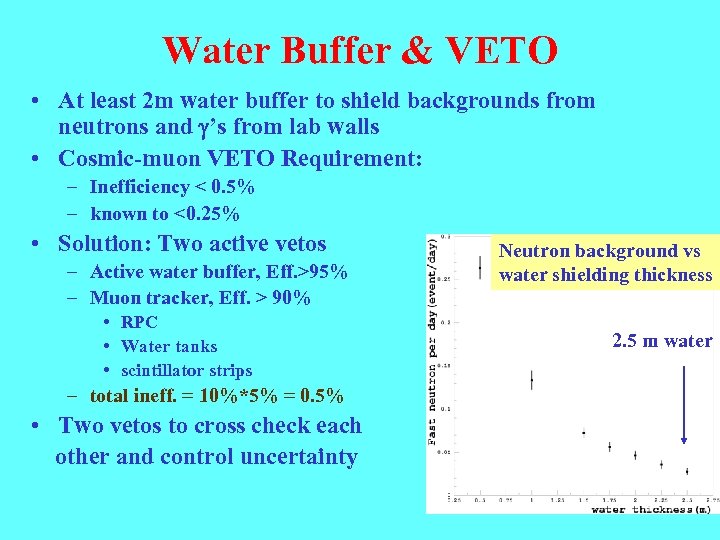
Water Buffer & VETO • At least 2 m water buffer to shield backgrounds from neutrons and g’s from lab walls • Cosmic-muon VETO Requirement: – Inefficiency < 0. 5% – known to <0. 25% • Solution: Two active vetos – Active water buffer, Eff. >95% – Muon tracker, Eff. > 90% • RPC • Water tanks • scintillator strips – total ineff. = 10%*5% = 0. 5% • Two vetos to cross check each other and control uncertainty Neutron background vs water shielding thickness 2. 5 m water
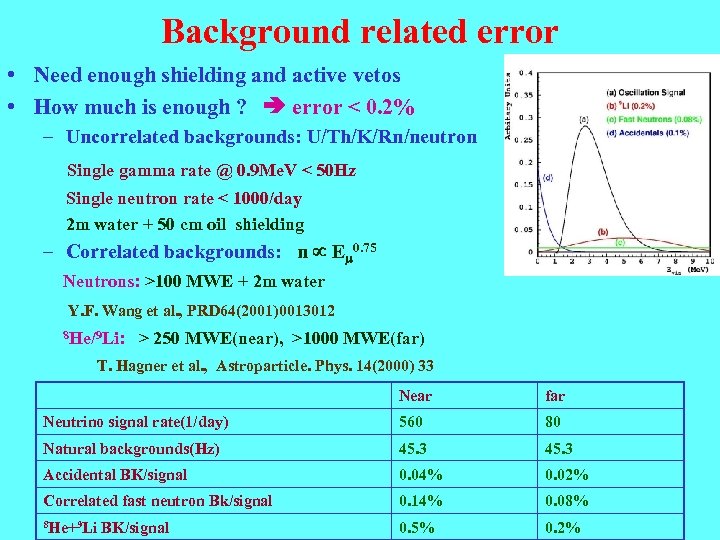
Background related error • Need enough shielding and active vetos • How much is enough ? error < 0. 2% – Uncorrelated backgrounds: U/Th/K/Rn/neutron Single gamma rate @ 0. 9 Me. V < 50 Hz Single neutron rate < 1000/day 2 m water + 50 cm oil shielding – Correlated backgrounds: n Em 0. 75 Neutrons: >100 MWE + 2 m water Y. F. Wang et al. , PRD 64(2001)0013012 8 He/9 Li: > 250 MWE(near), >1000 MWE(far) T. Hagner et al. , Astroparticle. Phys. 14(2000) 33 Near far Neutrino signal rate(1/day) 560 80 Natural backgrounds(Hz) 45. 3 Accidental BK/signal 0. 04% 0. 02% Correlated fast neutron Bk/signal 0. 14% 0. 08% 8 He+9 Li 0. 5% 0. 2% BK/signal
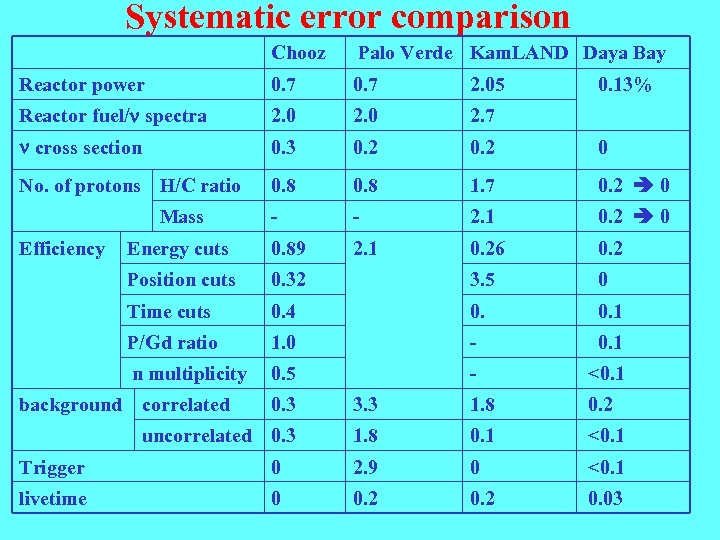
Systematic error comparison Chooz Palo Verde Kam. LAND Daya Bay Reactor power 0. 7 2. 05 Reactor fuel/n spectra 2. 0 2. 7 n cross section 0. 3 0. 2 0 No. of protons H/C ratio 0. 8 1. 7 0. 2 0 - - 2. 1 0. 2 0 Energy cuts 0. 89 2. 1 0. 26 0. 2 Position cuts 0. 32 3. 5 0 Time cuts 0. 4 0. 1 P/Gd ratio 1. 0 - 0. 1 n multiplicity 0. 5 - <0. 1 Mass Efficiency background correlated 0. 13% 0. 3 3. 3 1. 8 0. 2 uncorrelated 0. 3 1. 8 0. 1 <0. 1 Trigger 0 2. 9 0 <0. 1 livetime 0 0. 2 0. 03
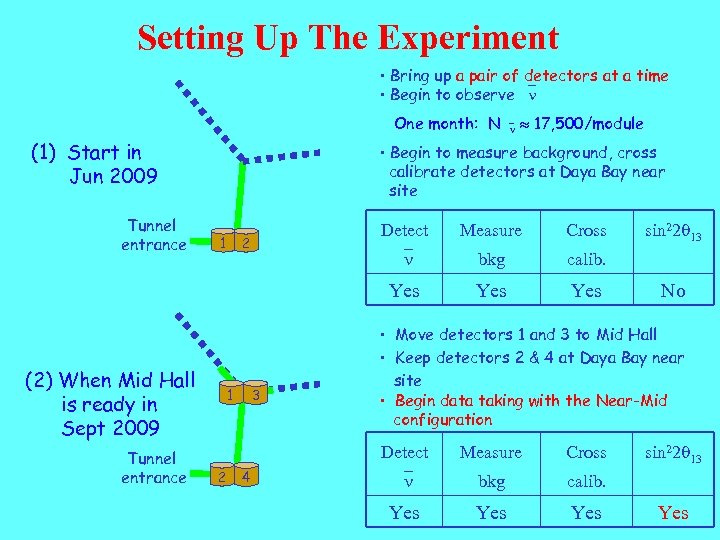
Setting Up The Experiment • Bring up a pair of detectors at a time • Begin to observe One month: N 17, 500/module (1) Start in Jun 2009 Tunnel entrance • Begin to measure background, cross calibrate detectors at Daya Bay near site Tunnel entrance 3 Cross bkg calib. Yes 1 Measure 2 1 (2) When Mid Hall is ready in Sept 2009 Detect Yes 4 No • Move detectors 1 and 3 to Mid Hall • Keep detectors 2 & 4 at Daya Bay near site • Begin data taking with the Near-Mid configuration Detect 2 sin 22 13 Measure Cross bkg calib. Yes Yes sin 22 13 Yes
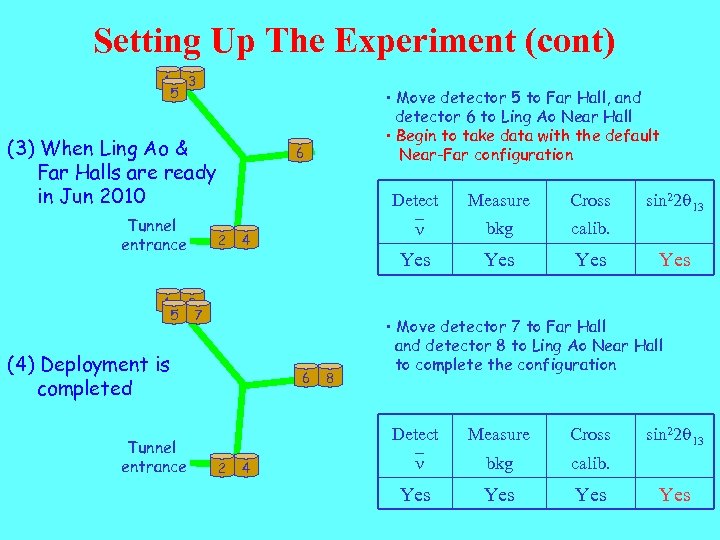
Setting Up The Experiment (cont) 1 3 5 (3) When Ling Ao & Far Halls are ready in Jun 2010 Tunnel entrance • Move detector 5 to Far Hall, and detector 6 to Ling Ao Near Hall • Begin to take data with the default Near-Far configuration 6 Detect 2 (4) Deployment is completed Tunnel entrance 6 8 bkg calib. Yes 1 3 5 7 Cross 4 Measure Yes 4 Yes • Move detector 7 to Far Hall and detector 8 to Ling Ao Near Hall to complete the configuration Detect 2 sin 22 13 Measure Cross bkg calib. Yes Yes sin 22 13 Yes
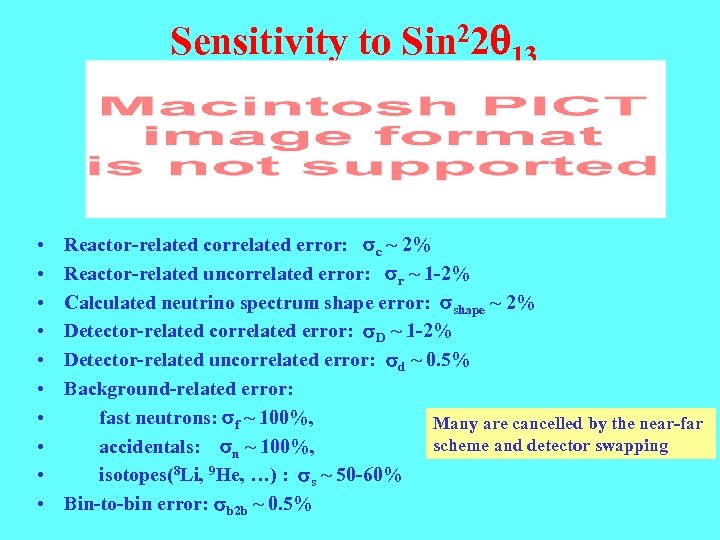
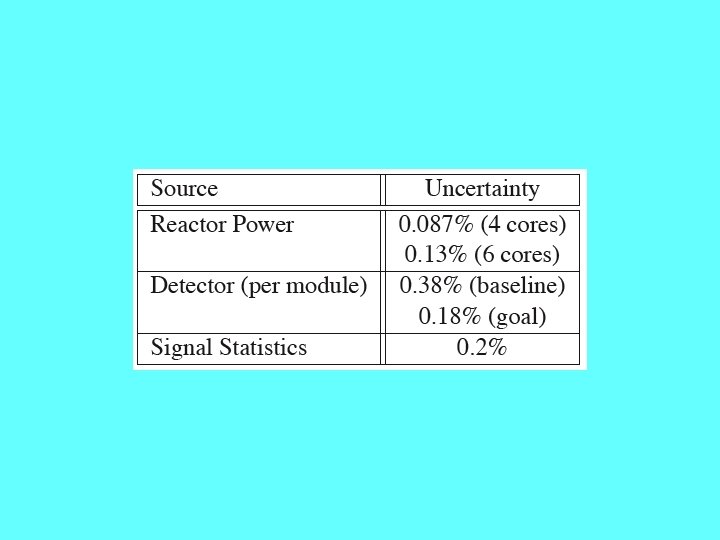
Sensitivity to Sin 22 13 • • • Reactor-related correlated error: sc ~ 2% Reactor-related uncorrelated error: sr ~ 1 -2% Calculated neutrino spectrum shape error: sshape ~ 2% Detector-related correlated error: s. D ~ 1 -2% Detector-related uncorrelated error: sd ~ 0. 5% Background-related error: fast neutrons: sf ~ 100%, Many are cancelled by the near-far scheme and detector swapping accidentals: sn ~ 100%, isotopes(8 Li, 9 He, …) : ss ~ 50 -60% Bin-to-bin error: sb 2 b ~ 0. 5%
Sensitivity to Sin 22 13 Other physics capabilities: Supernova watch, Sterile neutrinos, …
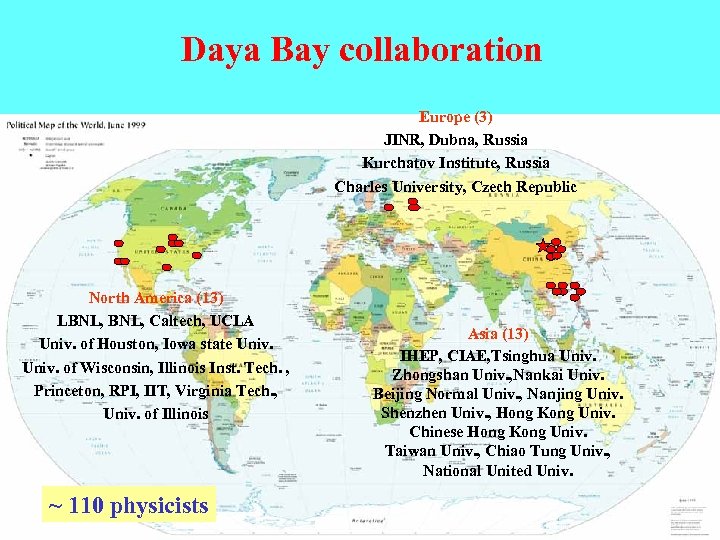
Daya Bay collaboration Europe (3) JINR, Dubna, Russia Kurchatov Institute, Russia Charles University, Czech Republic North America (13) LBNL, Caltech, UCLA Univ. of Houston, Iowa state Univ. of Wisconsin, Illinois Inst. Tech. , Princeton, RPI, IIT, Virginia Tech. , Univ. of Illinois ~ 110 physicists Asia (13) IHEP, CIAE, Tsinghua Univ. Zhongshan Univ. , Nankai Univ. Beijing Normal Univ. , Nanjing Univ. Shenzhen Univ. , Hong Kong Univ. Chinese Hong Kong Univ. Taiwan Univ. , Chiao Tung Univ. , National United Univ.
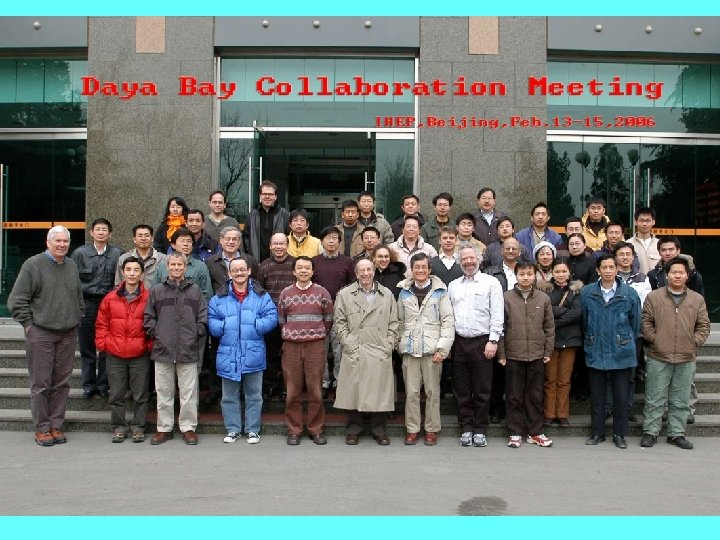
Organization of Daya Bay Collaboration • Governed by Bylaws. • Institutional board: with one representative from each member institution and two spokespersons. • Executive board (two-year term): Y. F. Wang (China) C. G. Yang (China) M. C. Chu (Hong Kong) Y. Hsiung (Taiwan) A. Olshevski (Russia) K. B. Luk (U. S. ) R. Mc. Keown (U. S. ) • Scientific spokespersons (two-year term): Y. F. Wang (China), K. B. Luk
Project management • Project managers: Y. F. Wang, W. Edwards • Chief engineers: H. L. Zhuang, R. Brown • Sub-system managers: – Anti-neutrino detector: J. W. Zhang, K. Heeger – Muon detector: L. Littenberg, C. G. Yang – Calibration: R. Mc. Keown – Trigger/DAQ/electronics: X. N. Li, C. White – Offline/computing: J. Cao, C. Tull – Civil construction: H. Y. Zhang
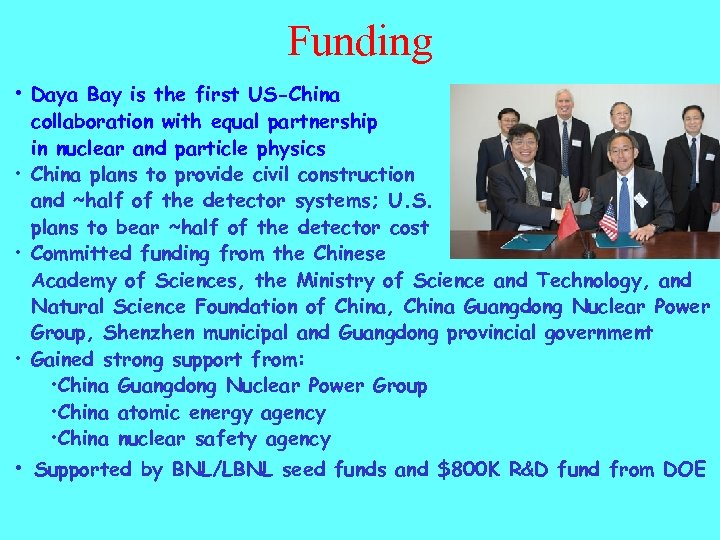
Funding • Daya Bay is the first US-China collaboration with equal partnership in nuclear and particle physics • China plans to provide civil construction and ~half of the detector systems; U. S. plans to bear ~half of the detector cost • Committed funding from the Chinese Academy of Sciences, the Ministry of Science and Technology, and Natural Science Foundation of China, China Guangdong Nuclear Power Group, Shenzhen municipal and Guangdong provincial government • Gained strong support from: • China Guangdong Nuclear Power Group • China atomic energy agency • China nuclear safety agency • Supported by BNL/LBNL seed funds and $800 K R&D fund from DOE
Schedule • begin civil construction April 2007 • Bring up the first pair of detectors Jun 2009 • Begin data taking with the Near-Mid configuration Sept 2009 • Begin data taking with the Near-Far configuration Jun 2010
Summary • The Daya Bay experiment will reach a sensitivity of ≤ 0. 01 for sin 22 13 • The Daya Bay Collaboration continues to grow – Bylaws approved; – Working groups established; – Management structure introduced • Design of detectors is in progress and R&D is ongoing • Engineering design of tunnels and infrastructures will begin soon • Continue to receive strong support from Chinese agencies • Plan to start deploying detectors in 2009, and begin full operation in 2010

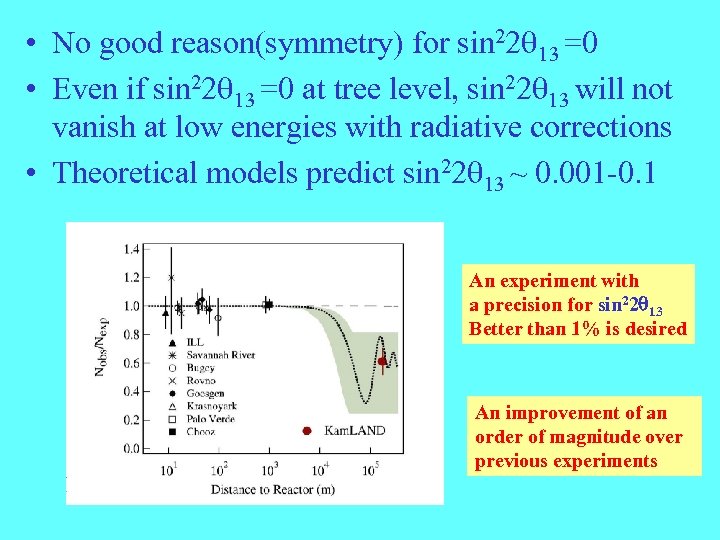
• No good reason(symmetry) for sin 22 13 =0 • Even if sin 22 13 =0 at tree level, sin 22 13 will not vanish at low energies with radiative corrections • Theoretical models predict sin 22 13 ~ 0. 001 -0. 1 An experiment with a precision for sin 22 13 Better than 1% is desired An improvement of an order of magnitude over previous experiments
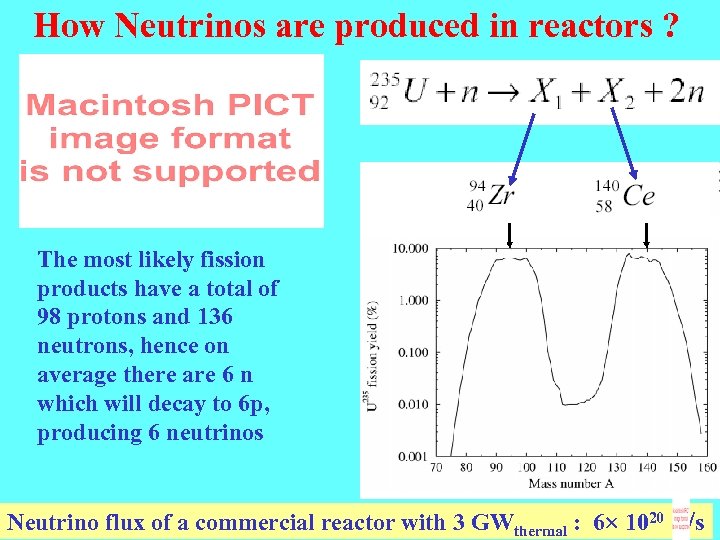
How Neutrinos are produced in reactors ? The most likely fission products have a total of 98 protons and 136 neutrons, hence on average there are 6 n which will decay to 6 p, producing 6 neutrinos Neutrino flux of a commercial reactor with 3 GWthermal : 6 1020 /s
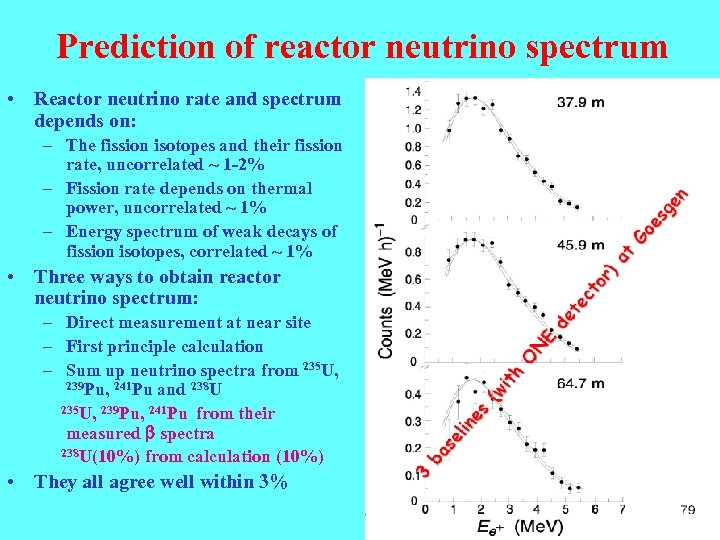
Prediction of reactor neutrino spectrum • Reactor neutrino rate and spectrum depends on: – The fission isotopes and their fission rate, uncorrelated ~ 1 -2% – Fission rate depends on thermal power, uncorrelated ~ 1% – Energy spectrum of weak decays of fission isotopes, correlated ~ 1% • Three ways to obtain reactor neutrino spectrum: – Direct measurement at near site – First principle calculation – Sum up neutrino spectra from 235 U, 239 Pu, 241 Pu and 238 U 235 U, 239 Pu, 241 Pu from their measured b spectra 238 U(10%) from calculation (10%) • They all agree well within 3%
 Скачать презентацию Overview of the Daya Bay experiment Yifang Wang
4132f181ddc9172dd243a932807c623f.ppt