


 Скачать презентацию Overview of the Capacity Markets in the United
79c74381c5017578baec4b607d057062.ppt
- Количество слайдов: 27
 Overview of the Capacity Markets in the United States 2008 APEX Conference in Sydney, Australia October 13 -14, 2008 Hung-po Chao Director, Market Strategy and Analysis
 The Need for Capacity Markets • To provide long-term financial commitment to obtain adequate resources to meet customers’ needs – To attract new investments in generation capacity and demand resources – To defer old capacity retirement • Electricity markets continue to evolve – Demand side does not yet fully participate – Price cap is still needed Presentation Title © 2007 ISO New England Inc. 2
 Capacity Markets in the U. S. • ISO New England – Forward Capacity Market (FCM) • PJM ISO/RTO – Reliability Pricing Model (RPM) • New York ISO – Installed Capacity Market (ICAP) © 2008 ISO New England Inc. 3
 The Forward Capacity Market (FCM) at ISO New England
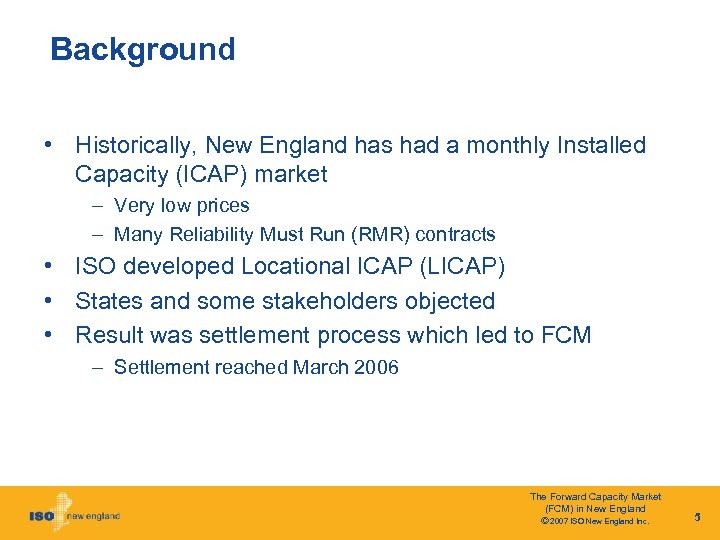 Background • Historically, New England has had a monthly Installed Capacity (ICAP) market – Very low prices – Many Reliability Must Run (RMR) contracts • ISO developed Locational ICAP (LICAP) • States and some stakeholders objected • Result was settlement process which led to FCM – Settlement reached March 2006 The Forward Capacity Market (FCM) in New England © 2007 ISO New England Inc. 5
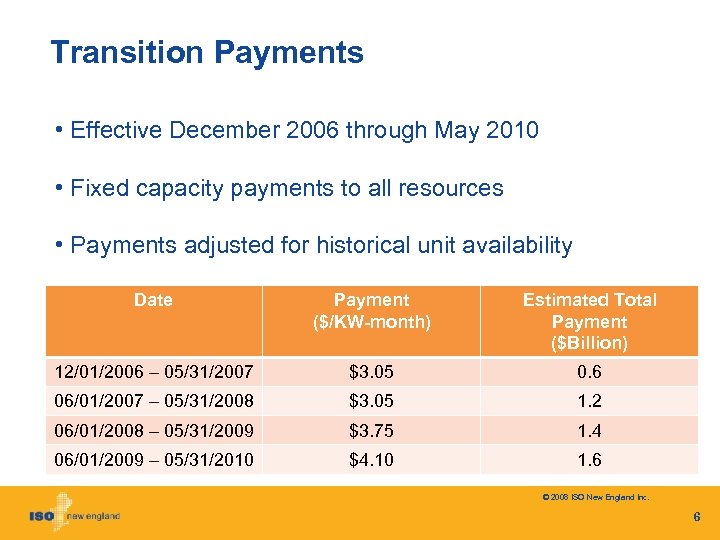 Transition Payments • Effective December 2006 through May 2010 • Fixed capacity payments to all resources • Payments adjusted for historical unit availability Date Payment ($/KW-month) Estimated Total Payment ($Billion) 12/01/2006 – 05/31/2007 $3. 05 0. 6 06/01/2007 – 05/31/2008 $3. 05 1. 2 06/01/2008 – 05/31/2009 $3. 75 1. 4 06/01/2009 – 05/31/2010 $4. 10 1. 6 © 2008 ISO New England Inc. 6
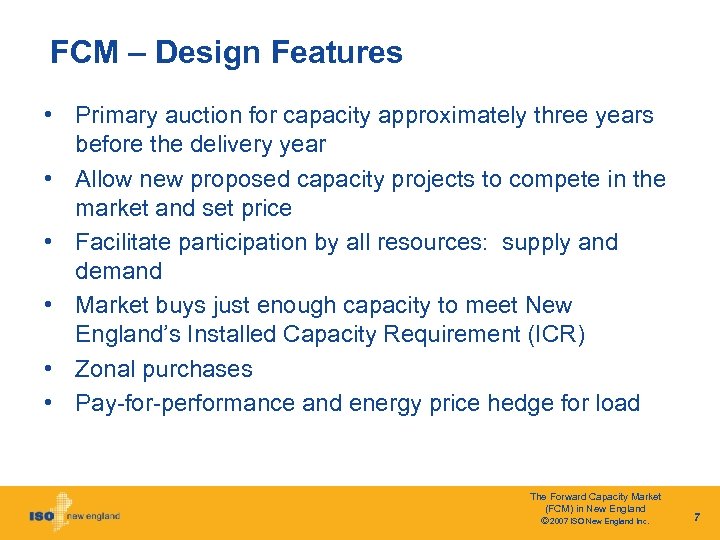 FCM – Design Features • Primary auction for capacity approximately three years before the delivery year • Allow new proposed capacity projects to compete in the market and set price • Facilitate participation by all resources: supply and demand • Market buys just enough capacity to meet New England’s Installed Capacity Requirement (ICR) • Zonal purchases • Pay-for-performance and energy price hedge for load The Forward Capacity Market (FCM) in New England © 2007 ISO New England Inc. 7
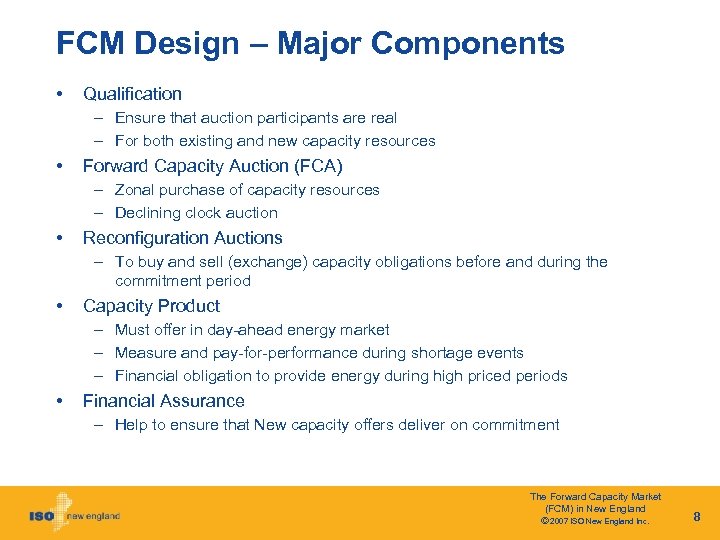 FCM Design – Major Components • Qualification – Ensure that auction participants are real – For both existing and new capacity resources • Forward Capacity Auction (FCA) – Zonal purchase of capacity resources – Declining clock auction • Reconfiguration Auctions – To buy and sell (exchange) capacity obligations before and during the commitment period • Capacity Product – Must offer in day-ahead energy market – Measure and pay-for-performance during shortage events – Financial obligation to provide energy during high priced periods • Financial Assurance – Help to ensure that New capacity offers deliver on commitment The Forward Capacity Market (FCM) in New England © 2007 ISO New England Inc. 8
 Forward Capacity Market Results • Capacity market transition payments of $3. 05/k. W-month were made to all ICAP resources in accordance with the FCM Settlement Agreement • The ISO evaluated over 13, 000 MW of new capacity projects submitted in the qualification stage for the first Forward Capacity Auction • The first FCA was successfully completed in February 2008 with competitive offers from 6, 102 MW. A total of approximately 1, 813 MW of new resources was selected © 2008 ISO New England Inc. 9
 Forward Capacity Auction Results • The first FCA held February 4 -6, 2008 – Procurement met regional ICR for 2010 -2011 Commitment Period – FCA was successful and went smoothly • No technical problems or observed anti-competitive behavior • Prices – FCA starting price was $15. 00/k. W-mo – FCA ending price was $4. 50/k. W-mo • Floor price negotiated as part of Settlement Agreement • Over 1, 800 MW of new Supply and Demand Resources cleared the auction, © 2008 ISO New England Inc. 10
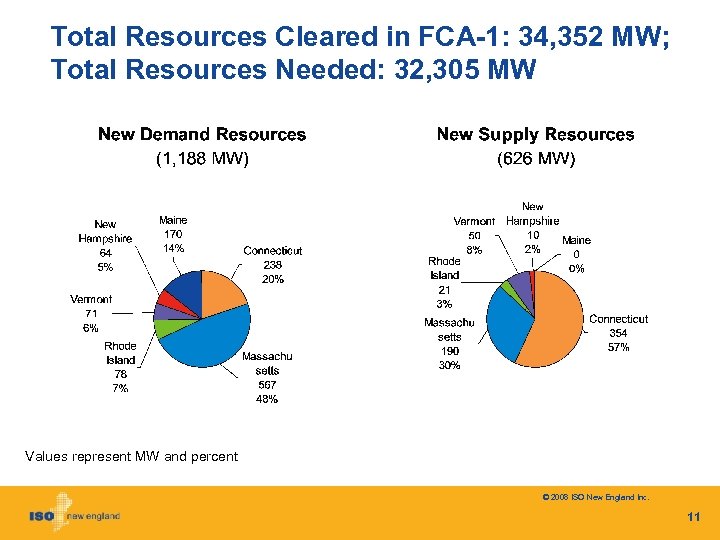 Total Resources Cleared in FCA-1: 34, 352 MW; Total Resources Needed: 32, 305 MW Values represent MW and percent © 2008 ISO New England Inc. 11
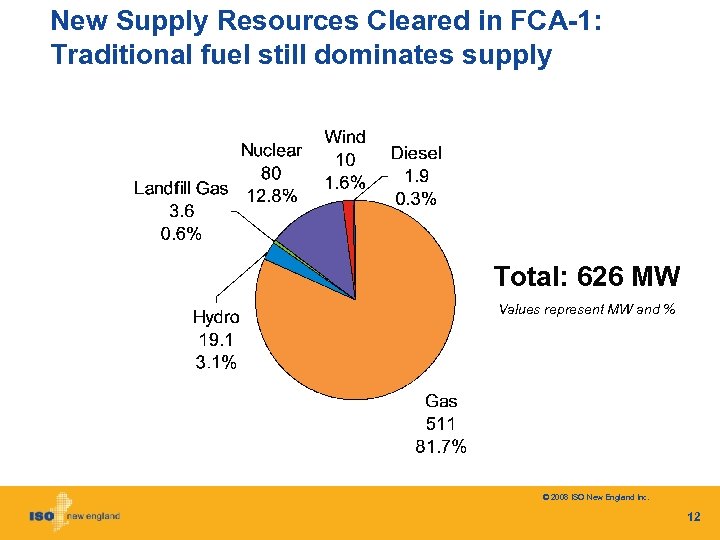 New Supply Resources Cleared in FCA-1: Traditional fuel still dominates supply Total: 626 MW Values represent MW and % © 2008 ISO New England Inc. 12
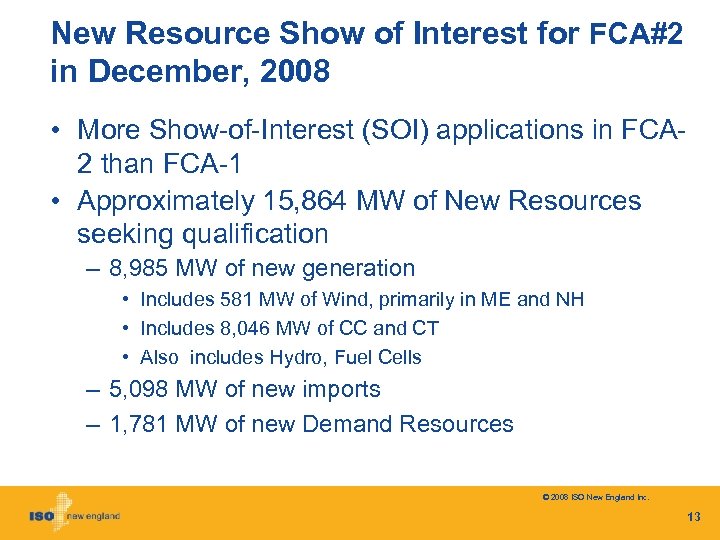 New Resource Show of Interest for FCA#2 in December, 2008 • More Show-of-Interest (SOI) applications in FCA 2 than FCA-1 • Approximately 15, 864 MW of New Resources seeking qualification – 8, 985 MW of new generation • Includes 581 MW of Wind, primarily in ME and NH • Includes 8, 046 MW of CC and CT • Also includes Hydro, Fuel Cells – 5, 098 MW of new imports – 1, 781 MW of new Demand Resources © 2008 ISO New England Inc. 13
 The Reliability Pricing Model (RPM) at PJM ISO/RTO
 Background • The RPM replaced the previous PJM capacity market construct to ensure PJM’s long term resource adequacy – It was implemented on June 1, 2007 • The RPM design was developed through a multi-year stakeholder discussion and a FERC settlement process • The primary driver was to address projected reliability concerns and infrastructure investment issues – PJM was facing the prospect of persistent and worsening imbalances between supply and demand • Four auctions have been conducted so far © 2008 ISO New England Inc. 15
 RPM- Design Features • Three Year Forward Auctions – Residual auction after specification of self-supply and bilaterals. – Provides price signal and forward commitment process that allows new entry to participate or existing units to retire with forward notification. • Locational Constraints – Recognize limited ability to import capacity in certain areas due to transmission, voltage, or stability limitations (as identified in PJM’s RTEP analysis). – Higher capacity prices in constrained areas – Lower capacity prices in areas with significant excess capacity © 2008 ISO New England Inc. 16
 RPM- Design Features (Cont’d) • Variable Resource Requirement (VRR) – Recognizes the Cost of New Entry. – Recognizes the value of additional capacity above the reserve margin thereby reducing volatility in capacity prices. – Sloped demand curve reduces market power concerns. • Ability of Transmission and Demand Resources to participate – Allows direct competition between various options including new generation resources and demand response to address reliability requirements. – Provides opportunity for incremental transmission upgrades to provide solutions to capacity import limitations • © 2008 ISO New England Inc. 17
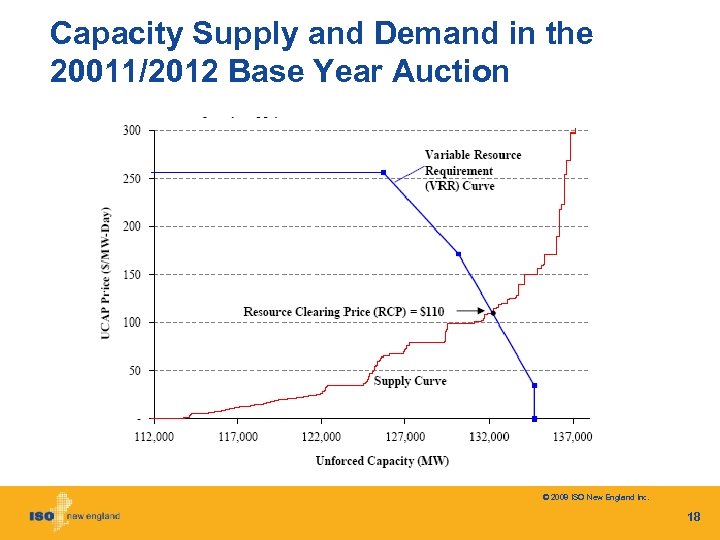 Capacity Supply and Demand in the 20011/2012 Base Year Auction © 2008 ISO New England Inc. 18
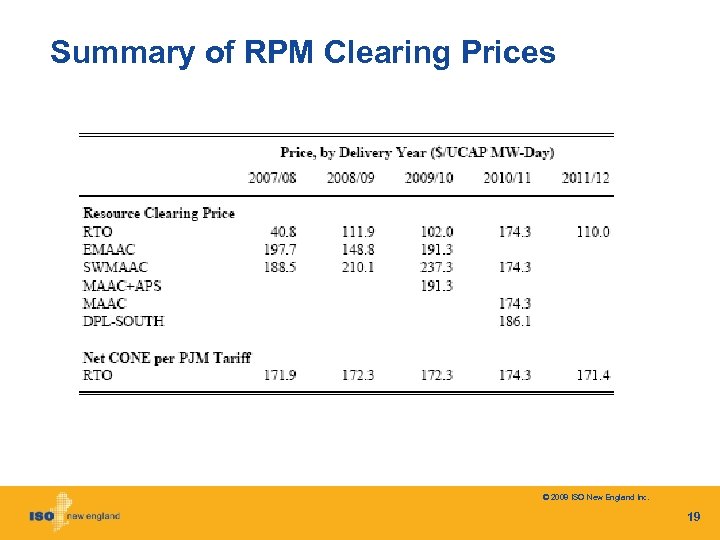 Summary of RPM Clearing Prices © 2008 ISO New England Inc. 19
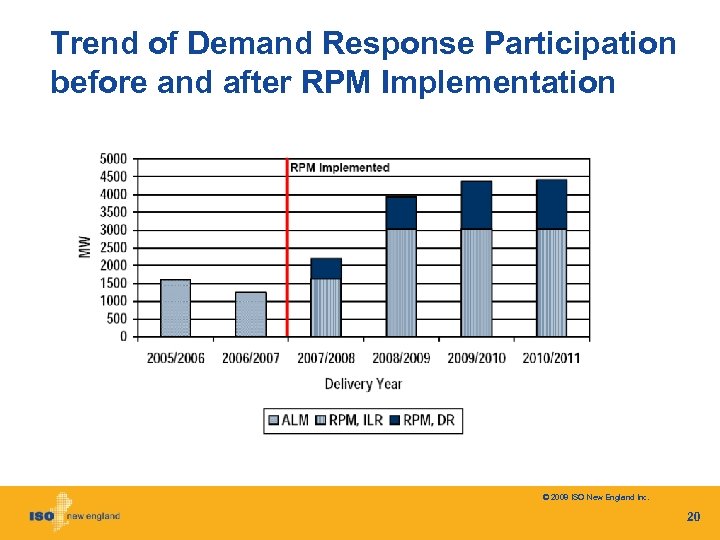 Trend of Demand Response Participation before and after RPM Implementation © 2008 ISO New England Inc. 20
 The Installed Capacity Market (ICAP) at New York ISO
 Background • The design of the Northeastern installed capacity markets was born of the pre-existing planning and operating practices of the power pools in the Northeast. • The New York market structure addresses the need for: – system reliability (insured through installed capacity requirements); – overall market design coordinating energy, capacity and ancillary services – reining in potential market power – encouraging robust competition – mitigating potential barriers to trade – certainty, market stability – recognizing the political realities of energy price caps and regulatory oversight © 2008 ISO New England Inc. 22
 NYISO ICAP- Design Features • ICAP Requirements: – Are based on a Reserve margin set in advance for the upcoming Capability Year by the New York State Reliability Council (NYSRC) • All ICAP Requirements are translated into UCAP (Unforced Capacity) Requirements – Unforced Capacity is a measure of the expected supply based on the historical performance of each resource when in demand (dispatched) © 2008 ISO New England Inc. 23
 NYISO ICAP- Design Features • Load Serving Entities (LSEs) meet their NYISO-allocated UCAP requirements by: – Self-Supply or Bilateral Transactions with Suppliers – Purchasing in the Capability Period Auctions (6 -month strip) – Purchasing in the Monthly Auctions (for balance of Capability Period) – Paying for the balance of their obligation procured on their behalf in the Spot Market Auction (1 -month) using a Demand Curve • All supply is certified and checked out monthly. © 2008 ISO New England Inc. 24
 NYISO ICAP- Locational Features • Due to transmission constraints into certain localities, areas or zones, some LSE’s must procure a substantial portion of their ICAP/UCAP requirements from local resources • There are two such transmission constrained zones in New York: – New York City – Long Island © 2008 ISO New England Inc. 25
 NYISO ICAP “Demand Curve” • Initially a monthly auction was designed as a deficiency auction where LSEs that were short were required to buy the balance needed at the clearing price in the NYISO deficiency auction • The market price could be anywhere between a preset maximum deficiency price and zero, essentially following a vertical demand curve • This design resulted in volatile market outcomes and eroded the quality of any price signals • The deficiency auction is replaced by a spot auction (one month) that relied on a sloped demand curve, which would lead to more certain and rational price signals © 2008 ISO New England Inc. 26
 Questions?