


 Скачать презентацию Overview of SPF and extension of Social Security
637d8096c24c2ecf0c1340f0bda34230.ppt
- Количество слайдов: 16
 “Overview of SPF and extension of Social Security in the region” Launching of the Bachelet Report in Indonesia 12 December 2011
 Structure of the presentation • • Why do we need the SPF? What is the SPF? Relevance in Asia Questions and recommendations when designing and implementing the SPF
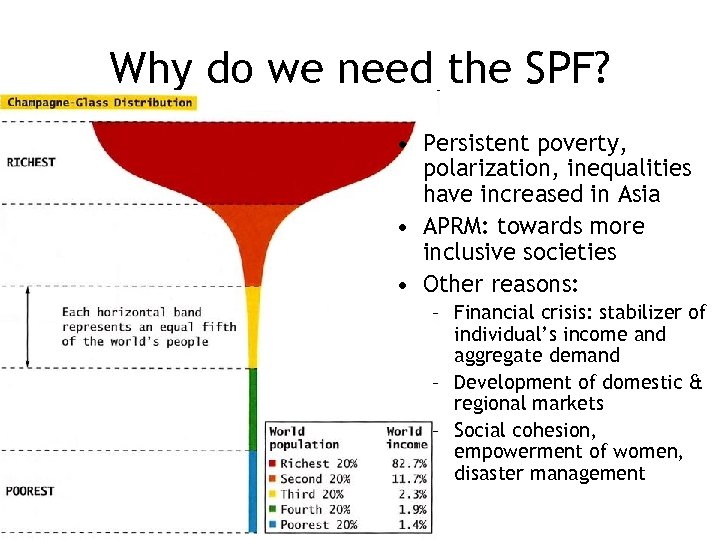 Why do we need the SPF? • Persistent poverty, polarization, inequalities have increased in Asia • APRM: towards more inclusive societies • Other reasons: – Financial crisis: stabilizer of individual’s income and aggregate demand – Development of domestic & regional markets – Social cohesion, empowerment of women, disaster management
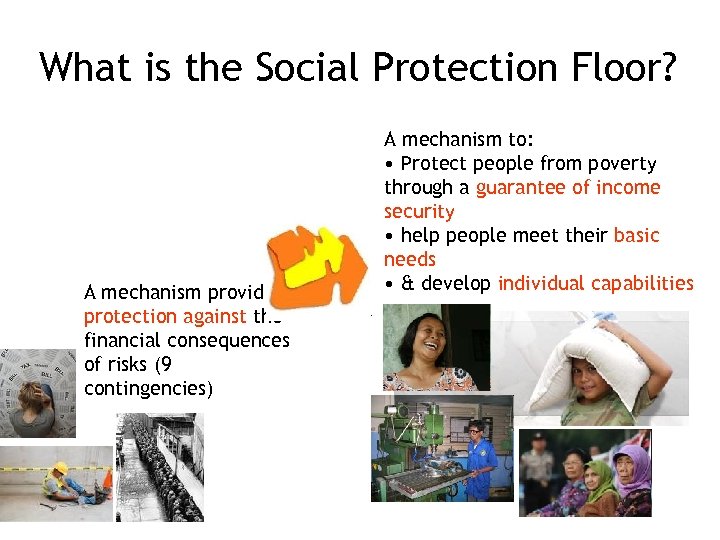 What is the Social Protection Floor? A mechanism providing protection against the financial consequences of risks (9 contingencies) A mechanism to: • Protect people from poverty through a guarantee of income security • help people meet their basic needs • & develop individual capabilities
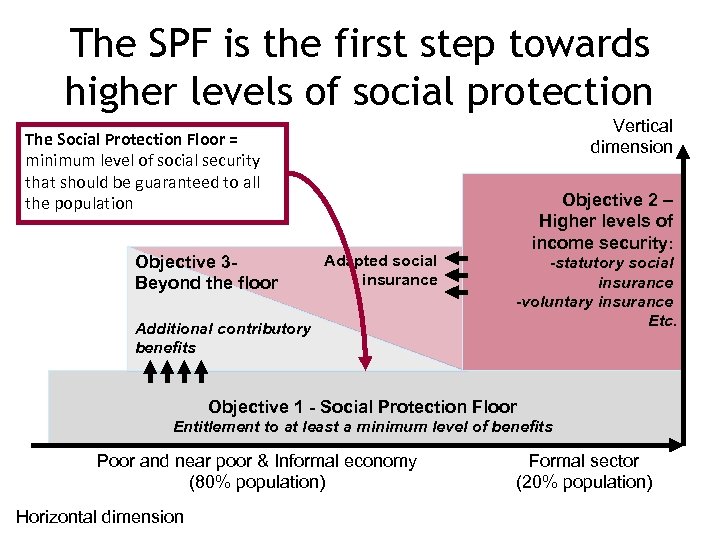 The SPF is the first step towards higher levels of social protection Vertical dimension The Social Protection Floor = minimum level of social security that should be guaranteed to all the population Objective 3 Beyond the floor Adapted social insurance Additional contributory benefits Objective 2 – Higher levels of income security: -statutory social insurance -voluntary insurance Etc. Objective 1 - Social Protection Floor Entitlement to at least a minimum level of benefits Poor and near poor & Informal economy (80% population) Horizontal dimension Formal sector (20% population)
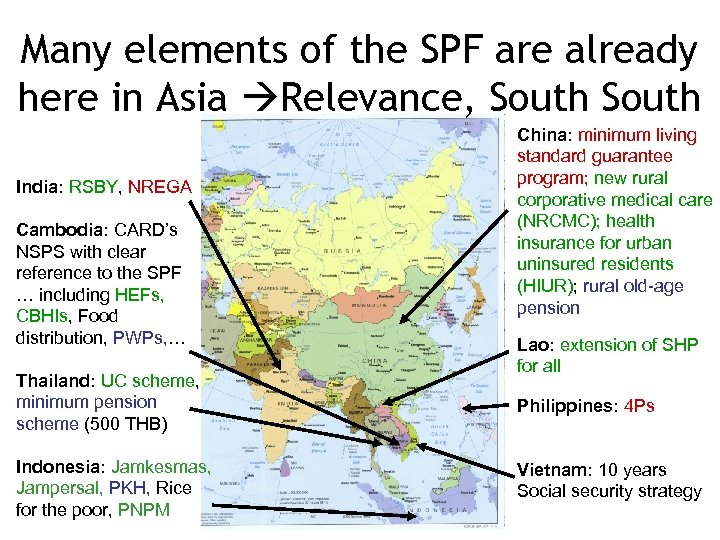 Many elements of the SPF are already here in Asia Relevance, South India: RSBY, NREGA Cambodia: CARD’s NSPS with clear reference to the SPF … including HEFs, CBHIs, Food distribution, PWPs, … Thailand: UC scheme, minimum pension scheme (500 THB) Indonesia: Jamkesmas, Jampersal, PKH, Rice for the poor, PNPM China: minimum living standard guarantee program; new rural corporative medical care (NRCMC); health insurance for urban uninsured residents (HIUR); rural old-age pension Lao: extension of SHP for all Philippines: 4 Ps Vietnam: 10 years Social security strategy
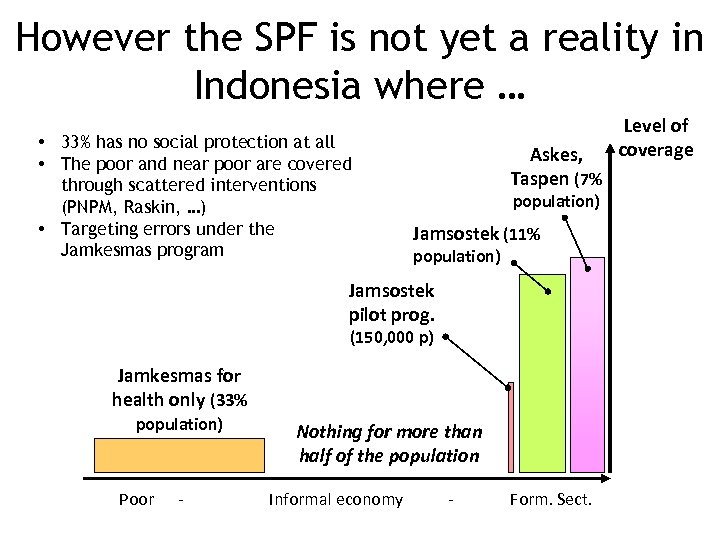 However the SPF is not yet a reality in Indonesia where … • 33% has no social protection at all • The poor and near poor are covered through scattered interventions (PNPM, Raskin, …) • Targeting errors under the Jamkesmas program Askes, Taspen (7% population) Jamsostek (11% population) Jamsostek pilot prog. (150, 000 p) Jamkesmas for health only (33% population) Poor - Nothing for more than half of the population Informal economy - Form. Sect. Level of coverage
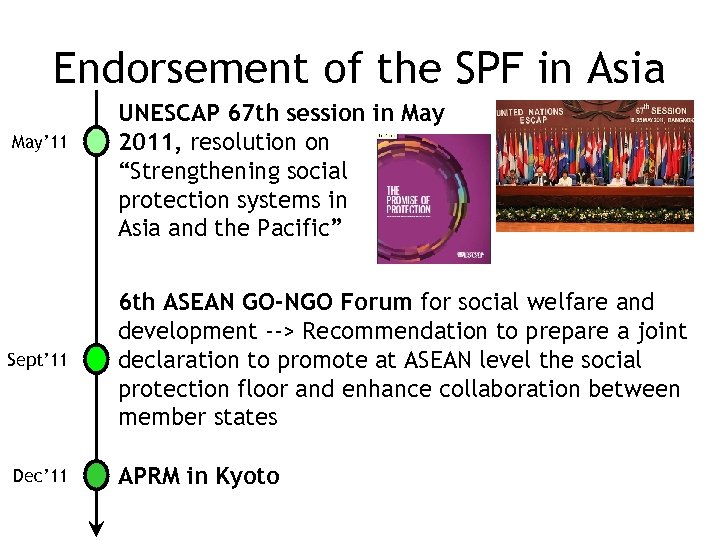 Endorsement of the SPF in Asia May’ 11 Sept’ 11 Dec’ 11 UNESCAP 67 th session in May 2011, resolution on “Strengthening social protection systems in Asia and the Pacific” 6 th ASEAN GO-NGO Forum for social welfare and development --> Recommendation to prepare a joint declaration to promote at ASEAN level the social protection floor and enhance collaboration between member states APRM in Kyoto
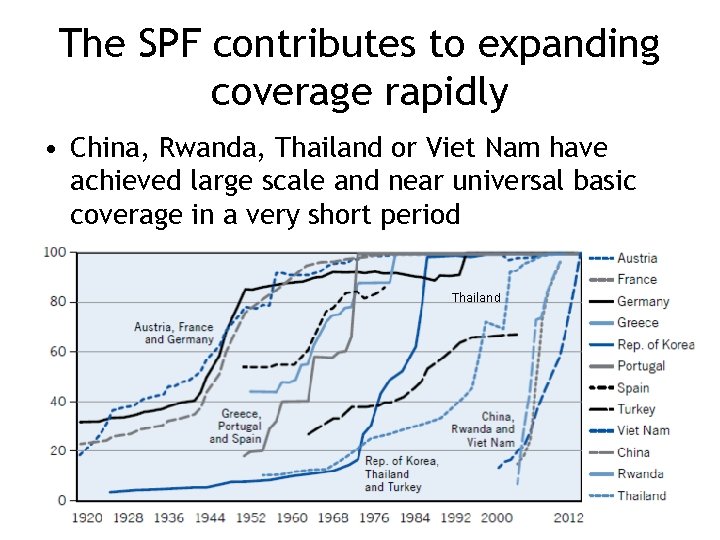 The SPF contributes to expanding coverage rapidly • China, Rwanda, Thailand or Viet Nam have achieved large scale and near universal basic coverage in a very short period Thailand
 There is no “one size fits all” solution in implementing SPFs • The SPF design and implementation should be country-led and responsive to national needs, priorities and resources • However a list of principles to ensure full potential of SPF interventions Affordability and long term sustainability Progressive implementation Coordination between programs and institutions Legal frame-work to ensure rights and obligations… Pilot testing of the mechanisms to reach efficiency Linkages with macroeconomic, fiscal, employment policies Adequate institutions with trained staff, sufficient budgets…
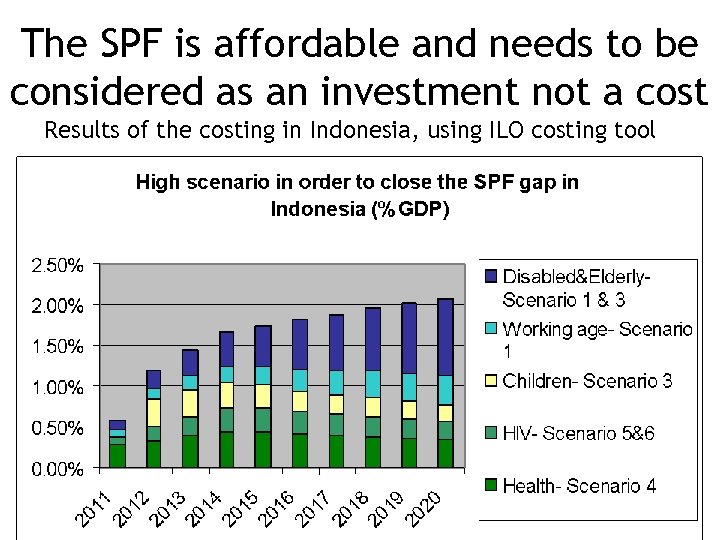 The SPF is affordable and needs to be considered as an investment not a cost Results of the costing in Indonesia, using ILO costing tool
 The potential of the SPF = to request coordination • The SPF tries to address several dimensions of poverty and calls for a combination of interventions – PWP + health care – income security + vocational training – health + education + nutrition • Need for coordination between line ministries, central/sub-national level, UN agencies (SPF Teams & Working groups) • The ABND – first coordination exercise
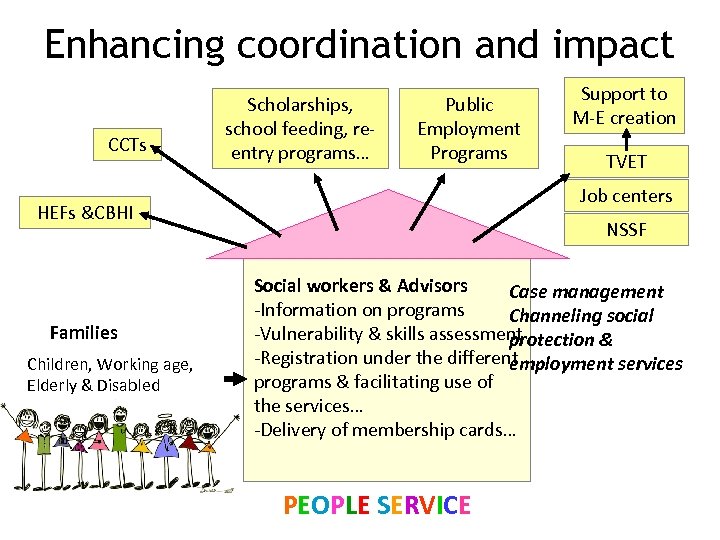 Enhancing coordination and impact CCTs Scholarships, school feeding, reentry programs… Public Employment Programs Children, Working age, Elderly & Disabled TVET Job centers HEFs &CBHI Families Support to M-E creation NSSF Social workers & Advisors Case management -Information on programs Channeling social -Vulnerability & skills assessment protection & -Registration under the different employment services programs & facilitating use of the services… -Delivery of membership cards… PEOPLE SERVICE
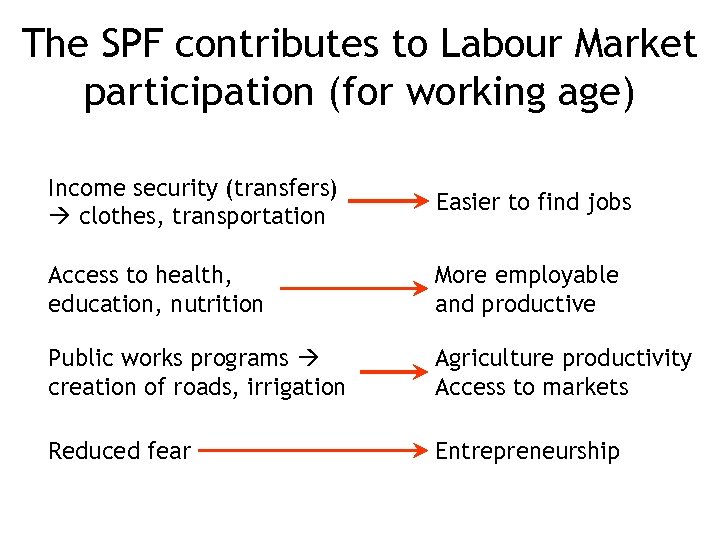 The SPF contributes to Labour Market participation (for working age) Income security (transfers) clothes, transportation Easier to find jobs Access to health, education, nutrition More employable and productive Public works programs creation of roads, irrigation Agriculture productivity Access to markets Reduced fear Entrepreneurship
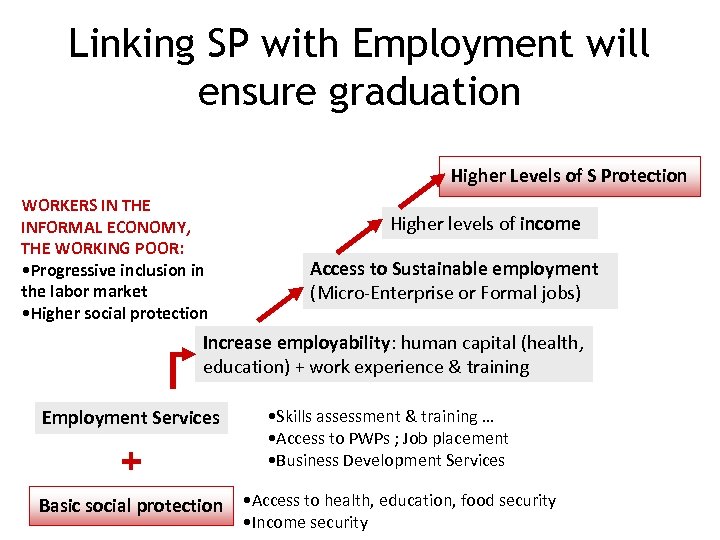 Linking SP with Employment will ensure graduation Higher Levels of S Protection WORKERS IN THE INFORMAL ECONOMY, THE WORKING POOR: • Progressive inclusion in the labor market • Higher social protection Higher levels of income Access to Sustainable employment (Micro-Enterprise or Formal jobs) Increase employability: human capital (health, education) + work experience & training Employment Services + • Skills assessment & training … • Access to PWPs ; Job placement • Business Development Services Basic social protection • Access to health, education, food security • Income security
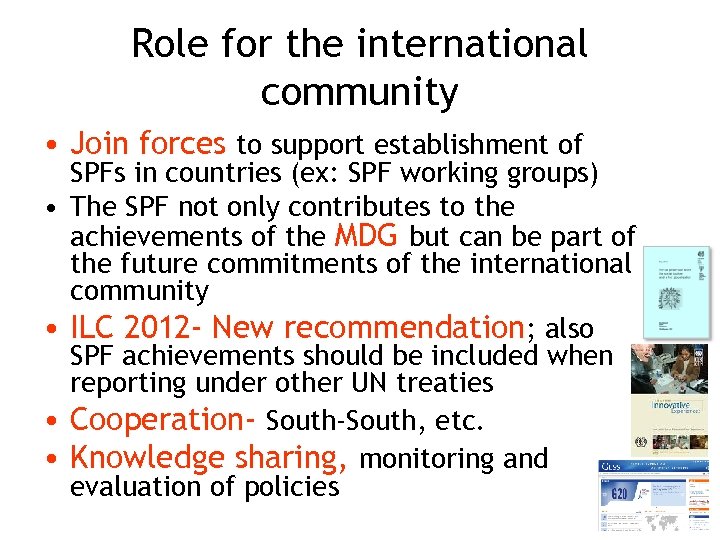 Role for the international community • Join forces to support establishment of • • SPFs in countries (ex: SPF working groups) The SPF not only contributes to the achievements of the MDG but can be part of the future commitments of the international community ILC 2012 - New recommendation; also SPF achievements should be included when reporting under other UN treaties Cooperation- South-South, etc. Knowledge sharing, monitoring and evaluation of policies