


 Скачать презентацию Overview of Results session Tuesday 24 March 2009
6be4f92779a015827b3b9654a4d57514.ppt
- Количество слайдов: 16
 Overview of Results session Tuesday 24 March 2009 Overview of Deliverable 4 Direct and indirect impact (on energy) of ITU-T standards Editor’s Group of Deliverable 4 Sungchul Kang (KCC, Korea), Chairman Eunsook Kim “Eunah” (ETRI, Korea), Editor Takafumi Hashitani (Fujitsu, Japan), co-editor Franz Zichy (US State Department, USA), co-editor Liu Yan (CTTL, China), co-editor International Telecommunication Union 1
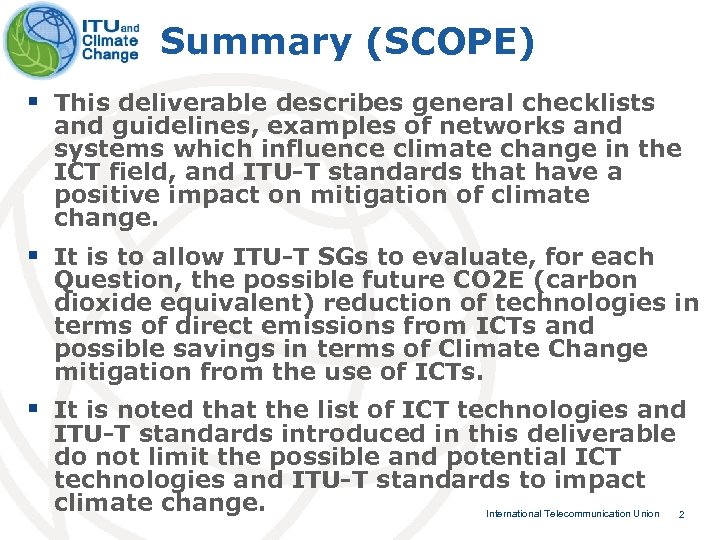 Summary (SCOPE) § This deliverable describes general checklists and guidelines, examples of networks and systems which influence climate change in the ICT field, and ITU-T standards that have a positive impact on mitigation of climate change. § It is to allow ITU-T SGs to evaluate, for each Question, the possible future CO 2 E (carbon dioxide equivalent) reduction of technologies in terms of direct emissions from ICTs and possible savings in terms of Climate Change mitigation from the use of ICTs. § It is noted that the list of ICT technologies and ITU-T standards introduced in this deliverable do not limit the possible and potential ICT technologies and ITU-T standards to impact climate change. International Telecommunication Union 2
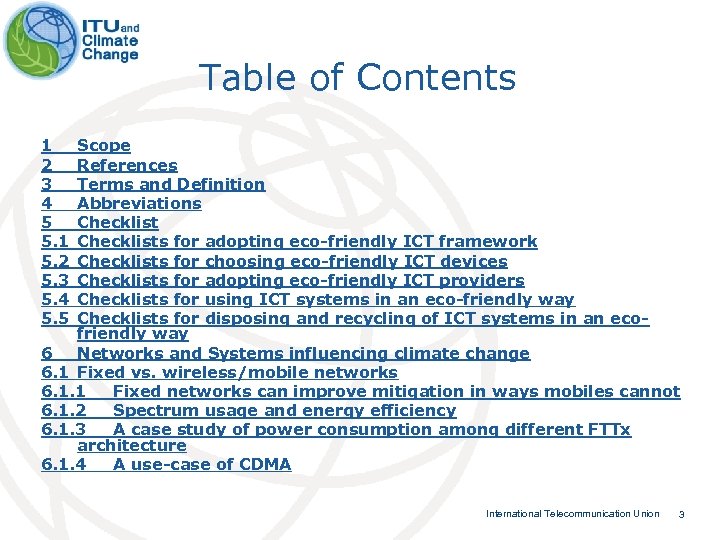 Table of Contents 1 2 3 4 5 5. 1 5. 2 5. 3 5. 4 5. 5 Scope References Terms and Definition Abbreviations Checklists for adopting eco-friendly ICT framework Checklists for choosing eco-friendly ICT devices Checklists for adopting eco-friendly ICT providers Checklists for using ICT systems in an eco-friendly way Checklists for disposing and recycling of ICT systems in an ecofriendly way 6 Networks and Systems influencing climate change 6. 1 Fixed vs. wireless/mobile networks 6. 1. 1 Fixed networks can improve mitigation in ways mobiles cannot 6. 1. 2 Spectrum usage and energy efficiency 6. 1. 3 A case study of power consumption among different FTTx architecture 6. 1. 4 A use-case of CDMA International Telecommunication Union 3
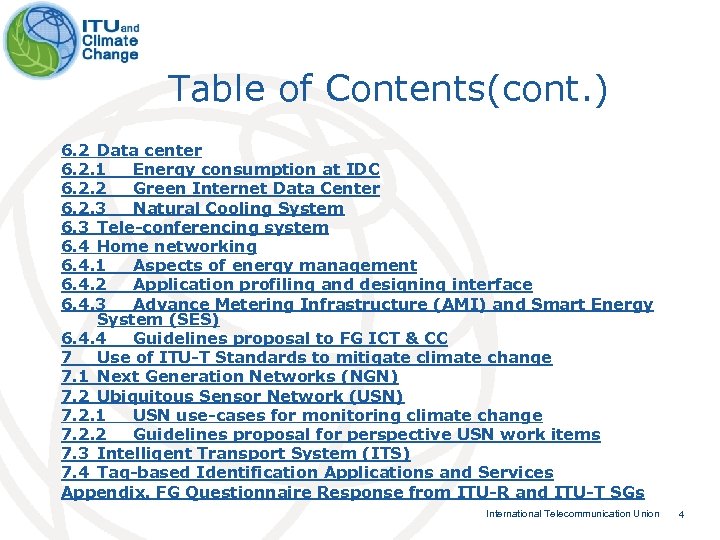 Table of Contents(cont. ) 6. 2 Data center 6. 2. 1 Energy consumption at IDC 6. 2. 2 Green Internet Data Center 6. 2. 3 Natural Cooling System 6. 3 Tele-conferencing system 6. 4 Home networking 6. 4. 1 Aspects of energy management 6. 4. 2 Application profiling and designing interface 6. 4. 3 Advance Metering Infrastructure (AMI) and Smart Energy System (SES) 6. 4. 4 Guidelines proposal to FG ICT & CC 7 Use of ITU-T Standards to mitigate climate change 7. 1 Next Generation Networks (NGN) 7. 2 Ubiquitous Sensor Network (USN) 7. 2. 1 USN use-cases for monitoring climate change 7. 2. 2 Guidelines proposal for perspective USN work items 7. 3 Intelligent Transport System (ITS) 7. 4 Tag-based Identification Applications and Services Appendix. FG Questionnaire Response from ITU-R and ITU-T SGs International Telecommunication Union 4
 5. Checklists are useful for developing and promoting ecofriendly standards for ICT architecture, ICT devices, ICT providers, ICT systems, and disposal and recycling of ICT systems in an eco-friendly way. To lead • Limit the negative impacts • Enhance the positive impacts International Telecommunication Union 5
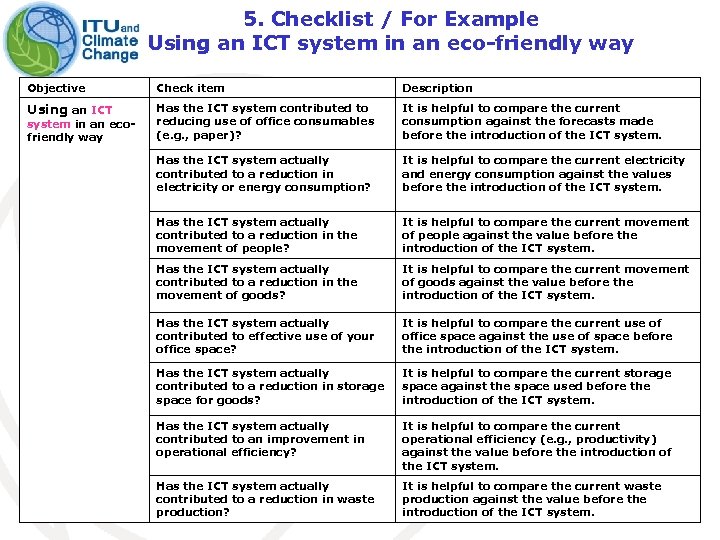 5. Checklist / For Example Using an ICT system in an eco-friendly way Objective Check item Description Using an ICT Has the ICT system contributed to reducing use of office consumables (e. g. , paper)? It is helpful to compare the current consumption against the forecasts made before the introduction of the ICT system. Has the ICT system actually contributed to a reduction in electricity or energy consumption? It is helpful to compare the current electricity and energy consumption against the values before the introduction of the ICT system. Has the ICT system actually contributed to a reduction in the movement of people? It is helpful to compare the current movement of people against the value before the introduction of the ICT system. Has the ICT system actually contributed to a reduction in the movement of goods? It is helpful to compare the current movement of goods against the value before the introduction of the ICT system. Has the ICT system actually contributed to effective use of your office space? It is helpful to compare the current use of office space against the use of space before the introduction of the ICT system. Has the ICT system actually contributed to a reduction in storage space for goods? It is helpful to compare the current storage space against the space used before the introduction of the ICT system. Has the ICT system actually contributed to an improvement in operational efficiency? It is helpful to compare the current operational efficiency (e. g. , productivity) against the value before the introduction of the ICT system. Has the ICT system actually contributed to a reduction in waste production? It is helpful to compare the current waste production against the value before the introduction of the ICT Telecommunication Union International system in an ecofriendly way 6
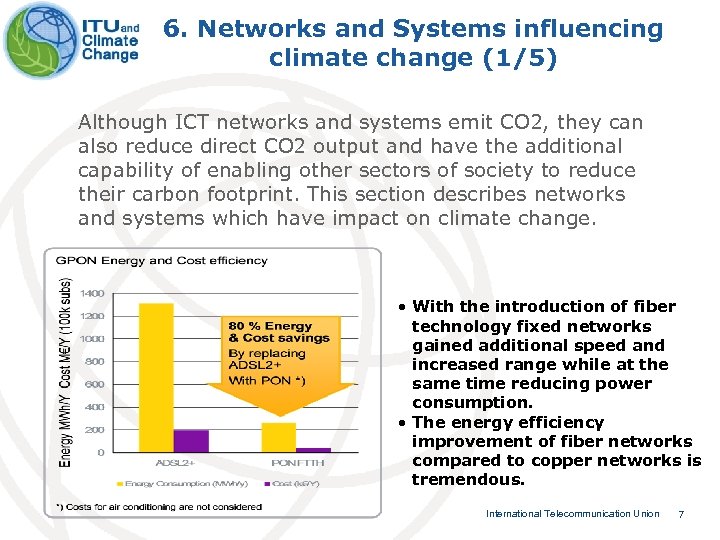 6. Networks and Systems influencing climate change (1/5) Although ICT networks and systems emit CO 2, they can also reduce direct CO 2 output and have the additional capability of enabling other sectors of society to reduce their carbon footprint. This section describes networks and systems which have impact on climate change. • With the introduction of fiber technology fixed networks gained additional speed and increased range while at the same time reducing power consumption. • The energy efficiency improvement of fiber networks compared to copper networks is tremendous. International Telecommunication Union 7
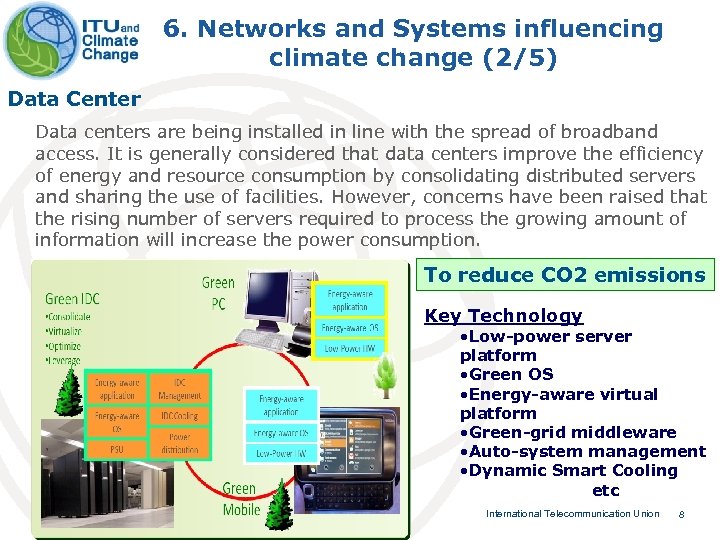 6. Networks and Systems influencing climate change (2/5) Data Center Data centers are being installed in line with the spread of broadband access. It is generally considered that data centers improve the efficiency of energy and resource consumption by consolidating distributed servers and sharing the use of facilities. However, concerns have been raised that the rising number of servers required to process the growing amount of information will increase the power consumption. To reduce CO 2 emissions Key Technology • Low-power server platform • Green OS • Energy-aware virtual platform • Green-grid middleware • Auto-system management • Dynamic Smart Cooling etc International Telecommunication Union 8
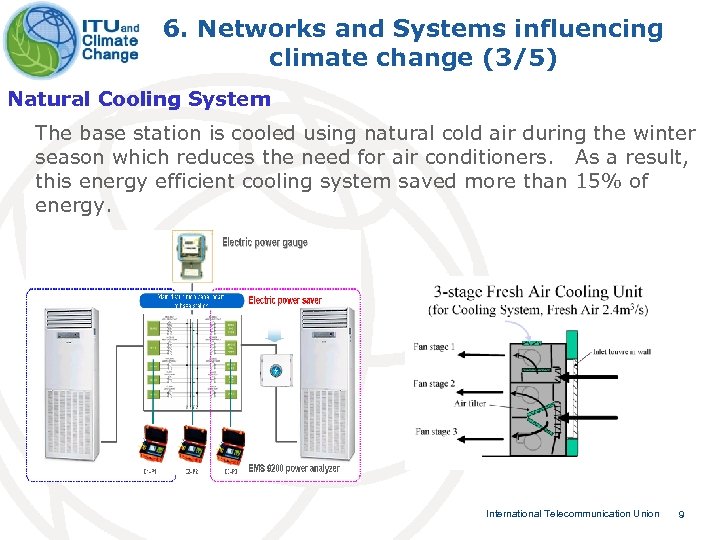 6. Networks and Systems influencing climate change (3/5) Natural Cooling System The base station is cooled using natural cold air during the winter season which reduces the need for air conditioners. As a result, this energy efficient cooling system saved more than 15% of energy. International Telecommunication Union 9
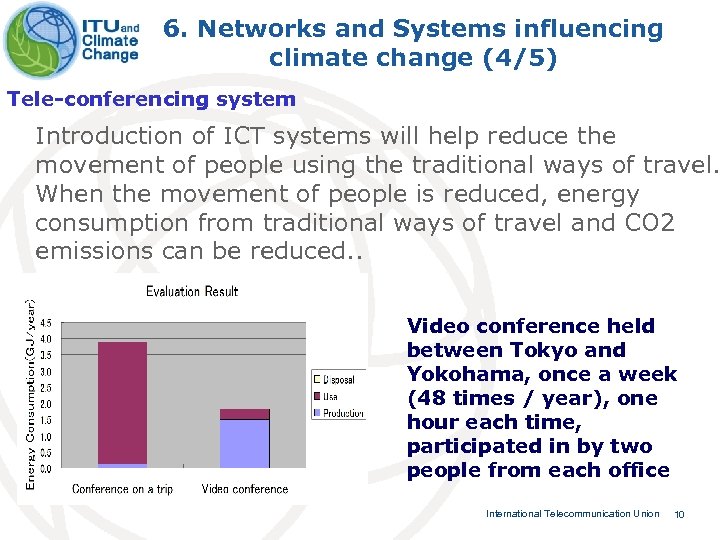 6. Networks and Systems influencing climate change (4/5) Tele-conferencing system Introduction of ICT systems will help reduce the movement of people using the traditional ways of travel. When the movement of people is reduced, energy consumption from traditional ways of travel and CO 2 emissions can be reduced. . Video conference held between Tokyo and Yokohama, once a week (48 times / year), one hour each time, participated in by two people from each office International Telecommunication Union 10
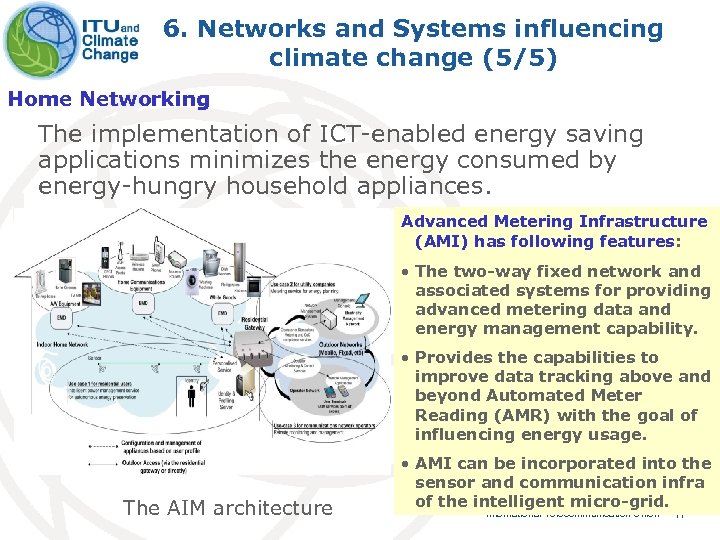 6. Networks and Systems influencing climate change (5/5) Home Networking The implementation of ICT-enabled energy saving applications minimizes the energy consumed by energy-hungry household appliances. Advanced Metering Infrastructure (AMI) has following features: • The two-way fixed network and associated systems for providing advanced metering data and energy management capability. • Provides the capabilities to improve data tracking above and beyond Automated Meter Reading (AMR) with the goal of influencing energy usage. The AIM architecture • AMI can be incorporated into the sensor and communication infra of the intelligent micro-grid. International Telecommunication Union 11
 7. Use of ITU-T Standards to mitigate climate change (1/5) This section introduces some of the key ITU-T standards which can be applied toward mitigating climate change. It should be noted that the list of the ITU-T standards that address climate change is not limited by the technologies mentioned in this section. There are other ITU-T standards that can be applied. International Telecommunication Union 12
 7. Use of ITU-T Standards to mitigate climate change (2/5) Next Generation Networks (NGNs) NGNs are seen by many as the new network architecture that will unify today’s fixed, mobile and broadcast networks. NGN is expected to bring about greater energy efficiency than legacy networks. In turn, by improving the energy efficiency of ICTs, NGNs can potentially make a significant contribution in the battle against global warming. Following SG 15 work example on the Energy Saving Checklist, ITU-T Study Groups and other ITU-T relevant groups (as Focus Groups or Joint Coordination Activities efforts) could prepare new energy saving checklists, as a recommended tool for manufacturers and providers. An example of such a tool could be an energy saving checklist for materials used in transport systems, where type, size, raw material and recycling options should be evaluated to be considered as energy efficient. International Telecommunication Union 13
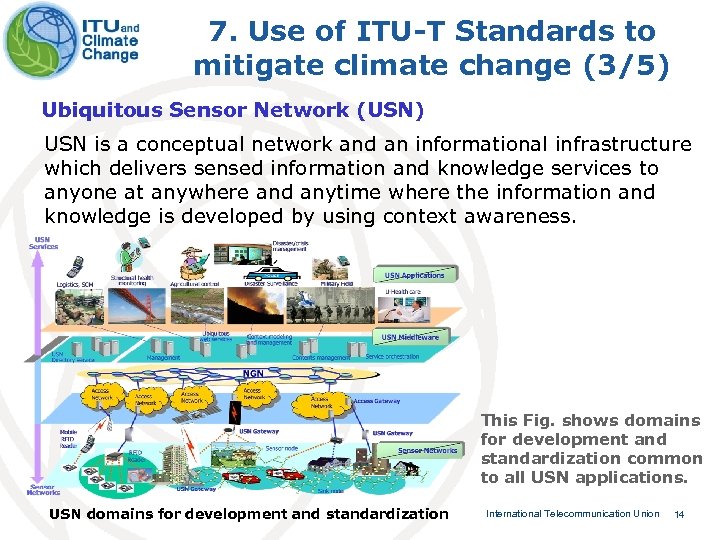 7. Use of ITU-T Standards to mitigate climate change (3/5) Ubiquitous Sensor Network (USN) USN is a conceptual network and an informational infrastructure which delivers sensed information and knowledge services to anyone at anywhere and anytime where the information and knowledge is developed by using context awareness. This Fig. shows domains for development and standardization common to all USN applications. USN domains for development and standardization International Telecommunication Union 14
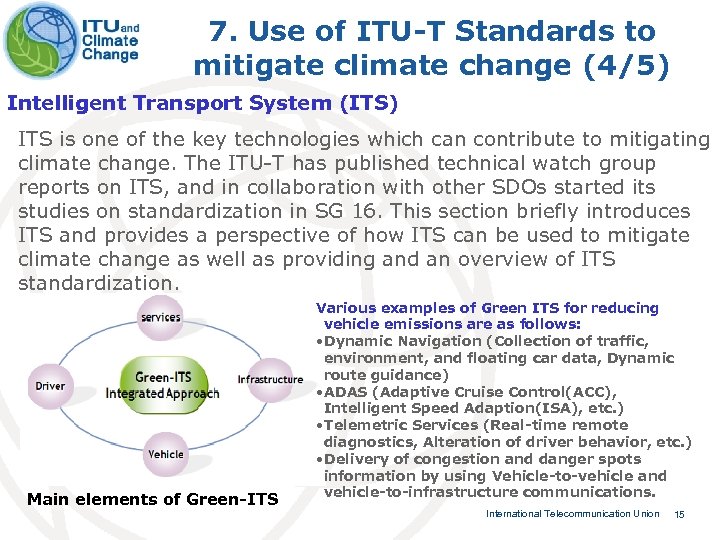 7. Use of ITU-T Standards to mitigate climate change (4/5) Intelligent Transport System (ITS) ITS is one of the key technologies which can contribute to mitigating climate change. The ITU-T has published technical watch group reports on ITS, and in collaboration with other SDOs started its studies on standardization in SG 16. This section briefly introduces ITS and provides a perspective of how ITS can be used to mitigate climate change as well as providing and an overview of ITS standardization. Main elements of Green-ITS Various examples of Green ITS for reducing vehicle emissions are as follows: • Dynamic Navigation (Collection of traffic, environment, and floating car data, Dynamic route guidance) • ADAS (Adaptive Cruise Control(ACC), Intelligent Speed Adaption(ISA), etc. ) • Telemetric Services (Real-time remote diagnostics, Alteration of driver behavior, etc. ) • Delivery of congestion and danger spots information by using Vehicle-to-vehicle and vehicle-to-infrastructure communications. International Telecommunication Union 15
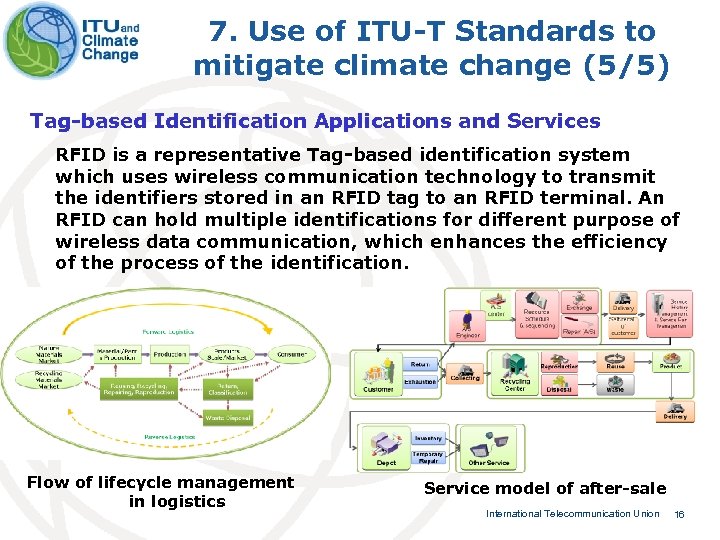 7. Use of ITU-T Standards to mitigate climate change (5/5) Tag-based Identification Applications and Services RFID is a representative Tag-based identification system which uses wireless communication technology to transmit the identifiers stored in an RFID tag to an RFID terminal. An RFID can hold multiple identifications for different purpose of wireless data communication, which enhances the efficiency of the process of the identification. Flow of lifecycle management in logistics Service model of after-sale International Telecommunication Union 16